山西省运城市2025-2026学年高二5月份过程性素质评价英语试题
一、听力选择题
1.What will the man do next?
A.Write a report. B.Send an email. C.Free up the computer.
2.What is the probable relationship between the speakers?
A.Tourist and guide. B.Librarian and student. C.Manager and salesman.
3.Why was the woman late?
A.She got up late. B.Her car broke down. C.She was caught in traffic.
4.Where are the speakers probably?
A.In a hospital. B.In a museum. C.In a library.
5.How does the man feel about the upcoming exam?
A.Anxious. B.Confident. C.Relaxed.
听下面一段对话,回答以下小题。
6.What do the speakers decide to watch?
A.A comedy. B.A documentary. C.A sci-fi movie.
7.When will the movie start?
A.At 6:30. B.At 7:00. C.At 7:30.
听下面一段对话,回答以下小题。
8.How did the man spend his summer holiday?
A.He worked full-time. B.He traveled abroad. C.He looked after his sister.
9.What does the man think of his job?
A.Boring but easy. B.Tiring but rewarding. C.Difficult and complex.
10.What will the woman do this weekend?
A.Learn to make coffee. B.Watch TV at home. C.Visit the shop.
听下面一段对话,回答以下小题。
11.What is the woman looking for?
A.A blue silk dress. B.A woolen sweater. C.A cotton shirt.
12.What size does the woman need?
A.Small. B.Medium. C.Large.13.How much will the woman pay?
A.$50. B.$80. C.$100.
听下面一段对话,回答以下小题。
14.What is the man’s problem?
A.He can’t find his suitcase.
B.His suitcase is broken.
C.He missed his flight.
15.What color is the man’s suitcase?
A.Black. B.Red. C.Silver.
16.What does the woman suggest the man do?
A.Wait at the gate. B.Fill out a form. C.Call the airline office.
听下面一段独白,回答以下小题。
17.What is the speech mainly about?
A.A charity event. B.A sports meet. C.A school program.
18.When will Challenge Week come to an end?
A.On Wednesday. B.On Friday. C.On Sunday.
19.What challenge is mentioned by the speaker?
A.Giving up sugar for just five days.
B.Speaking 20 words a day for a month.
C.Disconnecting from social media for a week.
20.What should Challenge Week participants do?
A.Donate as much as possible.
B.Find sponsors for their challenges.
C.Complete challenges together with partners.
二、阅读理解
The minerals behind energy transition
Moving away from fossil fuels is not only about making clean energy, but also about the materials needed tobuild clean technology. Many green technologies depend on critical minerals.
The International Energy Agency says that demand for these minerals will grow very fast. By 2030, the
world will need three times more critical minerals than today. By 2040, demand may be four times higher. Meeting
this demand will not be easy. Many of these minerals are hard to find, unevenly spread across the world, and
affected by price changes. So which minerals are the most important?
Lithium, nickel, cobalt, manganese and graphite are widely used in batteries.
Batteries These batteries power electric cars and store energy from wind and solar power.
As more people use electric cars, the need for these minerals keeps rising.
Electricity networks need aluminium and copper to move power from place to
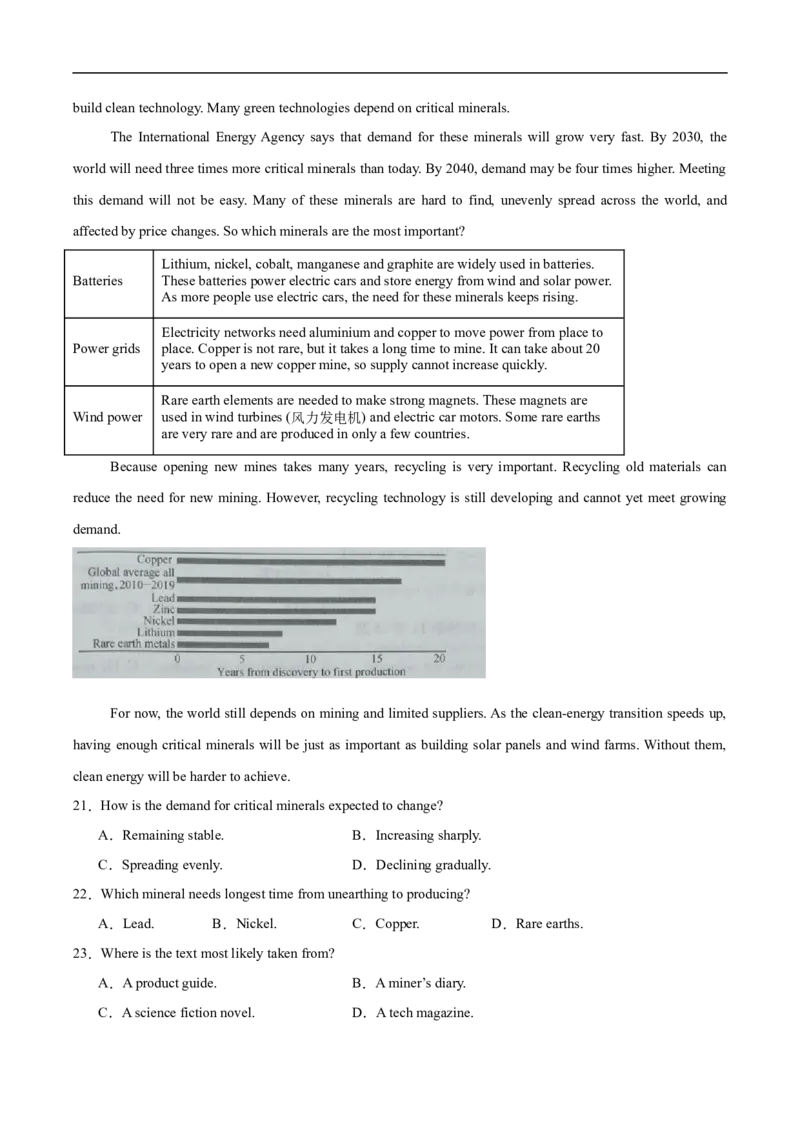
Power grids place. Copper is not rare, but it takes a long time to mine. It can take about 20
years to open a new copper mine, so supply cannot increase quickly.
Rare earth elements are needed to make strong magnets. These magnets are
Wind power used in wind turbines (风力发电机) and electric car motors. Some rare earths
are very rare and are produced in only a few countries.
Because opening new mines takes many years, recycling is very important. Recycling old materials can
reduce the need for new mining. However, recycling technology is still developing and cannot yet meet growing
demand.
For now, the world still depends on mining and limited suppliers. As the clean-energy transition speeds up,
having enough critical minerals will be just as important as building solar panels and wind farms. Without them,
clean energy will be harder to achieve.
21.How is the demand for critical minerals expected to change?
A.Remaining stable. B.Increasing sharply.
C.Spreading evenly. D.Declining gradually.
22.Which mineral needs longest time from unearthing to producing?
A.Lead. B.Nickel. C.Copper. D.Rare earths.
23.Where is the text most likely taken from?
A.A product guide. B.A miner’s diary.
C.A science fiction novel. D.A tech magazine.Turkuaz, a Turkish restaurant, has been a special place for my family since it opened in 2005. It was my late
father’s favourite, and he first took us there as a family. We quickly fell in love with it.
Over the years, Turkuaz became much more than just a place to dine. We celebrated birthdays, anniversaries,
and other important moments there. We shared dishes, enjoying not only the food but also the warmth of being
together. The restaurant saw our family grow — from my generation to our own children.
When my dad passed away last October, Turkuaz became a place of memory and comfort. The owner, who
learned about the death of my father, greeted us with sadness and kindness. They have seen generations of our
family come through the restaurant door.
Now, my own children, aged six and eight, name it “Granddad’s Turkish place”. It is a part of our childhood,
too. In a world where countless local restaurants are closing, places like Turkuaz powerfully remind us of the
importance of community. They give us a space where we feel safe, where we laugh, cry, and share our stories.
Though my dad is no longer with us, his favourite restaurant continues to bring our family together. It is not
just a restaurant — it is part of our family’s story, a place that holds our history and our hearts.
24.What do we know about the author’s father from paragraph 1?
A.He was the founder of Turkuaz. B.He managed a family restaurant nearby.
C.He introduced Turkuaz to his friends first. D.He thought highly of Turkuaz.
25.What can be inferred about Turkuaz from the text?
A.It has accompanied the author’s family for decades.
B.It has gained nationwide popularity for its food.
C.It has been faced with the risk of being closed down.
D.It has improved its service since the author’s father died.
26.What is the author’s attitude towards the owner of Turkuaz?
A.Doubtful. B.Grateful. C.Tolerant. D.Uncaring.
27.What is the text mainly about?
A.The unforgettable memories of a lost family member.
B.The key role of local restaurants in community life.
C.A restaurant that carries a family’s love and memories.
D.The emotional connection between restaurants and customers.
When I was a child, my grandmother used to tell me something strange on hot days. She would say, “Drink acup of hot tea. It will cool you down.” As a seven-year-old, I thought this was silly. On a hot day, I wanted cold
lemon juice or ice cream, not hot tea. But it turns out my grandmother may have been right.
People have been drinking hot drinks in warm places for hundreds of years. In some countries, tea is very
popular, even though the weather is hot. Many people living in deserts or tropical areas drink hot tea every day.
Scientists have now started to study why this might help.
In 2012, a scientist named Ollie Jay did an experiment. He asked people to ride bikes in warm weather while
drinking water at different temperatures. The scientists then studied how hot their bodies became. At first, it seemed
that drinking warm water made body temperature rise more. But when scientists looked at the total heat stored in
the body, they found something surprising. People who drank warm water actually ended up with less body heat.
The reason is sweat. When you drink something hot, your body produces more sweat. When sweat dries on
your skin, it removes heat from your body. This helps cool you down.
However, this only works well in dry places with good airflow (气流). Other studies have found that in hot
and wet weather, sweat does not dry easily. Instead, it just flows off. In these conditions, cold drinks may be better
because they help save water in the body. Scientists have also found that cold drinks reduce sweating only when
they reach the stomach. This shows that the body senses temperature inside the stomach, not just in the mouth.
The lesson is simple: sometimes old advice has real science behind it. Maybe listening to your grandmother
is not such a bad idea after all.
28.What can we conclude from Grandma’s advice?
A.It is merely an old woman’s tale. B.It may have scientific basis.
C.It works in freezing climates. D.It has been widely ignored.
29.What did Ollie Jay’s experiment show?
A.Exercise affects body heat. B.Cold water lowers body temperature.
C.Drinking hot water increases overall body heat. D.Drinking warm water can reduce total body heat.
30.Under which condition are hot drinks most effective in cooling the body?
A.When airflow allows sweat to disappear easily. B.When the weather is hot and wet.
C.When people drink large amounts of hot tea. D.When sweat production is kept to a minimum.
31.Why does the author write the text?
A.To explain why people in hot countries prefer tea.
B.To compare the effects of hot and cold drinks.
C.To show how scientific research can test everyday advice.
D.To encourage people to follow all traditional habits.The rapid emergence of artificial intelligence (AI) tools such as ChatGPT has prompted widespread debate
about their impact on education. While some teachers worry that such technology may weaken students’ writing
abilities, others argue that it presents an opportunity to rethink how critical thinking and effective writing are taught
in middle and high school classrooms.
AI tools can generate fluent text within seconds, raising concerns about accuracy and originality. Because
these systems are trained on vast amounts of online material, their responses may contain errors,
oversimplifications, or hidden biases. Rather than banning such tools, some educators suggest using them as objects
of analysis. By examining AI-generated responses carefully, students can practice identifying inconsistencies (矛
盾), questioning claims, and checking information against reliable sources.
Another concern is that AI reflects the material it is trained on. Voices and perspectives that are
underrepresented online may be further marginalised (使处于边缘) through repeated use of automated tools. This
limitation offers a teaching moment. When students compare multiple AI responses on related topics, they can
begin to recognise patterns of omission (遗漏) and bias, strengthening their awareness of how information systems
shape knowledge.
AI-generated writing also differs noticeably from human writing. Although grammatically sound, it often
lacks a distinctive voice, emotional depth, or original insight.
Some teachers respond by designing assignments that rely on personal experience or unique sources. Tasks
such as interviews, first-person accounts, or comparisons of uncommon texts require synthesis that automated tools
cannot easily provide. Similarly, drawing on classroom discussion as a reference point encourages students to
engage actively and treat shared dialogue as part of the learning process. Ultimately, the challenge posed by AI is
not purely technological but educational. As AI becomes more common, these skills grow more valuable rather
than less. Instead of resisting change, educators are increasingly focused on guiding students to use new tools
critically, thoughtfully, and responsibly.
32.How do educators react to AI tools like ChatGPT?
A.They hold mixed views. B.They all welcome them warmly.
C.They find them improves accuracy. D.They see them as a source of insight.
33.What is a suggested educational use of AI-generated text?
A.Letting students copy it directly. B.Making it a major research source.
C.Having students analyze it critically. D.Training students to imitate its style.34.What does the underlined word “synthesis” in paragraph 5 most likely mean?
A.Summarizing AI reports. B.Combining different sources.
C.Simplifying complex text. D.Telling human writing from AI writing.
35.Which of the following can be the best title for the text?
A.Ban AI Tools in Schools
B.The End of Writing Education
C.AI Makes Human Thinking Less Valuable
D.Guiding Students to Use AI Wisely
To protect yourself and your information, you’ll want to use long and strong passwords on the Web that are
easy for you to recall but difficult for others to guess. However, some of the most commonly used passwords are
based on family names, hobbies, or just a simple pattern. This kind of password is easy to remember but highly
insecure. 36
Password: brian12kate5 — It’s my kids’ names and ages.
Problem: This password uses too much personal information, along with common words.
Solution: 37 And rather than using family names, we could combine a character from a movie
with a type of food. For example, Chewbacca and pizza could become chEwbAccA&p! ZZa.
Password: w3St! — It’s just the beginning of my street address with a few extra characters.
Problem: This password is too short and simple. 38
Solution: A stronger version of this password would be much longer, ideally more than 10 characters. We
could also substitute a nearby street name instead of her current address. For example, Pemberly Ave could become
p3MberL.Y% Av.
Password: 123abccba321 — 39
Problem: While patterns like this are easy to remember, they’re also some of the first things a hacker might
guess when attempting to access your account.
Solution: Remember that random passwords are much stronger than simple patterns. If you’re having trouble
creating a new password, try using a password generator instead. Here’s an example of a generated password: #eV$
pIg&qf.
Password: BrAveZ!2 — I use the same passwords for all my accounts.
Problem: 40 However, remember that you should never use the same password with different
accounts.Solution: Create a unique password for each of your online accounts.
A.There’s nothing really wrong with this password.
B.This kind of password is hard to remember and slow to type.
C.It’s easy to remember the simple pattern and type on my keyboard.
D.Some people are interested in creating passwords in different ways.
E.A stronger password would use symbols, capital letters, and a random order.
F.It also includes part of the user’s address, which is publicly available information.
G.Let’s take a look at some of the most common password mistakes and how to fix them.
三、完形填空
The first project I took on at my new job was a brand strategy proposal, and it changed my career.
Our first task was to write a response to the customer’s request for a 41 update. The customer
offered nothing and he simply said, “Just about the future development of our brand, and I want to see what you
42 .” However, through all the confusion in dealing with this 43 project, many of my 44
about work were answered.
I was extremely 45 about the task as well as my new role. I was confused. What was the 46
way to meet the customer’s 47 ? Full of anxiety, I tried various 48 — brainstorming, idea
mapping, outlining. 49 , after a lot of stress, my ideas became more organized and the content 50
. I had my understanding of the customer’s needs, and my reasons for it. I finished my 51 with
uncertainty, had it 52 and submitted (提交) it.
To my surprise, I received their full 53 . The customer praised my original perspective and
organized thoughts. My 54 and newfound confidence upon hearing their feedback could not be
overstated.
What I learned through this process extended well beyond how to write a business proposal. I learned to be
open to new 55 . This project gave me the confidence, critical-thinking skills and courage to try a new
career path.
41.A.brand B.climate C.computer D.society
42.A.give in to B.take part in C.come up with D.break away from
43.A.well-organizedB.old-fashioned C.open-ended D.cold-blooded
44.A.ideas B.dreams C.plans D.questions45.A.calm B.nervous C.certain D.proud
46.A.proper B.strange C.wrong D.single
47.A.habits B.hobbies C.needs D.companies
48.A.feelings B.jobs C.tasks D.strategies
49.A.Suddenly B.Particularly C.Eventually D.Factually
50.A.fell into place B.got into trouble C.settled into routine D.sank into silence
51.A.homework B.proposal C.order D.speech
52.A.refused B.received C.forgotten D.checked
53.A.approval B.doubt C.blame D.refusal
54.A.luck B.relief C.pity D.worry
55.A.changes B.challenges C.plans D.teammates
四、语法填空
阅读下面短文,在空白处填入1个适当的单词或括号内单词的正确形式。
In Fujian, 46 tulou were listed as UNESCO World Heritage Sites in 2018, with 23 of them in Yongding.
Tulou are closed circular structures with earthen outer 56 (wall) and wooden frames inside. They
were built by the Hakka, a group of people 57 moved from China’s central plains to the south to avoid
wars centuries ago.
There are thousands of tulou across Fujian, with Longyan’s Yongding district being home 58
1,768 of them. Have you ever dreamed of spending a day 59 (live) in a tulou? Now, that dream can
come true.
Shenghuang Lou, 60 tulou in Yongding with nearly four centuries of history, has now become a
hotel. The condition of the building 61 (be) quite bad, but now it has been turned into a modern hotel.
The rebuilding has fixed the old problems and added new functions like toilets.
Zeng Jieshan, a high school student from Shenzhen, Guangdong province, traveled four hours by train to
experience the tulou firsthand on 62 (he) own. I used to think ancient buildings were mostly temples or
royal palaces, like the Forbidden City, Zeng said 63 (excited). But here in the tulou, people still live and
thrive.
Tulou are not only special structures 64 also windows into the rich history and culture of the
Hakka people. 65 (conduct) interviews with residents to showcase tulou life is an important way tokeep their culture alive.
五、书信写作
66.假定你是李华,你的外国笔友Peter打算给你邮寄纳瓦霍蜜罐蚁(Navajo honey pot ant)作为异宠礼物。
请你给他写一封回信,内容包括:
1.感谢他的好意并委婉拒收礼物;
2.说明至少两个拒收理由(生物层面和法律层面)。
入侵物种:invasive species
注意:1.写作词数应为80个左右;
2.请按如下格式在答题卡的相应位置作答。
Dear Peter,
____________________________________________________________________________________________
____________________________________________________________________________________________
____________________________________________________________________________________________
____________________________________________________________________________________________
___________________________
Yours,
Li Hua
六、书面表达
67.阅读下面材料,根据其内容和所给段落开头语续写两段,使之构成一篇完整的短文。
Lily had a sweet voice and a lovely appearance. Yet she was born extremely shy, always holding back and
refusing to display herself in public. She worried constantly that others might look down on her or make fun of her.
To avoid being the centre of attention, she remained quiet most of the time and kept a low profile whenever there
was any school activity. Secretly, she really admired those confident classmates who were brave enough to express
themselves and shine on different occasions.
When the school launched project-based learning, various research groups were set up to carry out different
tasks. “Lily, would you like to join our group? We’re going to research the glorious history of our school,” Anna
invited her warmly. She explained that the group work was assigned into separate parts; collecting related
materials, sorting out useful information, drafting presentation scripts, delivering speeches on camera, andcompleting video recording, editing as well as online uploading. “I want to take charge of video recording, data
sorting and online uploading.” Anna shared her plan excitedly with Lily. Anna was fond of video creation and had
rich experience in this field.
Lily smiled from the heart and spoke highly of Anna. “You’re absolutely born for this role,” she said gently.
“You’re outgoing, creative and totally passionate about video making. It’s such a perfect chance for you to combine
your job with your strengths.”
注意:1.续写词数应为150个左右;
2.请按如下格式在答题卡的相应位置作答。
Hearing her words, Anna looked at Lily softly and asked, “What about you?”
____________________________________________________________________________________________
____________________________________________________________________________________________
____________________________________________________________________________________________
____________________________________________________________________________________________
___________________________
Lily did a great job and the project-based learning was finally awarded first prize.
____________________________________________________________________________________________
____________________________________________________________________________________________
____________________________________________________________________________________________
____________________________________________________________________________________________
___________________________参考答案
题号 1 2 3 4 5 6 7 8 9 10
答案 C B C B A C C A B C
题号 11 12 13 14 15 16 17 18 19 20
答案 A B B A A B A C C B
题号 21 22 23 24 25 26 27 28 29 30
答案 B C D D A B C B D A
题号 31 32 33 34 35 36 37 38 39 40
答案 C A C B D G E F C A
题号 41 42 43 44 45 46 47 48 49 50
答案 A C C D B A C D C A
题号 51 52 53 54 55
答案 B D A B B
1.C
【原文】W: Are you almost done with that report, Peter? I need to use the computer to send an urgent email to the
manager.
M: Just a second. I’m saving the file now. I will be off in a minute, so you can take over.
2.B
【原文】M: Good morning. Need any help?
W: Yes. I’m looking for some books on European history for my term paper.
M: Follow me, please. They’re in the history section on the third floor.
3.C
【原文】M: You’re finally here. The meeting started 10 minutes ago. Did you oversleep again?
W: No, I left home early, but a truck broke down on the main bridge and blocked the road. I was there for half an
hour.
4.B
【原文】W: Excuse me, sir. Taking photos is not allowed here.
M: I’m sorry. I didn’t see the sign. I just thought the painting was so beautiful.
W: I understand, but we must protect the artworks.
5.A
【原文】W: You’ve been studying all day, Mark. Are you worried about the finals?
M: A little bit. Math has always been my weak point, and I really want to get a scholarship this term.
6.C 7.C
【原文】W: Let’s go to the cinema tonight. I heard there’s a new comedy starring your favorite actor.
M: Actually, I’m not in the mood for a laugh.
W: Then what about the documentary that just came out? It has great ratings.M: I’d rather see that new science fiction film, The Martian Colony.
W: OK, let’s go with that. What time is the showing?
M: I checked earlier — the next showing starts in half an hour from now.
W: Good. It’s only 7:00 now. We have time to grab a quick bite before that.
8.A 9.B 10.C
【原文】W: Hi, Jack. Long time no see. How was your summer holiday?
M: It was quite busy. I didn’t go traveling. Instead, I worked at my uncle’s coffee shop.
W: Really? That must have been hard work.
M: It was. I had to stand for 8 hours a day and deal with all kinds of customers, but I learned a lot about how to run
a business and made some money.
W: I admire your spirit. I just stayed at home and watched TV.
M: Well, why don’t you come to the shop this weekend? I’ll make you a special coffee.
W: I’d love to. I’ll bring my sister along.
11.A 12.B 13.B
【原文】M: Good afternoon. What are you looking for? We have some nice new arrivals.
W: I saw a blue silk dress in the window. Do you have it in medium?
M: Let me check. We don’t have the blue dress in medium here, but I have it in red. If you prefer blue, our new
woolen sweaters might also suit your needs. We have them in blue and medium.
W: A sweater might be too informal for a wedding.
M: We also carry cotton shirts in blue, medium. They’re quite elegant.
W: Actually, I really want the silk dress.
M: Let me check our downtown store. Yes, they have one left in medium. It’s on sale. Originally $100, now 20%
off. Would you like me to reserve it?
W: Yes, please. I’ll go and pick it up now. Thank you.
14.A 15.A 16.B
【原文】M: Excuse me. I think there’s a problem. My suitcase didn’t come out on the belt. I just arrived on flight
BA 123 from London.
W: I’m sorry to hear that, sir. Don’t worry. This happens occasionally. Can you describe your suitcase for me?
M: Sure, it’s a medium-sized black suitcase with a silver handle. And I tied a red decoration on the side, so it’s easy
to spot.
W: OK, noted. We’ll check the back area first. In the meantime, please come with me to the service counter. You’llneed to fill out a lost item report. We can also call our airline office to see if it was left behind in London.
M: All right. Thank you. I really hope it will be found quickly. My passport and some important work documents
are inside.
W: Let’s start with the form, and I’ll call London right after. We usually locate missing bags within 24 hours.
17.A 18.C 19.C 20.B
【原文】
W: Hello, everyone. This week is Challenge Week across the nation. There is a full schedule of activities
running until midnight on Sunday. Since it is only Wednesday, you still have plenty of time to join in and help raise
money for many wonderful charities. You can take part either in your local community or online. For those who
prefer to join from home, there are many excellent personal challenges available. For example, you could give up
social media for a week, or cut out sugar for a month. You may also join in the chatterbox challenge in which you
promise to speak only 20 words a day for five days. After signing up, try to find as many sponsors as possible. They
will donate money to your chosen charity once you finish the challenge. For more details and a complete list of
challenges, please visit the website — ChallengeWeekNow.com.
41.A 42.C 43.C 44.D 45.B 46.A 47.C 48.D 49.C 50.A
51.B 52.D 53.A 54.B 55.B
56.walls 57.who/that 58.to 59.living 60.a 61.was 62.his 63.excitedly
64.but 65.Conducting
66.One possible version:
Dear Peter,
Thank you so much for your kindness to send me Navajo honey pot ants as a gift. However, I’m afraid I
have to politely decline this wonderful offer.
The main reasons are as follows. First, these ants are classified as an invasive species in China. They would
severely disrupt the local ecological balance and threaten the survival of native species. Besides, Chinese laws
strictly prohibit the private import or mailing of invasive species, which could lead to serious legal consequences.
I truly appreciate your thoughtfulness, and I hope you can understand my situation.
Yours,
Li Hua
67.One possible version:
Hearing her words, Anna looked at Lily softly and asked, “What about you?” At this question, Lily lowered
her head at once, her hands twisting uneasily. A flood of nervousness washed over her. “I can’t do it well,” she saidin a low voice. Seeing her hesitation, Anna smiled and encouraged her, “You have such a sweet voice and good
appearance. Why not show your talent?” She comforted Lily, saying that if she was too nervous to speak before the
camera, she could work as a voice broadcaster for the project. After a brief inner struggle, Lily gathered her
courage and nodded, deciding to give it a try.
Lily did a great job and the project-based learning was finally awarded first prize. Knowing the result, a
wave of joy and pride swept over Lily. More than the honor, she was proud of herself for overcoming her long-
standing shyness. No longer afraid of being judged or laughed at, she was brave enough to show her own strengths.
Having long admired confident peers, she finally became one of them. She came to realize that everyone has
unique strengths, and only by stepping out of our comfort zone can we grow into a more confident and better
version of ourselves.