高二年级 5 月份阶段检测
英 语 试 题
注意事项:
1.答题前,考生务必将自己的姓名、考生号、考场号、座位号填写在答题卡上。
2.回答选择题时,选出每小题答案后,用铅笔把答题卡上对应题目的答案标号涂黑。如需改动,用橡皮
擦干净后,再选涂其他答案标号。回答非选择题时,将答案写在答题卡上。写在本试卷上无效。
3.考试结束后,将本试卷和答题卡一并交回。
第一部分 听力(共两节,满分30分)
第一节 (共5小题;每小题1.5分,满分7.5分)
听下面5段录音。每段录音后有一个小题,从题中所给的A、B、C三个选项中选出最佳选项。听完每
段录音后,你都有10秒钟的时间来回答有关小题和阅读下一小题。每段录音播放两遍。
1. What will the woman probably do?
A. Buy a new clock.
B. Change the clock’s batteries.
C. Send her clock to a repairman.
2. How did Judy go to the art exhibition?
A. By bus. B. By subway. C. By taxi.
3. Where are the speakers probably?
A. In the teacher’s office. B. In the classroom. C. In the library.
4. What is the probable relationship between the speakers?
A. Brother and sister. B. Mother and son. C. Close friends.
5. What are the speakers mainly talking about?
A. Ways to reduce loneliness.
B. The increase in loneliness.
C. The negative effects of the modern lifestyle.
第二节 (共15小题;每小题1.5分,满分22.5分)
听下面5段录音。每段录音后有几个小题,从题中所给的A、B、C三个选项中选出最佳选项。听每段
录音前,你将有时间阅读各个小题,每小题 5秒钟;听完后,每小题都有5秒钟的作答时间。每段录音播
放两遍。
听第6段录音,回答第6、7题。
6. When does the conversation take place?
A. On October 22nd. B. On October 23rd. C. On October 24th.
7. Why are gibbons called the “singers of the forest”?
A. Their calls have a unique rhythm.
B. Their calls can resonate in the forest.
C. Their calls reflect the condition of tropical forests.听第7段录音,回答第8、9题。
8. What did the CEO think of the message of the activity?
A. Unsatisfactory. B. Understandable. C. Impressive.
9. What does the woman suggest doing?
A. Creating more slogans.
B. Asking the CEO for advice.
C. Learning from previous experience.
听第8段录音,回答第10至12题。
10. Who is the trail most suitable for?
A. Hikers seeking a challenging trail.
B. Climbers hoping for steep rock paths.
C. Casual hikers looking for easy walks.
11. What can be seen along the trail?
A. A famous architect’s workshop.
B. Historical ruins and natural scenery.
C. Two old houses in good condition.
12. What does the man remind the woman to do in the end?
A. Arrive early for parking.
B. Avoid driving on the weekend.
C. Enjoy the ocean views along the way.
听第9段录音,回答第13至16题。
13. Why did Mr. Zhou return to the countryside?
A. To help kids through art.
B. To build his hometown.
C. To run a cooking class.
14. What do the examples of the boy and the girl show?
A. Kids have great talent.
B. Art can inspire kids’ dreams.
C. Volunteers can make a difference.
15. What is the purpose of forming the group?
A. To raise funds for the center.
B. To learn about villagers’ demands.
C. To attract young people back to villages.
16. How many kids have been served by the center so far?
A. About 3,000. B. About 5,000. C. About 10,000.
听第10段录音,回答第17至20题。
17. Where is the camp located?
A. Near a beach. B. In a German town. C. In a beautiful village.
18. What does the camp provide?
A. Food and drinks. B. French lessons. C. Individual rooms.
19. What can participants do?A. Focus on digital art creation.
B. Have art exchange with global artists.
C. Attend professional music training courses.
20. Why does the speaker give the talk?
A. To invite a friend to a camp.
B. To advertise a creative camp.
C. To share a camping experience.
第二部分 阅读(共两节, 满分50分)
第一节(共15小题; 每小题2.5分, 满分37.5分)
阅读下列短文,从每题所给的A、B、C、D四个选项中选出最佳选项。
A
Santander Cycles: Your Complete Guide to London's Bike Hire
London's public bike-sharing project, Santander Cycles, has become an essential part of the capital's
transport network since its launch in 2010. With 800 docking stations(停车点) and over 12,000 bikes across
inner London, it offers an affordable and sustainable way to explore the city. The project has recorded over 106
million hires since 2015, with e-bikes accounting for 2.8 million of those journeys.
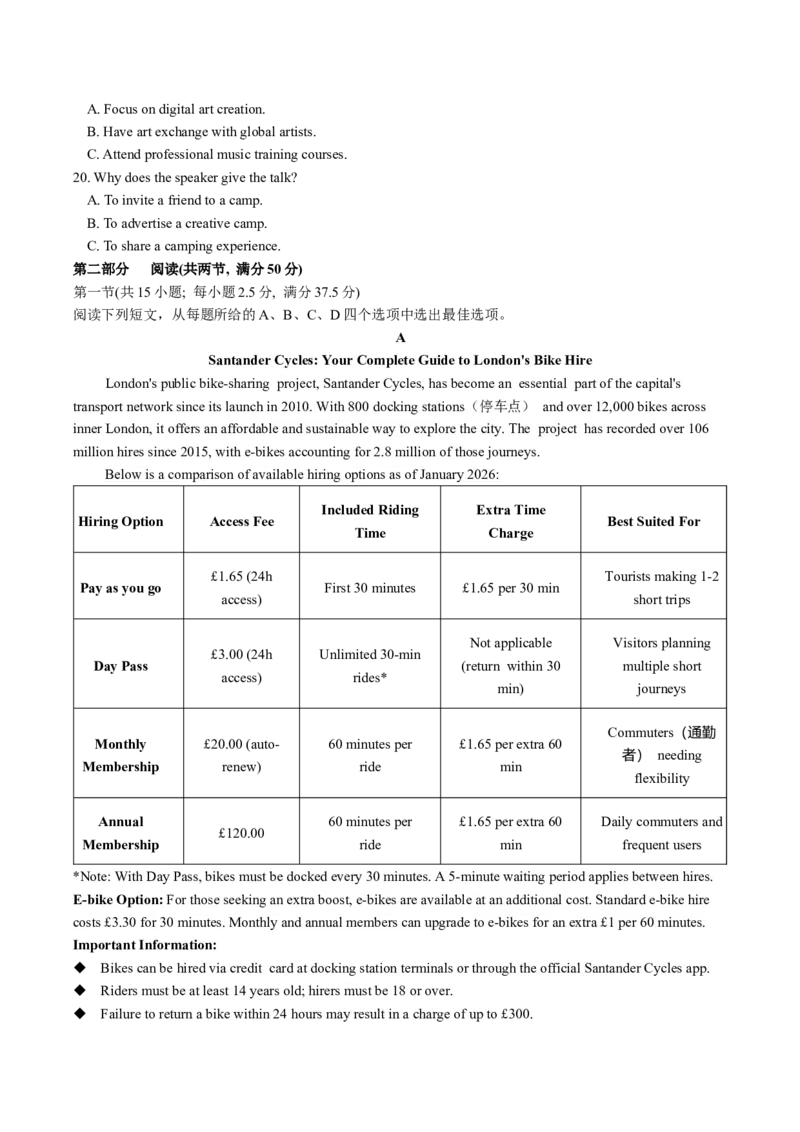
Below is a comparison of available hiring options as of January 2026:
Included Riding Extra Time
Hiring Option Access Fee Best Suited For
Time Charge
£1.65 (24h Tourists making 1-2
Pay as you go First 30 minutes £1.65 per 30 min
access) short trips
Not applicable Visitors planning
£3.00 (24h Unlimited 30-min
Day Pass (return within 30 multiple short
access) rides*
min) journeys
Commuters(通勤
Monthly £20.00 (auto- 60 minutes per £1.65 per extra 60
者) needing
Membership renew) ride min
flexibility
Annual 60 minutes per £1.65 per extra 60 Daily commuters and
£120.00
Membership ride min frequent users
*Note: With Day Pass, bikes must be docked every 30 minutes. A 5-minute waiting period applies between hires.
E-bike Option: For those seeking an extra boost, e-bikes are available at an additional cost. Standard e-bike hire
costs £3.30 for 30 minutes. Monthly and annual members can upgrade to e-bikes for an extra £1 per 60 minutes.
Important Information:
Bikes can be hired via credit card at docking station terminals or through the official Santander Cycles app.
Riders must be at least 14 years old; hirers must be 18 or over.
Failure to return a bike within 24 hours may result in a charge of up to £300. The project operates 24 hours a day, 365 days a year, with real-time bike availability shown on the app.
21. Which option is best for a tourist with several short trips?
A. Pay as you go B. Day Pass
C. Monthly Membership D. Annual Membership
22. How much does a member pay for 120 minutes on an e-bike?
A. £1.65. B. £3.30. C. £3.65. D. £13.2.
23. What is the purpose of this text?
A. To call for travel in London
B. To teach how to travel on bikes in London.
C. To provide information on a bike-sharing project.
D. To compare different bike-hiring options in London
B
In early March, a short video of a food deliveryman sitting on a kerb(马路牙子) weeping in Hà Nội went viral.
The caption — a simple unfinished thought, translated roughly as "What if your whole life is never brilliant?" —
had no complex scientific wording, no self-help jargon(行话). Just an exhausted young man and a question that
refused to stay quiet.
The video attracted more than half a million interactions, and 50,000 comments from people sharing their own
experiences and empathy for the young deliveryman.
I paused the video after seeing the young man cry, because it was too emotional. It is still rare to see a man
cry, as many of us are taught by our fathers to hold our emotions inside. That teaching is now somewhat outdated
and, to a certain extent, toxic(有害的), but it shows the weight of the pressure — enough to make a young man
break from it and stay true to his feelings.
A close friend of mine had been working a regular job for five years, earning a modest salary. Last week he
was given a chance to double his salary elsewhere. He prepared for his final week of work and said his goodbyes to
colleagues, only for the employers to call and apologize, saying they had chosen a different candidate at the last
minute. My friend broke down and called me, uttering the phrase "What if my life is never brilliant?" while sobbing
uncontrollably. He wanted that job so badly, believing it could be his big break. But it never came, and in the
cruelest way.
One of my favourite movies is The Pursuit of Happiness. It tells Chris Gardner's rags-to-riches story. Yet I
believe Gardner's happiness did not come from wealth or social status. His joy was his son Christopher, who guided
him to go on, even in the darkest days when they had to sleep in a public restroom.
Your life is defined by how you react to it. Despite what the outside circumstances throw at you, only you can
change it. The deliveryman never answered his own question. And perhaps that is the point. The pursuit of
happiness does not require a destination. Happiness is a choice: live each day with intention, and you may find it
has been there all along.
24. Which statement is false about the teaching mentioned in Para.3?
A. It shows the weakness of the deliveryman. B. It’s outdated but still influential.
C. It’s not the golden rule for being a true man. D. It shows the unbearable pressure on the
deliveryman.
25. What does the story of a friend of the writer’s indicate?A. Job failure hurts most B. Stable jobs reduce loss
C. Job changes are common D.Youth fear being unbrilliant
26. For what purpose is the film talked about in this passage?
A. To prove wealth brings long-term happiness.
B. To challenge the traditional idea of happiness.
C. To introduce an meaningful film to the readers.
D. To explain why rags-to-riches stories is comforting.
27. Which of the following best reflects the main idea of the text?
A. Man should never cry. B. Brilliance depends on hard work.
C. Happiness is a choice, not success. D. Youth must struggle for brilliance.
C
For decades, researchers have carefully avoided claiming that any non-human animal possesses true language.
That caution is now fading, thanks to artificial intelligence. AI’s ability to detect patterns in large collections of
animal noises and behaviors has opened a new frontier in cross-species communication.
The urgency has been strengthened by the Coller Dolittle Challenge. This competition, established by Tel
Aviv University in partnership with a charitable foundation, tasks the scientific community with developing
algorithms to understand animal communication. The winner of the 2025 challenge received 100,000 dollars and
a10 million grand prize awaits the first team that successfully cracks the code of cross-species dialogue.
Researchers are already making surprising discoveries. Sophie Cohen-Bodénès at Washington University
observed that cuttlefish use arm movements to create four distinct signs—dubbed “up,” “side,” “roll,” and “crown.”
When one cuttlefish sees another signing, it responds with its own signals. While the exact meanings remain
unclear, the “crown” sign—formed by touching fingertips together—appears to express unease. Cuttlefish showing
this gesture often change their body color to orange or black and move away.
Mammals(哺乳动物) are also revealing their secrets. David Omer at the Hebrew University of Jerusalem and
his colleagues discovered that marmosets, small monkeys living in family groups, use special “phee” calls to
address specific individuals. This makes them the first non-human primates known to use name-like labels, though
recent research suggests elephants also employ random sounds as names.
Perhaps most impressive is dolphin communication. Laela Sayigh at the Woods Hole Oceanographic
Institution and her team used AI to analyze recordings covering six generations of wild bottlenose dolphins. They
have identified 22 different whistles used by many dolphins. The most common signal occurs when dolphins meet
something unexpected—working much like a human asking, “What was that?” Together with their ability to use a
higher pitch when communicating with calves—similar to human “baby talk”—these findings suggest a
communication system far more complex than previously believed.
However, AI is not a magic solution. Frants Jensen at Aarhus University warns that while AI allows
researchers to process data faster, models trained on specific recordings often fail when faced with slightly different
sound characteristics. Moreover, understanding the context of a call—whether an animal is signaling a enemy
nearby or recalling a past event—remains a fundamental challenge.
28. Why is the Coller Dolittle Challenge introduced ?
A. to praise the 2025 competition winners. B. to prove language is uniquely human.
C. to illustrate the achievements we've made. D. to show a key driver of AI research.
29. What do cuttlefish and marmosets have in common?A. Both show intentional communication. B. Both live in complex family groups.
C. Both use signs to express unease. D. Both can employ name-like labels .
30. What does underlined word “calves” in paragraph 5 mean?
A. young dolphins B. adult female dolphins
C. dolphin’s enemies D. different dolphin species
31. What does the author imply about AI in animal communication research in the last paragraph?
A. It fails to process data faster. B. It is limited by sound differences and context.
C. It has solved call understanding. D. It needs large much more data to be reliable.
D
The idea that a diet best known as a popular weight-loss approach could treat serious mental illness might
sound like the latest offering from the wild west of online wellness. Yet a growing number of scientists are now
taking the ketogenic diet(生酮饮食) seriously as a potential treatment for conditions ranging from severe
depression to schizophrenia(精神分裂).
For over a century, research has shown that ketogenic diets—which are high in fat and extremely low in
carbohydrates(碳水)—have real, measurable effects on the body. The diet forces the body to shift from using sugar
as its primary fuel source to burning ketones, chemicals produced by the liver from fat stores. This metabolic(代
谢的) switch causes a string of changes at the cell level, many of which happen to be known treatment targets
in mental illness.
In February 2026, Christopher Palmer, a psychiatrist(精神病学家) at Harvard Medical School, made
headlines not by claiming a "cure" for schizophrenia—a word he has never used in his work—but by carefully
documenting cases of "symptom easing." His small-scale studies have shown that some patients with treatment-
resistant mental health conditions experienced dramatic symptom improvement after adopting a ketogenic diet.
One of the most striking aspects of this approach is that it addresses the underlying metabolic problem that
may contribute to mental disorders. Emerging evidence suggests that certain mental illnesses are associated with
damaged energy metabolism in the brain. By providing an alternative fuel source—ketones—the diet may help go
around these metabolic blockages, restoring proper neuronal(神经元的) function.
The field, now called "metabolic psychiatry," is still in its early stages. Large-scale clinical trials are underway
to determine which patients might benefit most. However, the existing evidence is strong enough that researchers
are calling for a major shift in thinking. "Many of these changes—some at the cell level, others throughout the
whole body—are known treatment targets in mental illness," Palmer explains.
While no one is suggesting that diet alone can replace traditional psychiatric drugs, the potential of metabolic
interventions offers new hope for patients who have not responded to existing treatments. As the science matures,
the once-dismissed idea that what we eat could fundamentally change our mental health is gaining undeniable
believeability.
32. How does the ketogenic diet affect the body's energy system?
A. It increases sugar production in the liver. B. It burns ketones rather than sugar for fuel.
C. It blocks the absorption of carbohydrates. D. It turns all fats directly into brain fuel.
33. Why does the author speak of Christopher Palmer ?
A. To show Palmer is cautions with his research.
B. To prove the diet can cure most mental illnesses.C. To show expert support for the diet’s clinical value.
D. To show the diet’s effect on mental illness is limited.
34. What can be inferred about sugar as brain fuel source?
A. It is perfect for mental health. B. It has no relation to brain disorders.
C. It produces more ketones than fat does. D. Its use may fail in some mental illnesses.
35. What is the author's overall attitude toward the potential of kitogenic diet for mental illness?
A. Disapproving and skeptical. B. Neutral and uninterested.
C. Enthusiastic but cautious. D. Critical and opposed.
第二节(共5小题; 每小题2.5分,满分12.5分)
阅读下面短文,从短文后的选项中选出可以填入空白处的最佳选项。选项中有两项为多余选项。
Why Your Brain Prefers Junk Food?
Have you ever wondered why a bag of chips is so much more appealing than an apple? The answer lies not in
your willpower but in your brain's ancient reward system. Over millions of years, human brains evolved to seek out
high-calorie foods because they provided the energy needed for survival. 3 6
Modern food companies have learned to use this biological weakness. By combining salt, sugar, and fat in
precise ratios, they create what scientists call “highly appealing” foods. These foods cause a much stronger
dopamine(多巴胺) release in the brain than natural foods do. 37 As a result, you find yourself reaching for
another cookie even when you are not hungry.
38 Long-term exposure to highly appealing foods can actually rewire your brain's reward circuits.
Over time, you need more and more of these foods to feel the same level of pleasure. This is similar to how drug
addiction develops. Meanwhile, natural foods like vegetables begin to taste less satisfying by comparison.
So how can you fight back against your own brain? 39 If you keep unhealthy snacks out of sight or
simply do not buy them, you reduce the constant temptation. Another powerful strategy is mindful eating — paying
full attention to the taste, texture, and smell of each bite. This practice helps your brain relearn to appreciate natural
flavors.
Understanding the neuroscience of food preference does not mean you are powerless. 40 Small,
consistent changes in your daily habits can gradually help your brain learn to prefer healthier options. The key is
patience, not punishment.
A. One effective method is to change your food environment.
B. Fortunately, you can use this knowledge to your advantage.
C. The reason has nothing to do with genetics or personal taste.
D. Slowly introducing more whole foods can help correct the change.
E. That explains why some people lose control around processed foods.
F. This intense pleasure signal overcome the brain's natural fullness sign.
G. However, the same mechanism now works against us in today's world of cheap calories.
第三部分 语言运用(共两节,满分30分)
第一节 (共15小题;每小题1分,满分15分)
阅读下面短文,从每题所给的A、B、C、D四个选项中选出最佳选项。
“Hello, this is your captain speaking. We are now flying over Chengdu, China…”The announcement 41 me from a deep sleep. Through the window, a well-planned city 42
far below. Chengdu’s new airport shone like a modern artwork. At over 10,000 meters, my brand-new life was just
43 .
I come from Balochistan, where there is a severe 44 of job opportunities and basic public facilities.
Stepping into Tianfu Airport, I was deeply struck by its perfect order and efficiency. My first Didi ride was in a
neat electric car. The driver chatted warmly, and I 45 with simple Chinese phrases. It was a confusing yet
pleasant 4 6 for a newcomer.
Using Baidu Maps, I was amazed by its remarkable 47 — detailed guidance, quick response and
real-time traffic reminders. As we travelled across Chengdu, modern technology worked silently in the background,
letting natural scenery take the 4 8 . The city felt warm and user-friendly.
Getting a local SIM card was surprisingly 49 with simple procedures. Soon I experienced 5G, not a
distant fantasy but a vivid 5 0 . Paying by scanning QR codes in the canteen made me feel I had stepped into
a totally new lifestyle. Spicy food and slippery noodles offered me a unique 5 1 of local culture.
I came to China mainly for advanced technology, but eventually 52 precious order, mutual trust and
thoughtful social management. Back in my hometown, I had long dreamed of 53 a brighter future for my
people. In Chengdu, I saw the ideal 5 4 for my future life.
Looking up at the bright moon over the campus, I felt closely connected to my hometown thousands of miles
away. One day, I will return home, not only with a college degree, but also with a clear vision to 55 my
hometown’s long-term development.
41. A. forced B. awakened C. interrupted D. rescued
42. A. spread B. folded C. floated D. rested
43. A. fading B. adjusting C. setting D. beginning
44. A. limit B. lack C. loss D. waste
45. A. replied B. communicated C. argued D. agreed
46. A. coincidence B. occasion C. adventure D. experience
47. A. efficiency B. capability C. stability D. flexibility
48. A. chance B. turn C. lead D. place
49. A. boring B. complex C. difficult D. convenient
50. A. dream B. reality C. puzzle D. target
51. A. taste B. insight C. view D. air
52. A. explored B. discovered C. admired D. deserved
53. A. replacing B. predicting C. rebuilding D. approving
54. A. model B. insight C. harmony D. symbol
55. A. catch up on B. give rise to C. contribute to D. make up for
第二节(共10小题; 每小题1.5分,满分15分)
阅读下面短文,在空白处填入1个适当的单词或括号内单词的正确形式。
In Lisbon, local resident Suzana Carvalho tried a stylish TCM robot at Instituto Universitario Egas Moniz on
May 10. After a brief scan and interactive 56 (consult), the unit provided a personalized herbal drink
tailored to her health profile, 57 innovation she described as unexpectedly advanced. "It's incredible,"
Carvalho said. "I've always been curious about traditional Chinese medicine, but I didn't anticipate it 58
(be) so advanced."59 (joint) developed by Macau University of Science and Technology and the Guangdong Provincial
Laboratory of Traditional Chinese Medicine, it integrates a specialized TCM model from Hengqin 60
advanced AI including DeepSeek. Led by Professor Han Zitian, the robot stores up to 1,300 prescriptions, of
61 most are drawn from classic TCM formulas that have been pre-vetted by experienced practitioners.
The robot became an instant hit on campus. "The robot's popularity is 6 2 our expectations," said Jose
Joao Mendes, president of the Portuguese institute. "It gives us 63 (great) confidence in expanding
collaboration with Chinese partners in this field."
Cooperation between Chinese and Portuguese institutions 64 (promote) recently across various
fields. Looking ahead, Han said the team hopes to introduce more advanced versions of the robot to Portugal, with
Portugal's regulatory approval, 65 (make) TCM more accessible and serve the public abroad more
efficiently
第四部分: 写作(共两节,满分40分)
第一节(满分15分)
你校英语社团上周举办以 Teenagers’ Cyber Security and Personal Information Protection 为主题的宣传活
动。请为校英文报Campus Life栏目写一篇短文,分享你的参与经历,内容包括:
(1) 个人承担的宣传任务;
(2) 活动收获与感悟。
注意:(1) 写作词数应为80个左右;
(2) 请按如下格式在答题纸的相应位置作答。
Teenagers’ Cyber Security and Personal Information Protection
Last week, our school club held a promotion activity themed Teenagers’ Cyber Security and Personal
Information Protection.
第二节(满分25分)
阅读下面材料,根据其内容和所给段落开头句子续写两段,使之构成一篇完整的短文。
It was my first day at Springfield High School and I was filled with anxiety, fearing my deskmate would never
arrive. Bursts of laughter and the sound of students’ chatting spread across the classroom, making my loneliness
even stronger. I had long looked forward to meeting my deskmate, arranging our desks together and getting used to
the new school life. However, I thought I would have to start my high school life on my own.
When disappointment was about to fill my heart, the classroom door opened suddenly. A girl named Candace
hurried in with her schoolbag, rather tired from the long trip. Though she looked quiet, her shy smile made me feel
warm at once. We greeted each other politely and arranged our desks side by side, our new textbooks neatly placed
on the table.
Our desk space was small but tidy, with simple stationery (文具) neatly arranged. Candace dreamed of being a
writer, and among her things was an amusing collection of small notebooks with colorful covers — she told me
they were her lucky charms (幸运符), a gift from her grandma that she’d kept since primary school. “They’re mylittle inspirations,” she laughed, picking up one with a sunflower cover and handing it to me to look at. By the end
of the first day, we were bonded by the unexpected joy of finding a true friend.
Three years later, that friendship remained unshaken. Candace had been my anchor through all ups and downs
of high school life. She accompanied me through exam failures, sports meetings and unexpected illnesses. And
now, as I lay in the school hospital suffering from a bad fever and a severe headache, she was there again — not
just standing quietly by the bed, but clutching a small, wrapped box in her hand, her eyes filled with worry and
care. The nurse held my arm to take my temperature while comforting me softly. I looked over at Candace and
stretched out my free hand toward her. “Come here too,” I whispered weakly.
注意:
(1)续写词数应为150左右;
(2)请按如下格式在答题卡的相应位置作答。
Paragraph 1: The sound of the nurse’s soft reminder pulled me back to my senses.
Paragraph 2: Before leaving the hospital later that day, Candace gently laid a familiar small box on the
bedside table.