重庆八中高 2027 届高二(下)阶段性检测(二)
英 语
第一部分 听力(共两节,满分 30 分)
第一节(共 5 小题;每小题 1.5 分,满分 7.5 分)
听下面 5 段对话。每段对话后有一个小题,从题中所给的 A、B、C 三个选项中选出最佳选项。
听完每段对话后,你都有 10 秒钟的时间来回答有关小题和阅读下一小题。每段对话读两遍。
1. How will the man probably get to the town?
A. By bus. B. By taxi. C. By bike.
2. Who is the woman reading about now?
A. Neil Armstrong. B. Picasso. C. Napoleon.
3. Where did the woman work last Friday?
A. At a café. B. In the office. C. At home.
4. What is the woman probably good at?
A. Chess. B. Cards. C. Football.
5. What are the speakers talking about?
A. Their biology teacher. B. The pet of the class. C. The woman's parents.
第二节(共 15 小题;每小题 1.5 分,满分 22.5 分)
听下面 5 段对话或独白。每段对话或独白后有几个小题,从题中所给的 A、B、C 三个选项中
选出最佳选项。听每段对话或独白前,你将有时间阅读各个小题,每小题 5 秒钟;听完后,
各小题将给出 5 秒钟的作答时间。每段对话或独白读两遍。
听第 6 段材料,回答第 6、7 题。
6. Why is the man calling?
A. To ask the opening hours. B. To join a club. C. To buy tickets.
7. What is the man concerned about?
A. Whether the time suits him.
B. Whether the activity changes.
C. Whether his kid is allowed to get in.
听第 7 段材料,回答第 8 至 10 题。
8. What is important to the woman?
第 1页/共 24页
学 科 网 ( 北 京 ) 股 份 有 限 公 司A. A fancy hotel. B. Adventurous activities. C. A private beach.
9. What will the company teach the speakers?
A. How to surf. B. How to dive. C. How to drive a boat.
10. What will the man do next?
A. Make a phone call. B. Book flight tickets. C. Pack for their holiday.
听第 8 段材料,回答第 11 至 13 题。
11. What is the probable relationship between the speakers?
A. Boss and secretary. B. Husband and wife. C. Host and guest.
12. When is the interview scheduled?
A. On Tuesday. B. On Thursday. C. On Wednesday.
13. What is special about today?
A. It is the man's birthday.
B. Staff received a pay raise.
C. The new engineers arrived.
听第 9 段材料,回答第 14 至 16 题。
14. What did people believe a few centuries ago?
A. That Earth was a flat planet.
B. That Pluto was not a planet.
C. That Jupiter was made of rock.
15. How does the man feel about the presentation at the end?
A. Confused. B. Nervous. C. Confident.
16. Where are the speakers now?
A. In the museum. B. In the computer lab. C. In the school café.
听第 10 段材料,回答第 17 至 20 题。
17. How will the weather be like in Russia tomorrow?
A. Sunny. B. Windy. C. Rainy.
18. Where does the speaker live?
A. In Spain. B. In France. C. In Italy.
19. What is the speaker mainly concerned about?
A. The risk for wildlife. B. The pollution in cities. C. The damage to farms.
第 2页/共 24页
学 科 网 ( 北 京 ) 股 份 有 限 公 司20. What is the next news about?
A. Recovery of local businesses.
B. Action against climate change.
C. Development of global economy.
第二部分 阅读(共两节,满分 50 分)
第一节(共 15 小题;每小题 2.5 分,满分 37.5 分)
阅读下列短文,从每题所给的 A、B、C、D 四个选项中选出最佳选项。
A
With midterms and finals nearing, finding time to work out between all the studying and classes can be a
challenge. But who says you must choose between studying and working out? This study break exercise routine is
all you need to stay on track for your fitness goals. Better yet, it’s just 5 minutes long.
How It Works
For every hour of studying, take a 5-minute break to get up and move your body. This routine is filled with
light cardio, bodyweight exercises, and dynamic stretches to wake your body up and prepare it for your next period
of studying. This routine may be short but do it enough times throughout the day and the calories will add up!
Routine Details
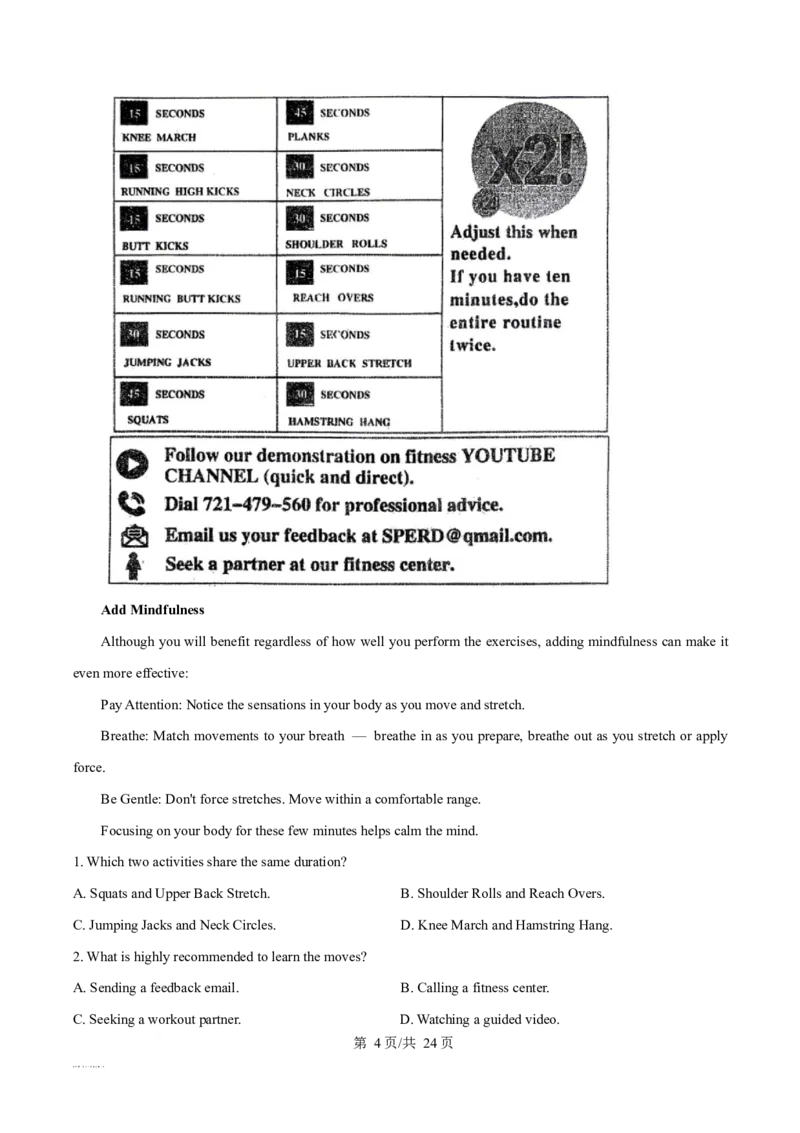
5 Minute Study Break Exercise
第 3页/共 24页
学 科 网 ( 北 京 ) 股 份 有 限 公 司Add Mindfulness
Although you will benefit regardless of how well you perform the exercises, adding mindfulness can make it
even more effective:
Pay Attention: Notice the sensations in your body as you move and stretch.
Breathe: Match movements to your breath — breathe in as you prepare, breathe out as you stretch or apply
force.
Be Gentle: Don't force stretches. Move within a comfortable range.
Focusing on your body for these few minutes helps calm the mind.
1. Which two activities share the same duration?
A. Squats and Upper Back Stretch. B. Shoulder Rolls and Reach Overs.
C. Jumping Jacks and Neck Circles. D. Knee March and Hamstring Hang.
2. What is highly recommended to learn the moves?
A. Sending a feedback email. B. Calling a fitness center.
C. Seeking a workout partner. D. Watching a guided video.
第 4页/共 24页
学 科 网 ( 北 京 ) 股 份 有 限 公 司3. Which can improve the workout results?
A. Taking deep breaths in between. B. Rushing through the entire routine.
C. Pairing movement with mental focus. D. Pushing each move to the maximum.
【答案】1. C 2. D 3. C
B
After ten years in London, I recently relocated to Berlin, and as is customary when making new friends, the
question “Where are you from?” tends to come up. My honest answer would be, “I don’t really know.”
The truth is, most of us TCKs (Third Culture Kids) — a term coined to describe “children who move between
cultures before they have had the opportunity to fully develop their personal and cultural identity” — had no
choice growing up but to follow our parents around the world. We’d often be told, “Pack your bags, kids. We’re
moving!” and in the blink of an eye, everything would change.
By the time I was 18, I had changed schools 10 times, moved countries at least 6 times, acquired a confusing
accent, and developed both a love of travel and a desire for stability. Being an Indonesian-Italian, I often felt an
identity crisis weighing on me in my teens.
Moving to a new country after spending ten years in the UK — the longest I have lived anywhere — has
brought back feelings of this cultural confusion. Growing up as a TCK isn’t as charming as many people would
expect. It is both a blessing and a curse (诅咒), beautiful but unpredictable, and full of adventures. This lack of
roots and stability will likely cause issues later in life.
Ye t kids are adaptable. After overcoming culture shock, you start to adjust and see the bigger picture. You learn
that the world is much bigger than you, and that your problems are small. You also learn responsibility, respect
different beliefs, and form your own opinions. Making friends and then losing touch teaches you that everything is
temporary.
Growing up as a TCK, you rarely realize how adaptable you are, until your older friends often comment on
how “wise and mature” you are for your age. Travelling from a young age opens your eyes beyond
“Hypernormalization”. It teaches that diversity is nothing to be afraid of. Growing up as a TCK was tough, but I
wouldn’t trade it for anything. It has shaped me to be the person that I am today — an actual “citizen of the
world”.
4. How does the author usually respond to “Where are you from”?
A. By stating her nationality directly. B. By admitting her uncertainty honestly.
C. By explaining the TCK concept briefly. D. By describing her experiences in detail.5. What does the author say about TCKs’ childhood?
A. They enjoyed planning their moves.
B. They resisted their parents’ decisions.
C. They maintained their personal lifestyle.
D. They were forced to adapt to sudden changes.
6. Which of the following can best describe TCKs’ experiences?
A. Tough and confusing. B. Peaceful and predictable.
C. Routine but eye-opening. D. Adventurous but beneficial.
7. What can be a suitable title for the text?
A. Growing up as a TCK B. Challenges for Migration
C. How to Become a Global Citizen D. How to Adapt to Diverse Cultures
【答案】4. B 5. D 6. D 7. A
C
On a summer afternoon, the surface of a black asphalt (沥青) roof can reach 85°C — hot enough to fry an
egg. These dark surfaces absorb most of the sunlight that hits them, turning cities into dangerous “heat islands.”
During a severe heatwave, this extra warmth pushes already high temperatures several degrees higher, leading to
hundreds of avoidable deaths each year. The solution, some urban planners argue, lies on top of our buildings.
Reflective roofs, also called “cool roofs,” are painted white or coated with special materials that bounce back
up to 85% of incoming sunlight. By contrast, a standard dark roof reflects only about 20%. Buildings with cool
roofs stay cooler inside, reducing air conditioning use by 15‒30%. On a citywide scale, this means lower electricity
bills, fewer power plant emissions, and most importantly, safer streets during extreme heat events.
Los Angeles became an early adopter. In 2013, the city required all new flat roofs to be cool roofs and started
coating existing rooftops with a white, reflective sealant. Satellite images taken five years later showed that surface
temperatures in coated areas dropped by an average of 2.5℃. The city also noticed something unexpected:
residents living near cool roofs reported improved sleep quality, as the reflective coating reduced nighttime heat
release from buildings.
Despite clear benefits, cool roofs face barriers in the city. Older buildings with tar and gravel roofs are
expensive to retrofit. Some homeowners complain that white roofs show dirt easily, reducing reflectivity over time.
Meanwhile, winter cooling could increase heating costs. Researchers are developing adaptive coatings that change
color with temperature — dark in winter to capture heat, white in summer to reflect it.As one climate resilience expert puts it, “We cannot wait decades to redesign entire cities. Cool roofs are
something we can install next month, on the building where you live or work. That is why they are one of our most
powerful immediate tools.”
8. How do dark roofs affect cities during heatwaves?
A. They put more residents at risk of death.
B. They keep buildings cooler during heatwaves.
C. They weaken the structure of buildings over time.
D. They increase the cost of coating existing rooftops.
9. The word “bounce” in paragraph 2 is closest in meaning to ________.
A. absorb B. return C. reflect D. send
10. What can be inferred about the reflective sealant used in Los Angeles?
A. It produced a positive effect on people’s rest.
B. It worked better on new buildings than on old ones.
C. It mainly benefited homeowners with new buildings.
D. It reduced the need for air conditioning in all coated buildings.
11. What is the main idea of the last paragraph?
A. Waiting decades to redesign cities is fine.
B. Redesigning cities should be our top priority.
C. Cool roofs are the best solution for every city.
D. Cool roofs are a quick and workable fix.
【答案】8. A 9. C 10. A 11. D
D
For generations, parents and teachers have warned children against daydreaming, calling it a waste of time.
However, recent cognitive neuroscience research suggests otherwise. Rather than being a sign of distraction,
daydreaming may represent a unique mental state where creativity and future planning flourish.
The key lies in the brain’s default mode network (DMN), a set of regions that becomes active when people
are not focused on external tasks. Far from being idle, the DMN allows the brain to make remote associations
between seemingly unrelated ideas. In a 2021 study, participants who completed a tedious button-pressing task
followed by a rest period showed 40% more creative solutions on subsequent problems than those who moved
directly to a second demanding task. The rest period, during which minds naturally wandered, allowed the DMN to
secure memories and generate novel connections.Critics of deliberate mind-wandering point to its obvious risks. Students who daydream during lectures miss
critical information. Drivers whose attention drifts pose safety dangers. Yet researchers distinguish between two
types: unintentional mind-wandering, often triggered by boredom or tiredness, and intentional mind-wandering,
where individuals consciously allow their thoughts to flow while remaining able to return to the task when needed.
The latter, when practiced under appropriate conditions, carries creative benefits without significant costs.
Workplace studies support this distinction. Employees given regular short breaks for “structured daydreaming”
— reflecting on personal goals or imagining future scenarios — reported higher job satisfaction and produced
more innovative ideas than those following continuous work schedules. Interestingly, the most creative workers
surveyed exhibited not fewer but more frequent episodes of intentional mind-wandering during low-stakes tasks
such as data entry or routine emails.
The implication is not that students should abandon focus during exams or drivers should lose attention on
highways. Rather, the research suggests rethinking the cultural bias against daydreaming. Periods of mental
wandering, when deliberately employed in safe and low-demand situations, act as a hidden engine for innovation.
Learning to control when and where the mind wanders may be as valuable as learning to focus it.
12. What does recent research suggest about daydreaming?
A. It serves a useful brain function.
B. It only happens when the mind is idle.
C. It helps the brain process external tasks.
D. It improves the ability to focus for long periods.
13. What did the 2021 study find about participants who rested?
A. They felt less mentally tired.
B. They showed more creativity later.
C. They showed higher job satisfaction.
D. They performed better on memory tests.
14. What can be inferred about intentional mind-wandering?
A. It may bring safety dangers.
B. It may be common during low-stakes tasks.
C. It prevents one from returning to the task.
D. It reduces mental tiredness after demanding work.
15. What does the author suggest about daydreaming?A. Practice it to reduce mental tiredness.
B. Apply it to boost creativity in all tasks.
C. Use it as a replacement for focused work.
D. Let your mind wander on purpose during easy work.
【答案】12. A 13. B 14. B 15. D
第二节(共 5 小题;每小题 2.5 分,满分 12.5 分)
阅读下面短文,从短文后的选项中选出可以填入空白处的最佳选项。选项中有两项为多余选
项。
Experts constantly remind us that drinking enough water is absolutely important in order for our bodies to
function properly. ____16____ Though most people worry more about getting dehydrated (脱水), drinking too
much water can be dangerous.
____17____, you may be drinking too much water. Constantly adding water to your body can result in low
sodium (钠) levels in your blood, which can cause all of the cells in your body to swell. What’s more, this can
become particularly dangerous when your brain starts to swell.
The best way to know if your body really needs more water is to be consciously aware of whether or not you
actually feel thirsty. Our bodies are so programmed to fight against dehydration because we’ve always been living
in fear of not having enough, so we have all of these built-in mechanisms to protect us against that. Thirst is every
body’s individual monitor that lets them know if they need more. The more water you need, the thirstier you get.
____18____
You may be drinking too much water if you find yourself often waking up in the middle of the night to use the
bathroom. ____19____ If you find yourself urinating (尿) more than ten times a day, you may be drinking more
water than your body needs. To prevent nighttime urination, have your last glass of water a couple hours before bed
to give your kidneys time to filter the water through your body.
Your kidneys are responsible for filtering the water you drink through your body. When you drink too much
water, your kidneys have to work even harder, creating a stressful reaction from your hormones that leaves your
body stressed and tired. ____20____, it may be because you’ve added unneeded stress to your kidneys.
A. And it is — unless you drink too much of it.
B. Surely you have to drink water as much as you can.
C. Most people urinate between six and eight times a day.
D. These are the reasons you may not be aware of for being thirsty.E. If you take some water with you in the day but empty it in the night
F. If you’re constantly drinking water and find yourself struggling to get out of bed
G. If you carry around your water bottle all day and immediately refill it when it is empty
【答案】16. A 17. G 18. D 19. C 20. F
第三部分语言运用(共两节,满分 55 分)
第一节完形填空(共 15 小题;每小题 1 分,满分 15 分)
阅读下面短文,从每题所给的四个选项中选出可以填入空白处的最佳选项。
I was on the way to my father’s house. The constant drizzle made my driving a little ____21____. Suddenly,
my car began fishtailing and ____22____ toward a bank where it rolled over three times.
Passing drivers ____23____ to help. A nurse appeared and ____24____ my neck and someone called 911. The
fire department arrived, and, with much ____25____, removed me from the vehicle.
Soon, I learned I had broken my back and neck and would need to be transported to another hospital equipped
to handle serious ____26____. The doctors there ordered a plastic body cast (全身石膏) to be made for me. When I
was finally discharged, I was told to keep the body cast on for four months.
I had always been active, so being restricted was completely ____27____ to me. I felt like I had lost
____28____ of my life. I decided to get my life back. I began physical therapy and after ____29____ forty days, I
returned to my job, ____30____ my body cast underneath my clothes. While I had to limit how I moved, I could
function fairly _____31_____.
When the body cast ____32____, I continued physical therapy and was doing yoga within one year. I never
____33____ my ability to recover. I always kept my eyes on the ____34____, which was regaining my normal
activities, even though I couldn’t do all the things in ____35____ the same way I did before.
I was fortunate to be alive and to have the ability to do what I could still do.
21. A. thrilling B. challenging C. refreshing D. boring
22. A. headed B. jumped C. pointed D. leaned
23. A. sped up B. broke down C. pulled over D. watched out
24. A. rubbed B. turned C. grabbed D. stabilized
25. A. effort B. amusement C. kindness D. compromise
26. A. accidents B. injuries C. consequences D. crises
27. A. accessible B. harmful C. engaging D. foreign
28. A. track B. control C. sight D. count29. A. gaining B. recording C. missing D. lasting
30. A. wearing B. abandoning C. improving D. restoring
31. A. automatically B. quickly C. normally D. tirelessly
32. A. carried on B. turned around C. ran out D. came off
33. A. developed B. doubted C. overestimated D. recognized
34. A. prize B. talent C. cost D. health
35. A. slightly B. basically C. exactly D. typically
【答案】21. B 22. A 23. C 24. D 25. A 26. B 27. D 28. B 29. D 30. A
31. C 32. D 33. B 34. A 35. C
第二节语法填空(共 10 小题;每小题 1.5 分,满分 15 分)
阅读下边短文, 在空白处填入 1 个适当的单词或括号内单词的正确形式。
On Thursday, the National Cultural Heritage Administration in Beijing ____36____ (reveal) that
archaeologists had discovered two sunken ships in the depths of the South China Sea. It offered tangible evidence
of commercial and ____37____ (culture) exchanges along the ancient Maritime Silk Road.
The latest underwater archaeological ____38____ (explore) carried out by the National Center for
Archaeology have ____39____ (significant) uncovered important artifacts. In addition to the shipwrecks, a variety
of artifacts, including pottery, porcelain and ironware, have been unearthed, most of ____40____ were made in
kilns (窑炉) in Jingdezhen, Jiangxi province, known as China’s “porcelain capital.” The precise locations of the
shipwrecks and the associated cultural relics ____41____ (determine) through the use of oceanographic technology
and underwater investigations involving manned submersibles, which conducted 41 dives throughout the year, as
confirmed by Song Jianzhong, ____42____ researcher at the National Center for Archaeology.
The Ming Dynasty’s No.1 shipwreck, ____43____ (measure) 37 meters long and 11 meters wide, has yielded
543 artifacts, suggesting it sailed from Fujian or Guangdong to Southeast Asia trade centers like Malacca. The No.
2 shipwreck dates ____44____ the rule of Emperor Hongzhi and measures about 21 meters long and 8 meters wide.
A total of 36 artifacts have been found on it, porcelain and pottery _____45_____ (include).
【答案】36. revealed
37. cultural
38. explorations
第 18页/共 24页
学 科 网 ( 北 京 ) 股 份 有 限 公 司39. significantly
40. which 41. were determined
42. a 43. measuring
44. from 45. Included
第四部分写作(共两节,满分 40 分)
第一节书面表达(满分 15 分)
46. 假定你是李华,你的外国朋友 Tim 给你写信说在社交媒体上看到重庆爆火的视频,其中防空洞火锅引
起了他浓厚兴趣。请你结合图片给他回信向他介绍防空洞火锅,并邀请他来重庆亲自感受重庆的魅力。
注意:词数 80 左右;参考词汇:air-raid shelters 防空洞 bunker hotpot 防空洞火锅
Dear Tim,
____________________________________________________________________________________________
____________________________________________________________________________________________
____________________________________________________________________________________________
____________________________________________________________________________________________
____________________________________________________________________________________________
__________________
Yours,
Li Hua
【答案】Dear Tim,
I’m glad to know that you’re fascinated by bunker hotpot after watching videos online.
Originally built as air-raid shelters in old Chongqing, these caves are now transformed into unique hotpot
restaurants. The constant cool temperature inside makes it perfect to enjoy spicy hotpot even in the hot summer.
Besides authentic, tasty broth and fresh ingredients, you can also feel the special historical atmosphere of
Chongqing.
I sincerely invite you to Chongqing to taste the delicious bunker hotpot and explore the city’s amazing charmin person. We can also wander around mountain streets and visit local scenic spots together.
Looking forward to your arrival.
Yours,
Li Hua
第二节读后续写(满分 25 分)
47. 阅读下面材料,根据其内容和所给段落开头语续写两段,使之构成一篇完整的短文。
Our school’s “Help Others” week was approaching, and our team was responsible for organizing a used book
donation campaign for a rural partner school. We had five days to plan and carry it out, and everyone was eager to
contribute.
On Monday morning, our team leader, Mia, brought us together to discuss our roles. There were four of us on
the team: Mia, Jenny, Kevin and me. Mia assigned different tasks to each of us based on our strengths and interests.
I was put in charge of contacting the rural school to confirm their book needs — a task I felt comfortable with.
By Wednesday, things were going smoothly. We had already collected over 500 books from students and
teachers, and some had been sorted and placed neatly into boxes.
Then, on Thursday morning, Mia received a phone call from Kevin, one of our teammates. He explained that
he had been in a minor car accident and needed to stay at the hospital for check-ups. He sounded worried about
falling behind on his task: sorting and categorizing the donated books by grade level.
We immediately told Kevin to focus on his recovery and that we would handle things.There were over 200
books that had not been sorted out. Each book needed to be labeled by grade (1-6) and packed into boxes. If we
didn’t step up, the rural school would receive a mess of books they couldn’t use, and our campaign would end in
disaster.
After finishing our own tasks, we came together as a team that afternoon. Without hesitation, we all agreed to
take on the remaining work together, making sure nothing fell behind.
注意:
1.续写词数应为 150 左右;
2.每段的开头语已为你写好,不计入词数。
That evening, instead of going home, we stayed.
____________________________________________________________________________________________
____________________________________________________________________________________________
________________________________________________________________________________________________________________________________________________________________________________________
____________________________________________________________________________________________
__________________
When Kevin returned on Friday morning, he was surprised at the progress we had made in his absence.
____________________________________________________________________________________________
____________________________________________________________________________________________
____________________________________________________________________________________________
____________________________________________________________________________________________
____________________________________________________________________________________________
__________________
【答案】 That evening, instead of going home, we stayed. Mia put the unsorted books into three piles. Jenny
called out each grade level from one to six. I wrote the numbers on small labels. Mia put every labeled book into
the correct box. We worked without stopping. At seven o’clock we were half done. At eight thirty we finished.
Twelve boxes stood in a neat row. We washed the ink off our hands and locked the library. Walking home in the
dark, no one complained. We felt proud. We had done something good for Kevin.
When Kevin returned on Friday morning, he was surprised at the progress we had made in his absence. He
stopped at the door and stared at the boxes. His eyes turned red. Mia told him we stayed late to finish his task.
Kevin hugged each of us. Later that morning we took the books to the rural school. The children ran to the boxes
and opened them with loud cheers. Standing there, we knew the truth. Helping others begins with helping the
person right next to you. That is what teamwork means.