关注更新免费领取,淘宝唯一每月更新店铺:知二教育
9B Unit 4 Reading 备课资源
★ 教材原文
The great flood
大洪水
Last week in Geography class, we learnt that if all the ice in the North and South Poles melted,
sea level around the world would rise, and many cities would be flooded and disappear.
上周,在地理课上,我们了解到,如果在北极和南极所有的冰都融化了,全球的海平面将
上升,许多城市将被淹没、消失。
It started to worry me. What would happen if our city was badly flooded? Would anyone remain
alive?
这开始让我担心,如果我们的城市被严重地淹没,会发生什么事?会有人活着吗?
Last night, I dreamt about a great flood:
昨晚,我梦见了一个大洪水:
It was nine o'clock in the morning. My bedroom floor was a pool of water.
现在是早上九点钟。我的卧室地板上有一滩水。
I looked out of the window. Water was everywhere. It covered roads, parks and *all houses.
我看着窗外,到处都是水,淹没了道路、公园和小房子。
Large objects, such as coaches and boats, passed by my window. They were floating in the water.
大型的物件,例如客车和船只,经过了我的窗户,它们是在漂在水中的。
I could not just stand there! I had to do something!
我不能只是傻站在那里!我必须做些什么!
I tried to call my dad, but the line was dead, my computer was still working, so I sent him an
email.
我试着打电话给我爸爸,但电话线路已断了,我的电脑还在工作,所以我给他发了一封电
子邮件。
I wrote, “Dad, there's a flood! What should we do?”
我写道:“爸爸,发洪水了!我们应该怎么办?”
He sent me an email back which said, “Kevin, my boss has given me some work. It's important to
stick with it. I can't afford to sit around and worry about the flood.”
他给我回复了一封电子邮件,说:“Kevin,我的老板交给我一些工作要做,坚守岗位是很
重要的,我不能坐在那里担心洪水。”
Then I emailed my best friend. “What should we do about the flood?” I asked.
然后我发邮件给我最好的朋友。“关于洪水我们应该做些什么?”我问。
My friend replied, “I have no time to think about the flood. I'm playing computer games …”
我的朋友回我说,“我没有时间去想什么洪水,我在玩电脑游戏……”
I shouted, “The WATER! Look at the WATER!” But my cries fell on deaf ears.
我大喊道:“水!看水!”但是,他们对我的哭喊声置若罔闻。
In offices and homes, people just sat and stared at their computer screens.
在办公室里,在家里,人们只是呆坐在他们的电脑屏幕前。
It seemed that they did not want to leave. Computers were more important than the flood.
看起来,他们不想离开——电脑比洪水更重要。
Very soon, the water came into people's rooms. It poured onto their desks and covered their
关注更新免费领取,淘宝唯一每月更新店铺:知二教育关注更新免费领取,淘宝唯一每月更新店铺:知二教育
computers.
很快,水就进入了人们的房间。流到他们的办公桌上,淹到了他们的电脑。
In surprise, people finally started to notice the flood, but it was too late.
惊喜的是,人们终于开始注意到洪水了,但为已太迟了。
Then I awoke. There was no water. I was safe-for now.
然后我就醒了。并没有水,我是安全的,现在。
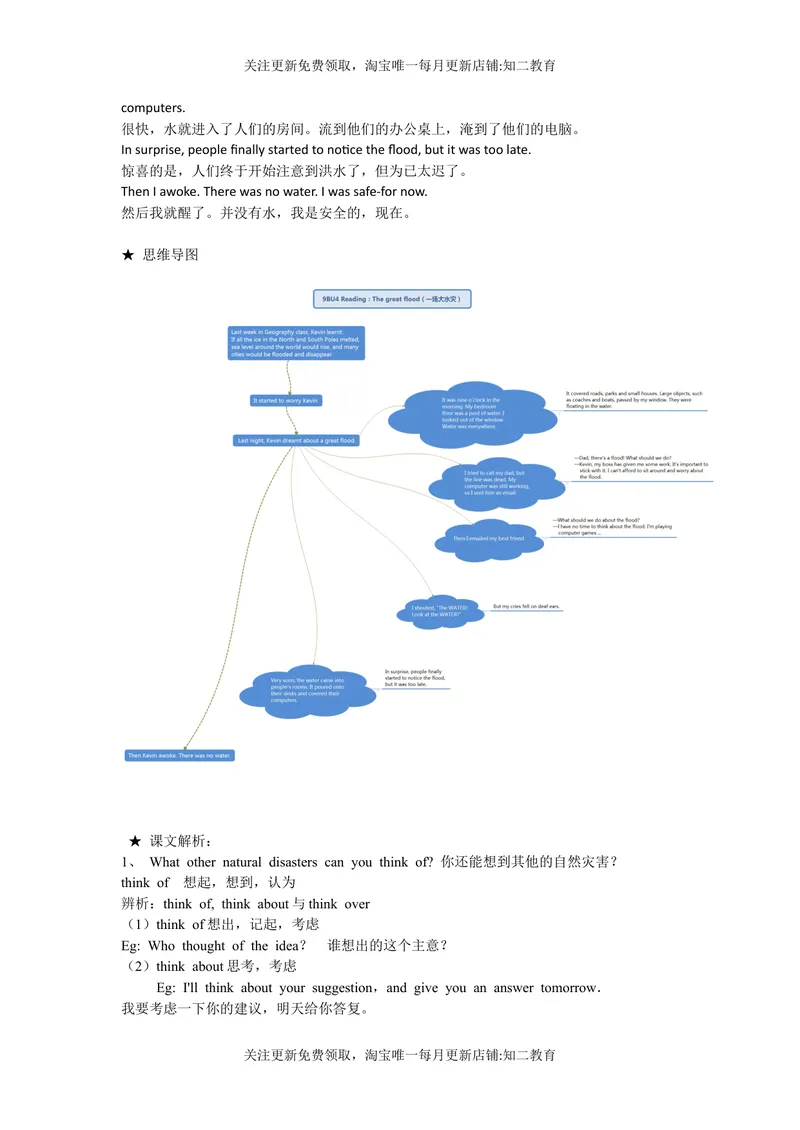
★ 思维导图
★ 课文解析:
1、 What other natural disasters can you think of? 你还能想到其他的自然灾害?
think of 想起,想到,认为
辨析:think of, think about与think over
(1)think of想出,记起,考虑
Eg: Who thought of the idea? 谁想出的这个主意?
(2)think about思考,考虑
Eg: I'll think about your suggestion,and give you an answer tomorrow.
我要考虑一下你的建议,明天给你答复。
关注更新免费领取,淘宝唯一每月更新店铺:知二教育关注更新免费领取,淘宝唯一每月更新店铺:知二教育
(3)think over 意为“仔细考虑”。
Eg: Think over,and you'll find a way. 仔细考虑一下,你就会有办法的。
【拓展】What do you think of…? 是固定句型,意为“你觉得……怎么样?”,相当于
“How do you like…?”。
Eg: What do you think of the film? = How do you like the film?
2、Because he is interested in the North and South Poles. 因为他对南北极感兴趣。
be interested in 对…..感兴趣, 后面跟名词或者动名词作宾语。
The boy is interested in science.
They are interested in playing computer games.
辨析: interested与interesting
Interesting表示事物本身具有使人产生兴趣之处;如The cat is interesting.
而interested表示某人对某事感兴趣;如I am interested in the book bought yesterday.
3、What would happen if our city was badly flooded? 如果我们的城市严重淹水,将会
发生什么事情?
happen是不及物动词。happen的用法主要有以下三种:
(1)"sth.+happen+地点/时间",意为"某地/某时发生了某事"。
Eg:An accident happened in that street. 那条街发生了一起事故。
What's happening outside? 外面发生什么事了?
(2)"sth.+happen to+sb."意为"某人出了某事(常指不好的事发生在某人身上)"。
Eg: A car accident happened to him yesterday. 昨天他发生了交通事故。
What happened to you? (=What was wrong / the matter with you?) 你怎么啦?
(3)"sb.+happen+to do sth."意为"某人碰巧做某事";或者”It happens + that从句”,
意为“碰巧…..”
Eg: I happened to meet her in the street. 我碰巧在街上遇见她。
It happened that I was out when he called. 他来访时我碰巧不在。
辨析:happen与take place
1). take place 表示“发生、举行、举办”,一般指非偶然性事件的“发生”,即这种事件
的发生一定有某种原因或事先的安排。
Eg:Great changes have taken place in our hometown during the past ten years.
The Olympic Games of 2008 will take place in Beijing.
2). happen作“发生、碰巧”解,一般用于偶然或突发性事件。
Eg:What happened to you?
I happened to see him on my way home. = It happened that I saw him on my way home.
4、Would anyone remain alive? 还有人活着吗?
(1)remain此处作连系动词,意为“一直保持;仍然处于某种状态”,后面可接形容词、
名词、动名词ing形式、动词ed形式或介词短语。
Eg:Whatever achievements you’ve made, you should remain modest. 无论你取得多么大
的成就,你都该保持谦虚。
【拓展】remain stay 都指“继续停留”或“继续保持某种状态、关系或行动。”remain
常可与stay 互换。
1)表示“继续呆在某处”时,应该用不及物动词remain或stay
Eg:Shall I go or stay?
He remained in his seat after all the other students had gone home.
2)表示“继续保持或处于原来的状态”时,可用remain或stay
关注更新免费领取,淘宝唯一每月更新店铺:知二教育关注更新免费领取,淘宝唯一每月更新店铺:知二教育
Eg: The door stayed closed.
3)表示“暂住、短期停留”时,只能用不及物动词stay
Eg:He is staying at Hilton Hotel.
4)表示“残留、剩下”时,只能用不及物动词remain
Eg:Not much of the house remained after the fire.
5) remain 强调“继续停留于一处或保持原状态、情况性质而不改变”, stay强调“某人
[物]继续留在原地而不离开
Eg:This place remains cool all summer.
He stayed to see the end of the game.
(2)alive形容词,意为“活着的,在世的”。
Eg: Is the old man alive now?
【注意】alive和living都可以表示“活着的”,但alive通常作表语或后置定语;而living
修饰人或者物时需要前置。
Eg: All living things need air.
5、It covered roads, parks and small houses. 水淹没了道路、公园和小房子。
Cover 此处用作及物动词,意为“覆盖;盖上”,常与介词with搭配。
cover… with … 意为“用……把……盖住”(表示动作)
be covered with... 意为“被……覆盖”(表示状态)
Eg: Please cover the table with a white cloth.
The hills are covered with trees.
【拓展】cover 还可以用作名词,意为“覆盖物;封面等”
Eg:The book needs a new cover.
6、Large objects, such as coaches and boats, passed by my window. 大件的物体,例如
汽车和轮船,从窗前经过。
pass by 意为“通过;经过”;还可以表示“(时间)逝去;过去”。
Eg: I see them pass by my house every day.
Three years had passed by before she finally found a suitable job.
7、I had to do something. 我必须做点什么。
辨析:have to 与must
(1)must多表示主观需要或责任感的驱使有必要或有义务去做某事,多译为“必须”,
而have to多表示客观存在的环境所限,即客观要求(无奈)而为之,多译为“不得不干某事”。
Eg:I must clean the room because there are too dirty.(无人强迫) 因为太脏了,我必须
要打扫房间。
We must be there on time. (责任感的驱使)我们一定准时到达。
I have to do my homework now.(不得不做) 我现在不得不做作业。
I have to leave school because my family is poor now.(无奈) 因为家里穷了,我不得
不退学。
(2)must没有时态的变化,而have to有时态的变化。
Eg: Daming was hurt. The doctor said he had to stay in hospital for about two weeks. His
father has to go to take care of him.
We don’t have to go to school on Sundays. 星期天我们不必上学。
(3)must的否定为mustnt, 多表示“禁令”。
Eg:No!You mustnt turn left! You must turn right into The Strand. 不!你不能向左转!
关注更新免费领取,淘宝唯一每月更新店铺:知二教育关注更新免费领取,淘宝唯一每月更新店铺:知二教育
你应该向右转进入到strand中。
由must引起的疑问句,肯定回答要用must或have to,否定回答要用needn’t或don’t
have to,意思是“不必”; 此用法在中考中的单选题中容易出现!
Eg: 1)—Must I finish my homework before eight o’clock? 我必须要在8点之前完成作
业吗?
—Yes, you must. 是的,必须。
2)—Must I attend the meeting? 我必须要参加这次会议吗?
—No, you needn’t/don’t have to. You can ask Tom to go instead. 不,你不必。你可
以让汤姆替你去。
8、I tried to call my dad, but the line was dead. 我试图给我爸爸打电话,但是电话线路
不通。
(1)try to do sth. 意为“试图/努力做某事”,侧重尽力,为了达到目的而努力;否定
形式为try not to do sth.
I’m trying to learn English well.
(2)try doing sth. 意为“试着/尝试做某事”,只是一种新的尝试,不一定付出很大的
努力。
Let’s try knocking at the back door.
【拓展】
1)try one’s best to do sth. 意为“尽某人最大努力做某事”
We should try our best to practice speaking English.
2)try on 意为“试穿”
Can I try in on?
3)try 作可数名词,意为“尝试”,常构成have a try,意为“试一试”
I can’t open the door. Will I have a try?
9、It’s impossible to stick with it. 坚持工作很重要。
(1)It’s +形容词+ for sb. + to do sth. 意为“对某人来说做某事时……的”
It’s +形容词+of sb. +to do sth. 意为“某人做某事是…..的“,此句式中的形容
词是描述人的性格、品质的,如:polite, nice, kind, good, friendly等。此句式也可以改为
Sb. +be +形容词+ to do sth.
Eg: It’s hard for me to answer your questions.
It was foolish of him to go alone. = He was foolish to go alone.
(2)stick with 意为“持续;坚持;不放弃”;还可以表示“紧接;不离开;和……呆
在一起”
Eg: Stick with your schedule for the week.
Stick with them. There’s safety in numbers.
10、My friends replied,” I have no time to drink about the flood…” 我的朋友说:
“我没有时间考虑洪水…..”
辨析:reply与answer
(1)两者均可表示“回答”,但 answer 属常用词,多用于一般性应答,而 reply 则较正
式,多指经过考虑而作出答复。
Eg: I was so nervous that I couldn’t answer [reply]. 我紧张得没作回答。
(2)answer 可自由地用作及物或不及物动词,而 reply 除后接 that 从句或引出直接引语
是及物动词外,一般只用作不及物动词。其后若接名词或代词作宾语,应借助介词 to。
Eg:He replied that he had changed his mind. 他回答说他改变了主意。
关注更新免费领取,淘宝唯一每月更新店铺:知二教育关注更新免费领取,淘宝唯一每月更新店铺:知二教育
He didn’t answer [reply to] my question. 他没有回答我的问题。 比较下面两句:
He did not know what to reply. 他不知道回答什么(即:用什么回答)。
He did not know what to reply to. 他不知道回答什么问题(即:对什么作回答)。
(3)answer 除表示“回答”外,还可表示接听(电话)或对门铃等声响作出反应等(常与
telephone, door, bell, door-bell 等连用)。但 reply 不能这样用。
Eg:Who answered the telephone? 谁接的电话?
A little girl answered the door. 一个小女孩应声去开门。
Nobody answered my call for help. 没有人理会我的呼救。
(4)两者除用作动词外,都可用作名词。要表示“对……的回答(答复,答案)”等,其后
均接介词 to (不用 of)。
Eg:Have you had an answer to your letter? 你寄出的信有回音没有?
I received no reply to my request. 我的要求没有收到任何答复。
11、In surprise people finally started to notice the flood, but it was too late. 最后人们惊
讶地开始注意到洪水,但是已经太晚了。
in surprise 惊讶地 to one’s surprise 令人吃惊的是
【拓展】notice sb. doing sth. 注意到某个人正在做某事; notice sb. do sth. 注意到某人
做了某事
我注意到她正在房间里哭。___________________________________
我注意到她在房间里哭。_____________________________________
12、My computer is dead, so I will have to buy a new one. 我的电脑不运转了,所以
我必须买一台新的。
辨析:one, it, that
it指代的是同类同物,that指代的是同类异物,one指的是上下文中提到的同类事物中的一
个。
Eg: ①I'm looking for a flat. I'd really like one with a garden.
②-Where did you find your watch? - I find it in our classroom.
③The population of China is larger than that of any other country.
11、The boy was so quiet that often no one would notice when he came in the room.
那个男孩如此安静,以至于当他进入房间时经常没有人会注意到。
So… that 意为“如此……以至于”,引导结果状语从句,so后接形容词或副词。
Eg:He is such a clever boy that everybody likes him.
【拓展】在so… that结构中,若that 从句的主语一致,在否定句中可与too… to…或
not… enough to…结构互换。
He is so young that he can’t join the army.
= He is too young to join the army.
= He isn’t old enough to join the army.
13、What awful weather! 多糟糕的天气啊!
(1)what+(a/an)+adj.+n.+主语+谓语+(it is).
What a clever girl she is!
(2)How+adj.(adv.)+主语+谓语+(it is).
How cold it is today!
14、The government asked people to leave for higher ground…
leave for 动身去……;启程去……
昨天他们动身去北京。_____________________________________
关注更新免费领取,淘宝唯一每月更新店铺:知二教育关注更新免费领取,淘宝唯一每月更新店铺:知二教育
【拓展】
(1)leave可用作及物或不及物动词,意为“离开。出发。”常用于短语,意为“动身,
出发(去某地)” He left Pairs for New York.
(2)leave 属非延续性动词,它不能和表示一段时间的词连用,如果要表示离开一段时间,
要用be away来代替。 I have been away for a week.
(3)leave用作名词时,可以表达多种含义,如“休假。假期,许可,同意” I had a
two week leave.
(4)take leave of =take one’s leave意为“向… 告别” He took his leave and went
home.
15、Barry suggested putting food, water and medicine in a disaster survival kit. 巴里建
议把食物、水和药品放进一个灾难救生包里。
(1)suggest后接名词、代词或动词-ing形式,但不接动词不定式。
He suggested going by plane, but I thought it would cost too much.
(2)suggest sb. to do sth. 向某人建议某事
What did you suggest to the manager?
(3)suggest表“建议”,其后接that引导的宾语从句时,从句要用虚拟语气,即“主语
(+should)+动词原形”
I suggest(that)we (should)hold a meeting.
16、In the end, the asteroid did not hit the Earth. 最后,小行星没有撞击地球。
辨析:in the end, finally, at last
(1)in the end 意为“终于”“最后”,表示经过许多变化、周折或捉摸不定的情况后发
生了某事,也许是期待中的情况,也许是非期待中的情况。还可以表示一种推测。
He worked hard, and in the end he succeeded.
(2)at last 仅仅用于表示经过周折、等待或努力出现所期待的结果,不用于出现非期待
的结果。
My son is at home in the end/at last.
(3)finally 既可用于表示时间位置,相当于 in the end,也可以用于表示时间的先后顺序,
如同 first(ly),second(ly),next,then,last,lastly 等词的用法。
Finally, I’d like to thank you all for coming.
★巩固提升
一、完形填空
The great flood
Last week in Geography class, we learnt that if all the ice in the North and South Poles melted, sea
level around the world would 1, and many cities would be flooded and disappear.
It started to 2 me. What would happen if our city was badly flooded? Would anyone remain
alive?
Last night, I 3 about a great flood:
It was nine o’clock in the morning. My bedroom floor was a 4 of water. I looked out of the
window. Water was everywhere. It covered roads, parks and small houses. 5 objects, such as
coaches and boats, passed by my window. They were floating in the water.
I could not just 6 there! I had to do something!
I tried to call my dad, but the line was 7 . My computer was still working, so I sent him an email.
关注更新免费领取,淘宝唯一每月更新店铺:知二教育关注更新免费领取,淘宝唯一每月更新店铺:知二教育
I wrote, “Dad, there’s a flood! What should we do?”He sent me an email back 8 said, “Kevin,
my boss has given me some work. It’s important to 9 it. I can’t afford to sit 10 and worry about
the flood.”
Then I emailed my best friend. “What should we do about the flood?” I asked. My friend replied,
“I have no time to 11 the flood. I’m playing computer games …”
I shouted, “The WATER! Look at the WATER!” But my cries fell on deaf 12. In offices and homes,
people just sat and stared at their computer screens. It seemed that 13 did not want to leave.
Computers were more important than the flood.
Very soon, the water came into people’s rooms. It poured onto their desks and 14 their
computers. In surprise, people finally started to notice the flood, 15 it was too late.
Then I awoke. There was no water. I was safe—for now.
( ) 1.A.fall B. raise C. rise D. stay
( ) 2.A.fear B. worry C. surprise D. save
( ) 3.A.dreamt B. talked C. thought D. learnt
( ) 4.A.bottle B. glass C. pool D. bowl
( ) 5.A.Large B. Small C. Little D. Few.
( ) 6.A.run B. stand C. walk D. rush
( ) 7.A.free B. lazy C. dead D. alive
( ) 8.A.who B. which C. what D. where
( ) 9.A.give up B. keep on C. help with D. stick with
( )10.A.about B. down C. around D. on
( )11.A.think about B. run after C. talk about D. look at
( )12.A.faces B. noses C. mouths D. ears
( )13.A.he B. they C. we D.I
( )14.A.placed B. pushed C. covered D. crossed
( )15.A.and B. or C. but D. so
答案:1—5 CBACA 6—10 BCBDC 11—15 ADBCC
二、阅读填空
Then I __10__ (email) my best friend. “What should we do about the flood?” I asked. My
friend_11___ (reply), “I have no time to think about the flood. I’m__12___ (play )computer
games …”
I shouted, “The WATER! Look at the WATER!” But my __13__(cry) fell on deaf ears. In offices
and homes, people just sat and stared at their computer screens. It seemed that they did not want to
leave. Computers were 14 (important) than the flood.
Very soon, the water came into 15 (people) rooms. It poured onto their desks and covered their
computers. In surprise, people finally started to notice the flood, but it was too late.
Then I awoke. There was no water. I was safe—for now
答案: 10. emailed 11. replied 12. playing 13. cries 14. more important 15.people’s
三、阅读理解
The great flood
Last week in Geography class, we learnt that if all the ice in the North and South Poles melted, sea
level around the world would rise, and many cities would be flooded and disappear.
关注更新免费领取,淘宝唯一每月更新店铺:知二教育关注更新免费领取,淘宝唯一每月更新店铺:知二教育
It started to worry me. What would happen if our city was badly flooded? Would anyone remain
alive?
Last night, I dreamt about a great flood:
It was nine o’clock in the morning. My bedroom floor was a pool of water. I looked out of the
window. Water was everywhere. It covered roads, parks and small houses. Large objects, such as
coaches and boats, passed by my window. They were floating in the water.
I could not just stand there! I had to do something!
I tried to call my dad, but the line was dead. My computer was still working, so I sent him an
email. I wrote, “Dad, there’s a flood! What should we do?”He sent me an email back which said,
“Kevin, my boss has given me some work. It’s important to stick with it. I can’t afford to sit around
and worry about the flood.”
Then I emailed my best friend. “What should we do about the flood?” I asked. My friend replied,
“I have no time to think about the flood. I’m playing computer games …”
I shouted, “The WATER! Look at the WATER!” But my cries fell on deaf ears. In offices and
homes, people just sat and stared at their computer screens. It seemed that they did not want to
leave. Computers were more important than the flood.
Very soon, the water came into people’s rooms. It poured onto their desks and covered their
computers. In surprise, people finally started to notice the flood, but it was too late.
Then I awoke. There was no water. I was safe—for now.
( ) 1. What would happen to the Earth if all the ice in the North and South Poles melted?
A. Everyone around the Earth would die. B. All the cities would disappear.
C. Sea level around the world would rise. D. My home would be flooded
( ) 2.When Kevin realized there was a great flood in his dream, he tried to .
A. ring up his father first B. email his best friend first
C. deal with his computer D. go on playing his games
( ) 3. What do you think Kevin ’s father was busy doing?
A. Helping other people. B. Doing some work.
C. Thinking about the flood. D. Sitting around.
( ) 4. When people started to pay attention to the flood, it had .
A. run away quickly B. rushed into their rooms.
C. covered the streets D. poured into their cars.
( ) 5. From the text, we know Kevin had this dream because .
A. he enjoys studying the North and South Poles B. he is interested in Geography class.
C. he prefers to dream about a flood D. he is worried about the environment.
答案:1—5CABBD
四、回答问题
6. When did Kevin have his Geography class?
7. What did Kevin dream about last night?
8.Why did Kevin email his father instead of calling him?
关注更新免费领取,淘宝唯一每月更新店铺:知二教育关注更新免费领取,淘宝唯一每月更新店铺:知二教育
9. Who gave his father some work to do?
10.What was his best friend doing when Kevin emailed him?
答案:6. Last week 7. A great flood. 8. Because the line was dead.
9. His father’s boss. 10. He was playing computer games.
五、综合阅读
Last night, I dreamt about a great flood:
It was nine o’clock in the morning. My bedroom floor was a pool of water. I (A)向窗外看.
Water was everywhere. It covered roads, parks and small houses. Large objects, such as coaches
and boats,(B)passed by my window. They were floating in the water.
I could not just stand there! I had to do something!
I tried to call my dad, but the line was dead. My computer was still working, (C)_____I sent
him an email. I wrote, “Dad, there’s a flood! What should we do?”He sent me an email back
which said, “Kevin, my boss has given me some work. It’s important to stick with it. I can’t afford
to sit around and worry about the flood.”
Then I emailed my best friend. “What should we do about the flood?” I asked. My friend replied,
“I have no time to(D)think about the flood. I’m playing computer games …”
I shouted, “The WATER! Look at the WATER!”(E) But my cries fell on deaf ears. In offices
and homes, people just sat and stared at their computer screens. It seemed that they did not want to
leave. Computers were more important than the flood.
Very soon, the water came into people’s rooms. It poured onto their desks and covered their
computers. In surprise, people finally started to notice the flood, but it was too late.
Then I awoke. There was no water. I was(F) —for now.
1. 将文中划线部分A译成英语:
2. 写出文中划线部分B和D的同义词或近义词语: ( B) ; ( D)
3. 在文中C和F的空白处分别填入适当的单词: (C ) ( F)
4. 将文中划线部分E改写为: But nobody to my cries.
5. 从文中找出能说明本文主旨大意的中心句:
答案: 1. looked out of the window 2. went past; consider
3. so; safe 4. paid attention 5. Last night , I dreamt about a great flood.
牛津英语(沪教版)九年级英语下册单词表
Unit4
单词
关注更新免费领取,淘宝唯一每月更新店铺:知二教育关注更新免费领取,淘宝唯一每月更新店铺:知二教育
1. asteroid n. 小行星
2.typhoon n. 台风
3.earthquake n. 地震
4.melt v. (使)熔化(使)融化
5.flood v. (使)灌满水;淹没
6.badly adv. 严重地;厉害地
7.alive adj. 活着,在世
8.pool n. 水坑;水塘
9.object n. 物体;物品
10.coach n. 长途汽车
11.pass v. 通过
12.line n. 电话线路
13.dead adj. (缺电)不运行的;不转动的
14.boss n. 老板
15.deaf adj. 聋的
16.stare v. 盯着看;凝视;注视
17.screenn. 屏幕;荧光屏
18.notice v. 看(或听)到,注意到;意识到
19.awakev. (使)醒来
20.immediately adv. 立即;马上;立刻
21.missing adj. 失踪的
22.fellow n 同类的;同伴的
短语
1. natural disaster 自然灾害
2. think of 想起,想到
3. be interested in ... 对......感兴趣
4. be worried about 担心
5. dream about 梦见,梦到
6.such as 例如
7.pass by 通过;经过
8.stick with 持续,坚持
9.worry about 担心
10.think about 考虑
11.stare at 盯着看,凝视
12.in surprise 惊讶地
13.for now 暂时
14.so...that... 如此......以至于......
15.wait for 等候
16.pack up 收拾行李
17.for example 例如
18.write down写下
19.survival kit 救生包
关注更新免费领取,淘宝唯一每月更新店铺:知二教育关注更新免费领取,淘宝唯一每月更新店铺:知二教育
20.in the end最后
21.from...to... 例如
22.how far 多远
23.pay attention to 注意,留心
24.fall down倒塌
25.at once 立刻
26.as...as possible 尽可能......地
27.wake up 醒来
28.in case of 假如
29.stay away from... 远离......
30.sit around 无所事事地消磨时间;闲坐
31.fall on deaf ears 不被理睬,不被注意
固定句型用法
1. start to do sth. 开始做某事
2. have to do sth. 必须/不得不做某事
3. try to do sth. 试图/尽力做某事
4. it is/was adj. to do sth. 做某事是. . . . . . 的
5. afford to do sth. 负担得起做某事
6. have no time to do sth. 没有时间做某事
7. it seems that +从句 似乎. . . . . .
8. want to do sth. 想要做某事
9. stop doing sth. 停止做某事
10. ask sb. to do sth. 让某人做某事
11. be able to do sth. 能够做某事
12. suggest doing sth. 建议做某事
13. It takes (sb. ) some time to do sth. (某人)花费多少时间做某事
14. make +宾语+形容词 使某人/某物. . . . . .
15. find sb. +doing sth. 发现某人正在做某事
16. let sb. do sth. 让某人做某事
17. adj. /adv. enough to do sth 足够. . . . . . 可以做某事
18. had better do sth. 最好做某事
19. help sb. (to) do sth. 帮助某人做某事
20. expect sb. to do sth. 期待某人做某事
21. keep doing sth. 一直做某事
关注更新免费领取,淘宝唯一每月更新店铺:知二教育