文档文本内容
X3 Unit3 复习导学案(一)
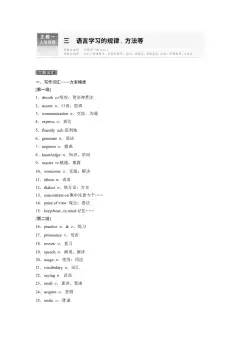
【学习目标】
1. Write a report on an environmental issue.
2. Learn more about environmental issues and ways to protect our planet.
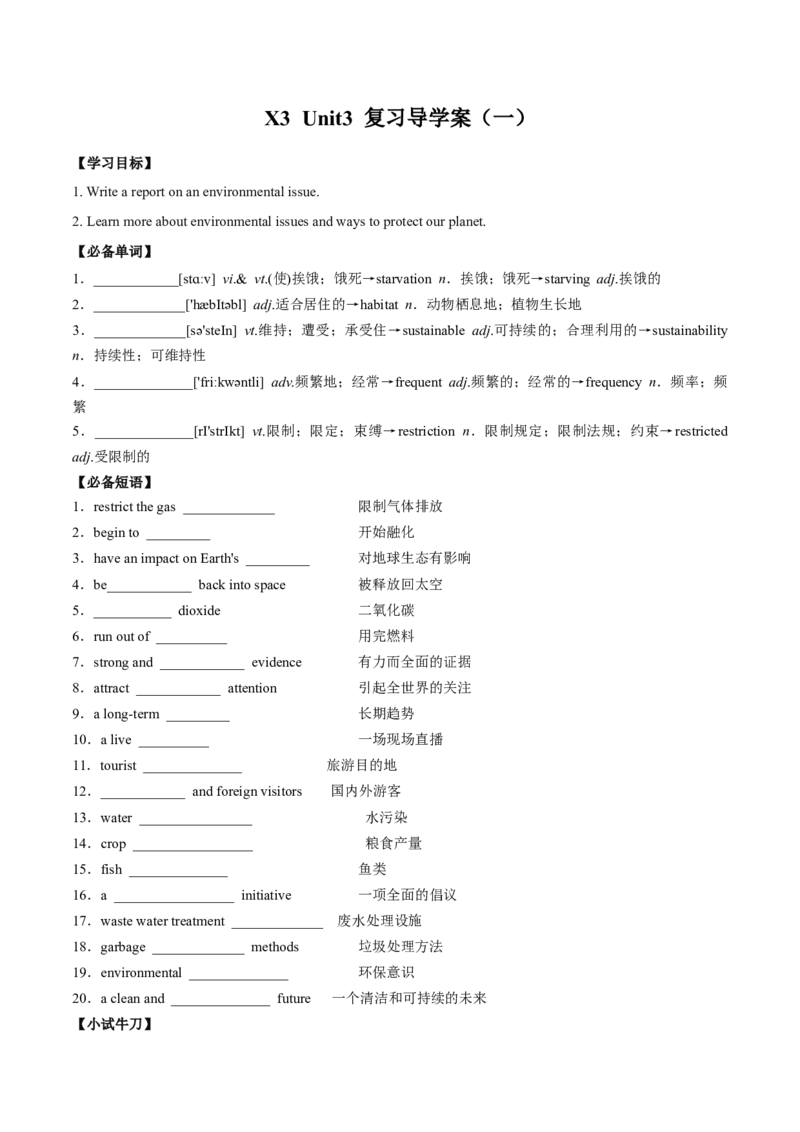
【必备单词】
1.____________[stɑːv] vi.& vt.(使)挨饿;饿死→starvation n.挨饿;饿死→starving adj.挨饿的
2._____________['hæbItəbl] adj.适合居住的→habitat n.动物栖息地;植物生长地
3._____________[sə'steIn] vt.维持;遭受;承受住→sustainable adj.可持续的;合理利用的→sustainability
n.持续性;可维持性
4.______________['friːkwəntli] adv.频繁地;经常→frequent adj.频繁的;经常的→frequency n.频率;频
繁
5.______________[rI'strIkt] vt.限制;限定;束缚→restriction n.限制规定;限制法规;约束→restricted
adj.受限制的
【必备短语】
1.restrict the gas _____________ 限制气体排放
2.begin to _________ 开始融化
3.have an impact on Earth's _________ 对地球生态有影响
4.be____________ back into space 被释放回太空
5.___________ dioxide 二氧化碳
6.run out of __________ 用完燃料
7.strong and ____________ evidence 有力而全面的证据
8.attract ____________ attention 引起全世界的关注
9.a long-term _________ 长期趋势
10.a live __________ 一场现场直播
11.tourist ______________ 旅游目的地
12.____________ and foreign visitors 国内外游客
13.water ________________ 水污染
14.crop _________________ 粮食产量
15.fish ______________ 鱼类
16.a _________________ initiative 一项全面的倡议
17.waste water treatment _____________ 废水处理设施
18.garbage _____________ methods 垃圾处理方法
19.environmental ______________ 环保意识
20.a clean and ______________ future 一个清洁和可持续的未来
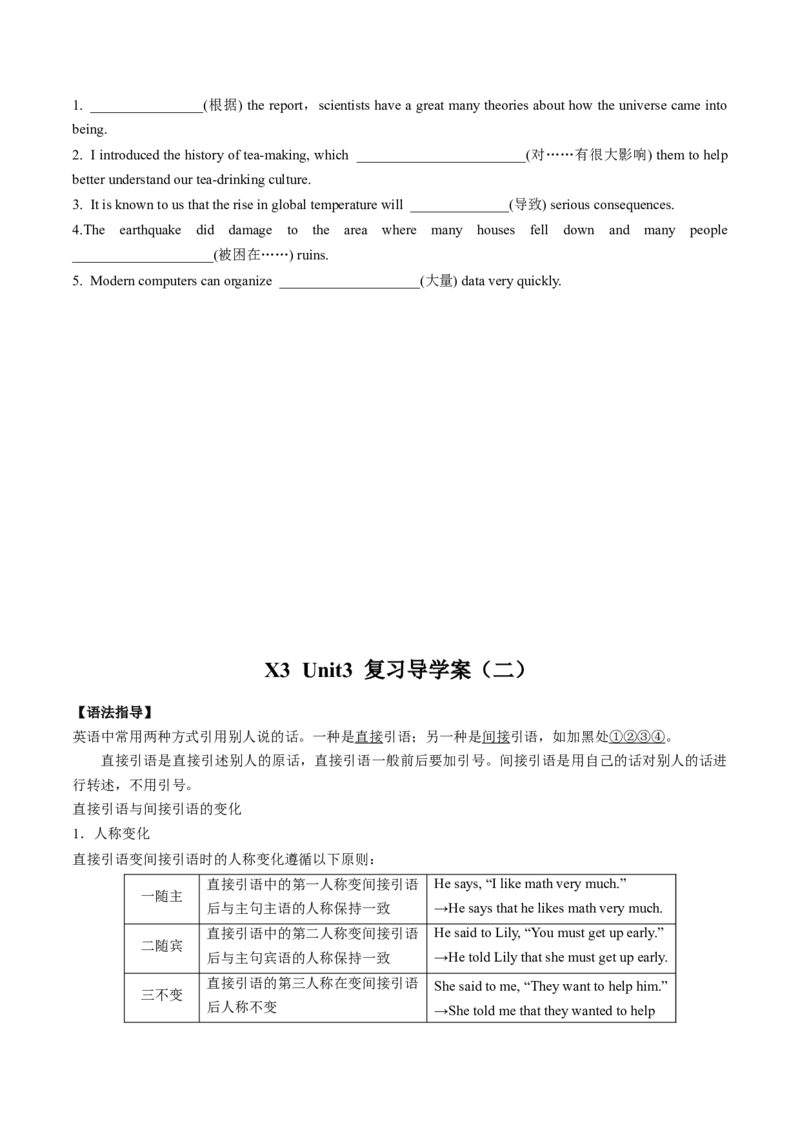
【小试牛刀】1. ________________(根据) the report,scientists have a great many theories about how the universe came into
being.
2. I introduced the history of tea-making, which ________________________(对……有很大影响) them to help
better understand our tea-drinking culture.
3. It is known to us that the rise in global temperature will ______________(导致) serious consequences.
4.The earthquake did damage to the area where many houses fell down and many people
____________________(被困在……) ruins.
5. Modern computers can organize ____________________(大量) data very quickly.
X3 Unit3 复习导学案(二)
【语法指导】
英语中常用两种方式引用别人说的话。一种是直接引语;另一种是间接引语,如加黑处①②③④。
直接引语是直接引述别人的原话,直接引语一般前后要加引号。间接引语是用自己的话对别人的话进
行转述,不用引号。
直接引语与间接引语的变化
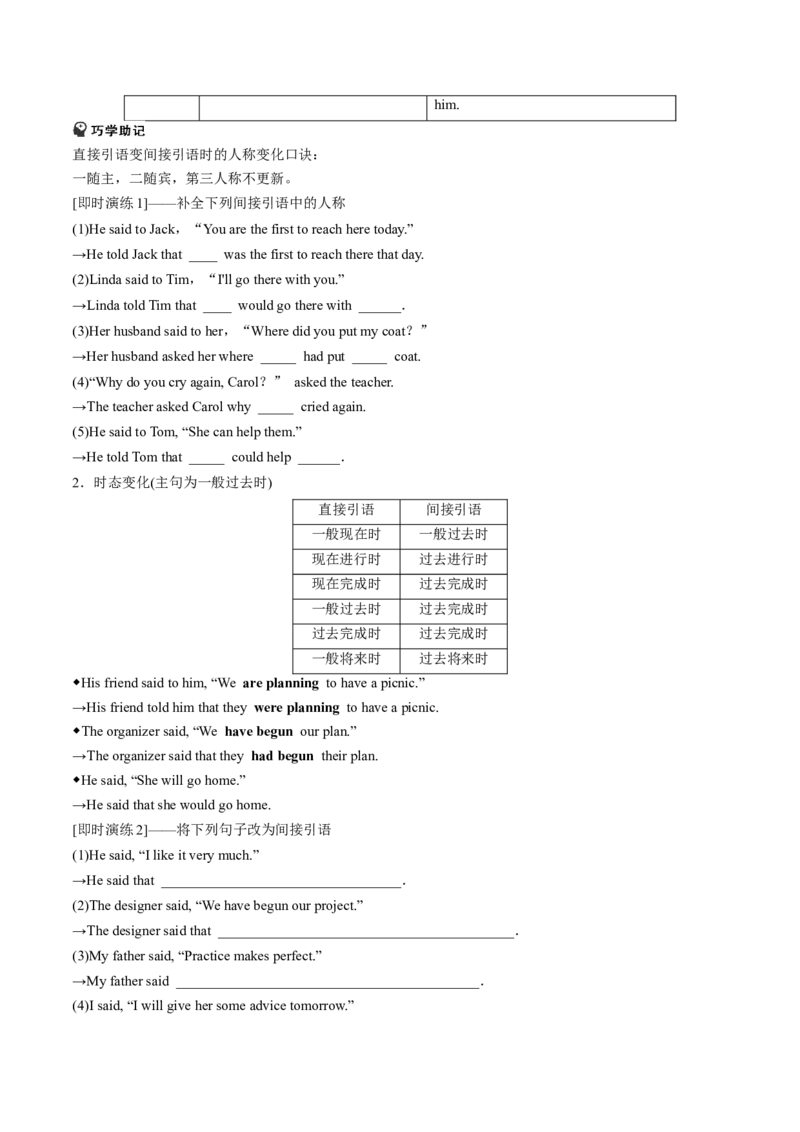
1.人称变化
直接引语变间接引语时的人称变化遵循以下原则:
直接引语中的第一人称变间接引语 He says, “I like math very much.”
一随主
后与主句主语的人称保持一致 →He says that he likes math very much.
直接引语中的第二人称变间接引语 He said to Lily, “You must get up early.”
二随宾
后与主句宾语的人称保持一致 →He told Lily that she must get up early.
直接引语的第三人称在变间接引语 She said to me, “They want to help him.”
三不变
后人称不变
→She told me that they wanted to helphim.
直接引语变间接引语时的人称变化口诀:
一随主,二随宾,第三人称不更新。
[即时演练1]——补全下列间接引语中的人称
(1)He said to Jack,“You are the first to reach here today.”
→He told Jack that ____ was the first to reach there that day.
(2)Linda said to Tim,“I'll go there with you.”
→Linda told Tim that ____ would go there with ______.
(3)Her husband said to her,“Where did you put my coat?”
→Her husband asked her where _____ had put _____ coat.
(4)“Why do you cry again, Carol?” asked the teacher.
→The teacher asked Carol why _____ cried again.
(5)He said to Tom, “She can help them.”
→He told Tom that _____ could help ______.
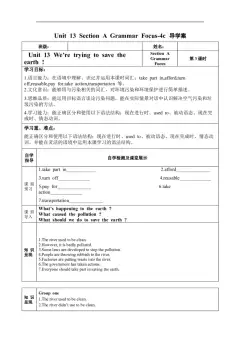
2.时态变化(主句为一般过去时)
直接引语 间接引语
一般现在时 一般过去时
现在进行时 过去进行时
现在完成时 过去完成时
一般过去时 过去完成时
过去完成时 过去完成时
一般将来时 过去将来时
◆His friend said to him, “We are planning to have a picnic.”
→His friend told him that they were planning to have a picnic.
◆The organizer said, “We have begun our plan.”
→The organizer said that they had begun their plan.
◆He said, “She will go home.”
→He said that she would go home.
[即时演练2]——将下列句子改为间接引语
(1)He said, “I like it very much.”
→He said that __________________________________.
(2)The designer said, “We have begun our project.”
→The designer said that __________________________________________.
(3)My father said, “Practice makes perfect.”
→My father said ___________________________________________.
(4)I said, “I will give her some advice tomorrow.”→I said that ____________________________________________.