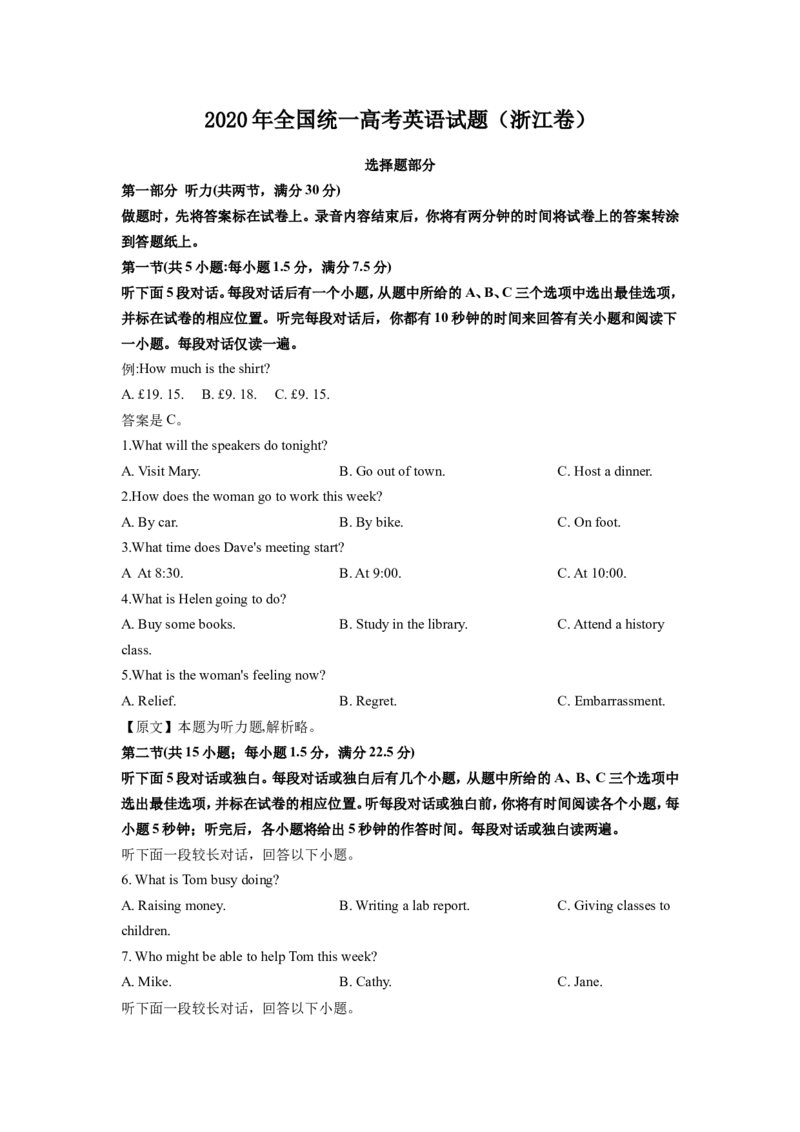
2020 年全国统一高考英语试题(浙江卷)
选择题部分
第一部分 听力(共两节,满分30 分)
做题时,先将答案标在试卷上。录音内容结束后,你将有两分钟的时间将试卷上的答案转涂
到答题纸上。
第一节(共5 小题:每小题1.5 分,满分7.5 分)
听下面5 段对话。每段对话后有一个小题,从题中所给的A、B、C 三个选项中选出最佳选项,
并标在试卷的相应位置。听完每段对话后,你都有10 秒钟的时间来回答有关小题和阅读下
一小题。每段对话仅读一遍。
例:How much is the shirt?
A. £19. 15.     B. £9. 18.     C. £9. 15.
答案是C。
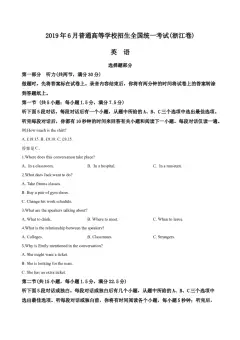
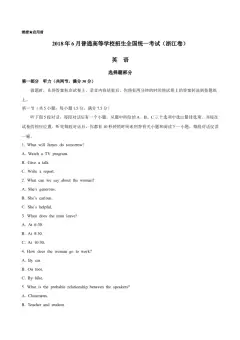
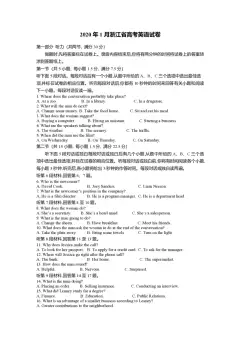
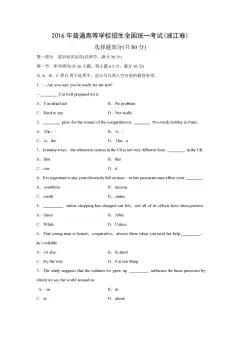
1.What will the speakers do tonight?
A. Visit Mary.
B. Go out of town.
C. Host a dinner.
2.How does the woman go to work this week?
A. By car.
B. By bike.
C. On foot.
3.What time does Dave's meeting start?
A At 8:30.
B. At 9:00.
C. At 10:00.
4.What is Helen going to do?
A. Buy some books.
B. Study in the library.
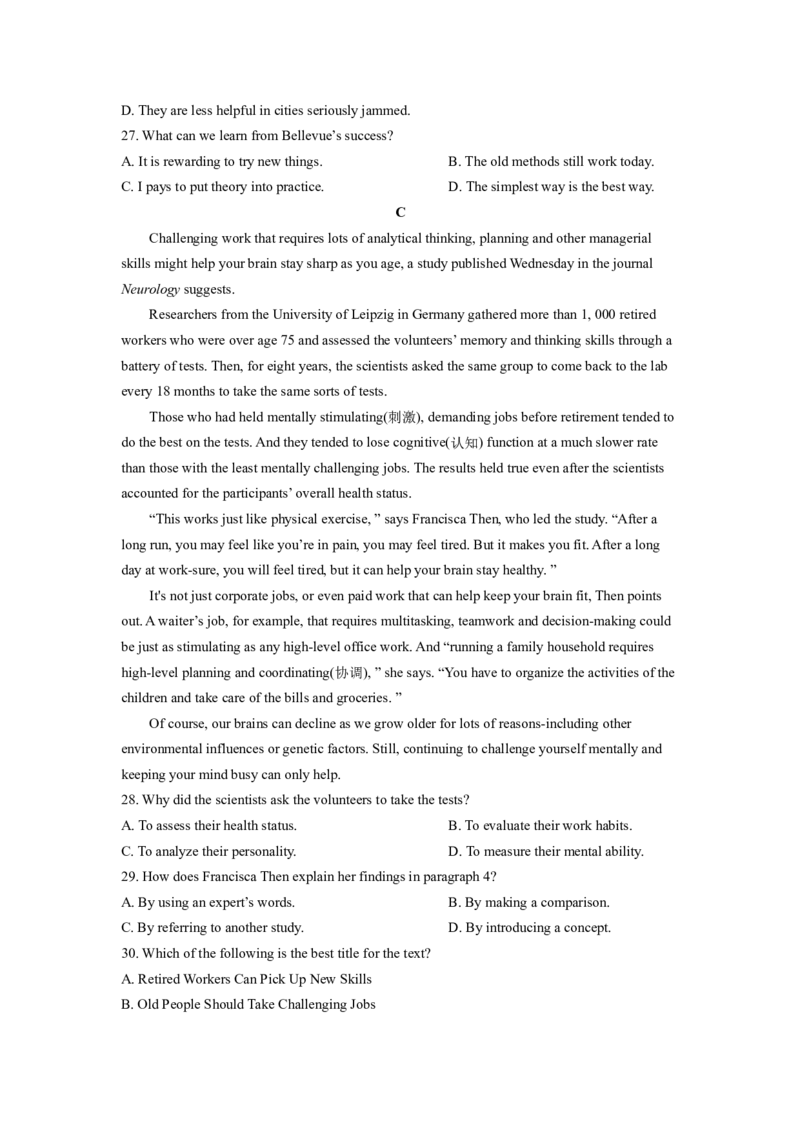
C. Attend a history
class.
5.What is the woman's feeling now?
A. Relief.
B. Regret.
C. Embarrassment.
【原文】本题为听力题,解析略。
第二节(共15 小题;每小题1.5 分,满分22.5 分)
听下面5 段对话或独白。每段对话或独白后有几个小题,从题中所给的A、B、C 三个选项中
选出最佳选项,并标在试卷的相应位置。听每段对话或独白前,你将有时间阅读各个小题,每
小题5 秒钟;听完后,各小题将给出5 秒钟的作答时间。每段对话或独白读两遍。
听下面一段较长对话,回答以下小题。
6. What is Tom busy doing?
A. Raising money.
B. Writing a lab report.
C. Giving classes to
children.
7. Who might be able to help Tom this week?
A. Mike.
B. Cathy.
C. Jane.
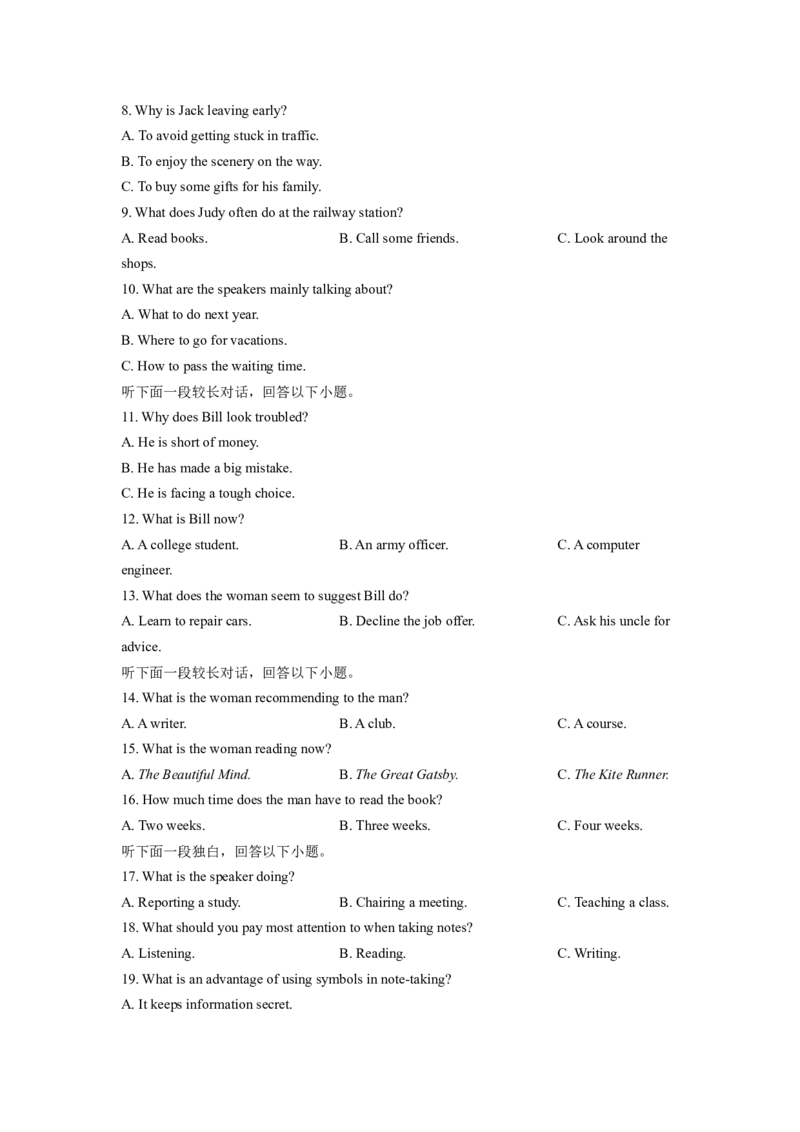
听下面一段较长对话,回答以下小题。
8. Why is Jack leaving early?
A. To avoid getting stuck in traffic.
B. To enjoy the scenery on the way.
C. To buy some gifts for his family.
9. What does Judy often do at the railway station?
A. Read books.
B. Call some friends.
C. Look around the
shops.
10. What are the speakers mainly talking about?
A. What to do next year.
B. Where to go for vacations.
C. How to pass the waiting time.
听下面一段较长对话,回答以下小题。
11. Why does Bill look troubled?
A. He is short of money.
B. He has made a big mistake.
C. He is facing a tough choice.
12. What is Bill now?
A. A college student.
B. An army officer.
C. A computer
engineer.
13. What does the woman seem to suggest Bill do?
A. Learn to repair cars.
B. Decline the job offer.
C. Ask his uncle for
advice.
听下面一段较长对话,回答以下小题。
14. What is the woman recommending to the man?
A. A writer.
B. A club.
C. A course.
15. What is the woman reading now?
A. The Beautiful Mind.
B. The Great Gatsby.
C. The Kite Runner.
16. How much time does the man have to read the book?
A. Two weeks.
B. Three weeks.
C. Four weeks.
听下面一段独白,回答以下小题。
17. What is the speaker doing?
A. Reporting a study.
B. Chairing a meeting.
C. Teaching a class.
18. What should you pay most attention to when taking notes?
A. Listening.
B. Reading.
C. Writing.
19. What is an advantage of using symbols in note-taking?
A. It keeps information secret.
B. It leaves space for future use.
C. It makes key words noticeable.
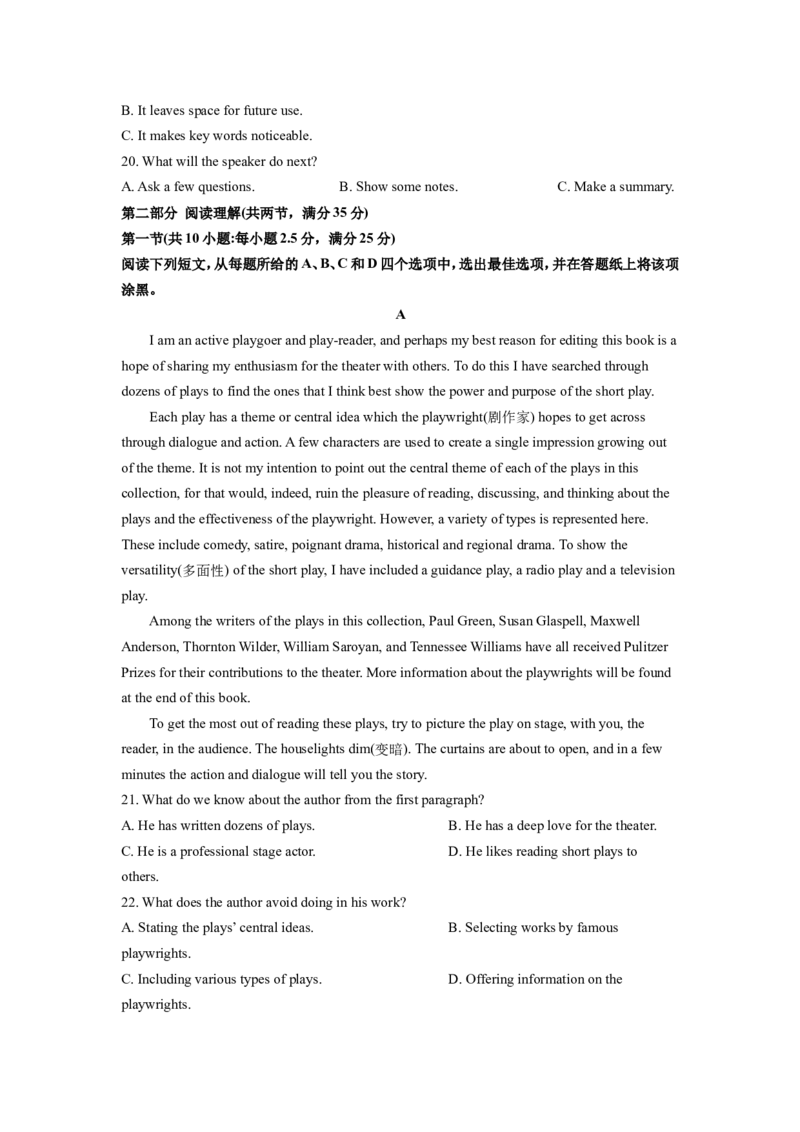
20. What will the speaker do next?
A. Ask a few questions.
B. Show some notes.
C. Make a summary.
第二部分 阅读理解(共两节,满分35 分)
第一节(共10 小题:每小题2.5 分,满分25 分)
阅读下列短文,从每题所给的A、B、C 和D 四个选项中,选出最佳选项,并在答题纸上将该项
涂黑。
A
I am an active playgoer and play-reader, and perhaps my best reason for editing this book is a
hope of sharing my enthusiasm for the theater with others. To do this I have searched through
dozens of plays to find the ones that I think best show the power and purpose of the short play.
Each play has a theme or central idea which the playwright(剧作家) hopes to get across
through dialogue and action. A few characters are used to create a single impression growing out
of the theme. It is not my intention to point out the central theme of each of the plays in this
collection, for that would, indeed, ruin the pleasure of reading, discussing, and thinking about the
plays and the effectiveness of the playwright. However, a variety of types is represented here.
These include comedy, satire, poignant drama, historical and regional drama. To show the
versatility(多面性) of the short play, I have included a guidance play, a radio play and a television
play.
Among the writers of the plays in this collection, Paul Green, Susan Glaspell, Maxwell
Anderson, Thornton Wilder, William Saroyan, and Tennessee Williams have all received Pulitzer
Prizes for their contributions to the theater. More information about the playwrights will be found
at the end of this book.
To get the most out of reading these plays, try to picture the play on stage, with you, the
reader, in the audience. The houselights dim(变暗). The curtains are about to open, and in a few
minutes the action and dialogue will tell you the story.
21. What do we know about the author from the first paragraph?
A. He has written dozens of plays.
B. He has a deep love for the theater.
C. He is a professional stage actor.
D. He likes reading short plays to
others.
22. What does the author avoid doing in his work?
A. Stating the plays’ central ideas.
B. Selecting works by famous
playwrights.
C. Including various types of plays.
D. Offering information on the
playwrights.
23. What does the author suggest readers do while reading the plays?
A. Control their feelings.
B. Apply their acting skills.
C. Use their imagination.
D. Keep their audience in mind.
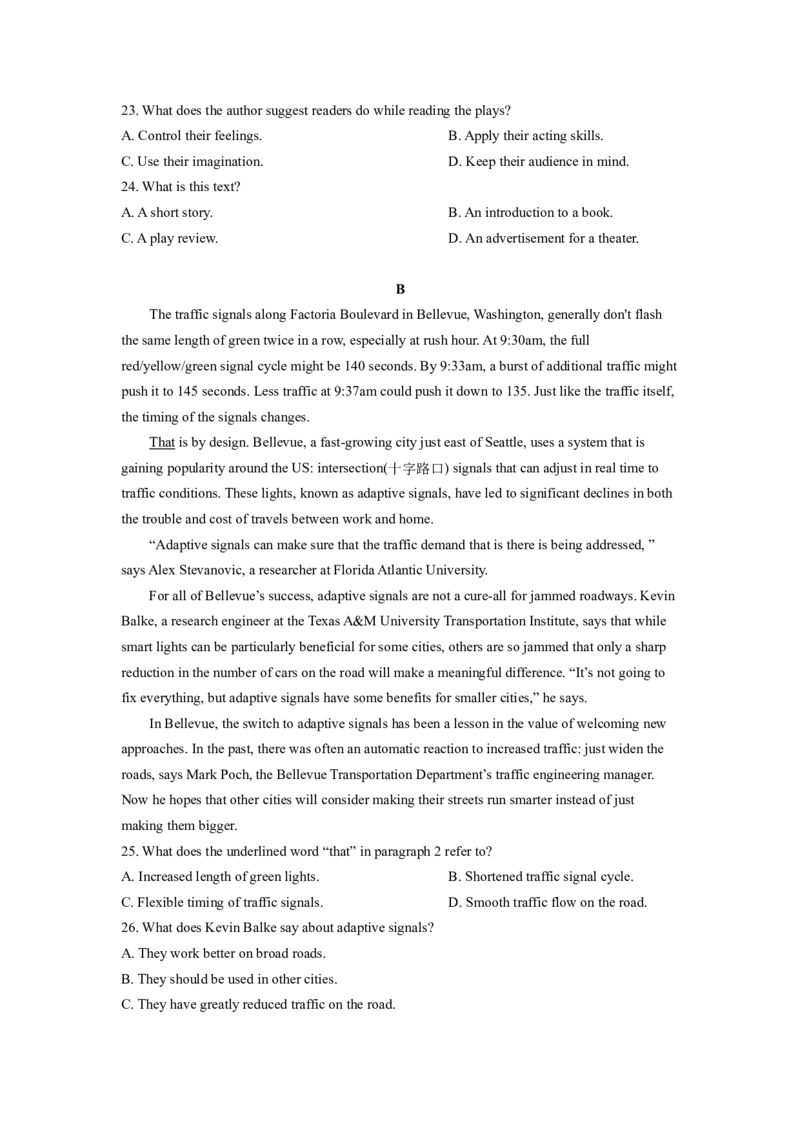
24. What is this text?
A. A short story.
B. An introduction to a book.
C. A play review.
D. An advertisement for a theater.
B
The traffic signals along Factoria Boulevard in Bellevue, Washington, generally don't flash
the same length of green twice in a row, especially at rush hour. At 9:30am, the full
red/yellow/green signal cycle might be 140 seconds. By 9:33am, a burst of additional traffic might
push it to 145 seconds. Less traffic at 9:37am could push it down to 135. Just like the traffic itself,
the timing of the signals changes.
That is by design. Bellevue, a fast-growing city just east of Seattle, uses a system that is
gaining popularity around the US: intersection(十字路口) signals that can adjust in real time to
traffic conditions. These lights, known as adaptive signals, have led to significant declines in both
the trouble and cost of travels between work and home.
“Adaptive signals can make sure that the traffic demand that is there is being addressed, ”
says Alex Stevanovic, a researcher at Florida Atlantic University.
For all of Bellevue’s success, adaptive signals are not a cure-all for jammed roadways. Kevin
Balke, a research engineer at the Texas A&M University Transportation Institute, says that while
smart lights can be particularly beneficial for some cities, others are so jammed that only a sharp
reduction in the number of cars on the road will make a meaningful difference. “It’s not going to
fix everything, but adaptive signals have some benefits for smaller cities,” he says.
In Bellevue, the switch to adaptive signals has been a lesson in the value of welcoming new
approaches. In the past, there was often an automatic reaction to increased traffic: just widen the
roads, says Mark Poch, the Bellevue Transportation Department’s traffic engineering manager.
Now he hopes that other cities will consider making their streets run smarter instead of just
making them bigger.
25. What does the underlined word “that” in paragraph 2 refer to?
A. Increased length of green lights.
B. Shortened traffic signal cycle.
C. Flexible timing of traffic signals.
D. Smooth traffic flow on the road.
26. What does Kevin Balke say about adaptive signals?
A. They work better on broad roads.
B. They should be used in other cities.
C. They have greatly reduced traffic on the road.
D. They are less helpful in cities seriously jammed.
27. What can we learn from Bellevue’s success?
A. It is rewarding to try new things.
B. The old methods still work today.
C. I pays to put theory into practice.
D. The simplest way is the best way.
C
Challenging work that requires lots of analytical thinking, planning and other managerial
skills might help your brain stay sharp as you age, a study published Wednesday in the journal
Neurology suggests.
Researchers from the University of Leipzig in Germany gathered more than 1, 000 retired
workers who were over age 75 and assessed the volunteers’ memory and thinking skills through a
battery of tests. Then, for eight years, the scientists asked the same group to come back to the lab
every 18 months to take the same sorts of tests.
Those who had held mentally stimulating(刺激), demanding jobs before retirement tended to
do the best on the tests. And they tended to lose cognitive(认知) function at a much slower rate
than those with the least mentally challenging jobs. The results held true even after the scientists
accounted for the participants’ overall health status.
“This works just like physical exercise, ” says Francisca Then, who led the study. “After a
long run, you may feel like you’re in pain, you may feel tired. But it makes you fit. After a long
day at work-sure, you will feel tired, but it can help your brain stay healthy. ”
It's not just corporate jobs, or even paid work that can help keep your brain fit, Then points
out. A waiter’s job, for example, that requires multitasking, teamwork and decision-making could
be just as stimulating as any high-level office work. And “running a family household requires
high-level planning and coordinating(协调), ” she says. “You have to organize the activities of the
children and take care of the bills and groceries. ”
Of course, our brains can decline as we grow older for lots of reasons-including other
environmental influences or genetic factors. Still, continuing to challenge yourself mentally and
keeping your mind busy can only help.
28. Why did the scientists ask the volunteers to take the tests?
A. To assess their health status.
B. To evaluate their work habits.
C. To analyze their personality.
D. To measure their mental ability.
29. How does Francisca Then explain her findings in paragraph 4?
A. By using an expert’s words.
B. By making a comparison.
C. By referring to another study.
D. By introducing a concept.
30. Which of the following is the best title for the text?
A. Retired Workers Can Pick Up New Skills
B. Old People Should Take Challenging Jobs
C. Your Tough Job Might Help Keep You Sharp
D. Cognitive Function May Decline As You Age
第二节(共5 小题;每小题2 分,满分10 分)
根据短文内容,从短文后的选项中选出能填入空白处的最佳选项。选项中有两项为多余选项。
I experienced years of loneliness as a child. ___31___ His friends teased him about
babysitting his sister and his interests were far different from mine. With no other kids of my age
in the neighborhood, I had to spend hours by myself.
A bright spot for me turned out to be reading. My love of the written word began early as my
mother read to me every evening. ___32___ I started reading books on my own before age 5 and
my mother took me to the public library once a week to borrow several books. I quickly graduated
from typical children’s books to ones with fewer pictures and longer chapters. Reading opened
new worlds to me. ___33___
My mother also encouraged me to make what I wanted. I tried making toy cars with
cardboard boxes and constructing buildings from leftover cardboard and bits of wood my father
gave me. When my mother saw my creations, she told me how creative my designs were.
___34___ I learned a lot about how to extend the life of objects and transform them into
something new and useful. It was a trait(特点) others found helpful, and I soon had friends who
wanted to make things with me.
___35___My parents made it a point for their two kids to spend time outside, no matter the
weather or season. My brother, of course, raced off to be with his friends, while I had plenty to do
myself. There was making leaf houses in autumn, ice skating in winter, and so much more.
They’re all memories I treasure today.
A. I wasn't alone any longer.
B. I enjoyed reading stories aloud.
C. I was invited to play with another kid.
D. I loved the colorful photographs in the books.
E. Another habit I formed early was being outdoors.
F. Thus, I began my lifelong interest in making things.
G. My older brother couldn’t be bothered to play with me.
第三部分 语言运用(共两节,满分45 分)
第一节(共20 小题;每小题1.5 分,满分30 分)
阅读下面短文,从短文后各题所给的A、B、C 和D 四个选项中,选出可以填入空白处的最佳
选项,并在答题纸上将该项涂黑。
I’ve been farming sheep on a hillside for 54 years. I use a small tractor to get about. My dog
Don always sits beside me in the passenger scat.
One morning I ___36___ a lost lamb when I was in the top field,near where a motorway cuts
through my land. The lamb had become separated from its ___37___ , so I jumped out of the
tractor to ___38___ it while Don stayed in his scat.
Lamb and mother ___39___ , I turned back to the tractor only to see it move suddenly away
from me. This was so ___40___ because I had put the handbrake on when I jumped out. ___41___
Don had somehow made the ___42___move.
My heart froze in my chest as I ___43___ the tractor heading towards the ___44___ .I ran
desperately but failed to _____45_____. It crashed through a wooden fence and disappeared. The
_____46_____ thing I saw was Don’s face, looking calmly back at me.
Heart in mouth, I _____47_____ the fence and looked over. The tractor was
_____48_____against the crash barrier in the central reservation, having miraculously(奇迹般地)
crossed the _____49_____ road with fast-flowing traffic. I couldn’t see Don, but as I
_____50_____ the tractor he jumped out onto the road, apparently _____51_____ , and dashed
back to me.
The police _____52_____ and the motorway ran normally again. I couldn't quite believe my
_____53_____ it turned out no one got badly hurt, but the outcome could have been
_____54_____ .Don was given a special _____55_____ that night—I didn’t want him thinking I
was angry with him.
36. A. dropped
B. spotted
C. carried
D. returned
37. A. kids
B. friends
C. owner
D. mother
38. A. ask about
B. play with
C. tend to
D. run into
39. A. freed
B. switched
C. reunited
D. examined
40. A. unexpected
B. dangerous
C. embarrassing
D. difficult
41. A. Fortunately
B. Generally
C. Immediately
D. Obviously
42. A. lamb
B. vehicle
C. seat
D. fence
43. A. saw
B. stopped
C. remembered
D. drove
44. A. crowd
B. motorway
C. field
D. hill
45. A. take off
B. catch up
C. hold back
D. get out
46. A. real
B. best
C. basic
D. last
47. A. fixed
B. noticed
C. reached
D. closed
48. A. resting
B. running
C. parking
D. turning
49. A. sleep
B. long
C. rough
D. busy
50. A. abandoned
B. approached
C. recognized
D. repaired
51. A. unclean
B. uncertain
C. unhurt
D. unhappy
52. A. arrived
B. replied
C. survived
D. waited
53. A. ability
B. dream
C. luck
D. idea
54. A. common
B. confusing
C. desirable
D. awful
非选择题部分
第三部分 语言运用(共两节,满分45 分)
第二节(共10 小题;每小题1.5 分,满分15 分)
阅读下面材料,在空白处填入适当的内容(1 个单词)或括号内单词的正确形式。
Some time after 10,000 BC,people made the first real attempt to control the world they
lived ___56___ ,through agriculture. Over thousands of years,they began to depend less on
___57___ could be hunted or gathered from the wild,and more on animals they had raised and
crops they had sown.
Farming produced more food per person ___58___ hunting and gathering,so people were
able to raise more children. And,as more children were born,more food ___59___(need).
Agriculture gave people their first experience of the power of technology ___60___(change)lives.
By about 6000 BC,people ___61___ (discover)the best crops to grow and animals to raise.
Later,they learned to work with the ___62___ (season),planting at the right time and,in dry
areas, ___63___ (make)use of annual floods to irrigate(灌溉)their fields.
This style of farming lasted for quite a long time. Then,with ___64___ rise of science,
changes began. New methods _____65_____ (mean)that fewer people worked in farming. In the
last century or so,these changes have accelerated. New power machinery and artificial
fertilizers(化肥)have now totally transformed a way of life that started in the Stone Age.
第四部分 写作(共两节,满分40 分)
第一节应用文写作(满分15 分)
66.假定你是李华,你校来自爱尔兰的外教Peter 因病回国休假。请给他写一封电子邮件,内容
包括:1. 询问近况;2. 分享班级最新消息;3. 表达祝愿。
注意:1. 词数80 左右;2. 可适当增加细节,以使行文连贯。
_______________________________________________________________________________
_______________________________________________________________________________
_______________________________________________________________________________
______
第二节 读后续写(满分25 分)
67.阅读下面短文,根据所给情节进行续写,使之构成一个完整的故事。
One fall,my wife Elli and I had a single goal:to photograph polar bears. We were staying at a
research camp outside “the polar bear capital of the world”-the town of Churchill in Manitoba,
Canada.
Taking pictures of polar bears is amazing but also dangerous. Polar bears-like all wild
animals-should be photographed from a safe distance. When I'm face to face with a polar bear,I
like it to be through a camera with a telephoto lens. But sometimes,that is easier said than done.
This was one of those times.
As Elli and I cooked dinner,a young male polar bear who was playing in a nearby lake
sniffed,and smelled our garlic bread.
The hungry bear followed his nose to our camp,which was surrounded by a high wire fence.
He pulled and bit the wire. He stood on his back legs and pushed at the wooden fence posts.
Terrified,Elli and I tried all the bear defense actions we knew. We yelled at the bear,hit pots
hard,and fired blank shotgun shells into the air. Sometimes loud noises like these will scare bears
off. Not this polar bear though-he just kept trying to tear down the fence with his massive paws(爪
子).
I radioed the camp manager for help. He told me a helicopter was on its way,but it would be
30 minutes before it arrived. Making the best of this close encounter(相遇),I took some pictures
of the bear.
Elli and I feared the fence wouldn't last through 30 more minutes of the bear's punishment.
The camp manager suggested I use pepper spray. The spray burns the bears' eyes,but doesn't hurt
them. So I approached our uninvited guest slowly and,through the fence,sprayed him in the face.
With an angry roar(吼叫),the bear ran to the lake to wash his eyes.
注意:1. 所续写短文的词数应为150 左右;
2. 至少使用5 个短文中标有下划线的关键词语;
3. 续写部分分为两段,每段的开头语已为你写好;
4. 续写完成后,请用下划线标出你所使用的关键词语。
_______________________________________________________________________________
_______________________________________________________________________________
_______________________________________________________________________________
_______________________________________