2018 年全国统一高考英语试卷(新课标Ⅲ卷)
第二部分  阅读理解(共两节,满分40 分)
第一节(共15 小题;每小题2 分,满分30 分)
阅读下列短文,从每题所给的A、B、C 和D 四个选项中,选出最佳选项。
A
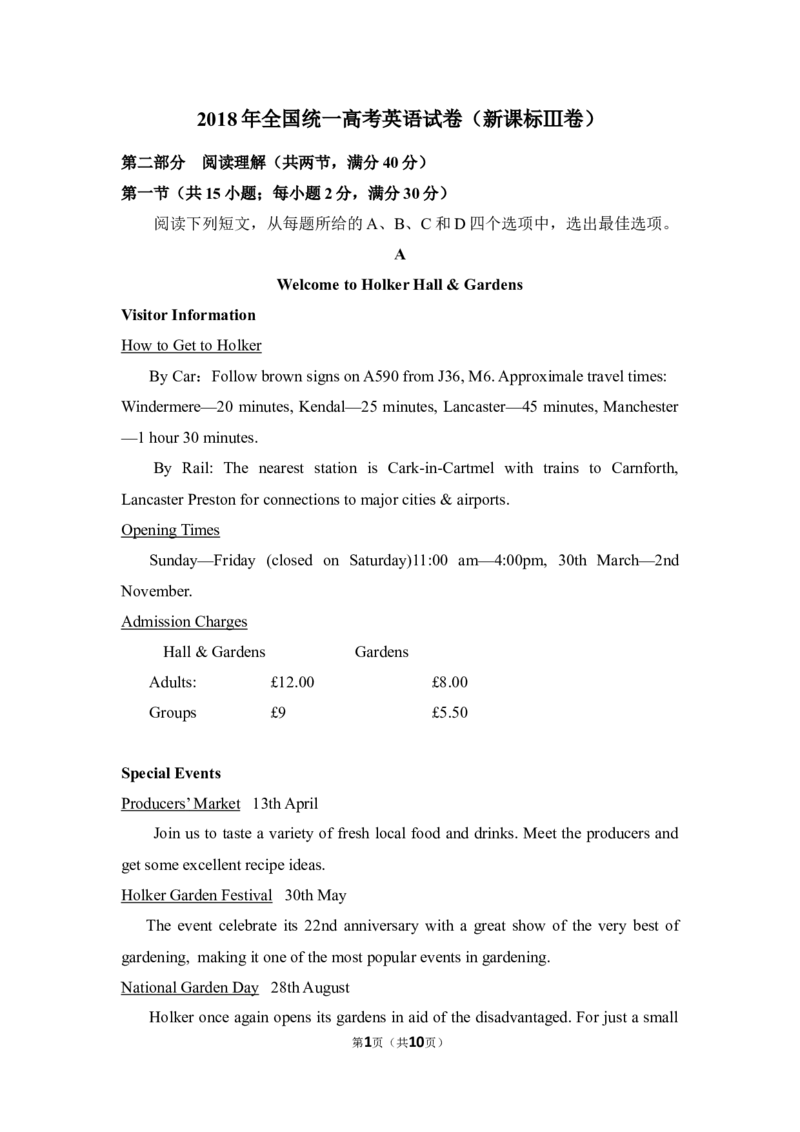
Welcome to Holker Hall & Gardens
Visitor Information
How to Get to Holker
By Car:Follow brown signs on A590 from J36, M6. Approximale travel times:
Windermere—20 minutes, Kendal—25 minutes, Lancaster—45 minutes, Manchester
—1 hour 30 minutes.
By Rail: The nearest station is Cark-in-Cartmel with trains to Carnforth,
Lancaster Preston for connections to major cities & airports.
Opening Times
Sunday—Friday (closed on Saturday)11:00 am—4:00pm, 30th March—2nd
November.
Admission Charges
Hall & Gardens
  Gardens
Adults:
  £12.00
£8.00
Groups
  £9
£5.50
Special Events
Producers

 ’  Market

    13th April
Join us to taste a variety of fresh local food and drinks. Meet the producers and
get some excellent recipe ideas.
Holker Garden Festival   30th May
    The event celebrate its 22nd anniversary with a great show of the very best of
gardening,  making it one of the most popular events in gardening.
National Garden Day   28th August
Holker once again opens its gardens in aid of the disadvantaged. For just a small
第1页(共10页)
donation you can take a tour with our garden guide.
Winter Market   8th November
This is an event for all the family. Wander among a variety of shops selling gifts
while enjoying a live music show and nice street entertainment.
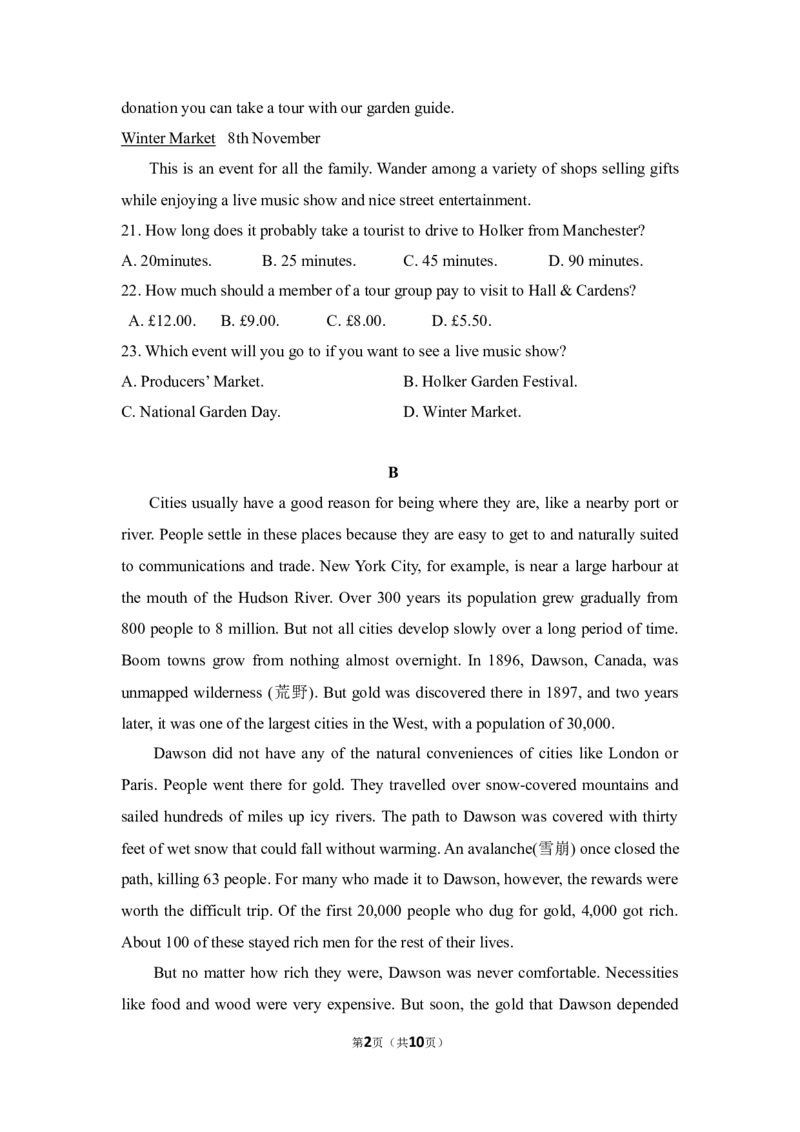
21. How long does it probably take a tourist to drive to Holker from Manchester?
A. 20minutes.
B. 25 minutes.
C. 45 minutes.
 D. 90 minutes.
22. How much should a member of a tour group pay to visit to Hall & Cardens?
A. £12.00.      B. £9.00.
  C. £8.00.
D. £5.50.
23. Which event will you go to if you want to see a live music show?
A. Producers’ Market.
B. Holker Garden Festival.
C. National Garden Day.
D. Winter Market.
B[来源:
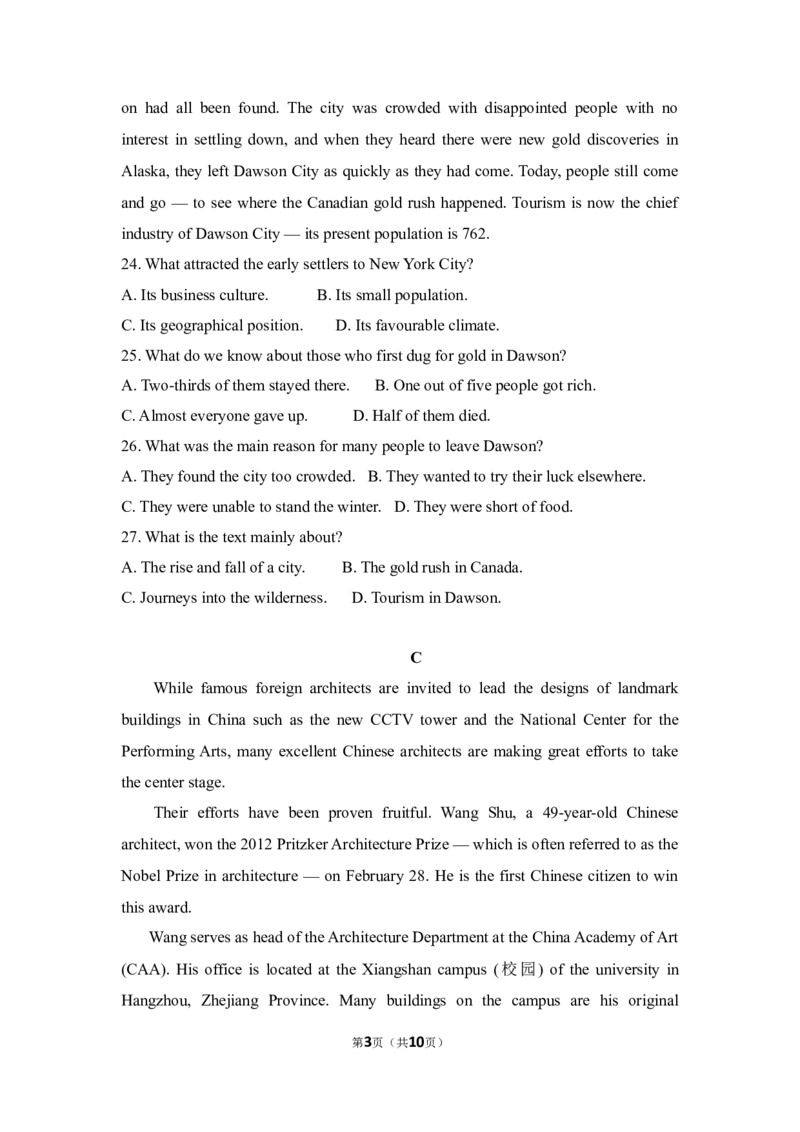
Cities usually have a good reason for being where they are, like a nearby port or
river. People settle in these places because they are easy to get to and naturally suited
to communications and trade. New York City, for example, is near a large harbour at
the mouth of the Hudson River. Over 300 years its population grew gradually from
800 people to 8 million. But not all cities develop slowly over a long period of time.
Boom towns grow from nothing almost overnight. In 1896, Dawson, Canada, was
unmapped wilderness (荒野). But gold was discovered there in 1897, and two years
later, it was one of the largest cities in the West, with a population of 30,000.
Dawson did not have any of the natural conveniences of cities like London or
Paris. People went there for gold. They travelled over snow-covered mountains and
sailed hundreds of miles up icy rivers. The path to Dawson was covered with thirty
feet of wet snow that could fall without warming. An avalanche(雪崩) once closed the
path, killing 63 people. For many who made it to Dawson, however, the rewards were
worth the difficult trip. Of the first 20,000 people who dug for gold, 4,000 got rich.
About 100 of these stayed rich men for the rest of their lives.
But no matter how rich they were, Dawson was never comfortable. Necessities
like food and wood were very expensive. But soon, the gold that Dawson depended
第2页(共10页)
on had all been found. The city was crowded with disappointed people with no
interest in settling down, and when they heard there were new gold discoveries in
Alaska, they left Dawson City as quickly as they had come. Today, people still come
and go — to see where the Canadian gold rush happened. Tourism is now the chief
industry of Dawson City — its present population is 762.
24. What attracted the early settlers to New York City?
A. Its business culture.            B. Its small population.[来]
C. Its geographical position.        D. Its favourable climate.
25. What do we know about those who first dug for gold in Dawson?
A. Two-thirds of them stayed there.      B. One out of five people got rich.
C. Almost everyone gave up.           D. Half of them died.
26. What was the main reason for many people to leave Dawson?
A. They found the city too crowded.   B. They wanted to try their luck elsewhere.
C. They were unable to stand the winter.   D. They were short of food.
27. What is the text mainly about?
A. The rise and fall of a city.         B. The gold rush in Canada.
C. Journeys into the wilderness.      D. Tourism in Dawson.
C
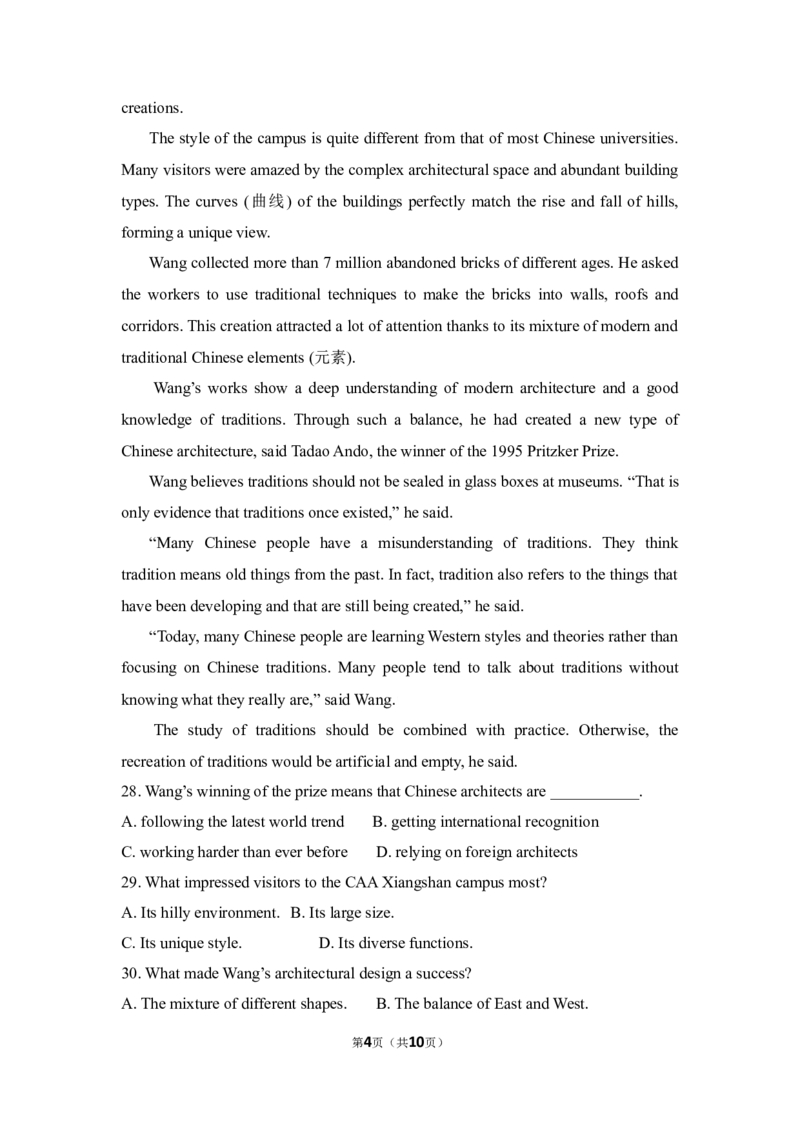
While famous foreign architects are invited to lead the designs of landmark
buildings in China such as the new CCTV tower and the National Center for the
Performing Arts, many excellent Chinese architects are making great efforts to take
the center stage.
Their efforts have been proven fruitful. Wang Shu, a 49-year-old Chinese
architect, won the 2012 Pritzker Architecture Prize — which is often referred to as the
Nobel Prize in architecture — on February 28. He is the first Chinese citizen to win
this award.
Wang serves as head of the Architecture Department at the China Academy of Art
(CAA). His office is located at the Xiangshan campus (校园) of the university in
Hangzhou, Zhejiang Province. Many buildings on the campus are his original
第3页(共10页)
creations.
The style of the campus is quite different from that of most Chinese universities.
Many visitors were amazed by the complex architectural space and abundant building
types. The curves (曲线) of the buildings perfectly match the rise and fall of hills,
forming a unique view.
Wang collected more than 7 million abandoned bricks of different ages. He asked
the workers to use traditional techniques to make the bricks into walls, roofs and
corridors. This creation attracted a lot of attention thanks to its mixture of modern and
traditional Chinese elements (元素).
Wang’s works show a deep understanding of modern architecture and a good
knowledge of traditions. Through such a balance, he had created a new type of
Chinese architecture, said Tadao Ando, the winner of the 1995 Pritzker Prize.
Wang believes traditions should not be sealed in glass boxes at museums. “That is
only evidence that traditions once existed,” he said.
“Many Chinese people have a misunderstanding of traditions. They think
tradition means old things from the past. In fact, tradition also refers to the things that
have been developing and that are still being created,” he said.
“Today, many Chinese people are learning Western styles and theories rather than
focusing on Chinese traditions. Many people tend to talk about traditions without
knowing what they really are,” said Wang.[来源:学K]
The study of traditions should be combined with practice. Otherwise, the
recreation of traditions would be artificial and empty, he said.
28. Wang’s winning of the prize means that Chinese architects are ___________.
A. following the latest world trend       B. getting international recognition
C. working harder than ever before       D. relying on foreign architects
29. What impressed visitors to the CAA Xiangshan campus most?
A. Its hilly environment. B. Its large size.
C. Its unique style.
D. Its diverse functions.
30. What made Wang’s architectural design a success?
A. The mixture of different shapes.       B. The balance of East and West.
第4页(共10页)
C. The use of popular techniques.        D. The harmony of old and new.
31. What should we do about Chinese traditions according to Wang?
A. Spread them to the world.
B. Preserve them at museums.
C. Teach them in universities.
D. Recreate them in practice.
D
Adults understand what it feels like to be flooded with objects. Why do we often
assume that more is more when it comes to kids and their belongings? The good news
is that I can help my own kids learn earlier than I did how to live more with less.
I found the pre-holidays a good time to encourage young children to donate less-
used things, and it worked. Because of our efforts, our daughter Georgia did decide to
donate a large bag of toys to a little girl whose mother was unable to pay for her
holiday due to illness. She chose to sell a few larger objects that were less often used
when we promised to put the money into her school fund (基金) (our kindergarten
daughter is serious about becoming a doctor).
For weeks, I’ve been thinking of bigger, deeper questions: How do we make it a
habit for them? And how do we train ourselves to help them live with, need, and use
less? Yesterday, I sat with my son, Shepherd, determined to test my own theory on
this. I decided to play with him with only one toy for as long as it would keep his
interest. I expected that one toy would keep his attention for about five minutes, ten
minutes, max. I chose a red rubber ball—simple, universally available. We passed it,
he tried to put it in his mouth, he tried bouncing it, rolling it, sitting on it, throwing it.
It was totally, completely enough for him. Before I knew it an hour had passed and it
was time to move on to lunch.
We both became absorbed in the simplicity of playing together. He had my full
attention and I had his. My little experiment to find joy in a single object worked for
both of us.
32. What do the words “more is more” in paragraph 1 probably mean?
A. The more, the better.
B. Enough is enough.
C. More money, more worries.
D. Earn more and spend more.
第5页(共10页)
33. What made Georgia agree to sell some of her objects?
A. Saving up for her holiday
B. Raising money for a poor girl
C. Adding the money to her fund
D. Giving the money to a sick mother
34. Why did the author play the ball with Shepherd?
A. To try out an idea        B. To show a parent's love
C. To train his attention      D. To help him start a hobby
35.What can be a suitable title for the text?
 A. Take It or Leave It
B. A Lesson from Kids
C. Live More with Less
D. The Pleasure of Giving
第二节  (共5 小题;每小题2 分,满分10 分)
根据短文内容,从短文后的选项中选出能填入空白处的最佳选项。选项中有
两项为多余选项。
Before there was the written word, there was the language of dance. Dance
expresses love and hate, joy and sorrow, life and death, and everything else in
between.
    36    We dance from Florida to Alaska, from north to south and sea to sea. We
dance at weddings, birthdays, office parties and just to fill the time.
“I adore dancing,” says Lester Bridges, the owner of a dance studio in Iowa. “I
can’t imagine doing anything else with my life.” Bridges runs dance classes for all
ages. “Teaching dance is wonderful.    37    It’s great to watch them. For many of
them, it’s a way of meeting people and having a social life.”
   38    “I can tell you about one young couple,” says Bridges. “They’re learning
to do traditional dances. They arrive at the class in low spirits and they leave with a
smile.
  39

 ”
So, do we dance in order to make ourselves feel better, calmer, healthier? Andrea
Hillier says, “Dance, like the pattern of a beating heart, is life. Even after all these
years, I want to get better and better.   40     I find it hard to stop! Dancing reminds me
I’m alive.”
A. So why do we dance?
B. Dance in the U.S. is everywhere.
第6页(共10页)
C. If you like dancing outdoors, come to America.
D. My older students say it makes them feel young.
E. I keep practicing even When I’m extremely tired.
F. Dancing seems to change their feeling completely.
G. They stayed up all night long singing and dancing.
第三部分 语言知识运用(共两节,满分45 分)
第一节  完形填空(共20 小题;每小题1.5 分,满分30 分)
阅读下面短文,从短文后各题所给的A、B、C 和D 四个选项中,选出可以填
入空白处的最佳选项。
When most of us get a text message on our cell phone from an unknown person,
we usually say “sorry,    41    number!” and move on. But when Dennis Williams    42
a text that clearly wasn’t intended for him, he did something    43   .
   On March 19, Dennis got a group text    44    him that a couple he didn’t know were
at the hospital, waiting for the    45    of a baby.
   “Congratulations! But I think someone was mistaken,” Dennis    46   . The baby was
born and update texts were    47    quickly from the overjoyed grandmother, Teresa. In
her 48   , she didn’t seem to realize that she was    49    the baby’s photos with a
complete stranger.” “Well, I don’t    50    you all but I will get there to take pictures
with the baby,” replied Dennis before asking which room the new    51    were in.
   Much to the family’s surprise, Dennis stuck to his    52   ! He turned up at the
hospital    53    gifts for the new mother Lindsey and her baby boy. Lindsey’s husband
was totally    54    by the unexpected visit. “I don’t think we would have randomly
invited him over but we    55    it and the gifts.”
   Teresa    56    a photo of the chance meeting on a social networking website    57
by the touching words: “What a    58    this young man was to our family! He was so
59    and kind to do this.” The post has since gained the    60    of social media users
all over the world, receiving more than 184,000 shares and 61,500 likes in just three
days.
41. A. unlucky    B. secret
C. new
D. wrong
42. A. received     B. translated
C. copied
D. printed
第7页(共10页)
43. A. reasonable   B. special
C. necessary
D. practical
44. A. convincing   B. reminding
C. informing
D. warning
45. A. wake-up     B. recovery
C. growth
D. arrival
46. A. responded    B. interrupted
C. predicted
D. repeated
47. A. coming in
B. setting out    C. passing down    D. moving around
48. A. opinion    B. anxiety
C. excitement     D. effort
49. A. comparing    B. exchanging
C. discussing     D. sharing
50. A. accept     B. know
C. believe
D. bother
51. A. parents    B. doctors
C. patients
D. visitors
52. A. dream    B. promise       C. agenda
D. principle
53. A. bearing     B. collecting
C. opening
D. making
54. A. discouraged  B. relaxed
C. astonished     D. defeated
55. A. admit     B. need
   C. appreciate      D. expect
56. A. found     B. selected
C. developed     D. posted
57. A. confirmed    B. simplified
C. clarified
D. accompanied
58. A. pity
B. blessing
C. relief
D. problem
59. A. smart
B. calm
C. sweet
D. fair
60. A. sympathy
B. attention
C. control
D. trust
第二节  (共10 小题;每小题1.5 分,满分15 分)
阅读下面短文,在空白处填入1 个适当的单词或括号内单词的正确形式。
I’m not sure     61     is more frightened, me or the female gorilla (大猩猩) that
suddenly appears out of nowhere. I’m walking on a path in the forest in the Central
African Republic. Unexpectedly, I’m face-to-face with the gorilla, who begins
screaming at    62    top of her lungs. That makes her baby scream, and then a 400-
pound male appears. He screams the    63    (loud) of all. The noise shakes the trees as
the male beats his chest and charges toward me. I quickly lower myself, ducking my
head to avoid    64    (look) directly into his eyes so he doesn’t feel    65   (challenge).
My name is Mireya Mayor. I’m a   66  (science) who studies animals such as apes
and monkeys. I was searching   67    these three western lowland gorillas I’d been
observing. No one had seen them for hours, and my colleagues and I were worried.
第8页(共10页)
When the gorillas and I frightened each other, I was just glad to find    68   (they)
alive. True to a gorilla’s unaggressive nature, the huge animal    69   (mean) me no
real harm. He was just saying: “I’m king of this forest, and here is your reminder!”
Once his message was delivered, he allowed me    70    (stay) and watch.
第四部分 写作(共两节,满分35 分)
第一节 短文改错(共10 小题;每小题1 分,满分10 分)
假定英语课上老师要求同桌之间交换修改作文,请你修改你同桌写的以下作
文,文中共有10 处语言错误,每句中最多有两处,每处错误仅涉及一个单词的增
加、删改或修改。
增加:在缺词处加一个漏字符号(Λ),并在其下面写出该加的词。
删除:把多余的词用斜线(\)划掉。
修改:在错的词下划一横线,并在该词下面写出修改后的词。

注意:1.每处错误及其修改均仅限一词;
      2.只允许修改10 处,多者(从第11 处起)不计分。
It was Monday morning, and the writing class had just begin. Everyone was
silent, wait to see who would be called upon to read his and her paragraph aloud.
Some of us were confident and eager take part in the class activity, others were
nervous and anxious. I had done myself homework but I was shy. I was afraid that to
speak in front of a larger group of people. At that moment, I remembered that my
father once said, “The classroom is a place for learning and that include leaning from
textbooks, and mistake as well.” Immediate, I raised my hand.[来源:学科网]
第二节 书面表达(满分25 分)
假定你是李华,你的英国朋友Peter 来信询问你校学生体育运动情况。请给他
回信,内容包括:
1. 学校的体育场馆;
2. 主要的运动项目;
3. 你喜欢的项目。
注意:
第9页(共10页)
1. 词数100 左右:
2. 可以适当增加细节,以使行文连贯。
第10页(共10页)