2026 年高考第一次模拟考试(上海专用)01
高三英语
(考试时间:105 分钟  试卷满分:115 分)
注意事项:
1.答卷前,考生务必将自己的姓名、准考证号等填写在答题卡和试卷指定位置上。
2.回答选择题时,选出每小题答案后,用铅笔把答题卡上对应题目的答案标号涂黑。如需改动,用
橡皮擦干净后,再选涂其他答案标号。回答非选择题时,将答案写在答题卡上。写在本试卷上无效。
3.考试结束后,将本试卷和答题卡一并交回。
I. Grammar and Vocabulary(每题1 分;20 分)
Section A
Directions: After reading the passage below, fill in the blanks to make the passage coherent and grammatically
correct. For the blanks with a given word, fill in each blank with the proper form of the given word; for the other
blanks, use one word that best fits each blank.
(原创题)How the Familiar Becomes Invisible
We often go through life assuming things continue as they are, following a predictable, linear path. But this
sense of continuity is an illusion. What looks like smooth movement, whether in a film or in our daily routine, is
actually a rapid succession of single moments ____1____(gather) together by our mind. Few of us stop to question
whether this "stability" truly exists, let alone reflect on why we take it for granted.
Driving to campus one morning, I suddenly felt this break in the illusion. The campus that once excited me now
felt ordinary. While I ____2____(not notice) the shifts in the landscape, I still viewed it with an old mental map,
expecting the same spark I felt years ago.
This experience made me realize how often I hold on to the first version of something ____3____ once moved
me. This applies not only to places but also to people. We do the same with those who we love most—
____4____(stick) to the version we first fell for. When our partner is stressed, we easily feel disappointed.
Our partners change daily due to new interactions and pressures; they are never exactly the same as ____5____
they were a decade ago. Yet we cling to their old selves, expecting continuity whose source no one can guarantee.
Psychological research shows ____6____(adapt) expectations to changes contributes to well-being far more than
clinging to the past. It is easy to take familiarity for granted, but it often blinds us to new possibilities.
This idea extends ____7____ relationships. Think about how energized we feel when traveling to places where
novelty hasn’t faded—such moments remind us ____8____ we often overlook the beauty in the familiar due to
habituation. Yet even the most exciting places turn ordinary over time, as humans naturally adapt to routine.
Instead of chasing constant novelty, we should learn to see the new in the familiar. When we approach our
loved ones or workplace with fresh eyes, we ____9____ find that a sense of presence and appreciation emerges
without changing our circumstances. After all, everything around us changes, and recognizing this transforms us too.
What surprises many is that such a simple shift in perspective can bring great joy. Among all life skills, being able to
embrace change is perhaps ____10____(rare) one, yet it’s the most valuable.
Section B
Directions: Complete the following passage by using the words in the box. Each word can only be used once. Note
that there is one word more than you need.
A. characteristic   B. blame   C. slave    D. accepting   E. oriented
F. remaining  G. properly   H. behaviors  I. surprise  J. resist  K. consistently
An American researcher who studied 600 millionaires found how rich you can get comes down to 6 “wealth
factors”. She found that six behaviors are related to net worth potential, regardless of age or income. These were
thriftiness, confidence, responsibility, planning, focus and social indifference.
Being thrifty comes as no great ____11____.“Spending above your means, spending instead of saving for
retirement, spending in anticipation of becoming wealthy makes you a ____12____ to the paycheck, even with an
astronomical level of income,” she wrote. To properly build wealth, experts recommend saving 20% your income
and living off the ____13____ 80%.
Having confidence is another key ____14____, as it helps people to be thrifty. It takes confidence to live
within your means. It also takes confidence to invest ____15____. Instead of making investing decisions with your
emotions, financial planners advise that you should leave your investments alone and focus on a long-term
investment plan.
But people can’t invest--or manage their own money — without ____16____ responsibility for the outcomes.
Many millionaires take on personal responsibility — and most also happen to be self-made, meaning they didn’t
acquire their wealth through luck. Millionaires don’t count on anyone else to make them rich, and they don’t
____17____anyone else if they fall short. They focus on things they can control and align their daily habits to the
goals they have set for themselves. They tend to be goal-____18____ and hard workers, which enables them to plan
financially and focus on seeing those plans through. 92% of the millionaires surveyed developed a long-term plan
for their money, and 97% almost always achieved the goals they set for themselves.
And it is these ____19____ that make it easy for them to be socially indifferent. They ____20____ lifestyle
creep, the tendency to spend more whenever one earns more. Essentially, they don’t yield to pressure to buy the
latest thing or to keep up with others or what they have acquired. Instead of being focused on what might make them
happy today, they’re focused on their long-term wealth-building plan.
II. Reading Comprehension(共45 分。21-35 每题1 分,36-50 每题2 分)
Section A
Directions: For each blank in the following passage there are four words or phrases marked A, B, C and D. Fill in
each blank with the word or phrase that best fits the context.
Paris has long been at the heart of the history of flight. It is where the Montgolfier brothers went up in the first
hot-air balloon in 1783, and where Charles Lindbergh completed the first one-person transatlantic areophane journey
in 1927. Next year, if all goes to plan, Paris will witness the birth of another industry ____21____, when Volocopter,
a German maker of electric aircraft, launches a flying-taxi service during the Olympic Games. At the Paris Airshow
in June, Volocopter and some of its competitors displayed a new generation of ____22____ flying machines
designed for urban transport.
The electrification of aviation (航空) has often been dismissed as a pipe dream, with batteries assumed too
heavy a ____23____ for traditional fuel in an airborne vehicle. For longer journeys, that may well be true. Yet
upstarts like Volocopter are betting that electrification can ____24____ a boom in demand for clean and quick air
journeys over shorter distances.
The main form of a flying taxi under ____25____, called an electric vertical (垂直的) take-off and landing
(eVTOL) aircraft, is expected to carry up to four passengers plus a pilot. Powered by batteries, it is predicted to be
both quiet enough to reduce complaints in crowded cities, and fast: capable of up to 300kph, enough to comfortably
____26____ a car, especially the one stuck in traffic. And optimists believe the absence of traffic in the sky will also
make eVTOLs well-suited to ____27____ operation. They could prove handy for transporting goods, too. That
vision has inspired ____28____ predictions. For example, Morgan Stanley, an investment bank, estimates global
spending on eVTOLs could hit $1,000 billion by 2040!
Regardless of the above ____29____ expectations, challenges remain. One problem is technical certification,
which is turning out to be a(n) ____30____ process as aviation regulators work on an entirely new form of aircraft.
Late last year, due to regulatory delays and some other factors, Joby, a Silicon Valley startup, was forced to
____31____ its launch by one more year until 2025. Many have even longer to go. The bigger question is — is the
business of flying taxis ____32____ practicable? EVTOLs currently range in price from $1 million to $ 4 million.
Some believe that their cost may come down as the industry develops. Brian Yutko of Wisk, a maker backed by
Boeing, says that flying-taxi rides will be accessible to ____33____ in the near future. And Joby promises that its
fares will be comparable to catching a common taxi. ____34____, there is an opposite belief that eVTOLs are likely
to remain expensive. Some studies suggest the cost could end up as high as $7 per kilometer, many times a regular
taxi fare. That means, even without a pilot, flying taxis may remain a convenience ____35____ only to a lucky few.
Let’s expect plenty more experiments with electric aircraft in the years ahead.
21. A. cooperator
B. competitor
C. observer
D. pioneer
22. A. wind-driven
B. battery-driven
C. gas-driven
D. solar-driven
23. A. substitute
B. shelter
C. treatment
D. desire
24. A. regulate
B. maintain
C. unlock
D. reverse
25. A. pressure
B. attack
C. development
D. repair
26. A. underestimate
B. update
C. outpace
D. overdo
27. A. rigid
B. autonomous
C. attentive
D. illegal
28. A. daring
B. discouraging
C. unclear
D. ordinary
29. A. technological
B. unrealistic
C. rewarding
D. enthusiastic
30. A. efficient
B. simple
C. lengthy
D. intelligent
31. A. put off
B. speed up
C. object to
D. approve of
32. A. historically
B. technically
C. theoretically
D. economically
33. A. the learned
B. the disabled
C. the seniors
D. the masses
34. A. Furthermore
B. However
C. Fortunately
D. Consequently
35. A. affordable
B. valuable
C. unbelievable
D. unsuitable
Section B
Directions: Read the following four passages. Each passage is followed by several questions. For each of them there
are four choices marked A, B, C and D. Choose the one that fits best according to the information given in the
passage you have just read.
(A)
Comparatively few fresh-water species of fishes are limited in their distribution to a single river system, yet not
many are found on both sides of a high mountain ridge, such as the Rocky Mountains in North America. That is to
say, the fishes of the Mississippi Valley are generally different from those of the Pacific slope.
While it is a well-known fact that the fish life in no two river systems, even though they empty into the sea on
the same side of a divide, is exactly identical, such streams do have many species in common. The principal rivers of
the Atlantic slope of the United States, for example, contain several species common to all of them, including the
bullhead catfish, the bluegill sunfish, and the large mouth bass. None of these species can endure salt water, so they
cannot move from one river system to another. On the other hand, the more northern streams contain species not
found in the southern ones, and vice versa. The common pike, for example, is found in the Atlantic streams from
Maryland northward, and the brook trout and yellow perch occur only in the streams from North Carolina
southward.
How the present distribution came about must remain a matter of quest. It is quite probable that some of the
streams, including those on opposite sides of a divide, may have been connected at one time. Again, streams may be
entirely separate during normal weather, but an exceptionally heavy rainfall or the sudden melting of snow in the
uplands sometimes causes floods which may form a temporary connection between them, providing a passageway
for fishes. It is also possible that water birds may accidentally carry fish or spawn(卵)  from one stream to another,
or that man may be instrumental in such a transfer.
36. The fishes in the Atlantic slope cannot move from one river system to another because ________.
A. there is no canal linking different rivers
B. fishes cannot swim by way of the Atlantic
C. different rivers do not have the same salt content
D. different fishes need different rivers
37. What is NOT the reason for the same fish to be found in different rivers?
A. Different rivers may have been linked to each other in the past.
B. Floods carried fish from one river to another.
C. Birds carried fish from place to place.
D. Earthquake may have caused links between rivers.
38. “man may be instrumental in such a transfer” in the last sentence means ________.
A. man may use instruments to transport fish
B. the movement of fish doesn’t depend on human instruments
C. it is because of man that fish can move from one river to another
D. it is through man’s tools that fish can move from one river to another
39. Which of the following best states the main idea of the passage?
A. Fish Distribution and the Reasons.
B. Why Different Rivers Have the Same Fishes.
C. Different Fishes in Different Rivers.
D. Similar Fishes in Different Rivers.
 (B)
Whether you’re looking to learn more about sustainability or imagine yourself as a media big man at the head
of a world-famous magazine, here are several books worth popping on your Good Reads list.
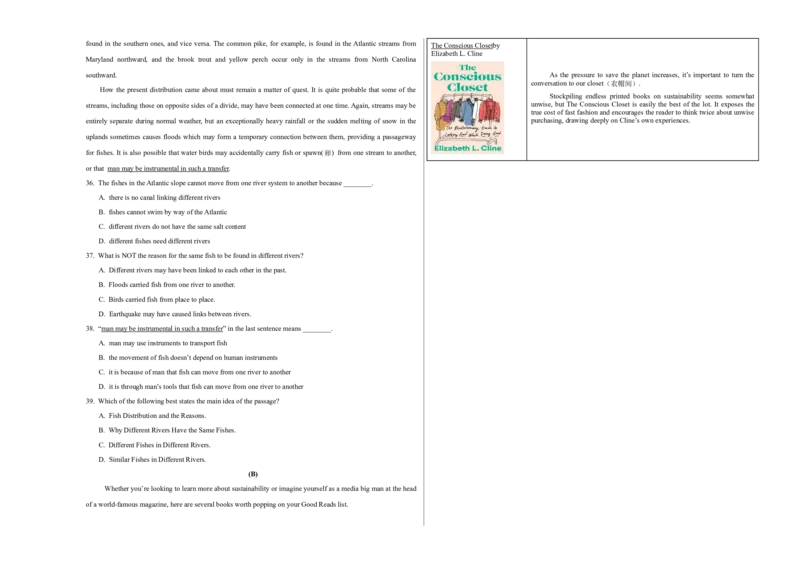
The Conscious Closetby
Elizabeth L. Cline
As the pressure to save the planet increases, it’s important to turn the
conversation to our closet(衣帽间).
Stockpiling endless printed books on sustainability seems somewhat
unwise, but The Conscious Closet is easily the best of the lot. It exposes the
true cost of fast fashion and encourages the reader to think twice about unwise
purchasing, drawing deeply on Cline’s own experiences.
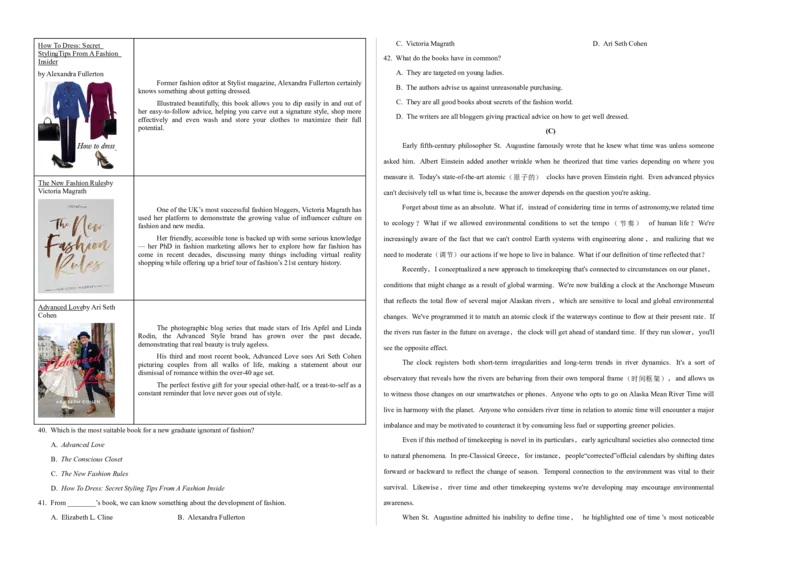
How To Dress: Secret
StylingTips From A Fashion
Insider
by Alexandra Fullerton
Former fashion editor at Stylist magazine, Alexandra Fullerton certainly
knows something about getting dressed.
Illustrated beautifully, this book allows you to dip easily in and out of
her easy-to-follow advice, helping you carve out a signature style, shop more
effectively and even wash and store your clothes to maximize their full
potential.
The New Fashion Rulesby
Victoria Magrath
One of the UK’s most successful fashion bloggers, Victoria Magrath has
used her platform to demonstrate the growing value of influencer culture on
fashion and new media.
Her friendly, accessible tone is backed up with some serious knowledge
— her PhD in fashion marketing allows her to explore how far fashion has
come in recent decades, discussing many things including virtual reality
shopping while offering up a brief tour of fashion’s 21st century history.
Advanced Loveby Ari Seth
Cohen
The photographic blog series that made stars of Iris Apfel and Linda
Rodin, the Advanced Style brand has grown over the past decade,
demonstrating that real beauty is truly ageless.
His third and most recent book, Advanced Love sees Ari Seth Cohen
picturing couples from all walks of life, making a statement about our
dismissal of romance within the over-40 age set.
The perfect festive gift for your special other-half, or a treat-to-self as a
constant reminder that love never goes out of style.
40. Which is the most suitable book for a new graduate ignorant of fashion?
A. Advanced Love
B. The Conscious Closet
C. The New Fashion Rules
D. How To Dress: Secret Styling Tips From A Fashion Inside
41. From ________’s book, we can know something about the development of fashion.
A. Elizabeth L. Cline
B. Alexandra Fullerton
C. Victoria Magrath
D. Ari Seth Cohen
42. What do the books have in common?
A. They are targeted on young ladies.
B. The authors advise us against unreasonable purchasing.
C. They are all good books about secrets of the fashion world.
D. The writers are all bloggers giving practical advice on how to get well dressed.
 (C)
Early fifth-century philosopher St. Augustine famously wrote that he knew what time was unless someone
asked him. Albert Einstein added another wrinkle when he theorized that time varies depending on where you
measure it. Today's state-of-the-art atomic(原子的) clocks have proven Einstein right. Even advanced physics
can't decisively tell us what time is, because the answer depends on the question you're asking.
Forget about time as an absolute. What if,instead of considering time in terms of astronomy,we related time
to ecology ?What if we allowed environmental conditions to set the tempo (节奏) of human life ?We're
increasingly aware of the fact that we can't control Earth systems with engineering alone ,and realizing that we
need to moderate(调节)our actions if we hope to live in balance. What if our definition of time reflected that?
Recently,I conceptualized a new approach to timekeeping that's connected to circumstances on our planet,
conditions that might change as a result of global warming. We're now building a clock at the Anchorage Museum
that reflects the total flow of several major Alaskan rivers ,which are sensitive to local and global environmental
changes. We've programmed it to match an atomic clock if the waterways continue to flow at their present rate. If
the rivers run faster in the future on average,the clock will get ahead of standard time. If they run slower,you'll
see the opposite effect.
The clock registers both short-term irregularities and long-term trends in river dynamics. It's a sort of
observatory that reveals how the rivers are behaving from their own temporal frame(时间框架),and allows us
to witness those changes on our smartwatches or phones. Anyone who opts to go on Alaska Mean River Time will
live in harmony with the planet. Anyone who considers river time in relation to atomic time will encounter a major
imbalance and may be motivated to counteract it by consuming less fuel or supporting greener policies.
Even if this method of timekeeping is novel in its particulars,early agricultural societies also connected time
to natural phenomena. In pre-Classical Greece,for instance,people“corrected”official calendars by shifting dates
forward or backward to reflect the change of season. Temporal connection to the environment was vital to their
survival. Likewise ,river time and other timekeeping systems we're developing may encourage environmental
awareness.
When St. Augustine admitted his inability to define time, he highlighted one of time 's most noticeable
qualities:Time becomes meaningful only in a defined context. Any timekeeping system is valid,and each is as
praiseworthy as its purpose.
43. What is the main idea of Paragraph 1?
A. Timekeeping is increasingly related to nature.
B. Everyone can define time on their own terms.
C. The qualities of time vary with how you measure it.
D. Time is a major concern of philosophers and scientists.
44. The author raises three questions in Paragraph 2 mainly to ________.
A. present an assumption
B. evaluate an argument
C. highlight an experiment
D. introduce an approach
45. What can we learn from this passage?
A. Those who do not go on river time will live an imbalanced life.
B. New ways of measuring time can help to control Earth systems.
C. Atomic time will get ahead of river time if the rivers run slower.
D. Modern technology may help to shape the rivers’ temporal frame.
46. What can we infer from this passage?
A. It is crucial to improve the definition of time.
B. A fixed frame will make time meaningless.
C. We should live in harmony with nature.
D. History is a mirror reflecting reality.
Section C
Directions: Read the following passage. Fill in each blank with a proper sentence given in the box. Each sentence
can be used only once. Note that there are two more sentences than you need.
Living off grid
A. Many are self-sufficient, not just providing their own electricity, water and sewage systems, but in all aspects.
B. After you use the toilet, you flush it and the waste disappears.
C. This shift from individual to group off-gridding reflects the fact that the trend is growing noticeably.
D. They live in a huge variety of types of accommodation.
E. Living off-grid still has a long way to go before it becomes a mainstream way of living.
F. Rather than building permanent homes, vans or mobile homes or even old shipping containers are other
options.
When you need electricity, you just plug in the machine and switch it on. If you need water, you turn on the
tap. ____47____ For many people, these facilities are the basics of civilized society and the idea of living without
them seems risky. Yet for a growing number of people, the idea of living off grid — without electricity, water or
sewage — is an increasingly attractive lifestyle.
Off-gridders do not have to give up electricity or a modern lifestyle — some choose to, but most use small
hydroelectric power systems, solar panels or windmills to generate enough power for their needs. Heating and
cooking needs are met by solar energy or wood burning systems, and toilet facilities range from non-water toilets to
outside compost toilets. ____48____ It ranges from traditional yurts (a type of tent) to luxury house with high-
speed internet and central heating. Whether they live in simple homes or luxury houses, what they all have in
common is that their lifestyles do not create any pollution or carbon emissions — the ultimate goal for off-gridders.
Around 100,000 people are thought to be living off grid in the UK now. ____49____ They grow their own
food, home-school their children and provide their own medical care. They are people who have been priced out of
the housing market or who have grown disillusioned with what modern society can offer and who decides that an
alternative lifestyle isn’t a pipe dream, but a viable option.
A part from living an alternative lifestyle, cost is a big factor in choosing to live off-grid. Off-grid houses are
far cheaper to build than ordinary homes since they don’t need to be connected to the electricity or water supplies
and even road access is not necessary. Materials tend to be cheaper, too. Popular options include straw or old tyres
and cement.
Surprisingly, the biggest problem off-gridders face is not building their homes or becoming self-sufficient but
getting permission to build. Rural areas away from town are the perfect choice but these are often protected by law
from construction of any kind or have building restrictions. There are now several websites dedicated to land-sharing
so that the costs of buying land and getting permission can be shared, and there are increasing numbers of off-grid
communities. ____50____ Off-gridding could soon be common all over Europe and America.
III. Summary Writing(共10 分)
51. Directions: Read the following passage. Summarize the main idea and the main point(s) of the passage in no
more than 60 words. Use your own words as far as possible.
Major trends that may affect education systems
The Organization for Economic Co-operation and Development (OECD), which promotes policies that will
improve the economic and social well-being of people around the world, has been looking at the future of global
education. Its head of education, Andreas Schleicher, has been talking about some major international trends
affecting education systems around the world.
One trend is the widening gap between rich and poor. In OECD countries, the richest 10% have incomes 10
times greater than the poorest 10%. This inequality is a challenge for schools who want to offer equal and fair access
to education for everyone.
Another trend is the rising wealth in Asia. It’s suggested that a large rise in the middle-classes in countries like
India will increase demand for university places. Andreas Schleicher asks the question “What values will these
newly wealthy consumers want from their schools?”
Increasing migration will also have an impact on education systems. Mobility results in more culturally diverse
students eager to learn and develop good life for themselves. But that can be challenge, too, as Andreas Schleicher
asks: “How should schools support pupils arriving from around the world? Will schools have a bigger role in
teaching about shared values?”
Funding pressure is another issue: as our demand and expectation for education rises and more people go to
university, who’s going to pay for it all? The rise in dependency on technology is another concern. What should
students learn when many of their talents can be reproduced by machines? And how reliant should we be on learning
from the internet?
These are just some of the issues the OECD is highlighting. But they remain irrelevant for hundreds of millions
of the world’s poorest children who don’t even have access to school places or receive such low-quality education
that they leave without the most basic literacy or numeracy.
_____________________________________________________________________________________________
_____________________________________________________________________________________________
_____________________________________________________________________________________________
_____________________________________________________________________________________________
_____________________________________________________________________________________________
_____________________________________________________________________________________________
_____________________________________________________________________________________________
_____________________________________________________________________________________________
____________________________________________________________________________________
IV. Translation(共15 分。第1 小题和第2 小题每题3 分;第3 题4 分;第4 题5 分)
Directions: Translate the following sentences into English, using the word given in the brackets.
52. 到底是什么让你对考试结果抱有如此乐观的态度?(it)
_____________________________________________________________________________________________
___________________________________________________________________________________________53.
在有些公司,重文凭轻能力的现象使很多求职者处于不利地位。(disadvantage) (汉译英)
_____________________________________________________________________________________________
___________________________________________________________________________________________54.
(原创题)不积跬步,无以至千里。 (Only…) (汉译英)
_____________________________________________________________________________________________
___________________________________________________________________________________________55.
这所百年老校近年来开展了一系列“古典乐进课堂”活动,让更多学生感受到经典的独特魅力。(launch)
(汉译英)
_____________________________________________________________________________________________
___________________________________________________________________________________________V.
Guided Writing(共25 分)(原创题)
56. Directions: Write an English composition in 120-150 words according to the instructions given below in
Chinese.
近期学生会针对“学生是否应该使用AI 写作业”这一话题开展征文活动,假如你是上海市明启中学的
李华,请你投稿谈谈你的看法。稿件内容应包括:
1. 你的选择,二选一(应该/不应该);
2. 通过比较,阐述这样选的理由。
_____________________________________________________________________________________________
_____________________________________________________________________________________________
_____________________________________________________________________________________________
_____________________________________________________________________________________________
_____________________________________________________________________________________________
_____________________________________________________________________________________________
_____________________________________________________________________________________________
_____________________________________________________________________________________________
_____________________________________________________________________________________________
_____________________________________________________________________________________________
__________________________________________________________________________________