专题 02
运动员奥运之后的心理战
1. 精编外刊阅读
2. 阅读理解专项
3. 语法填空专项
4. 外刊中的课标词
【精编·外刊阅读】
For Olympic Athletes, First Come the Games—Then Come the Post-Olympics Blues
(文章来源:Scientific American)
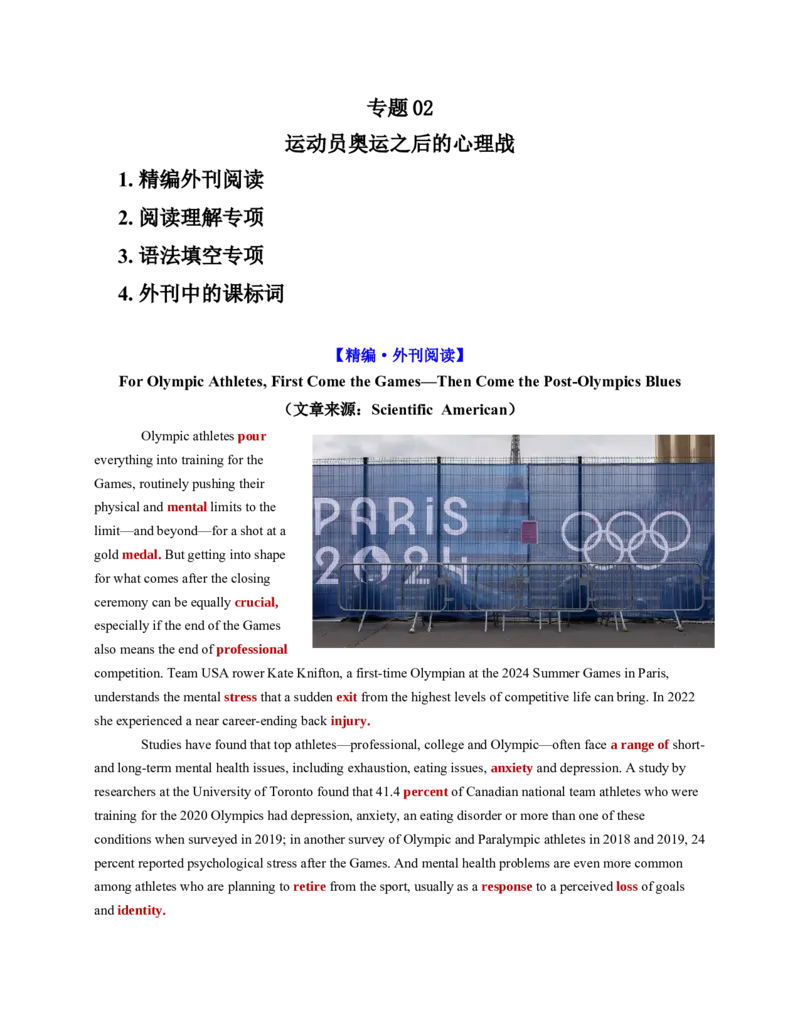
Olympic athletes pour
everything into training for the
Games, routinely pushing their
physical and mental limits to the
limit—and beyond—for a shot at a
gold medal. But getting into shape
for what comes after the closing
ceremony can be equally crucial,
especially if the end of the Games
also means the end of professional
competition. Team USA rower Kate Knifton, a first-time Olympian at the 2024 Summer Games in Paris,
understands the mental stress that a sudden exit from the highest levels of competitive life can bring. In 2022
she experienced a near career-ending back injury.
Studies have found that top athletes—professional, college and Olympic—often face a range of short-
and long-term mental health issues, including exhaustion, eating issues, anxiety and depression. A study by
researchers at the University of Toronto found that 41.4 percent of Canadian national team athletes who were
training for the 2020 Olympics had depression, anxiety, an eating disorder or more than one of these
conditions when surveyed in 2019; in another survey of Olympic and Paralympic athletes in 2018 and 2019, 24
percent reported psychological stress after the Games. And mental health problems are even more common
among athletes who are planning to retire from the sport, usually as a response to a perceived loss of goals
and identity.Emotions are also intensified by the nature of the event itself. The Olympics is a massive cultural
show—a whirlwind of global public attention, financial investment and extensive media coverage. New
international celebrities are created, and some contenders fall from grace during various accusations or
controversies. Athletes bear the pressure of representing their country, and winning medals, in front of a
worldwide audience. But then “all of that buzz and intensity around being an Olympian falls off very quickly,”
Cogan, a sports psychologist says. Painful decisions can follow: Do I want to keep competing? Should I
pursue a completely different direction or occupation? Such questions can be even more anxiety-causing if
athletes have injuries and need surgery or recovery, Cogan says.
【原创·阅读理解】
1. Why does the author use Kate Knifton's experience as an example?
A. To highlight the difficulty of physical training.
B. To share the joy of winning Olympic medals.
C. To show the mental stress after the Olympics.
D. To describe the process of recovery from injury.
2. What mental health issues are common among top athletes?
A. Depression, anxiety, and eating disorders.
B. Fatigue, sleep problems, and headaches.
C. Physical injuries, muscle pain, and cramps.
D. Financial stress, sponsorship loss, and pressure.
3. How does the nature of the Olympics affect athletes emotionally?
A. It offers chances for new friendships.
B. It causes intense pressure and emotional highs and lows.
C. It helps improve physical fitness.
C. It brings global recognition, fame, and financial rewards.
4. What questions do athletes face after the Games?
A. Whether to continue competing or change careers.
B. When to start training again.
C. Whether to remain in competition or retire entirely.
D. How to find a new coach.
【原创·语法填空】
Olympic athletes dedicate themselves entirely to training, pushing their physical and mental limits for a
chance at a gold medal. However, ____1____ (prepare) for life after the Games is equally crucial, especially if
it marks the end of their professional careers. Team USA rower Kate Knifton, ____2____ first-time Olympianat the 2024 Paris Summer Games, _____3____ (understand) the mental stress of suddenly leaving competitive
sports. In 2022, she faced a near career-ending back injury.
Studies show that elite athletes—professional, collegiate, and Olympic—often face various mental health
____4____ (issue), including exhaustion, eating disorders, anxiety, and depression. A University of Toronto
study found that 41.4 percent of Canadian national team athletes training for the 2020 Olympics experienced
depression, anxiety, or eating disorders. ____5____ (additional), 24 percent of Olympic and Paralympic
athletes ____6____ (survey) in 2018 and 2019 reported psychological stress after the Games. Mental health
problems are even ____7____ (common) among athletes planning to retire, often due to a perceived loss of
goals and identity.
The Olympics is a grand cultural event, drawing global public attention, significant financial investment,
and extensive media coverage. New international stars emerge, while some athletes face public controversies.
Competing under the intense pressure of representing their country ____8____ winning medals before a
worldwide audience can be overwhelming. “All the excitement and intensity around ____9____ (be) an
Olympian fades away quickly,” says sports psychologist Cogan. Difficult decisions often follow: Should I
continue competing? Should I pursue a different career path? These questions can be even more stressful
____10____ athletes have injuries and require recovery, Cogan notes.
【原创·课标高频词训练】
1. The constant noise and crowded environment of the city can lead to increased levels of ________ (anxiety)
among its residents.
2. Seeking ________ (profession) advice from an experienced counselor can be beneficial for mental well-
being.
3. The researcher examined the effects of ________ (vary) environmental factors on plant growth over a five-
year period.
4. The company's ________ (respond) to the customer complaints was swift and aimed at resolving the issues
immediately.
5. As a demanding and challenging ________ (occupy), emergency medicine requires quick thinking and
resilience.
6. The ________ (mass) earthquake caused widespread devastation and left thousands homeless.
7. The extensive media ________ (cover) of the scandal brought the issue to the forefront of public attention.
8. Diversifying one's portfolio is a wise strategy to minimize risk and maximize returns on ________ (invest).
9. The therapist suggested that she should practice mindfulness to improve her ________ (mental) well-being.
10. The ________ (stress) deadlines at work made it difficult for him to maintain a healthy work-life balance.
11. The project involves ________ (range) from data collection to detailed analysis, requiring meticulous
planning.12. Having ________ (pursue) a career in law, she now finds great satisfaction in helping others seek justice.
【梳理·外刊中的课标词】
词汇 中文意思 词汇 中文意思
mental anxiety
stress professional
percent found
various surgery
retire response
range pursue
pressure pour
occupation media
medal means
massive loss
limit investment
injury identity
global financial
exit event
crucial coverage
career beyond