文档文本内容
高中英语外刊时文阅读训练
专题26
Rogue 恒星重塑太阳系
Ⅰ.文章话题导入
Ⅱ.外刊原文阅读
Ш.阅读理解专项针对性练习
Ⅳ.话题高频词汇强化训练
Ⅴ.参考译文赏析
【话题·导语】
新的研究表明,数十亿年前一颗靠近太阳系的恒星可以解释遥远天体的奇怪轨道以及木星和土星的不
规则卫星。数十亿年前,一颗恒星的近距离飞越可能影响了太阳系的结构,导致海王星外天体的异常轨
道,并解释了木星和土星不规则卫星的起源。
【原文·外刊阅读】
Did a Rogue Star Reshape Our Solar System?
(文章来源:Sci Tech Daily)
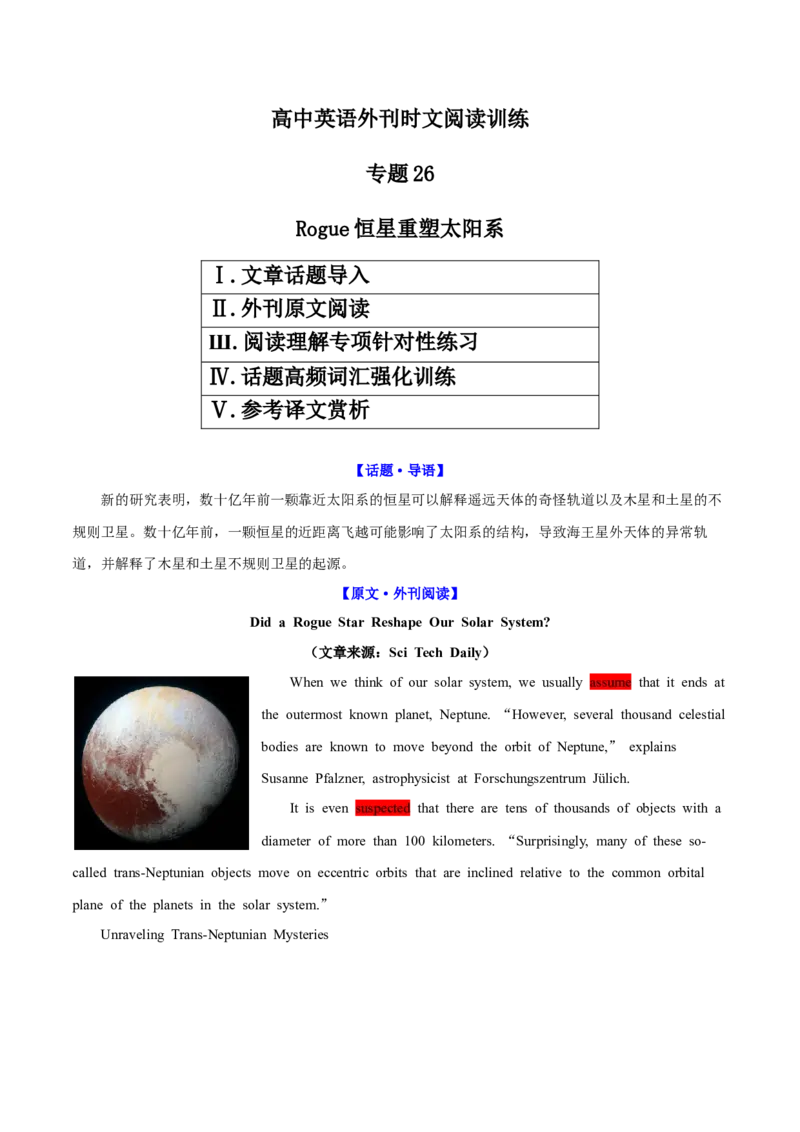
When we think of our solar system, we usually assume that it ends at
the outermost known planet, Neptune. “However, several thousand celestial
bodies are known to move beyond the orbit of Neptune,” explains
Susanne Pfalzner, astrophysicist at Forschungszentrum Jülich.
It is even suspected that there are tens of thousands of objects with a
diameter of more than 100 kilometers. “Surprisingly, many of these so-
called trans-Neptunian objects move on eccentric orbits that are inclined relative to the common orbital
plane of the planets in the solar system.”
Unraveling Trans-Neptunian Mysteries
Together with her student Amith Govind and Simon Portegies Zwart from Leiden University, Susanne
Pfalzner has used more than 3,000 computer simulations to investigate a possible cause of the unusual
orbits: could another star have caused the strange orbits of trans-Neptunian objects?
The three astrophysicists found that a distinctive, close flyby of another star can explain the inclined
and eccentric orbits of the known transneptunian celestial bodies. “Even the orbits of very distant objects
can be deduced, such as that of the dwarf planet Sedna in the outermost reaches of the solar system,
which was discovered in 2003. And also objects that move in orbits almost perpendicular to the planetary
orbits,” says Susanne Pfalzner.
Such a flyby can even explain the orbits of 2008 KV42 and 2011 KT19 – the two celestial bodies
that move in the opposite direction to the planets.
Celestial Mechanics and Moons: Unearthing the Impact
“The best match for today’s outer solar system that we found with our simulations is a star that
was slightly lighter than our Sun – about 0.8 solar masses,” explains Pfalzner’s colleague Amith
Govind. “This star flew past our sun at a distance of around 16.5 billion kilometers. That’s about 110
times the distance between Earth and the sun, a little less than four times the distance of the outermost
planet Neptune.”
However, the scientists’ most surprising realization was that the flyby of an alien star billions of
years ago could also provide a natural explanation for phenomena closer to home. Susanne Pfalzner and
her colleagues found that in their simulations, some trans-Neptunian objects were hurled into our solar
system – into the region of the outer giant planets Jupiter, Saturn, Uranus, and Neptune.
The Moons’ Tale: From Chaos to Capture
“Some of these objects could have been captured by the giant planets as moons,” says Simon
Portegies Zwart from Leiden University. “This would explain why the outer planets of our solar system
have two different types of moons.”
In contrast to the regular moons, which orbit close to the planet on circular orbits, the irregular
moons orbit the planet at a greater distance on inclined, elongated orbits. Until now, there was no
explanation for this phenomenon.
“The beauty of this model lies in its simplicity,” says Pfalzner. “It answers several open questions
about our solar system with just a single cause.”
【原创·阅读理解】
1. What recent discovery about trans-Neptunian objects was made by researchers from Forschungszentrum
Jülich and Leiden University?
A. They discovered new planets beyond Neptune.
B. A close flyby of another star may explain the unusual orbits of trans-Neptunian objects.
C. The solar system has more moons than previously thought.
D. There are no trans-Neptunian objects larger than 100 kilometers.
2. What is the suspected diameter of many trans-Neptunian objects?
A. Less than 10 kilometers.
B. Between 10 and 50 kilometers.
C. More than 100 kilometers.
D. Over 1,000 kilometers.
3. How did the close flyby of another star impact the orbits of trans-Neptunian objects according to the
researchers?
A. It caused them to orbit closer to the Sun.
B. It explained their inclined and eccentric orbits.
C. It made their orbits circular and aligned.
D. It resulted in the destruction of these objects.
4. What kind of star is suggested to have passed close to the Sun according to the simulations?
A. A star much heavier than the Sun.
B. A star with about the same mass as the Sun.
C. A star slightly lighter than the Sun, about 0.8 solar masses.
D. A star with a mass significantly less than the Sun.
5. What does the new model proposed by the researchers explain about the moons of the outer planets?
A. The formation of regular moons in circular orbits.
B. The capture of objects by giant planets as irregular moons.
C. The migration of moons from inner to outer planets.
D. The creation of new moons from asteroid collisions.
【高频词汇训练】
1.         (assume) that you are right, we’ll make a great deal of money from the project. (所给词的适当形式
填空)
2.Drivers who are          (suspect) of drink driving will be tested. (所给词的适当形式填空)
3.The scientist developed one model for          (simulator) a full year of the globe’s climate. (所给词的适当
形式填空)
4.In the          (distant), elephants were eating grass, ears flapping lazily as they moved slowly over the
plains. (所给词的适当形式填空)
5.He is a shy person. He finds it difficult to speak to the ones        the opposite sex.
6.Her heart was slightly damaged         a result of her long illness. (用适当的词填空)
7.It was not until then      he realized how foolish he was to cheat her.
8.The English         (prefer) for the weather has nothing to do with the natural phenomena. (所给词的适当
形式填空)
9.My most frightening but magical experience was not captured forever in          single image.(用适当的词
填空)
10.She couldn’t find any         (irregular) employment. (所给词的适当形式填空)
【参考译文】
Rogue 恒星重塑太阳系
当我们想到我们的太阳系时,我们通常假设它在已知的最外层行星海王星结束。Forschungszentrum
Jülich 的天体物理学家Susanne Pfalzner 解释说:“然而,已知有数千个天体会超出海王星的轨道。”。
甚至怀疑有数以万计的直径超过100 公里的物体。“令人惊讶的是,许多所谓的海王星外天体在偏心
轨道上移动,这些轨道相对于太阳系行星的共同轨道平面倾斜。”
揭开跨海王星之谜
Susanne Pfalzner 与莱顿大学的学生Amith Govind 和Simon Portegies-Zwart 一起使用了3000 多台计算
机模拟来调查异常轨道的可能原因:另一颗恒星是否可能导致海王星外天体的异常轨道?
三位天体物理学家发现,另一颗恒星的独特近距离飞越可以解释已知海王星外天体的倾斜和偏心轨
道。“甚至可以推断出非常遥远的物体的轨道,比如2003 年发现的太阳系最外层的矮行星塞德娜的轨道。
还有在几乎垂直于行星轨道的轨道上移动的物体,”Susanne Pfalzner 说。
这样的飞越甚至可以解释2008 KV42 和2011 KT19 的轨道,这两个天体的运动方向与行星相反。
天体力学与月球:揭示其影响
Pfalzner 的同事Amith Govind 解释说:“我们通过模拟发现,与今天的外太阳系最匹配的是一颗比我
们的太阳稍轻的恒星,大约0.8 个太阳质量。”。“这颗恒星在大约165 亿公里的距离飞过我们的太阳。
这大约是地球和太阳之间距离的110 倍,略小于最外层行星海王星距离的四倍。”
然而,科学家们最令人惊讶的认识是,数十亿年前一颗外星恒星的飞越也可以为离家更近的现象提供
一个自然的解释。Susanne Pfalzner 和她的同事们发现,在他们的模拟中,一些海王星外的物体被扔进了我
们的太阳系——木星、土星、天王星和海王星等外巨行星的区域。
月亮的故事:从混沌到捕捉
莱顿大学的Simon Portegies-Zwart 说:“其中一些天体可能被巨行星捕获为卫星。”。“这将解释为
什么我们太阳系的外行星有两种不同类型的卫星。”
与在圆形轨道上靠近行星的规则卫星相比,不规则卫星在倾斜的细长轨道上以更大的距离绕行星运
行。到目前为止,还没有对这一现象的解释。
“这个模型的美妙之处在于它的简单性,”Pfalzner 说。“它用一个原因回答了关于我们太阳系的几
个悬而未决的问题。”