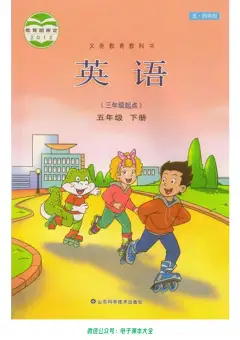
义务教育教科书
英
语
九年级下册
主
编:孙有中
副主编:夏谷鸣
分册主编:徐
浩
编
者:王雨芳文
伟
兰
虹
张秀红
张艳玲张黎新陈春晖祝和军
(按照姓氏笔画排序)
外语教学与研究出版社
FOREIGN LANGUAGE TEACHING AND RESEARCH PRESS
北京 BEIJING
前言
2 0 0 0年,外语教学与研究出版社依据国家《义务教育英语课程标准(实验稿)》组
织开发了本套教材。至今,本套教材已出版使用二十余年,得到了广大师生的一致好评。
2 0 2 2年,以马克思主义中国化时代化最新成果为指引,根据教育部《义务教育英语课程
标准(2 0 2 2年版)》的理念与要求,在充分考虑我国义务教育阶段英语教育实际学情和
教情的基础上,我们对本套教材进行了认真修订,重建了框架结构且进行了全新的内容
设计、确保在初中英语学科教育中全面贯彻党的教育方针,落实立德树人根本任务。
修订后的初中教材共6 册,每册均由6 个学习单元及附录组成,七年级上册增设了
小初衔接单元(Starter)。教材各学习单元均遵循认知发展过程编写,分为“理解一发
展一实践”三个环节,由5 个板块构成,分别为:背景激活(Starting out)、主题理解
(Understanding ideas)、思维拓展(Developing ideas)、主题实践(Presenting ideas)、
自我评价(Reflection)。附录包括 Communication bank、Language notes、Words and
expressions等板块。
修订后的教材的主要特色如下:
一、科学设计单元流程,整体设计单元内容,秉持在体验中学习、在实践中运用、
在迁移中创新的学习理念,切实落实学思结合、用创为本的英语学习活动观。
二、语篇题材多样、体裁丰富,语言地道鲜活、难度适中,符合学生的兴趣特点,
有助于提升学生的语篇意识、丰富学生的语言感知与学习体验。
三、活动设计紧密围绕主题,指向主题意义建构与产出,促使学生发现问题、分析
问题和解决问题。
四、坚持“教一学一评”一体化,围绕教材各环节的学习过程和成果,将评价贯穿
于英语课程教与学的全过程,彰显评价的促学和促教作用。
五、融通多元文化,促进文明互鉴。引导学生在增强国家认同的基础上,尊重世界
文化多样性,开展灵活、有效、坚守中国立场的跨文化沟通,提升文化自信。
学习英语没有捷径,需要持之以恒的努力。本套教材旨在帮助广大学生以开放的心
态接受新挑战,积极尝试,大胆实践。通过不断学习,提升核心素养,为继续学习英语
和终身发展打下坚实的基础。
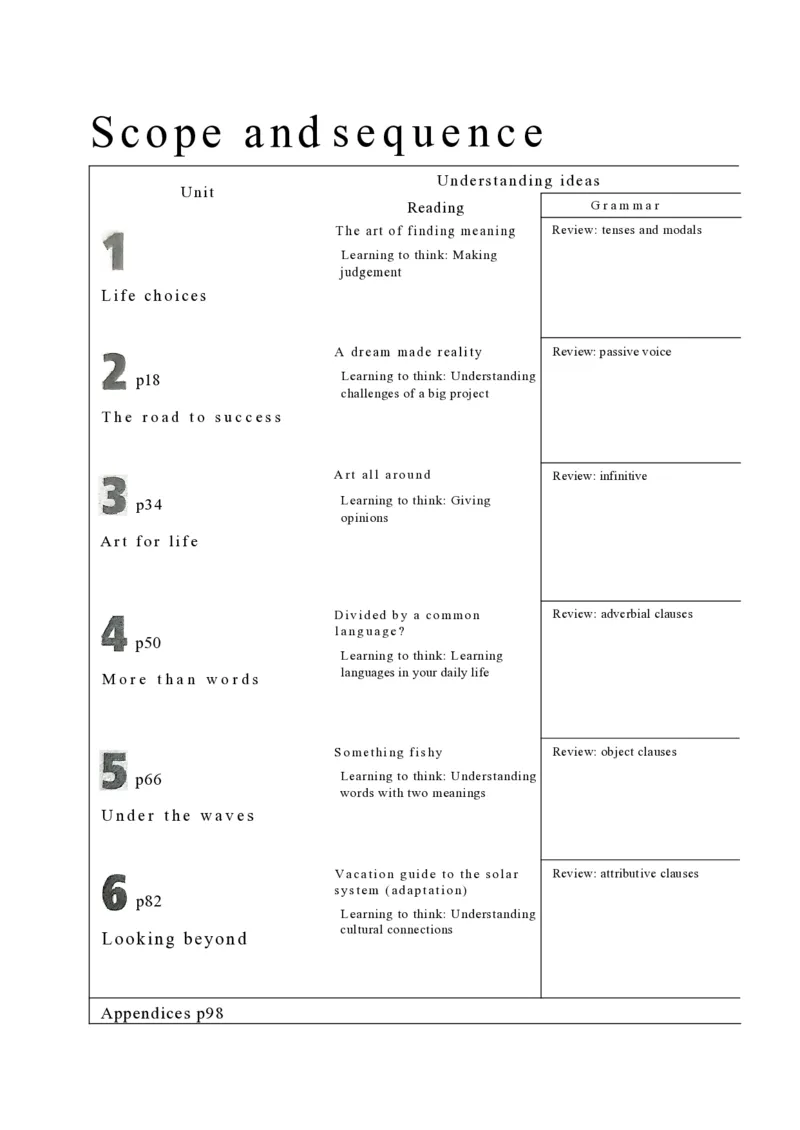
Scope and s e q u e n c e
Unit
Understanding ideas
Reading
G r a m m a r
The art of finding meaning
Review: tenses and modals
Learning to think: Making
judgement
L i f e c h o i c e s
A dream made reality
Review: passive voice
p18
Learning to think: Understanding
challenges of a big project
T h e r o a d t o s u c c e s s
A r t a l l a r o u n d
Review: infinitive
p34
Learning to think: Giving
opinions
A r t f o r l i f e
Divided by a common
Review: adverbial clauses
p50
l a n g u a g e ?
Learning to think: Learning
M o r e t h a n w o r d s
languages in your daily life
Something fishy
Review: object clauses
p66
Learning to think: Understanding
words with two meanings
U n d e r t h e w a v e s
Vacation guide to the solar
Review: attributive clauses
system (adaptation)
p82
Learning to think: Understanding
Looking beyond
cultural connections
Appendices p98
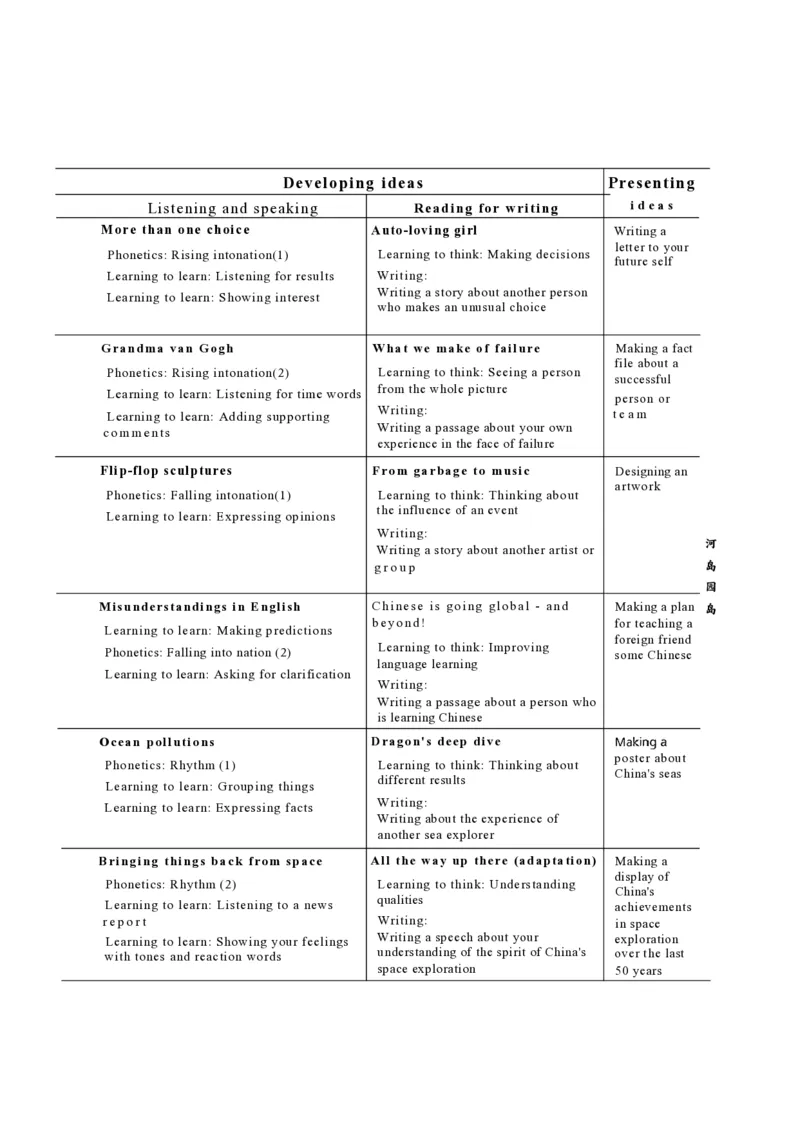
Developing ideas
Presenting
Listening and speaking
Reading for writing
i d e a s
More than one choice
Auto-loving girl
Writing a
letter to your
Phonetics: Rising intonation(1)
Learning to think: Making decisions
future self
Learning to learn: Listening for results
Writing:
Learning to learn: Showing interest
Writing a story about another person
who makes an unusual choice
Grandma van Gogh
What we make of failure
Making a fact
Phonetics: Rising intonation(2)
Learning to think: Seeing a person
file about a
from the whole picture
successful
Learning to learn: Listening for time words
person or
Learning to learn: Adding supporting
Writing:
t e a m
c o m m e n t s
Writing a passage about your own
experience in the face of failure
Flip-flop sculptures
From garbage to music
Designing an
Phonetics: Falling intonation(1)
Learning to think: Thinking about
artwork
Learning to learn: Expressing opinions
the influence of an event
Writing:
Writing a story about another artist or
g r o u p
河
岛
园
岛
Misunderstandings in English
Chinese is going global - and
Making a plan
Learning to learn: Making predictions
b e y o n d !
for teaching a
Learning to think: Improving
foreign friend
Phonetics: Falling into nation (2)
some Chinese
Learning to learn: Asking for clarification
language learning
Writing:
Writing a passage about a person who
is learning Chinese
Ocean pollutions
Dragon's deep dive
poster about
Phonetics: Rhythm (1)
Learning to think: Thinking about
China's seas
Learning to learn: Grouping things
different results
Learning to learn: Expressing facts
Writing:
Writing about the experience of
another sea explorer
Bringing things back from space
All the way up there (adaptation)
Making a
Phonetics: Rhythm (2)
Learning to think: Understanding
display of
qualities
China's
Learning to learn: Listening to a news
achievements
r e p o r t
Writing:
in space
Learning to learn: Showing your feelings
Writing a speech about your
exploration
with tones and reaction words
understanding of the spirit of China's
over the last
space exploration
50 years
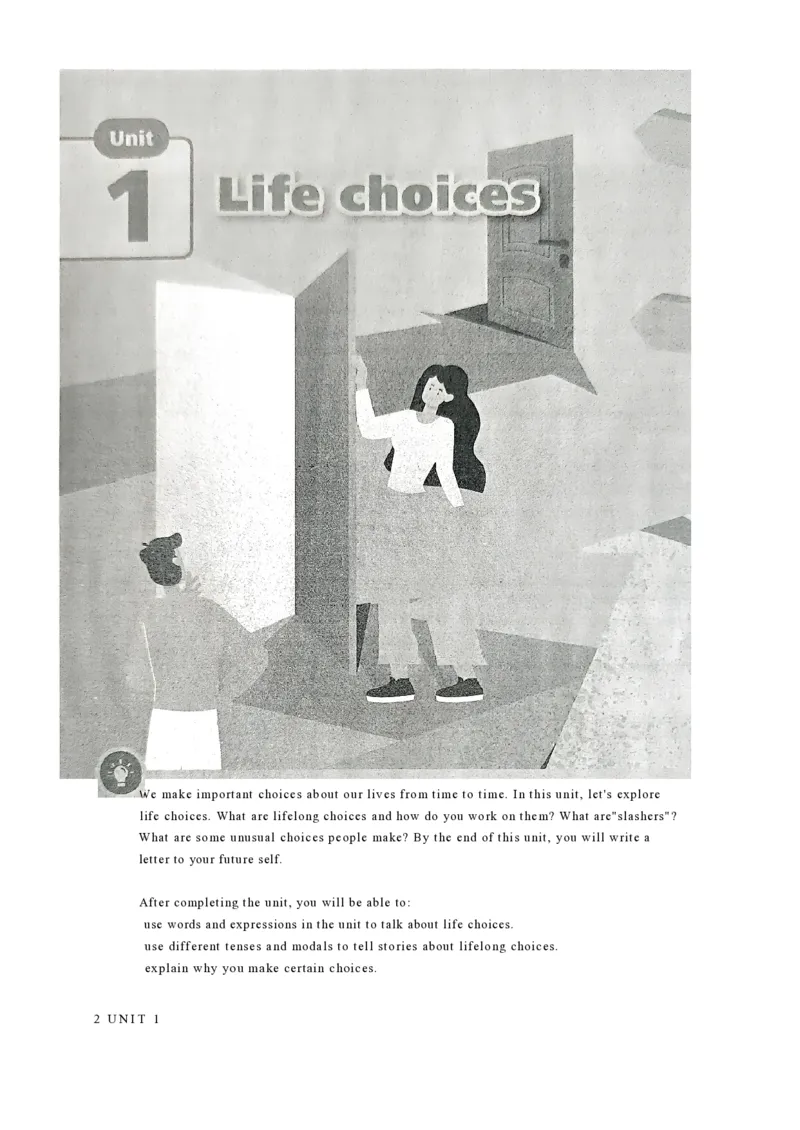
We make important choices about our lives from time to time. In this unit, let's explore
life choices. What are lifelong choices and how do you work on them? What are"slashers"?
What are some unusual choices people make? By the end of this unit, you will write a
letter to your future self.
After completing the unit, you will be able to:
use words and expressions in the unit to talk about life choices.
use different tenses and modals to tell stories about lifelong choices.
explain why you make certain choices.
2 U N I T 1
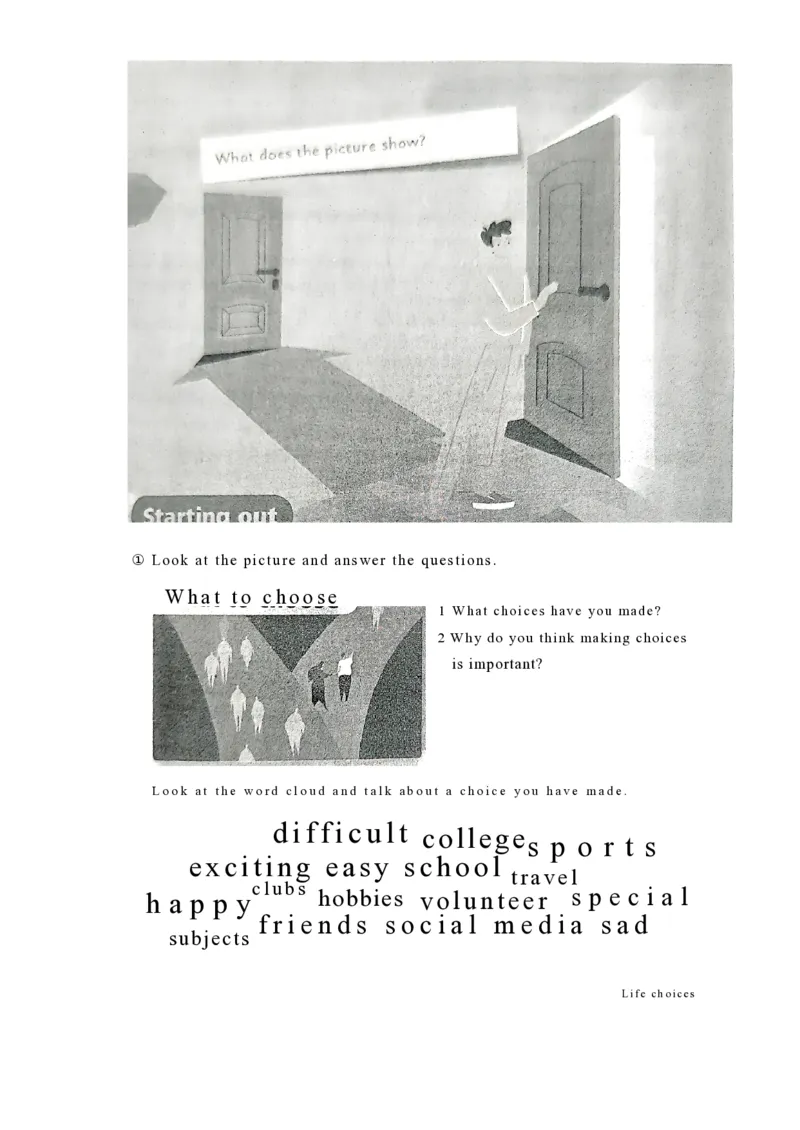
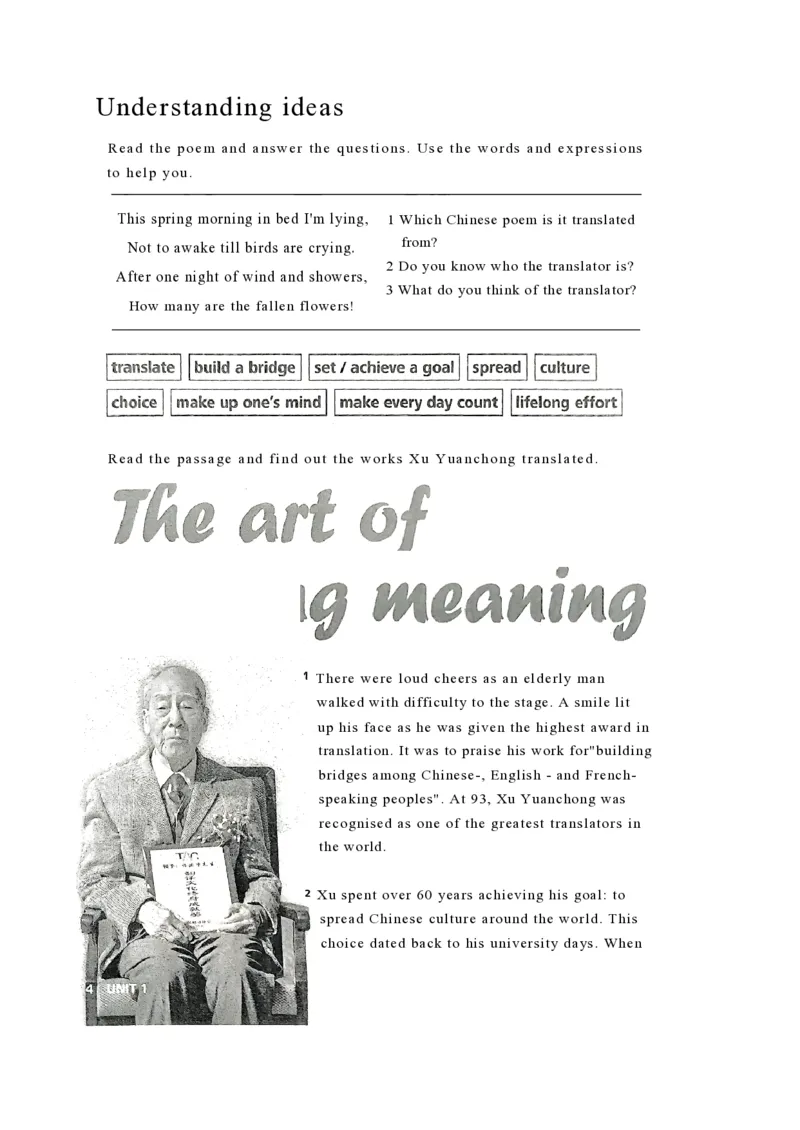
① Look at the picture and answer the questions.
W h a t t o c h o o s e
1 What choices have you made?
2 Why do you think making choices
is important?
L o o k a t t h e w o r d c l o u d a n d t a l k a b o u t a c h o i c e y o u h a v e m a d e .
difficult colleges p o r t s
exciting easy school travel
c l u b s hobbies volunteer
s p e c i a l
h a p p y f r i e n d s s o c i a l m e d i a s a d
subjects
L i f e c h o i c e s
Understanding ideas
Read the poem and answer the questions. Use the words and expressions
to help you.
This spring morning in bed I'm lying,
1 Which Chinese poem is it translated
Not to awake till birds are crying.
from?
After one night of wind and showers,
2 Do you know who the translator is?
3 What do you think of the translator?
How many are the fallen flowers!
Read the passage and find out the works Xu Yuanchong translated.
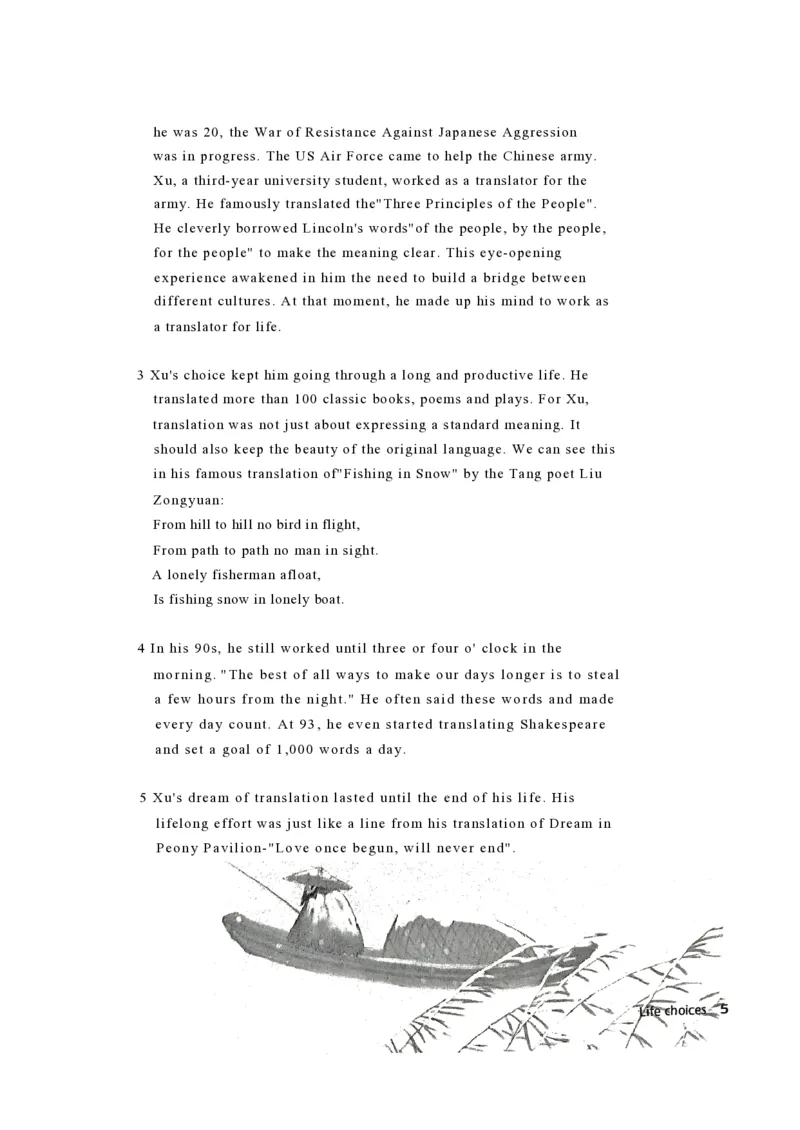
1 There were loud cheers as an elderly man
walked with difficulty to the stage. A smile lit
up his face as he was given the highest award in
translation. It was to praise his work for"building
bridges among Chinese-, English - and French-
speaking peoples". At 93, Xu Yuanchong was
recognised as one of the greatest translators in
the world.
2 Xu spent over 60 years achieving his goal: to
spread Chinese culture around the world. This
choice dated back to his university days. When
he was 20, the War of Resistance Against Japanese Aggression
was in progress. The US Air Force came to help the Chinese army.
Xu, a third-year university student, worked as a translator for the
army. He famously translated the"Three Principles of the People".
He cleverly borrowed Lincoln's words"of the people, by the people,
for the people" to make the meaning clear. This eye-opening
experience awakened in him the need to build a bridge between
different cultures. At that moment, he made up his mind to work as
a translator for life.
3 Xu's choice kept him going through a long and productive life. He
translated more than 100 classic books, poems and plays. For Xu,
translation was not just about expressing a standard meaning. It
should also keep the beauty of the original language. We can see this
in his famous translation of"Fishing in Snow" by the Tang poet Liu
Zongyuan:
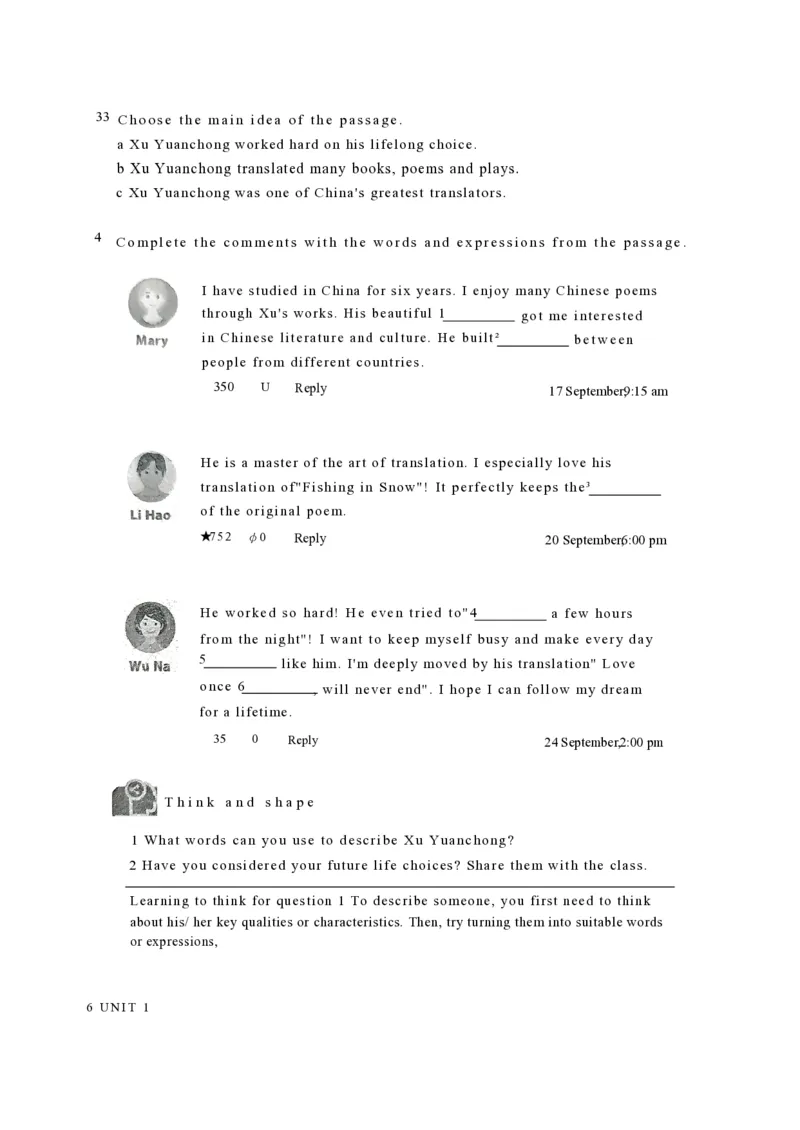
From hill to hill no bird in flight,
From path to path no man in sight.
A lonely fisherman afloat,
Is fishing snow in lonely boat.
4 In his 90s, he still worked until three or four o' clock in the
morning. "The best of all ways to make our days longer is to steal
a few hours from the night." He often said these words and made
every day count. At 93, he even started translating Shakespeare
and set a goal of 1,000 words a day.
5 Xu's dream of translation lasted until the end of his life. His
lifelong effort was just like a line from his translation of Dream in
Peony Pavilion-"Love once begun, will never end".
33 Choose the main idea of the passage.
a Xu Yuanchong worked hard on his lifelong choice.
b Xu Yuanchong translated many books, poems and plays.
c Xu Yuanchong was one of China's greatest translators.
4
C o m p l e t e t h e c o m m e n t s w i t h t h e w o r d s a n d e x p r e s s i o n s f r o m t h e p a s s a g e .
I have studied in China for six years. I enjoy many Chinese poems
through Xu's works. His beautiful 1
 got me interested
in Chinese literature and culture. He built²
 b e t w e e n
people from different countries.
350
U
Reply
17 September,9:15 am
He is a master of the art of translation. I especially love his
translation of"Fishing in Snow"! It perfectly keeps the³
of the original poem.
★752
φ0
Reply
20 September,6:00 pm
He worked so hard! He even tried to"4
 a few hours
from the night"! I want to keep myself busy and make every day
5
 like him. I'm deeply moved by his translation" Love
once 6
, will never end". I hope I can follow my dream
for a lifetime.
35
0
Reply
24 September,2:00 pm
T h i n k a n d s h a p e
1 What words can you use to describe Xu Yuanchong?
2 Have you considered your future life choices? Share them with the class.
Learning to think for question 1 To describe someone, you first need to think
about his/ her key qualities or characteristics. Then, try turning them into suitable words
or expressions,
6 UNIT 1
Read the sentences from the reading passage and summarise the
trammar rules.
(b) h sh ould also keep the beauty of the original language.
(e) A lo mtly fisherms h af lo at / is fishing s now in lonely boat.
(4) His lifelong ef fort was just like a line from his translation of Dream in
Peony Pavilion-"Love once begun, will never end".
Complete the passage using the correct form of the verbs in brackets
or mod al verbs.
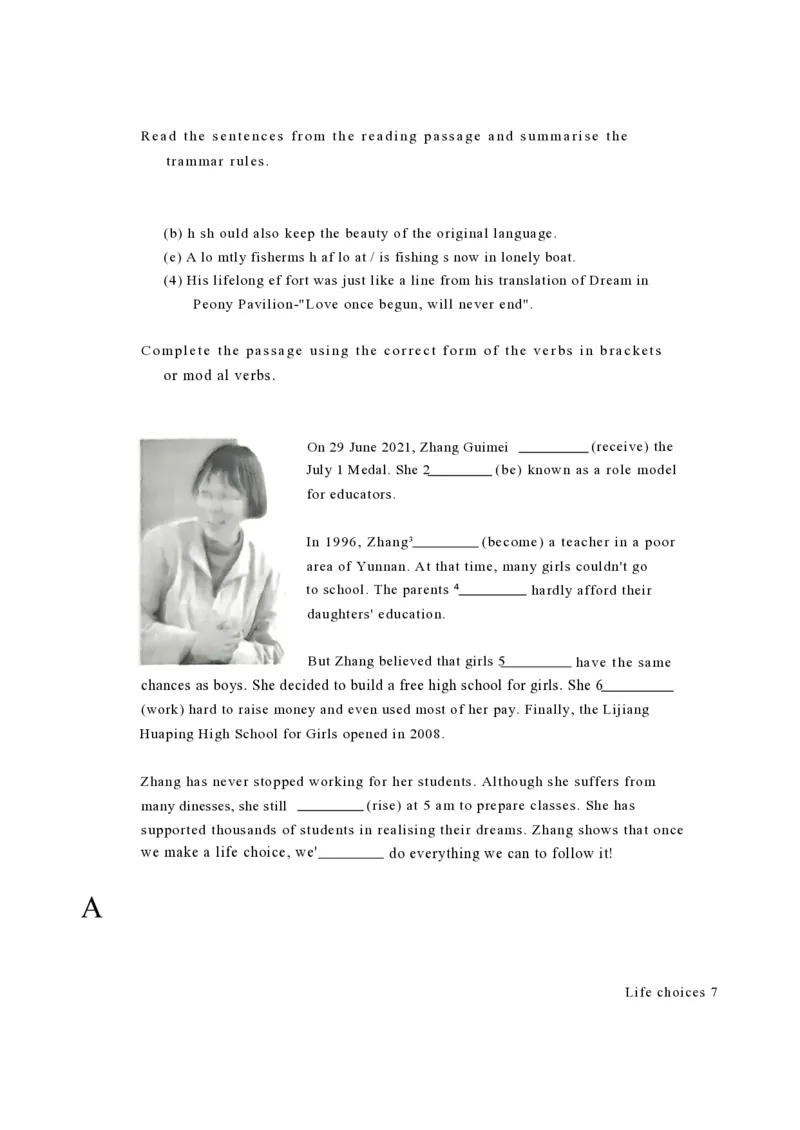
On 29 June 2021, Zhang Guimei
(receive) the
July 1 Medal. She 2
(be) known as a role model
for educators.
In 1996, Zhang³
(become) a teacher in a poor
area of Yunnan. At that time, many girls couldn't go
to school. The parents ⁴
 hardly afford their
daughters' education.
But Zhang believed that girls 5
 have the same
chances as boys. She decided to build a free high school for girls. She 6
(work) hard to raise money and even used most of her pay. Finally, the Lijiang
Huaping High School for Girls opened in 2008.
Zhang has never stopped working for her students. Although she suffers from
many dinesses, she still
(rise) at 5 am to prepare classes. She has
supported thousands of students in realising their dreams. Zhang shows that once
we make a life choice, we'
 do everything we can to follow it!
A
Life choices 7
7
W o r k i n p a i r s . T e l l t h e s t o r y o f a n o t h e r p e r s o n ' s l i f e l o n g c h o i c e . U s e
t h e w o r d s a n d e x p r e s s i o n s f r o m t h e r e a d i n g p a s s a g e a n d t h e U s e f u l
expressions to help you.
Example
Useful expressions
· He/ She is famous for/ known as…
· For example, …
· He/ She never...
·…… is / was a great challenge.
·I' ve heard that…
· Through..., he / she...
·…… still works/ worked until...
· The choice kept him / her...
8 U N I T 1
1
①Listen to the radio and choose the correct programme.
Phonetics in use
See all
Rising intonation (1)
a The most famous"slashers" in history
A rising intonation
b"Slashers": old idea, new popularity
is common in yes-no
questions. For example:
c A beginner's guide to being a"slasher"
Is it a good choice?
Practise more……p99
Life choices 9
L i s t e n a g a i n a n d c o m p l e t e t h e t a b l e .
This idea isn't 1
.
A survey was carried out among
a b o u t 4
 people aged
between 18 and 35.
Examples:
· Su Shi was both 2
 and a
Results:
government official.
5
 knew slashers around
· Leonardo da Vinci was both an
them.
artist and 3
.
6
 thought of themselves
as slashers.
4 6 . 3 % w a n t e d t o⁷       a
slasher.
L e a r n i n g t o f e a r n
Listening for results To listen for results, you should
focus on important information like numbers, findings etc. Pay
attention to expressions like It turned out that… and One of
the main findings is....
10 UNIT 1
L i s t e n t o t h e c o n v e r s a t i o n a n d c o m p l e t e t h e f i l e .
W e d n Y o u
Jobs: an eye doctor and a ¹
 in a band
Reasons for choosing two jobs:
Y o u n g p e o p l e t o d a y h a v e ²
. We can 3
different things.
Benefits of having two jobs:
·I' ve got many 4
.
· I c a n m a k e m y m u s i c f a n s h a p p y w i t h s o n g s a b o u t
5
.
· I c a n a l s o h e l p t h e m w i t h m y 6
 as a doctor.
Challenges of having two jobs:
I n e e d t o u s e⁷
 after work for music. It makes me a bit busy.
Advice for others:
Think carefully before you 8
. Don't just follow others.
Learning to learn
Showing interest To show interest in someone's
words, you can react with expressions like Sounds nice! and
t a l k a b o u t h o w t h e
That sounds amazing!. You can also smile and use body
h o s t s h o w s i n t e r e s t i n
language.
t h e c o n v e r s a t i o n .
Work in pairs. Tell the story of another"slasher".
The slasher:
· C h o i c e s
。R e a s o n s
· Benefits
· Challenges
8
· Advice
Useful expressions ⋯⋯p101
T a l k a b o u t w h a t y o u h a v e l e a r n t a b o u t h a v i n g m o r e t h a n o n e c h o i c e i n
this section.
Life choices 11
R e a d i n g f o r w r i t i n g
1 Look at the pictures and answer
the questions. Use the word
and expressions to help you.
1 What's the girl's choice of work?
2 What do you think of her choice?
Read the interview and find out
what Linda has achieved.
Host: Thank you for watching"Shining Youth". Today our guest is
Linda Brown. Welcome, Linda!
Linda: Hello! Thank you for inviting me here.
Host: As an outstanding 16-year-old student at a local middle school,
you made a surprising choice a year ago. Why did you choose
to be a car mechanic?
Linda: From a young age, I' ve loved playing with cars. I' ve always
been really interested in taking them apart. It was fun to see
how they worked. So it was an easy decision for me.
Host: Pardon me for saying so. But in many people's eyes, this is an
unusual choice, especially for girls. The work may make you
1 2 U N I T 1
dirty and tired. And it can be
very challenging. Were your
parents OK with that?
Linda: At first they weren't happy.
They would rather I worked
for the family business.
Host: Right, I love the butter
biscuits your family make. But you didn't want to join the trade.
So what changed your parents' minds?
Linda: Well, I did lots of research into the job. I also worked as a part-
time mechanic for several months. My parents talked to my
boss. They knew I was serious. They understood my love for
the work, so they decided to support me.
Host: That's really touching! Now, a year has passed. Do you find
studying car repair difficult?
Linda: Yes and no. On the one hand, I have to use computers and
operate other high-tech machines. I have to learn a lot about
physics and chemistry. On the other hand, I find the subjects
interesting. It's worth the effort.
Host: You recently won first prize in a car repair competition. You are
the first woman to enter the competition and win! After such a
success, what do you think of your choice a year ago?
Linda: Well, luckily, the prize proves
that my choice wasn't made
in a rush. We should always
follow our love and dreams,
even if they seem unusual.
Live life to the full and never
regret it!
Host: That's an excellent life lesson
for everyone! Good luck to
you, Linda!
Linda: Thank you.
Life choices 13
Complete the thinking map with the words and expressions from the interview.
1 Why do you think Linda's
1 What kind of person do you think Linda is?
choice is"an unusual choice"?
2 Will you make an unusual life choice? Why
2 What kind of choice can be
or why not?
seen as" made in a rush"?
3 What does Linda mean by
Learning to think for question 2 To decide
"live life to the full"?
if you' ll make an unusual life choice, think about
your interests, goals, dreams and values. Compare
the advantages and disadvantages of the choice
and consider how it might help you.
14 UNIT 1
Write a story about another person who makes an unusual choice.
step ①
Do research on a person who makes an unusual choice. Use the chart to
help you.
Who is this person?
What is his/ her unusual choice?
How did he / she make the choice?
Opening
What are other people's opinions?
Body
What is the result?
Ending
What are his/ her feelings and thoughts now?
What are your ideas about making an unusual choice?
S t e p 2
Organise the information and write your story.
Step ❸
Check. Did you:
cover all the main points of a story?
use the word and expressions from the reading passage?
give your opinions about making unusual choices?
Step
Share your story with the class.
Life choices 15
Presenting ideas
Write a letter to your future self.
Step 1
You are going to write a letter to your future self about a choice you have made.
Think about what to include in your letter.
· reasons for your choice
· importance of your choice
· hopes for the future
S t e p 2
Use the outline below to prepare the letter. You can use the language tips or find
useful expressions or sentences from this unit.
Opening Stating the purpose of your letter
- I'm writing this letter to…
- This letter is to…
Body
Describing the choice you' ve made
Giving reasons for your choice
- I c h o s e t o …
一…… made me realise that…
- I made a(n)… decision to…
- I' ve always been interested in…
- I made up my mind to...
-I am..., so my choice is about...
Describing what you' ve done for your choice
Describing the importance of your choice
- It kept me going through...
- I am… and it's worth the effort.
-I did lots of things, such as…
- The choice kept me...
- I h a v e t o …
Ending Stating wishes for your future self
-I hope I can follow... and have a productive life.
- This showed me that following...
- Live life to the full and...
1 6 U N I T 1
S t e p
Practise and present your letter to the class. Then put your letter in a box or a
bottle. Place it somewhere safe and decide when to open it.
s t e p
Vote on the best three letters and the best three presentations.
Reflection
① After completing this unit, I understand more about life choices.
24 To express my understanding, I can...
use words and expressions in the unit to talk about life choices:
use different tenses and modals to tell stories about lifelong choices.
explain why I make certain choices.
*1= excellent,2= good, 3= not yet
一)I still need to improve:
Life choices 17
U n i t
T h e r o a d t o
2
s u c c e s s
success: the achievement of something that
y o u p l a n n e d t o d o
Do you agree with the provided definition of
success? Why or why not?
Success can mean very different things to different people. In this unit, let's explore the
meaning of success. What qualities do we need to be successful? Can we achieve success
in old age? How do you deal with failure? By the end of this unit, you will make a fact file
about a successful person or team.
After completing the unit, you will be able to:
use words and expressions in the unit to talk about success.
use the passive voice to talk about qualities for achieving success.
describe the meaning of success.
18 UNIT2
Starting out
Look at the pictures and read the quotes. Then answer the questions.
1 What"success" did each of these people achieve?
2 What did they think helps one become successful?
❷ Look at the picture and answer the questions.
U n d e r s t a n d i n g s u c c e s s
1 What does success mean to you?
2 Can you give an example?
The road to success 19
Understanding ideas
Look at the word cloud and the pictures. Predict what the passage is about.
c o m e t r u e d r e a m c h a l l e n g e
solve problems
feel a strong wish never give up
w a s t e n o t i m e
Read the passage and check your prediction.
A dream made reality
1 FAST, or the Sky Eye, was first put into
operation on 25 September 2016. On that
day, an elderly man looked on with warmth
in his heart. He was Nan Rendong, the chief
scientist and chief engineer of FAST. He had
worked on the project for 22 years.
2 It all started when Nan worked in Japan. He
attended an international meeting on radio science in 1993. Sadly,
he found China had no say in the discussion. The largest radio
telescope in China was then only 25 metres wide. Nan was greatly
2 0 U N I T 2
shocked. He felt a strong wish to build a larger one. In fact, he
wanted to build one of the largest telescopes in the world.
3 He wasted no time in packing his bags to return to China. But
when he started working on his idea, the first challenge was
where to put the telescope. From 1994 on, Nan and his team
searched every corner of Guizhou Province. In 11 years, they
reviewed 391 places. The difficulties they experienced are hard to
imagine. But Nan led the team forward, never giving up until the
perfect place was found.
4 The building of the telescope was an even bigger challenge. FAST
is large, but it also needs to be very accurate. There was nothing
like it anywhere. Nan used his knowledge and skills to solve all
the technological challenges. He always rushed to solve new
problems, even when he was halfway through a meal.
5 Sadly, when FAST was reaching its final stage, Nan was seriously
ill with cancer. But he wouldn't be stopped by that. Even in his
final days, he still fought in the front line of the project. It meant
so much to him to see his dream come true.
6 For 22 years, Nan set his eyes on space
and followed a single dream. The Sky Eye
is a great success in China's exploration
of space. Now we will use it to look deep
into the universe.
The road to success 21
C h o o s e t h e n e w s p a p e r c o l u m n t h a t t h e p a s s a g e m o s t l i k e l y c o m e s f r o m .
Give your reasons.
a Science and technology
b Great people
c Exploring space
d Teamwork
Complete the thinking map with the words and expressions from the
p a s s a g e .
The making of FAST
. The start
Nan Rendong'
 an international meeting. He was greatly
shocked.
。H e f e I t 2
 to build a larger radio telesco pe in China.
· H e 3
 no time in packing his bags to return to China.
-Finding the location
) The first 4
 was where to put the telescope.
) Nan and his team searched every corner of Guizhou Province. They
never 5
 until the perfect place was found.
Building FAST
· Nan used his 6
 to solve
1 Why did Nan Rendong decide to build
all the technological challenges.
a larger telescope?
He always rushed to 7
.
2 What challenges do you think Nan
Even in his final days, he still
Rendong and his team faced?
8
 in the front line of
the project.
Learning to think for question 2
A big project may bring different challenges.
For example, think about what the landscape is
like in Guizhou Province.
2 2 U N I T 2
Grammar rules…… p136
Read the sentences from the reading passage and summarise the
grammar rules.
(a) FAST, or the Sky Eye, was first put into operation on 25 September 2016.
(b) Nan was greatly shocked.
Complete the passage with the active or passive form of the verbs in
brackets.
If you' ve seen the film Hidden Figures, you may know the story of
Katherine Johnson, one of the first black women scientists at NASA.
Johnson started to work for NASA in the 1950s. She was so skilled at
doing calculations that she '
(know) as a"human computer".
However, being a woman, and black, she was separated from her white
co-workers, and her name 2
(not appear) in NASA reports.
Johnson took all these at ease, and just ³
(prove) herself
with her accuracy. In 1961, before sending an American astronaut into
space, NASA had to depend on Johnson's calculations. Her calculations
4
(consider) more accurate than the ones produced by
computers.
After being a hidden
figure for many ears,
Johnson 5
(recognise) for her efforts
at last.
A
The road to success 23
Introduce a person who realised his / her dream. Use the words and
e x p r e s s i o n s f r o m t h e r e a d i n g p a s s a g e a n d t h e U s e f u l e x p r e s s i o n s t o
h e l p y o u .
Example
Useful expressions
To…, it's important to…
Take..., for example.
· It all started when...
At that time...
· In fact, ……
·…… spend his / her whole life in…
2 4 U N I T 2
Developing ideas
published the first part of Don Quixote when he was nearly 60, and the second part 10
years later. Similarly, Wu Cheng' en, the writer of Journey to the West, started writing the
novel in his old age. Sometimes, it takes a very long time before people achieve success.
P h o n e t i c s i n u s e
a n d a n s w e r T ( t r u e ) o r F ( f a l s e ) t o t h e
Rising intonation (2)
f o l l o w i n g s t a t e m e n t s .
Rising intonation is sometimes used
a Vincent van Gogh's grandmother lived
for known or given information. For
in China.
example, in We all know Vincent van
b Grandma van Gogh learnt from
Gogh..., right?, rising intonation is
Vincent van Gogh's paintings.
used, as" Vincent van Gogh" is known
c Grandma van Gogh spent most of her
information.
life as a farmer.
P r a c t i s e m o r e · · · p 9 9
d Grandma van Gogh published her
o w n b o o k .
The road to success 25
T h e L i f e o f
G r a n d m a v a n G o g h
Chang Xiufeng, known as Grandma van Gogh, is famous for the
1
 in her paintings. She was born in²
 in Henan Province
and worked as a farmer ³
. She started painting at about the age
of ⁴
.
Her son 5
 some of her paintings on his blog. People⁶
her works very much. After this, she appeared on ⁷
 in 2006 and
then 8
 her own book.
A r t w o r k s
2 6 U N I T 2
L i s t e n t o t h e c o n v e r s a t i o n a n d c o m p l e t e t h e t a b l e .
What happened
Comments
Grandma van Gogh never
learnt'
. She
?
 painting and she
She's really ³
.
could paint very well.
She discovered t he4
of painting later in life, but
once she did, she 5
It's never too late to ⁷
!
painting and became a
6
 painter.
Learning to learn
Adding supporting comments When making
comments on a story or a person's life, try to describe
T h e n t a l k a b o u t h o w
what happened, then explain what you think about the
t h e s p e a k e r s a d d
events. You can also draw conclusions and relate the
story to your life.
supporting comments.
④ Work in groups. Talk about another example that shows it's never too late
t o s t a r t .
Useful expressions⋯ p101
T a l k a b o u t w h a t y o u h a v e l e a r n t a b o u t f i n d i n g s u c c e s s l a t e r i n l i f e i n
t h i s s e c t i o n .
The road to success 27
R e a d i n g f o r w r i t i n g
① Describe the two pictures below with the words.
Read the passage and find out what Matthew Emmons thinks of failure.
1 There is a famous saying: failure is the mother of success. But life
isn't always that simple. What if failure is followed by more failure,
and success never appears?
2 It was the 2004 Olympic Games. Twenty-three-year-old Matthew
Emmons had one gold medal already. He raised his gun. With nine
perfect shots in hand, he could win another gold medal with his eyes
2 8 U N I T 2
closed . Bang! Oh no ! He missed... and shot someone else's target! He
ended the Olympic Games without a second medal around his neck.
3 But Emmons refused to give up. He allowed himself to be sad for just
one night. Then he went back to training hard. He aimed once more
at being an Olympic champion.
4 However, over the years, bad luck stuck
to him like glue. History repeated itself
at the Beijing Olympics. He missed
another shot and lost out on the gold
medal. And life handed him more
challenges. He was told that he had
cancer. He got through the disease,
but he never made it as an Olympic
champion again in his sporting life.
5 Some might consider Emmons one of
the unluckiest athletes in history. But
Emmons wouldn't agree. He always
looks at life on the bright side. For him,
those failures have made his life rich.
On that night in 2004, after missing the
shot, he went out with some friends.
That's when he met his future wife. And
while he was unlucky to have cancer, he
took it as a chance to spend time with his family. He didn't win all
the medals, but he is a winner at what really counts-life!
6 It's important to learn lessons from failures. And it is equally
important to accept them. When you' ve tried your best, just smile
and enjoy the journey. Failure does not always bring success, but it
can always help you grow. Remember that"success" and"win" don't
mean the same thing. Success is so much more than that.
The road to success 29
Complete the chart with the words and expressions from the passage.
E m m o n s ' s f a i l u r e
E m m o n s ' s s u c c e s s
A t t h e 2 0 0 4 '
, he
· After missing the shot in 2004,
shot someone else's target.
he met his 4
.
He missed another shot at
。While he was unlucky to
the Beijing Olympics and
have cancer, he took it as a
5
2
 on the gold medal.
 to spend time with
。He was told that he had 3
.
his family.
· He is a 6
 at life.
It is important to 7
 from failures.
Failure does not always 8
, but it can always help us grow.
Answer the questions.
1 What does the writer mean by" he could win another gold meda l with his eyes
closed"?
2 What does the writer mean by" stuck to him like glue"?
3 What is the difference between"success" and"win"?
1 Do you think Emmons is one of the unluckiest athletes in history?
Why or why not?
2 How can staying positive help you in your life?
Learning to think for question 1 Do not just focus on one single deed.
Try to see a person from the whole picture.
3 0 U N I T 2
Write a passage about your own experience in the face of failure.
S t e p
Think about the failures you had. How did you deal with them?
Being
Failures
p o s i t i v e
· losing a sports competition
· learning a lesson
· failing an exam
· trying harder next time
· not getting onto a team
· losing a friend
setting a goal but not achieving it
B e i n g
n e g a t i v e
· getting angry
· giving up
Step 2
Organise your ideas based on the questions below. Then use them to help
you write your story.
1 What was the"failure"?
2 How did you feel at the time? What did you do?
3 What lesson did you learn?
4 How can this help you in the future?
Step 3
Check. Did you:
describe clearly what happened and how you felt?
use the words from the reading passage?
summarise the lesson you' ve learnt?
Step 4
Share your story with the class.
The road to success 31
P r e s e n t i n g i d e a s
Make a fact file about a successful person or team.
Step
Work in groups. Search for information about successful people or teams. Then
take a group vote to decide on the person or team for your file.
· country
· experiences
· achievements
· qualities
Step
Use the outline below to organise your ideas and write your fact file. You can use
the language tips or find useful expressions or sentences from this unit.
B a s i c i n f o r m a t i o n a b o u t t h e p e r s o n o r t e a m
- He / She is… He / She was born in……
- There are... people in the team. They are...
I m p o r t a n t a c h i e v e m e n t s
- …… is / are famous for…
- …… is / are / was/ were responsible for...
- …… has/ have/ had worked on…… for..
Experiences
- It all started when...
- The difficulties they experienced
- ,.. wasted no time in...
are hard to imagine.
-…… led the team forward.
- But he / she/ they refused to
- …… used his/ her/ their knowledge
give up.
and skills to...
一… aimed once more at…
- For… years,…… set his/ her / their
eyes on...
Q u a l i t i e s a n d c o m m e n t s
-…… is a great success in…
- We can learn from him / her / them that…
-It's never too late to……
-
 shows that failure can help you grow.
3 2 U N I T 2
S t e p 3
Practise and present your fact file to the class.
S t e p
Vote on the best three fact files and the best three presentations.
R e f l e c t i o n
After completing this unit, I understand more about the meaning of
success.
23 To express my understanding, I can...
use words and expressions in the unit to talk about success:
use the passive voice to talk about qualities for achieving success.
describe the meaning of success,
"1= excellent,2= good,3= not yet.
I still need to improve:
The road to success 33
From music to painting, sculpture to dance, art brightens our lives. In this unit, let's
explore art. What is art in your eyes? What can art bring us? By the end of this unit, you
will design an artwork.
After completing the unit, you will be able to:
use words and expressions in the unit to talk about art and artists.
use the infinitive to talk about artworks.
describe the importance of art.
34 UNIT 3
What does this picture make you feel?
Starting out
① Lo ok at the picture and answer the questions.
1 Which forms of art do you know?
2 C a n y o u s h a r e o n e e x a m p l e w i t h
the class?
Look at the pictures and answer the questions.
Composition with Yellow,
Blue and Red
by Piet Mondrian
(1872-1944)
1 Are they all art?
2 Which one do you like the most? Why?
A r t f o r l i f e 3 5
Understanding ideas
Look at the title and the pictures. Then predict what the passage is about.
Use the words and expressions to help you.
Now read the passage and check your answer.
1 When we speak of art, we often think of paintings
on a wall-possibly in a museum or an art centre.
But is that the only way to experience art? Did
Leonardo da Vinci want the Mona Lisa to live
behind a wall of glass? When they were created,
great works of art weren't hidden away and
guarded. They were placed where everyone could
see them. Art is meant to be enjoyed. And to be
enjoyed, it needs to be where people can reach it!
2 Street art is a wonderful example of this. Artists paint
on walls to make cities and towns more beautiful.
Liu Zhicheng and his partner Xu Fengkai are two
3 6 U N I T 3
young artists in China. They are from the
village of Xingyi in Yunnan Province. There, they
paint on the walls of farmhouses. People, especially
children, visit to admire the artwork. Classic symbols
in Chinese culture, such as lotus flowers and cranes,
are the local villagers' favourites. It makes the two young
men happy-they know that their paintings have planted
seeds of love for art in people's hearts.
3 Street art doesn't always last long. It's often created to bring
a moment of joy to busy people as they pass by. David Zinn
is known for his 3-D drawings in interesting places on streets
and walls. He surprises people by turning common things
into pretty creations with his chalk. So a hole in the
wall becomes a window for a mouse. Or some grass
becomes a rabbit's skirt. Zinn's art adds a touch of
magic to people's lives and brings joy. It stays there
to please people's eyes until the next time it rains!
4 Art in museums is wonderful. However, when
we put art outside, it can make our everyday
experiences a bit brighter. Beyond the walls of
museums, art walks into our lives and our hearts.
Choose the main idea of the passage.
a Art in public places makes the world a more beautiful place.
b Artists usually do not agree to put their art work in museums.
c Street artists are more talented than other types of artists.
C o m p l e t e t h e n o t e s w i t h t h e w o r d s a n d e x p r e s s i o n s f r o m t h e p a s s a g e .
M a i n i d e a :
Art is not only ¹
 on a wall. Art is meant to 2
, and it needs to be
where people can reach it!
S u p p o r t i n g p o i n t :
Artists paint on walls to make cities and towns 3
.
Example 1: Street art has planted seeds of love for art in people's hearts.
In the village of Xingyi in Yunnan Province, two Chinese artists, Liu Zhicheng
and his partner, paint on 4
. Local people admire 5
, and their
favourites are classic symbols in Chinese 6
, such as lotus flowers and
cranes.
Example 2: Street art doesn't always last long. It's often created to bring a
moment of 7
 to busy people as they pass by.
Known for his 3-D drawings, artist David Zin n uses chalk to turn common things
into pretty creations, such as 8
 in the wall becoming a window for a
mouse, or9
 becoming a rabbit's skirt.
Conclusion
Putting art outside can make our everyday experiences 10
.
T h i n k a n d s h a r e
1 Why does the writer mention the Mona Lisa at the beginning?
2 Have you ever seen any street art in your town/ city? Did you like it? Why or
why not?
Learning to think for question 2 Consider both advantages and disadvantages of street
art. You should also compare street art with other kinds of art. Then you can give your opinions.
3 8 U N I T 3
Grammar rules
 p137
R e a d t h e s e n t e n c e s f r o m t h e r e a d i n g p a s s a g e a n d s u m m a r i s e t h e
drammar rules.
(a) Did Leonardo da Vinci want the Mona Lisa to live behind a wall of
glass?
(b) …… it needs to be where people can reach it!
(c) Artists paint on walls to make cities and towns more beautiful.
Complete the information about an art camp using the correct form of
the verbs in brackets.
Calling all young artists from 8 to 12 years old!
Let's 1
(find) the magic of art through
three days of exciting activities!
D a y 1 :
D a y 2 :
D a y 3 :
Morning: Explore
Morning: Work in groups
Morning:6
4
different art forms
(create) a wall
(improve) your artwork
through workshops.
painting.
for an art show.
Teachers will ask you
2
(try) different
Afternoon: Learn
Afternoon: Take part in
ways of drawing.
speaking skills 5
the Closing Art Show
(present) the ideas
7
(celebrate)
Afternoon: Take a walk
behind your work.
your wonderful journey.
in the forest 3
Parents are invited
(get) creative ideas and
8
(see) your
see the beauty of nature.
work.
A
A r t f o r l i f e 3 9
W o r k i n p a i r s . I n t r o d u c e y o u r f a v o u r i t e a r t w o r k . T h e n t a l k a b o u t h o w
a r t b r i n g s b e a u t y i n t o o u r l i v e s . U s e t h e w o r d s a n d e x p r e s s i o n s f r o m t h e
r e a d i n g p a s s a g e a n d t h e U s e f u l e x p r e s s i o n s t o h e l p y o u .
I n a m p l e
U s e f u l e x p r e s s i o n s
· My favourite artwork is...
· He/ She surprises people by...
· The colours of this artwork are...
·…… adds a touch of magic to people's
· The story behind this artwork is……
lives and brings...
·…… is a wonderful example of,..
· It makes... feel...
· It was created to bring...
4 0 U N I T 3
U
L i s t e n t o t h e r a d i o a n d c h o o s e
P h o n e t i c s i n u s e
t h e m a i n i d e a .
Falling intonation (1)
a The Waste to Wonder exhibition
We usually use falling intonation in
shows people how to turn waste into
statements. For example: They are all
paintings.
made from flip-flops.
b People can go to the Waste to Wonder
Practise more ···> p99
exhibition to see sculptures made from
flip-flops.
c The Waste to Wonder exhibition is
going to be in the City Mall for the first
time.
d People can attend the Waste to
Wonder exhibition without paying.
Art for life 41
L i s t e n a g a i n a n d c o m p l e t e t h e p o s t e r f o r t h i s e x h i b i t i o n .
Hug e sculptures of
1
 m a d e f r o m
flip-flops
Highlights
· World's 2
 flip-flop art exhibition
· A 3
 way of solving pollution
problems
Where:
When:
Fee:
6
The City Mall
From4
 to
 for all
5
visitors
42 UNIT 3
Listen to the conversation and complete the Q&A.
① W h a t i s t h i s e x h i b i t i o n ?
① How many artists
ATh e exhibition includes sculptures of wild animals
were involved?
made from flip-flops, including '
 and
Ⓐ More than²
.
whales.
0 How many flip-flops were used
O How long did it take to make the
in the sculptures?
sculptures?
Ⓐ³
.
A About4
.
O Why did they decide to use flip-flops to make art?
A · 5
 the ocean and beaches.
· P r o v i d e 6
 for artists and workers.
· Let people feel 7
 and pay attention to 8
.
Learning to learn
Expressing opinions You can give your
N o w t a l k a b o u t h o w J i m a n d
opinions with expressions like I think, ... to
Olive express their opinions. Listen
me, I (can't) believe... and in my opinion.
again if necessary.
conversation.
Useful expressions⋯⋯p101
T a l k a b o u t w h a t y o u h a v e l e a r n t a b o u t t h e r o l e s o f a r t i n o u r s o c i e t y i n
this section.
Art for life 43
R e a d i n g f o r w r i t i n g
Look at the pictures below and answer the questions. Use the words and
expressions to help you.
1 What are these instruments made from?
2 What can users get from playing these instruments?
Read the story and check your answers.
F r o m
g a r b a g e
to
M u s
一
切
的
姿
态C
1 The dark stage stood empty except
2 The musicians were between the ages
for 25 seats and some music stands.
of 10 and 25. They were a long way
People waited quietly for the
from their home in Paraguay. But the
performance to start. The Orchestra
instruments in their hands reminded
of Recycled Instruments came onto
them of their hometown. These were
the stage. The players had serious
not expensive instruments like violins
looks on their young faces. This was
or drums. Instead, they were made from
the United Nations, after all.
garbage around the players' homes.
44 UNIT3
3 Yes, garbage: oil cans, old forks and
Chavez wanted to give children
spoons, and even hairbrushes... They
there something positive in their
were completely out of place in the
lives. He once worked as a music
beautiful music hall. But once the
teacher. So, he decided to share his
youths took their seats and began to
love of music with the children. But
play, none of that mattered. Beautiful
Chavez's classes became so popular
classical music poured from their
that they soon ran out of donated
instruments of waste.
instruments. With the help of a local
man, he started making instruments
4"The world gives us garbage. We
from waste. Piece by piece, the
give them back music," said Favio
instruments began to take shape. The
Chavez. He is the man behind
orchestra was formed. The local kids
the orchestra. He works as an
went into the world of Bach, Mozart
environmental engineer in a poor
and Beethoven.
area of Paraguay. The community
there lives beside a mountain of
6 Music has breathed new life into
garbage. Every day, more than 1,300
a place full of garbage. The young
tons of garbage arrive in trucks. The
musicians have now performed in
local people make a living by looking
concerts around the world. They
for anything of value in the garbage.
have seen the bigger world outside
It is a difficult and hopeless life with
and brought changes back home.
so many problems.
Music has given them the power to
face life bravely. It offers these young
people beauty and hope.
Art for life 45
C o m p l e t e t h e c h a r t w i t h t h e w o r d s a n d e x p r e s s i o n s f r o m t h e p a s s a g e .
Where the Orchestra of Recycled Instruments came from
The musicians were between the ages '
. They were a long way from
their home in Paraguay. Their community lives beside²
.
How the orchestra came into being
· Favio Chavez decided to share³
 with the children.
· Without enough instruments, Chavez started making
instruments from ⁴
.
· The orchestra was 5
 and the local kids learnt to play
the music of Bach, Mozart and Beethoven.
What the Orchestra of Recycled Instruments has achieved
· Music has 6
 into a place full of garbage.
· The Orchestra of Recycled Instruments played at the United
Nations, and performed in concerts 7
.
· The young musicians have seen the bigger world outside and
brought8
 back home.
1 What does Favio Chavez's quote" The world gives us garbage. We give them back
music." mean?
2 What do you think makes the quote sound powerful?
T h i n k a n d s h a r e
1 How does music change people's lives in this story?
2 What can we learn from the story of the Orchestra of Recycled Instruments?
Learning to think for question 1 To understand a change, you need to look at the
order of events in the passage. This will help you see how one event led to another.
46 UNIT 3
Write a story about another artist or group.
s t e p (
Research an artist or a group and make notes. Use the chart to help you.
W h o i s t h e a r t i s t o r g r o u p ?
S t e p ❷
Write your story with the help of the chart.
S t e p 3
Check. Did you: □ include the main elements of a story?
use the words and expressions from the reading passage?
give your opinions about the power of art?
S t e p
Share your story with the class.
Art for life 47
P r e s e n t i n g i d e a s
Design an artwork.
S t e p 01
Work in groups. Search for information about different kinds of artwork. Then
take a group vote to decide on an artwork to design.
· photograph
· drawing
· painting
· sculpture
Step
Use the outline below to organise your ideas and make your plan. You can use the
language tips or find useful expressions or sentences from this unit.
Introduction I ntroducing the basic information about your artwork
-I will paint... to...
- As you can see, it…
B o d y
Descrome the Bleme of the work
- My work tries to express...
- Through art like this, we will see...
- My work shows...
-This work will give you a… feeling.
-This work will bring a moment of joy.
ining how the work can help solve problems and change our lives
-This work will add a touch of magic to people's lives.
-This work will make you see the world in a new way.
- This work will breathe new life into..,
E X (
2)
Be creative outside class and make
C o n c l u s i o n
your artwork!
Ending your presentation with comments on the artwork
- Art affects us all differently.
-Art can make our lives more exciting and meaningful.
48 UNIT 3
Stemp
Practise and present your plan for the art work to the class.
S t e p
Vote on the best three plans and the best three presentations.
R e f l e c t i o n
A f t e r c o m p l e t i n g t h i s u n i t , I u n d e r s t a n d m o r e a b o u t t h e i m p o r t a n c e
of art.
T o e x p r e s s m y u n d e r s t a n d i n g , I c a n . . .
use words and expressions in the unit to talk about art and artists:
use the infinitive to talk about artworks.
describe the importance of art.
*1= excellent, 2= good,3= not yet
一
号I still need to improve:
Art for life 49
U n i t
4
M o r e t h a n
w o r d s
добродошао
l a u k i a m a s
W e l c o m e
K a r i b u
X 2 n 7 1 7 2 환영
добро
пожаловать
B i e n v e n i d o
欢迎
Bonvenon
6
T44
1
Language allows us to communicate with each other. In this unit, let's explore language.
What are the different types of English? What are the difficulties in learning a foreign
language? Why do people learn foreign languages? By the end of this unit, you will make
a plan for teaching a foreign friend some Chinese.
After completing the unit, you will be able to:
use words and expressions in the unit to talk about languages.
use adverbial clauses to talk about different types of English.
describe what we can gain from learning a language.
5 0 U N I T 4
Which languages can you speak?
What do you know about them?
F o g a d t a t á s
Dobrodošli V e l k o m m e n
B e n v e n u t o 欢迎
Starting out
① Read the facts about languages and answer the questions.
There are about 7,000 languages around the world today.
According to some experts, language appeared around 100,000 BCE.
Over 50% of the world's population speak just 23 languages.
One language dies out every two weeks.
1 Which fact do you find most surprising? Why?
2 What other interesting facts about languages do you know?
2
Look at the picture and answer the questions.
The changing English
1 Do you find the English strange?
2 How has the English language
Sha ll I compare thee
changed?
to a summer's day?
More than words 51
Understanding ideas
Look at the two pictures below and answer
the questions. Use the words and expressions
to help you.
1 What problem do the pictures show?
2 What do you think has caused the problem?
Read the title and predict what the passage is about.
Now read the passage and check your prediction.
We have everything in common with America nowadays,
except, of course, language.
-Oscar Wilde
r e a l i s e
dialogue
1 British English and American English are the two most
c e n t r e
important types of English in the world. They are the same
language, of course. But the differences between them have
realize
confused many English learners.
dialog
c e n t e r
2 The most common problem lies where there are differences
in spelling. The words realise, dialogue and centre in British
English are spelt realize, dialog and center in American English.
3 Then there are different words that are used to mean the same
thing. Candies, French fries, movie, apartment and mall are used in
the USA. But sweets, chips, film, flat and shopping centre are used
in the UK.
5 2 U N I T 4
4 Next are words that mean different things on opposite
sides of the Atlantic. These can be so confusing that people
sometimes misunderstand each other. When people say
trainers in the USA, they mean sports coaches. In the UK,
trainers usually mean shoes that you wear for sport!
5 British and American people also have different ways of
talking. It's not just because of pronunciation or spelling. Just
look at how they talk about the same things. British people
might say"There's a bit of a problem" when something bad
has happened. They are less direct because they think it's
politer. But Americans might call a problem"a disaster"
because they like to be"straight-talking". Therefore,
Americans might be confused if a British person said their
work was"not bad", instead of"very good".
6 So why are these two types of English different? English
speakers first arrived in America in the 17th century. Since
then, the two types have developed separately because of
many historical and cultural reasons. For example, when Noah
Webster published the American Dictionary of the English Language
in 1828, he made the words easier on purpose. He changed
many spellings so that they became closer to their pronunciation.
That's how"colour" became"color".
7 Despite these differences, British and American English are
mostly the same. Most of the time, people from these two
countries understand each other well. And you don't have to
learn two languages!
More than words 53
Choose the writer's purpose in writing the passage.
a To tell us that the UK and the USA are divided by a common language.
b To show us the different types of the same language with examples.
c To teach us how to learn British English and American English.
Complete the table with the words and expressions from the passage.
Add examples.
T h e d i f f e r e n c e s b e t w e e n A m e r i c a n a n d B r i t i s h E n g l i s h
The most
 problem lies where there are differences in spelling.
Example(s):
There are 2
 words that are used to mean³
.
Example(s):
There are words that mean different things o n⁴
 sides of the Atlantic.
Example(s):
British and American people also have different 5
.
Example(s):
R e a s o n s
The two types have developed separately because of many 6
 and
7
 reasons.
T h i n k a n d s h a r e
1 Which of the differences do you find most surprising?
2 Can you give other examples of the differences between the
two types of English? Share them with the class.
Learning to think for question 2 Note down the differences
between American English and British English in books and films.
54 UNIT 4
Grammar rules -- - p138
R e a d t h e s e n t e n c e s f r o m t h e r e a d i n g p a s s a g e a n d s u m m a r i s e t h e
grammar rules.
(a) When people say trainers in the USA, they mean sports coaches.
(b) They are less direct because they think it's politer.
(c) …… Americans might be confused if a British person said their work was
"not bad", instead of"very good".
(d) He changed many spellings so that they became closer to their
pronunciation.
Complete the passages with the words and expressions below.
because
if
s o t h a t
so… that
w h e n
What type of English do people speak in your country?
W h a t i s s p e c i a l a b o u t i t ?
8 Jul,9:05 am
@SamSurfs  I'm Australian.People who speak English sometimes can't
understand us, 1
 we have some words of our own.
We often make expressions shorter²
 they' re easier
to say. For example, "G' day!" is short for"Good day!". But
don't worry³
 you can't understand us at first. You
will work it out later!
Likes I
Comments
Share
10 Jul,3:00 pm
@ kaya
Here in South Africa, we use a lot of words from other local
languages.⁴
 people first come here, they often
find our form of English confusing! It's 5
 different
 it takes a while to really understand it. I think you'd
find it fun⁶
 you can learn lots of cool words like
lekker(good) or tackies (sports shoes).
浮
宗
Likes'
Comments
Share.
More than words 55
Choose one type of English that you are interested in. Complete the notes.
U s e t h e w o r d s a n d e x p r e s s i o n s f r o m t h e r e a d i n g p a s s a g e a n d t h e U s e f u l
e x p r e s s i o n s t o h e l p y o u .
What type of English would you like to introduce?
Where is it spoken?
How is it different from other types? Can you give examples?
What caused the differences?
U s e f u l e x p r e s s i o n s
· It is spoken by…
· They are... because...
· The most common problem lies where...
· If a British person said that…
· There are different words that…
.... have developed separately...
5 6 U N I T 4
Developing ideas
English Grammar
What are the top difficulties in learning English?
DID YOU
K N O W ?
Top reasons why non-native speakers find English difficult to learn:
Small words. Many small words are confusing. For example, we get up in the morning but
we go to bed at night, not get down.
Tenses. There are different tenses in English. Each has its own rules.
Idioms. Idioms usually don't mean what they say. Do you know what"green fingers" are?
1
4 Listen to the lesson and choose
Learning to learn
w h a t t h e t e a c h e r i s t a l k i n g a b o u t .
Making predictions To better
a common English expressions that have
understand listening material, think
no real meaning
about what you might hear before you
b words and expressions that are
listen. You can do this by reading the
difficult to pronounce
questions first or writing down what
c expressions that are used to show
you know about the topic.
politeness
d expressions that don't mean what
they seem to
M o r e t h a n w o r d s 5 7
Listen again and complete the expressions and their meaning.
√E n d
Expression
Expression
raining
Expression
3
 the weather
getting the wrong
5
Meaning
 of the stick
raining²
Meaning
feeling 4
Meaning
6
 something
+
+
>>
+
+
+
+
Expression
having⁷
 fingers
Expression
a small 9
Meaning
being good at 8
Meaning
somebody that is not
10
P h o n e t i c s i n u s e
Falling intonation (2)
As well as in statements, falling intonation is used in wh-questions. For
example: What does it mean?
Practise more···p99
5 8 U N I T 4
L i s t e n t o t h e c o n v e r s a t i o n a n d c o m p l e t e t h e d e s c r i p t i o n s .
Wu Lin had an idea in 1
.
Wu Lin said"no" when James asked
The other students all said
her"Would you like a 5
?”.
"2
". Wu Lin thought they
James asked, “6
?”
3
. But actually they didn't
like it at all.
Reason
Reason
Sometimes, saying that an idea
The Chinese often say"no" not to
7
is"interesting" is a polite way of
, but to be 8
.
saying that you 4
.
Learning to learn
L i s t e n a g a i n . T h e n t a l k a b o u t
Asking for clarification When you
h o w t h e s p e a k e r s a s k f o r a n d
are confused by or not sure about an
give clarification.
expression, you should ask for clarification.
You can use I don't get it. or What do you
mean? to show that you need clarification.
45 Work in pairs. Act out a conversation to ask for and give clarification.
T a l k a b o u t w h a t y o u h a v e l e a r n t a b o u t l a n g u a g e l e a r n i n g a n d c u l t u r e i n
t h i s s e c t i o n .
More than words 59
R e a d i n g f o r w r i t i n g
13 Read the news headlines
Chinese courses studied in
and answer the questions.
schools in over 70 countries
Use the words and
expression to help you.
Chinese language learners abroad reached
1 What conclusion can you
over 25 million in total
draw from the headlines?
2 What do you think is the reason?
❷ Read the passage and find out where the three learners come from.
Chinese is going
global - and beyond!
1 Nowadays, the Chinese language is becoming so popular that over
25 million foreigners around the world are learning it.
2 Matthias is a European Space Agency
(ESA) astronaut and an expert in space
materials. He's learnt Chinese since 2012
and has a Chinese name, Ma Tian. "It
means a horse in the sky who wants
to fly very high," he explains. In fact,
the German wants to fly to the greatest
height of all: to the Tiangong space station.
Astronauts need to know Chinese, because it is the
only working language on Tiangong. Ma Tian is working hard in
his training and his studies.
3 Viktor has two amazing achievements to his name: he won a gold
medal at the Tokyo Olympics and he can say difficult Chinese
tongue twisters. The Danish badminton player started learning
60 UNIT 4
studying the language itself.
4 Bianca is a doctor in the USA. She started to learn Chinese when
she was a college student. At that time, she thought Chinese was
the most difficult language in the world. She managed
to learn quickly, and started making online videos to
teach people how to learn Chinese. Thousands of
people have watched her videos and some of them
became her friends. They all love her friendly manner
and helpful advice.
5 Though these three learners have different reasons for
learning Chinese, they have something in common: Chinese is
helping them make friends and improve their lives. As China
continues to quickly develop in many areas, Chinese is becoming
more important internationally. In the future, many more people
will enjoy the benefits of joining the Chinese-speaking community.
M o r e t h a n w o r d s 6 1
Complete the chart with the words and expressions from the passage.
Introduction
The Chinese language is becoming '
.
Examples of learners
Matthias is an
Viktor can say
Bianca is a doctor.
4
astronaut. He
 Chinese
She thought Chinese
2
 because
tongue twisters.
was the6
he wants to go to the
He started learning
language in the world.
Tiangong space station.
Chinese in 2014. He
She managed to learn
Chinese is the only
learns from Chinese
quickly and made
3
7
 language.
players and has
 to teach
5
 many fans.
people.
Conclusion
Chinese is helping people make friends and 8
 their lives.
In the future, many more people will enjoy the 9
 of joining the Chinese-
speaking community.
1 Who does" the German" refer to?
2 Who does" the Danish badminton player" refer to?
3 Why does the writer refer to them this way?
T h i n k a n d s h a r e
1 What does the title of the passage mean?
2 What advice would you give to someone who is learning Chinese?
Learning to think for question 2 Getting a better understanding of a country,
people and culture can help you learn a language better and in a more interesting way.
62 UNIT 4
Write a passage about a person who is learning Chinese.
S t e p ①
Research a person who is learning Chinese as a foreign language.
Step 2
Fill in the table.
Name:
Country:
What does he / she do?
Why is he / she learning Chinese?
Are there any quotes from him / her?
Is there anything special about him / her?
What benefit does he / she gain from learning Chinese?
Step 3
Write your passage with the help of the table.
S t e p 4
Check. Did you:
include the experience of the person you chose?
use the words and expression from the reading passage?
summarise the reason why he / she is learning Chinese?
Step 5
Share your passage with the class.
M o r e t h a n w o r d s 6 3
Presenting ideas
Make a plan for teaching a foreign friend some Chinese.
step 1
Work in groups. Discuss what you could teach to a foreign friend about Chinese.
Consider the following ideas:
· what you will teach (useful expressions, idioms, Chinese characters...)
· the materials or situations you will use(stories, songs, traditional art, films…)
· how you will teach (face to face, through social media…)
Use the outline below to organise your ideas and write your plan. You can use the
language tips or find useful expressions or sentences from this unit.
Introduction Who you will teach
- He/ She is a(n)…
- He / She is from...
B o d y
What you will teach
How you will teach
- We' ll teach him/ her...
- We' ll teach him / her face to face.
- We have decided to use...
- We' ll go to...
because…
What might be difficult and how to solve it
Why you have chosen that
- …… can be so confusing that…
- Our friend needs to know...
- There are many small words that
because...
are not always logical.
- And / But more importantly, he/
- In…, while in Chinese...
she can…
Conclusion The benefits of the experience
- Our friend will learn. .. and we will also...
- At the same time, …
- …… and enjoy the benefits of joining the Chinese-speaking community.
64 UNIT 4
Step
Practise and present your plan to the class.
Step
Vote on the best three plans and the best three presentations.
After completing this unit, I understand more about languages.
Michaba
HE Meihnba
SALUT你好3ADABO
SALUT 你好30PABO
HALLOHEi HEi
ALOHA
HALIO
HEi HEi
01
1800000000
ALOHD
Date
o r t i
안녕
A
JAMBO
TEIαδOU
A
JAMBO
H
◯L
H. O
L
To express my understanding, I can...
use words and expressions in the unit to talk about languages:
use adverbial clauses to talk about different types of English.
describe what we can gain from learning a language.
*1= excellent,2= good, 3= not yet
3) I still need to improve:
More than words 65
U n i t
5
u n d e r t h e w a v e s
Do you like the sea? What do you know about it? How can you live in harmony with it?
What is sea exploration? In this unit, let's explore the relationship between people and
the sea. By the end of this unit, you will make a poster about China's seas.
After completing the unit, you will be able to:
use words and expressions in the unit to talk about the relationship between people
and the sea.
use object clauses to share interest in sea life.
describe the importance of sea exploration.
6 6 U N I T 5
Look at the picture and answer the questions.
1 How much of the sea has been
explored?
2 What fact about the sea interests
you the most?
Think of the benefits of the sea and complete the thinking map.
Under the waves 67
U n d e r s t a n d i n g i d e a s
L o o k a t t h e p i c t u r e s o n t h e r i g h t a n d a n s w e r
the questions. Use the words and expression
to help you.
1 What do you think of the animals in the pictures?
2 Where can you find these animals?
Read the passage and check your answers.
Something fishy
1 W h e n I w a s i n m i d d l e s c h o o l , I s a w a n e x h i b i t i o n a t t h e P a l a c e
Museum. I was drawn to a book called the Catalogue of Marine
Creatures. It was written and painted by the Qing Dynasty
artist Nie Huang. To my surprise, it was totally different from
the other books. The strange-looking animals looked
2 Years later, I grew up and became a bi ology researcher. The
curiosity from my younger days drove me to read the book
again. I was surprised to find out what ancient Chinese people
knew about sea life. For example, the Chinese name for dolphin
translates to"sea pig". This may sound strange. After all, dolphins
don't look like pigs, no r do they make piggy noises! I didn't realise
what lay behind the connection until I read the book. It said that
the inside of a do lphin is like that of a pig. That's quite a scientific
way of thinking about things!
3 There are also some funny records though. Perhaps the writer's
imagination just took over! For example, the book states that
jellyfish can turn into seabirds and fly away! It also mentions
that parrot fish can change into real parrots. Now, think about
mermaids-what comes to mind? Beautiful long-haired women
with tails like fish, right? Well, the one in this book will change
that picture! It's a hairless man with a long fin down his back.
This made me laugh.
4 I wanted to know why people thought this way in the past. So I
spent years going around China to research what was described
in the book. I learnt that the records and paintings aren't always
correct. But I still value what Nie did. He showed people's long-
standing interest in the sea-and that curiosity continues today.
Choose the best description of the Catalogue of Marine Creatures.
a It's an ancient Chinese book about dolphins and mermaids.
b It's an ancient book with funny stories of imaginary sea animals.
c It's an ancient Chinese book with pictures of sea animals.
d It's an ancient book about animals that no longer live in the sea.
Complete the post with the words and expressions from the passage.
R e a d t h e
Catalogue of Marine Creatures!
This book shows Chinese people's
1
 in the sea.
Learn about real animals!
It shows their 2
 of thinking about
sea life. For example, they knew that the
3
 of a dolphin is like that of a pig!
Sec the writer's4
 go wild!
Be prepared for some funny misunderstandings!
For example, the book states that jellyfish can
5
 seabirds, and that parrot fish can 6
 real parrots! It
also presents the mermaid as 7
 with a long fin! These records will
surely make you 8
.
T h i n k a n d s h a r e
1 What does the word"fishy" in the title of the passage mean?
2 What other interesting sea creatures do you know about?
Learning to think for question 1 Sometimes the writer will use words.
in a funny way to stress the topic, or to make the passage interesting. When
reading a passage, note any word or expression with two meanings.
70 UNIT5
Grammar rules……p140
Read the sentences from the reading passage and summarise the
grammar rules.
(a) For example, the book states that jellyfish can turn into seabirds and
fly away!
(b) I wanted to know why people thought this way in the past.
Complete the introduction with the correct words in brackets.
I n t r o d u c t i o n
Read the Book of the Sea to learn fun facts
about your favourite sea animals!
Have you ever wondered 1
(if / that)
seahorse fathers give birth to babies? Did you know ²
(how/ that) the heart of a blue whale is as large as a small car?
Can you explain³
(what/ why) a turtle can hold up
thousands of kilogrammes on its back? Did you know 4
(where/ that) some animals can live in parts of the sea hotter
than boiling water? In this book, we' ll answer these questions and
more.
Are you ready for this exciting journey into the sea? Open
the book and get started!
Under the waves 71
C a r r y o u t a s u r v e y i n g r o u p s a n d s h a r e t h e r e s u l t s . U s e t h e w o r d s a n d
e x p r e s s i o n f r o m t h e r e a d i n g p a s s a g e a n d t h e U s e f u l e x p r e s s i o n s t o h e l p y o u .
Example
What are you
curious about in the sea?
N a m e
Questions
Useful expressions
·I wonder why...
· Why do/ does… think this way?
·I'm curious about…
·…… drives me to…
·…… interests me greatly.
·I want to know why/ how/ what...
· How on earth do/ does…?
7 2 U N I T 5
4Listen to the conversation and choose
P h o n e t i c s i n u s e
t h e m a i n i d e a .
Rhythm (1) In chats, people
a They are doing research on ocean pollution.
speak with fast, slow, loud and
b They are giving a speech on noise pollution.
soft sounds. It's like music in
c They will learn more about chemical
language. When someone talks
pollution.
more quietly or slowly, you can
d They plan to hold activities to protect the
join in the conversation. Rhythm
ocean.
makes chats sound natural.
Practise more···p100
Under the waves 73
①Listen again and complete the poster. Then match the activities with
the tags.
A G r e e n W e e k
f o r a B l u e O c e a n
The ocean is crying out for help:
· Our ocean is suffering from ¹
, chemical pollution and noise
pollution.
· Dealing with ocean rubbish 2
.
。3
 alone could cost billions of dollars a year!
L e t ' s t a k e a c t i o n !
Come together and protect the ocean:
Join our beach clean-up activity
to⁴
.
Make some⁵
 to call for
people to 6
 the use of
chemicals.
N o m o r e c h e m i c a l p o l l u t i o n !
N o m o r e r u b b i s h !
Learning to learn
Grouping things When you listen, you may need to put information into
groups. Pay attention to the names of the groups before or while listening.
Taking notes during listening can also help. Remember, some information
may fit into more than one group.
7 4 U N I T 5
L i s t e n t o t h e s p e e c h a n d c o m p l e t e t h e s l i d e s .
Noise pollution 1
 the
ocean greatly.
Whales find it hard to 4
by sound.
m Sea turtles may 5
 or die
with too much sound.
W e s h o u l d 6
 a n d c a r e
a b o u t o u r f r i e n d s i n t h e s e a .
It can be caused by ships, 2
and the search for oil and gas.
· It has doubled every 3
since the 1960s.
L e a r n i n g t o l e a r n
Expressing facts You can introduce
facts using It's a fact that…, Research
Listen again. Then talk about
shows that… or It's well-known that…… .
how Dr Chang expresses facts.
46 Work in pairs. Choose one ocean pollution problem and discuss the solutions.
T a l k a b o u t w h a t y o u h a v e l e a r n t a b o u t p r o t e c t i n g t h e o c e a n i n t h i s
s e c t i o n .
U n d e r t h e w a v e s 7 5
R e a d i n g f o r w r i t i n g
Look at the title and the pictures and predict what the passage is about.
Use the word cloud to help you.
g o d o w n e x p l o r a t i o n s h o c k
deep sea go deep into uncover
journey never-ending unknown
1 They went down to a depth of 200
metres. Outside the window, it was
already as black and quiet as night. But
Dragons
then, little"stars" began to shine outside.
"Are these greetings from the deep sea?"
Wang Chunsheng thought. Suddenly, an
octopus swam past. It had two large fins,
and looked like an elephant with two big
ears. Wang quickly held the camera to
catch this moment. Later, they named
this cute little thing"Dumbo", after the
d
e
e
p
famous flying cartoon elephant. But this
was not from a film. It was the first dive
of the Jiaolong - China's first research
vessel.
2 As the Jiaolong's chief scientist, Wang
has been in it more times than anyone
else. But no matter how many times
he travels, that first experience stays
in his memory. He remembers how
dive
the Jiaolong went deeper and deeper
into the sea. Wang was shocked by the
view when they reached the bottom of
the Pacific Ocean. Before the dive, he
imagined many times what the seabed
76 UNIT 5
Read the passage and check your prediction.
would look like. But beyond his wildest
expectations, the silent world down
there was full of life!
3 So far, the Jiaolong has reached 7,062
metres. Wang and other scientists have
discovered many deep-sea creatures.
They are confident of finding more.
They have also found sources of energy
on the seabed. This could change the
way we live in the future.
4 The centre of the earth, outer space,
and the deep sea. .. For thousands of
years, these have always been subjects
of our imagination. Explorations of the
land and space have brought people a
deeper understanding of the unknown.
But our knowledge of the ocean is still
limited. As we journey farther, the
Jiaolong is opening our eyes to what is
possible. It takes us to uncover wonders
on this never-ending journey. Just as
Wang has said, "The Jiaolong carries the
dreams of China and the world. There
is still a long way for it to dive."
Under the waves 77
Complete the table with the words and expressions from the passage.
1 What does"as black and quiet as night" show about the deep sea?
2 What are the"stars" in Paragraph 1?
3 What other expressions can you use to describe the sea?
T h i n k a n d s h a r e
1 Why does Wang Chunsheng say that the Jiaolong"carries the dreams of
China and the world"?
2 Do you think it's important to explore the deep sea? Why or why not?
Learning to think for question 2
Think about different results. What could happen if we explore the deep sea? What
could happen if we don't?
7 8 U N I T 5
Write about the experience of another sea explorer.
Stop
Research someone who has explored the sea and make notes. Use the chart
to help you.
Basic information about the
What part of the sea the person
person
explored, e g the deep sea, open
waters
What the person saw or
How the person felt about the
discovered
experience
Step 2
Write about the experience with the help of the chart.
Step 3
Check. Did you:
include the main parts of an experience?
use the words and expressions from the reading passage?
give your opinions about exploring the sea?
Step 4
Sha re your writing with the class.
Under the waves 79
Presenting ideas
Make a poster about China's seas.
Step 1
Work in groups. Search for information about China's seas.
· What do we know about the seas?
· What do we get from the seas?
· How can we protect the seas?
· What has been done to explore the seas?
S t e p ❷
Organise your ideas with the help of the following outline and create your poster.
You may use the following language tips or find other useful expressions or
sentences from this unit.
I n t e r e s t i n g f a c t s a b o u t C h i n a ' s s e a s
W h a t d o w e k n o w a b o u t t h e s e a s ?
- We can hold activities to...
- We could use... to reduce...
-I learnt that…
- Research shows that…
What has been done to explore
- But our knowledge of… is still
t h e s e a s ?
limited.
一…… have brought people a deeper
W h a t d o w e g e t f r o m t h e s e a s ?
understanding of...
- …… have discovered…
- One benefit of the seas is...
- …… have also found...
- Most importantly, they' re useful
for...
How can we protect the seas?
Photos of China's seas
- To protect our seas, we should...
- It's time for us to take action
and...
80 UNIT 5
S t e p 3
Practise and present your poster to the class.
s t e p A
Vote on the best three posters and the best three presentations.
R e f l e c t i o n
After completing this unit, I understand more about the relationship
between people and the sea.
To express my understanding, I can...
use words and expressions in the unit to talk about the relationship between
people and the sea:
use object clauses to share interest in sea life.
describe the importance of sea exploration.
*1= excellent,2= good, 3= not yet
I still need to improve:
Under the waves 81
U n i t
6
Looking beyond
12:38
中
国
派
沃
细
110
用
HD
Space is full of mystery. In this unit, let's explore space. What is in space? What can
people get from space exploration? What spirit drives people to explore space? By the
end of this unit, you will make a display of China's achievements in space exploration.
After completing the unit, you will be able to:
use words and expressions in the unit to talk about space and space exploration.
use attributive clauses to talk about facts about space.
explain the spirit of space exploration.
82 UNIT 6
What can you see in the picture?
Starting out
H o w m u c h
1 Complete the quiz.
0 k n o w a b o u t S P A C E
1 How many earths could fit inside the sun?
6 0 y 0
a.13,000 b. 1 3 0 , 0 0 0 c . 1.3 million
2Wh at colour is the sunset on Mars?
a. Red, of course! b. A pretty blue. c. As yellow as a lemon!
3. How many small planets have been named after Chinese scientists?
a. more than 100 b. about 50 c. fewer than 20
4. How many planets in our solar system have spacecraft reached?
a. two b. four c. all of them
5 How long can you survive in space without a spacesuit?
a. zero seconds b. less than three minutes c. more than five minutes
Look at the picture and answer the questions.
1 What events in space exploration
do you know?
2 What do you think will be the
next achievement?
Looking beyond 83
Understanding ideas
Look at the title and the pictures and answer the
questions. Use the words and expression to help you.
1 What kind of trip is the book about?
2 What places are people going to visit in the trip?
3 What might the trip be like?
t r a v e l
g u i d e
the moon
Mars
e a r t h
explore
visit
enjoy
surprise
excitement
1


W H A T T O S E E
T h e


m
o
o
n
Be sure to visit the first footprints
left in 1969 by astronaut Neil
Armstrong. They are still perfectly kept. The people
who first reached the moon traveled 234,000 miles.
This may surprise you-they walked in circles no
bigger than a baseball field. They stayed for just about
22 hours, and spent more than two hours outside.
They kicked dirt, practised walking on the moon,
and collected rocks to bring home. The flag that they
planted (and which fell down as they left) is still there.
But it has turned white from sunlight.
2


It's named after the moon goddess Chang'e. A rover
from the program is named Yutu (Jade Rabbit),
after Chang'e's pet. It explored for about 31 months
before sending its last"Goodnight" back to earth.
You can still visit its final resting place.
84 UNIT 6
R e a d t h e p a s s a g e a n d c h e c k y o u r a n s w e r s .
3
W H A T T O D O
M a r s
The falling speed that you reach is about 150 miles
per hour on earth. But on Mars, the air is much less
thick. Therefore, your final speed will be about four
or five times faster than that. You' ll have to use a
group of parachutes and pull them earlier. And they
must be huge to slow you down enough. There is
no excitement like that on earth.
4
With one-third of earth's gravity, the balls will go
higher with the same force. If you throw them to
the same height as on earth, they will take longer
to fall. This is great news if you don't have the best
ability to react. You' ll have plenty of time to catch
the balls!
(Adaptation of excerpts from Vacation Guide to the Solar
System by Olivia Koski and Jana Grcevich)
Looking beyond 85
Choose the topic sentences and
w r i t e t h e m o n t h e c o r r e c t l i n e s i n
t h e p a s s a g e .
1 Why do you think China named
a Skydiving on Mars is a much
its moon programme and rover
riskier sport than it is back home.
Chang'e and Yutu?
b The Chinese moon program
2 Which of the two places do you
provides another historic
want to visit more?
landmark.
Learning to think for question 1
c If you' re learning to juggle, Mars
Sometimes understanding cultural
is a great place to do it.
connections can help you better
d History fans will enjoy the
understand the passage.
place which was chosen for the
Apollo 11 landing.
Complete the blog with the words and expressions from the passage.
My trip to the moon was amazing!
I saw Neil Armstrong's footprints.
They were
 kept.
I wanted to 2
 some rocks
for my friends, but the tour guide
said no! I also saw t he³
from the first moon landing. It's white now. What's
more, I got to⁴
 the final resting place of the
Yutu rover.
Mars was just as amazing as the guide said! I went
skydiving. The⁵
 that I reached was really high!
There is no 6
 like that on earth! I also learnt
to juggle. Thanks to the low gravity, the balls flew high
M
o
r
s
into the air without much 7
. It also took them
8
 to fall. This gave me enough time to get
prepared!
8 6 U N I T 6
Grammar rules …… p142
R e a d t h e s e n t e n c e s f r o m t h e r e a d i n g p a s s a g e a n d s u m m a r i s e t h e
grammar rules.
(a) History fans will enjoy the place which was chosen for the Apollo 11
landing.
(b) The people who first reached the moon traveled 234,000 miles.
(c) The falling speed that you reach is about 150 miles per hour on earth.
C o m p l e t e t h e n e w s w i t h t h e c o r r e c t w o r d s i n b r a c k e t s .
Breaking News @BreakingNews 15 Apr.
C l o u d y , w i t h H E A V Y s h o w e r s
Recently, scientists ¹
(which / who) study planets outside the
solar system have discovered a hot one. It's called Wasp-76b, and it's
about 640 light years away. Something about it has really got everyone's
attention-it's a planet 2
(that/ who) has iron rain.
The day side of Wasp-76b is hot enough to turn iron in the air into gas.
There are also strong winds ³
(who / which) blow the gas to
the night side. The temperature on this side is cooler. The gas then forms
clouds 4
(which/ who) fall as iron rain.
So, anyone 5
(which/ who) visits Wasp-76b will probably need
a very strong umbrella!
A
Looking beyond 87
W r i t e a f a c t c a r d a b o u t a n a t u r a l o b j e c t i n s p a c e . U s e t h e w o r d s a n d
e x p r e s s i o n f r o m t h e r e a d i n g p a s s a g e a n d t h e U s e f u l e x p r e s s i o n s t o h e l p y o u .
W r i t e
FACT CARD
Name
What is it called?
Introduction
What are some
interesting/ surprising
facts about it?
What have people
done to explore it?
U s e f u l e x p r e s s i o n s
It is... kilometres/ light years away.
· Surprisingly, it...
· Its… has got everyone's attention.
·... have been done to...
· It is known as…
· Questions have been raised about…
8 8 U N I T 6
Developing ideas
1
L i s t e n t o t h e n e w s r e p o r t a n d
P h o n e t i c s i n u s e
c h o o s e t h e b e s t h e a d l i n e .
Rhythm (2)
a China collects moon soil for the first time.
A news report usually uses rhythm
b The Chang'e 5 spacecraft leaves Hainan.
to stress important information. For
c Moon soil will travel around China soon.
example: It was the first time for
d Scientists are studying moon soil.
people to take soil from the moon in
over 40 years.
Practise more⋯⋯p100
Looking beyond 89
3
 to take soil from
t h e m o o n .
B a c k g r o u n d i n f o r m a t i o n
· The spacecraft left Hainan.
· I t t o o k ⁴
 t o r e a c h t h e m o o n .
· It collected 5
 of soil.
S u p p o r t i n g d e t a i l s
· The soil will be used for
scientific research.
· S o m e o f i t w i l l t h e n
6
 cities in China.
Learning to learn
Listening to a news report A news report often starts with the
most important information (the who, what, when, where and why).
Then it's followed by background information and supporting details.
This allows listeners to understand the main idea right away.
9 0 U N I T 6
L i s t e n t o t h e c o n v e r s a t i o n a n d c o m p l e t e t h e s t u d e n t ' s n o t e s .
1
②
3
C a n w e u s e i t t o g r o w  W h y d i d s c i e n t i s t s b r i n g
W h a t d i d s c i e n t i s t s
p l a n t s ?
it back?
l e a r n ?
· We can, but it's
They wanted to
· T h e y f o u n d n e w
3
 about
sources of⁴
· The soil is not
the moon.
o n t h e m o o n .
2
 enough.
· It can meet the world's
energy needs for
5
 years.
· They found 6
in the soil.
L e a r n i n g t o l e a r n
Showing your feelings with tones and reaction
words Changing your tone can show your feelings in a
conversation. Reaction words such as wow can also show
t a l k a b o u t h o w t h e
how you feel. Expressions such as I'm afraid… can give
s p e a k e r s s h o w t h e i r
away your feelings as well.
feelings.
Work in pairs. Act out a conversation about bringing things back from space.
T a l k a b o u t w h a t y o u h a v e l e a r n t a b o u t s p a c e e x p l o r a t i o n i n t h i s s e c t i o n .
Looking beyond 91
R e a d i n g f o r w r i t i n g
① Lo ok at the pictures on the right
experience
s p a c e
r o c k e t
and answer the questions. Use the
taikonaut
love for our country
words and expressions to help you.
1 What can you see in the pictures?
peace and progress
2 What do you know about the person
courage to face challenges
in Picture 2?
3 What words and expressions can you
responsibility
spirit
use to describe him?
space station
Read the speech and check your answers.
1 An astronaut is someone who is qualified to work in space. Because of
China's success in space, we coined a new term for Chinese astronauts:
"taikonaut".
2 Today, I would like to share with you my experience as a taikonaut.
3 To enter space, we have to withstand a rocket's increase in speed. We
use a fast-turning machine to train ourselves to leave the earth's gravity.
During training, we need to lie in the machine to experience a force of
8 G's. What is that like? To put it simply, it's like eight of you pressing
on your own body. Every time, our faces change shape and tears run
from our eyes. We try very hard, but still can't hold them back. Before
we start training, we are given an alarm. If we can't take the pressure,
we can sound the alarm to stop the machine. However, none of our
taikonauts has ever done this. What keeps us going? It's the love
for our country and the courage to face challenges. It's also
the willingness to take on hardship and a responsibility to
our society. It's the spirit of a taikonaut.
92 UNIT 6
4 On 15 October 2003, I flew into space on Shenzhou V. I still remember
the moment I looked outside. I saw the beautiful planet that mankind has
depended on for so long. Right at that moment, I felt great excitement
and a strong sense of pride in our country. There is a sentence that I
then wrote proudly in my work notebook:"For the peace and progress of
mankind, the Chinese have come to outer space!"
5 Over the years since then, China has made more and more progress.
Now, we' ve entered the new era of building our own space station.
What will happen in the next 20 years? How will we prepare for the
future? I believe taikonauts will always be around to work for China's
space dream!
6 Our destination is the sea of stars!
(Adaptation from" Our Destination Is the Sea of Stars"
by Yang Liwei)
Yang Liwei, the first taikonaut to go into space
Looking beyond 93
Complete the thinking map with the words and expressions from the passage.
t h e s p e e c h a n d a n s w e r t h e
questions.
1 What does the title of the speech
(a) What is that like?
mean?
(b) What keeps us going?
2 How will the spirit of taikonauts
1 Does the speaker expect
encourage you in your daily life?
answers to these questions?
Learning to think for question 2
2 Why does the speaker use
It's important to have excellent people
these questions?
encourage you. Try to see their qualities and
apply their spirit to your daily life.
9 4 U N I T 6
Write a speech about your understanding of the spirit of China's space
exploration.
s t e p ①
Think of China's space exploration and complete the chart.
Step 2
Write your speech with the help of the chart.
Step 3
Check. Did you: □ include your main points about the spirit?
use the words and expressions from the reading passage?
give your comments on the spirit?
S t e p (4
Give your speech to the class,
Looking beyond 95
P r e s e n t i n g i d e a s
Make a display of China's achievements in space exploration over the last
50 years.
S t e p 1
Work in groups. Search for information about China's achievements in space
exploration over the last 50 years. Take a group vote to decide on the
achievements for your display.
· What has China achieved in moon exploration?
.Which space station has China built?
· How many rockets has China sent to space?
Organise your ideas with the help of the following outline and put together
materials for the display. You may use the following language tips or find useful
expressions or sentences from this unit.
Achievements Stating the achievements
- China is one of the countries that
- It was the first time for… to……
has...
- It explored...
Progress Describing the developments over the last 50 years
- We have done. .. since...
- China has made more and more
R e m e m b e r !
progress.
Include photos and interesting facts
- Now, we' ve entered the era of...
to make your display more fun.
I m p o r t a n c e
Explaining the importance of the achievements
- They found new sources of…
- Because of China's success, ……
Stating the spirit of exploration
- For the peace and progress of
- What keeps… going? It's...
mankind, …
- It shows the spirit of. ..
- Scientists can learn more about…
9 6 U N I T 6
Step
Display your materials and present them to the class.
S t e p
Vote on the best three displays and the best three presentations.
After completing this unit, I understand more about space exploration.
23 To express my understanding, I can...
use words and expressions in the unit to talk about space and space
exploration:
use attributive clauses to talk about facts about space.
explain the spirit of space exploration.
*1= excellent,2= good, 3= not yet
I still need to improve:
Looking beyond 97