绝密★启用前
2025年高考考前信息必刷卷(北京卷)03
英 语
(考试时间:90分钟 试卷满分:100分)
考情速递
高考·新动向:近年北京卷英语试题持续强化“素养立意”“价值引领”和“德育渗透”,以语言能力、文
化意识、思维品质和学习能力为核心考查维度,注重学生解决真实问题的综合能力。例如,2024年阅读C
篇探讨“宇宙模拟”争议,引导考生关注科技伦理与创新路径,体现对批判性思维和科学探究能力的考查;
2024年完形填空探讨合作与自立关系;2024年应用文写作涉及家国情怀(新中国成立75周年写作任务)。
高考·新考法:语法考查的隐性综合化。近年北京卷的语法填空不再局限于单句,而是依托完整语篇,需结
合上下文时态、连词逻辑及语义连贯性解题(如故事类语篇中过去完成时与现在完成时的交替使用)。
命题·大预测:文化和科技主题是近年北京卷阅读理解和应用文写作的命题热点,本套试卷在研究近5年高
考题目的基础上,对相关话题进行分析和探索,命制成高质量的题目供广大师生学习使用。如本套试卷中
阅读理解的B篇,体现“科技创新”(VR教育)、“挫折教育”(竞赛失败)呼应北京卷“立足首都发
展,关注青年成长”命题导向,同时符合北京英语高考“时代性、教育性、思辨性”的命题原则。
备考策略:根据北京高考英语真题命题特点,建议跨学科阅读积累:精读《经济学人》《科学美国人》等
外刊的科技、社科类文章,掌握高频术语与论证逻辑。
第一部分 知识运用(共两节, 满分30分)
第一节(共10小题;每小题1.5分, 满分15分)
阅读下列短文, 掌握其大意,从每题所给的A、B、C和D四个选项中,选出最佳选项。
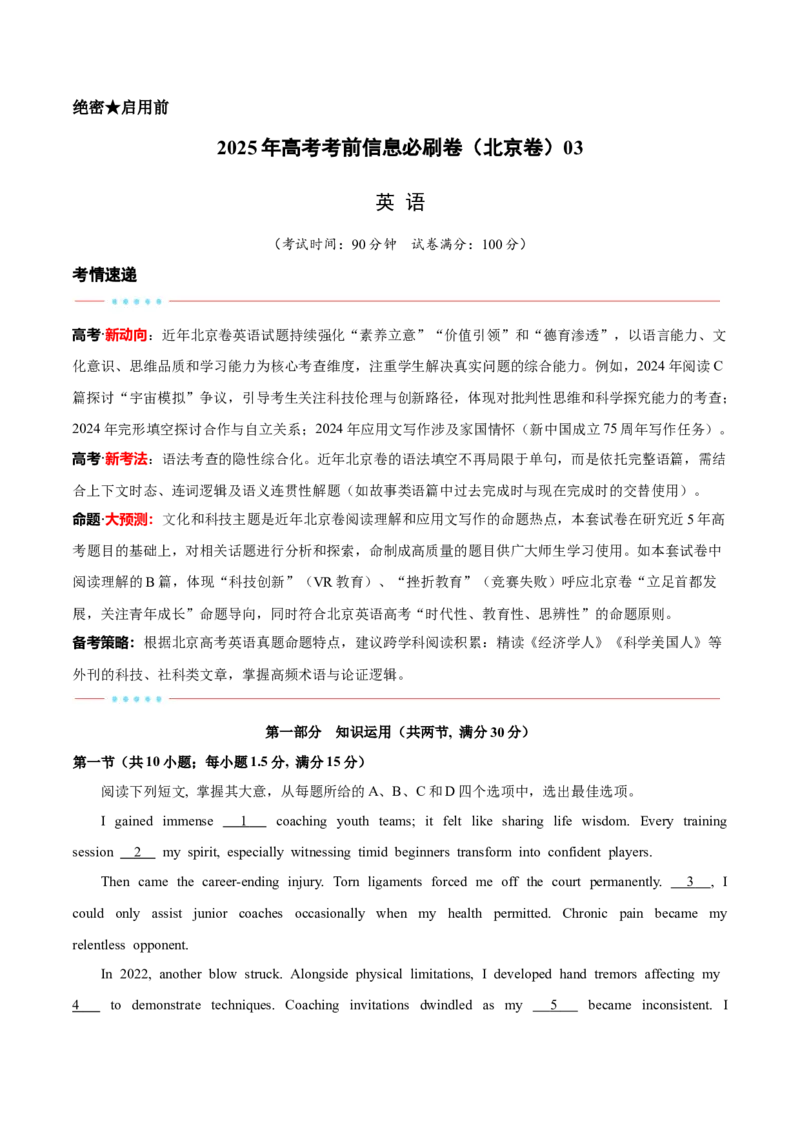
I gained immense 1 coaching youth teams; it felt like sharing life wisdom. Every training
session 2 my spirit, especially witnessing timid beginners transform into confident players.
Then came the career-ending injury. Torn ligaments forced me off the court permanently. 3 , I
could only assist junior coaches occasionally when my health permitted. Chronic pain became my
relentless opponent.
In 2022, another blow struck. Alongside physical limitations, I developed hand tremors affecting my
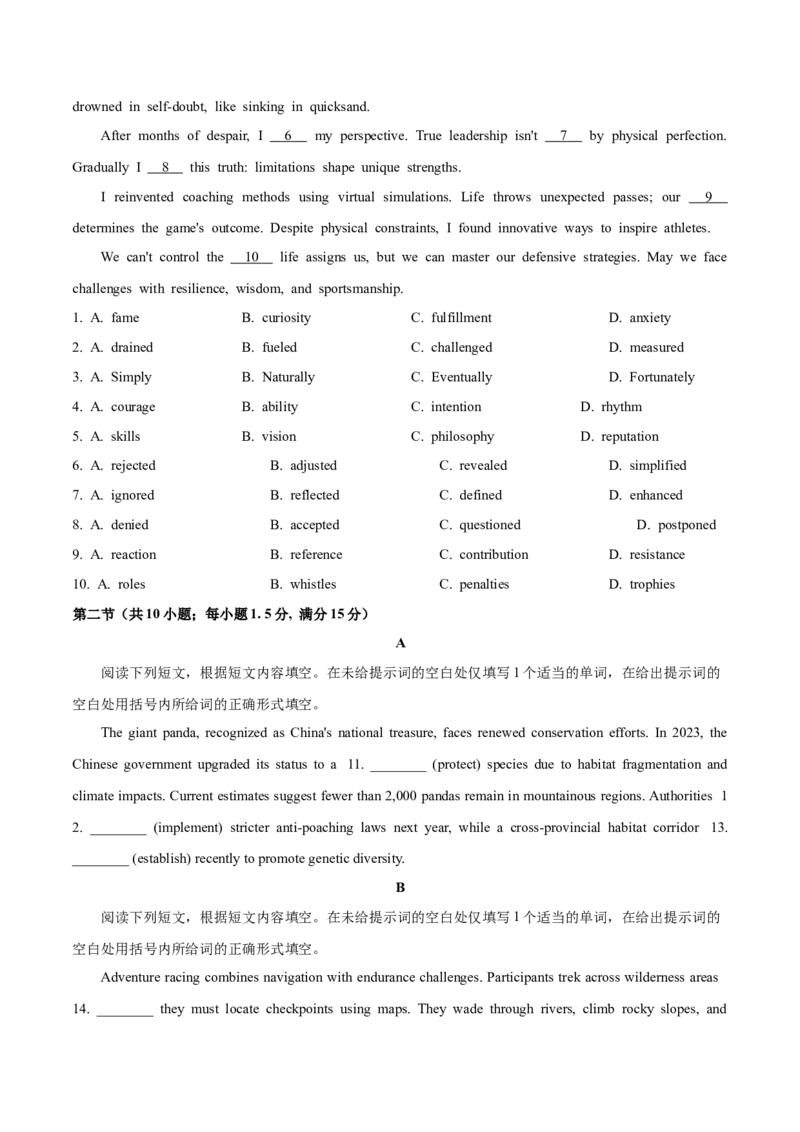
4 to demonstrate techniques. Coaching invitations dwindled as my 5 became inconsistent. Idrowned in self-doubt, like sinking in quicksand.
After months of despair, I 6 my perspective. True leadership isn't 7 by physical perfection.
Gradually I 8 this truth: limitations shape unique strengths.
I reinvented coaching methods using virtual simulations. Life throws unexpected passes; our 9
determines the game's outcome. Despite physical constraints, I found innovative ways to inspire athletes.
We can't control the 1 0 life assigns us, but we can master our defensive strategies. May we face
challenges with resilience, wisdom, and sportsmanship.
1. A. fame B. curiosity C. fulfillment D. anxiety
2. A. drained B. fueled C. challenged D. measured
3. A. Simply B. Naturally C. Eventually D. Fortunately
4. A. courage B. ability C. intention D. rhythm
5. A. skills B. vision C. philosophy D. reputation
6. A. rejected B. adjusted C. revealed D. simplified
7. A. ignored B. reflected C. defined D. enhanced
8. A. denied B. accepted C. questioned D. postponed
9. A. reaction B. reference C. contribution D. resistance
10. A. roles B. whistles C. penalties D. trophies
第二节(共10小题;每小题1. 5分, 满分15分)
A
阅读下列短文,根据短文内容填空。在未给提示词的空白处仅填写1个适当的单词,在给出提示词的
空白处用括号内所给词的正确形式填空。
The giant panda, recognized as China's national treasure, faces renewed conservation efforts. In 2023, the
Chinese government upgraded its status to a 11. ________ (protect) species due to habitat fragmentation and
climate impacts. Current estimates suggest fewer than 2,000 pandas remain in mountainous regions. Authorities 1
2. ________ (implement) stricter anti-poaching laws next year, while a cross-provincial habitat corridor 13.
________ (establish) recently to promote genetic diversity.
B
阅读下列短文,根据短文内容填空。在未给提示词的空白处仅填写1个适当的单词,在给出提示词的
空白处用括号内所给词的正确形式填空。
Adventure racing combines navigation with endurance challenges. Participants trek across wilderness areas
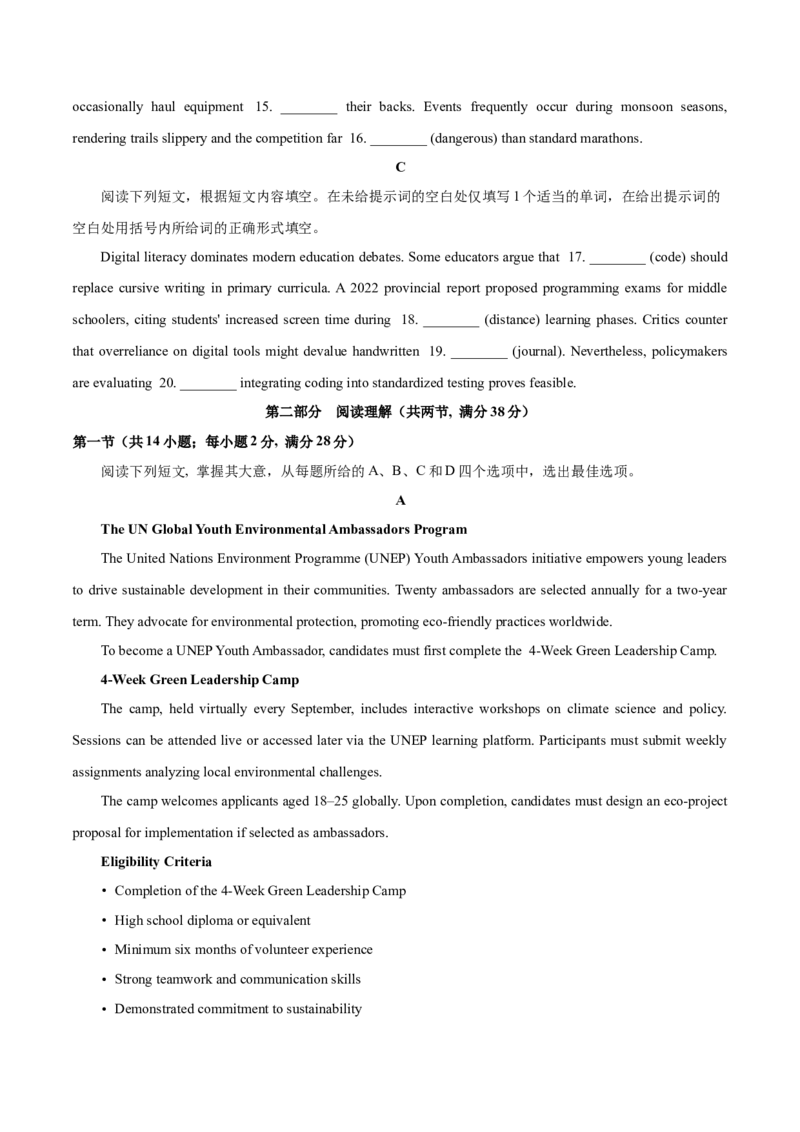
14. ________ they must locate checkpoints using maps. They wade through rivers, climb rocky slopes, andoccasionally haul equipment 15. ________ their backs. Events frequently occur during monsoon seasons,
rendering trails slippery and the competition far 16. ________ (dangerous) than standard marathons.
C
阅读下列短文,根据短文内容填空。在未给提示词的空白处仅填写1个适当的单词,在给出提示词的
空白处用括号内所给词的正确形式填空。
Digital literacy dominates modern education debates. Some educators argue that 17. ________ (code) should
replace cursive writing in primary curricula. A 2022 provincial report proposed programming exams for middle
schoolers, citing students' increased screen time during 18. ________ (distance) learning phases. Critics counter
that overreliance on digital tools might devalue handwritten 19. ________ (journal). Nevertheless, policymakers
are evaluating 20. ________ integrating coding into standardized testing proves feasible.
第二部分 阅读理解(共两节, 满分38分)
第一节(共14小题;每小题2分, 满分28分)
阅读下列短文, 掌握其大意,从每题所给的A、B、C和D四个选项中,选出最佳选项。
A
The UN Global Youth Environmental Ambassadors Program
The United Nations Environment Programme (UNEP) Youth Ambassadors initiative empowers young leaders
to drive sustainable development in their communities. Twenty ambassadors are selected annually for a two-year
term. They advocate for environmental protection, promoting eco-friendly practices worldwide.
To become a UNEP Youth Ambassador, candidates must first complete the 4-Week Green Leadership Camp.
4-Week Green Leadership Camp
The camp, held virtually every September, includes interactive workshops on climate science and policy.
Sessions can be attended live or accessed later via the UNEP learning platform. Participants must submit weekly
assignments analyzing local environmental challenges.
The camp welcomes applicants aged 18–25 globally. Upon completion, candidates must design an eco-project
proposal for implementation if selected as ambassadors.
Eligibility Criteria
• Completion of the 4-Week Green Leadership Camp
• High school diploma or equivalent
• Minimum six months of volunteer experience
• Strong teamwork and communication skills
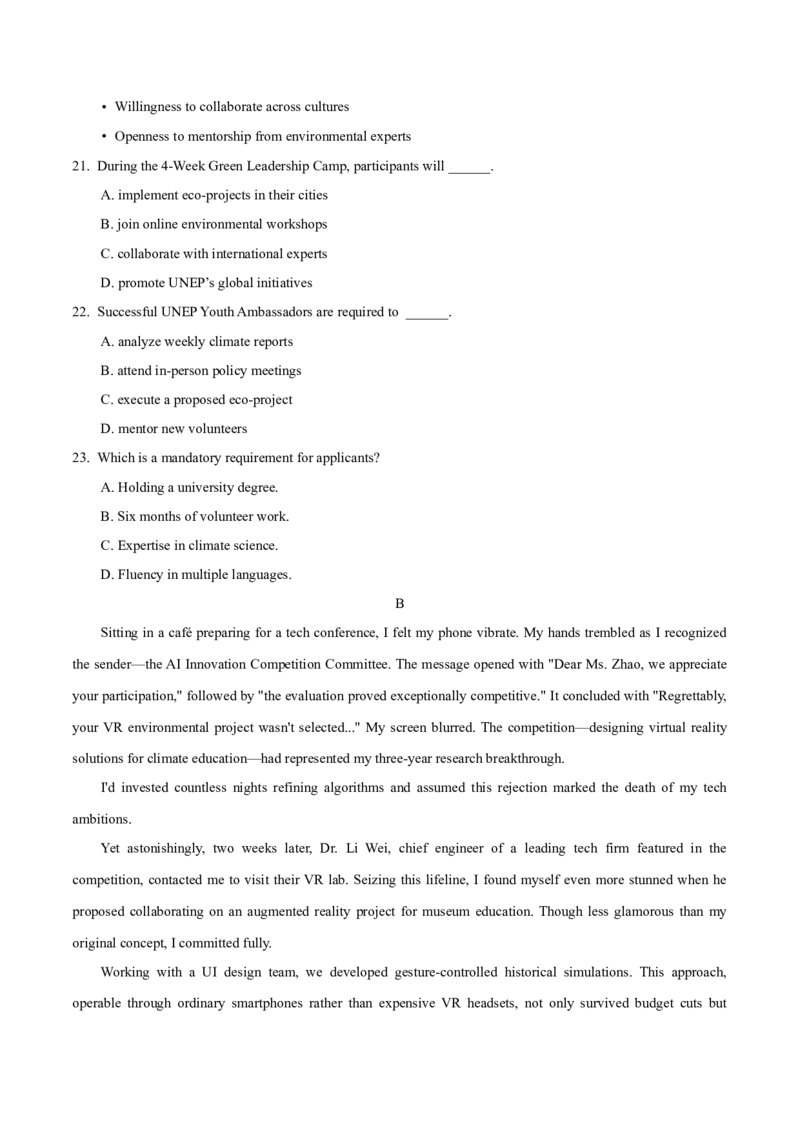
• Demonstrated commitment to sustainability• Willingness to collaborate across cultures
• Openness to mentorship from environmental experts
21. During the 4-Week Green Leadership Camp, participants will ______.
A. implement eco-projects in their cities
B. join online environmental workshops
C. collaborate with international experts
D. promote UNEP’s global initiatives
22. Successful UNEP Youth Ambassadors are required to ______.
A. analyze weekly climate reports
B. attend in-person policy meetings
C. execute a proposed eco-project
D. mentor new volunteers
23. Which is a mandatory requirement for applicants?
A. Holding a university degree.
B. Six months of volunteer work.
C. Expertise in climate science.
D. Fluency in multiple languages.
B
Sitting in a café preparing for a tech conference, I felt my phone vibrate. My hands trembled as I recognized
the sender—the AI Innovation Competition Committee. The message opened with "Dear Ms. Zhao, we appreciate
your participation," followed by "the evaluation proved exceptionally competitive." It concluded with "Regrettably,
your VR environmental project wasn't selected..." My screen blurred. The competition—designing virtual reality
solutions for climate education—had represented my three-year research breakthrough.
I'd invested countless nights refining algorithms and assumed this rejection marked the death of my tech
ambitions.
Yet astonishingly, two weeks later, Dr. Li Wei, chief engineer of a leading tech firm featured in the
competition, contacted me to visit their VR lab. Seizing this lifeline, I found myself even more stunned when he
proposed collaborating on an augmented reality project for museum education. Though less glamorous than my
original concept, I committed fully.
Working with a UI design team, we developed gesture-controlled historical simulations. This approach,
operable through ordinary smartphones rather than expensive VR headsets, not only survived budget cuts butoutperformed conventional systems. Ultimately, it redirected my focus toward accessible educational technology.
When applying for master's programs, I identified three universities supporting this new direction. The
familiar nervous hope returned. Being declined by my top choice hurt, but now I possessed the wisdom to prevent
despair. Eventually, I received an offer from another institution better aligned with my evolved vision.
This journey taught me that rigid roadmaps limit possibilities. Embracing unexpected opportunities, even
imperfect ones, often leads to unanticipated success.
24. How did the author react when noticing the message sender?
A. Relieved. B. Panicked.
C. Confused. D. Embarrassed.
25. After communicating with Dr. Li Wei, the author chose to ______.
A. abandon technology research
B. organize another competition
C. devote herself to the new project
D. challenge the evaluation criteria
26. The AR museum project was considered ______.
A. costly but effective
B. complex yet outdated
C. affordable and superior
D. entertaining but impractical
27. What message does the story convey?
A. Failure fuels fierce competition.
B. Technology replaces human effort.
C. Closed doors open new pathways.
D. Perfection guarantees achievement.
C
In the digital age, scholars across disciplines warn that cognitive fragmentation—scattered attention across
endless information—has eroded humanity’s capacity for deep focus. This fragmented thinking exacerbates critical
issues: misinformation spread, declining critical analysis, and weakened cultural continuity. Sociologist Liang Wen
argues that modern societies now inhabit a “perpetual present”, where “endless digital noise drowns reflection,
leaving minds trapped between fleeting stimulation and intellectual numbness”.
Studies confirm humans’ present bias toward instant gratification. Social media algorithms feed this bias,prioritizing viral content over substantive knowledge. In education, this manifests as students skimming headlines
instead of reading deeply; in policymaking, as prioritizing quick public approval over sustainable strategies. For
complex challenges like AI ethics, it breeds reluctance to establish long-term regulatory frameworks, favoring
temporary fixes that ignore future risks.
This cognitive shift stems from multiple factors, yet psychological patterns dominate. The availability
heuristic—overvaluing easily accessible information—is key. For example, one might claim: “This viral post says
AI is safe, so regulations aren’t urgent.” Similarly, emotionally charged content (e.g., celebrity scandals)
overshadows gradual societal shifts, like declining book-reading rates.
As a neuroscientist quipped, if aliens sought to paralyze human progress, they wouldn’t launch missiles;
they’d invent TikTok. Generational “attention amnesia” emerges: elders recall pre-digital concentration spans,
while youth perceive constant distraction as normal. A grandparent might remember hours spent reading novels; a
teenager, accustomed to 15-second videos, scarcely comprehends that depth of focus.
28. The author cites Liang Wen primarily to ________.
A. challenge a popular belief
B. define a core concept
C. emphasize cultural values
D. illustrate a scientific theory
29. What is implied in the last paragraph?
A. Traditional reading is irreplaceable.
B. Humans struggle to perceive gradual mental shifts.
C. Younger generations reject technological advancements.
D. Alien intervention explains cognitive deterioration.
30. What message does the author convey?
A. Fragmented thinking enhances adaptability.
B. Sustained attention is crucial for societal progress.
C. Algorithmic systems prioritize long-term benefits.
D. Viral content promotes critical analysis.
D
What is consciousness? Like the mystery of life itself, this question escapes definitive answers. Our
understanding is limited because consciousness manifests uniquely in biological systems. The emerging field of
quantum cognition (QC) seeks to decode consciousness’s fundamental rules by creating synthetic awareness inquantum simulations. QC researchers believe that engineering artificial consciousness could finally reveal its
essence.
So far, no quantum model has achieved true self-awareness. This fuels skepticism, with critics dismissing QC
as philosophical speculation. Dr. Elena Marquez, a quantum physicist, counters such doubts: “Questioning QC’s
practicality misses its purpose. Consciousness isn’t about utility,” she argues. “When asked ‘What’s the value of
synthetic consciousness?’, I reply, ‘What’s the value of a sunset?’”
Though QC resists commercial focus, its research may revolutionize AI. Quantum cognition shares DNA with
blockchain technology—both pursue decentralized innovation. QC aims to mimic the brain’s capacity for
spontaneous idea generation, a phenomenon exclusive to biological minds. Success here could birth machines
capable of unpredictable creativity.
QC’s progress differs from blockchain’s visible milestones. Its core challenge lies in defining
“consciousness”—a concept as elusive as QC itself. Divisions among QC scholars further cloud its path, resulting
in scattered experimental approaches. Ironically, QC’s chaotic evolution mirrors biological consciousness’s messy
emergence.
Unconstrained by rigid definitions, QC drives radical rethinking of classical theories. This turbulence might
not be unique. All revolutionary sciences may endure similar growing pains. Ultimately, QC’s significance may lie
not in its conclusions but in its inevitability as humanity’s next cognitive frontier.
31. Regarding Dr. Marquez’s defense of QC, the author is ______.
A. supportive B. critical
C. indifferent D. uncertain
32. What does the word “enthralled” underlined in Paragraph 3 most probably mean?
A. Restricted. B. Fascinated.
C. Confused. D. Replaced.
33. What can we infer from the passage?
A. Blockchain depends on QC’s breakthroughs.
B. QC and blockchain target decentralized systems.
C. Quantum models have achieved true innovation.
D. Blockchain accelerates biological consciousness.
34. Which would be the best title for the passage?
A. Consciousness Is Mysterious. Can Blockchain Decode It?
B. Consciousness Emerges. Will QC’s Journey Mirror Nature?C. Consciousness Is Fluid. Can Quantum Physics Freeze It?
D. Consciousness Evolves. Has Blockchain Outpaced QC?
第二节(共5小题;每小题2分, 满分10分)
根据短文内容,从短文后的七个选项中选出能填入空白处的最佳选项。选项中有两项为多余选项。
If you aim to excel in problem-solving, is it wiser to be a soloist (独奏者) or a collaborator? The soloist
works independently, diving deep into individual analysis, while the collaborator thrives in team dynamics,
integrating diverse perspectives.
Is one method inherently superior? Soloist-style thinkers often insist so. 35 They are widely admired
for their focused expertise and decisive conclusions. According to Dr. Wang Lei, a cognitive scientist, the “soloist
mindset” is crucial for developing precision in technical fields. These individuals master complex systems through
concentrated study, identify their unique strengths within their domain, and refine solutions with laser-like
accuracy. 3 6 The soloist approach appears a proven route to specialized mastery.
3 7 Professor Li Ming’s research on innovation patterns in tech startups reveals that soloists are less likely
to generate disruptive ideas compared to collaborators. Moreover, they often resist adjusting their strategies when
market demands shift.
Collaborators, however, leverage collective intelligence. They comfortably navigate conflicting viewpoints
and synthesize ideas from varied sources. 3 8 They actively seek to reconcile opposing proposals rather than
dismissing them. Additionally, collaborators demonstrate clearer awareness of their cognitive blind spots and
teammates’ strengths.
So, which strategy wins? The answer lies in a hybrid model. 3 9 Framing the choice as “soloist vs.
collaborator” creates a false dilemma. True problem-solving excellence emerges from blending both approaches—
the rare “solo-collaborator” who thinks deeply while engaging widely.
A. In reality, both strategies offer unique advantages.
B. They tend to prioritize efficiency over creative exploration.
C. Thus, they benefit from rigorous specialization and self-reliance.
D. Yet exclusive reliance on solo work carries hidden limitations.
E. However, soloists may selectively adopt external feedback.
F. When a teammate’s suggestion challenges their hypothesis, they engage constructively.
G. They commit wholly to one methodology, dismissing alternatives as distractions.
第三部分 书面表达(共两节,满分32分)
第一节(共4小题;第40、41题各2分,第42题3分,第43题5分,满分12分)阅读下面短文, 根据题目要求回答问题。
Lina, a 16-year-old environmental advocate, noticed plastic straws piling up in her school cafeteria.
Determined to address single-use plastic waste, she drew inspiration from her family's stainless steel straws at
home. "They worked well but were bulky to carry," Lina recalls. Her solution? A collapsible reusable straw called
StrawTwist.
The idea sparked when Lina watched her father struggle to pack rigid metal straws for camping trips. "I
wanted something portable yet eco-friendly," she says. The StrawTwist features a silicone body with a twist-lock
mechanism, folding into a capsule smaller than a lipstick. Its brush attachment ensures easy cleaning.
Now sold online and in eco-stores, Lina takes pride not just in sales but in her impact: each purchase funds
beach cleanups, and schools using StrawTwist report 60% less plastic waste. Despite winning national
sustainability awards, Lina stays grounded. Her advice to young innovators? "Start small but think big. Patience
beats perfectionism — prototypes will fail, but persistence pays off.
40. What problem did Lina observe in her school cafeteria?
41. Where did Lina get the idea for the StrawTwist design?
42. Please decide which part is false in the following statement, then underline it and explain why.
Lina feels proudest of StrawTwist's sales success because she uses expensive materials for durability and
comp▷letely replaces plastic straws in all schools.
43. Which of Lina's qualities do you find most valuable for solving real-world problems? Why? (In about 40
words)
第二节(满分20分)
44.假设你是红星中学高三学生李华。5月22日是国际生物多样性日,你在京学习的澳大利亚好友Amy
计划当天参加社区湿地保护志愿活动,并邀请你一同参与。请你用英文给她写一封邮件,内容包括:
1.是否愿意参加及理由;
2.建议其他保护生物多样性的行动(如拒绝购买濒危物种制品、参与校园生态调查等);
3. 表达对生态保护的长期支持。
注意:
1. 词数 100 左右;2. 开头和结尾已给出,不计入总词数。
Dear Tom
____________________________________________________________________________________________
____________________________________________________________________________________________
____________________________________________________________________________________________
____________________________________________________________________________________________
____________________________________________________________________________________________
Yours
Li Hua