文档文本内容
长对话分话题专项训练
专题 04 环境保护、动植物
一、听力选择题
听下面一段较长对话,回答以下小题。
1.What was Paul’s first impression of Pingyao?
A.Amazing. B.Disappointing. C.Peaceful.
2.How long is the history of Pingyao?
A.200 years. B.1,000 years. C.2,000 years.
3.Which place will Paul probably explore next time in Pingyao?
A.Rishengchang Bank. B.Shuanglin Temple. C.The city wall.
听下面一段较长对话,回答以下小题。
4.Why did the teenagers get up early?
A.To search for wild birds.B.To see the sunrise. C.To go hiking.
5.What do the speakers have?
A.A CD. B.A camera. C.A pair of sunglasses.
6.Where is one of the best bird watching sites in China?
A.The Great Wall. B.The Qinling Mountains. C.The Yellow River.
听下面一段较长对话,回答以下小题。
7.How long have Mount Tai and the temples been protected?
A.Over 1,000 years. B.Over 2,000 years. C.Over 3,000 years.
8.Why is Mount Tai chosen as the subject for this project?
A.It is a great example of cultural heritage preservation.
B.It is known as “China’s foremost mountain”.
C.It offers the best hiking experience.
9.What additional services does the app include about Mount Tai?A.Maps of hiking paths.
B.Games about cultural relics.
C.Restaurant recommendations.
听下面一段较长对话,回答以下小题。
10.How does the woman feel about the poster?
A.Funny. B.Useless. C.Meaningful.
11.How many species die out every day according to the poster?
A.50 to 100. B.150 to 200. C.250 to 300.
12.What are the reasons for species dying out?
A.Overpopulation and climate change.
B.Pollution and habitat loss.
C.Lack of food and water.
听下面一段较长对话,回答以下小题。
13.What does the man suggest to protect wildlife?
A.Stopping hunting. B.Raising awareness. C.Using technology.
14.What does the woman suggest to help protect wildlife?
A.Making more posters. B.Creating wildlife reserves. C.Ensuring clean air and water.
听下面一段较长对话,回答以下小题。
15.What do sharks think of humans according to the new research?
A.Delicious. B.Not tasty. C.Friendly.
16.What probably makes sharks attack humans?
A.Curiosity. B.Fright. C.Hunger.
17.Why should sharks be afraid of humans?
A.Humans far outnumber sharks.
B.Many sharks are killed by humans.
C.Their living environment is polluted by humans.
听下面一段较长对话,回答以下小题。18.How does Leo deal with dying flowers?
A.Clear them out. B.Keep them indoors. C.Put them in the sunlight.
19.How often does Leo think the plants should be watered?
A.Twice a day. B.Every two days. C.Twice a week.
20.What are the speakers mainly talking about?
A.Buying flowers.
B.Raising houseplants.
C.Downloading an app for houseplants.
听下面一段较长对话,回答以下小题。
21.Why did the man take all the glass back home?
A.There was no space in the bottle bank (玻璃回收站).
B.The glass was broken.
C.The bottle bank was closed.
22.What does the woman suggest the man do?
A.Leave the glass on the ground.
B.Make a complaint to a newspaper.
C.Empty the bottle bank more often.
听下面一段长对话,回答小题。
23.What does the man find lovely?
A.A dress. B.A dog. C.A child.
24.Who is Greg?
A.The woman’s boss.
B.The woman’s friend.
C.The woman’s husband.
听下面一段对话,回答以下小题。
25.What is the relationship between the speakers?
A.Classmates. B.Guide and visitor. C.Teacher and student.
26.Where is the bird usually seen?A.Up in the tree. B.Beside a river. C.High in the sky.
27.Why does the bird keep looking around?
A.To enjoy the sight. B.To defend himself. C.To search for food.
听下面一段较长对话,回答以下小题。
28.What are the two speakers talking about?
A.Waste collection. B.House cleaning. C.Building materials.
29.When is garbage collected?
A.On Mondays. B.On Wednesdays. C.On Thursdays.
听下面一段较长对话,回答以下小题。
30.What is the aim of the campaign?
A.To remind people of Earth Day.
B.To encourage people to reduce garbage.
C.To warn people of the negative impacts of pollution.
31.What will be the task on the second day?
A.Growing trees. B.Designing posters. C.Collecting garbage.
32.What does the man expect the teachers to do?
A.Paint paper. B.Stop driving cars. C.Decorate classrooms.
33.How does Sara find the man’s ideas?
A.Strange. B.Funny. C.Superb.
听下面一段较长对话,回答以下小题。
34.How long can a mouse live at most?
A.Three years. B.Twenty years. C.Seventy years.
35.What affects the lifetime of animals according to scientists?
A.The diet. B.The behavior. C.The heart rate.
听下面一段较长对话,回答以下小题。
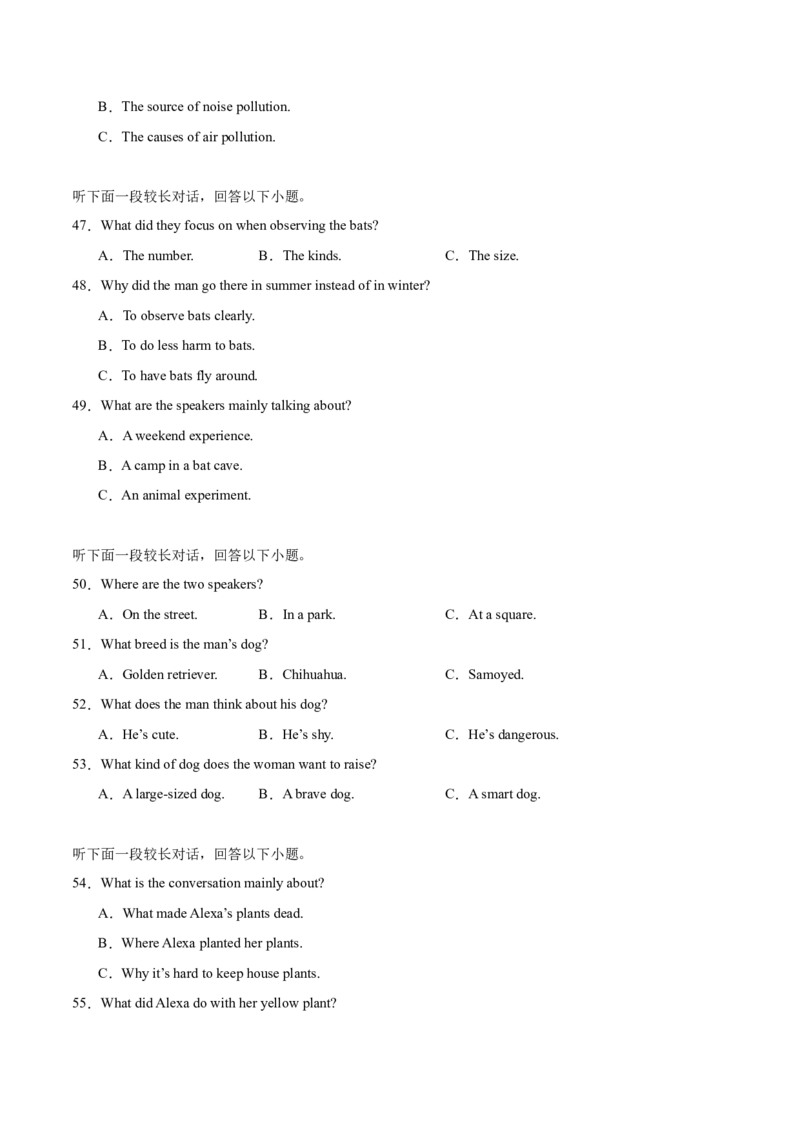
36.How many types of flowers are there in the garden?
A.Ten. B.Twenty. C.Thirty.37.What can Sally get from her grandmother in the autumn?
A.Cabbages. B.Lettuce. C.Carrots.
38.What does Sally’s grandmother do when it gets cold?
A.She covers her plants.
B.She clears out the dead plants.
C.She gives some food to the animals.
39.What does Nick think of growing a garden?
A.It needs a lot of work.
B.It takes too much time.
C.It can help save some money.
40.Where is the factory mentioned in the dialogue?
A.Near the town. B.Far from the town. C.North of the town.
41.How much rubbish can the factory deal with each day?
A.300 tons. B.3,000 tons. C.30,000 tons.
42.What can we learn from the conversation?
A.A big factory is being built to deal with the rubbish.
B.Another factory will be set up in town to produce rubbish.
C.A factory was built to clean the town.
听下面一段较长对话,回答以下小题。
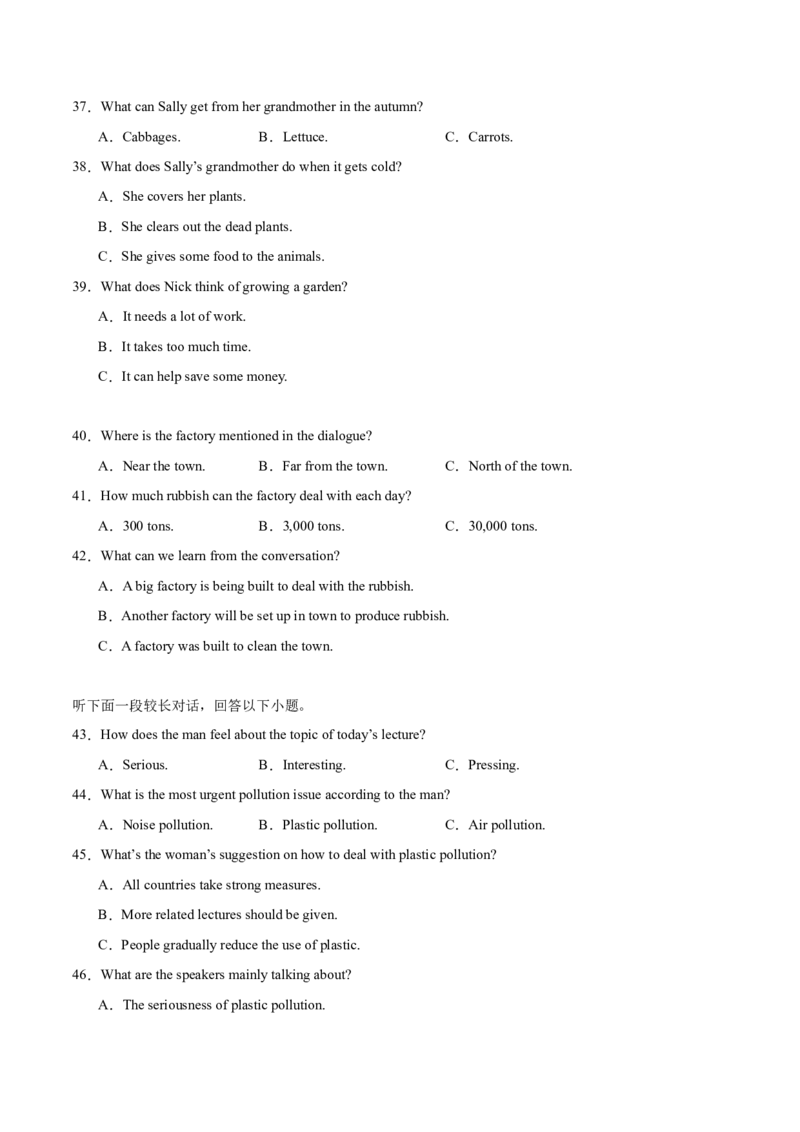
43.How does the man feel about the topic of today’s lecture?
A.Serious. B.Interesting. C.Pressing.
44.What is the most urgent pollution issue according to the man?
A.Noise pollution. B.Plastic pollution. C.Air pollution.
45.What’s the woman’s suggestion on how to deal with plastic pollution?
A.All countries take strong measures.
B.More related lectures should be given.
C.People gradually reduce the use of plastic.
46.What are the speakers mainly talking about?
A.The seriousness of plastic pollution.B.The source of noise pollution.
C.The causes of air pollution.
听下面一段较长对话,回答以下小题。
47.What did they focus on when observing the bats?
A.The number. B.The kinds. C.The size.
48.Why did the man go there in summer instead of in winter?
A.To observe bats clearly.
B.To do less harm to bats.
C.To have bats fly around.
49.What are the speakers mainly talking about?
A.A weekend experience.
B.A camp in a bat cave.
C.An animal experiment.
听下面一段较长对话,回答以下小题。
50.Where are the two speakers?
A.On the street. B.In a park. C.At a square.
51.What breed is the man’s dog?
A.Golden retriever. B.Chihuahua. C.Samoyed.
52.What does the man think about his dog?
A.He’s cute. B.He’s shy. C.He’s dangerous.
53.What kind of dog does the woman want to raise?
A.A large-sized dog. B.A brave dog. C.A smart dog.
听下面一段较长对话,回答以下小题。
54.What is the conversation mainly about?
A.What made Alexa’s plants dead.
B.Where Alexa planted her plants.
C.Why it’s hard to keep house plants.
55.What did Alexa do with her yellow plant?A.She put it in the sunlight.
B.She returned it to the shop.
C.She gave it too much water.
56.What does the man suggest Alexa do?
A.Throw all her plants away.
B.Find out more about plants online.
C.Move all her plants out of the sun.
听下面一段较长对话,回答以下小题。
57.What are the speakers mainly talking about?
A.A family story. B.A garden. C.A travel plan.
58.Where are the trees by the house from?
A.Australia. B.America. C.New Zealand.
听下面一段较长对话,回答以下小题。
59.Where are the speakers?
A.On a hill.
B.On a snow mountain.
C.On a volcano.
60.When did the bad earthquake happen?
A.10 years ago.
B.50 years ago.
C.100 years ago.
听下面一段较长对话,回答以下小题。
61.Where are the speakers?
A.In a house.
B.In a park.
C.In a school.
62.What is the man?
A.A dustman.B.A teacher.
C.A student.
63.What does most of the litter consist of?
A.Cans.
B.Bottles.
C.Papers.
64.What can the speakers be described?
A.Careless.
B.Awkward
C.Responsible.
听下面一段较长对话,回答以下小题。
65.Where are the speakers?
A.At a science lab
B.At a plastic factory
C.At a paper recycling station
66.What is unwanted in the process?
A.Paper.
B.Plastic.
C.Water.
67.Who is the woman?
A.A writer.
B.A factory owner.
C.A photographer.
听下面一段较长对话,回答以下小题。
68.Who is the man?
A.A host. B.A star. C.A researcher.
69.What do we know about Genie?
A.She lives in Hawaii.
B.She was the longest shark.C.She traveled a long distance.
70.What was the scientists’ response towards Genie’s journey?
A.Worried. B.Amazed. C.Doubtful.
71.What will the speakers talk about later?
A.The tracking system. B.Some clever whales. C.A new song.
听下面一段较长对话,回答以下小题。
72.When did the woman start running in the park?
A.Today. B.One month ago. C.One year ago.
73.What is Plogging according to the man’s introduction?
A.A global trend that started this year.
B.An activity for the benefit of marathon runners.
C.A new trend combining picking up trash and running.
74.Why is Plogging becoming popular?
A.Because of the good effect of losing weight.
B.Because of the desire to be close to nature.
C.Because of the increasing awareness of the plastic problems.
听下面一段较长对话,回答以下小题。
75.How does the man feel now?
A.Worried. B.Puzzled. C.Bored.
76.What has pollution caused according to the man?
A.Damage to natural resources.
B.Ecosystem imbalances.
C.The spread of disease.
77.What does the woman suggest doing now?
A.Protecting wildlife from extinction.
B.Listing the harmful effects of pollution.
C.Letting people know pollution is serious.
听下面一段较长对话,回答以下小题。78.What does the man ask the woman to do for the dog?
A.To bathe it. B.To feed it. C.To walk it.
79.Why does the woman refuse to keep a dog?
A.She can’t afford a dog.
B.She has no room for the dog.
C.She dislikes the dog’s barking.
80.Who’d like to have a cat at home?
A.The woman. B.The man. C.The woman’s mother.
81.What kind of pet will the man have finally?
A.A parrot. B.A rabbit. C.A cat.
听下面一段较长对话,回答以下小题。
82.Where are the speakers?
A.At school. B.On the street. C.At a bus stop.
83.What are the speakers planning to do?
A.Talk to the boy. B.Pick up the bottle. C.Call the teacher.
84.What do we know about the woman?
A.She is quite polite.
B.She cares about the planet.
C.She has great respect for others.
85.What is the probable relationship between the speakers?
A.Classmates. B.Strangers. C.Teacher and student.
听下面一段较长对话,回答以下小题。
86.Where did the woman do volunteer work last summer?
A.On the coast. B.In a park. C.At a shelter.
87.Why does the man want to do volunteer work?
A.To help the homeless. B.To protect the environment. C.To look after animals.
88.What will the man do this evening?
A.Talk to his parents. B.Surf the Internet. C.Call community organizations.听下面一段较长对话,回答以下小题。
89.Why did John go to Kenya?
A.To take a business trip.
B.To see wild animals.
C.To visit his parents.
90.What did some farmers do with the elephant in that village?
A.They put it to death. B.They drove it away. C.They protected it.
91.What solution is mentioned?
A.Giving farmers more food.
B.Removing the farmers.
C.Offering elephants more space.