文档文本内容
• 微博@新东方 彤彤 老师
• 考研英语、考博英语
主讲
• 新东方大学事业部优秀教师、绩优教师
• 西安外国语翻译学 优秀生源& 优秀毕业生
415 88
• 初试成绩 ;考研英一 分
• 曾任西安外国语大学中文系外聘教师
西京大学外语学院兼职英语教师课前请准备
03
01 02
黑、红两种笔 笔记本-句型梳理 空白草稿本考研写作预备⑤
从零起步:打造高效写作技能
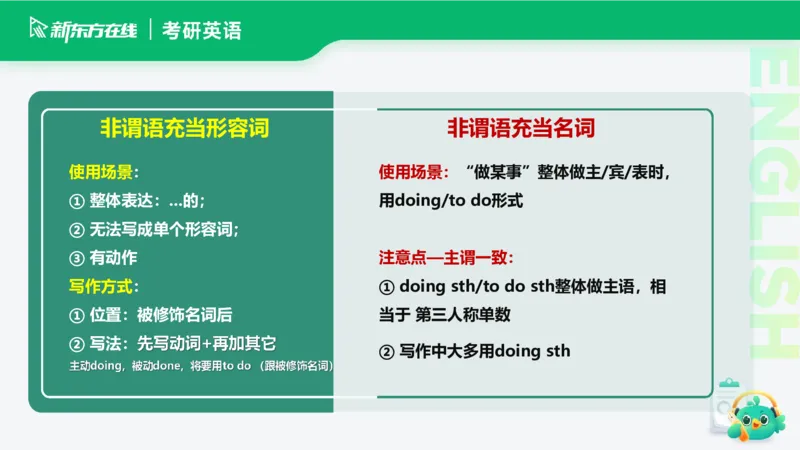
彤彤老师@新东方彤彤老师非谓语充当形容词 非谓语充当名词
使用场景: 使用场景:“做某事”整体做主/宾/表时,
① 整体表达:...的; 用doing/to do形式
② 无法写成单个形容词;
③ 有动作 注意点—主谓一致:
写作方式: ① doing sth/to do sth整体做主语,相
① 位置:被修饰名词后 当于 第三人称单数
② 写法:
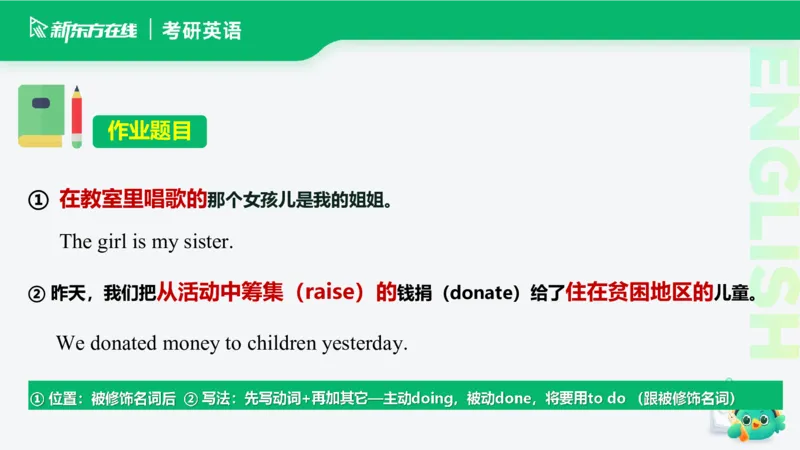
② 写作中大多用doing sth作业题目
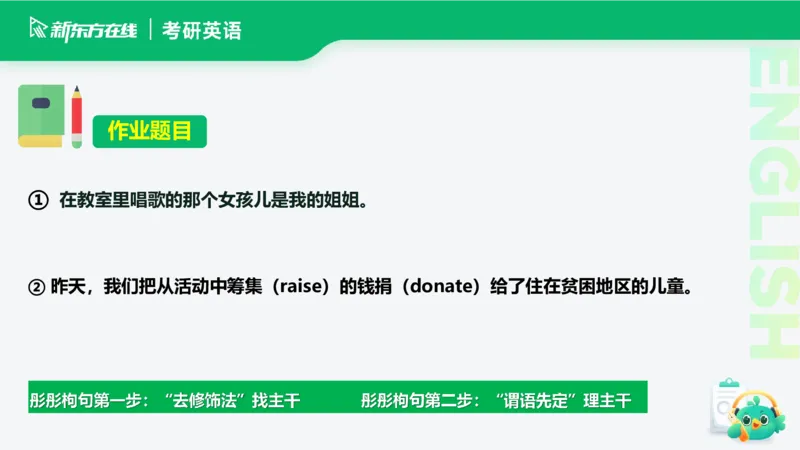
① 在教室里唱歌的那个女孩儿是我的姐姐。
② 昨天,我们把从活动中筹集(raise)的钱捐(donate)给了住在贫困地区的儿童。作业题目
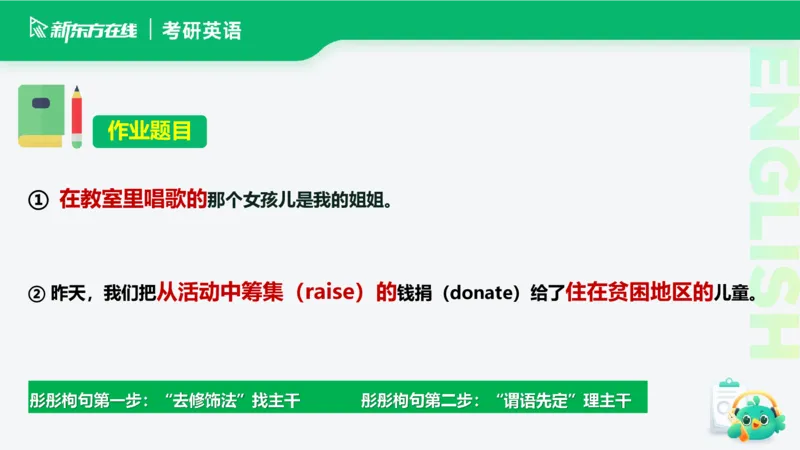
① 在教室里唱歌的那个女孩儿是我的姐姐。
② 昨天,我们把从活动中筹集(raise)的钱捐(donate)给了住在贫困地区的儿童。作业题目
① 在教室里唱歌的那个女孩儿是我的姐姐。
The girl is my sister.
② 昨天,我们把从活动中筹集(raise)的钱捐(donate)给了住在贫困地区的儿童。
We donated money to children yesterday.作业题目
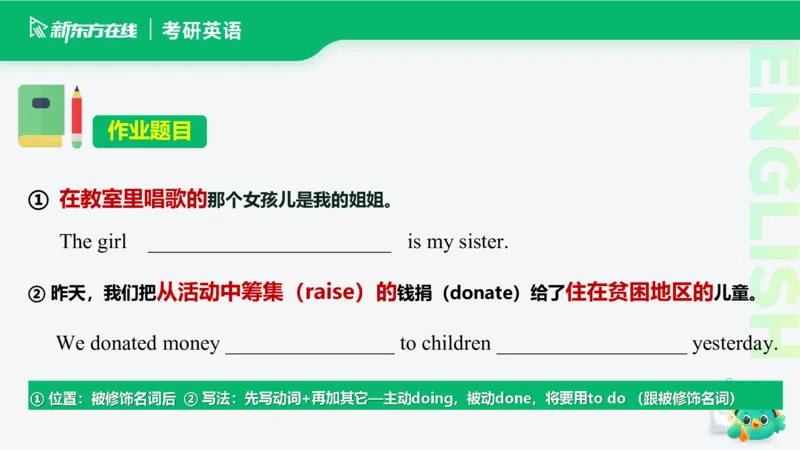
① 在教室里唱歌的那个女孩儿是我的姐姐。
The girl _______________________ is my sister.
② 昨天,我们把从活动中筹集(raise)的钱捐(donate)给了住在贫困地区的儿童。
We donated money ________________ to children __________________ yesterday.作业题目
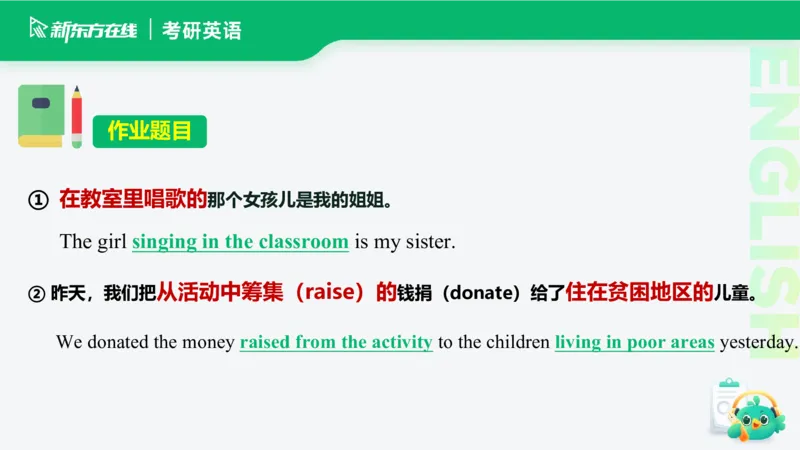
① 在教室里唱歌的那个女孩儿是我的姐姐。
The girl singing in the classroom is my sister.
② 昨天,我们把从活动中筹集(raise)的钱捐(donate)给了住在贫困地区的儿童。
We donated the money raised from the activity to the children living in poor areas yesterday.标
目
节
本
1 掌握 非谓语的常见功能
2 掌握 非谓语的写作应用=形容词,修饰名词
=副词,修饰句子语法概述—非谓语做状语
p To save the child, he spent all his money.
p Driven by his dream, he decided to work hard.
p Listening to that song, I felt very happy.语法概述—非谓语做状语
p To save the child, he spent all his money.
p Driven by his dream, he decided to work hard.
p Listening to that song, I felt very happy.
修饰句子的非谓语 句子主语语法概述—非谓语做状语
p To save the child, he spent all his money.
表示”目的“
p Driven by his dream, he decided to work hard. 与句子主语之间—被动
p Listening to that song, I felt very happy.
与句子主语之间—主动
修饰句子的非谓语 句子主语doing/done修饰名词/修饰句子的区别
I have read three books written by Mo Yan this year.
修饰名词
The boy sitting on the steps wants the book.
修饰名词
Driven by his dream, he decided to work hard.
The government has raised a lot of money, encouraging people to visit museums.doing/done修饰名词/修饰句子的区别
I have read three books written by Mo Yan this year.
修饰名词,紧跟名词后,无逗号
The boy sitting on the steps wants the book.
修饰句子,句前/句后,有逗号
Driven by his dream, he decided to work hard.
The government has raised a lot of money, encouraging people to visit museums.1
doing/done修饰句子
使用场景 :主语的”第二个动作“
Ø 考虑到这些原因,我们可以得出结论(come to a conclusion)。1
doing/done修饰句子
使用场景 :主语的”第二个动作“
Ø 考虑 得出
到这些原因,我们可以 结论(come to a conclusion)。
动作2 动作11
doing/done修饰句子
使用场景 :主语的”第二个动作“
Ø 考虑 得出
到这些原因,我们可以 结论(come to a conclusion)。
We can come to a conclusion.1
doing/done修饰句子
使用场景 :主语的”第二个动作“
Ø 考虑 得出
到这些原因,我们可以 结论(come to a conclusion)。
Considering these reasons, we can come to a conclusion.Practice
1. 受到Jack的驱使,我昨天参加了那场活动。
2. 住在大城市,我感到非常地开心。Practice
1. 受到Jack的驱使,我昨天参加了那场活动。
2. 住在大城市,我感到非常地开心。Practice
1. 受到Jack的驱使,我昨天参加了那场活动。
I attended the activity yesterday.
2. 住在大城市,我感到非常地开心。
I feel very happy.Practice
1. 受到Jack的驱使,我昨天参加了那场活动。
Driven by Jack, I attended the activity yesterday.
2. 住在大城市,我感到非常地开心。
Living in a big city, I feel very happy.2
to do 的用法
使用场景1 :句末加(无逗号),表达”去/来做某事“
Ø 政府颁布了很多政策来鼓励(encourage)人们去种树。
Ø The government issued many policies __________________________________.2
to do 的用法
使用场景1 :句末加(无逗号),表达”去/来做某事“
Ø 政府颁布了很多政策来鼓励(encourage)人们去种树。
Ø The government issued many policies to encourge people to plant trees.2
to do 的用法
使用场景2 :句首逗号隔开/句末(无逗号),表达”为了做某事“
Ø 为了实现我的梦想,我必须努力学习。2
to do 的用法
使用场景2 :句首逗号隔开/句末(无逗号),表达”为了做某事“
Ø 为了实现我的梦想,我必须努力学习。
Ø To realize my dream, I must study hard.
Ø I must study hard to realize my dream.doing/done修饰句子 to do 修饰句子
使用场景:
使用场景① :表达“去/来做某事”
主语的”第二个动作“
写法:句末直接写,无逗号
写作方式:
① 位置:可以跟中文一致
使用场景②:表达“为了做某事”
② 写法:主动doing
被动done 写法1:句首直接写,逗号隔开
✹跟主语之间的主被动
写法2:句末直接写,不写逗号
注意:有逗号隔开Practice
① 我们使用电脑来节省时间。
② 走在公园里,我注意到一只美丽的蝴蝶(butterfly)。
③ 从山上看,这个村庄(village)非常美丽。谢谢!
微博@新东方彤彤老师 小红书
作业打卡不迷路~ 日常学习分享~