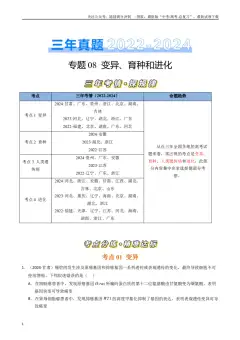
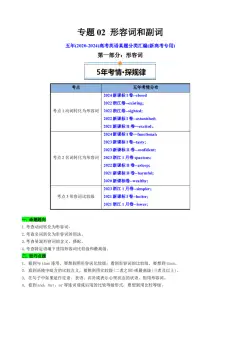
专题 06 完形填空
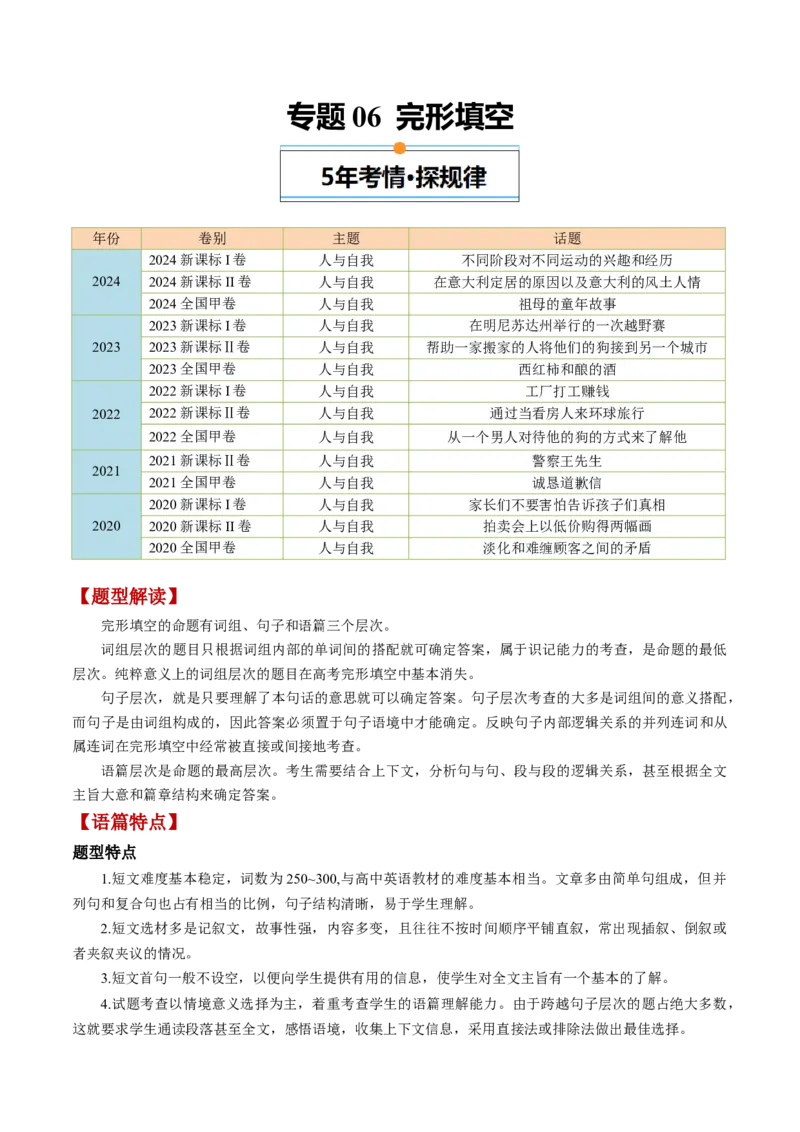
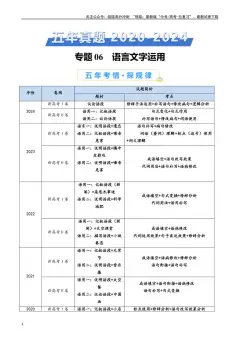
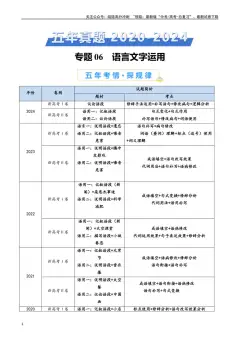
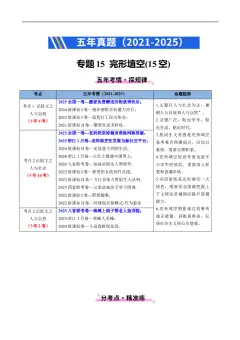
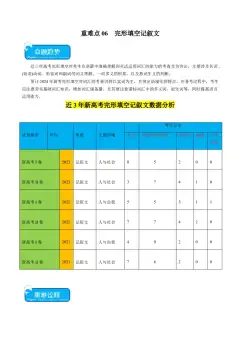
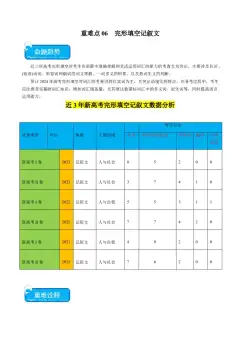
年份 卷别 主题 话题
2024新课标I卷 人与自我 不同阶段对不同运动的兴趣和经历
2024 2024新课标II卷 人与自我 在意大利定居的原因以及意大利的风土人情
2024全国甲卷 人与自我 祖母的童年故事
2023新课标I卷 人与自我 在明尼苏达州举行的一次越野赛
2023 2023新课标Ⅱ卷 人与自我 帮助一家搬家的人将他们的狗接到另一个城市
2023全国甲卷 人与自我 西红柿和酿的酒
2022新课标I卷 人与自我 工厂打工赚钱
2022 2022新课标Ⅱ卷 人与自我 通过当看房人来环球旅行
2022全国甲卷 人与自我 从一个男人对待他的狗的方式来了解他
2021新课标Ⅱ卷 人与自我 警察王先生
2021
2021全国甲卷 人与自我 诚恳道歉信
2020新课标I卷 人与自我 家长们不要害怕告诉孩子们真相
2020 2020新课标II卷 人与自我 拍卖会上以低价购得两幅画
2020全国甲卷 人与自我 淡化和难缠顾客之间的矛盾
【题型解读】
完形填空的命题有词组、句子和语篇三个层次。
词组层次的题目只根据词组内部的单词间的搭配就可确定答案,属于识记能力的考查,是命题的最低
层次。纯粹意义上的词组层次的题目在高考完形填空中基本消失。
句子层次,就是只要理解了本句话的意思就可以确定答案。句子层次考查的大多是词组间的意义搭配,
而句子是由词组构成的,因此答案必须置于句子语境中才能确定。反映句子内部逻辑关系的并列连词和从
属连词在完形填空中经常被直接或间接地考查。
语篇层次是命题的最高层次。考生需要结合上下文,分析句与句、段与段的逻辑关系,甚至根据全文
主旨大意和篇章结构来确定答案。
【语篇特点】
题型特点
1.短文难度基本稳定,词数为250~300,与高中英语教材的难度基本相当。文章多由简单句组成,但并
列句和复合句也占有相当的比例,句子结构清晰,易于学生理解。
2.短文选材多是记叙文,故事性强,内容多变,且往往不按时间顺序平铺直叙,常出现插叙、倒叙或
者夹叙夹议的情况。
3.短文首句一般不设空,以便向学生提供有用的信息,使学生对全文主旨有一个基本的了解。
4.试题考查以情境意义选择为主,着重考查学生的语篇理解能力。由于跨越句子层次的题占绝大多数,
这就要求学生通读段落甚至全文,感悟语境,收集上下文信息,采用直接法或排除法做出最佳选择。设空特点
1.设空密度稳定。在250~300词的短文中,设空为15个。稳定的设空密度决定了完形填空稳定的命题
难度。
2.设空以实词为主,虚词为辅;单词为主,短语为辅。高中英语完形填空试题绝大部分是单词填空,
短语填空的题量极少,且以实词(动词、形容词、副词等)为主,虚词(连词、介词等)为辅。这就需要学生根
据上下文语境和逻辑关系进行词义辨析。
3.设空词汇均不超出考纲词汇,且仅涉及基本意义和用法。在“瞻前顾后”的前提下,学生只要进行
细致推敲和细微辨析,就能够锁定最佳选项。
【解题策略】
1.通览-速读全文,把握大意
快速阅读全文要求学生一气呵成,跳过空格或不明白的地方,通览全文,领会短文大意(when、who、
where、what、how),大致了解文章的体裁、背景、内容、结构层次、情节、写作风格等,获得整体印象,
弄清行文脉络,找出主旨和关键词。在通读全文时,学生应重视首句的开篇启示作用,注意文中反复出现
的主题词,体会作者的行文思路,从宏观上把握全文,找出解题突破口。
2.试填-“瞻前顾后”,先易后难
在理解全文的基础上,学生应结合所给选项细读全文,联系上下文、词汇意义、固定搭配和句法结构
寻找解题线索,逐层深入,各个击破。“瞻前顾后”即前后观察,对空格前后内容深入分析,确定空格在
句中的意思。如果是语义问题,要根据上下文完整的语境进行推敲;如果是语法问题,则要考虑整体时态、
语态以及词法、句法。“瞻前顾后”时,应特别注意首尾照应,既要明确首句引出全文的重要地位,也不
要忽视尾句画龙点睛的作用。先易后难即首先选出能直接确定的答案,如固定搭配、常见句型等,然后回
过头来集中精力解决难度较大的问题。
3.复核-全面检查,精选答案,消除疏漏
试填这一步完成后,应再次通读一遍全文,注意检查所选答案填入空白处后能否做到文意通顺、前后
连贯、逻辑严谨、结构完整。在复查过程中,如果有某些地方意义含混不清或矛盾,应该依据文章的中心
意思再次推敲,反复斟酌,从意义和语法两个角度仔细权衡,加以改正,以便弥补疏漏。
【考法归纳】
01跳读首尾句进行预测
一般来讲,高考完形填空的首、尾句通常是不挖空的。先跳读这两句,便可判断体裁,猜想它要讲什
么。若首句交代了when, where, who, what,即四个W,那么就是记叙文,很可能就是一个故事;若首句是
提出或解释说明某事物,一般来说是说明文;若首句提出一个论点,那么就是议论文。
02 利用语法分析解题
完形填空虽然以语境填空为主,但也有部分考查语法项目的题目。对于这类题,考生可以利用平时所
学的词汇知识,分析单词(组)的使用范围、动词的及物和不及物,并利用句子结构、句式特点等知识全面
衡量所有选项排除干扰。
03 利用固定搭配解题
完形填空题中对词汇知识的考查,主要体现在习惯用法和同义词、近义词的辨析两方面。习惯用法是英语中某种固定的结构形态,即所谓的“习语”,不能随意改动。所以,考生平时应掌握好习惯用法。对
词义辨析题的考查有加大力度的趋势。要做好这类题,需要有较大的词汇量和词语搭配能力、词语辨析能
力,特别是在特定的语境中能灵活运用的能力。
04 利用固定句型解题
完形填空虽然注重考查语境理解,但同时也会考到一些固定句型,考生掌握好这些句型,对确定题目
的答案很有帮助。
05 利用复现信息解题
语篇复现的信息包括原词复现、同义词和反义词复现、上义词和下义词复现、概括词复现和代词复现
等。语篇中有词汇和结构同现的现象,如与语篇话题相关、意义相关的词汇同时出现,结构同现,同义同
现,修饰同现,因果同现等。因此,利用上下文寻找解题信息,确定正确答案。
06 利用跳读法解题
一般而言,完形填空要填的20空中总有一些空是相对简单的。对于这类空格考生可以先将其确定下来,
之后再逐个去突破其他空。跳过那些不太容易得出答案的题。切忌做题时循规蹈矩地一个顺着一个地去完
成。
07 巧用排除法解题
在有些情况下,考生如果不能很有把握地直接得出某一道题的答案,可以把排除法和词汇、语法分析
结合起来运用,缩小选择的范围,提高正确率。
08 利用逻辑关系解题
尝试从逻辑关系的高度整体上把握,就会不无惊喜地发现逻辑关系才是征服完形填空的最佳途径。所
谓逻辑关系并不缥缈,它就隐藏在句子中、句与句之间以及段落与段落的衔接中。通过逻辑关系的方法,
我们可以通过确切、具体的线索,把答案的逻辑意义推测出来,从而在答案中寻找表现了相同逻辑意义的
选项。(1) 句中逻辑关系(2) 句间逻辑关系(3) 段间逻辑关系
09 巧用背景常识解题
解答完形填空题时,有时文章中提供的信息还不够,还需要把读者头脑中储存的一般知识信息结合起
来考虑,最后作出符合常识的最佳答案。因此,考生的知识范围越广,则对文章的理解会更容易,整体上
知道所选短文在说什么,那么局部上的每一个空填起来也会得心应手。因此解答完形填空题时,考生的英
语语言知识和有关世界的知识,都发挥着重要的作用。
10 利用对比结构解题
对比结构常把两种对立的事物或同一事物的两个不同方面并列出来加以比较或对比。高考完形填空题
常常利用句子之间的对比关系或者同一个句子的不同部分之间的对比关系设计题目。
11 利用平行结构解题
平行结构指的是结构相同或相似,意思密切关联,语法一致的句子或词组成串排列的语言现象。这些
结构的形式整齐匀称,内容联系紧密。
12 利用暗示和对应解题
完形填空题中虽然也穿插了对语法、短语和单词的辨析、句子结构的考查等,但对文章故事情节发展
线索的逻辑考查仍是重点。暗示与上下对应的思维方法,是突破此类完形填空最关键的思维方式。考生在
做题时要有全局观念,进行连贯性思维,做题时要把每个空白处的含义与前后句的意思联系起来理解,进
行合乎逻辑的推理判断。难选之处前后通常多有暗示,这种暗示多为后面暗示前面。13 根据文章的感情色彩解题
考生在第一遍通读时,应在掌握文章大意,弄清作者思路的基础上,着重寻找反映语境褒贬性的标志
性词汇或句子,这些标志性词汇或句子往往对文章的语境褒贬性起着决定性的作用。
14 综合利用各种线索解题
完形填空题主要考查短文阅读理解的能力。因此考生必须阅读全文,弄清句子与句子之间的关系,准
确理解全文。为了答好题,考生必须从字里行间寻找能够利用的线索。如书写和形态变化线索(graphic and
morphological clues)、词汇线索(lexical clues)、句法线索(syntactical clues)、社会文化线索(socio-cultural
clues),并根据有关的线索进行猜测,作出合理的判断。
【2024新课标I卷】
I’ve been motivated – and demotivated – by other folks’ achievements all my life.
When I was a teenager, a neighborhood friend 41 a marathon race. Feeling motivated, I started
running 42 , but then two things happened. First, a girl I met one day told me she was 43 for a
“super,” referring to a 52.4-mile double marathon. Then, the next day I went on my longest run – 15 miles. To be
honest, I 44 it! Between the girl making my 45 seem small and the pure boredom of jogging, I
decided that the only 46 I’d ever run again is if a big dog was running after me!
So I 47 cycling. I got a good bike and rode a lot. I 48 of entering cycle races until I flew to
San Diego to visit my sister. While she was at work one day, I 49 her bike and went for a ride. The 50
: The roads there went through large valleys where I’d be riding uphill for miles at a time. I’d never faced such
51 . That day, I got 52 by about 100 “local” bikers who were used to such roads. When I got back home,
suddenly riding my bike didn’t seem quite as 53 .
I’ve 54 a lot since then. I’ve come to accept that whatever 55 I set for myself, they just have
to be my own.
41. A. knew B. held C. won D. quit
42. A. regularly B. silently C. proudly D. recently
43. A. asking B. looking C. waiting D. training
44. A. made B. believed C. hated D. deserved
45. A. advantage B. achievement C. contribution D. influence
46. A. way B. risk C. place D. reason
47. A. gave up B. went on C. turned to D. dealt with
48. A. heard B. dreamed C. complained D. approved
49. A. painted B. borrowed C. bought D. parked
50. A. problem B. secret C. principle D. advice
51. A. dangers B. events C. opponents D. challenges
52. A. passed B. convinced C. admired D. stopped
53. A. reliable B. convenient C. familiar D. appealing54. A. traveled B. matured C. missed D. worried
55. A. limits B. dates C. goals D. tests
【2024新课标II卷】
When I decided to buy a house in Europe ten years ago, I didn't think too long. I liked traveling in France, but
when it came to picking my favorite spot to ___41___, Italy was the clear winner.
During my first visit to Italy, I ___42___ to ask for directions or order in a restaurant. But every time I tried to
___43___ a sentence of Italian together, the locals smiled at me and ___44___ my language skills. That
encouragement helped me to get through the language ___45___. After I made Italy my permanent home, I
discovered how ___46___ Italians are. Neighbors will bring me freshly made cheese and will come to my door to
___47___ me to close the window in my car when rain is coming. It's these small ___48___ of kindness that make
a new country feel like home.
As a foodie, the way to my heart is through my stomach, and nowhere fuels my ___49___ quite like Italy.
Each town has its own traditional ____50____, and every family keeps a recipe passed from one generation to
another. Families ____51____ for big meals on Sundays, birthdays, and whatever other excuses they can
____52____. These meals are always ____53____ by laughter and joy. Whatever ____54____ life in Italy might
have, the problems are ____55____ once you sit down to a big meal with friends and family.
41. A. study B. rent C. visit D. settle
44. A. planned B. struggled C. refused D. happened
45. A. string B. hang C. mix D. match
44. A. improved B. assessed C. admired D. praised
45. A. course B. barrier C. area D. test
46. A. open-minded B. strong-willed C. warm-hearted D. well-informed
47. A. remind B. allow C. persuade D. order
48. A. tricks B. promises C. acts D. duties
49. A. ambition B. success C. appetite D. growth
50. A. costume B. dish C. symbol D. tale
51. A. gather B. cheer C. leave D. wait
54. A. put up with B. stand up for C. come up with D. make up for
55. A. signaled B. confirmed C. represented D. accompanied
54. A. disadvantages B. meanings C. surprises D. opportunities
55. A. created B. forgotten C. understood D. identified
【2024全国甲卷】
One day, we had a family dinner. While the adults were busy with their serious talk outside, I was left alone in
the 41 to help my grandmother wash dishes. 42 my grandmother would tell me stories about her
childhood.
Born just before WWII, my grandmother 43 an entirely different childhood lifestyle from mine. She
did not have a chance to go to 44 . Like in typical families, where boys were 45 much more than
girls, my grandma had to stay at home to do 46 . The only opportunity (机会) she could seize to 47was when her brother was having Chinese 48 with the family tutor. She would sit quietly at the far end of
the long dinner table, listening 49 . This training taught her to read and write her Chinese upside down — a
skill that has turned out to be quite 50 , especially whenever we share the newspaper. On most weekends,
my grandmother, a young girl then, and her brother would go to the 51 . There, they would walk through
deep water, sit down cross-legged underwater and hold their 52 while they watched all action going on
around them. This is something I 53 — her ability to open her 54 underwater and still sit
comfortably on the seabed.
My childhood is quite 55 compared with hers. I am 56 that I did not need to 57 the
hardships like she did. I've never faced the problem of 58 . I guess our different childhood background is
what makes my grandmother such an amazing person to 59 to: her stories always make my history
textbooks 60 .
41. A. sitting room B. kitchen C. yard D. dining hall
42. A. As always B. By the way C. For example D. Here and now
43. A. adjusted B. promoted C. achieved D. experienced
44. A. work B. school C. court D. press
45. A. favored B. tolerated C. trusted D. acknowledged
46. A. gardening B. homework C. business D. housework
47. A. exercise B. study C. explore D. teach
48. A. food B. guests C. lessons D. tea
49. A. closely B. directly C. nervously D. freely
50. A. professional B. awkward C. simple D. practical
51. A. market B. mountain C. beach D. class
52. A. secret B. breath C. view D. tongue
53. A. admire B. notice C. adopt D. value
54. A. hands B. mouth C. eyes D. arms
55. A. difficult B. complex C. happy D. similar
56. A. grateful B. surprised C. convinced D. regretful
57. A. reflect upon B. go through C. ask about D. prepare for
58. A. unemployment B. health C. education D. communication
59. A. attend B. refer C. lead D. talk
40. A. come true B. come round C. come out D. come alive
【2023新课标I卷】
Bike Rental & Guided Tours
On Oct. 11, hundreds of runners competed in a cross-country race in Minnesota. Melanie Bailey should have
21 the course earlier than she did. Her 22 came because she was carrying a 23 across the
finish line.
As reported by a local newspaper, Bailey was more than two-thirds of the way through her 24 when a
runner in front of her began crying in pain. She 25 to help her fellow runner, Danielle Lenoue. Bailey tookher arm to see if she could walk forward with 26 . She couldn’t. Bailey then 27 to let Lenoue
climb onto her back and carried her all the way to the finish line, then another 300 feet to where Lenoue could get
28 attention.
Once there, Lenoue was 29 and later taken to a hospital, where she learned that she had serious
injuries in one of her knees. She would have struggled with extreme 30 to make it to that aid checkpoint
without Bailey’s help.
As for Bailey, she is more 31 about why her act is considered a big 32 . “She was just
crying. I couldn’t 33 her,” Bailey told the reporter. “I feel like I was just doing the right thing.”
Although the two young women were strangers before the 34 , they’ve since become friends. Neither
won the race, but the 35 of human kindness won the day.
21. A. designed B. followed C. changed D. finished
22. A. delay B. chance C. trouble D. excuse
23. A. judge B. volunteer C. classmate D. competitor
24. A. race B. school C. town D. training
25. A. agreed B. returned C. stopped D. promised
26. A. courage B. aid C. patience D. advice
27. A. went away B. stood up C. stepped aside D. bent down
28. A. medical B. public C. constant D. equal
29. A. interrupted B. assessed C. identified D. appreciated
30. A. hunger B. pain C. cold D. tiredness
31. A. worried B. ashamed C. confused D. discouraged
32. A. game B. problem C. lesson D. deal
33. A. leave B. cure C. bother D. understand
34. A. ride B. test C. meet D. show
35. A. secret B. display C. benefit D. exchange
【2023新课标II卷】
In April last year, I saw a post on the PNP (Pilots N Paws) website from a family in Topeka. They had to move
to Virginia but they were on a very tight 21 . They could not afford to pay for 22 for their dog, Tiffy,
and 23 wanted to take her with them.
It just 24 that I was planning another PNP flight with another pilot, Karen, who 25 to take
Tiffy from Kansas City to Virginia. What I was to do was fly to Topeka to 26 Tiffy.
When I met Tiffy’s owners, they seemed very 27 . George, the husband, was trying to be calm, but I
could tell this was 28 for him, having to leave his dog to a 29 and trust that everything would
30 .
After some goodbyes, I asked George and his wife to help me 31 Tiffy into the plane. I promised to
take care of Tiffy and 32 them as soon as we got to Kansas City.
The flight was 33 , and Tiffy was a great passenger. The next day, she 34 with Karen and made
it back to George in Virginia within a few days. He was so 35 and sent me a nice e-mail with pictures. It feltgreat to know that I had helped bring this family together again.
21. A. turn B. budget C. schedule D. connection
22. A. food B. shelter C. medicine D. transportation
23. A. desperately B. temporarily C. secretly D. originally
24. A. appeared B. proved C. happened D. showed
25. A. waited B. offered C. hurried D. failed
26. A. see off B. look for C. hand over D. pick up
27. A. confused B. nervous C. annoyed D. curious
28. A. hard B. fine C. common D. lucky
29. A. coworker B. passenger C. stranger D. neighbor
30. A. speed up B. work out C. come back D. take off
31. A. feed B. follow C. change D. load
32. A. call B. join C. leave D. serve
33. A. unnecessary B. unexpected C. unavoidable D. uneventful
34. A. returned B. fought C. flew D. agreed
35. A. thankful B. generous C. proud D. sympathetic
【2023全国甲卷】
Many years ago, I bought a house in the Garfagnana, where we still go every summer. The first time we 41
there, we heard the chug chug-chug of a motorbike 42 its way down the hill toward us. It was 43
called Mario, coming to 44 us a box containing some tomatoes and a bottle of wine. It was a very nice
45 for him to make. But when we looked at the tomatoes, we were 46 because they were so misshapen:
not at all like the nice, round, 47 things you get in a supermarket. And the wine was cloudy, in a funny old
bottle with no label (标签) on it. These can’t be any 48 , we thought. But we were 49 his kindness,
so we 50 them.
What we discovered is that it’s 51 to judge what you eat only by its 52 . Those tomatoes had
53 that reminded me of the ones my uncle used to grow when I was a child. Nowadays supermarket tomatoes
54 perfect but taste of water. Nobody’s going to have a 55 memory of those. It’s a surprise they haven’t
managed to grow square ones so that they can 56 them easily. Mario’s wine may have been cloudy and
come out of an old bottle, but it was 57 .
It’s good to eat things at the correct time, when they’re 58 , and as close as possible to where they were
59 . What Mario had 60 us was the taste of the Garfagnana.
41. A. waited B. met C. camped D. stayed
42. A. making B. searching C. squeezing D. feeling
43. A. customer B. neighbor C. relative D. passenger
44. A. lend B. send C. bring D. show
45. A. choice B. comment C. promise D. gesture
46. A. worried B. moved C. thrilled D. bored
47. A. simple B. real C. shiny D. fun48. A. more B. good C. new D. easy
49. A. sympathetic to B. thankful for C. cautious about D. interested in
50. A. tried B. sold C. returned D. mixed
51. A. unnecessary B. uncertain C. unwise D. unusual
52. A. appearance B. quality C. origin D. price
53. A. size B. shape C. color D. taste
54. A. smell B. look C. become D. work
55. A. happy B. vivid C. short D. vague
56. A. clean B. check C. count D. pack
57. A. perfect B. useful C. convenient D. familiar
58. A. on view B. on sale C. in season D. in need
59. A. finished B. stored C. found D. grown
40. A. cooked B. given C. bought D. told
【2022新课标I卷】
My life as a tax-paying employed person began in middle school, when, for three whole days, I worked in a
baking factory.
My best friend Betsy’s father was a manager at Hough Bakeries, which, at Easter time, 41 little
bunny (兔子) cakes for all its 42 throughout Cleveland. It happened that the plant downtown needed eight
kids for 43 help during our spring break, for which I had no 44 beyond listening to my favorite
records. I’d 45 minimum wage. I’d see how a factory 46 . My parents thought all of this was a grand
idea and called Betsy’s dad with their 47 .
Our 48 in the factory were simple: Place cakes on a moving belt. Attach icing (糖霜) ears. Apply
icing eyes and nose. 49 bunny from the belt. This was 50 than it sounds. 51 a bit and the
cakes pile up. As I told my parents at dinner that first night, it was all a little more high-pressure than I’d 52 .
Dad 53 . The son of a grocer, he’d spent the summers of his childhood 54 food in Benardsville,
New Jersey. This was the sort of work that made you 55 the dollars you earned and respect those who did
the work, he told me.
41. A. sold B. ordered C. made D. reserved
42. A. stores B. families C. schools D. citizens
43. A. generous B. financial C. technical D. temporary
44. A. plans B. problems C. excuses D. hobbies
45. A. offer B. earn C. set D. suggest
46. A. worked B. closed C. developed D. survived
47. A. ambition B. permission C. experience D. invitation
48. A. joys B. ideas C. roles D. choices
49. A. Save B. Keep C. Stop D. Remove
50. A. harder B. better C. longer D. cheaper
51. A. Calm down B. Slow down C. Stay on D. Move on52. A. indicated B. witnessed C. expected D. remembered
53. A. cried B. smiled C. hesitated D. refused
54. A. tasting B. finding C. sharing D. delivering
55. A. withdraw B. donate C. receive D. appreciate
【2022新课标II卷】
Like many young people, Jessica wants to travel the globe. Unlike most of them, this 25-year-old is doing it
41 . She and her husband have spent the last two years traveling the world, stopping everywhere from Paris to
Singapore. It might sound like one long, expensive 42 , but the couple has an unusual way to make their
travel 43 .
They’re part of a new form of the 44 economy: an online group of house sitters. Throughout their no-
cost stays in 45 homes, they feed pets and water plants in the homeowner’s 46 .
It’s not all sightseeing. The two travelers carefully 47 their trips, scheduling their days around the pets
that are sometimes difficult to 48 . But house sitting also offers a level of 49 they can’t find in a hotel.
“It’s like 50 at a friend’s house,” Jessica says.
The couple has a high 51 rate in getting accepted as house sitters and they always go beyond the
homeowner’s 52 . For Jessica, that means 53 plenty of pictures of happy pets, keeping the house 54
and leaving a nice small gift before heading to the next house. “You want to make the homeowner feel that they
made the right 55 ,” she says.
41. A. indoors B. online C. single-handed D. full-time
42. A. game B. service C. vacation D. procedure
45. A. safe B. busy C. helpful D. affordable
44. A. local B. private C. sharing D. agricultural
45. A. strangers’ B. parents’ C. co-workers’ D. neighbors’
46. A. favor B. defense C. honor D. absence
47. A. plan B. explain C. compare D. complete
48. A. buy B. transport C. choose D. please
49. A. support B. comfort C. control D. attention
50. A. cooking B. staying C. waiting D. studying
51. A. success B. survival C. growth D. unemployment
52. A. budget B. abilities C. expectations D. understanding
53. A. admiring B. donating C. sending D. borrowing
54. A. clean B. open C. simple D. empty
55. A. guess B. decision C. response D. impression
【2022全国甲卷】
You can tell a lot about a man by how he treats his dogs.
For many years, I enjoyed living with my dogs, Tilly and Chance. Their 41 was nearly enough to
keep my loneliness at bay. Nearly. Last year, I started dating, but with 42 . When I first dated Steve, I 43
he had a dog, Molly, and a cat, Flora. While I was 44 that he was an animal lover, I 45 that threedogs were perhaps too many, and my dogs might attack 46 , the cat.
The next week we 47 our dogs together. It was a hot day. When we paused to catch our 48 ,
Steve got down on one knee. Was he proposing (求婚)? I liked him too, but so 49 ? He poured water from
a bottle into his hand and offered it to my dogs. 50 , I began to fall for him.
We 51 to date, though neither of us brought up the future. And then in late November, Tilly had an
operation on her 52 . I took the dogs out four times a day, and I worried that Tilly 53 climbing
the stairs could reopen the wound. Then Steve 54 his house. All worked 55 . The three dogs
formed a pack that, with coaching, 56 Flora’s space; Steve and I formed a good team 57 for
Tilly. We made good housemates.
A year later, much to my 58 , this man produced a little box with a ring and proposed to me. He did
not kneel (跪) down, nor did I 59 him to. That’s only for giving 60 to the dogs that brought us
together.
41. A. ownership B. membership C. companionship D. leadership
42. A. reservations B. expectations C. confidence D. prejudice
43. A. feared B. doubted C. hoped D. learned
44. A. unsatisfied B. amused C. terrified D. thrilled
45. A. predicted B. worried C. regretted D. insisted
46. A. Flora B. Chance C. Molly D. Tilly
47. A. tied B. walked C. bathed D. fed
48. A. breath B. balance C. attention D. imagination
49. A. calm B. sure C. soon D. real
50. A. By the way B. In that case C. By all means D. In that moment
51. A. continued B. decided C. intended D. pretended
52. A. eye B. tail C. ear D. leg
53. A. secretly B. constantly C. eventually D. unwillingly
54. A. left B. sold C. suggested D. searched
55. A. late B. hard C. fine D. free
56. A. emptied B. respected C. occupied D. discovered
57. A. looking B. caring C. waiting D. calling
58. A. delight B. credit C. interest D. disadvantage
59. A. beg B. trust C. need D. aid
40. A. toys B. awards C. food D. water
【2021新课标II卷】
Over the past 38 years, Mr. Wang has pretended to be someone else many times, and has even learned to
____41____ different dialects(方言),leading to him being described as an “Oscar-winning actor".
The 60-year-old is not an actor, but a ____42____ However, he is more devoted to his “____43____ "than
any real actor.
In the 1990s, a group of thieves often sold stolen goods with the help of some beggars. To look into the____44____,Wang disguised(伪装)himself and ____45____ the beggars. Dirty shorts and old shoes gave him
the ____46____ of a real beggar and his convincing dialect soon won him the ____47____ of the beggars.
“I often ____48____ them to drink alcohol. Once they were ____49____,they began to talk a lot," Wang
said. “I'd then ____50____ myself to use the toilet, ____51____ what the beggars said, and send the
____52____ to my teammates.”
Wang,who is often in ____53____ situations, is also a judo (柔道) master. “As long as I get close
enough, no criminal can ____54____ from me," he said.
Wang's ____55____ won him several honors, including a National May Day Labor Medal and 11 Citations of
Merit. Paris.
41. A. teach B. compare C. assess D. speak
44. A. lawyer B. doctor C. policeman D. businessman
45. A. role B. study C. family D. audience
44. A. minor B. case C. future D. question
45. A. interviewed B. joined C. arrested D. assisted
46. A. challenge B. experience C. appearance D. freedom
47. A. vote B. sympathy C. permission D. trust
48. A. invited B. forced C. helped D. expected
49. A. drunk B. deserted C. bored D. lost
50. A. guide B. persuade C. excuse D. allow
51. A. refer to B. note down C. ask about D. miss out
54. A. plan B. agreement C. direction D. information
55. A. awkward B. dangerous C. unfortunate D. strange
54. A. separate B. recover C. escape D. hear
55. A. courage B. honesty C. kindness D. optimism
【2021全国甲卷】
It's the seaside birds that deserve at least part of the blame for getting Nick Burchill blacklisted at the Fairmont
Empress Hotel in Victoria, Canada.
Burchill was 21 at the hotel on business and planning to 22 some friends in the area. They had
asked him to 23 some pepperoni (辣香肠) from back east. So he 24 a suitcase full of pepperoni. As he
was 25 that it would be too warm, he 26 it out on the table near an open window. He thought his
pepperoni was 27 and well chilled (冷却) and he 28 .
That's when things went 29 . “I remember walking down the long 30 and opening the door to my
room to find an entire flock of seagulls,” Burchill said in a recent letter of 31 to the 4-star hotel. "The seagulls
immediately went 32 . They rushed to the window, 30 or 40 birds all trying to 33 at the same time, and
pepperoni—everywhere. The curtains were falling down, the lamps were falling down. It was a real 34 .”
Older and wiser now, Burchill chalked up the incident to youthful indiscretion (莽撞).
“I have 35 and I admit responsibility of my 36 ,” he said in the letter. “I come to you, 37 , to
apologize for the-damage I had 38 caused and to ask you to 39 my lifetime ban from the hotel.”His letter 40 . Banned from the hotel since 2001.Burchill is now welcome to come back, the Fairmont
said.
21. A. studying B. staying C. looking D. packing
22. A. visit B. help C. follow D. make
23. A. sell B. have C. bring D. taste
24. A. filled B. locked C. abandoned D. lost
25. A. surprised B. pleased C. excited D. worried
26. A. dug B. cleared C. cut D. laid
27. A. delicious B. safe C. soft D. ready
28. A. left B. nodded C. waited D. regretted
29. A. far B. funny C. wrong D. blind
30. A. beach B. driveway C. hall D. table
31. A. application B. apology C. request D. invitation
32. A. hungry B. dead C. missing D. wild
33. A. wake up B. get out C. take off D. break in
34. A. mess B. puzzle C. fight D. challenge
35. A. recovered B. retired C. escaped D. matured
36. A. suffering B. plans C. madness D. actions
37. A. hands in pocket B. nose in the air C. hat in hand D. feet on the ground
38. A. indirectly B. deliberately C. cautiously D. secretly
39. A. replace B. remember C. reconsider D. renew
40. A. arrived B. worked C. ended D. disappeared
【2020全国I卷】
Since our twins began learning to walk, my wife and I have kept telling them that our sliding glass door is just
a window. The 41 is obvious. If we 42 it is a door, they’ll want to go outside 43 . It will drive us crazy.
The kids apparently know the 44 .But our insisting it’s 45 a window has kept them from 46 millions of
requests to open the door.
I hate lying to the kids. One day they’ll 47 and discover that everything they’ve always known about
windows is a 48 . I wonder if 49 should always tell the truth no matter the 50 . I have a very strong 51
that the lie we’re telling is doing 52 damage to our children. Windows and doors have 53 metaphorical(比
喻) meanings. I’m telling them they can’t open what they absolutely know is a door. What if later in 54 they
come to a metaphorical door, like an opportunity of some sort, and 55 opening the door and taking the
opportunity, they just 56 it and wonder, “What if it isn’t a door?” That is, “What if it isn’t a 57
opportunity?”
Maybe it’s an unreasonable fear. But the 58 is that I shouldn’t lie to my kids. I should just 59
repeatedly having to say, “No. We can’t go outside now.” Then when they come to other doors in life, be they real
or metaphorical, they won’t 60 to open them and walk through.
41. A. relief B. target C. reason D. case42. A. admit B. believe C mean D. realize
43. A. gradually B. constantly C. temporarily D. casually
44. A. result B. danger C. method D. truth
45. A. merely B. slightly C. hardly D. partly
46. A. reviewing B. approving C. receiving D. attempting
47. A. win out B. give up C. wake up D. stand out
48. A. dream B. lie C. fantasy D. fact
49. A. parents B. twins C. colleagues D. teachers
50. A. restrictions B. explanations C. differences D. consequences
51. A. demand B. fear C. desire D. doubt
52. A. physical B. biological C. spiritual D. behavioral
53. A traditional B. important C. double D. original
54. A. life B. time C. reply D. history
55. A. by comparison with B. in addition to C. regardless of D. instead of
56. A. get hold of B. stare at C. knock on D. make use of
57. A real B. typical C. similar D. limited
58. A. safety rule B. comfort zone C. bottom line D. top secret
59. A. delay B. regret C. enjoy D. accept
60. A. hurry B. decide C. hesitate D. intend
【2020全国II卷】
It was just after sunrise on a June morning. “Nicolo,” whose real name cannot be 41 to the public
because of Italy’s privacy laws, 42 working the whole night at a factory in Turin. As he often did, he stopped by
the “after work auction(拍卖)” 43 by the Italian police where things 44 on the trains were sold to
the highest bidder. There, among many other things, Nicolo spotted two paintings he thought would look 45
above his dining room table. Nicolo and another bidder 46 until Nicolo finally won the paintings for $32.
When Nicolo retired and went to live in Sicily, he 47 the paintings with him. He hung them above the same
table he had 48 from Turin. His son, age 15, who had 49 an art appreciation class, thought that there was
something 50 about the one with a young girl sitting on a garden chair. It was signed(签名) “Bonnato” or so he
thought, but when he 51 it, he only found “Bonnard," a French 52 he had never heard of. He bought a book
and was 53 to find a picture of the artist Pierre Bonnard sitting on the same chair in the same 54 as his
father’s painting.
"That’s the garden in our picture, "Nicolo’s son told his father. They 55 learned that the painting they 56
was called "The Girl with Two Chairs." They 57 the other painting and learned that it was 58 Paul
Gauguin’s “Still Life of Fruit on a Table with a Small Dog." The 59 called the Italian Culture Ministry; the
official confirmed that the paintings were 60 and worth as much as $50 million.
41. A. attached B. allocated C. exposed D. submitted
42. A. finished B. delayed C. considered D. tried
43. A. attended B. reserved C. cancelled D. run44. A. shown B. found C. kept D. hidden
45. A. nice B. familiar C. useful D. real
46. A. battled B. debated C. discussed D. bargained
47. A. held B. left C. registered D. brought
48. A. chosen B. received C. ordered D. moved
49. A. missed B. failed C. taken D. led
50. A. concrete B. unusual C. unappealing D. natural
51. A. appreciated B. touched C. researched D. witnessed
52. A. painter B. designer C. author D. actor
53. A. expected B. surprised C. anxious D. ready
54. A. room B. kitchen C. hall D. garden
55. A. apparently B. confidently C. eventually D. temporarily
56. A. owned B. borrowed C. sold D. stole
57. A. collected B. cleaned C. framed D. studied
58. A. suitably B. actually C. rightly D. specifically
59. A. girl B. artist C. family D. police
60. A. copies B. originals C. models D. presents
【2020全国III卷】
As s businesswoman, I care deeply about my customers. But like anyone for whom you feel affection, 41
can also drive you mad. They’ll come rushing in, 42 their handbag’s been stolen. They’ll 43 that they left
it in the changing room, create havoe (混乱) and then 44 it had been in their car all the time. They’ll have out
half the 45 in the shop, and want the only style you don’t have left in a 46 colour. I do know how upset
the shop staff can get, but I try to persuade them to keep 47 .
I remember the first really 48 customer we had at Covent Garden. She was. 49 absolutely everything,
nothing was right and I was rather 50 that she became a “regular". After a while, she 51 for the way she
behaved at the beginning. She had split up with her husband the week before, was living in a flat 52 , and since
she’d found it too much to cope with (应对), she’d taken it out on 53 people.
That taught me a valuable 54 and I pass it on to the people who 55 in the market. Don’t take it 56
. If a customer is rude or difficult, just think "Maybe she’s had a row with her husband. Maybe her child’s not 57
.” Always water it down and don’t let your ego (自我) get 58 . If you do, you won’ be able to 59 it and
the whole thing develops into an unpleasant scene and that 60 everyone’s day.
41. A. shopkeepers B. customers C. salespersons D. receptionists
42. A. saying B. pretending C. guessing D. replying
43. A. agree B. promise C. imagine D. swear
44. A. forget B. decide C. discover D. assume
45. A. foods B. catalogues C. belongings D. goods
46. A. particular B. different C. matching D. natural
47. A. fighting B. smiling C. waiting D. changing48. A. generous B. polite C. careless D. difficult
49. A. curious about B. displeased with C. patient with D. uncertain about
50. A. relaxed B. delighted C. surprised D. embarrassed
51. A. searched B. argued C. prayed D. apologized
52. A. by chance B. by herself C. on purpose D. on duty
53. A. rude B. such C. other D. lonely
54. A. lesson B. trick C. skill D. trade
55. A. work B. shop C. meet D. quarrel
56. A. kindly B. secretly C. personally D. casually
57. A. ready B. away C. up D. well
58. A. out of sight B. in the way C. behind the scene D. above the law
59. A. stress B. expect C. handle D. blame
60. A. ruins B. makes C. starts D. saves