文档文本内容
2025 高考英语一轮复习外刊阅读与词汇专练
专题 11 适量饮酒真的有益于健康吗?
主题语境:人与自我 主题群:健康生活 语篇类型:说明文
1. 精编外刊阅读
2. 阅读理解专项
3. 语法填空专项
4. 课标高频词专练
5. 外刊中的课标词
【精编·外刊阅读】
Why many studies wrongly claim it’s healthy to drink a little alcohol
(文章来源:New Scientist)
文中红色粗体为课标词,下面有专门的高频课标词训练和课标词梳理表格
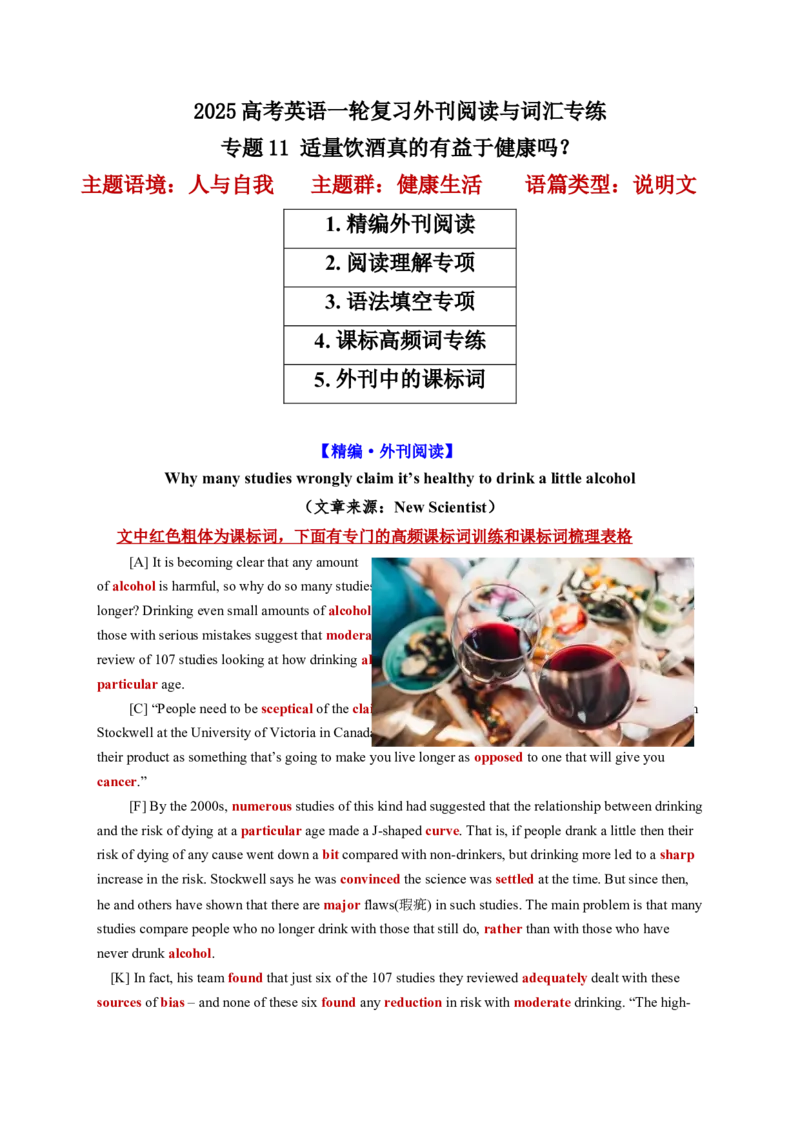
[A] It is becoming clear that any amount
of alcohol is harmful, so why do so many studies claim that moderate drinking could help you live
longer? Drinking even small amounts of alcohol reduces your life lifespan, thorough studies show. Only
those with serious mistakes suggest that moderate drinking is beneficial. That’s the conclusion of a
review of 107 studies looking at how drinking alcohol affects people’s risk of dying from any cause at a
particular age.
[C] “People need to be sceptical of the claims that the industry has fuelled over the years,” says Tim
Stockwell at the University of Victoria in Canada. “They obviously have a great interest in promoting
their product as something that’s going to make you live longer as opposed to one that will give you
cancer.”
[F] By the 2000s, numerous studies of this kind had suggested that the relationship between drinking
and the risk of dying at a particular age made a J-shaped curve. That is, if people drank a little then their
risk of dying of any cause went down a bit compared with non-drinkers, but drinking more led to a sharp
increase in the risk. Stockwell says he was convinced the science was settled at the time. But since then,
he and others have shown that there are major flaws(瑕疵) in such studies. The main problem is that many
studies compare people who no longer drink with those that still do, rather than with those who have
never drunk alcohol.
[K] In fact, his team found that just six of the 107 studies they reviewed adequately dealt with these
sources of bias – and none of these six found any reduction in risk with moderate drinking. “The high-quality studies suggest a linear relationship,” says Stockwell. “The more you drink, the higher your risk of
heart disease.”
【原创 阅读理解】
1. How does the author introduce the debate on alcohol’s effects on health?
A. By openly declaring alcohol is harmful.
B. By discussing age-related effects.
C. By stating moderate drinking is helpful.
D. By claiming alcohol has no impact.
2. What does the word “fuelled” most likely mean in the context of Stockwell’s statement?
A. Investigated or researched
B. Restricted or limited
C. Promoted or intensified
D. Ignored or overlooked
3. How does the comparison between different types of drinkers contribute to the flaws in the studies?
A. It falsely shows moderate drinkers as healthier.
B. It suggests all drinkers have similar health risks.
C. It minimizes the health issues of non-drinkers.
D. It ignores the health benefits of heavy drinking.
4. What overall conclusion does Stockwell reach about the safety of moderate drinking?
A. It’s neutral in terms of overall health impact.
B. It’s helpful to prevent some illnesses.
C. It’s less harmless than previously believed.
D. It’s considered safe for most people.
【原创 语法填空】
It is increasingly evident ____1____ any amount of alcohol is harmful, yet many studies still claim
moderate ____2____ (drink) could extend lifespan. Comprehensive research shows that even small
amounts of alcohol shorten life. ____3____ (claim) of benefits from moderate drinking often arise from
flawed studies. ____4____ review of 107 studies on alcohol's impact on mortality concluded that only
studies with significant errors suggest any benefit.
Tim Stockwell of the University of Victoria in Canada ____5____ (advice) skepticism towards
industry-backed claims, which promote alcohol as life-extending rather than a cancer risk. He emphasizes
that the public ____6____ (provide) with misleading information for years. By the 2000s, numerous
studies suggested a J-shaped curve, ____7____ light drinkers had a slightly lower mortality risk than non-
drinkers, but the risk surged with higher consumption. Initially convinced by this, Stockwell ____8____
(late) found significant flaws in such studies, particularly the comparison of current drinkers to former
drinkers rather than lifelong abstainers.Stockwell's team found that only six of the 107 studies adequately addressed these biases, and none
showed reduced risk from moderate drinking. High-quality studies indicate a linear relationship: the more
alcohol ____9____ (consume), the higher the risk of heart disease. The public should be wary of studies
that fail to account ____10____ these critical factors. It is clear that alcohol poses significant health risks,
regardless of the amount consumed.
【原创·课标高频词训练】
1. The manager looked at the proposal ________ (sceptical), unsure if it would bring the desired results.
2. Regular exercise is generally ________ (benefit) to both physical and mental health.
3. The medicine should be taken ________ (moderate) to avoid any potential side effects.
4. The drink was labeled as ________ (alcohol), so it was not served to minors.
5. The report was ________ (thorough) reviewed before being published to ensure accuracy.
6. The cost of living in the city has increased ________ (sharp) over the past few years.
7. The disagreement between the two companies ________ (settle) after long negotiations.
8. The pollution levels ________ (reduce) significantly after the new regulations were enforced.
9. The company announced a major ________ (promote) to attract more customers during the holiday
season.
10. Many citizens ________ (oppose) the new law, arguing that it goes against personal freedoms.
11. The ________ (major) of the board members agreed to the new policy.
12. She ________ (convince) that the new strategy would lead to success.
13. After reviewing all the data, the scientists reached their final ________ (conclude).
14. The scientist's ________ (claim) were supported by extensive research and evidence.
15. The puppy was extremely ________ (affection), always seeking attention from its owners.【梳理·外刊中的课标词】
单词 中文注释 单词 中文注释
sceptical numerous
curve beneficial
moderate bias
adequately alcohol
particular found
thorough source
sharp settle
reduce rather
quality promote
oppose obviously
major disease
convince conclusion
claim cancer
bit amount
affect