高中英语外刊时文阅读训练
专题28
SETI 探索外星信号新发现
Ⅰ.文章话题导入
Ⅱ.外刊原文阅读
Ш.阅读理解专项针对性练习
Ⅳ.话题高频词汇强化训练
Ⅴ.参考译文赏析
【话题·导语】
宾夕法尼亚州立大学的天文学家和SETI 研究所的科学家采用了一种专注于行星排列的新技术来扫描
TRAPPIST-1 恒星系统以寻找外星技术,这标志着在该位置对外星无线电信号的最长有针对性的搜索。
【原文·外刊阅读】
Breakthrough Technique Could Reveal Alien Communications Between Planets
(文章来源:Scitech daily)
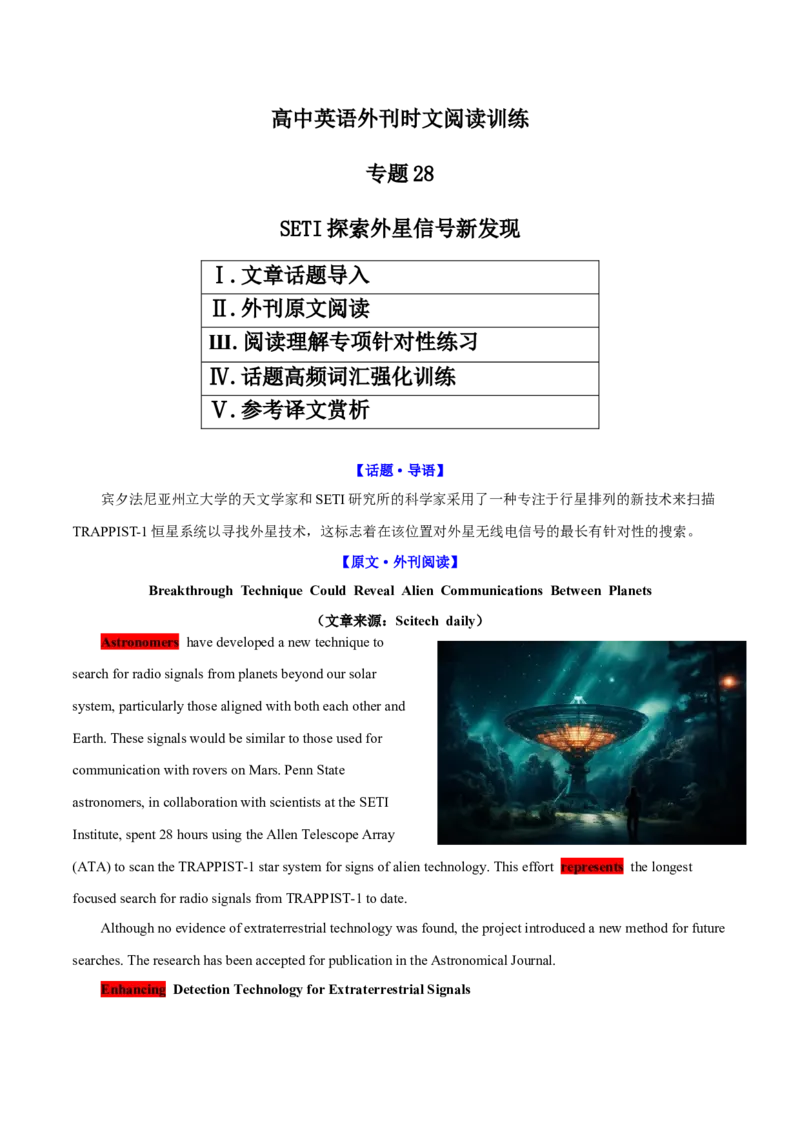
Astronomers have developed a new technique to
search for radio signals from planets beyond our solar
system, particularly those aligned with both each other and
Earth. These signals would be similar to those used for
communication with rovers on Mars. Penn State
astronomers, in collaboration with scientists at the SETI
Institute, spent 28 hours using the Allen Telescope Array
(ATA) to scan the TRAPPIST-1 star system for signs of alien technology. This effort represents the longest
focused search for radio signals from TRAPPIST-1 to date.
Although no evidence of extraterrestrial technology was found, the project introduced a new method for future
searches. The research has been accepted for publication in the Astronomical Journal.
Enhancing Detection Technology for Extraterrestrial Signals
“This research shows that we are getting closer to technology and methods that could detect radio signals
similar to the ones we send into space,” said Nick Tusay, a graduate student research fellow at Penn State and first
author of the paper. “Most searches assume a powerful signal, like a beacon intended to reach distant planets,
because our receivers have a sensitivity limit to a minimum transmitter power beyond anything we
unintentionally send out. But, with better equipment, like the upcoming Square Kilometer Array, we might soon be
able to detect signals from an alien civilization communicating with its spacecraft.”
The project focused on a phenomenon called planet-planet occultations (PPOs). PPOs happen when one planet
moves in front of another from Earth’s perspective. If intelligent life exists in that star system, radio signals sent
between planets could leak and be detected from Earth.
Advancements in Signal Analysis at ATA
Using the upgraded ATA — a series of radio antennae dedicated to the search for extraterrestrial technology
located at the Hat Creek Observatory in the Cascade Mountains about 300 miles north of San Francisco — the team
scanned a wide range of frequencies, looking for narrowband signals, which are considered possible signs of alien
technology. The team filtered millions of potential signals, narrowing down to about 11,000 candidates for detailed
analysis. The team detected 2,264 of these signals during predicted PPO windows. However, none of the signals
were of non-human origin.
The ATA’s new capabilities, which include advanced software to filter signals, helped the team separate
possible alien signals from Earth-based ones. The researchers said they believe that refining these methods and
focusing on events like PPOs could help increase the chances of detecting alien signals in the future.
SETI Research and Student Involvement
“This project included work by undergraduate students in the 2023 SETI Institute Research Experience for
Undergraduates program,” said Sofia Sheikh, a SETI researcher at the SETI Institute who earned her doctoral
degree at Penn State. “The students looked for signals from human-made orbiters around Mars to check if the
system could detect signals correctly. It was an exciting way to involve students in cutting-edge SETI research.”
The TRAPPIST-1 system is a small, cool star about 41 light years from Earth. It has seven rocky planets, some
of which are in the habitable zone, where conditions might allow liquid water to exist — an essential ingredient
for life as we know it. This makes TRAPPIST-1 a prime target searching for life beyond Earth.
Future Directions in Astronomical Research
“The TRAPPIST-1 system is relatively close to Earth, and we have detailed information about the orbit of its
planets, making it an excellent natural laboratory to test these techniques,” Tusay said. “The methods and
algorithms that we developed for this project can eventually be applied to other star systems and increase our
chances of finding regular communications among planets beyond our solar system, if they exist.”
The team did not find any alien signals this time, but they will continue improving their search techniques and
exploring other star systems. Future searches with bigger and more powerful telescopes could help scientists
detect even fainter signals and expand our understanding of the universe, the team said.
【原创·阅读理解】
1.What technique did astronomers develop to search for radio signals from planets beyond our solar
system?
A. Observing the sun’s radiation.
B. Analyzing planetary atmospheres.
C. Scanning for planet-planet occultations (PPOs).
D. Using optical telescopes for detailed imaging.
2.What did the team primarily search for during their scanning of the TRAPPIST-1 star system?
A. Bright beacons from other galaxies.
B. Signals indicative of alien technology.
C. Natural radio emissions from stars.
D. Infrared signals from nearby planets.
3.How many potential signals did the team narrow down for detailed analysis after filtering millions of
signals?
A. 1,500
B. 11,000
C. 2,264
D. 28
4.Why is the TRAPPIST-1 system considered a prime target for searching for life beyond Earth?
A. It is the closest star system to Earth.
B. It has a large number of gas giants.
C. Its planets are located in the habitable zone.
D. It contains a supermassive black hole.
【高频词汇训练】
1.It’s obvious that not all                 (专家) will be convinced of the astronomer’s opinion. (根据汉语
提示单词拼写)
2.By doing so, we can greatly decrease the frequency and            (严重性) of traffic accidents. (根据汉语
提示单词拼写)
3.The s         is an essential part of your body and it’s the largest organ. (根据首字母单词拼写)
4.The committee                  representatives from each department.
委员会由每个部门的代表组成。
5.人们私下说吉姆和玛丽就要分手了。
         Jim and Mary are to separate.
6.Music education is said to be a good opportunity           (enhance) children’s intelligence. (所给词的适当
形式填空)
7.He seems completely          (sensitive) to criticism. I think he doesn’t know what shame is. (用所给词
的适当形式填空)
8.The younger generation should know that actions are more        (power) than words. (所给词的适当形式
填空)
【参考译文】
突破性技术可能揭示行星之间的外星通信
天文学家已经开发出一种新技术,可以搜索来自太阳系以外行星的无线电信号,特别是那些相互对齐
和与地球对齐的行星。这些信号将类似于用于与火星探测车通信的信号。宾夕法尼亚州立大学的天文学家
与SETI 研究所的科学家合作,花了28 个小时使用艾伦望远镜阵列扫描TRAPPIST-1 恒星系统,寻找外星
技术的迹象。这是迄今为止对TRAPPIST-1 无线电信号进行的最长时间的集中搜索。
尽管没有发现外星技术的证据,但该项目为未来的搜索引入了一种新方法。这项研究已被《天文学杂
志》发表。
增强外星信号检测技术
宾夕法尼亚州立大学研究生研究员、该论文的第一作者尼克·图赛说:“这项研究表明,我们正越来越
接近能够检测到类似于我们发送到太空的无线电信号的技术和方法。”“大多数搜索都假设有一个强大的
信号,比如一个旨在到达遥远行星的信标,因为我们的接收器对我们无意中发出的任何信号的最小发射器
功率都有灵敏度限制。但是,有了更好的设备,比如即将推出的平方公里阵列,我们可能很快就能检测到
来自外星文明与其航天器通信的信号。”
该项目专注于一种称为行星掩星的现象。从地球的角度来看,当一颗行星在另一颗行星前方移动时,
这种现象就会发生。如果该恒星系统中存在智能生命,行星之间发送的无线电信号可能会泄漏并被地球探
测到。
ATA 信号分析的进步
该团队使用升级后的ATA——系列专门用于搜索外星技术的无线电天线,位于旧金山以北约300 英里
的喀斯喀特山脉的哈特克里克天文台——扫描了广泛的频率,寻找窄带信号,这些信号被认为是外星技术
的可能迹象。该团队过滤了数百万个潜在信号,筛选出约11000 个候选信号进行详细分析。该团队在预测
的PPO 窗口期间检测到了2264 个这些信号。然而,这些信号都不是非人类来源的。
ATA 的新功能,包括过滤信号的高级软件,帮助该团队将可能的外星信号与地球信号分开。研究人员
表示,他们相信,改进这些方法并专注于PPO 等事件可能有助于增加未来检测到外星信号的机会。
SETI 研究与学生参与
SETI 研究所的SETI 研究员Sofia Sheikh 在宾夕法尼亚州立大学获得了博士学位,她说:“这个项目
包括2023 年SETI 研究院本科生研究经验项目中本科生的工作。”“学生们寻找来自火星周围人造轨道器
的信号,以检查该系统是否能够正确检测信号。这是让学生参与尖端SETI 研究的一种令人兴奋的方
式。”
TRAPPIST-1 系统是一颗距离地球约41 光年的小型冷恒星。它有七颗岩石行星,其中一些位于宜居
带,那里的条件可能允许液态水存在,液态水是我们所知生命的重要组成部分。这使得TRAPPIST-1 成为
寻找地球以外生命的主要目标。
天文学研究的未来方向
Tusay 说:“TRAPPIST-1 系统离地球相对较近,我们有关于其行星轨道的详细信息,使其成为测试这
些技术的优秀自然实验室。”“我们为这个项目开发的方法和算法最终可以应用于其他恒星系统,并增加
我们在太阳系以外的行星之间找到定期通信的机会,如果它们存在的话。”
该团队这次没有发现任何外星信号,但他们将继续改进搜索技术并探索其他恒星系统。该团队表示,
未来使用更大、更强大的望远镜进行搜索,可以帮助科学家探测到更微弱的信号,并扩大我们对宇宙的理
解。