文档文本内容
高中英语外刊时文阅读训练
专题14
宇宙学家探索宇宙深处之光
Ⅰ.文章话题导入
Ⅱ.外刊原文阅读
Ш.阅读理解专项针对性练习
Ⅳ.话题高频词汇强化训练
Ⅴ.参考译文赏析
【话题·导语】
在过去的几年里,Cynthia Chiang 一直在寻找宇宙早期存在的迹象——从130 多亿年前第一颗恒星的
诞生到之前的“宇宙黑暗时代”——她正在建造自己的设备来实现这一目标。作为麦吉尔大学的物理学教
授,她专注于利用新颖的无线电技术,探索当今宇宙之外的遥远过去。
【原文·外刊阅读】
Cynthia Chiang is searching for signs of the universe's first light
(文章来源:National Geographic)
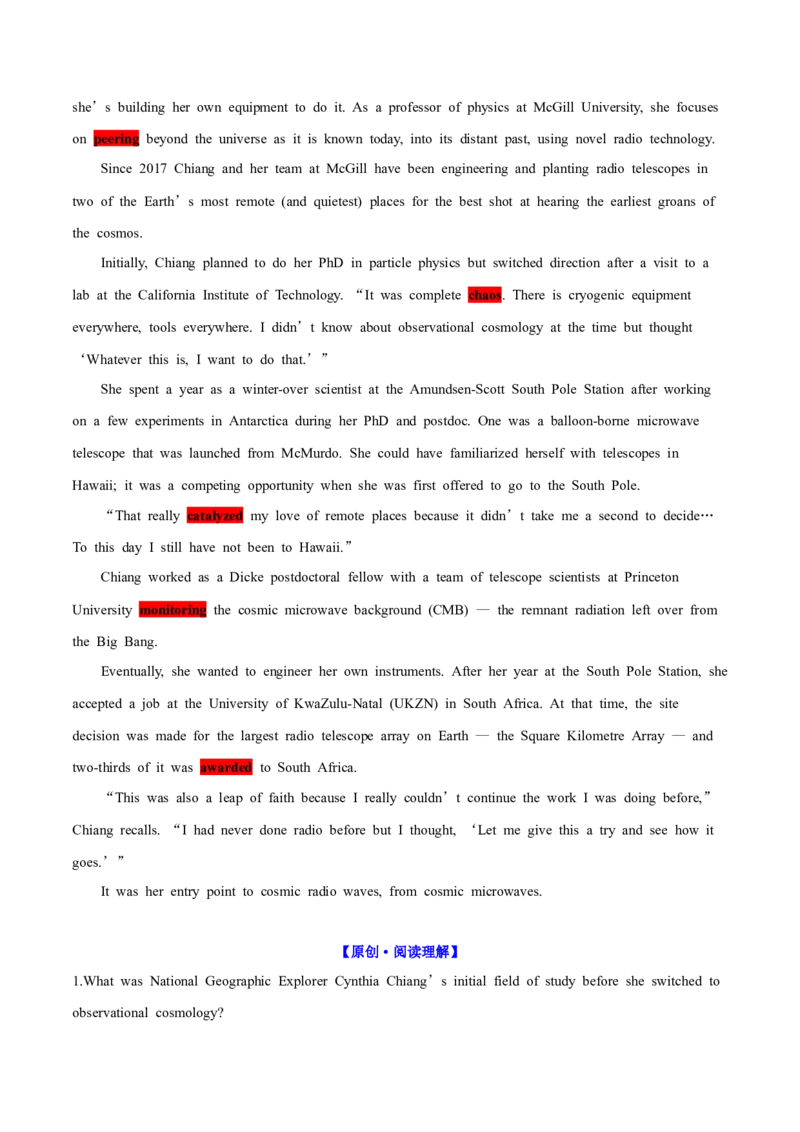
“It was written in some sense,” that National Geographic
Explorer Cynthia Chiang would end up in observational cosmology
— the study of the origin and development of the universe using
specialized detectors and telescopes. “I’m not going to lie, my
father was a physicist. My mother’s an astronomer. But no kid
wants to be like their parents,” she jokes, semi-seriously.
Chiang always enjoyed building things. It wasn’t unusual for
her to experiment with her father’s research equipment; disassembling vacuum chamber components and
putting them back together like a child engineer. She thanks, in part, her short attention span for her
evolving curiosity: “I am always looking for something.”
For the last few years, Chiang has been looking for signs of the universe’s early existence — from
the birth of the first stars more than 13 billion years ago, to the preceding “cosmic dark ages” — and
she’s building her own equipment to do it. As a professor of physics at McGill University, she focuses
on peering beyond the universe as it is known today, into its distant past, using novel radio technology.
Since 2017 Chiang and her team at McGill have been engineering and planting radio telescopes in
two of the Earth’s most remote (and quietest) places for the best shot at hearing the earliest groans of
the cosmos.
Initially, Chiang planned to do her PhD in particle physics but switched direction after a visit to a
lab at the California Institute of Technology. “It was complete chaos. There is cryogenic equipment
everywhere, tools everywhere. I didn’t know about observational cosmology at the time but thought
‘Whatever this is, I want to do that.’”
She spent a year as a winter-over scientist at the Amundsen-Scott South Pole Station after working
on a few experiments in Antarctica during her PhD and postdoc. One was a balloon-borne microwave
telescope that was launched from McMurdo. She could have familiarized herself with telescopes in
Hawaii; it was a competing opportunity when she was first offered to go to the South Pole.
“That really catalyzed my love of remote places because it didn’t take me a second to decide…
To this day I still have not been to Hawaii.”
Chiang worked as a Dicke postdoctoral fellow with a team of telescope scientists at Princeton
University monitoring the cosmic microwave background (CMB) — the remnant radiation left over from
the Big Bang.
Eventually, she wanted to engineer her own instruments. After her year at the South Pole Station, she
accepted a job at the University of KwaZulu-Natal (UKZN) in South Africa. At that time, the site
decision was made for the largest radio telescope array on Earth — the Square Kilometre Array — and
two-thirds of it was awarded to South Africa.
“This was also a leap of faith because I really couldn’t continue the work I was doing before,”
Chiang recalls. “I had never done radio before but I thought, ‘Let me give this a try and see how it
goes.’”
It was her entry point to cosmic radio waves, from cosmic microwaves.
【原创·阅读理解】
1.What was National Geographic Explorer Cynthia Chiang’s initial field of study before she switched to
observational cosmology?
A. Astronomy.
B. Particle Physics.
C. Mechanical Engineering.
D. Chemistry.
2.Why did Cynthia Chiang decide to pursue observational cosmology?
A. She wanted to work with cryogenic equipment.
B. She was inspired by a lab at Caltech.
C. She had a lifelong interest in astronomy.
D. She wanted to build radio telescopes.
3.Where did Chiang and her team install radio telescopes for their research?
A. Hawaii and the South Pole.
B. Two remote and quiet places on Earth.
C. The University of KwaZulu-Natal.
D. McMurdo Station.
4.What motivated Chiang to work in remote places?
A. Her interest in tropical climates.
B. The challenge of working in isolation.
C. Her previous experience in Antarctica.
D. Opportunities in warmer locations.
5.What was Chiang's role at the University of KwaZulu-Natal?
A. She worked with cryogenic equipment.
B. She engineered her own instruments for studying cosmic radio waves.
C. She studied cosmic microwave background radiation.
D. She worked on a balloon-borne microwave telescope.
【高频词汇训练】
1.(22-23 高二上·上海·阶段练习)Without agreed rules to play by, and strict punishments for violations, the
financial market would soon ________ into utter chaos.
A.descend
B.trap
C.reduce
D.involve
2.(23-24 高二上·黑龙江哈尔滨·期末)________ students’ learning status and efficiency in real-time, many
parents have latest monitoring devices ________ in their house.
A.To inform of; assigned
B.Being informed of; assigned
C.To be informed of; installed
D.Having informed of; installed
3.(23-24 高一下·河南信阳·阶段练习)Kashgar becomes even        (much) alive with tourists joyfully
exploring a city with a history of more than 2, 000 years. (所给词的适当形式填空)
4.(23-24 高二下·福建三明·阶段练习)The              (special) thought Tim’s chances of survival were
slim. (所给词的适当形式填空)
5.(17-18 高一下·浙江绍兴·期末)Curiosity drove him into her restaurant where he found no mutton, beef or
bacon          (serve). (所给词的适当形式填空)
6.(20-21 高二上·山东潍坊·阶段练习)R         (回应) to body language is an important component of
being a teacher. (根据汉语提示单词拼写)
7.(18-19 高二下·江西南昌·期末)There was a time when I was so proud that I o           my peers.
8.(22-23 高二上·山东济南·阶段练习)You are one of the         (理想的) monitor applicants in the
election. (根据汉语提示单词拼写)
9.(23-24 高一下·福建莆田·期中)Only when we learn to exist in       with nature can we stop being a

to wildlife and to our planet.
只有学会与大自然和谐相处,我们才不会成为野生动植物和地球的威胁。
10.(23-24 高二上·广东深圳·阶段练习)After receiving the Most Valuable Player award for two years
(连续地), Stephen explained his philosophy.(根据汉语提示补全句子)
【参考译文】
辛西娅·蒋正在寻找宇宙第一缕光的迹象
“从某种意义上说,”国家地理探险家Cynthia Chiang 最终将从事观测宇宙学——使用专门的探测器
和望远镜研究宇宙的起源和发展。“我不会撒谎,我爸爸是物理学家。我妈妈是天文学家。但没有孩子想
像他们的父母一样,”她半认真地开玩笑说。
蒋一向喜欢造东西。她用父亲的研究设备做实验并不罕见;像儿童工程师一样拆卸真空室组件并将其
重新组装在一起。在某种程度上,她感谢自己注意力持续时间短,导致好奇心不断发展:“我总是在找东
西。”
在过去的几年里,蒋一直在寻找宇宙早期存在的迹象——从130 多亿年前第一颗恒星的诞生到之前的
“宇宙黑暗时代”——她正在建造自己的设备来实现这一目标。作为麦吉尔大学的物理学教授,她专注于
利用新颖的无线电技术,探索当今宇宙之外的遥远过去。
自2017 年以来,蒋和她在麦吉尔大学的团队一直在地球上最偏远(也是最安静)的两个地方设计和安
装射电望远镜,以便最好地听到宇宙最早的呻吟。
起初,蒋计划攻读粒子物理学博士学位,但在参观了加州理工学院的一个实验室后改变了方向。“当
时一片混乱。到处都是低温设备,到处都是工具。当时我不知道观测宇宙学,但我想‘不管这是什么,我
都想这么做。’”
在攻读博士学位和博士后期间,她在南极洲进行了一些实验,之后在阿蒙森-斯科特南极站度过了一年
的冬季。其中一个是从麦克默多发射的气球载微波望远镜。她本可以熟悉夏威夷的望远镜;当她第一次被
邀请去南极时,这是一个竞争性的机会。
“这真的激发了我对偏远地区的热爱,因为我一秒钟都没有做出决定……直到今天,我还没有去过夏
威夷。”
蒋在普林斯顿大学的一个望远镜科学家团队担任Dicke 博士后研究员,负责监测宇宙微波背景辐射
(CMB)——大爆炸留下的残余辐射。
最终,她想设计自己的仪器。在南极站工作一年后,她接受了南非夸祖鲁-纳塔尔大学(UKZN)的一
份工作。当时,决定建造地球上最大的射电望远镜阵列——平方公里阵列,其中三分之二授予了南非。
“这也是一次信仰的飞跃,因为我真的无法继续我以前做的工作,”蒋回忆道。“我以前从未做过广
播,但我想,‘让我试试,看看情况如何。’”
这是她从宇宙微波中进入宇宙无线电波的入口。