2026 届高考英语时文精选阅读与训练
专题01
中国蛟龙号载人潜水器与ROV 北极首次作业
标题:China's Jiaolong manned submersible conducts world’s first joint operation with ROV in
Arctic waters
来源:Global Times
建议时间:10 分钟
难度:★★★☆
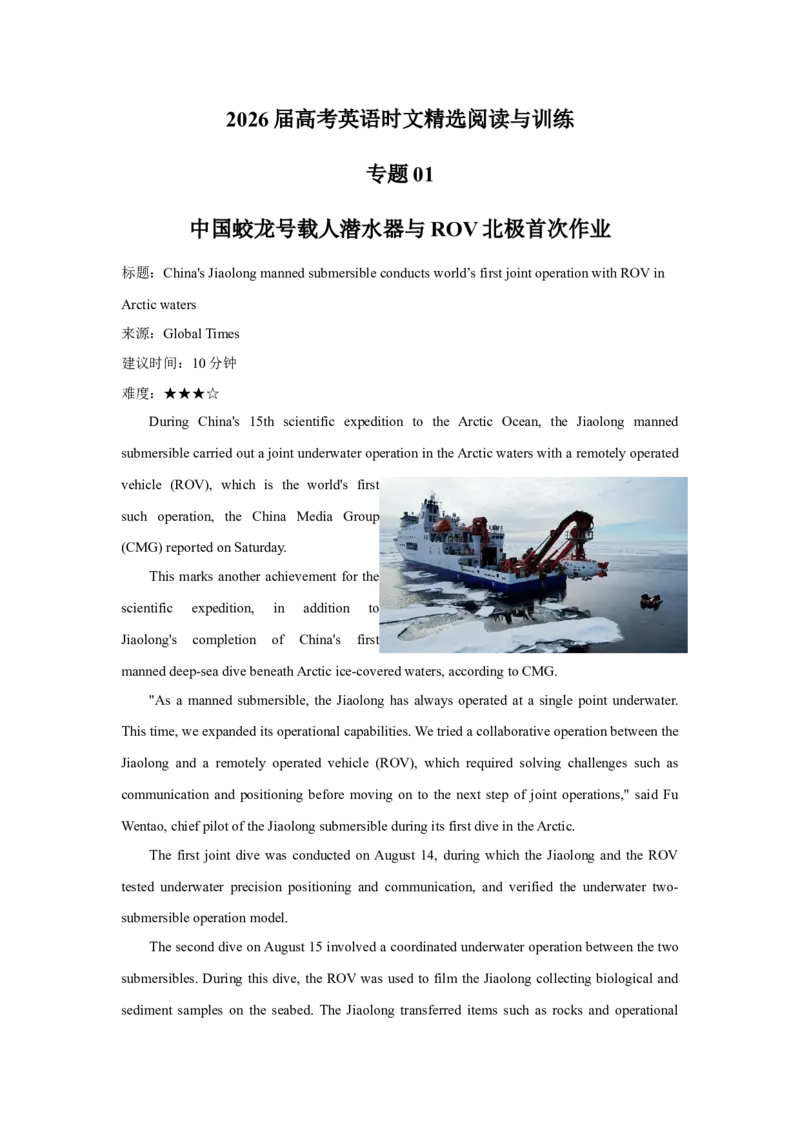
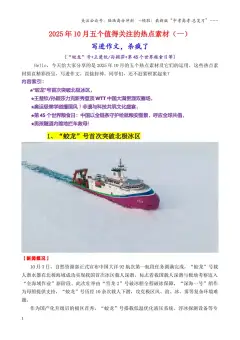
During China's 15th scientific expedition to the Arctic Ocean, the Jiaolong manned
submersible carried out a joint underwater operation in the Arctic waters with a remotely operated
vehicle (ROV), which is the world's first
such operation, the China Media Group
(CMG) reported on Saturday.
This marks another achievement for the
scientific expedition, in addition to
Jiaolong's completion of China's first
manned deep-sea dive beneath Arctic ice-covered waters, according to CMG.
"As a manned submersible, the Jiaolong has always operated at a single point underwater.
This time, we expanded its operational capabilities. We tried a collaborative operation between the
Jiaolong and a remotely operated vehicle (ROV), which required solving challenges such as
communication and positioning before moving on to the next step of joint operations," said Fu
Wentao, chief pilot of the Jiaolong submersible during its first dive in the Arctic.
The first joint dive was conducted on August 14, during which the Jiaolong and the ROV
tested underwater precision positioning and communication, and verified the underwater two-
submersible operation model.
The second dive on August 15 involved a coordinated underwater operation between the two
submersibles. During this dive, the ROV was used to film the Jiaolong collecting biological and
sediment samples on the seabed. The Jiaolong transferred items such as rocks and operational
markers to the ROV. The two submersibles also captured video footage of each other in the deep
sea, according to CMG.
The collaborative operation of manned submersibles and ROVs can achieve a synergy where
the whole is greater than the sum of its parts, compensating for the limitations of manned
submersibles in large-scale underwater sampling, the CMG reported, citing Li Dewei, a project
leader at the National Deep Sea Center.
The deep integration of human creativity and machine precision represents an inevitable
trend for future deep-sea technology development and exploration, Li said.
In another first, scientists used a new survey method that combines AI-based identification
with environmental DNA detection to identify deep-sea life on the seabed.
Over 10,000 images of deep-sea biological life forms were provided as technical support for
AI-powered biological identification while environmental DNA detection served as supplements
to verify the accuracy of AI identification results.
China's 15th scientific expedition to the Arctic Ocean, its largest-ever scientific exploration in
these waters, concluded in late September.
The expedition was jointly carried out by four vessels — Xuelong 2, Jidi, Shenhai 1 and
Tansuo 3.
Preliminary studies revealed major differences in benthic organism density, biodiversity and
individual body size across Arctic sea areas. The findings will help reveal spatial distribution
patterns of polar deep-sea organisms and assess the impacts of climate change on deep-sea
ecosystems, according to the Ministry of Natural Resources.
【阅读理解】
原文阅读并掌握大意后,请完成以下4 道阅读理解题。
1.What is the world's first operation mentioned in the passage?
A. Jiaolong's first manned dive under Arctic ice.
B. Jiaolong and ROV's joint underwater operation in the Arctic.
C. Using AI to identify deep-sea life on the seabed.
D. Combining AI identification with environmental DNA detection.
2.What can we infer from Fu Wentao's words?
A. Jiaolong once had the ability to cooperate with ROVs.
B. Communication and positioning were easy for the joint operation.
C. The collaborative operation expanded Jiaolong's capabilities.
D. The joint operation was done without preparation.
3.What is Li Dewei's attitude towards the collaborative operation of manned submersibles
and ROVs?
A. Doubtful.
B. Positive.
C. Neutral.
D. Negative.
4.What is the main idea of the passage?
A. Introduce Jiaolong's two joint dives in the Arctic.
B. Explain the new survey method of AI + environmental DNA detection.
C. Present achievements of China's 15th Arctic expedition.
D. Discuss climate change's impacts on Arctic deep-sea ecosystems.
【语法填空】
请在阅读完成原文和阅读理解题后,继续完成原文短文语法填空题。
China's 15th scientific expedition to the Arctic Ocean, its largest-ever scientific exploration
there, concluded in late September. It (1)______ (carry) out jointly by four vessels, including
Xuelong 2. A major achievement was that the Jiaolong manned submersible and an ROV
conducted the world's first joint underwater operation in the Arctic. Before this, Jiaolong had
completed China's first manned deep-sea dive beneath ______ (2) Arctic ice.
Two joint dives were held. On August 14, the pair tested positioning and communication. On
August 15, they worked coordinately: the ROV filmed Jiaolong (3)______ (collect) samples, and
Jiaolong transferred items to the ROV. Li Dewei noted the collaborative operation could create
synergy, (4)______ (compensate) for manned submersibles' limits in large-scale sampling, adding
human-machine integration was an inevitable trend (5)______ would shape future deep-sea
exploration.
______ (6) (add), scientists first used a new method combining AI-based identification and
environmental DNA detection to identify deep-sea life. Over 10,000 biological images supported
AI, (7)______ environmental DNA detection verified AI results' accuracy. Preliminary studies
found significant (8)______ (different) in Arctic benthic organisms, which would help study their
distribution and climate change's impacts (9)______ deep-sea ecosystems. These findings
(10)______ (provide) valuable data for global polar research so far.
【话题写作】
基于原文话题,请继续完成下面相关话题的应用文写作。
假定你是李华,你校英文报Science Corner 专栏正在征集关于“中国科技成就”的稿
件。请你根据上文提到的中国第15 次北极科考成果,写一篇短文投稿,内容包括:
1.科考的主要成就;
2.科考成果的意义;
3.你的感悟。
注意:
1.词数 80 左右;
2.可适当增加细节,使行文连贯;
3.开头和结尾已给出,不计入总词数。
Dear editors,
I’m writing to share China’s achievements in the 15th Arctic scientific expedition.


I believe such achievements will encourage more of us to explore the unknown.
Yours sincerely,
Li Hua
【参考译文】
中国中央广播电视总台周六报道,在中国第15 次北极科考期间,“蛟龙”号载人潜水
器与一台遥控潜水器在北极海域开展了联合水下作业,这是全球首次此类作业。
中央广播电视总台表示,除“蛟龙”号完成中国首次北极冰盖下载人深潜外,此次联
合作业也标志着该科考项目再添一项成果。
“作为载人潜水器,‘蛟龙’号此前一直采用水下单点作业模式。此次我们拓展了它
的作业能力,尝试让‘蛟龙’号与遥控潜水器开展协同作业。在推进下一步联合作业前,
我们需要先解决通信、定位等难题。”“蛟龙”号首次北极下潜任务的首席潜航员傅文涛
表示。
首次联合下潜于8 月14 日进行,期间“蛟龙”号与遥控潜水器测试了水下精密定位与
通信技术,并验证了水下双潜水器作业模式。
中央广播电视总台介绍,8 月15 日的第二次下潜中,两台潜水器开展了协同水下作
业。此次下潜期间,遥控潜水器负责拍摄“蛟龙”号在海底采集生物和沉积物样本的过
程,“蛟龙”号则将岩石、作业标志物等物品转移至遥控潜水器上。两台潜水器还在深海
中互相拍摄了视频素材。
中央广播电视总台援引国家深海中心项目负责人李德伟的话称,载人潜水器与遥控潜
水器的协同作业能够实现“1+1>2”的协同效应,弥补载人潜水器在大规模水下采样方面
的局限性。
李德伟表示,人类创造力与机器精准度的深度融合,是未来深海技术发展与探索的必
然趋势。
此外,科学家还首次采用了一种新的探测方法 —— 将基于人工智能的识别技术与环
境DNA 检测相结合,对海底深海生物进行识别。
超1 万张深海生物影像为人工智能生物识别提供了技术支持,而环境DNA 检测则作为
补充手段,用于验证人工智能识别结果的准确性。
中国第15 次北极科考是中国在北极海域开展的规模最大的科学考察活动,已于9 月末
收官。
此次科考由“雪龙 2”号、“极地”号、“深海 1”号和“探索 3”号四艘船舶联合
执行。
自然资源部表示,初步研究发现,北极不同海域的底栖生物密度、生物多样性及个体
体型存在显著差异。这些发现将有助于揭示极地深海生物的空间分布规律,并评估气候变
化对深海生态系统的影响。