Chapter III Chinese traditional etiquette
中国礼仪
Lesson 1 Chinese traditional etiquette中国礼节
There are mainly three kinds of etiquettes in China.
The first category is the daily life etiquette: including meeting etiquette, introduction etiquette, conversation
etiquette, banquet etiquette, reception etiquette, dance etiquette, etiquette
of gift giving and etiquette of visiting a sick person.
The second category is the festival customs and festival celebration
etiquette:including Spring Festival etiquette, Tomb-sweeping etiquette,
Dragon Boat etiquette, the Double Ninth Festival etiquette, Mid-autumn Day etiquette, wedding etiquette,
funeral etiquette and birthday celebration etiquette.
The third category is the business etiquette:including conference etiquette, negotiation etiquette, guest
welcoming and seeing-off etiquette, and knowledge of negotiation taboos, etc.
There is also etiquette of public relations, etiquette of public
affairs, etiquette at home and job search etiquette, etc. Here we just
talk about the first category of the main Etiquette of China.
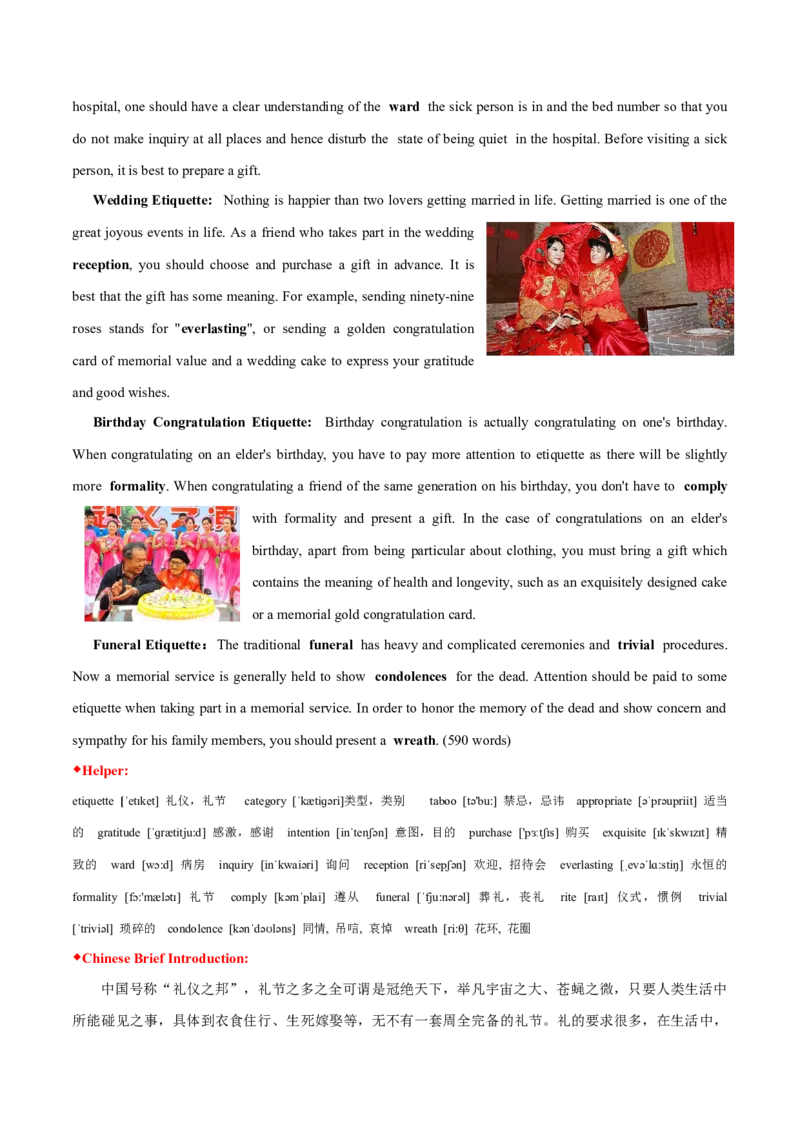
Etiquette of Gift Giving: The most common situations for
presenting a gift are at festivals, weddings, birthdays. It is also
appropriate to express gratitude, for sending-off relatives and friends, and to return a favor. The most important
thing in presenting a gift is to show intention.
As the saying goes, a goose feather sent from thousands of miles away is a present little in size but rich in
meaning. One should choose and purchase a gift according to his own economic conditions. In this way, the gift
receiver will accept the gift with ease of mind if he knows the real situation he is in. Attention should be paid to this
point. When presenting a gift, one should wrap it with exquisite wrapping paper. This not only shows there has
been much thought entered into the gift, but also raises the curiosity of the
gift receiver.
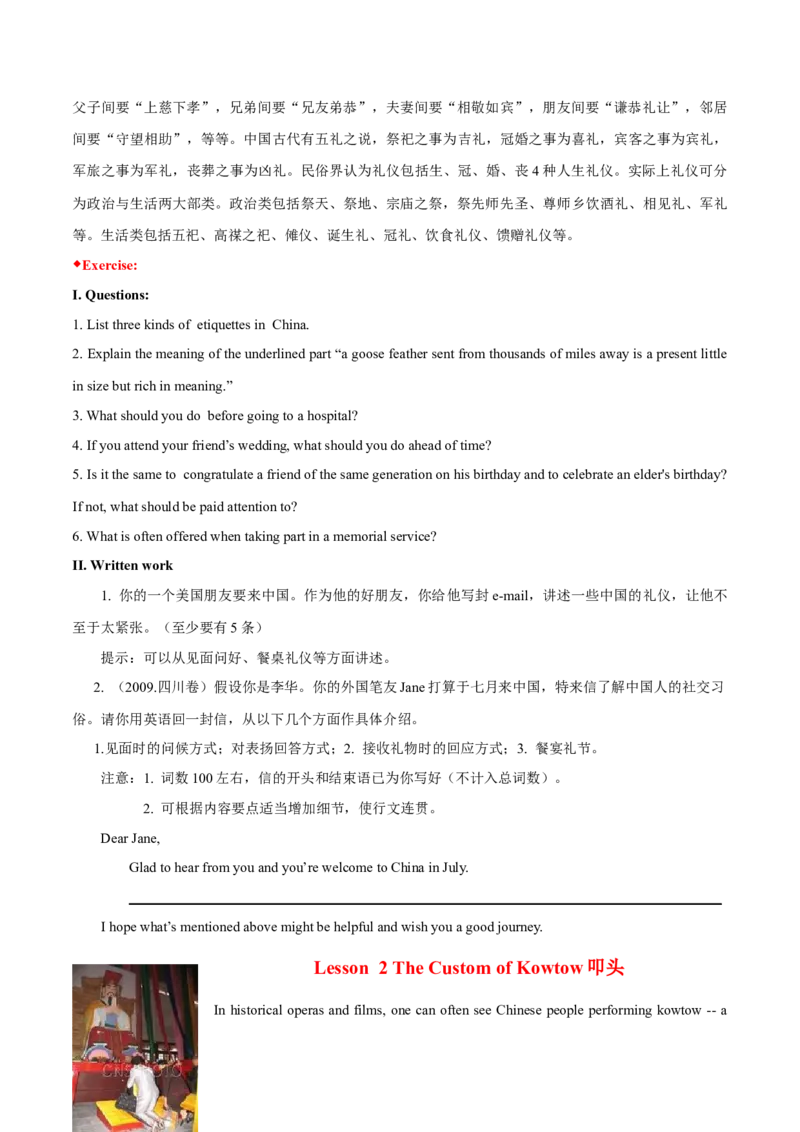
Etiquette of Visiting a Sick Person: The Hospital is a special site for
healing the wounded and rescuing the dying. Therefore, before going to ahospital, one should have a clear understanding of the ward the sick person is in and the bed number so that you
do not make inquiry at all places and hence disturb the state of being quiet in the hospital. Before visiting a sick
person, it is best to prepare a gift.
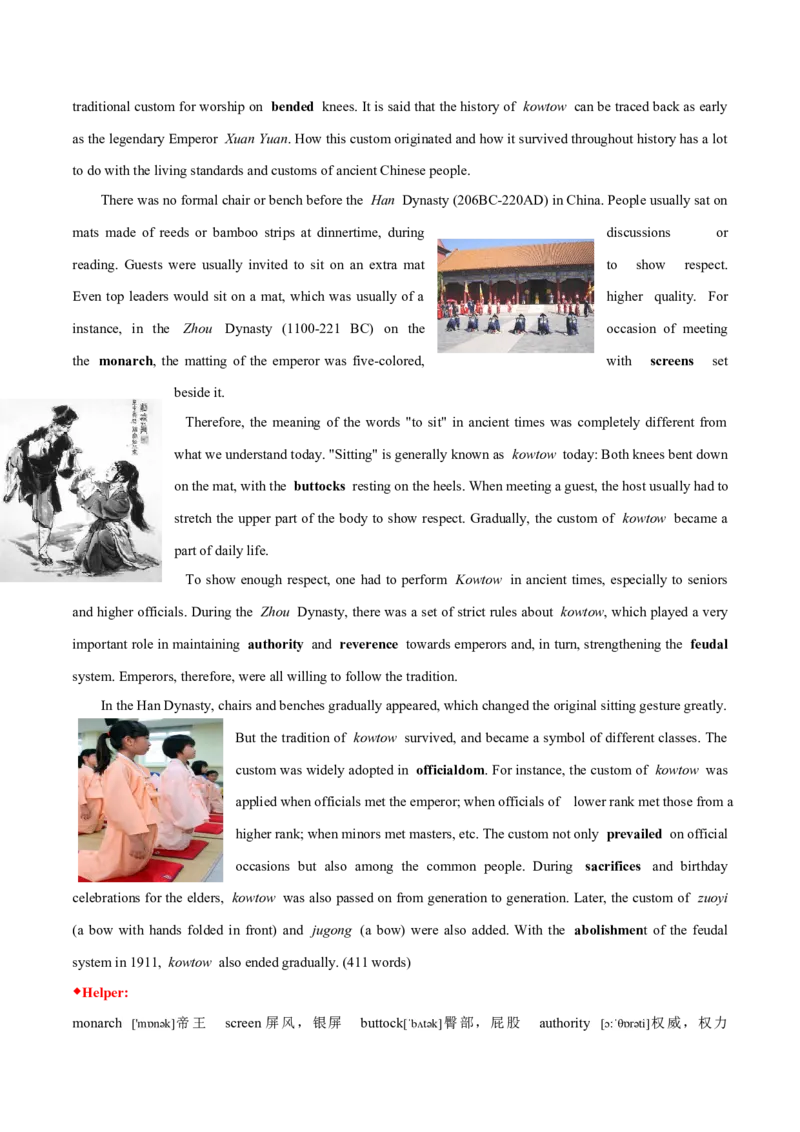
Wedding Etiquette: Nothing is happier than two lovers getting married in life. Getting married is one of the
great joyous events in life. As a friend who takes part in the wedding
reception, you should choose and purchase a gift in advance. It is
best that the gift has some meaning. For example, sending ninety-nine
roses stands for "everlasting", or sending a golden congratulation
card of memorial value and a wedding cake to express your gratitude
and good wishes.
Birthday Congratulation Etiquette: Birthday congratulation is actually congratulating on one's birthday.
When congratulating on an elder's birthday, you have to pay more attention to etiquette as there will be slightly
more formality. When congratulating a friend of the same generation on his birthday, you don't have to comply
with formality and present a gift. In the case of congratulations on an elder's
birthday, apart from being particular about clothing, you must bring a gift which
contains the meaning of health and longevity, such as an exquisitely designed cake
or a memorial gold congratulation card.
Funeral Etiquette:The traditional funeral has heavy and complicated ceremonies and trivial procedures.
Now a memorial service is generally held to show condolences for the dead. Attention should be paid to some
etiquette when taking part in a memorial service. In order to honor the memory of the dead and show concern and
sympathy for his family members, you should present a wreath. (590 words)
◆Helper:
etiquette [ˈetɪket] 礼仪,礼节 category [ˈkætiɡəri]类型,类别 taboo [tə'bu:] 禁忌,忌讳 appropriate [əˈprəupriit] 适当
的 gratitude [ˈɡrætitju:d] 感激,感谢 intention [inˈtenʃən] 意图,目的 purchase ['pɜːtʃɪs] 购买 exquisite [ɪkˈskwɪzɪt] 精
致的 ward [wɔ:d] 病房 inquiry [inˈkwaiəri] 询问 reception [riˈsepʃən] 欢迎, 招待会 everlasting [ˌevəˈlɑ:stiŋ] 永恒的
formality [fɔ:'mælətɪ] 礼节 comply [kəmˈplai] 遵从 funeral [ˈfju:nərəl] 葬礼,丧礼 rite [raɪt] 仪式,惯例 trivial
[ˈtriviəl] 琐碎的 condolence [kənˈdəʊləns] 同情, 吊唁, 哀悼 wreath [ri:θ] 花环, 花圈
◆Chinese Brief Introduction:
中国号称“礼仪之邦”,礼节之多之全可谓是冠绝天下,举凡宇宙之大、苍蝇之微,只要人类生活中
所能碰见之事,具体到衣食住行、生死嫁娶等,无不有一套周全完备的礼节。礼的要求很多,在生活中,父子间要“上慈下孝”,兄弟间要“兄友弟恭”,夫妻间要“相敬如宾”,朋友间要“谦恭礼让”,邻居
间要“守望相助”,等等。中国古代有五礼之说,祭祀之事为吉礼,冠婚之事为喜礼,宾客之事为宾礼,
军旅之事为军礼,丧葬之事为凶礼。民俗界认为礼仪包括生、冠、婚、丧4种人生礼仪。实际上礼仪可分
为政治与生活两大部类。政治类包括祭天、祭地、宗庙之祭,祭先师先圣、尊师乡饮酒礼、相见礼、军礼
等。生活类包括五祀、高禖之祀、傩仪、诞生礼、冠礼、饮食礼仪、馈赠礼仪等。
◆Exercise:
I. Questions:
1. List three kinds of etiquettes in China.
2. Explain the meaning of the underlined part “a goose feather sent from thousands of miles away is a present little
in size but rich in meaning.”
3. What should you do before going to a hospital?
4. If you attend your friend’s wedding, what should you do ahead of time?
5. Is it the same to congratulate a friend of the same generation on his birthday and to celebrate an elder's birthday?
If not, what should be paid attention to?
6. What is often offered when taking part in a memorial service?
II. Written work
1. 你的一个美国朋友要来中国。作为他的好朋友,你给他写封e-mail,讲述一些中国的礼仪,让他不
至于太紧张。(至少要有5条)
提示:可以从见面问好、餐桌礼仪等方面讲述。
2. (2009.四川卷)假设你是李华。你的外国笔友Jane打算于七月来中国,特来信了解中国人的社交习
俗。请你用英语回一封信,从以下几个方面作具体介绍。
1.见面时的问候方式;对表扬回答方式;2. 接收礼物时的回应方式;3. 餐宴礼节。
注意:1. 词数100左右,信的开头和结束语已为你写好(不计入总词数)。
2. 可根据内容要点适当增加细节,使行文连贯。
Dear Jane,
Glad to hear from you and you’re welcome to China in July.
____________________________________________________________________________________
I hope what’s mentioned above might be helpful and wish you a good journey.
Lesson 2 The Custom of Kowtow叩头
In historical operas and films, one can often see Chinese people performing kowtow -- atraditional custom for worship on bended knees. It is said that the history of kowtow can be traced back as early
as the legendary Emperor Xuan Yuan. How this custom originated and how it survived throughout history has a lot
to do with the living standards and customs of ancient Chinese people.
There was no formal chair or bench before the Han Dynasty (206BC-220AD) in China. People usually sat on
mats made of reeds or bamboo strips at dinnertime, during discussions or
reading. Guests were usually invited to sit on an extra mat to show respect.
Even top leaders would sit on a mat, which was usually of a higher quality. For
instance, in the Zhou Dynasty (1100-221 BC) on the occasion of meeting
the monarch, the matting of the emperor was five-colored, with screens set
beside it.
Therefore, the meaning of the words "to sit" in ancient times was completely different from
what we understand today. "Sitting" is generally known as kowtow today: Both knees bent down
on the mat, with the buttocks resting on the heels. When meeting a guest, the host usually had to
stretch the upper part of the body to show respect. Gradually, the custom of kowtow became a
part of daily life.
To show enough respect, one had to perform Kowtow in ancient times, especially to seniors
and higher officials. During the Zhou Dynasty, there was a set of strict rules about kowtow, which played a very
important role in maintaining authority and reverence towards emperors and, in turn, strengthening the feudal
system. Emperors, therefore, were all willing to follow the tradition.
In the Han Dynasty, chairs and benches gradually appeared, which changed the original sitting gesture greatly.
But the tradition of kowtow survived, and became a symbol of different classes. The
custom was widely adopted in officialdom. For instance, the custom of kowtow was
applied when officials met the emperor; when officials of lower rank met those from a
higher rank; when minors met masters, etc. The custom not only prevailed on official
occasions but also among the common people. During sacrifices and birthday
celebrations for the elders, kowtow was also passed on from generation to generation. Later, the custom of zuoyi
(a bow with hands folded in front) and jugong (a bow) were also added. With the abolishment of the feudal
system in 1911, kowtow also ended gradually. (411 words)
◆Helper:
monarch ['mɒnək]帝王 screen 屏风,银屏 buttock[ˈbʌtək]臀部,屁股 authority [ɔ:ˈθɒrəti]权威,权力reverence ['revərəns]尊严 feudal ['fjuːdl] 封建的 officialdom [ə'fɪʃldəm]官场 prevail[prɪ'veɪl]盛行 abolishment
[ə'bɒlɪʃmənt]废除
◆Chinese Brief Introduction:
叩头是东亚一种传统仪式和礼节,又称为磕头。行此礼的人以双膝跪地,以头触地,用以表示高度的
忠诚和尊敬。这种仪式本来用于人类对神佛,子女对父母,或犯上严重错误时道歉,后来则演变为包括下
属对于长官,尤其是臣子对君主的礼仪。磕头的礼仪形式,按照对象和场合的不同而有不同的规矩。单纯
磕头(单叩首),是儿童对长辈的常礼。一拜一叩,是成年人拜见长辈的常礼。一拜三叩,这是隆重的礼
节,大多是以下场合,初次见面的长辈,见祖宗级的长辈,拜见德望高或身份地位高者,拜师,拜年,拜
寿,拜谢等场合。除上述家常礼仪外,还有些与某种仪式相关的规矩,如祠堂中祭祀,不同庙宇中的敬
神,祭天祈雨,官场中的多种繁缛礼节等。“三拜三叩”用于敬神、祈福、许愿时;“三拜九叩”是拜见
皇帝的礼仪。
◆Exercise:
Questions:
1. Please describe how to kowow?
2. On which occasions should be kowow performed?
3. Why were emperors willing to follow the tradition of performing kowow?
4. When was it that kowtow began to disappear gradually?
Suggested Answers
1. Chinese traditional etiquetteI. Questions:
2. 千里送鹅毛礼轻人意重
II. Written work
1. Dear Jim,
I'm glad to hear that you'll visit China. I know it isn't easy to remember everything that you have to know in
China. But I think the following rules are important for you to know about them. First, you are supposed to shake
hands when you meet people for the first time. Then, at the dinner table, you are supposed to use chopsticks to eat
almost everything instead of knife and fork. And it's rude to stick your chopsticks into your food. Also you should
pick up you bowl of rice while eating rice. They are quite different from the manners in the US. But don't worry!
You'll get used to them quickly. And you'll have a good time here.
2.Dear Jane,
Glad to hear from you and you’re welcome to China in July. The following are some Chinese customs.
Firstly, we greet each other by saying “Hello” or asking such questions as “Where are you going?” or “Are
you busy?” to express our care. Secondly, when praised, we reply with “Oh, no!” or “I’m over-praised” to show
good manners. Next, when receiving a gift, we usually say “It’s unnecessary” besides “Thanks” to show politeness
and then put it away. Finally, at dinner parties, we talk loudly and touch glasses when drinking to someone’s health
or success to show that we’re warm.
Anyhow, different cultures, different customs. If you “Do as the Romans do when in Rome”, you’ll enjoy
more of your stay here.
I hope what’s mentioned above might be helpful and wish you a good journey.
Yours sincerely,
` Li Hua