第1 页 共20 页
中考英语完形填空300 篇
第0021 篇
A long time ago, there was a huge apple tree. A little boy loved to come   1   play around
it every day. He climbed to the tree top,   2   the apples or played under the tree. He loved the
tree and the tree loved to play with him.
Time went by. The little boy had   3   and he no longer played around the tree.
One day, the boy came back to the tree and   4   sad. “Come and play with me,” the tree
asked the boy.
“I am no longer a kid. I do not play around trees any more.” the boy   5   , “I want toys. I
need   6   to buy them.” “Sorry, but I don’t have money. But you can pick all my apples and
  7   them. So, you will have money.” The boy was so   8  . He picked all the apples on the
tree and left happily. The boy didn’t come back   9   he picked the apples. The tree was
  10  .
One day, the boy   11   and the tree was so excited. “Come and play with me,” the tree said.
“I don’t have time to play. I have to work for my family. We need a   12  . Can you help me?”
“Sorry, but I don’t have a house. But you can   13   my branches to build your house.” So the
boy cut all the branches of the tree and left   14  .
The tree was glad to see him full of joy but the boy didn’t appear. Since then the tree felt again
  15   and sad.
1.A. but


B. and


C. or


D. so
2.A. ate


B. destroyed

C. played


D. loved
3.A. lain down

B. stood up

C. grown up

D. put down
4.A. fell


B. saw


C. sounded

D. looked
5.A. asked


B. replied


C. told


D. laughed
6.A. money


B. wood


C. branches

D. apple
7.A. cook


B. eat


C. sell


D. offer
8.A. surprised

B. excited


C. nervous

D. sorry
9.A. if


B. before


C. when


D. after
10.A. sad


B. afraid


C. pleased


D. angry
11.A. disappeared
B. left


C. moved


D. returned
12.A. kitchen

B. yard


C. home


D. house
13.A. take off

B. pick


C. cut off


D. plant
14.A. happily

B. seriously

C. slowly


D. silently
15.A. alone


B. lonely


C. proud


D. satisfied
第2 页 共20 页
第0022 篇
Long ago, when the world was young, a spider was given a pot containing all the wisdom of
the world. Each day, he reached into the pot and learned   1   new.
But Spider would not   2  . He wanted to keep all the wisdom to   3  .
Spider made a plan. He began to climb a tall tree. “I will hide the wisdom pot way up high,”
he said. “I will be the   4   one in the world.”
As he climbed, he had a lot of trouble. The pot kept   5   stuck in the branches.
From   6  , Spider’s son watched. He called out, “  7   the pot to your back, Father. That
way, it will be easier to climb.”
Spider got mad. He thought, “My young son is wiser than I. I have the wisdom pot, yet he is
wiser.” Spider got very mad and threw the pot to the ground, breaking it   8   many pieces.
Everyone   9   a piece of wisdom.
And that is   10   many people know different things, but no one has all the wisdom in the
world.
1.A. nothing

B. anything

C. something

D. everything
2.A. share


B. shout


C. show


D. shut
3.A. myself


B. yourself

C. himself


D. herself
4.A. kindest

B. wisest


C. luckiest

D. richest
5.A. getting

B. giving


C. putting


D. playing
6.A. outside

B. above


C. behind


D. below
7.A. Tie


B. Lead


C. Turn


D. Connect
8.A. off


B. into


C. for


D. onto
9.A. set up


B. cut up


C. took up


D. picked up
10.A. what


B. where


C. when


D. why
第0023 篇
Have you ever been near an animal you were afraid of? How close have you been to a
dangerous snake? Well, Tony Kepler raises killer snakes for a living and he loves his   1  . He
has been working with them since he was a little boy and he’s not   2   at all.
Tony’s father has been a snake handler (驯蛇师) for twenty years and he has taught his son a
lot about them. Now Tony is   3   to make money from snakes. In order to   4   the venom
(毒液), he has to find rattlesnakes in the western part of the United States. He sends the venom to
a   5   where they make it into something called “anti-venin”. Anti-venin is what they give
people   6   they have been bitten by a poisonous snake. This anti-venin is really helpful in
  7   the person who has been bitten. He has been making his living this way for five years and
feels   8  .
Tony’s dad has handled nearly 1,000 snakes in his lifetime. And hundreds of people go to him
第3 页 共20 页
to   9   how to deal with snakes. Tony’s dad has been willing to   10   everything about how
to hold, how to feed and how to get venom from snakes. But not everyone   11   get used to the
idea of picking up a snake. Many people heard   12   stories about snakes when they were
children and have been afraid of them ever since. Tony has been trying to educate people about the
positive things snakes do. For one thing, they help   13   the rat and mouse population. Snakes
are also very clean and   14   and they seldom trouble humans.
Tony’s job is very different from any other job I’ve heard of, but it is a really   15   one.
Without venom collectors, many people would be in real danger and some would die.
1.A. family


B. job


C. hobby


D. pay
2.A. afraid


B. lonely


C. brave


D. patient
3.A. honest


B. lucky


C. able


D. careful
4.A. discover

B. collect


C. produce

D. taste
5.A. library


B. museum

C. hospital

D. laboratory
6.A. before


B. though


C. after


D. unless
7.A. calming

B. testing


C. saving


D. protecting
8.A. free


B. tired


C. safe


D. great
9.A. learn


B. show


C. discuss


D. explain
10.A. exchange

B. overcome

C. retell


D. share
11.A. may


B. can


C. has to


D. need
12.A. folk


B. humorous

C. moving

D. scary
13.A. count


B. control


C. double


D. stop
14.A. noisy


B. slow


C. quiet


D. active
15.A. important

B. dangerous

C. popular

D. cruel
第0024 篇
As a university student, I decided to learn German. For some reason I really liked the language,
but I was not very good at learning it. The grammar   1   me a lot and even drove me crazy. My
only advantage was   2   — I got an A on every word test I took. After two years of studies, I
struggled to communicate in   3   German and signed up to study in Germany to complete my
degree. It was the   4   term I would ever have.
The moment I arrived in Germany, I felt like I was starting from scratch (从头开始). The
German I’d learned in university wasn’t   5   for everyday conversation. My book knowledge
fell by the wayside as I thought about the basics of getting around, reading emails and talking with
my classmates, I was often nervous at school, worried about whether the teachers would call on me
in class and whether I’d understand their questions. I only   6   a little around my eight
roommates, who were willing to speak German slowly to me and didn’t seem to mind my   7  .
I chose to study three courses — reading & writing, grammar and history. All were in German
第4 页 共20 页
and difficult, but the history class was the worst. The teacher spoke so   8   that almost
everything he said flew right over my head. I sat in the front, took notes and even recorded every
single word he said in class, but   9   helped. I had no idea what the class was really about…
Years have passed, but I still remember how it felt to struggle so hard at   10   another
language. That trip was a difficult but valuable lesson. I think my failure that term taught me just
as much as my success.
1.A. gave


B. helped


C. troubled

D. brought
2.A. listening

B. spelling

C. speaking

D. writing
3.A. perfect

B. broken


C. beautiful

D. fluent
4.A. hardest

B. easiest


C. happiest

D. best
5.A. useless

B. meaningless
C. practical

D. bad
6.A. relaxed

B. feared


C. wondered

D. doubted
7.A. purposes

B. progress

C. mistakes

D. thought
8.A. slowly


B. quickly


C. clearly


D. loudly
9.A. nothing

B. anything

C. everything

D. something
10.A. creating

B. teaching

C. speaking

D. learning
第0025 篇
Last Saturday, Du Juan came to a park with her red chair and tools as usual. She put a sign
saying “  1   Haircuts” on the ground. Then a man, about 60 years old, came and sat down.
Du Juan took the   2   in her hands and began to work. They talked   3   like old friends.
Du Juan spoke of some funny things in her life. The old man   4   his old days and shared his
present life with her. He said that he was going to   5   his son’s graduation ceremony the next
Tuesday. Twenty minutes later, “OK, done,” said Du Juan. The old man looked at   6   in a
mirror. “I look good. Thank you!” he said.
So far Du Juan has   7   30 such free haircuts to people around the city. All began because
of an illness. It made her ever thick hair   8   terribly. After that, she didn’t dare to have her hair
cut until a professional barber appeared. “He talked with me and didn’t regard me   9   a patient.
I felt cared about and less   10  . He changed my appearance and more importantly, he changed
me,” Du Juan said.
“I learned the haircut   11   and later became a barber. I enjoyed   12   to people’s
stories of sadness and happiness,” she added. During her spare time, she not only gave people free
haircuts,   13   also made them feel the way she’d felt that day. In 2018, she   14   the Red
Chair Project to help more people. “I can’t fix their problems, but I can help them feel less alone
for a moment,” she said.
Du Juan believes simple acts of   15  , such as a free haircut, can make a difference. “The
way you show up in the world is important,” she said.
第5 页 共20 页
1.A. Free


B. Cheap


C. Expensive

D. Strange
2.A. notebooks

B. phones


C. keys


D. tools
3.A. angrily

B. happily


C. nervously

D. painfully
4.A. spent


B. recalled

C. wasted


D. changed
5.A. excuse


B. cancel


C. attend


D. order
6.A. himself

B. herself


C. yourself

D. myself
7.A. given


B. taught


C. told


D. lent
8.A. long


B. black


C. thin


D. curly
9.A. to


B. for


C. with


D. as
10.A. excited

B. alone


C. friendly

D. humorous
11.A. skills


B. goals


C. reasons


D. signs
12.A. writing

B. listening

C. turning


D. getting
13.A. but


B. or


C. nor


D. so
14.A. woke up

B. cut up


C. set up


D. dressed up
15.A. luck


B. fairness

C. interest


D. kindness
第0026 篇
A window is a common but powerful tool — a patch of the world, from which our body is
separated. The only thing we can do is look. You have no   1   on what you will see. However,
your brain may make an assumption (猜想) out of whatever happens to appear.
One day, I was taking a nap in my office when I woke up to the   2   of a car crash. I looked
out of my window. A car had just backed into a fence and damaged it.
The driver got out of the car. He was short without hair on his head. I   3   him at once.
To my surprise, the man tried to   4   the damage he caused. However, his efforts all failed.
Once he even funnily fell onto the road when trying to pull the fence. I   5   a lot. The failure of
this terrible man was brightening my whole day.
About 10 minutes later, the man left.
That, I thought, would be the   6   of his efforts. The man — that villainous (可憎的) man
— was going to   7   all the mess behind for someone else to clean up.
But this is the   8   of windows. They contradict (与…矛盾) your easy assumptions. The
man appeared a few minutes later with some   9  . For the next hour, I watched out of my window
as he kept on fixing the fence   10   it was extra safe, stronger than before.
This man was a hero. My   11   assumptions, I realized, were all about myself. I would be
  12   and run away if I came across such a messy situation.
My window had woken me up from a nap to teach me a lesson, a lesson that changed my
whole day and even my whole life.
1.A. agreement

B. influence

C. discovery

D. impression
第6 页 共20 页
2.A. symbol

B. sight


C. sound


D. sign
3.A. accepted

B. remembered
C. disliked

D. greeted
4.A. confirm

B. avoid


C. cover


D. repair
5.A. complained
B. laughed

C. learnt


D. thought
6.A. end


B. fun


C. problem

D. lesson
7.A. hide


B. push


C. move


D. leave
8.A. quality

B. shame


C. power


D. truth
9.A. friends

B. tools


C. medicines

D. plans
10.A. until


B. when


C. after


D. since
11.A. ugly


B. friendly

C. proper


D. possible
12.A. encouraged
B. pleased


C. scared


D. relaxed
第0027 篇
It was sunny last Friday. I arrived at the railway station at three in the afternoon. I would take
the   1   to Shanghai to see my old friend Jack. But it was two hours   2   my train left. I
thought it was the perfect time and place to look   3   an act of kindness to do.
Outside the station, there was a girl having   4   for sale. I told her that I’d like to buy
flowers for someone else, and that she could   5   who she will give the flowers to. She looked
a little puzzled,   6   I suggested that perhaps she could give the flowers to someone who looked
a little   7  . That was because the flowers might cheer him or her up.
“That’s a crazy idea!” said the girl. But then I explained a little more about the idea of doing
something for a   8  , and she understood.
“I’m leaving for Shanghai and then I’ll   9   know how it turns out,” I said. “But you will
have a good   10   to make someone happy.   11   good deeds (善举) we do, they always
come back to us.” At that time, she started to seem excited about it.
She went to   12   the flowers out of the water, and I explained, “You’d better leave the
flowers there until the person   13  .”
At that time, I thought she was   14   surprised and happy, because it might be her first
time to meet a customer like me. I   15   for the flowers, said goodbye, and walked into the
station.
How wonderful the day was!
1.A. bus


B. train


C. plane


D. underground
2.A. when


B. before


C. while


D. after
3.A. for


B. at


C. up


D. into
4.A. tickets


B. snacks


C. fruits


D. flowers
5.A. decide


B. follow


C. change


D. praise
6.A. or


B. but


C. so


D. yet
第7 页 共20 页
7.A. happy


B. sad


C. proud


D. nervous
8.A. customer

B. visitor


C. passenger

D. stranger
9.A. often


B. never


C. usually


D. seldom
10.A. plan


B. time


C. chance


D. promise
11.A. However

B. Whatever

C. Whenever

D. Wherever
12.A. take


B. put


C. carry


D. make
13.A. leaves


B. goes


C. appears

D. stands
14.A. between

B. from


C. among


D. beyond
15.A. prepared

B. asked


C. cared


D. paid
第0028 篇
According to several recent surveys, some people fear public speaking more than anything
else.   1  , this fear can be overcome with two simple methods: practice and using positive energy
from the audience.
Practicing for a speech is essential.   2   the task of writing the speech is complete, speakers
must practice, practice, practice. The more times they practice the speech, the more   3   they
are discussing the topic. Using   4   such as mirrors or video recordings as they practice can
show speakers what they look and sound like to the audience. Video is particularly helpful as it can
be   5   many times, with the presenters focusing on one part at a time.
Another   6   of dealing with public speaking fears is using the audience’s positive energy.
Speakers need to remember that the audience wants them to   7  . Something as basic as a small
nod or a smile from a member of the audience should give   8   to the presenters behind the
podium. While it is easy for nervous speakers to focus only on getting through the presentation,
using the audience’s   9   will (意愿) helps much in making a speech better.
All in all, these two strategies are sure to help with fear of public speaking. With proper
practice and audience empathy (共鸣), it is   10   to overcome the fear of public speaking and
deliver a successful speech. So there is no need to fear public speaking any more.
1.A. Luckily

B. Suddenly

C. Sadly


D. Terribly
2.A. Unless


B. After


C. Until


D. Before
3.A. nervous

B. scared


C. comfortable
D. difficult
4.A. objects

B. activities

C. signs


D. instructions
5.A. found


B. sold


C. cleared


D. watched
6.A. cause


B. problem

C. way


D. purpose
7.A. surprise

B. scream


C. suppose

D. succeed
8.A. confidence

B. challenge

C. humour

D. service
9.A. poor


B. good


C. weak


D. free
10.A. necessary

B. important

C. interesting

D. possible
第8 页 共20 页
第0029 篇
Slowly, I opened my eyes and found my legs hard to move.
A jar and a whip (鞭子) were in my sight. I smelled old plants. Stinky! I looked inside the jar.
It was a dark liquid. I guessed this gift might be able to make people get   1  . I tried it. It tasted
awful, so it must be good for us!
Wow! It   2  . I wasn’t tired any more! I held a rope with one hand and slid all the way down.
Then I tied the rope to the top of the cliff and slid down again with its help.
“Woohoo!” I screamed to my friends. They got out of my way quickly. I   3   the ground
and bounced back up. “I met the Emperor of Medicine, and he looks like all of you!” I shouted
with excitement. “I’ve got medicine...and...a whip. Not sure   4   the Emperor of Medicine gave
me a whip, but it’s lots of fun! Let’s go!” At my words, they were very   5  , but followed me.
We hurried toward the   6   but took a path that ended in a bush. There were too many
grasses and other plants for us to move forward. I used my whip to cut through the bush. Then I
tasted the juice of the plants I had cut. Suddenly, my tongue   7   feeling anything.
I now knew the value of the whip. “This juice would be useful for   8  .” I said. “My tongue
is unable to feel.” I turned to my friends. “See, all the medicines people need are already here
  9  . We only need to find and share them.”
Our friends worked in groups. Some went on to take the medicine jar to the village. Others
explored with me. In that bush, I began to   10  . My friends helped me make detailed notes
about every plant, including my feelings.
We travelled together, looking for   11  . We found the red mushroom which cured me after
I couldn’t breathe because of a poisonous plant. And every night, we wrote down what we had
learned. “This plant can cure a bad stomach.” “Don’t have this, or it may hurt you.”
We also knew what we had to do. I had to try every plant. My friends had to   12   the
knowledge. Then people would live and be healthy. We all knew that one day I would eat a plant
that would   13   me. And my friends would write everything about it. Then   14   else would
die from eating that poison. We didn’t talk about what would happen, but we knew.
......
I happened on top of a cliff. I took a bite of a plant and felt my insides   15  . My friends
ran to me. Their faces were the face of the Emperor of Medicine. I could not look away from my
last view. There was too much beauty.
1.A. smart


B. well


C. curious


D. interested
2.A. moved


B. smelled

C. appeared

D. worked
3.A. cleaned

B. visited


C. hit


D. set
4.A. when


B. why


C. where


D. how
5.A. excited

B. touched

C. relaxed


D. surprised
第9 页 共20 页
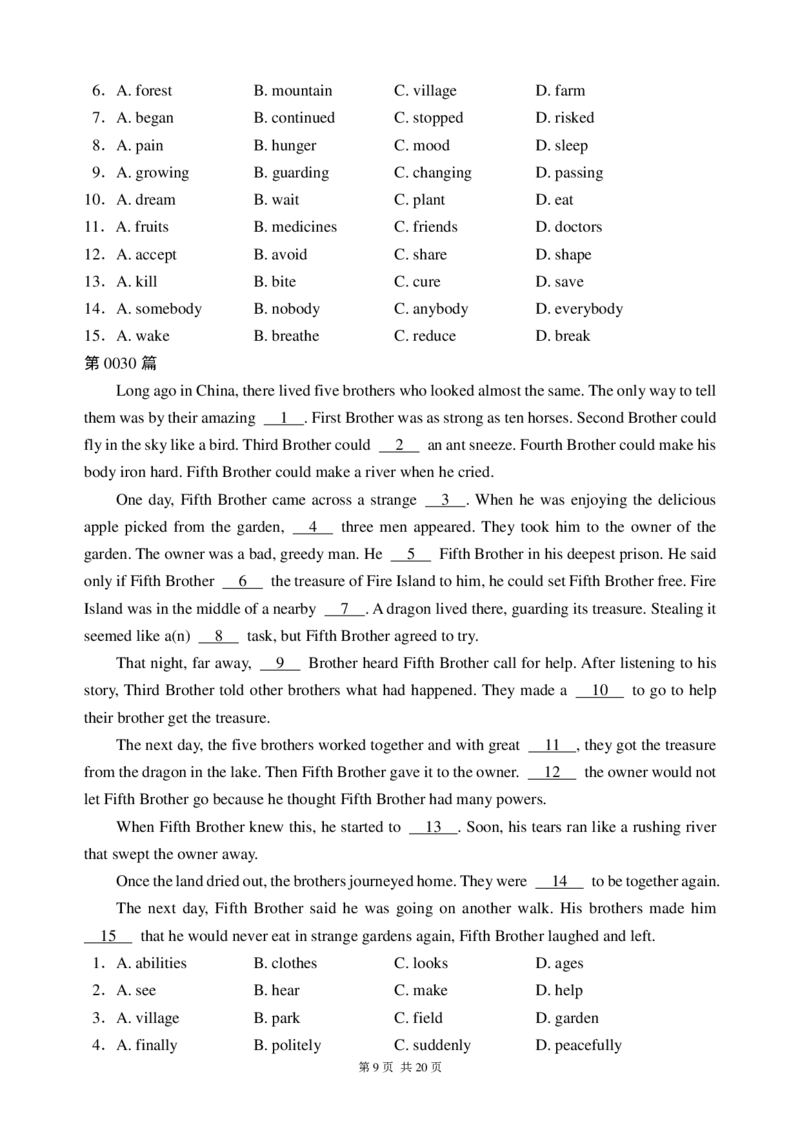
6.A. forest


B. mountain

C. village


D. farm
7.A. began


B. continued

C. stopped

D. risked
8.A. pain


B. hunger


C. mood


D. sleep
9.A. growing

B. guarding

C. changing

D. passing
10.A. dream


B. wait


C. plant


D. eat
11.A. fruits


B. medicines

C. friends


D. doctors
12.A. accept


B. avoid


C. share


D. shape
13.A. kill


B. bite


C. cure


D. save
14.A. somebody

B. nobody


C. anybody

D. everybody
15.A. wake


B. breathe


C. reduce


D. break
第0030 篇
Long ago in China, there lived five brothers who looked almost the same. The only way to tell
them was by their amazing   1  . First Brother was as strong as ten horses. Second Brother could
fly in the sky like a bird. Third Brother could   2   an ant sneeze. Fourth Brother could make his
body iron hard. Fifth Brother could make a river when he cried.
    One day, Fifth Brother came across a strange   3  . When he was enjoying the delicious
apple picked from the garden,   4   three men appeared. They took him to the owner of the
garden. The owner was a bad, greedy man. He   5   Fifth Brother in his deepest prison. He said
only if Fifth Brother   6   the treasure of Fire Island to him, he could set Fifth Brother free. Fire
Island was in the middle of a nearby   7  . A dragon lived there, guarding its treasure. Stealing it
seemed like a(n)   8   task, but Fifth Brother agreed to try.
That night, far away,   9   Brother heard Fifth Brother call for help. After listening to his
story, Third Brother told other brothers what had happened. They made a   10   to go to help
their brother get the treasure.
The next day, the five brothers worked together and with great   11  , they got the treasure
from the dragon in the lake. Then Fifth Brother gave it to the owner.   12   the owner would not
let Fifth Brother go because he thought Fifth Brother had many powers.
When Fifth Brother knew this, he started to   13  . Soon, his tears ran like a rushing river
that swept the owner away.
Once the land dried out, the brothers journeyed home. They were   14   to be together again.
The next day, Fifth Brother said he was going on another walk. His brothers made him
  15   that he would never eat in strange gardens again, Fifth Brother laughed and left.
1.A. abilities

B. clothes


C. looks


D. ages
2.A. see


B. hear


C. make


D. help
3.A. village


B. park


C. field


D. garden
4.A. finally


B. politely

C. suddenly

D. peacefully
第10 页 共20 页
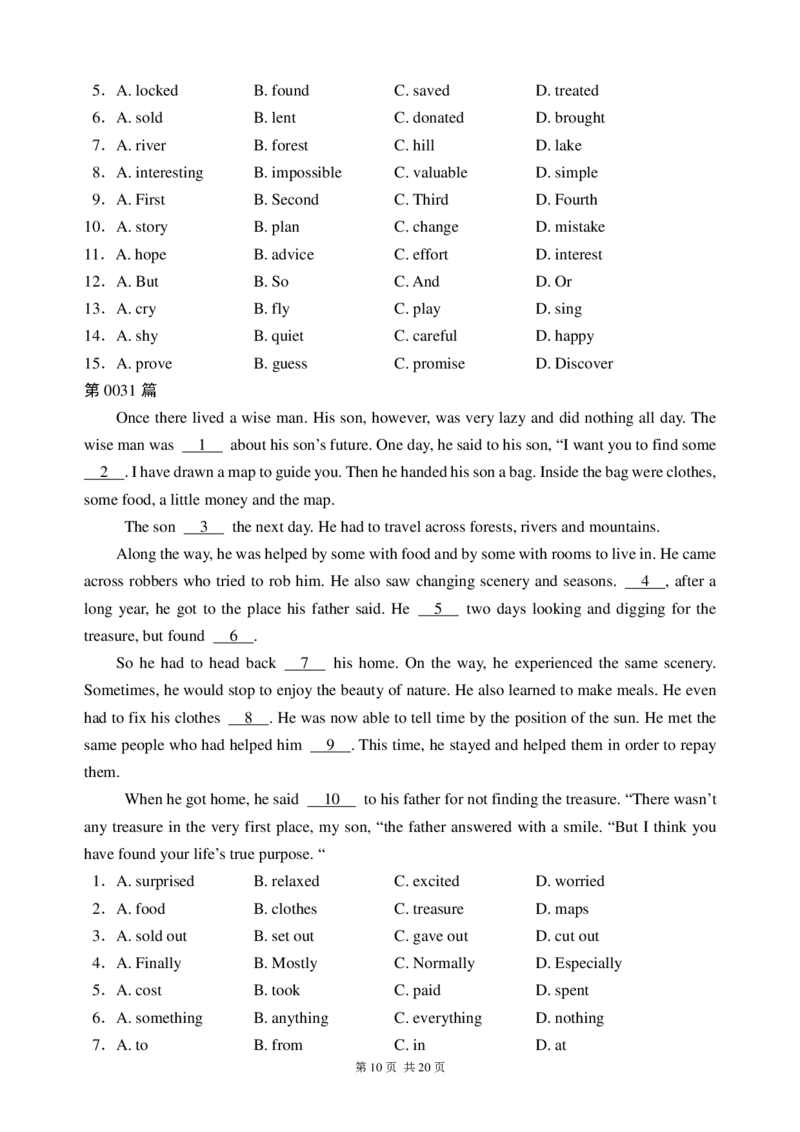
5.A. locked


B. found


C. saved


D. treated
6.A. sold


B. lent


C. donated

D. brought
7.A. river


B. forest


C. hill


D. lake
8.A. interesting

B. impossible

C. valuable

D. simple
9.A. First


B. Second


C. Third


D. Fourth
10.A. story


B. plan


C. change


D. mistake
11.A. hope


B. advice


C. effort


D. interest
12.A. But


B. So


C. And


D. Or
13.A. cry


B. fly


C. play


D. sing
14.A. shy


B. quiet


C. careful


D. happy
15.A. prove


B. guess


C. promise

D. Discover
第0031 篇
Once there lived a wise man. His son, however, was very lazy and did nothing all day. The
wise man was   1   about his son’s future. One day, he said to his son, “I want you to find some
  2  . I have drawn a map to guide you. Then he handed his son a bag. Inside the bag were clothes,
some food, a little money and the map.
The son   3   the next day. He had to travel across forests, rivers and mountains.
Along the way, he was helped by some with food and by some with rooms to live in. He came
across robbers who tried to rob him. He also saw changing scenery and seasons.   4  , after a
long year, he got to the place his father said. He   5   two days looking and digging for the
treasure, but found   6  .
So he had to head back   7   his home. On the way, he experienced the same scenery.
Sometimes, he would stop to enjoy the beauty of nature. He also learned to make meals. He even
had to fix his clothes   8  . He was now able to tell time by the position of the sun. He met the
same people who had helped him   9  . This time, he stayed and helped them in order to repay
them.
When he got home, he said   10   to his father for not finding the treasure. “There wasn’t
any treasure in the very first place, my son, “the father answered with a smile. “But I think you
have found your life’s true purpose. “
1.A. surprised

B. relaxed


C. excited


D. worried
2.A. food


B. clothes


C. treasure

D. maps
3.A. sold out

B. set out


C. gave out

D. cut out
4.A. Finally

B. Mostly


C. Normally

D. Especially
5.A. cost


B. took


C. paid


D. spent
6.A. something

B. anything

C. everything

D. nothing
7.A. to


B. from


C. in


D. at
第11 页 共20 页
8.A. herself


B. himself


C. itself


D. themselves
9.A. later


B. earlier


C. sooner


D. elder
10.A. sorry


B. congratulations
C. advice


D. pleasure
第0032 篇
My life was perfect when I was twelve years old. I had a big family,   1   my sister, Chrissy,
and a little brother, Patrick, whom I loved greatly. Spring was coming, and I was   2   about
another summer with Grandma. She and I had great fun together last summer. She was retiring this
year,   3   that meant more time with her. Then, on April 11, 2017, at 10:00 P.M., we were all
going to bed when the phone rang. My uncle was   4   to say that Grandpa had just taken
Grandma to the hospital.
The next morning I was told that Grandma was gone due to a heart disease. I tried to be strong
but even my father   5  . I hadn’t even said goodbye to her. I couldn’t control my   6
anymore and began to cry loudly. It finally hit me: She was gone   7  . All she had left me were
8   in the garden — the hours we spent planting flowers and taking care of   9  . I believe that
my grandma is a star watching over me, and she would have wanted me to be   10   and happy
like her, even though there are bad times. My family and friends love me for who I am and support
me for what I do, as I know my grandma would, too.
1.A. besides

B. including

C. except


D. beside
2.A. worried

B. excited


C. moved


D. surprised
3.A. but


B. while


C. so


D. or
4.A. calling


B. visiting


C. helping


D. writing
5.A. shouted

B. spoke


C. talked


D. cried
6.A. thoughts

B. words


C. ideas


D. feelings
7.A. ever


B. forever


C. always


D. sometimes
8.A. instructions
B. suggestions

C. memories

D. experiments
9.A. them


B. her


C. it


D. us
10.A. weak


B. careful


C. polite


D. strong
第0033 篇
If you were ninety years old, what would you plan to do? Few people want to have new
challenges   1   that age. However, an old man named Jing Kui did something that surprised a
lot of people.
As a man of 93, he met a challenge. One day,   2   film director came to him and asked
whether he wanted to act in his movie. “  3   in the movie?” asked the old man.
“You’ve been a barber. I believe you’re the right man for my movie The Barber.”
The old man read the script (剧本) before accepting the invitation.   4   he knew the story
well, he still needed to keep all the words in mind.   5   was! He finally made it and took home
第12 页 共20 页
a silver cup for a special acting prize. The movie also   6   both national and international prizes.
Jing became a barber when he was young. He loved the job, so he practiced hard   7   a
better one. In his eighties, he was still doing the same job. That was why he   8   by the film
director.
While the film was being made, the director had his worries because he didn’t know
  9   Mr. Jing could keep it going. At last, when the filming was done, the director was really
pleased. Jing   10   solved all his problems! Now Jing set a world record as being a 93-year-old
actor star who had never acted before!
1.A. from


B. of


C. at


D. on
2.A. the


B. /


C. a


D. an
3.A. What can I do
B. What I can do
C. How can I do
D. How I can do
4.A. Unless


B. Though

C. Since


D. Until
5.A. How big the challenge


B. What big the challenge
C. How the big challenge


D. What the big challenge
6.A. will win

B. win


C. wins


D. won
7.A. be


B. act


C. to be


D. to act
8.A. invites


B. invited


C. is invited

D. was invited
9.A. that


B. if


C. where


D. when
10.A. hard


B. hardly


C. successful

D. successfully
第0034 篇
“The grass looks greener on the other side of the fence.” That is an old   1   in English. It
means other places often look better, more interesting than the place   2   you live. Some people
worry that young Chinese are beginning to feel like that. They see young Chinese paying no
attention to Chinese culture and,   3  , buying Japanese cartoon books, watching Korean soap
operas and even   4   Western holidays.
Foreign books and soap operas are good,   5   Chinese writers and actors are just as good.
As for holidays, Christmas is nice, but for Chinese, it   6   has the special meaning like the
Spring Festival, and the West has   7   to compare with the Mid-Autumn Festival. Don’t forget
the best part of Chinese culture: Friendliness! Not all countries are as   8   as China.
It’s good to enjoy other cultures and   9   from them, but they can’t take the place of your
own culture. It’s good to look on the other side of the fence, but   10   you look carefully and
closely, and you will find that the grass isn’t always greener on the other side of the fence.
1.A. word


B. saying


C. sentence

D. rule
2.A. when


B. where


C. why


D. how
3.A. beside


B. besides


C. instead


D. then
4.A. celebrating

B. to celebrate

C. celebrated

D. celebrate
第13 页 共20 页
5.A. if


B. so


C. but


D. or
6.A. still


B. never


C. always


D. ever
7.A. everything

B. something

C. anything

D. nothing
8.A. warm


B. warmer

C. cold


D. colder
9.A. learns


B. learning

C. in learning

D. to learn
10.A. make up

B. make up of

C. make sure

D. be sure to
第0035 篇
I have two older brothers, Matt and Martin. They love me very much. Perhaps it is because I
am the   1   child and the only sister they have.
Both Matt and Martin have thick and dark hair. They look alike (相像) with   2   short
hairdos (发型) and big eyes. They are also very tan (晒黑的) because they enjoy outdoor   3  .
For example, Matt likes football and Martin is a tennis player. They are much taller than me and I
always have to look up when I   4   to them. They both love to   5  , so Mum often says that
they could eat a horse.
Their personalities are very   6  . Matt is very active and lively. He often takes part in club
activities and gets along   7   with people. He also likes to play jokes on others, especially
Martin! Sometimes Mum is not very   8   with Matt because he plays so much and does not
listen to his teachers carefully when he is in class.
Martin, on the other hand, is the quiet one. He is less active than Matt,   9   he has a really
close group of friends. He also does well in his   10   because he works very hard on his studies.
Mum never has to worry about Martin.
1.A. fattest


B. youngest

C. rudest


D. strongest
2.A. their


B. our


C. your


D. her
3.A. trips


B. picnics


C. sports


D. risks
4.A. talk


B. write


C. bow


D. fly
5.A. sing


B. eat


C. laugh


D. drive
6.A. important

B. difficult

C. dangerous

D. different
7.A. loudly


B. easily


C. suddenly

D. recently
8.A. nervous

B. honest


C. happy


D. angry
9.A. whether

B. if


C. or


D. but
10.A. exams


B. hobbies

C. interviews

D. adventures
第0036 篇
My friend Richard went far to work, so he asked me to take care of his yard in the mountains.
He worked hard and often kept the yard   1   without any grass. But I was too lazy to sweep the
fallen leaves, and I   2   pluck (拔) grass, allowing it to grow rapidly. In the early   3  , in
March, the leaves were green and soft. A month later, when the leaves spread quickly, I discovered
第14 页 共20 页
they were like wild orchids (兰花) in the forest.
As the summer came, the “grass” really flowered. The flowers looked like those forest orchids,
  4   they were yellow, unlike those purple or brown red forest orchids. I picked one flower, then
went to find a friend who studied   5  . As soon as my friend saw it he asked me   6   I picked
it. “It’s amazing!” He   7   explained, “This kind of orchid is hard to find. Now it is worth at
least 10,000 dollars each.”
I told the good news to Richard. He was   8  . After a while he said gently, he saw the orchid
in the yard every year, but he thought it was common grass, so he always plucked it. He said, “If I
could   9  , it would flower a few years before.” Yes, all of us might miss some rare orchids in
our own lives. We don’t give them the time to flower to prove their value.
Give the “grass” time to flower and give everybody a   10   to prove his value. Don’t pluck
a leave of any “grass” or negate (否定) a person rudely and how many “rare orchids “ we will get
in our lives!
1.A. wild


B. clean


C. dry


D. dirty
2.A. sometimes

B. often


C. never


D. always
3.A. spring


B. summer

C. autumn


D. winter
4.A. so


B. but


C. then


D. or
5.A. colors


B. rivers


C. seasons

D. plants
6.A. that


B. why


C. where


D. who
7.A. proudly

B. successfully
C. carelessly

D. excitedly
8.A. worried

B. surprised

C. scared


D. relaxed
9.A. wait


B. get


C. take


D. make
10.A. tree


B. yard


C. flower


D. chance
第0037 篇
Most of us like to know where we are and where we’re going. It can feel strange to be   1  .
The words “being lost” make us think of a dark and scary wood or street,   2   that’s not always
the case.
Once we were on holiday in Venice. My dad planned to go out to take photos early the next
morning. Mum wasn’t   3  , but I would go with him, only because he   4   I could have the
biggest ever bowl of Italian ice cream if I did.   5   else would I get up so early?
So at 5 a.m. the next day we left the hotel and started walking in the   6   streets. When the
sun came up, Dad started taking photos and I   7   him, down small streets and over little bridges.
After about an hour, I turned to Dad and asked, “Where are we?” He said, “I have no idea. “I
immediately felt a bit   8  , but Dad just laughed and said, “We’re lost!”, I told him to   9   his
map or phone. He said, “I only brought the   10  . Come on, let’s get more lost!” He laughed
again.
第15 页 共20 页
His laughter   11   me and made me feel safe. Slowly people were appearing on the streets
— shops and cafes began to open.
I began to   12   that we were lost, and just started watching and taking in everything that
was happening around me.
  13  , after about four hours of walking around, we were back. Mum asked anxiously(担心
地), “Where have you been?” I said with a big   14  , “We got lost!”
These days we   15   get lost with so many things around us—maps, GPS, apps on our
phones, and so on. But Dad showed me that being lost can sometimes simply be something to enjoy.
1.A. alone


B. lost


C. afraid


D. silent
2.A. or


B. so


C. but


D. and
3.A. worried

B. touched

C. satisfied

D. interested
4.A. expected

B. realized

C. remembered
D. promised
5.A. How


B. Why


C. When


D. Where
6.A. modern

B. noisy


C. empty


D. bright
7.A. left


B. invited


C. guided


D. followed
8.A. scared


B. hurt


C. hungry


D. tired
9.A. pick up

B. think of

C. take out

D. pay for
10.A. map


B. bowl


C. phone


D. camera
11.A. saved


B. relaxed


C. stopped

D. warned
12.A. doubt


B. forget


C. imagine

D. regret
13.A. Finally

B. Recently

C. Certainly

D. Suddenly
14.A. surprise

B. shame


C. smile


D. fear
15.A. hardly


B. often


C. nearly


D. always
第0038 篇
Sam was very nervous. It was his first day in new   1  , and lunch was only thirty minutes
away. For most students, lunch is the   2   part of the school day. It is time when you talk with
your friends, get to know what interesting things everyone is doing, and, of course,   3  . Sam,
however, didn’t know anyone or anything, like where to sit or with whom to sit at lunch.
Sam’s   4   was in the army, so his family moved a lot. He had really liked his old school
and   5   leaving his two best friends. They still talked to each other through phone calls and
emails,   6   he couldn’t see them every day. He wondered if their   7   would continue. He
didn’t want to lose them, but he knew it would be   8   for them to stay close.
“I know this is hard on you,” his mother said as he got ready for school this morning, “and
I’m really   9   you have to keep changing schools.” Sam could see regret in her eyes, but he
didn’t want her to feel that way.   10   had always been ready to defend not only the family but
also the country. Sam loved her so much. He gave her a smile and told her not to   11  . He had
第16 页 共20 页
wanted to mean it, but there was still always worry in him when they moved.
The   12   time came quickly. As Sam was walking to the dining room, a voice behind him
said. “Excuse me.” Sam   13   and saw five friendly faces.
“Would you like to join us?” asked one of them.
This   14   invitation was exactly what he needed. Sam nodded yes   15   and joined
them. He was sure about his future school life now.
1.A. company

B. family


C. factory


D. school
2.A. best


B. longest


C. shortest

D. worst
3.A. eat


B. learn


C. run


D. sleep
4.A. brother

B. father


C. mother


D. sister
5.A. hated


B. imagined

C. tried


D. suggested
6.A. so


B. or


C. but


D. if
7.A. discussion

B. dream


C. business

D. friendship
8.A. safe


B. hard


C. natural


D. terrible
9.A. proud


B. sorry


C. excited


D. surprised
10.A. He


B. I


C. She


D. We
11.A. forget


B. move


C. return


D. worry
12.A. breakfast

B. lunch


C. tea


D. dinner
13.A. sat down

B. got up


C. ran away

D. turned around
14.A. unexpected
B. creative

C. funny


D. popular
15.A. bravely

B. happily


C. nervously

D. patiently
第0039 篇
Our junior high school life is coming to an end. So my classmates and I decided to make a
special   1   for our own favorite teacher in the ceramics (陶艺) class.
After being dried for a long time in the fire, our gifts for teachers were   2  . Chen Hui took
them out of the kiln (窑). CRASH (碎裂声) ! His cup, Xiao Yao’s   3  , and my heart broke into
pieces all over the floor.
“My elephant lost her trunk!” Xiao Yao shouted. “My heart is broken!” I   4   almost at the
same time.
“I’m so sorry!” Chen Hui said.
“Bring   5   to the repair station,” said Xiao Yao, “Let’s see what we can do with some
magic   6   the magic glue worked only on Chen Hui’s cup. The trunk and glue.” We tried many
times, the heart were in too many broken bits to put back together.
“Now my elephant has a short nose instead of a trunk,” said Xiao Yao, “It   7   like a little
dog with big ears. And it’s   8   lovely! Let’s call it doglephant!”
“A cute doglephant! Cool! You just turned the accident into a happy one!” I said. And right
第17 页 共20 页
then, I knew   9   to do. Maybe I could make a mosaic (镶嵌画) by using the pieces of my
broken heart.
When it was all done, everyone thought it was pretty cool. Yes, my present didn’t turn out the
way I’d planned, but it turned out even   10  !
1.A. gift


B. hat


C. bag


D. coat
2.A. safe


B. broken


C. ready


D. wet
3.A. dog


B. elephant

C. cat


D. panda
4.A. smiled


B. read


C. wrote


D. cried
5.A. something

B. nothing

C. everything

D. anything
6.A. as


B. but


C. so


D. though
7.A. looks


B. sounds


C. smells


D. tastes
8.A. still


B. even


C. almost


D. hardly
9.A. when


B. how


C. which


D. what
10.A. worse


B. better


C. heavier


D. cheaper
第0040 篇
When you hear the world hero, you may think of someone like Mahatma Gandhi or Nelson
Mandela. But there are also “everyday” heroes — they may not be   1   to the public, but they
do what they can to help   2   people’s lives as well. Everyday heroes are normal people who
are working to make the world a better place.   3   them is Robert Lee.
Lee grew up in New York City.   4   his family was not rich, he learned from a young age
the importance of   5   the waste of food. When in college, he was part of a student group that
gave out leftover (剩余的) food to   6   people. This experience made him realize how
  7   the problem of food wastage actually was.
After he left university, Lee and a friend set up a(n)   8   called Rescuing Leftover Cuisine
(RLC). Its purpose is to collect   9   food from restaurants and send it for free to shelters (收容
所) and food kitchens. Volunteers   10   the food from restaurants around the city and hand it
out to those in need.
RLC operates   11  . Using an app developed by Lee’s team, restaurants   12   how
much leftover food they have each day. Then volunteers are sent to fetch it. The   13   is usually
short, so volunteers can just do their deliveries (递送) by   14   from the restaurants to the
shelters. Lee believes this is a quick way of delivery.
So far, Lee and his team have successfully   15   over 150,000 kilograms of food, serving
almost 300,000   16   to people who need them. Lee has shown that a   17   action can help
people around us greatly.   18   may have a greater influence than we imagine. When Lee is
asked   19   his next plan is, he says there’s still a lot to do. “It’s just the   20  . With more
restaurants, who knows how much more we can do.”
第18 页 共20 页
1.A. safe


B. close


C. friendly

D. well-known
2.A. record


B. share


C. improve

D. manage
3.A. Under


B. Beside


C. Among


D. Opposite
4.A. If


B. As


C. When


D. Though
5.A. storing

B. avoiding

C. burning

D. recycling
6.A. sick


B. blind


C. lonely


D. homeless
7.A. easy


B. serious


C. funny


D. strange
8.A. club


B. school


C. business

D. organization
9.A. cold


B. cheap


C. unsold


D. uncooked
10.A. pick up

B. go over


C. pay for


D. throw away
11.A. badly


B. quietly


C. simply


D. slowly
12.A. report


B. notice


C. discuss


D. consider
13.A. visit


B. break


C. meeting

D. distance
14.A. flying


B. walking

C. skating


D. shipping
15.A. saved


B. heated


C. lent


D. grown
16.A. jobs


B. meals


C. rooms


D. seats
17.A. small


B. secret


C. direct


D. social
18.A. It


B. He


C. You


D. They
19.A. who


B. when


C. what


D. where
20.A. need


B. time


C. promise

D. beginning
第19 页 共20 页
中考英语完形填空300 篇
参考答案
第0021 篇
1.B

 2.A

 3.C

 4.D

 5.B
6.A

 7.C

 8.B

 9.D

10.A
11.D

12.D

13.C

14.A

15.B
第0022 篇
1.C

 2.A

 3.C

 4.B

 5.A
6.D

 7.A

 8.B

 9.D

10.D
第0023 篇
1.B

 2.A

 3.C

 4.B

 5.D
6.C

 7.C

 8.D

 9.A

10.D
11.B

12.D

13.B

14.C

15.A
第0024 篇
1.C

 2.B

 3.B

 4.A

 5.C
6.A

 7.C

 8.B

 9.A

10.D
第0025 篇
1.A

 2.D

 3.B

 4.B

 5.C
6.A

 7.A

 8.C

 9.D

10.B
11.A

12.B

13.A

14.C

15.D
第0026 篇
1.B

 2.C

 3.C

 4.D

 5.B
6.A

 7.D

 8.C

 9.B

10.A
11.A

12.C
第0027 篇
1.B

 2.B

 3.A

 4.D

 5.A
6.C

 7.B

 8.D

 9.B

10.C
11.B

12.A

13.C

14.A

15.D
第0028 篇
1.A

 2.B

 3.C

 4.A

 5.D
6.C

 7.D

 8.A

 9.B

10.D
第0029 篇
1.B

 2.D

 3.C

 4.B

 5.D
6.C

 7.C

 8.A

 9.A

10.D
11.B

12.C

13.A

14.B

15.D
第20 页 共20 页
第0030 篇
1.A

 2.B

 3.D

 4.C

 5.A
6.D

 7.D

 8.B

 9.C

10.B
11.C

12.A

13.A

14.D

15.C
第0031 篇
1.D

 2.C

 3.B

 4.A

 5.D
6.D

 7.A

 8.B

 9.B

10.A
第0032 篇
1.B

 2.B

 3.C

 4.A

 5.D
6.D

 7.B

 8.C

 9.A

10.D
第0033 篇
1.C

 2.C

 3.A

 4.B

 5.A
6.D

 7.C

 8.D

 9.B

10.D
第0034 篇
1.B

 2.B

 3.C

 4.A

 5.C
6.B

 7.D

 8.A

 9.D

10.C
第0035 篇
1.B

 2.A

 3.C

 4.A

 5.B
6.D

 7.B

 8.C

 9.D

10.A
第0036 篇
1.B

 2.C

 3.A

 4.B

 5.D
6.C

 7.D

 8.B

 9.A

10.D
第0037 篇
1.B

 2.C

 3.D

 4.D

 5.B
6.C

 7.D

 8.A

 9.C

10.D
11.B

12.B

13.A

14.C

15.A
第0038 篇
1.D

 2.A

 3.A

 4.C

 5.A
6.C

 7.D

 8.B

 9.B

10.C
11.D

12.B

13.D

14.A

15.B
第0039 篇
1.A

 2.C

 3.B

 4.D

 5.C
6.B

 7.A

 8.A

 9.D

10.B
第0040 篇
1.D

 2.C

 3.C

 4.B

 5.B
6.D

 7.B

 8.D

 9.C

10.A
11.C

12.A

13.D

14.B

15.A
16.B

17.A

18.A

19.C

20.D