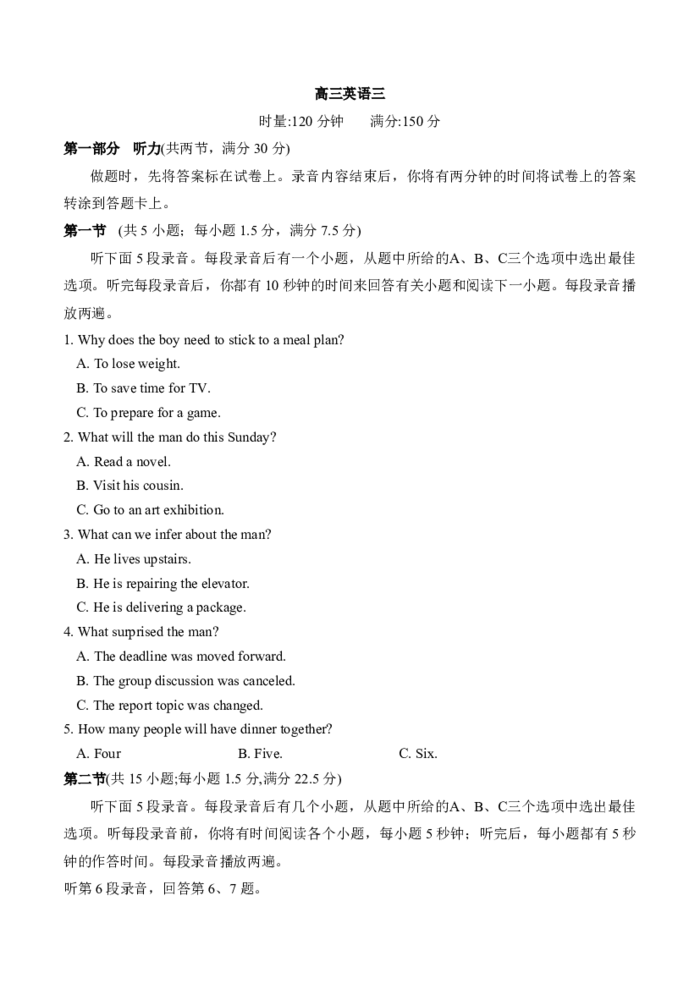
高三英语三
时量:120 分钟
满分:150 分
第一部分
听力(共两节,满分30 分)
做题时,先将答案标在试卷上。录音内容结束后,你将有两分钟的时间将试卷上的答案
转涂到答题卡上。
第一节
(共5 小题;每小题1.5 分,满分7.5 分)
听下面5 段录音。每段录音后有一个小题,从题中所给的A、B、C三个选项中选出最佳
选项。听完每段录音后,你都有10 秒钟的时间来回答有关小题和阅读下一小题。每段录音播
放两遍。
1. Why does the boy need to stick to a meal plan?
A. To lose weight.
B. To save time for TV.
C. To prepare for a game.
2. What will the man do this Sunday?
A. Read a novel.
B. Visit his cousin.
C. Go to an art exhibition.
3. What can we infer about the man?
A. He lives upstairs.
B. He is repairing the elevator.
C. He is delivering a package.
4. What surprised the man?
A. The deadline was moved forward.
B. The group discussion was canceled.
C. The report topic was changed.
5. How many people will have dinner together?
A. Four
B. Five.
C. Six.
第二节(共15 小题;每小题1.5 分,满分22.5 分)
听下面5 段录音。每段录音后有几个小题,从题中所给的A、B、C三个选项中选出最佳
选项。听每段录音前,你将有时间阅读各个小题,每小题5 秒钟;听完后,每小题都有5 秒
钟的作答时间。每段录音播放两遍。
听第6 段录音,回答第6、7 题。
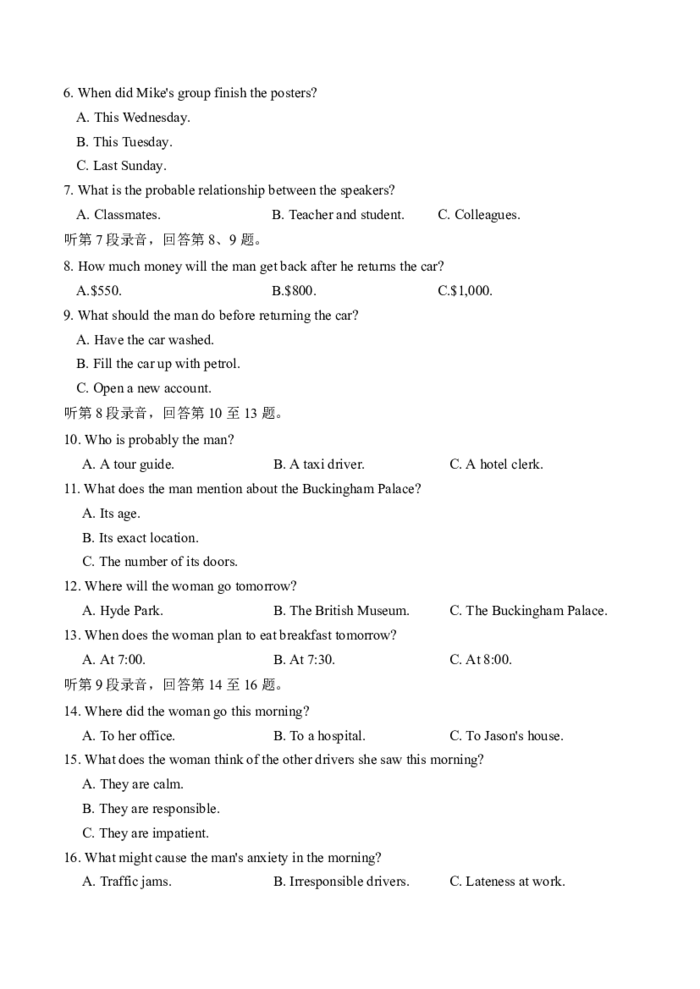
6. When did Mike's group finish the posters?
A. This Wednesday.
B. This Tuesday.
C. Last Sunday.
7. What is the probable relationship between the speakers?
A. Classmates.
B. Teacher and student.
C. Colleagues.
听第7 段录音,回答第8、9 题。
8. How much money will the man get back after he returns the car?
A.$550.
B.$800.
C.$1,000.
9. What should the man do before returning the car?
A. Have the car washed.
B. Fill the car up with petrol.
C. Open a new account.
听第8 段录音,回答第10 至13 题。
10. Who is probably the man?
A. A tour guide.
B. A taxi driver.
C. A hotel clerk.
11. What does the man mention about the Buckingham Palace?
A. Its age.
B. Its exact location.
C. The number of its doors.
12. Where will the woman go tomorrow?
A. Hyde Park.
B. The British Museum.
C. The Buckingham Palace.
13. When does the woman plan to eat breakfast tomorrow?
A. At 7:00.
B. At 7:30.
C. At 8:00.
听第9 段录音,回答第14 至16 题。
14. Where did the woman go this morning?
A. To her office.
B. To a hospital.
C. To Jason's house.
15. What does the woman think of the other drivers she saw this morning?
A. They are calm.
B. They are responsible.
C. They are impatient.
16. What might cause the man's anxiety in the morning?
A. Traffic jams.
B. Irresponsible drivers.
C. Lateness at work.
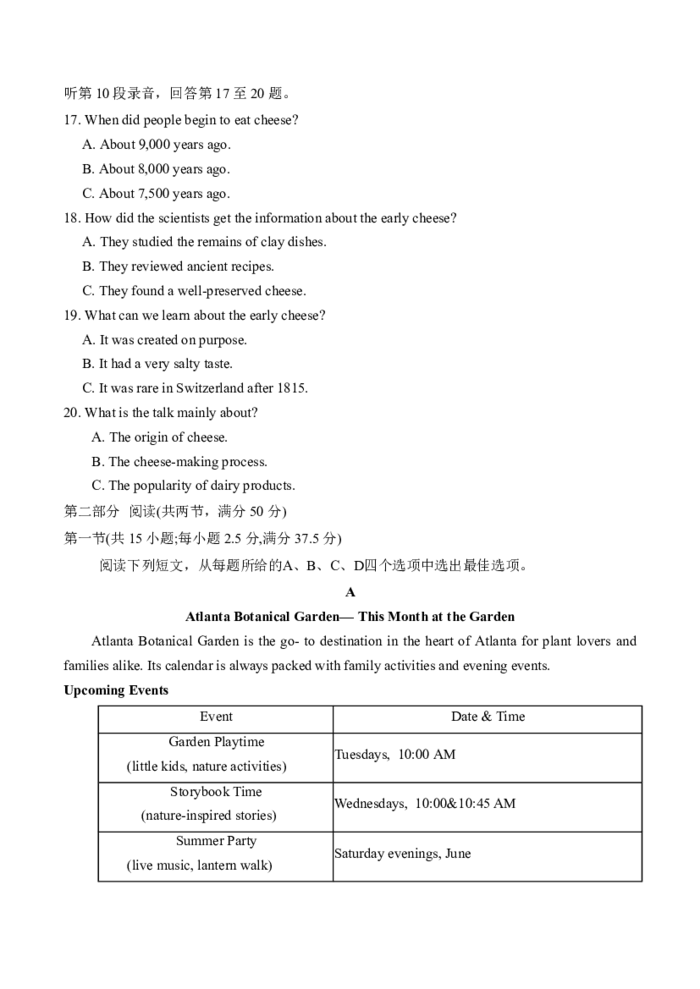
听第10 段录音,回答第17 至20 题。
17. When did people begin to eat cheese?
A. About 9,000 years ago.
B. About 8,000 years ago.
C. About 7,500 years ago.
18. How did the scientists get the information about the early cheese?
A. They studied the remains of clay dishes.
B. They reviewed ancient recipes.
C. They found a well-preserved cheese.
19. What can we learn about the early cheese?
A. It was created on purpose.
B. It had a very salty taste.
C. It was rare in Switzerland after 1815.
20. What is the talk mainly about?
A. The origin of cheese.
B. The cheese-making process.
C. The popularity of dairy products.
第二部分阅读(共两节,满分50 分)
第一节(共15 小题;每小题2.5 分,满分37.5 分)
阅读下列短文,从每题所给的A、B、C、D四个选项中选出最佳选项。
A
Atlanta Botanical Garden— This Month at the Garden
Atlanta Botanical Garden is the go- to destination in the heart of Atlanta for plant lovers and
families alike. Its calendar is always packed with family activities and evening events.
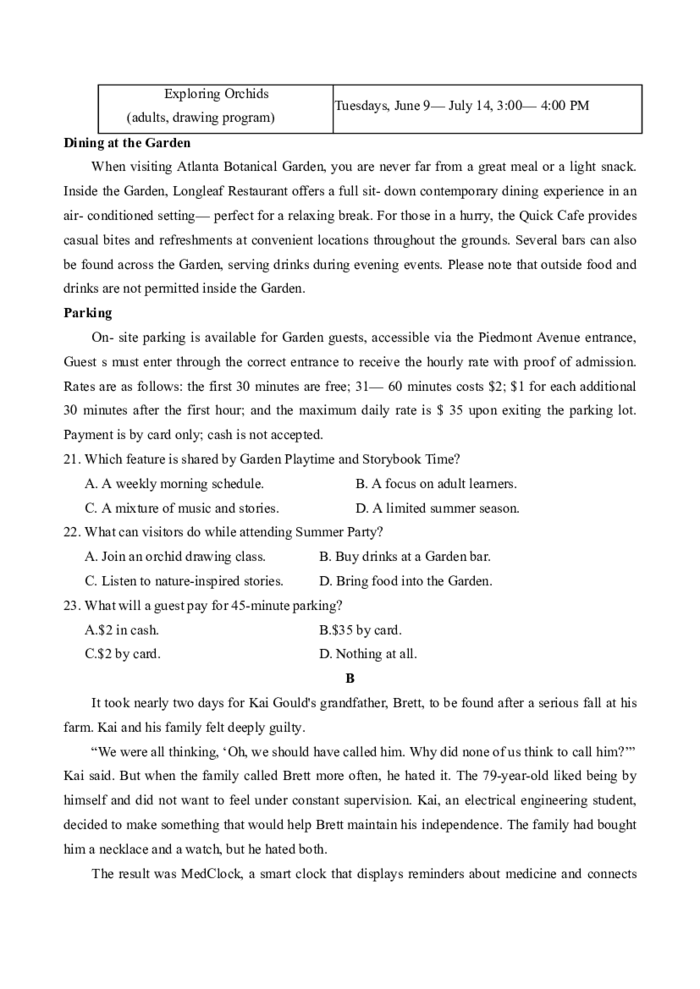
Upcoming Events
Event
Date & Time
Garden Playtime
(little kids, nature activities)
Tuesdays, 10:00 AM
Storybook Time
(nature-inspired stories)
Wednesdays, 10:00&10:45 AM
Summer Party
(live music, lantern walk)
Saturday evenings, June
Exploring Orchids
(adults, drawing program)
Tuesdays, June 9— July 14, 3:00— 4:00 PM
Dining at the Garden
When visiting Atlanta Botanical Garden, you are never far from a great meal or a light snack.
Inside the Garden, Longleaf Restaurant offers a full sit- down contemporary dining experience in an
air- conditioned setting— perfect for a relaxing break. For those in a hurry, the Quick Cafe provides
casual bites and refreshments at convenient locations throughout the grounds. Several bars can also
be found across the Garden, serving drinks during evening events. Please note that outside food and
drinks are not permitted inside the Garden.
Parking
On- site parking is available for Garden guests, accessible via the Piedmont Avenue entrance,
Guest s must enter through the correct entrance to receive the hourly rate with proof of admission.
Rates are as follows: the first 30 minutes are free; 31— 60 minutes costs $2; $1 for each additional
30 minutes after the first hour; and the maximum daily rate is $ 35 upon exiting the parking lot.
Payment is by card only; cash is not accepted.
21. Which feature is shared by Garden Playtime and Storybook Time?
A. A weekly morning schedule.
B. A focus on adult learners.
C. A mixture of music and stories.
D. A limited summer season.
22. What can visitors do while attending Summer Party?
A. Join an orchid drawing class.
B. Buy drinks at a Garden bar.
C. Listen to nature-inspired stories.
D. Bring food into the Garden.
23. What will a guest pay for 45-minute parking?
A.$2 in cash.
B.$35 by card.
C.$2 by card.
D. Nothing at all.
B
It took nearly two days for Kai Gould's grandfather, Brett, to be found after a serious fall at his
farm. Kai and his family felt deeply guilty.
“We were all thinking, ‘Oh, we should have called him. Why did none of us think to call him?’”
Kai said. But when the family called Brett more often, he hated it. The 79-year-old liked being by
himself and did not want to feel under constant supervision. Kai, an electrical engineering student,
decided to make something that would help Brett maintain his independence. The family had bought
him a necklace and a watch, but he hated both.
The result was MedClock, a smart clock that displays reminders about medicine and connects
older people with their families. Notifications can be set for certain times, causing the clock to ring
until a button is pressed. An automatic text message is then sent to a chosen phone number. Brett
uses the clock every morning and evening, so the messages give his family a regular signal that he is
all right. “It is essentially just an alarm clock that you put on your kitchen table,” Kai explained.
Unlike a watch or necklace, it does not have to be put on each day.
Kai's father, Chris, said the device not only provided peace of mind but also improved the
family's relationship with Brett. Their calls had mainly consisted of questions such as “Have you
done this? Have you done that?” With the clock taking care of those checks, the calls became “a lot
more social and easier”.
Kai built more clocks in his garage and asked for feedback online. The response was
overwhelming, with families, hospitals and retirement villages showing interest. Investors had also
been circling, but Kai wanted to keep ownership of the product. They often wanted to lift the price,
he said, making it unaffordable for many elderly people. “I’m trying to keep the price down as low
as I can, and keep it as accessible to people as I can.”
24. Why did Kai decide to invent the smart clock?
A. To help Brett live independently.
B. To monitor Brett's farm remotely.
C. To prove his engineering skills.
D. To reduce Brett's medicine use.
25. What sets MedClock apart from other supervision devices?
A. It provides several reminder sounds.
B. It records users' medical information.
C. It works without being worn.
D. It connects directly with hospitals.
26. How did MedClock make a difference to the family?
A. Calls became more frequent.
B. Conversations became less task-focused.
C. Exchanges became less detailed.
D. Relatives became more involved.
27. What message does Kai's story mainly convey?
A. Personal freedom deserves top priority.
B. Thoughtful care respects people's real needs.
C. Technology can replace family involvement.
D. Useful inventions should remain affordable.
C
Electric vehicles (EVs) are often billed as a clean fix for transport emissions. But their success
comes with a catch: an approaching wave of retired batteries. Global EV sales topped 17 million in
2024, and demand for battery capacity is set to triple by 2030. Since a typical battery lasts eight to
twelve years, a huge number of packs will soon reach the end of their useful life. By 2040,
end-of-life batteries could weigh about 20,500 kilotons— roughly55 times the weight of the Empire
State Building.
These batteries are not harmless waste. They are classified as hazardous in many countries. If
landfilled, they can release poisonous chemicals into soil and groundwater. If damaged or stored
carelessly, they may catch fire through “thermal runaway”, a chain reaction that generates intense
heat and poisonous fumes. Such fires are notoriously hard to extinguish. The risks fall hardest on
workers in informal recycling sectors, who often lack proper training and protective gear.
Yet an expired EV battery is far from dead. Most retain 70-80% of their original capacity and
could be repurposed for stationary energy storage. The real obstacle is institutional. Once removed
from a vehicle, a battery may lose its warranty and clear ownership, becoming “an orphan battery”
that no one is obliged to collect. In the U. S.,recycling remains largely voluntary, and much battery
waste is shipped abroad, shifting environmental risks to other countries.
Extended producer responsibility (EPR) offers a way forward. Under EPR, manufacturers— not
consumers or waste handlers— must ensure that batteries are collected, reused or recycled. The EU,
India and China have adopted some form of EPR; New Jersey has led a few U. S. states. Such laws
can set collection targets, ban landfill disposal, require public information and even demand recycled
minerals in new batteries.
But EPR is no silver bullet. Producers may pass costs onto consumers, raising EV prices and
slowing adoption. Weak enforcement could allow used batteries to be stockpiled or exported. The
real test, then, is not whether EPR laws exist, but whether they are carefully designed and
coordinated across borders. Only then can retired batteries be managed safely and kept within a
transparent, circular system.
28. Why is the Empire State Building mentioned in the first paragraph?
A. To warn of EV fire risks.
B. To indicate EV popularity.
C. To highlight EV waste scale.
D. To emphasize EV battery weight.
29. What does “an orphan battery” reveal?
A. A gap in end-of-life duty.
B. A rise in informal recycling.
C. A success of voluntary programs.
D. A failure of recycling technology.
30. What is the core idea of EPR?
A. Waste exports must be limited.
B. Collection targets are set by law.
C. Recycling costs fall on consumers. D. Producers bear life-cycle responsibility.
31. What is the author's key suggestion for EPR?
A. Avoiding slower EV adoption.
B. Ensuring sound planning and global cooperation.
C. Preventing cost shifts onto EV buyers.
D. Strengthening enforcement of existing EPR laws.
D
About 400 miles of blood vessels run through the human brain. The smallest are lined with
endothelial cells(内皮细胞) joined by tight-junction proteins, forming a nearly impassable barrier
that keeps unwanted substances in the bloodstream from entering the brain. Acting like passport
control at an airport, the blood-brain barrier tightly regulates what can enter. But that same
protection creates a problem: drugs targeting the brain cannot easily enter from the bloodstream,
making brain cancers, progressive nerve diseases, and genetic disorders difficult to treat. Scientists
have spent decades trying to get medicine across this barrier.
In 1989, a UCLA hormone specialist William M. Pardridge proposed a “Molecular Trojan Horse”
, laboratory-engineered antibodies(抗体) that could deliver drugs into the brain by exploiting the
barrier's own receptors. But for a long time, researchers couldn't make the approach work.
Antibodies were generally designed to bind as tightly as possible to their targets. That tight binding,
however, prevented the shuttles from crossing the barrier. So the strategy repeatedly failed with
transferrin-receptor shuttles(转铁蛋白受体穿梭载体).
The sudden insight came when Ryan Watts, a scientist at Genentech, and his colleagues
discovered that binding weakly to the receptor allowed antibody shuttles to cross the barrier and
spread throughout the brains of mice. Watts later started Denali Therapeutics, where he developed
the technology into a platform called TransportVehicle. Other companies have pursued similar
shuttle strategies. In 2021, Japan approved Izcargo, developed by JCR Pharmaceuticals, for Hunter
syndrome. In March 2026, Denali's Avlayah received accelerated approval in the U. S. for the same
disorder, confirming that the shuttle approach can deliver real treatments.
Now the strategy faces a bigger test: Alzheimer's, far more complicated than Hunter syndrome.
Roche’ s experimental Alzheimer’ s therapy uses the same route. In early trials, it cleared plaques(脑
内斑块) with fewer infusions. lower doses(剂量), and far fewer side effects than approved drugs,
which often cause brain swelling and bleeding. But whether it slows or prevents the disease remains
unclear, and Phase III trials are ongoing.
Excitement is growing, yet challenges remain. The transferrin receptor is present throughout the
body, so drugs may cause side effects in other organs. “The big vision for the future is not one
receptor or one shuttle, but a collection of blood-brain barrier shuttles that can be engaged depending
on the needs,” says scientist Viviana Gradinaru. If successful. this approach could open doors for
other brain diseases.
32. Which of the following best describes the blood-brain barrier according to paragraph 1?
A. A perfect filter.
B. An ineffective shield.
C. A serious threat.
D. A double-edged sword.
33. What can we infer about the early “Molecular Trojan Horse” approach?
A. It won quick success.
B. It used the barrier's receptors.
C. It rebuilt blood-brain barriers.
D. It spread drugs into the brain.
34. What was the key to making the shuttle strategy work?
A. Using higher drug doses.
B. Binding tightly to the target.
C. Attaching loosely to the receptor.
D. Injecting drugs into the brain.
35. What is the best title for the text?
A. Delivering Drugs into the Brain: A Long Journey
B. The Blood-Brain Barrier: A Barrier to Treatment
C. Alzheimer’ s: The Final Test for Brain Drug Delivery
D. Hunter Syndrome: A Breakthrough in Brain Medicine
第二节(共5 小题;每小题2.5 分,满分12.5 分)
阅读下面短文,从短文后的选项中选出可以填入空白处的最佳选项。选项中有两项为多
余选项。
In a world that celebrates busyness, unstructured free time is often seen as wasted time. People
fill every minute with to-do lists, scheduled activities, and productivity goals. 36 Yet, unstructured
time— when you have no plans, deadlines, or specific tasks to complete— holds surprising benefits
for mind.
Unstructured free time allows your brain to rest and recharge. When you' re constantly
switching between tasks, your prefrontal cortex(前额叶皮质) works overtime, leading to mental
exhaustion. 37
Without external demands, your mind can wander freely, making room for creative
thinking and problem-solving.
38
It is during these unplanned moments that many people discover new hobbies or revisit
forgotten passions. A casual walk in the park might spark an interest in birdwatching. A quiet
afternoon with no obligations could lead to picking up an old guitar again. These small discoveries
can bring unexpected joy and a renewed sense of purpose.
Too much structure can leave little room for self-reflection. 39 . Unstructured time gives you
the space to ask yourself simple but important questions: Am I happy with my routine? What do I
truly enjoy doing? This quiet self-check can help you stay connected to your own needs and values.
Of course, unstructured free time doesn't mean being lazy. 40 The key is to balance it with the
responsibilities of daily life. In the end, these unplanned moments are not empty— they are the
spaces where life's most meaningful experiences often grow.
A. Unstructured time can also be a powerful tool for personal growth.
B. Some people prefer to spend their free time with friends or family.
C. This kind of mental break is essential for restoring focus and clarity.
D. Many people even feel guilty when they are not being “productive”.
E. It simply means letting go of the pressure to always be doing something.
F. Creative ideas rarely appear when you are overloaded with tight schedules.
G. Constantly following plans leaves no time to process your thoughts and feelings.
第三部分语言运用(共两节,满分30 分)
第一节(共15 小题;每小题1 分,满分15 分)
阅读下面短文,从每题所给的A、B、C、D四个选项中选出可以填入空白处的最佳选项。
— 3 tablespoons butter
— 2 eggs
— 2 medium carrots
— 1 small white onion
— 3 cloves garlic
— 4 cups cooked and chilled rice
I bet you didn't read those numbers. I' ll let you in on a secret— I didn't either.
The ingredients above were copied and pasted from the first online search result for “fried rice
recipe”. But, without any 41
to the recipe's owner, I can tell you it's wrong.
The only 42
fried rice recipe is no recipe at all. No measurements, no exact instructions, and
no timer. There are only smells and feelings and 43 . I learned to cook fried rice on the rickety
stool covered in stickers, surrounded by the scents(芳香) of my Grandma’ s apron. We used however
much leftover rice we had and a combination of anything and everything
44
in the fridge. The
kitchen was always a little 45 , but that was part of the fun.
Yet I' ve always been more of a 46
than a cook. I enjoy recipes— I enjoy the process of being
47
and finding details, adjusting and leveling and weighing. From a young age, I found 48
in the
careful baking recipes in Western cookbooks.
But I understand the beauty of spontaneity(即兴) and organic creation, and 49 ,isn't that what
life is? Creation, without recipe?
It's funny. Creation without recipe may 50
everything I' ve written thus far, but the more I
bake, the more I realize perhaps baking is spontaneous too. I don't always need to 51
my flour
beforehand in order to get perfect cookies. Cupcakes are my 52
dish, but I challenged myself to
use a different recipe every time. You’ d be amazed at how different cupcakes taste when you add an
extra egg, and you’ d be especially 53
my baking skills if you tried my cupcakes that had way too
much baking soda (trial and error...).
I'm learning to love going with the 54 . Coming to terms with and embracing the unknown is
scary, but I assure you; One day, I' ll 55
my own fried rice.
41. A. honor
B. threat
C. kindness
D. disrespect
42. A. true
B. unhealthy
C. popular
D. risky
43. A. dreams
B. failures
C. memories
D. regrets
44. A. floating
B. sitting
C. growing
D. surviving
45. A. hot
B. messy
C. dusty
D. noisy
46. A. lecturer
B. talker
C. diner
D. baker
47. A. precise
B. creative
C. patient
D. flexible
48. A. pride
B. evidence
C.comfort
D. confidence
49. A. really
B. merely
C. luckily
D. naturally
50. A. confirm
B. replace
C. represent
D. contradict
51. A. buy
B. weigh
C. estimate
D. process
52. A. main
B. side
C. signature
D. homemade
53. A. interested in
B. disappointed with
C. worried about
D. uncertain about
54. A. flow
B. recipe
C. theory
D. tradition
55. A. sell
B. master
C. design
D. understand
第二节(共10 小题;每小题1.5 分,满分15 分)
阅读下面短文,在空白处填入1 个适当的单词或括号内单词的正确形式。
On October 6, 2026, Estadio Monumental in Buenos Aires, Argentina's capital, hosted an
emotional friendly billed as “the last tango”— a match that
56 (formal) brought Lionel Messi’ s
legendary 21-year career with Argentina’ s national football team to
57 end. It was his 208th and
final international game, 58 (mark) the close of one of football's most glorious chapters.
More than 85,000 fans packed the ground.
59
all tickets sold out in under two hours, the
atmosphere turned heated long before kick-off. In this farewell match, Argentina beat Benin 3—0.
Messi produced a splendid performance, scoring a free kick and setting up two more—— having a
hand in all three of Argentina’ s goals. In the 10th minute, play was briefly suspended. Fans rose to
60 (they) feet in warm applause, 61 Benin players took turns shaking hands with Messi to honor his
extraordinary legacy.
After the final whistle, Messi
62 (address) the packed crowd with tears in his eyes. In his
heartfelt speech, he shared that the first person on his mind at that emotional moment was his late
father. He expressed his support for the national team and 63 (optimistic)about its future. 64 he
stepped away from competitive play as a player, he promised to stand by the team and support
coming generations in his new role.
This retirement came after Argentina’ s narrow 1—0 loss to Spain in the World Cup final. Even
though Argentina finished second, Messi’ s total of eight goals and four assists in the tournament
made him one of the leading candidates for the tournament’ s best player prize. He remains the only
footballer
65 (claim) the Ballon d’ Or eight times, raising the bar for the sport.
第四部分写作(共两节,满分40 分)
第一节(满分15 分)
假定你是李华,你校上周举办了120 周年校庆活动。作为校庆志愿者,请你给校英文报
外教编辑Mr. Smith 写一封邮件,内容包括:
(1)简单介绍校庆主要活动;
(2)建议开辟校庆英文专栏。
注意:
(1)写作词数应为80 个左右;
(2)请按如下格式在答题卡的相应位置作答。
Dear Mr. Smith,
Yours,
Li Hua
第二节(满分25 分)
阅读下面材料,根据其内容和所给段落开头语续写两段话,使之构成一篇完整的短文。
Growing up, I understood one thing about my dad: He knew everything. This was our
relationship, in sum. Whenever I came across puzzles, I turned to him for answers. In my teen years,
he patiently taught me practical life skills, ranging from checking tire pressure to picking proper fruit
knives. Back then, he was a hero who knew everything in my eyes.
When I settled in my own apartment after marriage, I used to ring him up weekly for advice on
broken household facilities. Gradually, however, I needed his guidance less frequently. My husband
could handle most home repairs, and Google offered instant answers to almost every question.
Without my awareness, our phone calls shortened into a few casual sentences. I took it for granted
that Dad would always stay that powerful, ready to offer help whenever I needed it. I seldom called
him just to chat.
One autumn afternoon, water leaked from the old roof gutter of my house. My husband was
buried in urgent work, so I called Dad, expecting merely verbal guidance over the phone. Much to
my astonishment, he arrived with his worn toolbox before sunset. We climbed the ladder and worked
side by side. As I watched him, I noticed his rough hands covered with scars from decades of repairs.
He moved slower now, stopping now and then to steady his breath. It dawned on me that the
all-powerful father in my memory had been worn down quietly by time.
We finished fixing the leak as dusk fell. Dad packed his tools without much chatter. I offered to
drive him home, but he shook his head and headed toward his old truck.
注意:
(1)续写词数应为150 个左右;
(2)请按如下格式在答题卡的相应位置作答。
Standing by the truck, I suddenly asked whether he felt tired of being my problem-solver all
those years.
That night, I picked up the phone and dialed Dad's number without waiting for emergencies.