1 / 21
学科网(北京)股份有限公司
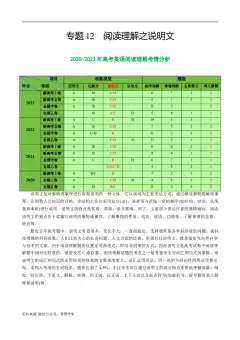
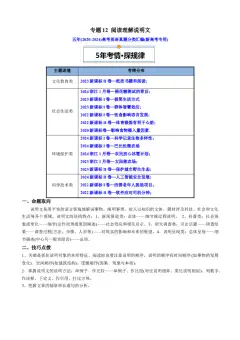
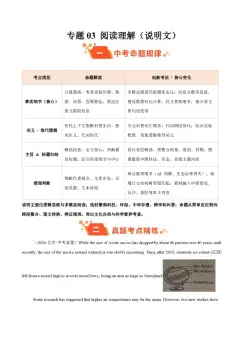
专题03 阅读理解说明文
5 年真题1 年模拟
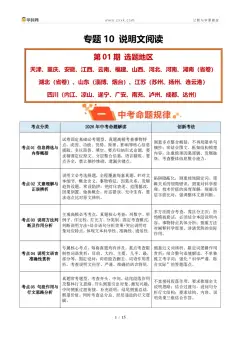
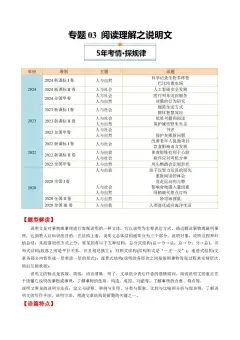
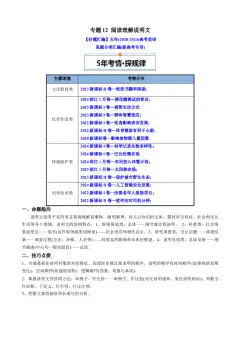
考点分类
河南考情(2022-2026)
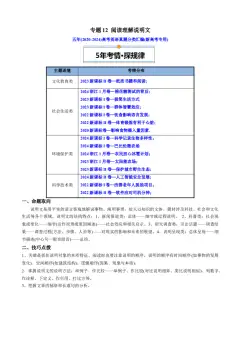
命题规律
考点01 细节理解
2026 年3 题;2025 年3 题;
2024 年4 题;2023 年2 题;
2022 年2 题
每年占比最高,答案可直接在原文定位,近年选项设置
更为隐蔽,信息多分散于多个段落,常结合图表、数据、
注释综合判断,局部截取原文设置干扰项。2026 年出
现明显变化,题目信息分散在多个段落,要求学生跨段
定位整合,新增图文匹配、数字计算类陷阱,干扰项多
截取片段原文,提升信息筛选难度。
考点02 主旨大意
2026 年1 题;2023 年1 题;
2022 年1 题
常以最佳标题、写作目的设问,高频使用main purpose
类问法,侧重考查科普价值、文化内涵提炼,不能仅凭
个别段落概括全文。
考点03 推理判断
2025 年1 题;2024 年1 题;
2022 年2 题
侧重推断文章出处、作者隐含观点、后续发展方向,需
要依托全文逻辑推导,不能直接摘抄原文,选项干扰性
逐年增强。2026 年新增信息回填、情节匹配新颖考法,
选材大量融入洛阳水席、剪纸、豫剧等河南本土文化,
作答不仅要依托细节,还要契合正向价值导向,单纯字
面理解难以得出正确答案。
考点04 数字计算
2026 年1 题;2025 年1 题;
2023 年2 题
考查频次稳定,多围绕实验数据、时间、数量换算设题,
干扰项常忽略限定条件、单位要求设置陷阱,需要整合
多处数据运算判断。
考点05 词义猜测
题
2024 年1 题;2023 年1 题;
2022 年1 题
说明文为该题型高频载体,依托上下文同义替换、因果、
转折逻辑推断科普类生词,需要结合说明对象特征综合
分析。
2 / 21
学科网(北京)股份有限公司
(2026·河南·中考真题)
Did you notice how nature sometimes repeats itself? Something that repeats is called a pattern. There are
many patterns for you to study and learn.
Look around you. Patterns are everywhere. You may see bright and colorful patterns if you look at fish in the
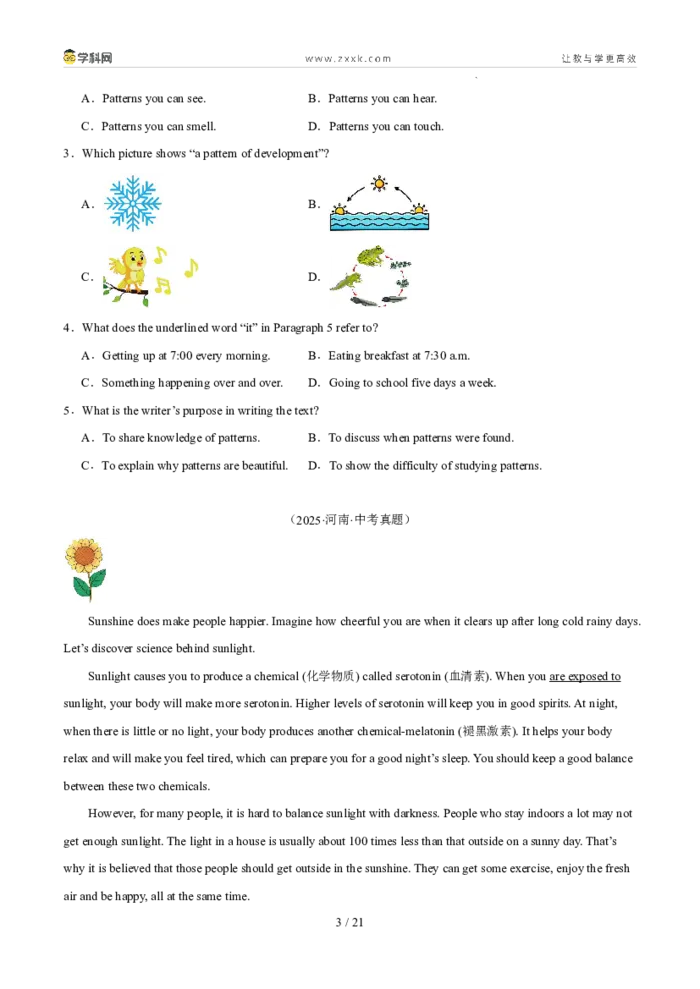
sea. In a bee’s honeycomb, the six-sided shape is repeated many times. Some leaves always have five points on
them.
Listening carefully, you will find a noisy world. Dogs bark, the rain falls and the wind blows. Are these
patterns? Of course! Sounds that repeat are patterns. A cricket (蟋蟀) uses its wings to make repeated chirping (啁
啾叫) sounds. Do you know that a cricket’s chirp changes with the temperature? The hotter it is, the more chirps a
cricket will make.
Try to find out how living things grow around you. Seeds (种子) grow into plants. A butterfly begins life as an
egg. Each living thing has its own pattern as it grows. When a human baby is born, it is small. With time, the baby
learns to lift its head and learns to roll over. Finally, the baby learns to stand up and walk. This kind of pattern is
called a pattern of development.
If something happens over and over, it, too, forms a pattern. For example, you get up at 7:00 every morning.
You get dressed and then eat breakfast at 7:30 a.m. If you repeat this many times, it becomes a pattern. Having a
music class every Monday is a pattern. So is going to school five days a week and having Saturday and Sunday off.
It seems as if the world is full of patterns. Just think—without patterns, the world would be much harder to
study!
根据材料内容选择最佳答案。
1.What makes the pattern in a bee’s honeycomb?
A.The shape.
B.The color.
C.The taste.
D.The weight.
2.What is Paragraph 3 mainly about?
3 / 21
学科网(北京)股份有限公司
A.Patterns you can see.
B.Patterns you can hear.
C.Patterns you can smell.
D.Patterns you can touch.
3.Which picture shows “a pattern of development”?
A.
B.
C.
D.
4.What does the underlined word “it” in Paragraph 5 refer to?
A.Getting up at 7:00 every morning.
B.Eating breakfast at 7:30 a.m.
C.Something happening over and over.
D.Going to school five days a week.
5.What is the writer’s purpose in writing the text?
A.To share knowledge of patterns.
B.To discuss when patterns were found.
C.To explain why patterns are beautiful.
D.To show the difficulty of studying patterns.
(2025·河南·中考真题)
Sunshine does make people happier. Imagine how cheerful you are when it clears up after long cold rainy days.
Let’s discover science behind sunlight.
Sunlight causes you to produce a chemical (化学物质) called serotonin (血清素). When you are exposed to
sunlight, your body will make more serotonin. Higher levels of serotonin will keep you in good spirits. At night,
when there is little or no light, your body produces another chemical-melatonin (褪黑激素). It helps your body
relax and will make you feel tired, which can prepare you for a good night’s sleep. You should keep a good balance
between these two chemicals.
However, for many people, it is hard to balance sunlight with darkness. People who stay indoors a lot may not
get enough sunlight. The light in a house is usually about 100 times less than that outside on a sunny day. That’s
why it is believed that those people should get outside in the sunshine. They can get some exercise, enjoy the fresh
air and be happy, all at the same time.
4 / 21
学科网(北京)股份有限公司
There are places where it gets dark for a long time in the winter. People in those places are easier to get
seasonal affective disorder (SAD). People with SAD usually go through bad experiences such as low energy and
sadness. The most common treatment for those people is to sit under bright artificial (人工的) lights for some time.
The roles that sunshine plays in people’s life are more than those above. For example, your body produces
Vitamin D (维生素D) from sunlight, which is important for being healthy. In fact, there is more science about
sunlight for you to discover. So next time, when you notice the sunshine on your shoulder, take a moment to think,
“Why do we love sunshine?”
根据材料内容选择最佳答案。
6.Which of the following can take the place of “are exposed to” in the text?
A.stay in
B.care about
C.dream of
D.depend on
7.What does Paragraph 2 mainly talk about?
A.What can help people to keep in good spirits
B.How light influences people through chemicals.
C.Why melatonin can help people relax for a sleep.
D.Which chemical is thought to be more important.
8.Which of the following is an opinion (观点) according to the text?
A.There are places where it gets dark for a long time in the winter.
B.People who stay indoors a lot should get outside in the sunshine.
C.The light in a house is usually less than that outside on a sunny day.
D.People’s bodies produce something called Vitamin D from sunlight.
9.Jack is a person with SAD.How could he solve his problem according to the text?
A.By staying indoors a lot.
B.By taking in more fresh air.
C.By doing some exercise.
D.By using man-made lights.
10.Why is the sentence “Why do we love sunshine?” written in the last paragraph?
A.To encourage readers to learn more about sunlight.
B.To advise readers to stay in houses for enough time.
C.To expect readers to realize the importance of Vitamin
D.To invite readers to walk into nature to enjoy the fresh air.
(2024·河南·中考真题)
An old saying used for forecasting (预测) the weather says, “Red sky at night, sailors’ delight. Red sky in the
morning, sailors (水手) take warning.” Is the saying true? It turns out that it is. A red sky at sunset may mean that
5 / 21
学科网(北京)股份有限公司
there are clear skies to the west, where the sun sets. A red sky at sunrise usually means that the clear weather has
already passed, so storms might be coming.
Forecasting the weather has been practiced for thousands of years. In the 5th century BC, the Greeks sent out
forecasts to sailors. They used signs in nature to forecast the weather. But today, meteorologists send exact
forecasts further in advance (提前). They use scientific instruments to study weather conditions around the world
and make forecasts. Pilots, farmers and many other people depend on these forecasts. Luckily, most of us can
simply look on the smart phone or turn on the TV to find out what kind of weather is coming.
If you are looking for some signs of the weather, pay attention to nature. There are two basic rules used in
weather forecasting: Weather generally moves from west to east, and low air pressure (压力) usually means rain or
snow. So pay attention to the signs. If rainbows form in the west at sunrise, the sun is on the way. Smell the
flowers—their smells are stronger in wet air. What are the ants doing? Are they moving to higher ground? This
could mean a drop in air pressure. Are the birds flying low or high? Falling air pressure may influence birds’ ears,
so they fly low. And if the sky is red at sunset, you might plan a picnic for the next day!
根据材料内容选择最佳答案。
11.What is the old saying about?
A.The beauty of sunrise.
B.The night sky.
C.The signs of the weather.
D.The sailors’ work.
12.What does the underlined word “meteorologists” mean?
A.The persons who give daily weather reports on TV.
B.The persons who carry out research on natural history.
C.The persons who take an interest in plants and animals.
D.The persons who do scientific studies of weather conditions.
13.How does the writer develop his idea in Paragraph 2?
A.By listing the reasons for terrible weather.
B.By telling a true story about weather forecasting.
C.By introducing different ways of forecasting the weather.
D.By mentioning the difficulties in forecasting the weather.
14.What do we know from the last paragraph?
A.It’ll be sunny if ants move to higher places.
B.The smells of flowers are stronger in wet air.
6 / 21
学科网(北京)股份有限公司
C.Birds fly higher because of the low air pressure.
D.It’ll rain if rainbows form in the west at sunrise.
15.What is the writer’s purpose in writing the text?
A.To encourage people to get close to nature.
B.To express the need for weather forecasting.
C.To explain nature can tell us about the weather.
D.To discuss how important weather forecasting is.
(2023·河南·中考真题)
Energy is the ability to do work. Solar energy comes from the Sun. There is also energy that comes from wind
and water.
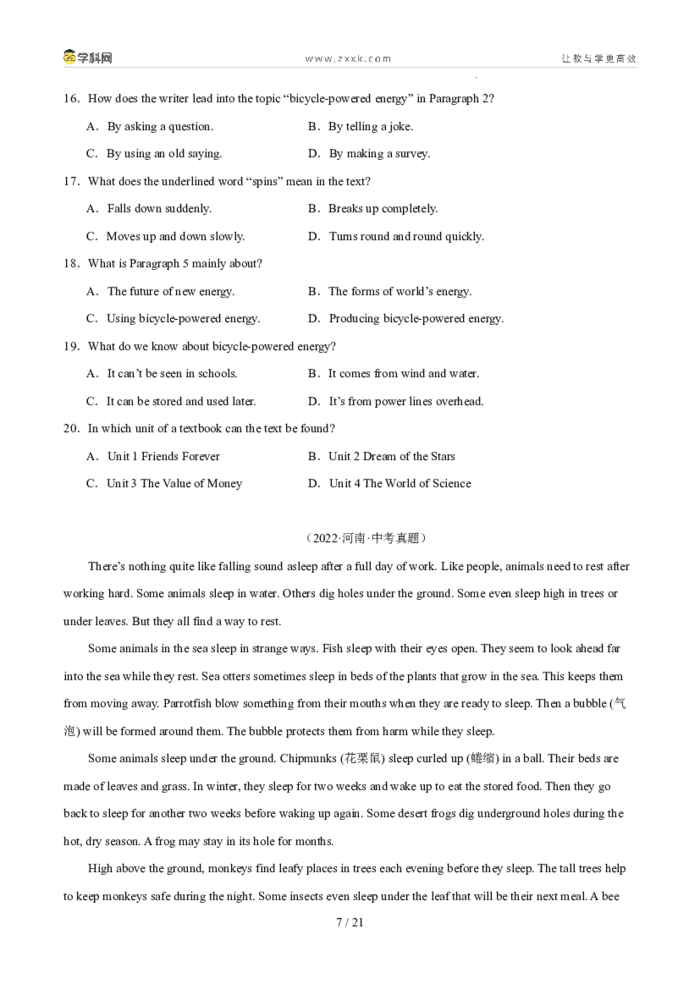
But do you know that energy can come from people, too? When you pedal a bike, you produce energy. You
use your legs to push the pedals. Your energy is transferred (转移) to the bike. That makes the bike move.
Now imagine riding your bike to create enough power to run a computer. Some students at one school did just
that! They jumped on bikes connected to generators (发电机) and pedaled in place. Soon they were producing
electricity. This energy is needed to run their computers.
Here is how bicycle-powered energy works. When a student pedals the bike, the back wheel spins. The wheel
spins the generator. The generator produces electricity. As long as a student pedals the bicycle, electricity moves
through the generator. The electricity can be used right away. This energy can also be stored and used later.
People use bicycle-powered energy to run small devices (设备) such as small televisions and fans. They often
use less than 100 watts per hour. However, it would be a mistake to use pedal power to run a fridge. This large
machine often uses more than 700 watts per hour. The electricity for these machines comes from power lines
overhead or underground.
Pedal power can be seen in schools, gyms, and homes. What a fun way to provide electricity!
根据材料内容选择最佳答案。
7 / 21
学科网(北京)股份有限公司
16.How does the writer lead into the topic “bicycle-powered energy” in Paragraph 2?
A.By asking a question.
B.By telling a joke.
C.By using an old saying.
D.By making a survey.
17.What does the underlined word “spins” mean in the text?
A.Falls down suddenly.
B.Breaks up completely.
C.Moves up and down slowly.
D.Turns round and round quickly.
18.What is Paragraph 5 mainly about?
A.The future of new energy.
B.The forms of world’s energy.
C.Using bicycle-powered energy.
D.Producing bicycle-powered energy.
19.What do we know about bicycle-powered energy?
A.It can’t be seen in schools.
B.It comes from wind and water.
C.It can be stored and used later.
D.It’s from power lines overhead.
20.In which unit of a textbook can the text be found?
A.Unit 1 Friends Forever
B.Unit 2 Dream of the Stars
C.Unit 3 The Value of Money
D.Unit 4 The World of Science
(2022·河南·中考真题)
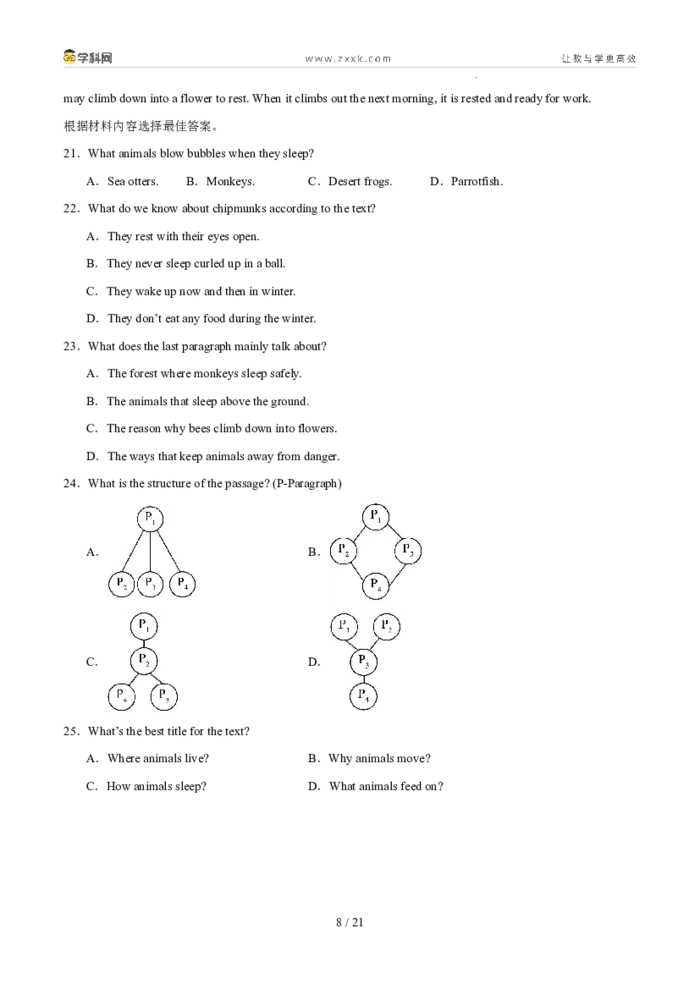
There’s nothing quite like falling sound asleep after a full day of work. Like people, animals need to rest after
working hard. Some animals sleep in water. Others dig holes under the ground. Some even sleep high in trees or
under leaves. But they all find a way to rest.
Some animals in the sea sleep in strange ways. Fish sleep with their eyes open. They seem to look ahead far
into the sea while they rest. Sea otters sometimes sleep in beds of the plants that grow in the sea. This keeps them
from moving away. Parrotfish blow something from their mouths when they are ready to sleep. Then a bubble (气
泡) will be formed around them. The bubble protects them from harm while they sleep.
Some animals sleep under the ground. Chipmunks (花栗鼠) sleep curled up (蜷缩) in a ball. Their beds are
made of leaves and grass. In winter, they sleep for two weeks and wake up to eat the stored food. Then they go
back to sleep for another two weeks before waking up again. Some desert frogs dig underground holes during the
hot, dry season. A frog may stay in its hole for months.
High above the ground, monkeys find leafy places in trees each evening before they sleep. The tall trees help
to keep monkeys safe during the night. Some insects even sleep under the leaf that will be their next meal. A bee
8 / 21
学科网(北京)股份有限公司
may climb down into a flower to rest. When it climbs out the next morning, it is rested and ready for work.
根据材料内容选择最佳答案。
21.What animals blow bubbles when they sleep?
A.Sea otters.
B.Monkeys.
C.Desert frogs.
D.Parrotfish.
22.What do we know about chipmunks according to the text?
A.They rest with their eyes open.
B.They never sleep curled up in a ball.
C.They wake up now and then in winter.
D.They don’t eat any food during the winter.
23.What does the last paragraph mainly talk about?
A.The forest where monkeys sleep safely.
B.The animals that sleep above the ground.
C.The reason why bees climb down into flowers.
D.The ways that keep animals away from danger.
24.What is the structure of the passage? (P-Paragraph)
A.
B.
C.
D.
25.What’s the best title for the text?
A.Where animals live?
B.Why animals move?
C.How animals sleep?
D.What animals feed on?
9 / 21
学科网(北京)股份有限公司
(2026·河南周口·三模)
Bionics is a new useful science that takes ideas from animals and plants to invent new machines or tools. In
recent years, many high-tech products around our daily life come from bionic research. Lots of scientists spend
years studying natural creatures to solve human production problems.
The lotus leaf effect is one famous bionic discovery. People find raindrops roll off clean lotus leaves without
staying, and dirt falls away together with water drops. After repeated experiments, scientists find the leaf surface
has special tiny uneven structures. Based on this discovery, researchers developed self-cleaning paint and
waterproof building materials. Walls painted with this paint never get dirty easily even in rainy days, which greatly
cuts down building cleaning cost for modern cities.
Another popular bionic design comes from kingfishers. Kingfisher birds dive into water from high air with
almost no loud noise. Japanese train designers studied the bird’s pointed beak and changed the front shape of
high-speed bullet trains. Before the change, trains made sharp loud sounds when rushing out of tunnels and
disturbed nearby residents. After improving the head like kingfisher’s mouth, train noise dropped by over 50% and
running speed rose as well.
Plants also bring great invention inspiration. The sticky burrs on grass seeds stick tightly to animal fur. A
Swiss engineer got inspiration and invented Velcro, the widely-used sticky fastener used on clothes, schoolbags and
sports shoes all over the world.
Scientists believe nature is the best invention textbook. More bionic products will appear in daily life with
continuous natural research in the future.
1.What is bionics according to Paragraph 1?
A.Study of living things’ living habits.
B.Invent new things by learning from nature.
C.Research on different kinds of plants.
D.Production of new environmental materials.
2.Lotus leaf’s special structure helps invent ________.
A.High-speed train head
B.Sticky fastener
C.Self-cleaning coating
D.Diving equipment
10 / 21
学科网(北京)股份有限公司
3.Why did designers change bullet train’s front?
A.To make trains run faster and more quietly.
B.To cut the cost of train production.
C.To make trains look more beautiful.
D.To let trains pass tunnels more safely.
4.Who invented Velcro from burr feature?
A.Chinese scientist.
B.Japanese designer.
C.Swiss engineer.
D.American biologist.
5.The text is mainly developed by ________.
A.Listing examples
B.Giving numbers
C.Comparing differences
D.Following time order
(2026·河南周口·三模)
Have you ever noticed that your body feels different when you’re nervous? Maybe before a speech, your
hands get cold, or your face turns warm. But scientists have found that your nose also goes through some changes.
Researchers at the University of Sussex recorded 29 people with a special camera to see what happened when
they were stressed. First, the volunteers listened to white noise to calm down. Then they had to finish two different
tasks in front of strangers. They had to give an unplanned (即兴的) speech and they had to do maths in their head,
saying the answers out loud.
The study found that people’s nose temperature dropped by 3℃~6℃when they’re under pressure. Normally,
people’s nose temperature is between 32℃and 35℃. This is because the blood in their faces goes to their ears and
eyes, which are important for people to find dangerous situations. Once the stress is over, the blood returns to
normal within a few minutes. Gillian Forrester, who led the study, also said that how long it takes someone’s nose
to return to its normal temperature could help show how well they manage their stress.
The study could help more than humans. Stress also changes blood flow in primates’ (灵长类动物) faces.
Researchers hope to use this to understand how they feel and how to make them feel better, since they cannot
describe it. As Gillian Forrester said, “We’ve studied them to better understand ourselves. It’s time to give back.”
根据材料内容选择最佳答案
6.Which word can take the place of “go through” in Paragraph 1?
A.Practise.
B.Experience.
C.Search.
D.Accept.
11 / 21
学科网(北京)股份有限公司
7.Which of the following activities did the volunteers do during the study?
A.Watch a speech.
B.Make white noise.
C.Solve math problems.
D.Record the temperature.
8.According to Paragraph 3, which picture shows the study result?
A.
B.
C.
D.
9.Which of the following is an opinion according to the text?
A.Stress changes blood flow in primates’ faces.
B.The study could help humans as well as primates.
C.People’s normal nose temperature is between 32℃and 35℃.
D.Volunteers had to finish two different tasks in front of strangers.
10.What does Gillian Forrester mean according to her words in the last paragraph?
A.They want to send all primates back to the forests.
B.They want to return home after finishing the study.
C.They want to understand primates and make them feel better.
D.They want to continue the study and learn more about humans.
(2026·河南平顶山·三模)
Look around your classroom. Pick up your pen. Throw a ball. Which hand do you use? If you use your left
hand, you are one of about 10% of people in the world. But why are some people left-handed while most people are
right-handed?
12 / 21
学科网(北京)股份有限公司
Studies show that handedness (偏手倾向) is often passed down in families. When both parents are
right-handed, their children most probably follow suit. However, when both parents are left-handed, their children
have a 40% chance of being left-handed. Interestingly, even twins with the same genes (基因) can have different
handedness. Clearly, something beyond genes is also at work.
The answer appears to be hidden inside our heads. The human brain has two halves, and each half controls the
opposite side of the body. For most right-handed people, the left half controls language. This function (功能) is
closely connected with movement control. Left-handers are different. About 70% of left-handers use the left half
for language, while about 30% use the right half or both of them. Dr. Brinkman, a brain researcher, says that this
difference might help left-handers recover (恢复) language abilities faster after certain harm to the brain. This may
be because a left-handed person’s brain is more flexible (灵活的). Left-handers use both sides of their brain more
evenly.
In one experiment, left-handers scored pictures on the left side of a screen more positively, while right-handers
preferred pictures on the right. It seems that the hand we prefer influences how we think!
So, are left-handers more creative or talented? Not necessarily. While many famous artists and musicians are
left-handed, scientists have found no clear evidence that left-handers are more gifted. However, left-handers do face
some challenges in the world designed for right-handers, such as scissors and school desks made for right-handed
people. Even the word “right” itself can suggest that “right” means “correct”.
根据材料内容选择最佳答案。
11.Which of the following can take the place of “follow suit” in Paragraph 2?
A.Do the same thing.
B.Ask for help.
C.Use their left hands.
D.Become different.
12.According to Dr. Brinkman, what might be the advantage of left-handers?
A.They can use both hands well.
B.They always think more positively.
C.They have better language skills.
D.They may get language abilities back faster.
13.What can we learn from the experiment mentioned in Paragraph 4?
A.Most people prefer to use their right hands.
B.Pictures on the left side of a screen look better.
C.Handedness may influence people’s preferences.
D.Left-handers and right-handers see things the same way.
14.What can we infer from the text?
13 / 21
学科网(北京)股份有限公司
A.Everyone should try to use both hands well.
B.There are more left-handed people in the world.
C.The brain influences whether people are left-handed.
D.Left-handed people are often better at sports and music.
15.What is the writer’s main purpose in writing this text?
A.To explain the challenges left-handers face in daily life.
B.To help readers understand handedness and its influence.
C.To tell readers how to train themselves to be left-handed.
D.To show the difference between left-handers and right-handers.
(2026·河南平顶山·三模)
Light pollution is a global problem. It is caused by artificial (人造的) light. Artificial light brightens the
natural darkness and tricks birds into thinking it is daytime for longer than it is. Then birds stay awake longer. The
following is a study on this.
In the study, scientists studied more than four million bird calls from Bird Weather. Bird Weather is a project
in which members of the public collect the information. People send in recordings of birdsong and Bird Weather
uses AI to identify (识别) the sounds. Bird Weather then uses that information to study birds’ behaviour and
population changes.
Researchers listened to birdsong from the mornings and evenings when the birds were most active. They
found that birds in towns or cities, which have lots of light pollution, sang for an average (平均数) of 50 minutes
longer every day. They started about 20 minutes earlier in the morning and then continued for about 30 minutes
more in the evening. This means birds in light-polluted areas are active for longer each day than birds in the
countryside.
Researchers also found that not all birds behaved similarly toward artificial light. The birds with larger eyes
were influenced more easily, but small-eyed birds showed less change. Even so, the reduced (减少的) sleep time
can be bad for those birds.
In reality, light pollution influences not only birds but also sea animals. The good news is that light pollution is
reversible. We can turn off lights when they’re not needed and use outdoor lighting only when we have to. Each
one of us can make a difference! Let’s take action to reduce light pollution and bring back the natural night sky.
根据材料内容选择最佳答案。
14 / 21
学科网(北京)股份有限公司
16.How many bird calls are studied according to the text?
A.More than four million calls.
B.About fifty thousand calls.
C.More than five million calls.
D.Nearly four thousand calls.
17.How does the writer show the result of the study in Paragraph 3?
A.By describing reasons.
B.By listing numbers.
C.By giving examples.
D.By telling stories.
18.Which of the following can take the place of “is reversible” in the text?
A.is famous
B.is different
C.can be changed
D.can be caused
19.Which of the following may be influenced by artificial light least easily?
A.
B.
C.
D.
20.What’s the writer’s purpose of writing the text?
A.To tell people the importance of protecting birds.
B.To teach people how to identify different bird calls.
C.To call on people to take action to reduce light pollution.
D.To describe the differences between city and country life.
(2026·河南三门峡·三模)
Have you ever wanted to share the taste of a delicious dish with a friend far away, only to find that words and
pictures fall short of presenting the full experience? A new invention called e-Taste might solve this problem!
Developed by scientists at Ohio State University in the US, this tool helps improve digital (数字的) experiences by
adding “tastes” to them.
However, creating digital tastes is challenging. Taste is about sensing real molecules that come out when food
is cut into pieces in our mouths or when we drink. The molecules activate certain cells (细胞) on the tongue (舌头),
the inside top part of the mouth, and the back of the throat. These cells send messages to a part of the brain called
the thalamus. It then sends the messages to other brain areas, helping us distinguish tastes.
E-Taste uses a special “digital tongue” to check the levels of five chemicals (化学物质) in foods and drinks
that are responsible for the five basic tastes. It records the information and sends it to another part of the tool. This
part gives off liquids (液体) that include the five chemicals. By drinking the liquids, people can taste the foods and
15 / 21
学科网(北京)股份有限公司
drinks no matter where they are.
Real-world tests of e-Taste go well. It works even when these two parts are placed in different cities thousands
of kilometers apart. Volunteers can tell foods like fish soup correctly almost 87% of the time.
Looking ahead, scientists plan to try new taste types. They also want to study the tool’s effect on different
people, since taste has a lot to do with human feelings and memory.
根据材料内容选择最佳答案。
21.How does the writer lead into the topic of e-Taste?
A.By telling a joke.
B.By using an old saying.
C.By asking a question.
D.By making a survey.
22.What does the underlined word “activate” mean in Paragraph 2?
A.Wake up.
B.Clean up.
C.Break down.
D.Cut down.
23.What is the main idea of the third paragraph?
A.Why e-Taste is special.
B.Where e-Taste is tested.
C.How e-Taste works.
D.How e-Taste was invented.
24.What can we learn about the performance of e-Taste in real-world tests?
A.It changes human feelings and memory. B.It has the same influence on different people.
C.It works with its parts placed in different cities.
D.It tells all kinds of foods correctly 87% of the time.
25.What’s the best title for the text?
A.Digital taste is challenging
B.E-Taste is popular in real life
C.An achievement in taste-sharing
D.The future of taste-sharing tools
(2026·河南周口·二模)
What are insects like in your eyes? Have you ever noticed them? Insects are very interesting animals. They
may be small, but they are smart and hard-working. Scientists have studied different kinds of insects very closely.
According to their studies, even the smallest insects have tools to help do their work.
Have you ever seen a little fly called a sawfly? It gets such a name because it has a saw (锯子) that is used on
plants to create a safe space for its eggs. After laying its eggs, the sawfly makes some glue. The glue fixes the eggs
to where they are laid.
Another insect that has its own natural tool is the poppy bee. The bees live in wood. Like people who make
things out of wood, poppy bees use special tools to dig nests out of wood. They dig and clean out the nest to make
16 / 21
学科网(北京)股份有限公司
it ready for use. When all is ready, poppy bees cut out pieces of leaves in the shape of a nest. They then join the
pieces together and put them into the nest.
Ants are also known for their clever use of natural tools. For example, they drop pieces of leaves into water so
that they take in the water. Then the ants carry them back to their nests. There are more insects than any other living
things in the world. Every insect is special. The more you notice them, the more they will surprise you.
26.What are insects like according to the first paragraph?
A.Small and lazy.
B.Small but smart.
C.Big and strong.
D.Interesting but weak.
27.Why is the small fly named “sawfly”?
A.Because it can make saws for plants.
B.Because it uses a saw to protect its eggs.
C.Because it looks like a small saw.
D.Because it likes playing with a saw.
28.Where do poppy bees build their nests?
A.In the leaves.
B.In the water.
C.In the wood.
D.In the grass.
29.What can we infer about insects from the passage?
A.Insects know how to use tools smartly. B.All insects live and play in water.
C.Insects are the strongest animals on Earth.
D.Scientists know little about insects.
30.What is the main idea of the passage?
A.Insects are small and easy to find.
B.Different insects have different living places.
C.Insects are special and good at using natural tools.
D.Ants are the cleverest insects in the world.
(2026·河南平顶山·三模)
Floods (洪水) are a serious and growing problem around the world. They happen when too much water covers
land. Each year, they bring great danger and damage (损害) to people’s lives and homes. Understanding this
problem is the first step in finding solutions (解决办法).
Floods are becoming more common. A big reason is that the Earth’s temperature is rising. Warmer air holds
more water, leading to heavier rain and stronger storms. Another big reason is rising sea levels, which make coastal
floods worse. Big waves push more water onto the land. Scientists say that by 2100, big floods that used to happen
only once every 100 years may happen every year. Many cities could then face great danger.
17 / 21
学科网(北京)股份有限公司
Floods create serious problems. According to a report, over 19 million people were forced to leave their homes
in a single year because of flooding—that’s like moving almost the whole country of the Netherlands (荷兰).
Floods damage roads, bridges, and schools. In the United States, they cause a loss of billions of dollars every year.
After a flood, it can be hard to find food, and dirty water can spread illnesses.
So, what can we do? Early warning tools can tell people when floods are coming, giving them time to reach
safety. Building sea walls can help stop floodwater. Experts are also creating “sponge cities” by building special
streets and parks that take in rainwater. But in some places, the safest plan may be “managed retreat”, which means
moving people away from areas that flood repeatedly.
Floods are a big challenge. But if we work together and plan well, we can stay safe and protect our
communities. By understanding the causes and taking action, we can make a real difference.
根据材料内容选择最佳答案。
31.What causes floods according to the text?
①Big waves.
②Earthquakes.
③Rising sea levels.
④The rising temperature.
A.①②
B.②③
C.①④
D.③④
32.Why does the writer mention the Netherlands in Paragraph 3?
A.To help people understand the large number.
B.To explain why the country has serious floods.
C.To show how many people lost their homes in the country.
D.To give an example of a country that helps people in floods.
33.Which of the following words can take the place of “retreat” in Paragraph 4?
A.safety
B.warning
C.building
D.movement
34.What is Paragraph 4 mainly about?
A.Ways to deal with floods.
B.Dangers brought by floods.
C.Advice from scientists on floods.
D.Causes of floods.
35.What is the structure of the text?
A.
B.
C.
D.
(2026·河南平顶山·三模)
Do you often play ball? Have you ever wondered which of your balls can bounce(反弹)the highest? You can
18 / 21
学科网(北京)股份有限公司
find out by trying this simple test.
To begin with, you will need a few different balls, such as a basketball, a soccer ball, and a tennis ball. Use
what you have on hand. Do this test inside a room, but before you start, ask your parents where you can do this to
make sure you won’t break anything or get hurt.
The next thing to do is to prepare a piece of paper to write down what you see. Draw a table with three
columns(列). In the first column, write the name of the ball. In the second column, you will later record how high
it bounces. In the third column, you will record how many times it bounces.
Now, find an empty wall. Stick a note on it at a certain height. This will be your starting line. Release each ball,
one at a time, from this line. When each ball bounces up, stick a note on the wall where it reaches the highest point.
Write the ball’s name on that note.
After that, use a ruler to measure(测量)how high each note is. Write that number in the second column on
your paper. Then, drop each ball one more time. This time, count how many times it jumps up and down before it
stops. Write that number in the third column.
Now look at your paper. Which ball bounces the highest? Which one jumps the most times? Is it the same ball?
This fun test helps you learn by doing.
根据材料内容选择最佳答案。
36.Why should you ask your parents before you do the test?
A.To make the test simpler.
B.To get more kinds of balls.
C.To make sure the test is safe.
D.To have them record the results.
37.Which of the following is supposed to be used in the test?
A.
B.
C.
D.
38.What does the underlined word “Release” mean?
A.Let something fall down.
B.Throw something with force.
C.Hold something in the air.
D.Move something up quickly.
19 / 21
学科网(北京)股份有限公司
39.What does Paragraph 5 mainly talk about?
A.How to get the balls ready.
B.How to record the test results.
C.How to compare different balls.
D.How to find a good place for the test.
40.What’s the purpose of the three questions in the last paragraph?
A.To show students what the final test results are.
B.To interest students in learning about ball games.
C.To make sure all students follow the correct steps.
D.To encourage students to think about the test results.
(2026·河南周口·三模)
Paper cutting is a traditional Chinese folk art with a history of more than 1,500 years. It was listed in the
World Intangible Cultural Heritage List in 2009. Most paper cuttings are red, because red stands for good luck and
happiness in Chinese culture.
Wang Xiuying, a 68-year-old paper cutting master from Luoyang, Henan, has practiced this skill for 52 years.
When she was 16, her grandma taught her basic cutting skills. At first, her fingers were often cut by sharp scissors,
and her paper works looked ugly. But she never gave up. She practiced for four hours every day after finishing farm
work. Slowly, she could cut vivid patterns—lively rabbits, blooming peonies, flying phoenixes and cute kids.
In the past, paper cuttings were mainly used for festivals and weddings. People stuck them on windows, doors
and walls to wish for a peaceful life. Now Wang Xiuying wants more young people to know this old art. She gives
free lessons at local middle schools every Wednesday afternoon. Many students show great interest. Some students
even create new styles: they mix paper cutting with cartoon characters and English letters, making traditional art fit
modern tastes.
Wang also sells her works online. Her store on a shopping platform gets hundreds of orders every month.
Some foreign visitors buy her cuttings as special Chinese gifts. “Paper cutting is our cultural treasure. I hope it can
be passed down from generation to generation,” Wang said with a big smile. She plans to make simple teaching
videos and post them online so that people all over China can learn this skill easily.
41.When did paper cutting become world intangible cultural heritage?
A.In 1500.
B.In 2009.
C.In 1958.
D.In 2026.
42.How old was Wang Xiuying when she started learning paper cutting?
A.16.
B.26.
C.52.
D.68.
20 / 21
学科网(北京)股份有限公司
43.Where does Wang give free lessons?
A.At her home.
B.At farm fields.
C.At local middle schools.
D.At an art museum.
44.What new change do young students bring to paper cutting?
A.They only cut red paper now.
B.They combine it with modern elements.
C.They stop using scissors.
D.They sell works to foreign countries.
45.What’s Wang’s future plan?
A.Open a big offline shop.
B.Travel around the world to show art.
C.Make online teaching videos.
D.Stop teaching and rest at home.
(2026·河南洛阳·三模)
Chinese opera is one of the world’s three oldest theatrical (戏剧) art forms, together with Greek Theatre and
Indian Opera. With over 2,000 years of history, it has developed into many local styles based on different customs,
such as Pingju Opera, Yue Opera, Huangmei Opera and Yu Opera. Beijing Opera, our national treasure, mixes the
best of all these styles. They are the five major operas of China.
It is a beautiful blend of arts. It grew from folk songs, dances, talking, funny plays, and special local music.
Gradually, it combined music, art, and literature into one wonderful stage performance.
Facial make-up is a key highlight. Performers use special skills to paint exaggerated (夸张的) patterns on their
faces. Each pattern stands for a character’s personality, like being brave or honest.
What fascinates people most is the amazing kung fu and acrobatics (杂技). Actors can breathe out fire, run
while squatting (蹲), or act like spirits and dwarfs (侏儒). These exciting shows make Chinese opera a beloved art
form that carries our traditional culture and stories.
根据材料内容选择最佳答案。
46.Which of the following is one of the five major dramas of China?
A.Greek Theatre.
B.Pingju Opera.
21 / 21
学科网(北京)股份有限公司
C.Qinqiang Opera.
D.Jin Opera.
47.What can we infer about Beijing Opera from the passage?
A.It is the oldest opera style in China.
B.It only uses kung fu and acrobatics.
C.It has no connection with local music.
D.It combines the best parts of different styles.
48.What can we know about facial make-up in Chinese opera?
A.It was first invented in Beijing Opera.
B.It is only used to make actors look beautiful.
C.It is the most difficult skill for actors to learn.
D.It helps the audience understand a character’s personality.
49.Which picture shows a skill that is NOT mentioned in this passage?
A.
B.
C.
D.
50.What type of writing is this passage?
A.An introduction to an art form.
B.A short story about an opera actor.
C.A personal diary about a live show.
D.A news report about a performance.