专题12 阅读理解说明文
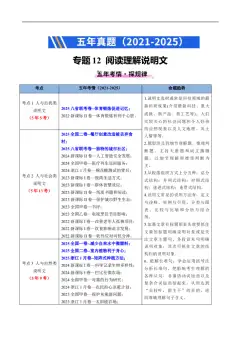
五年(2020-2024)高考英语真题分类汇编(新高考专用)
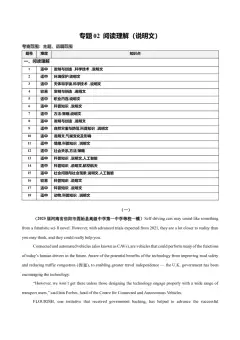
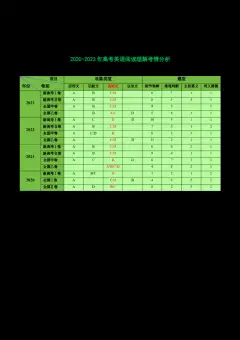
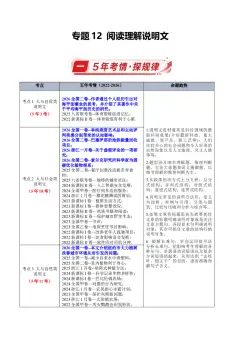
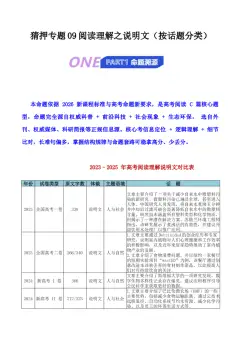
主题语境 考情分布
文化教育类 2023新课标II卷—纸质书籍和阅读;
2024浙江1月卷—棉花糖测试的背后;
2023新课标I卷—极简生活方式
2023新课标I卷—群体智慧效应;
社会生活类
2022新课标I卷—饮食影响语言发展;
2022新课标II卷—体育锻炼有利于心脏;
2020新课标卷—影响食物摄入量因素.
2024新课标I卷—科学记录生物多样性;
2024新课标I卷—巴比伦微农场
环境保护类 2024浙江1月卷—农民担心冰雹计划;
2023浙江1月卷—太阳能农场;
2023新课标II卷—保护城市野生生态;
2024新课标II卷—人工智能安全发展;
科学技术类 2022新课标I卷—改善老年人孤独项目;
2022新课标II卷—软件应对司机分神;
一、命题取向
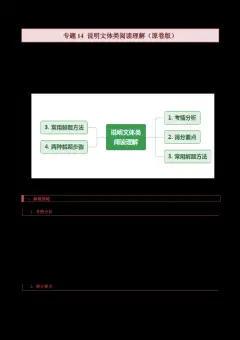
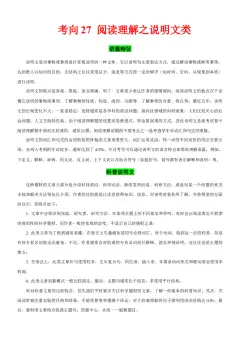
说明文是用平实的语言客观地解说事物、阐明事理,给人以知识的文体。题材涉及科技、社会和文化
生活等各个领域。说明文的结构特点:1、新闻报道类:总体——细节或过程说明。 2、科普类:社会现
象或变化——细节(运作原理或原因阐述)——社会效应和相关启示。3、研究调查类:引出话题——调查结
果——调查过程(方法、步骤、人员等)——对现实的影响和未来的展望。4、说明呈现类:总体呈现——细
节描述(中心句一般在段首)——总结。
二、技巧点拨
1、关键是抓住说明对象的本质特征。阅读时也要注意说明的顺序,说明的顺序有时间顺序(如事物的发展
变化)、空间顺序(如建筑结构)、逻辑顺序(因果、现象与本质)。
2、掌握说明文的说明方法:举例子、作比较——举例子、作比较(对比说明相异、类比说明相似)、列数字、
作诠释、下定义、作引用、打比方等。
3、把握文章的脉络和长难句的分析。考点1 文化教育类
2023新课标II卷—纸质书籍和阅读
Reading Art: Art for Book Lovers is a celebration of an everyday object — the book, represented here in
almost three hundred artworks from museums around the world. The image of the reader appears throughout
history, in art made long before books as we now know them came into being. In artists’ representations of books
and reading, we see moments of shared humanity that go beyond culture and time.
In this “book of books,” artworks are selected and arranged in a way that emphasizes these connections
between different eras and cultures. We see scenes of children learning to read at home or at school, with the book
as a focus for relations between the generations. Adults are portrayed (描绘) alone in many settings and poses —
absorbed in a volume, deep in thought or lost in a moment of leisure. These scenes may have been painted hundreds
of years ago, but they record moments we can all relate to.
Books themselves may be used symbolically in paintings to demonstrate the intellect (才智), wealth or faith of
the subject. Before the wide use of the printing press, books were treasured objects and could be works of art in
their own right. More recently, as books have become inexpensive or even throwaway, artists have used them as the
raw material for artworks — transforming covers, pages or even complete volumes into paintings and sculptures.
Continued developments in communication technologies were once believed to make the printed page
outdated. From a 21st-century point of view, the printed book is certainly ancient, but it remains as interactive as
any battery-powered e-reader. To serve its function, a book must be activated by a user: the cover opened, the pages
parted, the contents reviewed, perhaps notes written down or words underlined. And in contrast to our increasingly
networked lives where the information we consume is monitored and tracked, a printed book still offers the chance
of a wholly private, “off-line” activity.
8. Where is the text most probably taken from?
A. An introduction to a book. B. An essay on the art of writing.
C. A guidebook to a museum. D. A review of modern paintings.
9. What are the selected artworks about?
A. Wealth and intellect. B. Home and school.
C. Books and reading. D. Work and leisure.
10. What do the underlined words “relate to” in paragraph 2 mean?
A. Understand. B. Paint.
C. Seize. D. Transform.
11. What does the author want to say by mentioning the e-reader?
A. The printed book is not totally out of date.
B. Technology has changed the way we read.
C. Our lives in the 21st century are networked.
D. People now rarely have the patience to read.
考点2 社会生活类1. 2024浙江1月卷—棉花糖测试的背后;
The Stanford marshmallow(棉花糖) test was originally conducted by psychologist Walter Mischel in the late
1960s. Children aged four to six at a nursery school were placed in a room. A single sugary treat, selected by the
child, was placed on a table. Each child was told if they waited for 15 minutes before eating the treat, they would be
given a second treat. Then they were left alone in the room. Follow-up studies with the children later in life showed
a connect ion between an ability to wait long enough to obtain a second treat and various forms of success.
As adults we face a version of the marshmallow test every day. We’ re not tempted (诱惑) by sugary treats, but
by our computers, phones, and tablets — all the devices that connect us to the global delivery system for various
types of information that do to us what marshmallows do to preschoolers.
We are tempted by sugary treats because our ancestors lived in a calorie-poor world, and our brains developed
a response mechanism to these treats that reflected their value — a feeling of reward and satisfaction. But as we’ve
reshaped the world around us, dramatically reducing the cost and effort involved in obtaining calories, we still have
the same brains we had thousands of years ago, and this mismatch is at the heart of why so many of us struggle to
resist tempting foods that we know we shouldn’t eat.
A similar process is at work in our response to information. Our formative environment as a species was
information-poor, so our brains developed a mechanism that prized new information. But global connectivity has
greatly changed our information environment. We are now ceaselessly bombarded (轰炸) with new information.
Therefore, just as we need to be more thoughtful about our caloric consumption, we also need to be more
thoughtful about our information consumption, resisting the temptation of the mental “junk food” in order to
manage our time most effectively.
32. What did the children need to do to get a second treat in Mischel’s test?
A. Take an examination alone.
B. Show respect for the researchers.
C. Share their treats with others.
D. Delay eating for fifteen minutes.
33. According to paragraph 3, there is a mismatch between ___________.
A. the calorie-poor world and our good appetites
B. the shortage of sugar and our nutritional needs
C. the rich food supply and our unchanged brains
D. the tempting foods and our efforts to keep fit
34. What does the author suggest readers do?
A. Absorb new information readily.
B. Be selective information consumers.
C. Use diverse information sources.
D. Protect the information environment.
35. Which of the following is the best title for the text?
A. Eat Less, Read More
B. The Bitter Truth about Early Humans
C. The Later, the BetterD. The Marshmallow Test for Grownups
2. 2023新课标I卷—极简生活方式
The goal of this book is to make the case for digital minimalism, including a detailed exploration of what it
asks and why it works, and then to teach you how to adopt this philosophy if you decide it’s right for you.
To do so, I divided the book into two parts. In part one, I describe the philosophical foundations of digital
minimalism, starting with an examination of the forces that are making so many people’s digital lives increasingly
intolerable, before moving on to a detailed discussion of the digital minimalism philosophy.
Part one concludes by introducing my suggested method for adopting this philosophy: the digital declutter.
This process requires you to step away from optional online activities for thirty days. At the end of the thirty days,
you will then add back a small number of carefully chosen online activities that you believe will provide massive
benefits to the things you value.
In the final chapter of part one, I’ll guide you through carrying out your own digital declutter. In doing so, I’ll
draw on an experiment I ran in 2018 in which over 1,600 people agreed to perform a digital declutter. You’ll hear
these participants’ stories and learn what strategies worked well for them, and what traps they encountered that you
should avoid.
The second part of this book takes a closer look at some ideas that will help you cultivate (培养) a sustainable
digital minimalism lifestyle. In these chapters, I examine issues such as the importance of solitude (独处) and the
necessity of cultivating high-quality leisure to replace the time most now spend on mindless device use. Each
chapter concludes with a collection of practices, which are designed to help you act on the big ideas of the chapter.
You can view these practices as a toolbox meant to aid your efforts to build a minimalist lifestyle that words for
your particular circumstances.
8. What is the book aimed at?
A. Teaching critical thinking skills. B. Advocating a simple digital lifestyle.
C. Solving philosophical problems. D. Promoting the use of a digital device.
9. What does the underlined word “declutter” in paragraph 3 mean?
A. Clear-up. B. Add-on. C. Check-in. D. Take-over.
10. What is presented in the final chapter of part one?
A. Theoretical models. B. Statistical methods.
C. Practical examples. D. Historical analyses.
11. What does the author suggest readers do with the practices offered in part two?
A. Use them as needed. B. Recommend them to friends.
C. Evaluate their effects. D. Identify the ideas behind them.
3. 2023新课标I卷—群体智慧效应
On March 7, 1907, the English statistician Francis Galton published a paper which illustrated what has come
to be known as the “wisdom of crowds” effect. The experiment of estimation he conducted showed that in some
cases, the average of a large number of independent estimates could be quite accurate.
This effect capitalizes on the fact that when people make errors, those errors aren’t always the same. Some
people will tend to overestimate, and some to underestimate. When enough of these errors are averaged together,
they cancel each other out, resulting in a more accurate estimate. If people are similar and tend to make the sameerrors, then their errors won’t cancel each other out. In more technical terms, the wisdom of crowds requires that
people’s estimates be independent. If for whatever reasons, people’s errors become correlated or dependent, the
accuracy of the estimate will go down.
But a new study led by Joaquin Navajas offered an interesting twist(转折) on this classic phenomenon. The
key finding of the study was that when crowds were further divided into smaller groups that were allowed to have a
discussion, the averages from these groups were more accurate than those from an equal number of independent
individuals. For instance, the average obtained from the estimates of four discussion groups of five was
significantly more accurate than the average obtained from 20 independent individuals.
In a follow-up study with 100 university students, the researchers tried to get a better sense of what the group
members actually did in their discussion. Did they tend to go with those most confident about their estimates? Did
they follow those least willing to change their minds? This happened some of the time, but it wasn’t the dominant
response. Most frequently, the groups reported that they “shared arguments and reasoned together.” Somehow,
these arguments and reasoning resulted in a global reduction in error. Although the studies led by Navajas have
limitations and many questions remain the potential implications for group discussion and decision-making are
enormous.
12. What is paragraph 2 of the text mainly about?
A. The methods of estimation. B. The underlying logic of the effect.
C. The causes of people’s errors. D. The design of Galton’s experiment.
13. Navajas’ study found that the average accuracy could increase even if ________.
A. the crowds were relatively small B. there were occasional underestimates
C. individuals did not communicate D. estimates were not fully independent
14. What did the follow-up study focus on?
A. The size of the groups. B. The dominant members.
C. The discussion process. D. The individual estimates.
15. What is the author’s attitude toward Navajas’ studies?
A. Unclear. B. Dismissive. C. Doubtful. D. Approving.
4. 2022新课标I卷—饮食影响语言发展
The elderly residents(居民) in care homes in London are being given hens to look after to stop them feeling
lonely.
The project was dreamed up by a local charity(慈善组织) to reduce loneliness and improve elderly people’s
wellbeing, It is also being used to help patients suffering dementia, a serious illness of the mind. Staff in care homes
have reported a reduction in the use of medicine where hens are in use.
Among those taking part in the project is 80-year-old Ruth Xavier. She said: “I used to keep hens when I was
younger and had to prepare their breakfast each morning before I went to school. ”
“I like the project a lot. I am down there in my wheelchair in the morning letting the hens out and down there
again at night to see they’ve gone to bed.”
“It’s good to have a different focus. People have been bringing their children in to see the hens and residents
come and sit outside to watch them. I’m enjoying the creative activities, and it feels great to have done something
useful.”There are now 700 elderly people looking after hens in 20 care homes in the North East, and the charity has
been given financial support to roll it out countrywide.
Wendy Wilson, extra care manager at 60 Penfold Street, one of the first to embark on the project, said:
“Residents really welcome the idea of the project and the creative sessions. We are looking forward to the benefits
and fun the project can bring to people here.”
Lynn Lewis, director of Notting Hill Pathways, said: “We are happy to be taking part in the project. It will
really help connect our residents through a shared interest and creative activities.”
28. What is the purpose of the project?
A. To ensure harmony in care homes.
B. To provide part-time jobs for the aged.
C. To raise money for medical research.
D. To promote the elderly people’s welfare.
29. How has the project affected Ruth Xavier?
A. She has learned new life skills.
B. She has gained a sense of achievement.
C. She has recovered her memory.
D. She has developed a strong personality.
30. What do the underlined words “embark on” mean in paragraph 7?
A. Improve. B. Oppose.
C. Begin. D. Evaluate.
31. What can we learn about the project from the last two paragraphs?
A. It is well received. B. It needs to be more creative.
C. It is highly profitable. D. It takes ages to see the results.
5. 2022新课标II卷—体育锻炼有利于心脏
Human speech contains more than 2,000 different sounds, from the common “m” and “a” to the rare clicks of
some southern African languages. But why are certain sounds more common than others? A ground-breaking, five-
year study shows that diet-related changes in human bite led to new speech sounds that are now found in half the
world’s languages.
More than 30 years ago, the scholar Charles Hockett noted that speech sounds called labiodentals, such as “f”
and “v”, were more common in the languages of societies that ate softer foods. Now a team of researchers led by
Damián Blasi at the University of Zurich, Switzerland, has found how and why this trend arose.
They discovered that the upper and lower front teeth of ancient human adults were aligned(对齐), making it
hard to produce labiodentals, which are formed by touching the lower lip to the upper teeth. Later, our jaws
changed to an overbite structure(结构), making it easier to produce such sounds.
The team showed that this change in bite was connected with the development of agriculture in the Neolithic
period. Food became easier to chew at this point. The jawbone didn’t have to do as much work and so didn’t grow
to be so large.
Analyses of a language database also confirmed that there was a global change in the sound of world
languages after the Neolithic age, with the use of “f” and “v” increasing remarkably during the last few thousandyears. These sounds are still not found in the languages of many hunter-gatherer people today.
This research overturns the popular view that all human speech sounds were present when human beings
evolved around 300,000 years ago. ”The set of speech sounds we use has not necessarily remained stable since the
appearance of human beings, but rather the huge variety of speech sounds that we find today is the product of a
complex interplay of things like biological change and cultural evolution,” said Steven Moran, a member of the
research team.
32. Which aspect of the human speech sound does Damián Blasi’s research focus on?
A. Its variety. B. Its distribution. C. Its quantity. D. Its development.
33. Why was it difficult for ancient human adults to produce labiodentals?
A. They had fewer upper teeth than lower teeth.
B. They could not open and close their lips easily.
C. Their jaws were not conveniently structured.
D. Their lower front teeth were not large enough.
34. What is paragraph 5 mainly about?
A. Supporting evidence for the research results.
B. Potential application of the research findings.
C. A further explanation of the research methods.
D. A reasonable doubt about the research process.
35. What does Steven Moran say about the set of human speech sounds?
A. It is key to effective communication.
B. It contributes much to cultural diversity.
C. It is a complex and dynamic system.
D. It drives the evolution of human beings.
6. 2020新课标卷—影响食物摄入量因素.
According to a recent study in the Journal of Consumer Research, both the size and consumption habits of our
eating companions can influence our food intake. And contrary to existing research that says you should avoid
eating with heavier people who order large portions(份), it's the beanpoles with big appetites you really need to
avoid.
To test the effect of social influence on eating habits, the researchers conducted two experiments. In the first,
95 undergraduate women were individually invited into a lab to ostensibly(表面上)participate in a study about
movie viewership. Before the film began, each woman was asked to help herself to a snack. An actor hired by the
researchers grabbed her food first. In her natural state, the actor weighed 105 pounds. But in half the cases she wore
a specially designed fat suit which increased her weight to 180 pounds.
Both the fat and thin versions of the actor took a large amount of food. The participants followed suit, taking
more food than they normally would have. However, they took significantly more when the actor was thin.
For the second test, in one case the thin actor took two pieces of candy from the snack bowls. In the other case,
she took 30 pieces. The results were similar to the first test: the participants followed suit but took significantly
more candy when the thin actor took 30 pieces.
The tests show that the social environment is extremely influential when we're making decisions. If this fellowparticipant is going to eat more, so will I. Call it the “I’ll have what she's having” effect. However, we'll adjust the
influence. If an overweight person is having a large portion, I'll hold back a bit because I see the results of his
eating habits. But if a thin person eats a lot, I'll follow suit. If he can eat much and keep slim, why can't I?
32. What is the recent study mainly about?
A. Food safety. B. Movie viewership.
C. Consumer demand. D. Eating behavior.
33. What does the underlined word “beanpoles” in paragraph 1 refer to?
A. Big eaters. B. Overweight persons.
C. Picky eaters. D. Tall thin persons.
34. Why did the researchers hire the actor?
A. To see how she would affect the participants.
B. To test if the participants could recognize her.
C. To find out what she would do in the two tests.
D. To study why she could keep her weight down.
35. On what basis do we “adjust the influence” according to the last paragraph?
A. How hungry we are. B. How slim we want to be.
.
C How we perceive others. D. How we feel about the food.
考点3 环境保护类
1. 2024新课标I卷—科学记录生物多样性;
We all know fresh is best when it comes to food. However, most produce at the store went through weeks of
travel and covered hundreds of miles before reaching the table. While farmer’s markets are a solid choice to reduce
the journey, Babylon Micro-Farm (BMF) shortens it even more.
BMF is an indoor garden system. It can be set up for a family. Additionally, it could serve a larger audience
such as a hospital, restaurant or school. The innovative design requires little effort to achieve a reliable weekly
supply of fresh greens.
Specifically, it’s a farm that relies on new technology. By connecting through the Cloud, BMF is remotely
monitored. Also, there is a convenient app that provides growing data in real time. Because the system is
automated, it significantly reduces the amount of water needed to grow plants. Rather than watering rows of soil,
the system provides just the right amount to each plant. After harvest, users simply replace the plants with a new
pre-seeded pod (容器) to get the next growth cycle started.
Moreover, having a system in the same building where it’s eaten means zero emissions ( 排放) from
transporting plants from soil to salad. In addition, there’s no need for pesticides and other chemicals that pollute
traditional farms and the surrounding environment.
BMF employees live out sustainability in their everyday lives. About half of them walk or bike to work. Inside
the office, they encourage recycling and waste reduction by limiting garbage cans and avoiding single-use plastic.
“We are passionate about reducing waste, carbon and chemicals in our environment,” said a BMF employee.
28. What can be learned about BMF from paragraph 1?
A. It guarantees the variety of food. B. It requires day-to-day care.
C. It cuts the farm-to-table distance. D. It relies on farmer’s markets.29. What information does the convenient app offer?
A. Real-time weather changes. B. Current condition of the plants.
C. Chemical pollutants in the soil. D. Availability of pre-seeded pods.
30. What can be concluded about BMF employees?
A. They have a great passion for sports.
B. They are devoted to community service.
C. They are fond of sharing daily experiences.
D They have a strong environmental awareness.
31. What does the text mainly talk about?
A. BMF’s major strengths. B. BMF’s general management.
C. BMF’s global influence. D. BMF’s technical standards.
2. 2024新课标I卷—巴比伦微农场
We all know fresh is best when it comes to food. However, most produce at the store went through weeks of
travel and covered hundreds of miles before reaching the table. While farmer’s markets are a solid choice to reduce
the journey, Babylon Micro-Farm (BMF) shortens it even more.
BMF is an indoor garden system. It can be set up for a family. Additionally, it could serve a larger audience
such as a hospital, restaurant or school. The innovative design requires little effort to achieve a reliable weekly
supply of fresh greens.
Specifically, it’s a farm that relies on new technology. By connecting through the Cloud, BMF is remotely
monitored. Also, there is a convenient app that provides growing data in real time. Because the system is
automated, it significantly reduces the amount of water needed to grow plants. Rather than watering rows of soil,
the system provides just the right amount to each plant. After harvest, users simply replace the plants with a new
pre-seeded pod (容器) to get the next growth cycle started.
Moreover, having a system in the same building where it’s eaten means zero emissions ( 排放) from
transporting plants from soil to salad. In addition, there’s no need for pesticides and other chemicals that pollute
traditional farms and the surrounding environment.
BMF employees live out sustainability in their everyday lives. About half of them walk or bike to work. Inside
the office, they encourage recycling and waste reduction by limiting garbage cans and avoiding single-use plastic.
“We are passionate about reducing waste, carbon and chemicals in our environment,” said a BMF employee.
28. What can be learned about BMF from paragraph 1?
A. It guarantees the variety of food. B. It requires day-to-day care.
C. It cuts the farm-to-table distance. D. It relies on farmer’s markets.
29. What information does the convenient app offer?
A. Real-time weather changes. B. Current condition of the plants.
C. Chemical pollutants in the soil. D. Availability of pre-seeded pods.
30. What can be concluded about BMF employees?
A. They have a great passion for sports.
B. They are devoted to community service.
C. They are fond of sharing daily experiences.D They have a strong environmental awareness.
31. What does the text mainly talk about?
A. BMF’s major strengths. B. BMF’s general management.
C. BMF’s global influence. D. BMF’s technical standards.
3. 2024浙江1月卷—农民担心冰雹计划
On September 7, 1991, the costliest hailstorm(花暴) in Canadian history hit Calgary’s southern suburbs. As a
result, since 1996 a group of insurance companies have spent about $2million per year on the Alberta Hail
Suppression Project. Airplanes seed threatening storm cells with a chemical to make small ice crystals fall as rain
before they can grow into dangerous hailstones. But farmers in east-central Alberta — downwind of the hail project
flights — worry that precious moisture(水分) is being stolen from their thirsty land by the cloud seeding.
Norman Stienwand, who farms in that area, has been addressing public meetings on this issue for years
“Basically, the provincial government is letting the insurance companies protect the Calgary-Edmonton urban area
from hail,” Mr. Stienwan d says, “but they’re increasing drought risk as far east as Saskatchewan.”
The Alberta hail project is managed by Terry Krauss, a cloud physicist who works for Weather Modification
Inc. of Fargo, North Dakota. “We affect only a very small percentage of the total moisture in the air, so we cannot
be cousing drought.” Dr. Krauss says. “In fact, we may be helping increase the moisture downwind by creating
wetter ground.”
One doubter about the safety of cloud seeding is Chuck Doswell, a research scientist who just retired from the
University of Oklahoma. “In 1999, I personally saw significant tornadoes(龙卷风) form from a seeded storm cell in
Kansas,” Dr. Doswell says. “Does cloud seeding create killer storms or reduce moisture downwind? No one really
knows, of course, but the seeding goes on.”
Given the degree of doubt, Mr. Stienwand suggests, “it would be wise to stop cloud seeding.” In practice,
doubt has had the opposite effect. Due to the lack of scientific proof concerning their impacts, no one has succeeded
in winning a lawsuit against cloud-seeding companies. Hence, private climate engineering can proceed in relative
legal safety.
28. What does the project aim to do?
A. Conserve moisture in the soil.
B. Prevent the formation of hailstones.
C. Forecast disastrous hailstorms.
D. Investigate chemical use in farming.
29. Who are opposed to the project?
A. Farmers in east-central Alberta.
B. Managers of insurance companies.
C. Provincial government officials.
D. Residents of Calgary and Edmonton
30. Why does Dr. Doswell mention the tornadoes he saw in 1999?
A. To compare different kinds of seeding methods.
B. To illustrate the development of big hailstorms.
C. To indicate a possible danger of cloud seeding.D. To show the link between storms and moisture.
31. What can we infer from the last paragraph?
A. Scientific studies have proved Stienwand right.
B. Private climate engineering is illegal in Canada.
C. The doubt about cloud seeding has disappeared.
D. Cloud-seeding companies will continue to exist.
4. 2023新课标II卷—保护城市野生生态
As cities balloon with growth, access to nature for people living in urban areas is becoming harder to find. If
you’re lucky, there might be a pocket park near where you live, but it’s unusual to find places in a city that are
relatively wild.
Past research has found health and wellness benefits of nature for humans, but a new study shows that
wildness in urban areas is extremely important for human well-being.
The research team focused on a large urban park. They surveyed several hundred park-goers, asking them to
submit a written summary online of a meaningful interaction they had with nature in the park. The researchers then
examined these submissions, coding (编码) experiences into different categories. For example, one participant’s
experience of “We sat and listened to the waves at the beach for a while” was assigned the categories “sitting at
beach” and “listening to waves.”
Across the 320 submissions, a pattern of categories the researchers call a “nature language” began to emerge.
After the coding of all submissions, half a dozen categories were noted most often as important to visitors. These
include encountering wildlife, walking along the edge of water, and following an established trail.
Naming each nature experience creates a usable language, which helps people recognize and take part in the
activities that are most satisfying and meaningful to them. For example, the experience of walking along the edge
of water might be satisfying for a young professional on a weekend hike in the park. Back downtown during a
workday, they can enjoy a more domestic form of this interaction by walking along a fountain on their lunch break.
“We’re trying to generate a language that helps bring the human-nature interactions back into our daily lives.
And for that to happen, we also need to protect nature so that we can interact with it,” said Peter Kahn, a senior
author of the study.
12. What phenomenon does the author describe at the beginning of the text?
A. Pocket parks are now popular.
B. Wild nature is hard to find in cities.
C. Many cities are overpopulated.
D. People enjoy living close to nature.
13. Why did the researchers code participant submissions into categories?
A. To compare different types of park-goers.
B. To explain why the park attracts tourists.
C. To analyze the main features of the park.
D. To find patterns in the visitors’ summaries.
14. What can we learn from the example given in paragraph 5?
A. Walking is the best way to gain access to nature.B. Young people are too busy to interact with nature.
C. The same nature experience takes different forms.
D. The nature language enhances work performance.
15. What should be done before we can interact with nature according to Kahn?
A. Language study.
B. Environmental conservation.
C. Public education.
D. Intercultural communication.
考点4 科学技术类
1. 2024新课标II卷—人工智能安全发展
Given the astonishing potential of AI to transform our lives, we all need to take action to deal with our AI-
powered future, and this is where AI by Design: A Plan for Living with Artificial Intelligence comes in. This
absorbing new book by Catriona Campbell is a practical roadmap addressing the challenges posed by the
forthcoming AI revolution(变革).
In the wrong hands, such a book could prove as complicated to process as the computer code(代码) that
powers AI but, thankfully, Campbell has more than two decades’ professional experience translating the heady into
the understandable. She writes from the practical angle of a business person rather than as an academic, making for
a guide which is highly accessible and informative and which, by the close, will make you feel almost as smart as
AI.
As we soon come to learn from AI by Design, AI is already super-smart and will become more capable,
moving from the current generation of “narrow-AI” to Artificial General Intelligence. From there, Campbell says,
will come Artificial Dominant Intelligence. This is why Campbell has set out to raise awareness of AI and its future
now-several decades before these developments are expected to take place. She says it is essential that we keep
control of artificial intelligence, or risk being sidelined and perhaps even worse.
Campbell’s point is to wake up those responsible for AI-the technology companies and world leaders-so they
are on the same page as all the experts currently developing it. She explains we are at a “tipping point” in history
and must act now to prevent an extinction-level event for humanity. We need to consider how we want our future
with Al to pan out. Such structured thinking, followed by global regulation, will enable us to achieve greatness
rather than our downfall.
AI will affect us all, and if you only read one book on the subject, this is it.
32. What does the phrase “In the wrong hands” in paragraph 2 probably mean?
A. If read by someone poorly educated. B. If reviewed by someone ill-intentioned.
C. If written by someone less competent. D. If translated by someone unacademic.
33. What is a feature of AI by Design according to the text?
A. It is packed with complex codes. B. It adopts a down-to-earth writing style.
C. It provides step-by-step instructions. D. It is intended for AI professionals.
34. What does Campbell urge people to do regarding AI development?
A. Observe existing regulations on it.
B. Reconsider expert opinions about it.C. Make joint efforts to keep it under control.
D. Learn from prior experience to slow it down.
35. What is the author’s purpose in writing the text?
A. To recommend a book on AI. B. To give a brief account of AI history.
C. To clarify the definition of AI. D. To honor an outstanding AI expert.
2. 2022新课标I卷—改善老年人孤独项目
The elderly residents(居民) in care homes in London are being given hens to look after to stop them feeling
lonely.
The project was dreamed up by a local charity(慈善组织) to reduce loneliness and improve elderly people’s
wellbeing, It is also being used to help patients suffering dementia, a serious illness of the mind. Staff in care homes
have reported a reduction in the use of medicine where hens are in use.
Among those taking part in the project is 80-year-old Ruth Xavier. She said: “I used to keep hens when I was
younger and had to prepare their breakfast each morning before I went to school.”
“I like the project a lot. I am down there in my wheelchair in the morning letting the hens out and down there
again at night to see they’ve gone to bed.”
“It’s good to have a different focus. People have been bringing their children in to see the hens and residents
come and sit outside to watch them. I’m enjoying the creative activities, and it feels great to have done something
useful.”
There are now 700 elderly people looking after hens in 20 care homes in the North East, and the charity has
been given financial support to roll it out countrywide.
Wendy Wilson, extra care manager at 60 Penfold Street, one of the first to embark on the project, said:
“Residents really welcome the idea of the project and the creative sessions. We are looking forward to the benefits
and fun the project can bring to people here.”
Lynn Lewis, director of Notting Hill Pathways, said: “We are happy to be taking part in the project. It will
really help connect our residents through a shared interest and creative activities.”
28. What is the purpose of the project?
A. To ensure harmony in care homes.
B. To provide part-time jobs for the aged.
C. To raise money for medical research.
D. To promote the elderly people’s welfare.
29. How has the project affected Ruth Xavier?
A. She has learned new life skills.
B. She has gained a sense of achievement.
C. She has recovered her memory.
D. She has developed a strong personality.
30. What do the underlined words “embark on” mean in paragraph 7?
A. Improve. B. Oppose.
C. Begin. D. Evaluate.
31. What can we learn about the project from the last two paragraphs?A. It is well received. B. It needs to be more creative.
C. It is highly profitable. D. It takes ages to see the results.
3. 2022新课标II卷—软件应对司机分神
Over the last seven years, most states have banned texting by drivers, and public service campaigns have tried
a wide range of methods to persuade people to put down their phones when they are behind the wheel.
Yet the problem, by just about any measure, appears to be getting worse. Americans are still texting while
driving, as well as using social networks and taking photos. Road accidents, which had fallen for years, are now
rising sharply.
That is partly because people are driving more, but Mark Rosekind, the chief of the National Highway Traffic
Safety Administration, said distracted(分心)driving was "only increasing, unfortunately."
"Big change requires big ideas." he said in a speech last month, referring broadly to the need to improve road
safety. So to try to change a distinctly modern behavior, lawmakers and public health experts are reaching back to
an old approach: They want to treat distracted driving like drunk driving.
An idea from lawmakers in New York is to give police officers a new device called the Textalyzer. It would
work like this: An officer arriving at the scene of a crash could ask for the phones of the drivers and use the
Textalyzer to check in the operating system for recent activity. The technology could determine whether a driver
had just texted, emailed or done anything else that is not allowed under New York's hands-free driving laws.
"We need something on the books that can change people's behavior,” said Félix W. Ortiz, who pushed for the
state's 2001 ban on hand-held devices by drivers. If the Textalyzer bill becomes law, he said, "people are going to
be more afraid to put their hands on the cell phone."
28. Which of the following best describes the ban on drivers' texting in the US?
A. Ineffective. B. Unnecessary.
C. Inconsistent. D. Unfair.
29. What can the Textalyzer help a police officer find out?
A. Where a driver came from. B. Whether a driver used their phone.
C. How fast a driver was going. D. When a driver arrived at the scene.
30. What does the underlined word "something" in the last paragraph refer to?
A. Advice. B. Data. C. Tests. D. Laws.
31. What is a suitable title for the text?
A. To Drive or Not to Drive? Think Before You Start
B. Texting and Driving? Watch Out for the Textalyzer
C. New York Banning Hand-Held Devices by Drivers.
D. The Next Generation Cell Phone: The Textalyzer.