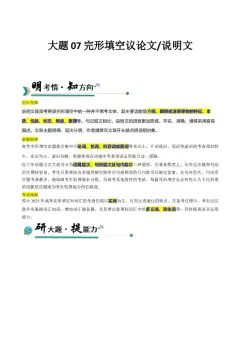
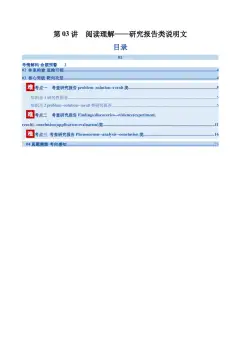
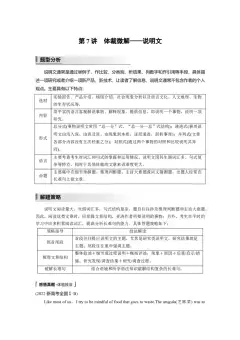
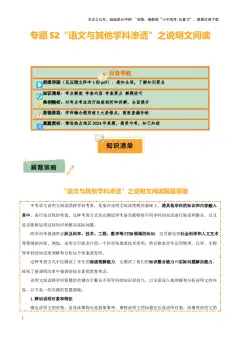
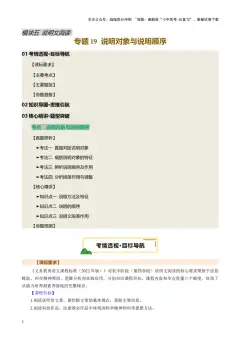
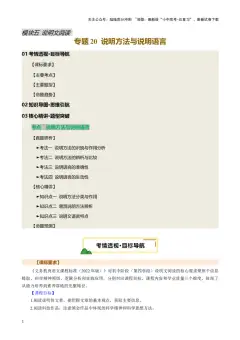
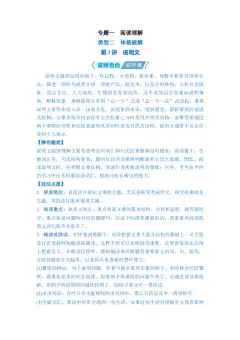
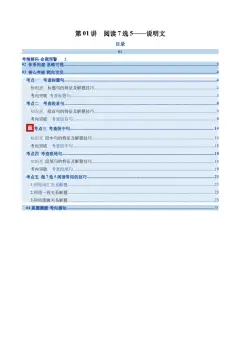
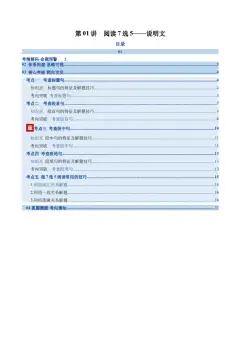
大题 阅读理解说明文
03
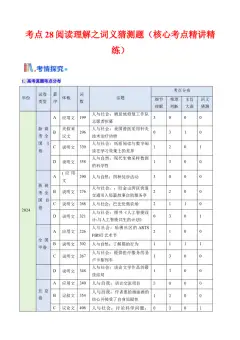
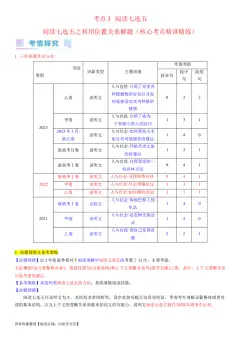
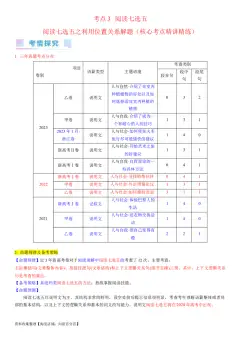
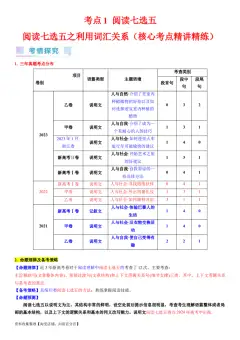
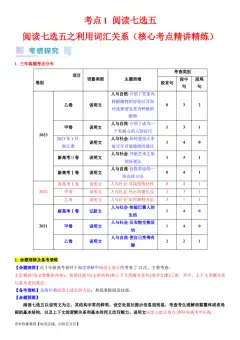
历年考情
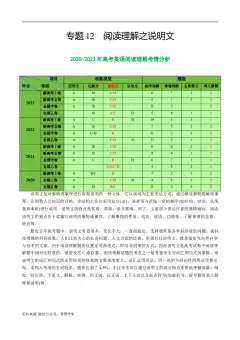
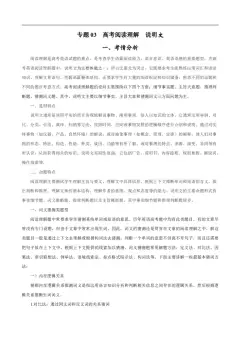
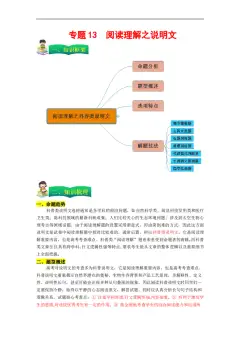
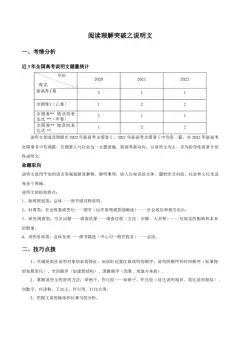
说明文阅读理解一般作为全国卷阅谈理解中的CD篇,主要分为两种类型:实验研究和介绍说明型。
说明文是对事物的形状,性质,特征,成果或公用等进行介绍,解释或阐述的文章,把我所说明事物的特
征和本质是理解说明文的关键,说明事物特征的方法很多,主要有定义法,解释法,比较法,比喻法,数
字法,图标法,引用法和距离法等。说明文的特点是客观、简洁、准确、清晰,文章很少表达作者的情感
倾向。阅读说明文的重点在于读懂它说明的事物或事理,了解事物的性质、结构、形成原因、功能;了解
事物的意义和特征等。
命题规律
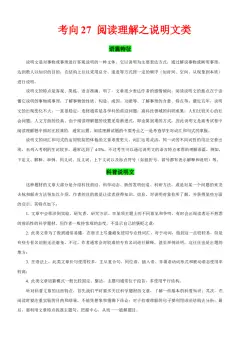
说明文所选材料题材丰富多样,涉及社会、科技、文化、生活、人物、教育、生态、安全等方面。在
高考英语阅读理解中,说明文所占比重尤为突出。它既要求考生能熟练运用词汇和语法知识、理解文章语
句、把握语篇整体结构,还要求学生有大量的阅读积淀和知识储备,熟悉不同的话题和不同的题目考查方
式。即便是细节理解题,大多数情况下考生也无法从文章中直接找到与选项表述完全一致的信息,而是需
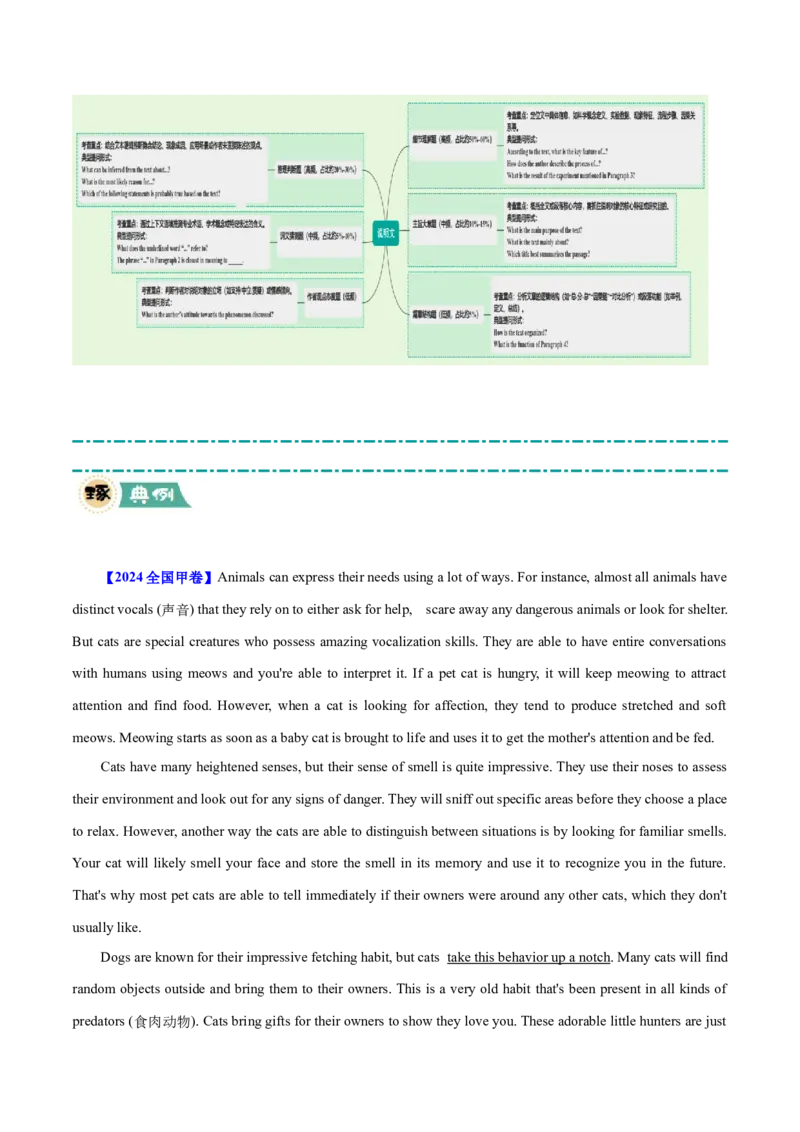
要在理解文章细节信息后作出归纳和判断。通常一套卷中主旨大意、词义猜测、写作意图/观点态度类高难
度试题的考查数量为2道左右,说明文考查此类题目的频率较高,且命题点呈多样化。
考向预测
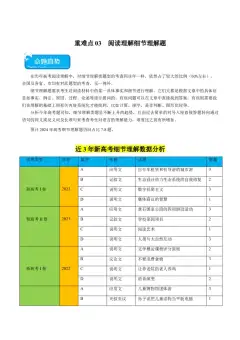
预测2025年高考说明文阅读理解试题难度会保持相对稳定,主要考查题型仍然为细节理解题和推理判
断题为主,主旨大意题和词义猜测题为辅。【2024全国甲卷】Animals can express their needs using a lot of ways. For instance, almost all animals have
distinct vocals (声音) that they rely on to either ask for help, scare away any dangerous animals or look for shelter.
But cats are special creatures who possess amazing vocalization skills. They are able to have entire conversations
with humans using meows and you're able to interpret it. If a pet cat is hungry, it will keep meowing to attract
attention and find food. However, when a cat is looking for affection, they tend to produce stretched and soft
meows. Meowing starts as soon as a baby cat is brought to life and uses it to get the mother's attention and be fed.
Cats have many heightened senses, but their sense of smell is quite impressive. They use their noses to assess
their environment and look out for any signs of danger. They will sniff out specific areas before they choose a place
to relax. However, another way the cats are able to distinguish between situations is by looking for familiar smells.
Your cat will likely smell your face and store the smell in its memory and use it to recognize you in the future.
That's why most pet cats are able to tell immediately if their owners were around any other cats, which they don't
usually like.
Dogs are known for their impressive fetching habit, but cats take this behavior up a notch. Many cats will find
random objects outside and bring them to their owners. This is a very old habit that's been present in all kinds of
predators (食肉动物). Cats bring gifts for their owners to show they love you. These adorable little hunters are justdoing something that it's been in their nature since the beginning of time. So just go along with it!
4. What can be learned about cats' meowing from the first paragraph?
A. It's a survival skill. B. It's taught by mother cats.
C. It's hard to interpret. D. It's getting louder with age.
5. How does a pet cat assess different situations?
A. By listening for sounds. B. By touching familiar objects.
C. By checking on smells. D. By communicating with other cats.
6. Which best explains the phrase "take. . . up notch" in paragraph 3?
A. Perform appropriately. B. Move faster. C. Act strangely. D. Do better.
7. What is a suitable title for the text?
A. Tips on Finding a Smart Cat B. Understanding Your Cat's Behavior
C. Have Fun with Your Cat D. How to Keep Your Cat Healthy
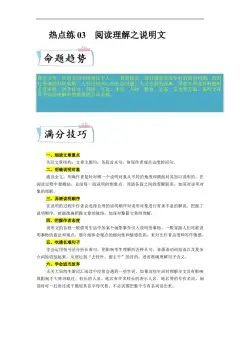
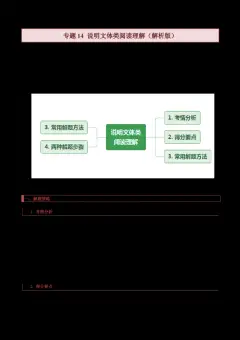
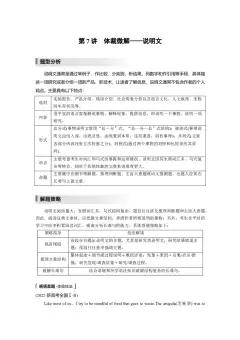
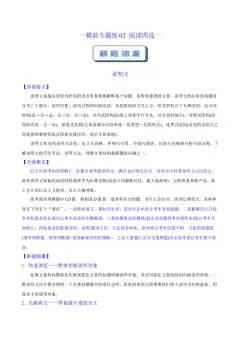
说明文阅读量大,生僻词汇多,句式结构复杂,这就需要考生有方法有技巧地去阅读。一般我们采
用的方法有三个:细读、略读和跳读。
(1)细读重点。重点,就原文而言,就是文章的基本结构、内容和态度;就答题而言,就
是问题所对应的题源句。以这个标准来衡量,需要重点阅读的原文词句就不会很多。
宏观方面:文章结构;文章主题句;各段首末句;体现作者观点态度的词句。
微观方面:有转折处;重要标点;句子主干。
(2)有选择地略读或跳读。在快速浏览了题干,初步把握了文章大意及结构的基础上,可大胆进行略读
或跳读,这样不但可以加快阅读速度,还更容易总体把握全文。在阅读中可略读或跳读的内容包括:
① 繁琐的例证。为了说明问题,作者可能会借用形象的例子,有时候会比较繁琐,虽能说明问题,但需
要读者花很多时间去阅读。如果例子所说明的问题不明了,可通过略读来理解;若例子所说明的问题比
较明了,则例子部分可一带而过。
② 并列多项列举。有时许多功能相同的项目并列列举,那么只读其中一两项即可,无需
全读。
③ 无关大局的生僻词汇。阅读中经常会遇到一些生词,如果这些生词对理解全文没有影响或影响不大就
可略过。
④ 较长的人名、地名。有许多较长的表示人名、地名等的专有名词,阅读时可一扫而过或干脆用其首字
母代替,不必试图把整个专有名词读出来。
在略读过程中,要特别注意对解题有重要意义的词、句、段等,并将其储存在大脑里,以免回头再
查看费时费力。
【2025届河北省石家庄市第一中学高三下学期一模】Envision a futuristic rooftop garden so astute that it
is capable of discerning the optimal moments to hoard water in anticipation of arid conditions, and when to expel
water to avert inundation. Now, such intelligent roofs are transitioning from the realm of fantasy to reality in theNetherlands.
With a substantial portion of the nation situated below sea level, the Netherlands has long been acquainted
with the perils of flooding. The advent of climate change has ushered in an era of more extreme meteorological
phenomena, including torrential downpours and periods of drought, compelling the city of Amsterdam to
contemplate novel strategies for self-preservation, and it is within this context that Resilio emerges as a pivotal
player.
As per the assertions on their official website, Resilio is engaged in the construction of blue-green roofs
across the expanse of Amsterdam. In conjunction with the local governmental authorities, from the years 2018
through to 2022, they have installed specialized roofing systems in the neighborhoods of Amsterdam that are most
vulnerable to the ravages of flood damage.
These roofs are composed of a multitude of strata. Paramount among these layers is the water retention layer.
During episodes of copious rainfall, this layer serves to accumulate the rainwater that would otherwise inundate the
streets, and in times of drought, it channels its stored water to nourish the garden situated on the uppermost layer. It
is this particular layer that distinguishes the blue-green roofs from their conventional green counterparts. Research
indicates that blue-green roofs possess the capacity to capture as much as 97% of extreme rainfall, in stark contrast
to the mere 12% that regular green roofs can retain.
However, what truly sets Resilio roofs apart is their sophisticated systems. An array of blue-green roofs are
interconnected via a digital communication network, thereby enabling each roof to be manipulated independently,
responding to the volume of water amassed on that specific roof as the situation demands. Each roof is also
equipped with a valve that is linked to a computerized system known as the Decision Support System (DSS). The
DSS interfaces with local weather prognostications to determine whether the valve on a particular roof should be
opened, allowing water to be discharged in a controlled and gradual manner into the sewerage system, or whether it
should remain sealed to collect the impending rain.
These innovations are the hallmarks that render Resilio truly revolutionary. Blue-green roofs exemplify that
the remedies to the hazards posed by climate change necessitate a blend of creativity and a multifaceted approach,
operating on various levels to mitigate the adverse effects of our changing environment.
8.What may directly lead to the building of Resilio roofs in Amsterdam?
A.The increasing disasters. B.The city’s financial suffering.
C.The ever-rising sea level. D.The city’s geographic advantage.
9.What do we know about the water retention layer of Resilio roofs?A.They are slow to drought. B.They are absolutely perfect.
C.They serve a double purpose. D.They can trap solar energy.
10.What is the main function of the DSS according to the text?
A.To collect weather information. B.To control the use of the valve.
C.To help the sewer system work. D.To connect the digital network.
11.What might be the best title of this passage?
A.Smart roof systems becoming a reality in Auckland
B.Resilio blue-green roof systems preventing disasters
C.The working principle of the blue-green roof systems
D.The differences between Resilio roofs and regular green roofs
Passage(1)
【2025届河南省郑州市中原区郑州中学高三上学期 12月模拟预测】Sadfishing, which researchers
defined in the Journal of American College Health in 2021, refers to the trend of exaggerating personal struggles
online to generate sympathy. It could be in the form of a sad photo, an ominous quote, or a post with a foggy
meaning.
We all may be guilty of posting something weak and emotional on social media from time to time, which
isn’t a bad thing. But posting repeatedly could be a sign of a larger mental health issue in teens or a cry for help.
Journalist Rebecca Reid coined the term in 2019 after a questionable Instagram post by Kendall Jenner. In
the post, Jenner described a “painful struggle” with acne and received a large amount of sympathetic responses
from her followers. However, it was later revealed that her post was just a complicated marketing plot for her
skincare partnership with Proactiv, and Reid labeled her behavior as sadfishing.
Experts say sadfishing is likely due to the fact that a child or teen is struggling with something and wants to
let others know. In these cases, they often don’t feel they have a person they feel comfortable with to share their
struggles with so they turn to the social media world. A 2023 study found that teens who participated in sadfishing
exhibited signs of anxiety and depression, while low social support was a large contributing factor. Researchers also
found that boys reported “higher sadfishing tendencies” than girls at age 12, but the trend decreased as they gotolder. For girls, the trend increased with age.
Researchers found that, in most cases, responses to sadfishing posts were positive and helpful. But in some
cases, there were negative responses which could lead to increased stress or anxiety. “When a social media post is
unsuccessful in seeking sympathetic responses, it can also cause the person posting it to be mocked,” Dr. Nissim-
Matheis warns. “Especially if the post is authentic.” And while any response is supportive for a child/ teen who
feels unseen and unheard, it may open them up to privacy violations and violent behavior.
28.What’s the intention of a social media user’s sadfishing?
A.To share an opinion. B.To demonstrate online skills.
C.To make a complaint. D.To satisfy an emotional need.
29.What can we infer about Jenner’s Instagram followers?
A.They had little knowledge of acne.
B.They had trust in Proactiv’s products.
C.They were probably misled by Jenner’s story.
D.They were encouraged by online information.
30.What do we know about teenagers’ sadfishing trends?
A.They peak at age 12 for boys. B.They decline after age 12 for girls.
C.They generally decrease as one ages. D.They disappear before one’s adulthood.
31.What does the underlined word “mocked” in the last paragraph mean?
A.Called on. B.Laughed at. C.Promoted. D.Supported.
Passage(2)
【2025届黑龙江省“六校联盟”高三上学期联合适应性考试】Engineers at Princeton University have
measured the cooling benefits of a simple solution for beating urban heat: reflecting sunlight back from where it
came by equipping building walls and roadways in urban centers with retroreflective (反光的) materials.
“With climate change and the increasing frequency and persistence of extreme heat events, more people in
the U.S. die from extreme heat than from any other weather-related disaster-heat kills more than tornadoes,
tsunamis, and hurricanes combined,” said Elie Bou-Zeid, professor of civil and environmental engineering.
Several technologies have been raised to fight against the issue of urban overheating, including cool
pavements and roof coatings. However, when sunlight hits these cooling technologies, it can be kicked back in any
number of directions instead of in one focused direction, which means that highly reflective materials could have an
opposite result if applied because sunlight could be reflected onto the ground, walls,and even the passers-by.“Actually, retroreflective materials are already used in transportation, where they are commonly found in
road signs and paint to improve nighttime visibility, but an important question is how efficient we can make them
and whether we can engineer them to have the performances we want,” said Jyotirmoy Mandal,assistant professor
of civil and environmental engineering.
Unlike common highly reflective materials, retroreflectors can reflect incoming sunlight with limited
scattering (散射). Consequently, most sunlight hitting a retroreflector on a building wall or city street would be
directed back in the same direction it came from-and out of the urban canyon. In this way, the retroreflectors can
release the sunlight that would otherwise be stuck in the urban canyon and exacerbate the urban overheating
problem.
Ultimately, they want to create a set of guidelines for policymakers, planners, and materials engineers. If
you’re an urban planner, for example, and you know the latitude of your city, the width-height ratio and the
direction of your streets, you can easily use their results to pick the suitable surfaces for applying these
retroreflective materials and estimate the cooling benefits you might receive in doing so.
8.What may Elie Bou-Zeid warn people of in paragraph 2?
A.The frequency of natural disasters. B.Thie urgency of keeping people cool.
C.The unpredictability of climate change. D.The necessity of temperature monitoring.
9.What is the limitation of current cooling technologies?
A.Influence upon the city’s appearance. B.Disturbance of the view of passes-by.
C.Production of something poisonous to humans.D.Inability to control the direction of reflected light.
10.What does the underlined word “exacerbate” in paragraph 5 probably mean?
A.Relieve. B.Cause. C.Intensify. D.Address.
11.What is probably the final goal of the engineers?
A.To increase urban green spaces. B.To personalize reflective materials.
C.To simplify existing building designs. D.To reduce costs of construction materials.
Passage(3)
【2025届山东省日照市高三下学期一模】Every time we make a new video or send an email, or post a
photo of our latest meal, it’s like turning on a small light bulb (灯泡) that’ ll never be turned off. This points to an
uncomfortable and extremely modern question: To help save the planet, should we be using less data? Given how
much of modern life depends on digital data, the answer could be a key aspect to living nobly in the AI age.
Why do posts produce carbon at all? When you send a post on Moments, it goes along a chain of energy-burning electronics. Your Wi-Fi router sends the signal along wires to the local exchange — the box on the street
corner — and from there to a telecoms company, and from there to huge data centers operated by the tech giants.
Each of those runs on electricity, and it all adds up.
Today, about 400 million homes worldwide have at least one “smart” device— curtains, electric cookers,
refrigerators, and pads. By 2028, that figure is expected to nearly double. We are, in other words, being taken into a
world where it’s harder to do anything without turning on a digital light bulb. This puts eco-conscious consumers
in a bind. After all, who would like to be someone that can’t get their information properly because they’re too busy
keeping the carbon footprint of their searches down?
In the absence of systemic change, worrying over our individual data-usage decisions is “like trying to hold
back a flood with a bucket and spade (铁铲).” Still, there’s something we can do. When we face a digital decision,
the less data-thirsty option will often be the smarter one. Blocking third-party tracking when we’ re on the web, for
example, not only reduces the power consumption of internet browsing; it’s also good for your privacy. More
fundamentally, maybe we don’t need to turn everything into data. If I put down my phone the next time I’m on a
train, it won’t save the planet. But I’ll be looking out the window with my own eyes, creating a memory that
releases no carbon at all.
8.What does the author imply about data usage?
A.It is energy-consuming.
B.It is easy and convenient.
C.Its negative effects are ignored.
D.Its benefits are underestimated.
9.What is the function of paragraph 2?
A.To entertain. B.To inform.
C.To persuade. D.To inspire.
10.What do the underlined words “in a bind” mean in paragraph 3?
A.At risk. B.At a loss.
C.At ease. D.At a disadvantage.
11.What does the author emphasize concerning carbon reduction in the last paragraph?
A.The removal of digital data.
B.The promotion of ecotourism.
C.The value of personal contribution.D.The significance of systemic change.
Passage(4)
【2025届山东省日照市高三下学期一模】Every time we make a new video or send an email, or post a
photo of our latest meal, it’s like turning on a small light bulb (灯泡) that’ ll never be turned off. This points to an
uncomfortable and extremely modern question: To help save the planet, should we be using less data? Given how
much of modern life depends on digital data, the answer could be a key aspect to living nobly in the AI age.
Why do posts produce carbon at all? When you send a post on Moments, it goes along a chain of energy-
burning electronics. Your Wi-Fi router sends the signal along wires to the local exchange — the box on the street
corner — and from there to a telecoms company, and from there to huge data centers operated by the tech giants.
Each of those runs on electricity, and it all adds up.
Today, about 400 million homes worldwide have at least one “smart” device— curtains, electric cookers,
refrigerators, and pads. By 2028, that figure is expected to nearly double. We are, in other words, being taken into a
world where it’s harder to do anything without turning on a digital light bulb. This puts eco-conscious consumers
in a bind. After all, who would like to be someone that can’t get their information properly because they’re too busy
keeping the carbon footprint of their searches down?
In the absence of systemic change, worrying over our individual data-usage decisions is “like trying to hold
back a flood with a bucket and spade (铁铲).” Still, there’s something we can do. When we face a digital decision,
the less data-thirsty option will often be the smarter one. Blocking third-party tracking when we’ re on the web, for
example, not only reduces the power consumption of internet browsing; it’s also good for your privacy. More
fundamentally, maybe we don’t need to turn everything into data. If I put down my phone the next time I’m on a
train, it won’t save the planet. But I’ll be looking out the window with my own eyes, creating a memory that
releases no carbon at all.
8.What does the author imply about data usage?
A.It is energy-consuming.
B.It is easy and convenient.
C.Its negative effects are ignored.
D.Its benefits are underestimated.
9.What is the function of paragraph 2?
A.To entertain. B.To inform.
C.To persuade. D.To inspire.10.What do the underlined words “in a bind” mean in paragraph 3?
A.At risk. B.At a loss.
C.At ease. D.At a disadvantage.
11.What does the author emphasize concerning carbon reduction in the last paragraph?
A.The removal of digital data.
B.The promotion of ecotourism.
C.The value of personal contribution.
D.The significance of systemic change.
Passage(5)
【湖北省武汉市第一中学2024-2025学年高三上学期12月联考】When science fiction and the science
of time meet, they invite us into a deep exploration of the nature of time. Despite its presence everywhere in daily
life, time remains a mystery, with no definitive definition. Our concept of time may be a mental shortcut, a tool for
our limited brains to comprehend change.
The English language frequently employs the noun“time,” yet we lack a satisfactory explanation for it.
Concerning time, quantum (量子) mechanics and daily experiences often contradict each other, suggesting time’s
complexity and ambiguous nature. Our mental conception of time may never correspond with its reality in the
universe, but this shouldn’t stop us from exploring it.
Many science fiction quotes touch on time. Ray Cummings’ 1919 novel, The Girl in the Golden Atom, offers
a memorable quote: “Time is what keeps everything from happening at once,” implying time’s structural role in the
universe. Blake Crouch’s Recursion presents a contrasting view: “Time is a false image, a concept made out of
human memory.”
Robert Charles Wilson’s Spin explores various forms of time, from personal measurement to cosmic scales,
emphasizing our challenging relationship with it. S. D.Unwin’s One Second Per Second suggests time as chaos
within a cosmic plan, with people and civilizations as its playthings. Robert V. S. Redick’s Vanishing Point
describes time as a trick due to our comprehension of time’s flow.
Captain Jean-Luc Picard from Star Trek says, “Time is a companion who reminds us to cherish every
moment,” emphasizing its value. David Brin’s Brightness Reef describes time as a cruel judge, punishing even the
successful and brilliant. Stephen Baxter’s The Time Ships catches time’s frightening nature, darkening human
achievements in the vastness of time.
Time travel, a major topic of science fiction, is often discussed. H. G. Wells’ 1895 novel The Time Machineposes the enduring question of whether moving backward and forward in time is possible. These quotes from
science fiction highlight our troubled relationship with time and encourage us to think more deeply about its reality.
8.What is the overall tone of the text?
A.Inquiring. B.Pessimistic. C.Persuasive. D.Definitive.
9.What can be learned about time from paragraph 2?
A.Time is easy to understand but has a complex nature in science.
B.Time is a common concept in daily life well corresponding with scientific reality.
C.Daily experiences often go against scientific understandings of time.
D.Quantum physics has no impact on our understanding of time.
10.What does Stephen Baxter’s The Time Ships emphasize?
A.Time as a companion who reminds us to cherish every moment.
B.The insignificance of human successes in the long history of time.
C.The possibility to move backward and forward in time at will.
D.A false belief due to our comprehension of time’s flow.
11.What does the text mainly talk about?
A.The history of time and famous quotes in science fiction.
B.The definition of time in scientific terms and time travel.
C.The relationship between time and daily life.
D.The science of time and its exploration in science fiction.
Passage(6)
【华中师范大学第一附属中学 2024-2025学年高三下学期开学】A wave of startups say seaweed is a
solution to climate change - able to absorb atmospheric carbon, provide raw materials for biofuels, and feed the
world - no fertilizers (化肥), fresh water, or even land required. Running Tide, a Maine-based company, is working
on a system that will eventually sink the buoys (浮标), attached with long locks of seaweed, to the deep ocean
floor, where the carbon they contain will remain stored for 800 years or more.
Running Tide was founded by Marty Odlin, an engineer and fourth-generation commercial fisherman. The
Gulf of Maine is warming faster than nearly every other oceanic region, and Odlin has seen the changes firsthand.
About 15 years ago, Odlin heard a talk from Klaus Lackner - the physicist who popularised the idea of removing
carbon from the atmosphere. It clicked. “It was like, oh, this is right because there’s no way we ’ re going to get
off fossil (化石的) fuels in the next 50 years, ” he recalls thinking. “We’ re going to have to pull it down.”
Using seaweed to draw down carbon would be an elegant solution - if it works. Seaweed forests collectivelycover an estimated two million square kilometers and absorb as much carbon as the Amazon rainforest. But much
of that storage is short-lived. When the seaweed is harvested, eaten by animals, or washes ashore, its stored carbon
is released back into the atmosphere. Running Tide’s model, in theory at least, would take that stored carbon and
sink it to the ocean floor where it would remain for centuries, breaking down slowly.
Some scientists are careful about rushing ahead before fundamental scientific, environmental, and regulatory
questions are answered. “Climate change is intensifying, and people are panicking, ”says Kristen Davis, a professor
of University of California Irvine, “but the science is not there yet to actually confirm that it’s a good idea. ”
8.What can we learn about Running Tide's system?
A.It removes carbon from seaweed.
B.It turns seaweed into fertilizers.
C.It sinks seaweed into the ocean floor.
D.It stores seaweed as food sources.
9.What did Lackner's speech lead Odlin to do?
A.Monitor changes in oceanic regions. B.Reduce commercial fishing industry.
C.Set restrictions on the use of fossil fuels. D.Remove carbon from the atmosphere.
10.What does paragraph 3 mainly talk about?
A.Steps of a carbon replacement method. B.The underlying logic of sinking seaweeds.
C.Examples of massive seaweed forests. D.The carbon absorbing ability of seaweeds.
11.Why does the author quote Kristen Davis?
A.To prove Odlin's opinion. B.To emphasise the climate crisis.
C.To advocate scientists' cooperation. D.To present the issue objectively.
Passage(7)
【江苏省苏州中学、海门中学、姜堰中学、淮阴中学等四校2024-2025学年高三下学期2月联考】
Two paralyzed patients have been able to walk short distances and even climb stairs after being implanted with
electrodes (电极) in their brains. In a world first, surgeons used a technique called deep brain stimulation to “re-
awaken” inactive nerve fibers in the spinal cord and re-establish control of the leg muscles.
The breakthrough came after neuroscientists at the Swiss Federal Technology Institute in Lausanne (EPFL)
used AI to map all the neurons in the brain involved in helping rats and mice walk. To their surprise, a region called
the lateral hypothalamus — known to be involved in arousal and motivation — was found to have a role in
walking. It was so unexpected that the finding was initially questioned by other scientists who peer reviewed thepaper for the journal Nature Medicine.
After successful tests in rats and mice, the Swiss team then implanted electrodes in the lateral hypothalamus
of the human patients. The technique is carried out while patients are wide awake. Only then can surgeons be sure
they have reached the right area in the brain, with the right strength of stimulation.
Professor Jocelyne Bloch, who carried out the operations at Lausanne University Hospital, said: “Once the
electrode was in place and we performed the stimulation, the first patient immediately said, ‘I feel my legs’. When
we increased the stimulation she said, ‘I feel the urge to walk!’”
Scientists believe the lateral hypothalamus sends signals down nerve fibres that remain undamaged after the
spinal injury, which helps engage the remaining nerve connections and improve neurological recovery.”
The two patients did not make a complete recovery from their injury, and were only able to walk slowly over
short distances with a stick or “walker”. But the Lausanne tea m has already shown it is possible to restore
movement by using implants in the spinal cord. They hope that stimulating both the spine and the brain in future
will enhance recovery and help patients walk further and faster.
8.What procedure allowed the patients to regain some mobility?
A.Deep brain stimulation. B.Spinal cord recovery.
C.Leg muscles improvement. D.Artificial intelligence mapping.
9.What was the first reaction of other scientists to the discovery?
A.Excitement. B.Skepticism. C.Acceptance. D.Indifference.
10.Why is the technique performed while the patient is awake?
A.To minimize suigical risks.
B.To speed up the implantation process.
C.To confirm the correct spot and stimulation level.
D.To ensure the patient experiences minimal discomfort.
11.What is the best title of the passage?
A.Artificial limbs are used for recovery
B.Brain part has new roles in movement
C.Regaining the ability to walk requires hi-tech
D.Paralyzed patients walk with brain electrodes
Passage(8)
【广东省红岭中学2024-2025学年高三下学期第五次统一考试】Fancy letting a machine mediate (调解)
your argument? It could be the latest application for AI as researchers reveal its mysterious recipe for findingcommon ground in culture war conflicts.
Scientists at Google’s DeepMind project designed what they call the Habermas Machine, a large language AI
inspired by German philosopher Jürgen Habermas’ theory of communicative action — the idea that common
understanding fosters cooperation. It works by taking differing written views on a contentious (争议的) topic and
coming up with a set of statements designed to keep everyone happy.
Researchers found that the machine’s musings ( 想法) were preferred 56% of the time compared to
statements produced by human mediators. Participants also found the AI response to be more logical and
informative. Study co-author Prof Chris Summerfield, from the University of Oxford, said: “Helping people find
agreement is a new frontier for AI. In the event, we found that it was not only as good as but better than humans
trying to do the same job.”
Summerfield believes the process of interacting through the AI model helps overcome the drawbacks of
traditional debating chambers such as public meetings and social media. “People can venture these private beliefs,”
he explained. “They’re not put in the position where they have to try and look clever or feel like they have to win
an argument irrespective of what they really think. “We were amazed at how articulate people were. They were
sensible and moderate. I bet that what happens on Twitter/X, for example, is that the process lends itself to digital
preening (得意).”
Part of the model’s success, he says, lies in its determination to give special weight to disagreeing opinion.
Rather than siding with the majority, it allowed minority voices to feel heard. “A lot of policymaking is about
finding good compromises, right?” he says. “And you can only fit so many people around the table. If you want a
very inclusive process, then you need lots of people to participate. I would love to see this tool used to give us all a
better opinion of what people think about everything, which I think would probably — on balance — be a good
thing.”
12.What is theoretical basis for the Habermas Machine?
A.Mutual trust originates from cooperation.
B.Finding common ground is equal to settling conflicts.
C.Resolving disagreements helps win argument.
D.Shared agreement promotes cooperation.
13.Which might be the disadvantage of traditional mediation?
A.Failing to show cleverness.
B.Strong desire to win regardless of true thoughts.C.Being too casual to share secret thoughts.
D.Making people extreme and unreasonable.
14.Which of the following helps the success of the Habermas Machine?
A.Supporting the beliefs of the majority.
B.Logical response with useful information.
C.Allowing the majority voices to be heard.
D.Completely ignoring disagreeing ideas.
15.What does Summerfield suggest about the Habermas Machine?
A.Applying it to more situations.
B.Involving more people in the research.
C.Finding good compromises for it.
D.Offering a better opinion of its process.
Passage(1)
【2024新课标Ⅰ卷】In the race to document the species on Earth before they go extinct, researchers and
citizen scientists have collected billions of records. Today, most records of biodiversity are often in the form of
photos, videos, and other digital records. Though they are useful for detecting shifts in the number and variety of
species in an area, a new Stanford study has found that this type of record is not perfect.
“With the rise of technology it is easy for people to make observations of different species with the aid of a
mobile application,” said Barnabas Daru, who is lead author of the study and assistant professor of biology in the
Stanford School of Humanities and Sciences. “These observations now outnumber the primary data that comes
from physical specimens (标本), and since we are increasingly using observational data to investigate how species
are responding to global change, I wanted to know: Are they usable?”
Using a global dataset of 1.9 billion records of plants, insects, birds, and animals, Daru and his team tested
how well these data represent actual global biodiversity patterns.
“We were particularly interested in exploring the aspects of sampling that tend to bias (使有偏差) data, like
the greater likelihood of a citizen scientist to take a picture of a flowering plant instead of the grass right next to it,”
said Daru.
Their study revealed that the large number of observation-only records did not lead to better global coverage.Moreover, these data are biased and favor certain regions, time periods, and species. This makes sense because the
people who get observational biodiversity data on mobile devices are often citizen scientists recording their
encounters with species in areas nearby. These data are also biased toward certain species with attractive or eye-
catching features.
What can we do with the imperfect datasets of biodiversity?
“Quite a lot,” Daru explained. “Biodiversity apps can use our study results to inform users of oversampled
areas and lead them to places — and even species — that are not well-sampled. To improve the quality of
observational data, biodiversity apps can also encourage users to have an expert confirm the identification of their
uploaded image.”
32. What do we know about the records of species collected now?
A. They are becoming outdated. B. They are mostly in electronic form.
C. They are limited in number. D. They are used for public exhibition.
33. What does Daru’s study focus on?
A. Threatened species. B. Physical specimens.
C. Observational data. D. Mobile applications.
34. What has led to the biases according to the study?
A. Mistakes in data analysis. B. Poor quality of uploaded pictures.
C. Improper way of sampling. D. Unreliable data collection devices.
35. What is Daru’s suggestion for biodiversity apps?
A. Review data from certain areas. B. Hire experts to check the records.
C. Confirm the identity of the users. D. Give guidance to citizen scientists.
Passage(2)
【2024 全国甲卷】The Saint Lukas train doesn’t accept passengers—it accepts only the sick. The Saint
Lukas is one of five government-sponsored medical trains that travel to remote towns in central and eastern Russia.
Each stop lasts an average of two days, and during that time the doctors and nurses on board provide rural(乡
村)populations with basic medical care, X-ray scans and prescriptions.
“People started queuing to make an appointment early in the morning,” says Emile Ducke, a German
photographer who traveled with the staff of the Saint Lukas for a two-week trip in November through the vast
regions(区域)of Krasnoyarsk and Khakassia.
Russia’s public health care service has been in serious need of modernization. The government has struggled
to come up with measures to address the problem, particularly in the poorer, rural areas east of the Volga River,including arranging doctor’s appointments by video chat and expanding financial aid programs to motivate doctors
to practice medicine in remote parts of the country like Krasnoyarsk.
The annual arrival of the Saint Lukas is another attempt to improve the situation. For 10 months every year,
the train stops at about eight stations over two weeks, before returning to the regional capital to refuel and
restock(补给). Then it starts all over again the next month. Most stations wait about a year between visits.
Doctors see up to 150 patients every day. The train’s equipment allows for basic checkups. “I was very
impressed by the doctors and their assistants working and living in such little space but still staying focused and
very concerned,” says Ducke. “They were the best chance for many rural people to get the treatment they want. ”
8. How is the Saint Lukas different from other trains?
A. It runs across countries. B. It reserves seats for the seniors.
C. It functions as a hospital. D. It travels along a river.
9. What can we infer from paragraph 3 about Krasnoyarsk?
A. It is heavily populated. B. It offers training for doctors.
C. It is a modern city. D. It needs medical aid.
10. How long can the Saint Lukas work with one supply?
A. About a year. B. About ten months.
C. About two months. D. About two weeks.
11. What is Ducke’s attitude toward the Saint Lukas’ services?
A. Appreciative. B. Doubtful C. Ambiguous. D. Cautious.
Passage(3)
【2024新课标ⅠⅠ卷】We all know fresh is best when it comes to food. However, most produce at the store
went through weeks of travel and covered hundreds of miles before reaching the table. While farmer’s markets are
a solid choice to reduce the journey, Babylon Micro-Farm (BMF) shortens it even more.
BMF is an indoor garden system. It can be set up for a family. Additionally, it could serve a larger audience
such as a hospital, restaurant or school. The innovative design requires little effort to achieve a reliable weekly
supply of fresh greens.
Specifically, it’s a farm that relies on new technology. By connecting through the Cloud, BMF is remotely
monitored. Also, there is a convenient app that provides growing data in real time. Because the system is
automated, it significantly reduces the amount of water needed to grow plants. Rather than watering rows of soil,
the system provides just the right amount to each plant. After harvest, users simply replace the plants with a new
pre-seeded pod (容器) to get the next growth cycle started.Moreover, having a system in the same building where it’s eaten means zero emissions (排放) from
transporting plants from soil to salad. In addition, there’s no need for pesticides and other chemicals that pollute
traditional farms and the surrounding environment.
BMF employees live out sustainability in their everyday lives. About half of them walk or bike to work. Inside
the office, they encourage recycling and waste reduction by limiting garbage cans and avoiding single-use plastic.
“We are passionate about reducing waste, carbon and chemicals in our environment,” said a BMF employee.
8. What can be learned about BMF from paragraph 1?
A. It guarantees the variety of food. B. It requires day-to-day care.
C. It cuts the farm-to-table distance. D. It relies on farmer’s markets.
9. What information does the convenient app offer?
A. Real-time weather changes. B. Current condition of the plants.
C. Chemical pollutants in the soil. D. Availability of pre-seeded pods.
10. What can be concluded about BMF employees?
A. They have a great passion for sports.
B. They are devoted to community service.
C. They are fond of sharing daily experiences.
.
D They have a strong environmental awareness.
11. What does the text mainly talk about?
A. BMF’s major strengths. B. BMF’s general management.
C. BMF’s global influence. D. BMF’s technical standards.
Passage(4)
【2024浙江1月卷】On September 7, 1991, the costliest hailstorm (雹暴) in Canadian history hit Calgary’s
southern suburbs. As a result, since 1996 a group of insurance companies have spent about $2million per year on
the Alberta Hail Suppression Project. Airplanes seed threatening storm cells with a chemical to make small ice
crystals fall as rain before they can grow into dangerous hailstones. But farmers in east-central Alberta —
downwind of the hail project flights — worry that precious moisture (水分) is being stolen from their thirsty land
by the cloud seeding.
Norman Stienwand, who farms in that area, has been addressing public meetings on this issue for years
“Basically, the provincial government is letting the insurance companies protect the Calgary-Edmonton urban area
from hail,” Mr. Stienwan d says, “but they’re increasing drought risk as far east as Saskatchewan.”
The Alberta hail project is managed by Terry Krauss, a cloud physicist who works for Weather ModificationInc. of Fargo, North Dakota. “We affect only a very small percentage of the total moisture in the air, so we cannot
be cousing drought.” Dr. Krauss says. “In fact, we may be helping increase the moisture downwind by creating
wetter ground.”
One doubter about the safety of cloud seeding is Chuck Doswell, a research scientist who just retired from the
University of Oklahoma. “In 1999, I personally saw significant tornadoes (龙卷风) form from a seeded storm cell
in Kansas,” Dr. Doswell says. “Does cloud seeding create killer storms or reduce moisture downwind? No one
really knows, of course, but the seeding goes on.”
Given the degree of doubt, Mr. Stienwand suggests, “it would be wise to stop cloud seeding.” In practice,
doubt has had the opposite effect. Due to the lack of scientific proof concerning their impacts, no one has succeeded
in winning a lawsuit against cloud-seeding companies. Hence, private climate engineering can proceed in relative
legal safety.
8. What does the project aim to do?
A. Conserve moisture in the soil. B. Prevent the formation of hailstones.
C. Forecast disastrous hailstorms. D. Investigate chemical use in farming.
9. Who are opposed to the project?
A. Farmers in east-central Alberta. B. Managers of insurance companies.
C. Provincial government officials. D. Residents of Calgary and Edmonton
10. Why does Dr. Doswell mention the tornadoes he saw in 1999?
A. To compare different kinds of seeding methods.
B. To illustrate the development of big hailstorms.
C. To indicate a possible danger of cloud seeding.
D. To show the link between storms and moisture.
11. What can we infer from the last paragraph?
A. Scientific studies have proved Stienwand right.
B. Private climate engineering is illegal in Canada.
C. The doubt about cloud seeding has disappeared.
D. Cloud-seeding companies will continue to exist.
Passage(5)
【2024北京卷】Franz Boas’s description of Inuit (因纽特人) life in the 19th century illustrates the probable
moral code of early humans. Here, norms (规范) were unwritten and rarely expressed clearly, but were well
understood and taken to heart. Dishonest and violent behaviours were disapproved of; leadership, marriage andinteractions with other groups were loosely governed by traditions. Conflict was often resolved in musical battles.
Because arguing angrily leads to chaos, it was strongly discouraged. With life in the unforgiving Northern Canada
being so demanding, the Inuit’s practical approach to morality made good sense.
The similarity of moral virtues across cultures is striking, even though the relative ranking of the virtues may
vary with a social group’s history and environment. Typically, cruelty and cheating are discouraged, while
cooperation, humbleness and courage are praised. These universal norms far pre-date the concept of any moralising
religion or written law. Instead, they are rooted in the similarity of basic human needs and our shared mechanisms
for learning and problem solving. Our social instincts (本能) include the intense desire to belong. The approval of
others is rewarding, while their disapproval is strongly disliked. These social emotions prepare our brains to shape
our behaviour according to the norms and values of our family and our community. More generally, social instincts
motivate us to learn how to behave in a socially complex world.
The mechanism involves a repurposed reward system originally used to develop habits important for self-care.
Our brains use the system to acquire behavioural patterns regarding safe routes home, efficient food gathering and
dangers to avoid. Good habits save time, energy and sometimes your life. Good social habits do something similar
in a social context. We learn to tell the truth, even when lying is self-serving; we help a grandparent even when it is
inconvenient. We acquire what we call a sense of right and wrong.
Social benefits are accompanied by social demands: we must get along, but not put up with too much. Hence
self-discipline is advantageous. In humans, a greatly enlarged brain boosts self-control, just as it boosts problem-
solving skills in the social as well as the physical world. These abilities are strengthened by our capacity for
language, which allows social practices to develop in extremely unobvious ways.
32. What can be inferred about the forming of the Inuit’s moral code?
A. Living conditions were the drive. B. Unwritten rules were the target.
C. Social tradition was the basis. D. Honesty was the key.
33. What can we learn from this passage?
A. Inconveniences are the cause of telling lies. B. Basic human needs lead to universal norms.
C. Language capacity is limited by self-control. D. Written laws have great influence on virtues.
34. Which would be the best title for this passage?
A. Virtues: Bridges Across Cultures B. The Values of Self-discipline
C. Brains: Walls Against Chaos D. The Roots of Morality
Passage 6【2024 浙江 1 月卷】The Stanford marshmallow (棉花糖) test was originally conducted by psychologist
Walter Mischel in the late 1960s. Children aged four to six at a nursery school were placed in a room. A single
sugary treat, selected by the child, was placed on a table. Each child was told if they waited for 15 minutes before
eating the treat, they would be given a second treat. Then they were left alone in the room. Follow-up studies with
the children later in life showed a connect ion between an ability to wait long enough to obtain a second treat and
various forms of success.
As adults we face a version of the marshmallow test every day. We’ re not tempted (诱惑) by sugary treats, but
by our computers, phones, and tablets — all the devices that connect us to the global delivery system for various
types of information that do to us what marshmallows do to preschoolers.
We are tempted by sugary treats because our ancestors lived in a calorie-poor world, and our brains developed
a response mechanism to these treats that reflected their value — a feeling of reward and satisfaction. But as we’ve
reshaped the world around us, dramatically reducing the cost and effort involved in obtaining calories, we still have
the same brains we had thousands of years ago, and this mismatch is at the heart of why so many of us struggle to
resist tempting foods that we know we shouldn’t eat.
A similar process is at work in our response to information. Our formative environment as a species was
information-poor, so our brains developed a mechanism that prized new information. But global connectivity has
greatly changed our information environment. We are now ceaselessly bombarded (轰炸) with new information.
Therefore, just as we need to be more thoughtful about our caloric consumption, we also need to be more
thoughtful about our information consumption, resisting the temptation of the mental “junk food” in order to
manage our time most effectively.
12. What did the children need to do to get a second treat in Mischel’s test?
A. Take an examination alone. B. Show respect for the researchers.
C. Share their treats with others. D. Delay eating for fifteen minutes.
13. According to paragraph 3, there is a mismatch between ___________.
A. the calorie-poor world and our good appetites
B. the shortage of sugar and our nutritional needs
C. the rich food supply and our unchanged brains
D. the tempting foods and our efforts to keep fit
14. What does the author suggest readers do?
A. Absorb new information readily. B. Be selective information consumers.C. Use diverse information sources. D. Protect the information environment.
15. Which of the following is the best title for the text?
A. Eat Less, Read More B. The Bitter Truth about Early Humans
C. The Later, the Better D. The Marshmallow Test for Grownups