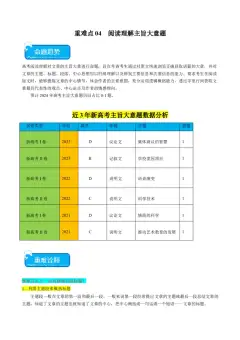
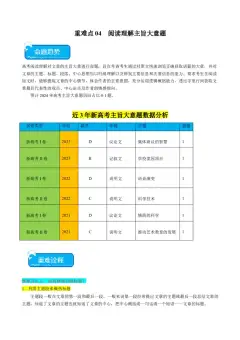
大题 03 阅读理解说明文
说明文所选材料题材丰富多样,涉及社会、科技、文化、生活、人物、教育、生态、安全等方面。在
高考英语阅读理解中,说明文所占比重尤为突出。它既要求考生能熟练运用词汇和语法知识、理解文章语
句、把握语篇整体结构,还要求学生有大量的阅读积淀和知识储备,熟悉不同的话题和不同的题目考查方
式。即便是细节理解题,大多数情况下考生也无法从文章中直接找到与选项表述完全一致的信息,而是需
要在理解文章细节信息后作出归纳和判断。通常一套卷中主旨大意、词义猜测、写作意图/观点态度类高难
度试题的考查数量为2道左右,说明文考查此类题目的频率较高,且命题点呈多样化。
(2023 年新高考 I 卷 D 篇)On March 7, 1907, the English statistician Francis Galton published a paper
which illustrated what has come to be known as the “wisdom of crowds” effect. The experiment of estimation he
conducted showed that in some cases, the average of a large number of independent estimates could be quite
accurate.
This effect capitalizes on the fact that when people make errors, those errors aren’t always the same. Some
people will tend to overestimate, and some to underestimate. When enough of these errors are averaged together,
they cancel each other out, resulting in a more accurate estimate. If people are similar and tend to make the same
errors, then their errors won’t cancel each other out. In more technical terms, the wisdom of crowds requires that
people’s estimates be independent. If for whatever reasons, people’s errors become correlated or dependent, the
accuracy of the estimate will go down.
But a new study led by Joaquin Navajas offered an interesting twist (转折) on this classic phenomenon. The
key finding of the study was that when crowds were further divided into smaller groups that were allowed to have a
discussion, the averages from these groups were more accurate than those from an equal number of independent
individuals. For instance, the average obtained from the estimates of four discussion groups of five was
significantly more accurate than the average obtained from 20 independent individuals.
In a follow-up study with 100 university students, the researchers tried to get a better sense of what the group
members actually did in their discussion. Did they tend to go with those most confident about their estimates? Did
they follow those least willing to change their minds? This happened some of the time, but it wasn’t the dominant
response. Most frequently, the groups reported that they “shared arguments and reasoned together”. Somehow,these arguments and reasoning resulted in a global reduction in error. Although the studies led by Navajas have
limitations and many questions remain, the potential implications for group discussion and decision-making are
enormous.
28.What is paragraph 2 of the text mainly about?
A.The methods of estimation. B.The underlying logic of the effect.
C.The causes of people’s errors. D.The design of Galton’s experiment.
29.Navajas’ study found that the average accuracy could increase even if ________.
A.the crowds were relatively small B.there were occasional underestimates
C.individuals did not communicate D.estimates were not fully independent
30.What did the follow-up study focus on?
A.The size of the groups. B.The dominant members.
C.The discussion process. D.The individual estimates.
31.What is the author’s attitude toward Navajas’ studies?
A.Unclear. B.Dismissive. C.Doubtful. D.Approving.
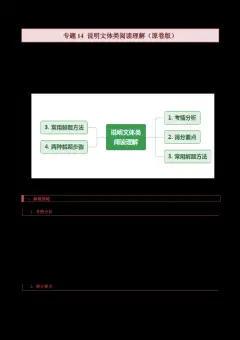
说明文阅读量大,生僻词汇多,句式结构复杂,这就需要考生有方法有技巧地去阅读。一般我们采用的方
法有三个:细读、略读和跳读。
(1)细读重点。重点,就原文而言,就是文章的基本结构、内容和态度;就答题而言,就
是问题所对应的题源句。以这个标准来衡量,需要重点阅读的原文词句就不会很多。
宏观方面:文章结构;文章主题句;各段首末句;体现作者观点态度的词句。
微观方面:有转折处;重要标点;句子主干。
(2)有选择地略读或跳读。在快速浏览了题干,初步把握了文章大意及结构的基础上,可大胆进行略读或跳
读,这样不但可以加快阅读速度,还更容易总体把握全文。在阅读中可略读或跳读的内容包括:
① 繁琐的例证。为了说明问题,作者可能会借用形象的例子,有时候会比较繁琐,虽能说明问题,但需要读者
花很多时间去阅读。如果例子所说明的问题不明了,可通过略读来理解;若例子所说明的问题比较明了,则例
子部分可一带而过。
② 并列多项列举。有时许多功能相同的项目并列列举,那么只读其中一两项即可,无需
全读。
③ 无关大局的生僻词汇。阅读中经常会遇到一些生词,如果这些生词对理解全文没有影响或影响不大就可略
过。
④ 较长的人名、地名。有许多较长的表示人名、地名等的专有名词,阅读时可一扫而过或干脆用其首字母代
替,不必试图把整个专有名词读出来。(2024 上·河北沧州·高三泊头市第一中学校联考期末)Think of your most prized possession. Now,
imagine you decide you must sell this item. How much is it worth to you? How much would you charge for it? And
would anyone else want to buy it at that price?
Let’s consider the real-world example of a yard sale. Before your neighbors come to look at your things, you
must first decide on the prices for them. For you, each item has a story, and some items may even evoke strong
emotions.
Let’s say you’re selling a pair of special edition sports shoes that you took care of and really enjoyed wearing
on special occasions. With these sweet memories in mind, you put a price tag of $130 on the shoes. However, a
customer offers $50 for them. You think, “How could they not see how special and valuable these are?”
In financial transactions like this, sellers often believe their own items are worth more than what buyers are
willing to pay. This occurs because buyers do not have the seller’s experiences with and emotional attachment to
the items. Buyers want a good deal, and they’re not willing to pay what the seller is asking for.
This negotiation process can even feel a little painful for the seller—over losing something and the buyer not
valuing it as much. Economists suggest this dynamic occurs through the endowment effect (禀赋效应)—people’s
tendency to value things they own more highly than they would if they did not own them. The endowment effect
can take hold anytime we feel a sense of ownership over a product, and it can happen quickly.
As the saying goes, “Emotions gel the best of us.” There is nothing wrong with being proud of owning things
and treasuring your experiences with them. But when you consider selling a prized possession, think about whether
you’re fully ready to part with il. The past is the past, though. Removing your emotional attachment to material
possessions can help you make more accurate assessments of how much your items are truly worth.
28.What does the underlined word “evoke” in paragraph 2 probably mean?
A.Advocate. B.Cause. C.Identify. D.Control.
29.What makes you put a price tag of $130 on your shoes according to paragraph3?
A.Your fondness for the shoes. B.Your ignorance of the market.
C.The high quality of the shoes. D.The special function of the shoes.
30.Which can best illustrate the result of endowment effect?
A.One likes collecting old things.
B.One tends to buy expensive goods.
C.One offers a lower price when shopping.
D.One charges a higher-than-usual price for something.31.What’s the purpose of the last paragraph?
A.To make a suggestion. B.To introduce a theory.
C.To analyze a phenomenon. D.To provide some evidence.
刷模拟
Passage(1)
(2024·江苏连云港·统考一模)Artificial intelligence models can trick each other into disobeying their
creators and providing banned instructions for making drugs, or even building a bomb, suggesting that preventing
such AI “jailbreaks” is more difficult than it seems.
Many publicly available large language models (LLMs), such as ChatGPT, have hard-coded rules that aim to
prevent them from exhibiting racial or sexual discrimination, or answering questions with illegal or problematic
answers — things they have learned from humans via training data. But that hasn’t stopped people from finding
carefully designed instructions that block these protections, known as “jailbreaks”, making AI models disobey the
rules.
Now, Arush Tagade at Leap Laboratories and his co-workers have found a process of jailbreaks. They found
that they could simply instruct one LLM to convince other models to adopt a persona (角色), which is able to
answer questions the base model has been programmed to refuse. This process is called “persona modulation (调
节)”.
Tagade says this approach works because much of the training data consumed by large models comes from
online conversations, and the models learn to act in certain ways in response to different inputs. By having the right
conversation with a model, it is possible to make it adopt a particular persona, causing it to act differently.
There is also an idea in AI circles, one yet to be proven, that creating lots of rules for an AI to prevent it
displaying unwanted behaviour can accidentally create a blueprint for a model to act that way. This potentially
leaves the AI easy to be tricked into taking on an evil persona. “If you’re forcing your model to be good persona, it
somewhat understands what a bad persona is,” says Tagade.
Yinzhen Li at Imperial College London says it is worrying how current models can be misused, but developers
need to weigh such risks with the potential benefits of LLMs. “Like drugs, they also have side effects that need tobe controlled,” she says.
28.What does the AI jailbreak refer to?
A.The technique to break restrictions of AI models.
B.The initiative to set hard-coded rules for AI models.
C.The capability of AI models improving themselves.
D.The process of AI models learning new information.
29.What can we know about the persona modulation?
A.It can help AI models understand emotions.
B.It prevents AI learning via online conversations.
C.It can make AI models adopt a particular persona.
D.It forces AI models to follow only good personas.
30.What is Yinzhen Li’s attitude towards LLMs?
A.Unclear. B.Cautious. C.Approving. D.Negative.
31.Which can be a suitable title for the text?
A.LLMs: Illegal Learning Models B.LLMs: The Latest Advancement
C.AI Jailbreaks: A New Challenge D.AI Jailbreaks: A Perfect Approach
Passage(2)
(2024·江苏连云港·统考一模)Not all birds sing, but several thousand species do. They sing to defend their
territory and croon (柔声唱) to impress potential mates. “Why birds sing is relatively well-answered,” says Iris
Adam, a behavioral neuroscientist. However, the big question for her was why birds sing so much.
“As soon as you sing, you reveal yourself,” Adam says. “Like, where you are and where your territory is.” In a
new study published in the journal Nature Communications, Adam and her co-workers offer a new explanation for
why birds take that risk. They may have to sing a lot every day to give their vocal (发声的) muscles the regular
exercise they need to produce top-quality songs. To figure out whether the muscles that produce birdsongs require
daily exercise, Adam designed an experiment on zebra finches-the little Australian songbirds.
She prevented them from singing for a week by keeping them in the dark cage almost around the clock. Light
is what galvanizes the birds to sing, so she had to work to keep them from warbling (鸣叫). “The first two or three
days, it’s quite easy,” she says. “But the longer the experiment goes, the more they are like, ‘I need to sing.’” At that
point, she’d tap the cage and tell them to stop singing.
After a week, the birds’ singing muscles lost half their strength. But Adam wondered whether that impacted
the quality of songs. When she played a male’s song before and after the seven days of darkness, she couldn’t heara difference. But when Adam played it to a group of female birds, six out of nine preferred the song that came from
a male who’d been using his singing muscles daily.
Adam’s conclusion shows that “songbirds need to exercise their vocal muscles to produce top-performance
songs. If they don’t sing, they lose performance, and their songs get less attractive to females.” This may help
explain songbirds’ continuous singing.
It’s a good rule to live by, whether you’re a bird or a human-practice makes perfect, at least when it comes to
singing one’s heart out.
28.According to Iris Adam, birds sing so much to ______.
A.warn other birds of risks B.produce more songs
C.perform perfectly in singing D.defend their territory
29.What does the underlined word “galvanizes” in Paragraph 3 mean?
A.Prepares. B.Stimulates. C.Forbids. D.Frightens.
30.What do we know about the caged birds in the experiment?
A.They lost the ability to sing. B.They strengthened their muscles.
C.Their songs showed no difference. D.Their songs became less appealing.
31.What may Iris Adam agree with?
A.The songbirds live on music. B.The songbirds are born singers.
C.Daily exercise keeps birds healthy. D.Practice makes birds perfect singers.
Passage(3)
(2024·福建·统考一模)On the streets of Manhattan and Washington, D.C., in neighborhoods in Seoul
and parks in Paris, ginkgo (银杏) trees are losing their leaves in reaction to the first gust of cold winter air. This leaf
drop, gradual at first, and then sudden, carpets streets with golden, fan-shaped leaves. Scientists are documenting
evidence of the event happening later and later, a possible indication of climate change. But the story of ginkgos is
not the familiar one of human carelessness with nature.
Thanks to fossils found in North Dakota, scientists found a ginkgo has genetically similar ancestors dating
back 170 million years to the Jurassic Period. “It almost went extinct. Then humans rescued it and spread it around
the world. It’s such a great evolutionary (进化) and cultural story,” says Peter Crane, a ginkgo expert.
One theory for the decline of the ginkgo species began 130 million years ago, when flowering plants began
spreading. They grew faster and attracted more pollinators (传粉者) than ginkgos. “It’s possible that ginkgos were
elbowed out of the way,” says Crane. Already competing to survive, ginkgos began to disappear during a time ofglobal cooling that began around 66 million years ago. By the time the last ice age ended 11,000 years ago, the
remaining survivors were found in China.
Ginkgo trees are smelly. “My guess is that they were eaten by animals that liked smelly things. They then
passed through their body and grew.” Crane says. Those same seeds may have helped ginkgo find favor with
humans 1,000 years ago. Once cleaned of their outer layer, ginkgo seeds are safe to eat. It’s then, when the trees
had long since disappeared elsewhere, that people in China may have begun planting them and eating their seeds.
Then gradually ginkgos spread across the world. Now it’s seemingly naturally resistant to insects and high levels of
air pollution.
Crane isn’t worried about its future, though: The popularity of the species will help it survive. “Though its
status in the wild may be difficult to access, it’s a plant that’s unlikely to ever go extinct,” he says.
28.What may have caused the further delay of ginkgo’s leaf drop?
A.The colder weather in winter.
B.The protection from city councils.
C.The global warming phenomenon.
D.The careless interaction with humans.
29.What does paragraph 3 mainly talk about?
A.The reasons why ginkgos almost died out.
B.The advantages of ginkgos over other plants.
C.The theories of experts for multiplying ginkgos.
D.The competition between various flowering plants.
30.What might have contributed to ginkgos’ survival?
A.Their eatable seeds. B.Their unpleasant smell.
C.The natural evolution. D.The careful planting.
31.How does Crane feel about ginkgos’ future?
A.Worried. B.Optimistic. C.Uncertain. D.Hopeless.
Passage(4)
(2024·湖南邵阳·统考一模)Listening to an audiobook (有声书) before bed affects a person’s brain activity
after they nod off as well as the content of their dreams.
Better understanding this effect could help treat certain mental health conditions by targeting memory
processing during sleep. When we sleep, our brain spontaneously (自发地) “replays”, or reactivates patterns of
electrical activity that are related to learning to transfer important new information to long-term memory storage. Ithas been suggested that dreams may reflect this reactivation, but exactly how is unclear.
To investigate, Deniz Kumral at the University of Freiburg, Germany, and her colleagues asked 20 people to
listen to different audiobooks just before they went to sleep. These included The Mystery of the Blue Train by
Agatha Christie and Inkheart by Cornelia Funke.
Among the participants who remembered their dreams, the researchers could identify which audiobook each
had heard from their descriptions of the dreams. While the participants slept, the researchers also used an EEG (脑
电图) cap that detects electrical activity to record their brain waves. This showed that the wave patterns during the
rapid eye movement phase of sleep, when dreams occurred, were more similar between those who had heard the
same audiobook than those who had heard different ones, suggesting that the listening experience shaped the brain
activity.
Further analysis of the patterns revealed that high-frequency beta waves — between 18 and 30hertz — were
most strongly associated with the participants recalling the audiobook-related content of their dreams. The findings
suggest that daily life experiences can shape dream content via memory reactivation, according to the researchers.
But while dreaming may serve a distinct purpose in memory formation, it could also be a by-product of memory
processing.
“Daytime experiences are rarely replayed as experienced, but are almost always modified or surface in
different contexts,” says Kumral. “Individuals with certain psychological conditions or mental problems might
benefit from tailored strategies that enhance memory processing or treat disorders of dreaming during sleep,
potentially contributing to improved mental and emotional health.”
28.What did the researchers ask the participants to do?
A.Record their dreams every night. B.Listen to audiobooks during the day.
C.Listen to audiobooks just before sleep. D.Wear an EEG cap during the day.
29.Why did Deniz Kumral and her colleagues do the research?
A.To know how people process information.
B.To find out the contents of people’s dreams.
C.To reveal the secret of improving people’s memory.
D.To investigate how dreams replay patterns of electrical activity.
30.What does the underlined word “modified” in the last paragraph probably mean?
A.Changed. B.Stored C.Strengthened. D.Forgotten.
31.What is the best title of the text?A.Listening experiences influencing brain activity
B.Listening to audiobooks before bed shaping one’s dream
C.The importance of dreams in memory formation
D.Integration of daily experiences into dreams
Passage(5)
(2024·广东肇庆·统考二模)“He is a giant of the 20th-century art, but that doesn’t mean he only did big
paintings, said Lynn Miller, director of Rochester Central Gallery, in an interview last Thursday.
Entitled “Picasso and His Drafts”, a special exhibit marking 50 years since the death of Pablo Picasso is held
at the gallery this month. Instead of his paintings, the notebooks on which the Spanish legendary artist drew drafts
are shown to the public for the first time.
Matchbox covers, postcards, restaurant napkins all served as drafting notes for the artist at moments of
inspiration. It is important to know that each of the 14 notebooks presented reflects what was going on in his life.
For example, a tiny notebook whose size is just 3 by 5 inches stands out among the exhibits. Inside the little
book was a self-portrait of the artist finished roughly in pencil, with deep and thoughtful eyes. It was done in 1918
and Picasso, then in his mid-30s, had just got married. He produced big-sized artworks but he also kept this tiny
notebook around, filling it with scenes of his wife, their friends, the beach and the town, and drafts of upcoming
paintings. Actually, many of the draft drawings are early versions of famed paintings like Les Demoiselles
d’Avignon (1907) and Dora Maar in an Armchair (1939).
”He is a great artist of the modern period, and we see practice and determination in his notebooks, said Lynn
Miller, referring to Picasso’s efforts in improving his skills through copious drawing. Bernard Ruiz-Picasso, a
grandson of Picasso’s, remembered him always drafting until the last piece of paper available. “My grandpa was
permanently drawing something, Ruiz-Picasso said.
In a documentary film shown at the gallery, Picasso, shirtless and in shorts, was standing on a ladder to reach
the top of his canvas (画布). It reminds visitors of the real size of his masterworks.
28.What are the key features of the recent exhibit at the gallery?
A.Notebooks for sale. B.Picasso’s artworks.
C.Priceless artistic drafts. D.Masterpieces of the 20th century.
29.What is reflected in the notebooks of Picasso?
A.His life experience. B.The love for his country.
C.The content of his books. D.His education background.30.Which of the following best describes Picasso according to his grandson?
A.Creative. B.Diligent. C.Optimistic. D.Humorous.
31.What can we learn from the author’s words in the last paragraph?
A.Picasso used to mind his appearance. B.The gallery exhibits real masterworks.
C.The documentary movie is worth seeing.D.Picasso’s artworks are actually of great size.
Passage(6)
(2024·广东茂名·统考一模)Researchers have identified a growing threat to astronomy from the sunlight
reflecting off communication devices in space. One such device, a communication satellite called BlueWalker 3, is
currently one of the brightest objects visible from Earth, matching the brightness of Procyon and Achemar, two of
the brightest stars in the night sky.
“BlueWalker 3 is visible in both dark sky and urban skies, though in urban settings this will be limited to when
BlueWalker 3 passes overhead,” said Dr. Jeremy Tregloan-Reed, a co-author of the study at the University of
Atacama in Chile. “Large constellations (星座) of bright artificial satellites in low Earth orbit pose significant
challenges to ground-based astronomy,” the study’s authors wrote.
Tregloan-Reed said a large reflective brightness means that when a satellite crosses the detector of a telescope,
it leaves a mark that can be difficult, if not impossible, to remove. This could lead to loss of data from the affected
pixels ( 像 素 ). But he said space-based astronomy also faced challenges from such satellites, noting that
observations by the Hubble telescope had increasingly been affected by marks from Starlink satellites. Besides, the
team notes the radio frequencies used by BlueWalker 3 are close to those used for radio astronomy, raising the
possibility that such satellites could cause interference.
While BlueWalker 3 was folded when it was launched last year, once in space it opened up to reveal a huge
surface area that reflected sunlight. Tregloan-Reed added that even if all the reflective brightness of all satellites
was reduced to below the level visible by the naked eye, “the sky background glow will increase due to the
accumulative effect of having hundreds of thousands of satellites from various operators from many countries in
low Earth orbit. It is disastrous!”
BlueWalker 3, built by AST Space Mobile, is just the first one to be launched. The company is planning a
constellation of satellites nicknamed BlueBirds, consisting of over 100 similar satellites and aimed to provide
satellite network service for the whole world. You can imagine how bright the night sky will be at that time!
28.What can we know about BlueWalker 3?
A.It threatens the sunlight. B.It was invented by Dr. Jeremy.C.It is brighter than Procyon and Achernar. D.It is visible in urban skies when passing overhead.
29.The brightness of BlueWalker 3 is most likely to affect ________.
A.earth orbit B.space observation
C.radio frequency D.satellite communication
30.Concerning the plan of BlueBirds, what might the author agree with?
A.It has potential drawbacks. B.It is bound to be accomplished.
C.It is irreplaceable for astronomy. D.It provides network service for the world.
31.What’s the best title of the passage?
A.BlueWalker 3—A Bright and Dark “Star”B.BlueWalker 3—The Most Valuable Satellite
C.The Night Sky—Glowing with BlueWalker 3 D.The Night Sky—Heavily Polluted by BlueWalker 3
Passage(7)
(2024·湖南长沙·统考一模)For the rapidly decreasing number of Americans who’ve never heard of
pickleball, the little-known paddleball game is one of America’s fastest-growing sports.
Invented in 1965 by three middle-aged fathers in Washington state, pickleball is an odd cross among tennis,
ping-pong and badminton, played with a paddle and a perforated (穿孔的) plastic ball. The founders are said to
have named the game after a family dog called Pickles.
Most of pickleball’s core players — those who play more than eight times per year — are over age 65, but the
game is getting younger, with the strongest growth among players under 55, according to USA Pickleball. But with
so many new players, the US is struggling to keep up with the demand for courts. The country has only about
10,000 places to play, by USA Pickleball’s count, but that continues to grow by several dozen every month.
Pickleball is also fast becoming a spectator sport (观赏性运动). Its first professional tournament, the
Professional Pickleball Association (PPA) Tour, was formed in 2018 and the professional players are being able to
really become celebrities and spotlights. Traditional broadcasters’ interest in the sport is growing. So far, pickleball
fans can watch amateur and professional matches on sports or social channels, mostly online.
“The ability for a sport to find an audience quickly via social media is unprecedented (前所未有的),” says
Ben Shields, who lectures at MIT’s Sloan School of Management and studies the sports industry. Shields adds that
pickleball still needs a famous star to draw in wider audiences, as has been the key to success for other sports
opularity of Pickleball
C.The Rise and Fall of Pickleball D.The Rules of Playing Pickleball
Passage(8)
(2024·湖南长沙·统考一模)ByteDance’s Douyin has been trialing a food delivery service since Decemberas it looks to expand its business beyond advertising. It potentially competes itself against major e-commerce
companies like Alibaba and Meituan. And the company is now considering extending the service beyond the trial.
A Douyin spokesperson says that the company has been “testing a feature in Beijing, Shanghai and Chengdu
that enables merchants (商人) to promote and sell ‘group-buying’ packages to Douyin users in these select cities
and have them delivered”. Restaurant owners often livestream on Douyin to market their business. While doing
this, they can offer discounts and coupons (优惠券) for their food to users watching the videos. Multiple users can
then purchase that offer mainly and choose a time within two days for the food to arrive. The model is very
different from Meituan and Alibaba’s Ele.me which are both on-demand food delivery services.
The digital giant has approached restaurant owners and food enterprises in the three cities to promote their
dishes on the app. Douyin states that the success of the trial run will determine whether the in-app meal delivery
service will be expanded to other cities. “We would consider expanding the feature to more cities in the future
depending on the testing results. There is no detailed timeline yet,” a Douyin spokesperson says.
China’s food delivery industry is dominated by Meituan and Ele.me. Douyin has fewer food buying options
than Meituan and Ele.me. But ByteDance’s tentative (暂定的) steps into the market suggest it wants a slice of the
market. Major e-commerce platforms are getting into the food delivery business.
One Weibo post reads, “More platforms could be advantageous for both food business owners and regular
consumers.” Users think the competition will help registered vendors (销售商) and users because customers will
have more options and food business owners can use the platform that charges the lowest service fee.
28.What does Douyin want to do?
A.Expand its market in tested cities. B.Get into the food delivery industry.
C.Gain control over Meituan and Ele.me. D.Livestream to sell group-buying packages.
29.What may most attract users to buy food from Douyin according to the text?
A.Fast and on-demand delivery time. B.Excellent after-sales service
C.Wonderful and effective live stream. D.Shop owners’ discounts and coupons.
30.What can we learn from the text?
A.Ele.me has less food choices than Douyin.
B.Douyin is expecting to occupy its share in the market.
C.Detailed timeline has been made by the digital company.
D.Ordered food can be delivered by Meituan within a week.
31.What’s people’s attitude towards Douyin in the last paragraph?A.Supportive. B.Demanding. C.Intolerant. D.Concerned.
刷真题
Passage(1)
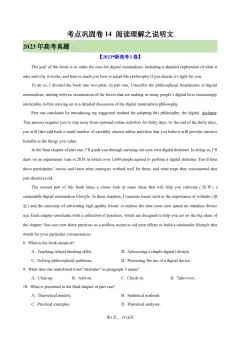
(2023 年新高考 I 卷 C )The goal of this book is to make the case for digital minimalism, including a
detailed exploration of what it asks and why it works, and then to teach you how to adopt this philosophy if you
decide it’s right for you.
To do so, I divided the book into two parts. In part one, I describe the philosophical foundations of digital
minimalism, starting with an examination of the forces that are making so many people’s digital lives increasingly
intolerable, before moving on to a detailed discussion of the digital minimalism philosophy.
Part one concludes by introducing my suggested method for adopting this philosophy: the digital declutter.
This process requires you to step away from optional online activities for thirty days. At the end of the thirty days,
you will then add back a small number of carefully chosen online activities that you believe will provide massive
benefits to the things you value.
In the final chapter of part one, I’ll guide you through carrying out your own digital declutter. In doing so, I’ll
draw on an experiment I ran in 2018 in which over 1,600 people agreed to perform a digital declutter. You’ll hear
these participants’ stories and learn what strategies worked well for them, and what traps they encountered that you
should avoid.
The second part of this book takes a closer look at some ideas that will help you cultivate (培养) a sustainable
digital minimalism lifestyle. In these chapters, I examine issues such as the importance of solitude (独处) and the
necessity of cultivating high-quality leisure to replace the time most now spent on mindless device use. Each
chapter concludes with a collection of practices, which are designed to help you act on the big ideas of the chapter.
You can view these practices as a toolbox meant to aid your efforts to build a minimalist lifestyle that works for
your particular circumstances.
28.What is the book aimed at?
A.Teaching critical thinking skills. B.Advocating a simple digital lifestyle.
C.Solving philosophical problems. D.Promoting the use of a digital device.
29.What does the underlined word “declutter” in paragraph 3 mean?
A.Clear-up. B.Add-on. C.Check-in. D.Take-over.
30.What is presented in the final chapter of part one?A.Theoretical models. B.Statistical methods.
C.Practical examples. D.Historical analyses.
31.What does the author suggest readers do with the practices offered in part two?
A.Use them as needed. B.Recommend them to friends.
C.Evaluate their effects. D.Identify the ideas behind them.
Passage(2)
(2023年新高考II卷C )Reading Art: Art for Book Lovers is a celebration of an everyday object — the
book, represented here in almost three hundred artworks from museums around the world. The image of the reader
appears throughout history, in art made long before books as we now know them came into being. In artists’
representations of books and reading, we see moments of shared humanity that go beyond culture and time.
In this “book of books,” artworks are selected and arranged in a way that emphasizes these connections
between different eras and cultures. We see scenes of children learning to read at home or at school, with the book
as a focus for relations between the generations. Adults are portrayed (描绘) alone in many settings and poses —
absorbed in a volume, deep in thought or lost in a moment of leisure. These scenes may have been painted hundreds
of years ago, but they record moments we can all relate to.
Books themselves may be used symbolically in paintings to demonstrate the intellect (才智), wealth or faith of
the subject. Before the wide use of the printing press, books were treasured objects and could be works of art in
their own right. More recently, as books have become inexpensive or even throwaway, artists have used them as the
raw material for artworks — transforming covers, pages or even complete volumes into paintings and sculptures.
Continued developments in communication technologies were once believed to make the printed page
outdated. From a 21st-century point of view, the printed book is certainly ancient, but it remains as interactive as
any battery-powered e-reader. To serve its function, a book must be activated by a user: the cover opened, the pages
parted, the contents reviewed, perhaps notes written down or words underlined. And in contrast to our increasingly
networked lives where the information we consume is monitored and tracked, a printed book still offers the chance
of a wholly private, “off-line” activity.
28.Where is the text most probably taken from?
A.An introduction to a book. B.An essay on the art of writing.
C.A guidebook to a museum. D.A review of modern paintings.
29.What are the selected artworks about?
A.Wealth and intellect. B.Home and school.C.Books and reading. D.Work and leisure.
30.What do the underlined words “relate to” in paragraph 2 mean?
A.Understand. B.Paint.
C.Seize. D.Transform.
31.What does the author want to say by mentioning the e-reader?
A.The printed book is not totally out of date.
B.Technology has changed the way we read.
C.Our lives in the 21st century are networked.
D.People now rarely have the patience to read.
Passage(3)
(2023年新高考II卷D )As cities balloon with growth, access to nature for people living in urban areas is
becoming harder to find. If you’re lucky, there might be a pocket park near where you live, but it’s unusual to find
places in a city that are relatively wild.
Past research has found health and wellness benefits of nature for humans, but a new study shows that
wildness in urban areas is extremely important for human well-being.
The research team focused on a large urban park. They surveyed several hundred park-goers, asking them to
submit a written summary online of a meaningful interaction they had with nature in the park. The researchers then
examined these submissions, coding (编码) experiences into different categories. For example, one participant’s
experience of “We sat and listened to the waves at the beach for a while” was assigned the categories “sitting at
beach” and “listening to waves.”
Across the 320 submissions, a pattern of categories the researchers call a “nature language” began to emerge.
After the coding of all submissions, half a dozen categories were noted most often as important to visitors. These
include encountering wildlife, walking along the edge of water, and following an established trail.
Naming each nature experience creates a usable language, which helps people recognize and take part in the
activities that are most satisfying and meaningful to them. For example, the experience of walking along the edge
of water might be satisfying for a young professional on a weekend hike in the park. Back downtown during a
workday, they can enjoy a more domestic form of this interaction by walking along a fountain on their lunch break.
“We’re trying to generate a language that helps bring the human-nature interactions back into our daily lives.
And for that to happen, we also need to protect nature so that we can interact with it,” said Peter Kahn, a senior
author of the study.28.What phenomenon does the author describe at the beginning of the text?
A.Pocket parks are now popular. B.Wild nature is hard to find in cities.
C.Many cities are overpopulated. D.People enjoy living close to nature.
29.Why did the researchers code participant submissions into categories?
A.To compare different types of park-goers. B.To explain why the park attracts tourists.
C.To analyze the main features of the park.D.To find patterns in the visitors’ summaries.
30.What can we learn from the example given in paragraph 5?
A.Walking is the best way to gain access to nature.
B.Young people are too busy to interact with nature.
C.The same nature experience takes different forms.
D.The nature language enhances work performance.
31.What should be done before we can interact with nature according to Kahn?
A.Language study. B.Environmental conservation.
C.Public education. D.Intercultural communication.
Passage(4)
(2022年新高考I卷C )The elderly residents (居民) in care homes in London are being given hens to look
after to stop them feeling lonely.
The project was dreamed up by a local charity (慈善组织) to reduce loneliness and improve elderly people’s
wellbeing. It is also being used to help patients suffering dementia, a serious illness of the mind. Staff in care homes
have reported a reduction in the use of medicine where hens are in use.
Among those taking part in the project is 80-year-old Ruth Xavier. She said: “I used to keep hens when I was
younger and had to prepare their breakfast each morning before I went to school. ”
“I like the project a lot. I am down there in my wheelchair in the morning letting the hens out and down there
again at night to see they’ve gone to bed.”
“It’s good to have a different focus. People have been bringing their children in to see the hens and residents
come and sit outside to watch them. I’m enjoying the creative activities, and it feels great to have done something
useful.”
There are now 700 elderly people looking after hens in 20 care homes in the North East, and the charity has
been given financial support to roll it out countrywide.
Wendy Wilson, extra care manager at 60 Penfold Street, one of the first to embark on the project, said:
“Residents really welcome the idea of the project and the creative sessions. We are looking forward to the benefitsand fun the project can bring to people here.”
Lynn Lewis, director of Notting Hill Pathways, said: “We are happy to be taking part in the project. It will
really help connect our residents through a shared interest and creative activities.”
28.What is the purpose of the project?
A.To ensure harmony in care homes. B.To provide part-time jobs for the aged.
C.To raise money for medical research. D.To promote the elderly people’s welfare.
29.How has the project affected Ruth Xavier?
A.She has learned new life skills. B.She has gained a sense of achievement.
C.She has recovered her memory. D.She has developed a strong personality.
30.What do the underlined words “embark on” mean in paragraph 7?
A.Improve. B.Oppose. C.Begin. D.Evaluate.
31.What can we learn about the project from the last two paragraphs?
A.It is well received. B.It needs to be more creative.
C.It is highly profitable. D.It takes ages to see the results.
Passage(5)
(2022年新高考I卷D )Human speech contains more than 2,000 different sounds, from the common “m”
and “a” to the rare clicks of some southern African languages. But why are certain sounds more common than
others? A ground-breaking, five-year study shows that diet-related changes in human bite led to new speech sounds
that are now found in half the world’s languages.
More than 30 years ago, the scholar Charles Hockett noted that speech sounds called labiodentals, such as “f”
and “v”, were more common in the languages of societies that ate softer foods. Now a team of researchers led by
Damián Blasi at the University of Zurich, Switzerland, has found how and why this trend arose.
They discovered that the upper and lower front teeth of ancient human adults were aligned (对齐), making it
hard to produce labiodentals, which are formed by touching the lower lip to the upper teeth. Later, our jaws
changed to an overbite structure (结构), making it easier to produce such sounds.
The team showed that this change in bite was connected with the development of agriculture in the Neolithic
period. Food became easier to chew at this point. The jawbone didn’t have to do as much work and so didn’t grow
to be so large.
Analyses of a language database also confirmed that there was a global change in the sound of world
languages after the Neolithic age, with the use of “f” and “v” increasing remarkably during the last few thousandyears. These sounds are still not found in the languages of many hunter-gatherer people today.
This research overturns the popular view that all human speech sounds were present when human beings
evolved around 300,000 years ago. “The set of speech sounds we use has not necessarily remained stable since the
appearance of human beings, but rather the huge variety of speech sounds that we find today is the product of a
complex interplay of things like biological change and cultural evolution,” said Steven Moran, a member of the
research team.
28.Which aspect of the human speech sound does Damián Blasi’s research focus on?
A.Its variety. B.Its distribution. C.Its quantity. D.Its development.
29.Why was it difficult for ancient human adults to produce labiodentals?
A.They had fewer upper teeth than lower teeth.
B.They could not open and close their lips easily.
C.Their jaws were not conveniently structured.
D.Their lower front teeth were not large enough.
30.What is paragraph 5 mainly about?
A.Supporting evidence for the research results.
B.Potential application of the research findings.
C.A further explanation of the research methods.
D.A reasonable doubt about the research process.
31.What does Steven Moran say about the set of human speech sounds?
A.It is key to effective communication. B.It contributes much to cultural diversity.
C.It is a complex and dynamic system. D.It drives the evolution of human beings.