英语试题
第1页(共8 页)
机密★启用前
TDA·标准学术能力诊断性测试2026 年10 月测试
英
语
本试卷共150 分。
注意事项:
1. 答卷前,考生务必将自己的姓名、准考证号填写在答题卡上。
2. 回答选择题时,选出每小题答案后,用2B 铅笔把答题卡上对应题目的答案标号涂黑。
如需改动,用橡皮擦干净后,再选涂其他答案标号。回答非选择题时,将答案写在答题卡上。
写在本试卷上无效。
3. 考试结束后,将本试卷和答题卡一并交回。
第一部分
阅读(共两节,满分60 分)
第一节(共15 小题;每小题3 分,满分45 分)
阅读下列短文,从每题所给的A、B、C 和D 四个选项中,选出最佳选项,并在答题卡
上将该项涂黑。
A
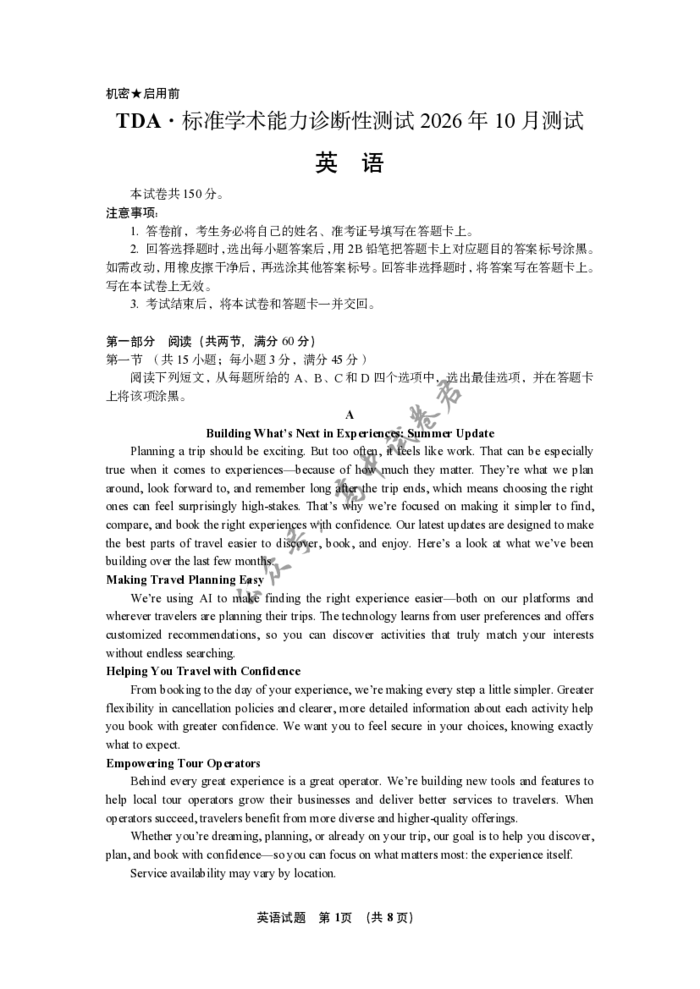
Building What’s Next in Experiences: Summer Update
Planning a trip should be exciting. But too often, it feels like work. That can be especially
true when it comes to experiences—because of how much they matter. They’re what we plan
around, look forward to, and remember long after the trip ends, which means choosing the right
ones can feel surprisingly high‑stakes. That’s why we’re focused on making it simpler to find,
compare, and book the right experiences with confidence. Our latest updates are designed to make
the best parts of travel easier to discover, book, and enjoy. Here’s a look at what we’ve been
building over the last few months.
Making Travel Planning Easy
We’re using AI to make finding the right experience easier—both on our platforms and
wherever travelers are planning their trips. The technology learns from user preferences and offers
customized recommendations, so you can discover activities that truly match your interests
without endless searching.
Helping You Travel with Confidence
From booking to the day of your experience, we’re making every step a little simpler. Greater
flexibility in cancellation policies and clearer, more detailed information about each activity help
you book with greater confidence. We want you to feel secure in your choices, knowing exactly
what to expect.
Empowering Tour Operators
Behind every great experience is a great operator. We’re building new tools and features to
help local tour operators grow their businesses and deliver better services to travelers. When
operators succeed, travelers benefit from more diverse and higher‑quality offerings.
Whether you’re dreaming, planning, or already on your trip, our goal is to help you discover,
plan, and book with confidence—so you can focus on what matters most: the experience itself.
Service availability may vary by location.
公众号:高中试卷君
英语试题
第2页(共8 页)
1. What is the main purpose of the updates mentioned in the text?
A.To make travel planning easier and more reliable.
B.To introduce new travel destinations.
C.To compare different booking platforms.
D.To encourage more people to become tour operators.
2. What can we learn about the new AI feature from the text?
A.It is only available on the company’s platform.
B.It can book flights for travelers automatically.
C.It replaces human travel agents completely.
D.It provides personalized suggestions based on user preferences.
3. Where is this text most likely to be found?
A.In a tourist guidebook.
B.On a travel booking website.
C.In a history textbook.
D.In a science magazine.
B
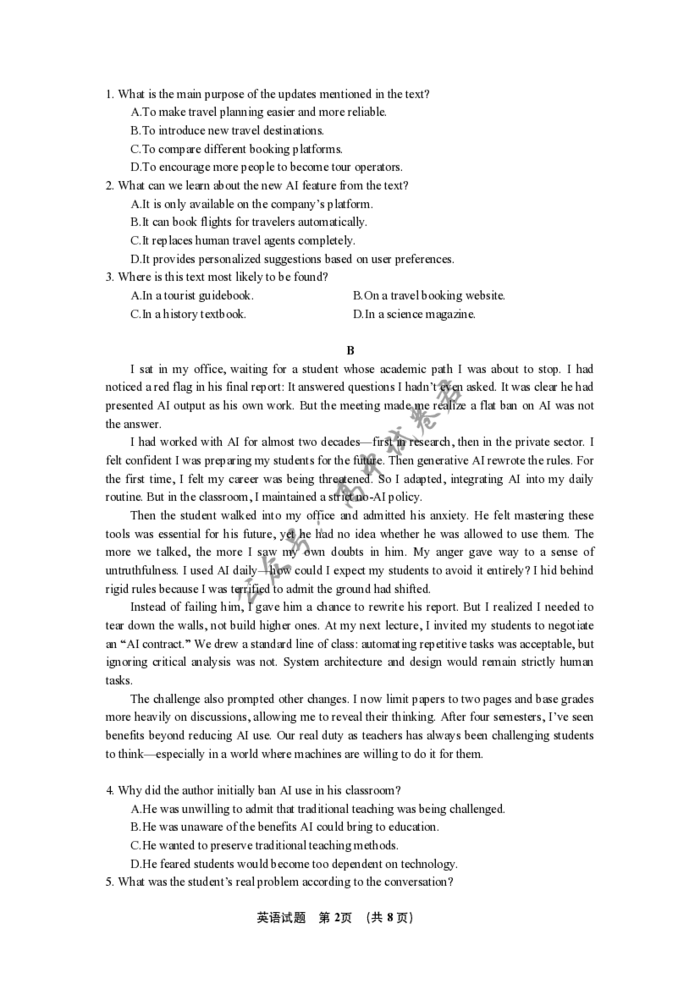
I sat in my office, waiting for a student whose academic path I was about to stop. I had
noticed a red flag in his final report: It answered questions I hadn’t even asked. It was clear he had
presented AI output as his own work. But the meeting made me realize a flat ban on AI was not
the answer.
I had worked with AI for almost two decades—first in research, then in the private sector. I
felt confident I was preparing my students for the future. Then generative AI rewrote the rules. For
the first time, I felt my career was being threatened. So I adapted, integrating AI into my daily
routine. But in the classroom, I maintained a strict no‑AI policy.
Then the student walked into my office and admitted his anxiety. He felt mastering these
tools was essential for his future, yet he had no idea whether he was allowed to use them. The
more we talked, the more I saw my own doubts in him. My anger gave way to a sense of
untruthfulness. I used AI daily—how could I expect my students to avoid it entirely? I hid behind
rigid rules because I was terrified to admit the ground had shifted.
Instead of failing him, I gave him a chance to rewrite his report. But I realized I needed to
tear down the walls, not build higher ones. At my next lecture, I invited my students to negotiate
an “AI contract.” We drew a standard line of class: automating repetitive tasks was acceptable, but
ignoring critical analysis was not. System architecture and design would remain strictly human
tasks.
The challenge also prompted other changes. I now limit papers to two pages and base grades
more heavily on discussions, allowing me to reveal their thinking. After four semesters, I’ve seen
benefits beyond reducing AI use. Our real duty as teachers has always been challenging students
to think—especially in a world where machines are willing to do it for them.
4. Why did the author initially ban AI use in his classroom?
A.He was unwilling to admit that traditional teaching was being challenged.
B.He was unaware of the benefits AI could bring to education.
C.He wanted to preserve traditional teaching methods.
D.He feared students would become too dependent on technology.
5. What was the student’s real problem according to the conversation?
公众号:高中试卷君
A.He lacked the ability to complete the report by himself.
B.He needed to learn AI tools but was unsure if they were allowed.
C.He deliberately ignored the teacher’s requirements.
D.He refused to accept the teacher’s feedback.
英语试题
第3页(共8 页)
6. What has the author learned from his experience with the student?
A.AI should be completely forbidden in academic settings.
B.Teachers should let students decide how to use AI on their own.
C.The best response to AI is to guide students in using it wisely.
D.Oral tests are more important than written assignments.
7. Which of the following statements is NOT true according to the text?
A.The author’s teaching methods have been improved by AI challenges.
B.Discussions help the teacher understand students’ thought processes.
C.The author has made the AI contract a regular part of his courses.
D.The author believes that critical thinking is no longer necessary.
C
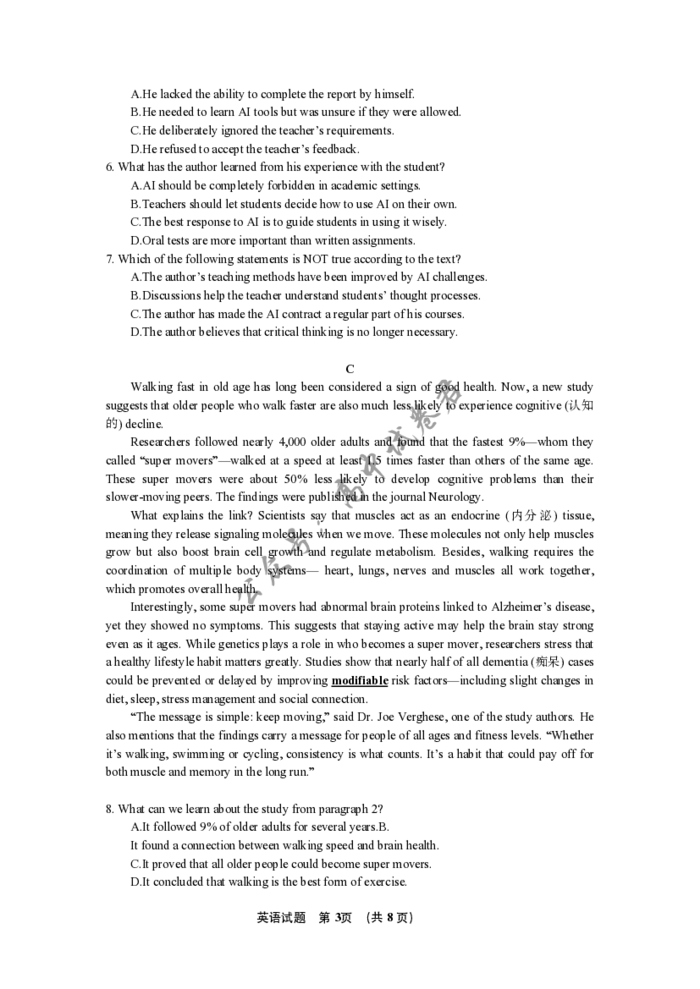
Walking fast in old age has long been considered a sign of good health. Now, a new study
suggests that older people who walk faster are also much less likely to experience cognitive (认知
的) decline.
Researchers followed nearly 4,000 older adults and found that the fastest 9%—whom they
called “super movers”—walked at a speed at least 1.5 times faster than others of the same age.
These super movers were about 50% less likely to develop cognitive problems than their
slower‑moving peers. The findings were published in the journal Neurology.
What explains the link? Scientists say that muscles act as an endocrine (内分泌) tissue,
meaning they release signaling molecules when we move. These molecules not only help muscles
grow but also boost brain cell growth and regulate metabolism. Besides, walking requires the
coordination of multiple body systems— heart, lungs, nerves and muscles all work together,
which promotes overall health.
Interestingly, some super movers had abnormal brain proteins linked to Alzheimer’s disease,
yet they showed no symptoms. This suggests that staying active may help the brain stay strong
even as it ages. While genetics plays a role in who becomes a super mover, researchers stress that
a healthy lifestyle habit matters greatly. Studies show that nearly half of all dementia (痴呆) cases
could be prevented or delayed by improving modifiable risk factors—including slight changes in
diet, sleep, stress management and social connection.
“The message is simple: keep moving,” said Dr. Joe Verghese, one of the study authors. He
also mentions that the findings carry a message for people of all ages and fitness levels. “Whether
it’s walking, swimming or cycling, consistency is what counts. It’s a habit that could pay off for
both muscle and memory in the long run.”
8. What can we learn about the study from paragraph 2?
A.It followed 9% of older adults for several years.B.
It found a connection between walking speed and brain health.
C.It proved that all older people could become super movers.
D.It concluded that walking is the best form of exercise.
公众号:高中试卷君
英语试题
第4页(共8 页)
9. According to scientists, how do muscles help keep the brain healthy?
A.By producing cells that replace old brain cells.
B.By increasing the heart rate during walking.
C.By sending out chemicals that benefit the brain.
D.By removing harmful proteins from the brain.
10. What does the underlined word “modifiable” in paragraph 4 mean?
A.reliable
B.available
C.adjustable
D.unchangeable
11. What is the author’s main purpose in writing the text?
A.To describe how to become a super mover.
B.To explain the genetic factors behind fast walking.
C.To introduce a new way to test brain health.
D.To encourage people to stay physically active as they age.
D
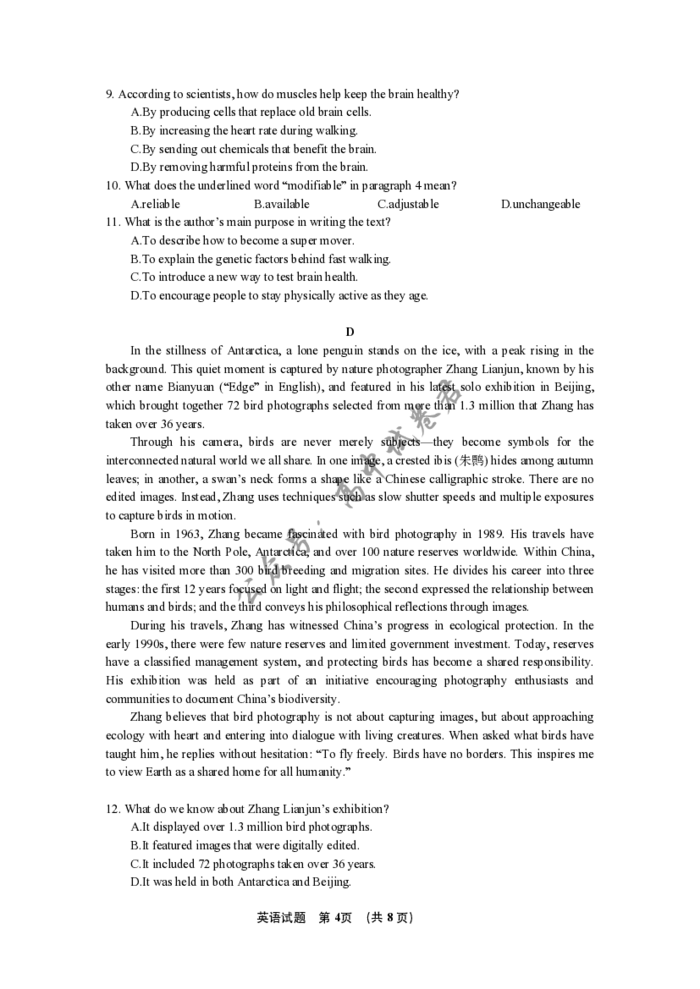
In the stillness of Antarctica, a lone penguin stands on the ice, with a peak rising in the
background. This quiet moment is captured by nature photographer Zhang Lianjun, known by his
other name Bianyuan (“Edge” in English), and featured in his latest solo exhibition in Beijing,
which brought together 72 bird photographs selected from more than 1.3 million that Zhang has
taken over 36 years.
Through his camera, birds are never merely subjects—they become symbols for the
interconnected natural world we all share. In one image, a crested ibis (朱鹮) hides among autumn
leaves; in another, a swan’s neck forms a shape like a Chinese calligraphic stroke. There are no
edited images. Instead, Zhang uses techniques such as slow shutter speeds and multiple exposures
to capture birds in motion.
Born in 1963, Zhang became fascinated with bird photography in 1989. His travels have
taken him to the North Pole, Antarctica, and over 100 nature reserves worldwide. Within China,
he has visited more than 300 bird breeding and migration sites. He divides his career into three
stages: the first 12 years focused on light and flight; the second expressed the relationship between
humans and birds; and the third conveys his philosophical reflections through images.
During his travels, Zhang has witnessed China’s progress in ecological protection. In the
early 1990s, there were few nature reserves and limited government investment. Today, reserves
have a classified management system, and protecting birds has become a shared responsibility.
His exhibition was held as part of an initiative encouraging photography enthusiasts and
communities to document China’s biodiversity.
Zhang believes that bird photography is not about capturing images, but about approaching
ecology with heart and entering into dialogue with living creatures. When asked what birds have
taught him, he replies without hesitation: “To fly freely. Birds have no borders. This inspires me
to view Earth as a shared home for all humanity.”
12. What do we know about Zhang Lianjun’s exhibition?
A.It displayed over 1.3 million bird photographs.
B.It featured images that were digitally edited.
C.It included 72 photographs taken over 36 years.
D.It was held in both Antarctica and Beijing.
公众号:高中试卷君
英语试题
第5页(共8 页)
13. How does Zhang Lianjun divide his photography career?
A.By the number of photographs he took.
B.By the places he visited around the world.
C.By the equipment he used at different stages.
D.By the themes he explored in each period.
14. What change has Zhang observed in China’s ecological protection?
A.Fewer nature reserves are available today.
B.Government investment has decreased over time.
C.The management system has become more organized and responsible.
D.Local communities are less willing to participate in protection efforts.
15. Which of the following can be the best title for the text?
A.A Photographer’s Solo Journey to Antarctica
B.How China’s Nature Reserves Have Improved
C.The Complete Guide to Bird Photography Exhibitions
D.Through the Camera: Birds, Life, and a Shared Planet
第二节(共5 小题;每小题3 分,满分15 分)
Throughout high school, I was on the school swimming team and buried in tough AP courses.
Busy with swim training and heavy schoolwork, I faced constant hardships that made me doubt
my abilities. In swim competitions, fears of losing flooded my mind.
16
These negative
feelings disturbed my performance, and I often lived up to my gloomy expectations.
17
When taking exams, I questioned my preparation and ability to grasp difficult
knowledge. In friendships, I worried I was not likable enough. Such lasting pessimism harmed my
emotions, grades and sports performance.
Negative thinking is common among teenagers nowadays. Many teens fail to notice their
negative thinking habits.
18
. According to psychologists Susan Reynolds and Teresa
Aubele Ph. D, long‑term negative thoughts harm people’s mental and physical health and lead to
lasting stress.
Near the end of high school, I found my mindset directly affected my performance. I decided
to fight pessimism with optimism. I trained harder for swimming, studied more efficiently and got
along nicely with others.
19
. I also became more outgoing to build more connections. For
the first time, I witnessed optimism improving my whole life.
Others noticed my change. My strict chemistry teacher, who rarely raised students’ grades,
bumped my score up to 75.
20
. She praised my continuous efforts and positive attitude,
despite my struggle with chemistry knowledge.
This shift in thinking improved my grades and swimming, and boosted my confidence. I have
learned that focusing on positivity helps overcome challenges, and a positive mindset matters
greatly for personal growth.
A.Reminders of how tired or sore I was also crossed my mind
B.People focus on what they lack, ignoring what they have
C.My teacher’s recognition of my attitude was a turning point
D.This mindset removed fear because I believed I could succeed
E.Self‑doubt bothered me beyond swimming
F.The support from my friends helped me stay positive
G.She appreciated my smile, hard work, and positive attitude
公众号:高中试卷君
第二部分
语言运用(共两节,满分50 分)
第一节(共15 小题;每小题2 分,满分30
英语试题
第6页(共8 页)
分)
阅读下面短文,从每题所给的A、B、C、D 四个选项中选出最佳选项。
A father’s brave deed turned a routine Disney cruise into a touching rescue. Last Sunday, the
ship Disney Dream was sailing
21
Florida and the Bahamas when an emergency happened.
A passenger witnessed the accident on the fourth‑floor deck. A little girl sat on the ship’s
railing while her father took a photo. Suddenly, she lost her balance and fell
22
into the sea.
Without a second’s
23
, the father jumped overboard immediately, determined to save his
daughter at all costs.
The unexpected
24
drew every passenger’s attention. People watched the scene with
25
fearing that the father and daughter might not survive in the open ocean.
Fortunately, the ship’s crew responded with great efficiency. A rescue boat was
26
right
away, and the ship made a sharp turn to return to the exact
27
of the incident. Within
minutes, the two were successfully
Disney released an official
28
29
from the water.
to praise the crew’s quick and skilled performance,
which proved the full
30
of the ship’s safety management system. The well‑trained staff
handled the emergency extremely
31
.
After the rescue, relieved passengers burst into warm 32. The whole operation lasted only 10
to 15 minutes. The ship soon
33
its scheduled voyage. Passengers were finally able to
34
the rest of their journey peacefully. For all witnesses, the loving father was undoubtedly a
true
35
.
21. A. among
B. between
C. across
D. through
22. A. upward
B. forward
C. overboard
D. onboard
23. A. hesitation
B. explanation
C. discussion
D. mistake
24. A. opportunity
B. accident
C. failure
D. dilemma
25. A. patience
B. caution
C. anxiety
D. confidence
26. A. sent out
B. taken off
C. turned up
D. broken down
27. A. position
B. direction
C. distance
D. destination
28. A. protected
B. recovered
C. recognized
D. observed
29. A. statement
B. conclusion
C. agreement
D. introduction
30. A. strictness
B. kindness
C. effectiveness
D. carefulness
31. A. casually
B. professionally
C. quietly
D. slowly
32. A. cheers
B. tears
C. complaints
D. whispers
33. A. paused
B. continued
C. finished
D. canceled
34. A. spare
B. share
C. enjoy
D. celebrate
35. A. guide
B. stranger
C. passenger
D. hero
公众号:高中试卷君
英语试题
第7页(共8 页)
第二节(共10 小题;每小题2 分,满分20 分)
阅读下面短文,在空白处填入1 个适当的单词或括号内单词的正确形式。
China launched more than 7,000 exhibitions and cultural activities across the country to
celebrate Cultural and Natural Heritage Day on Saturday,
36
(highlight) growing public
participation in heritage preservation.
According to the National Cultural Heritage Administration, China will complete its Fourth
National Cultural Relics Survey in 2026. A three‑year
37
(conserve) initiative has better
safeguarded 2,193 ancient covered bridges across the country. Currently, there are 7,188
registered museums in China,
38
have welcomed more than 4 billion visits over the past
five years, according to Rao Quan, director of the National Cultural Heritage Administration.
The main celebration
39
(hold) at the Panlongcheng site in Wuhan, Hubei province,
under the theme “Cultural Relics Belong to the People and Serve the People”. The Panlongcheng
site, one of the most important settlements of the Xia (c.21st to 16th century BC) and Shang
(c.16th to 11th century BC)
40
(dynasty) discovered in the Yangtze River Basin, is
regarded
41
a key source of Wuhan’s urban civilization. A special exhibition, Tracing
Xia And Shang, opened at the Panlongcheng Site Museum on
42
same day. Bringing
together 163 cultural relics from 35 museums and cultural institutions nationwide, the exhibition
highlights
43
(history) exchanges between the Yangtze River Basin
44
the
Central Plains, reflecting the diversity and unity of Chinese civilization. The ceremony marked the
launch of Cultural Heritage: Global Call for Submissions, an initiative
45
(joint) organized
by the National Cultural Heritage Administration and China Daily.
第三部分
写作(共两节,满分40 分)
第一节(满分15 分)
假定你是学校学生会主席李华,今年是你们学校一百周年校庆,请你代表全体同学给校
友们写一封信件,邀请他们参加校庆活动。内容包括:
(1)活动的时间和地点;
(2)活动的内容。
注意:
(1)词数为80 词左右,开头和结尾已给出,不计入总词数;
(2)可适当增加细节,使行文连贯。
Dear alumni,
Sincerely,
Li Hua
公众号:高中试卷君
第二节(满分25
英语试题
第8页(共8 页)
分)
阅读下面材料,根据其内容和所给段落开头语续写两段,使之构成一篇完整的短文。
It was to have been a pleasant family dinner at a nice restaurant with my husband Trevor, our
twenty‑two‑year‑old son Ryan, my husband’s father Bob, and me. Since his wife had died five
years earlier, Bob went everywhere with us. “So, Ryan, it looks like you’ve put on some weight,”
Bob observed. “How much do you weigh now?” Ryan shifted in his seat. “Two fifty.” He had
always struggled with his weight.
Bob gave a low whistle. “Two hundred and fifty pounds. That’s a lot of weight for a young
fellow like you to be carrying around. Hard on the heart, you know.”
“I know.”
“You still looking to get married some day?” Bob asked.
“Yes.” The single word was clipped, indicating that Ryan would rather be anywhere but here.
“What you need to do is to find an ugly girl for yourself. She’ll be so grateful that you asked
her out that she won’t care that you’re fat.”
I blinked in astonishment. Bob had always been blunt (直言不讳的), even rude at times, but
this was too much. I started to say something when my husband sent me a pleading look not to get
into it with his father.
Tight‑lipped, I nodded.
The evening limped by, Bob remarked that I was putting on weight myself. I nodded in
acknowledgment, grateful that the focus had moved away from Ryan. I was happy to be the target
of Bob’s insults if it took his attention away from my son. On the way home, I asked Trevor to
take me home before he dropped off his father, I couldn’t bear to be in Bob’s company a moment
longer than necessary, Ryan helped me out of the car and then climbed into his own car, which
he’d left in front of our house.
注意:
(1)续写词数应为150 左右;
(2)请按如下格式在答题卡的相应位置作答。
The following morning, I called Ryan and told him how sorry I was for the previous
night, “Your grandfather crossed the line”.
I have learnt much from Ryan’s words. A few weeks later, we had dinner together
again.
公众号:高中试卷君