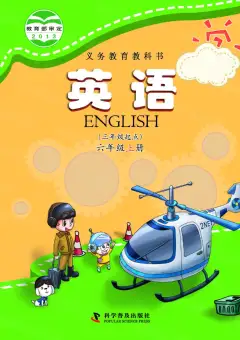
义务教育教科书
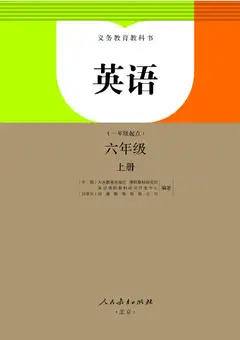
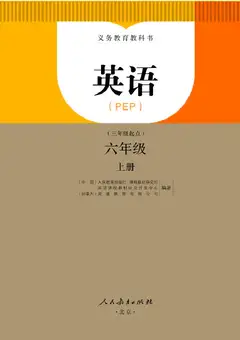
英语
(精通)
人民教育出版社 课程教材研究所
英语课程教材研究开发中心
泛太平洋教育出版有限公司
编著
(中 国)
(新加坡)
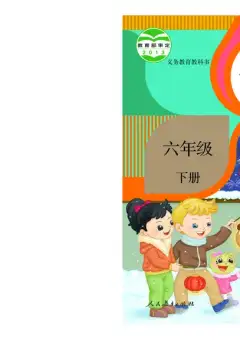
六年级
上册
(三年级起点)
·北 京·
致同学
亲爱的同学们:
你们好!这个学期你们就进入小学的最后一年啦!
新学年,朋友们又见面了,大家都很开心!Lisa 还结识了新笔友
Lucy!同学们将在更加丰富真实的语言情景中运用已学知识,学习新知
识,在快乐有趣的活动中,学会用英语做更多的事情。
本书六个单元将给大家介绍学校活动、兴趣爱好、生日聚会,月
份、节日和四季等话题。为适应你们不断提升的英语水平,我们准备了
更多的学习材料。每个单元的趣味百科(Fun Facts)知识面更宽、更广
了。歌谣(Let’s chant)部分增加了更多字母组合的说唱内容,帮助同学
们感受英语的声音与节奏。趣味小故事(Fun story)一直陪伴着你们,
Mimi 和 Micky 等着和你们一起开展新活动呢!在每个单元的最后,我们
依然安排了语言知识要点(Language Focus),大家可以用它来检查自己
的学习成果。
本书仍有两个快乐时光(Fun Time),这两个复习单元是温故而
知新的好机会,你们将从中获得合作学习的新体验。在趣味阅读(Fun
Reading)中,你们将会经历获取信息的真实过程。文化桥(Cultural
link)栏目为大家介绍了不同国家午餐饮食的特点和南北半球的圣诞节等
知识。
经过几年的学习,你们一定喜欢上英语了吧!做一个好学、勤学、
善学、乐学的英语学习者并不难,只要你们认真学习,勤于运用,按计
划、循序渐进地学习英语,你们就能够借助英语去了解外面更为广阔的
世界。
为帮助同学们更好地学习,我们还准备了活动手册、录音带、单词
卡片、光盘等辅助学习材料,你们可以根据自己的情况选择使用。
祝同学们在新学期的英语学习中取得更大的进步!
编 者
2013年5月
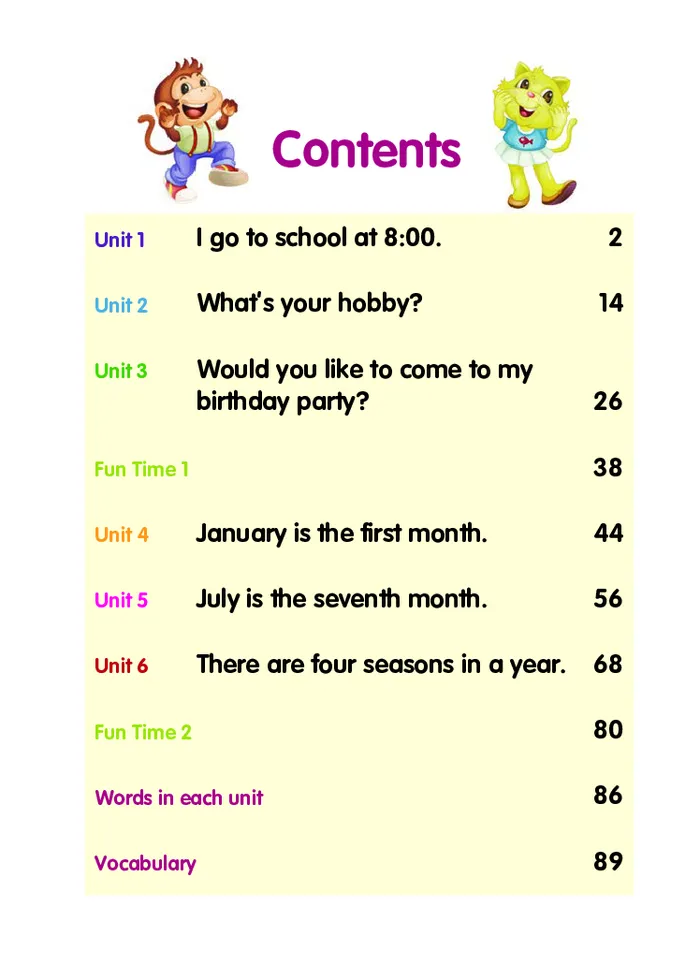
Contents
Unit 1
Unit 2
Unit 3
Fun Time 1
Unit 4
Unit 5
Unit 6
Fun Time 2
Words in each unit
Vocabulary
I go to school at 8:00.
2
What’s your hobby?
14
Would you like to come to my
birthday party?
26
38
January is the first month.
44
July is the seventh month.
56
There are four seasons in a year. 68
80
86
89
2
Unit 1
I go to school at 8:00.
Lesson 1
Just read and talk
Send to:
Subject:
From:
o:
t:
:
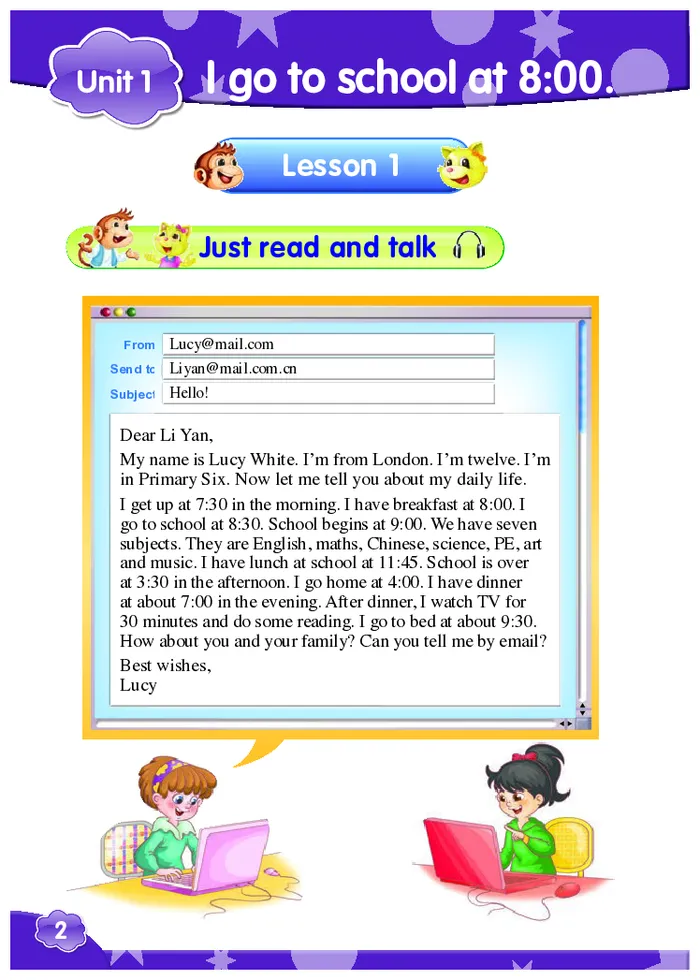
Dear Li Yan,
My name is Lucy White. I’m from London. I’m twelve. I’m
in Primary Six. Now let me tell you about my daily life.
I get up at 7:30 in the morning. I have breakfast at 8:00. I
go to school at 8:30. School begins at 9:00. We have seven
subjects. They are English, maths, Chinese, science, PE, art
and music. I have lunch at school at 11:45. School is over
at 3:30 in the afternoon. I go home at 4:00. I have dinner
at about 7:00 in the evening. After dinner, I watch TV for
30 minutes and do some reading. I go to bed at about 9:30.
How about you and your family? Can you tell me by email?
Best wishes,
Lucy
Liyan@mail.com.cn
Lucy@mail.com
Hello!
3
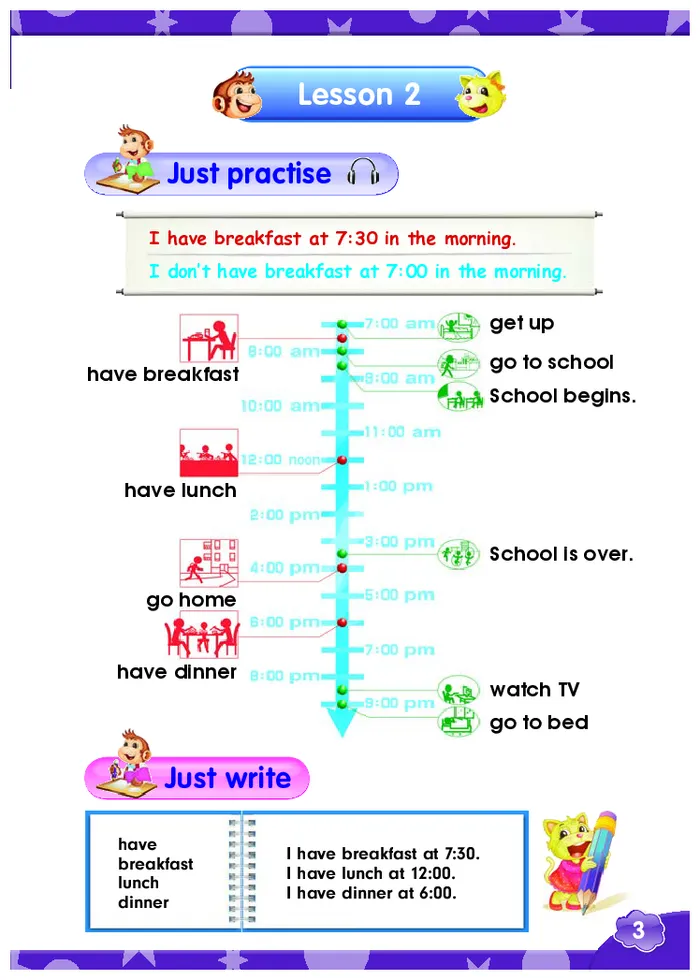
get up
go to school
have breakfast
School begins.
have lunch
School is over.
go home
have dinner
watch TV
go to bed
Lesson 2
Just practise
Just write
I have breakfast at 7:30.
I have lunch at 12:00.
I have dinner at 6:00.
have
breakfast
lunch
dinner
I have breakfast at 7:30 in the morning.
I don’t have breakfast at 7:00 in the morning.
4
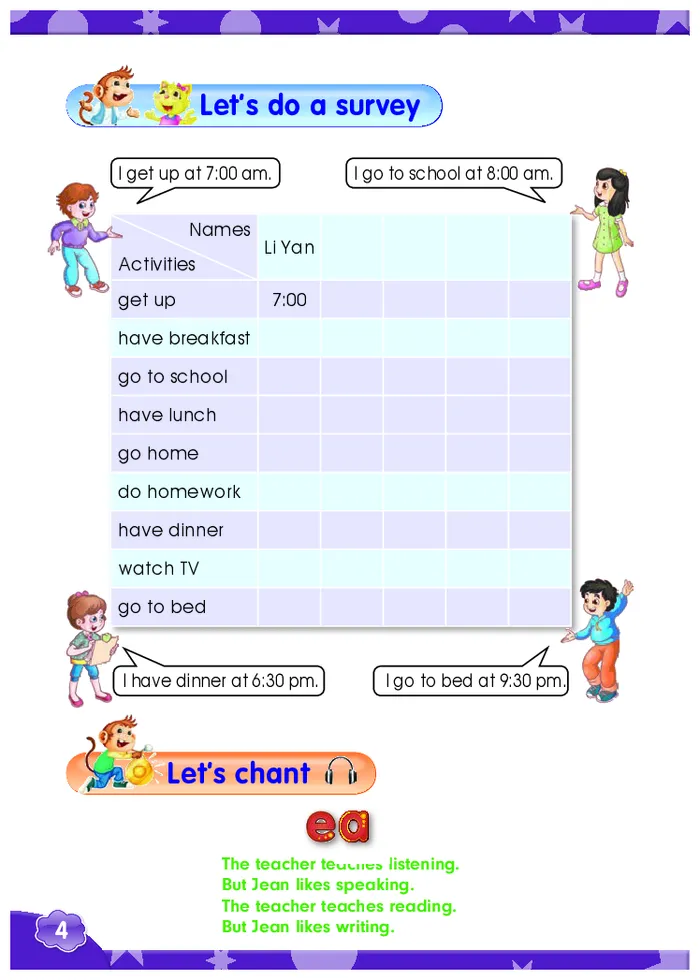
Names
Activities
Li Yan
get up
7:00
have breakfast
go to school
have lunch
go home
do homework
have dinner
watch TV
go to bed
Let’s chant
I have dinner at 6:30 pm.
I go to bed at 9:30 pm.
I go to school at 8:00 am.
I get up at 7:00 am.
Let’s do a survey
The teacher teaches listening.
But Jean likes speaking.
The teacher teaches reading.
But Jean likes writing.
eaches l
5
Send to:
Subject:
From:
o:
t:
:
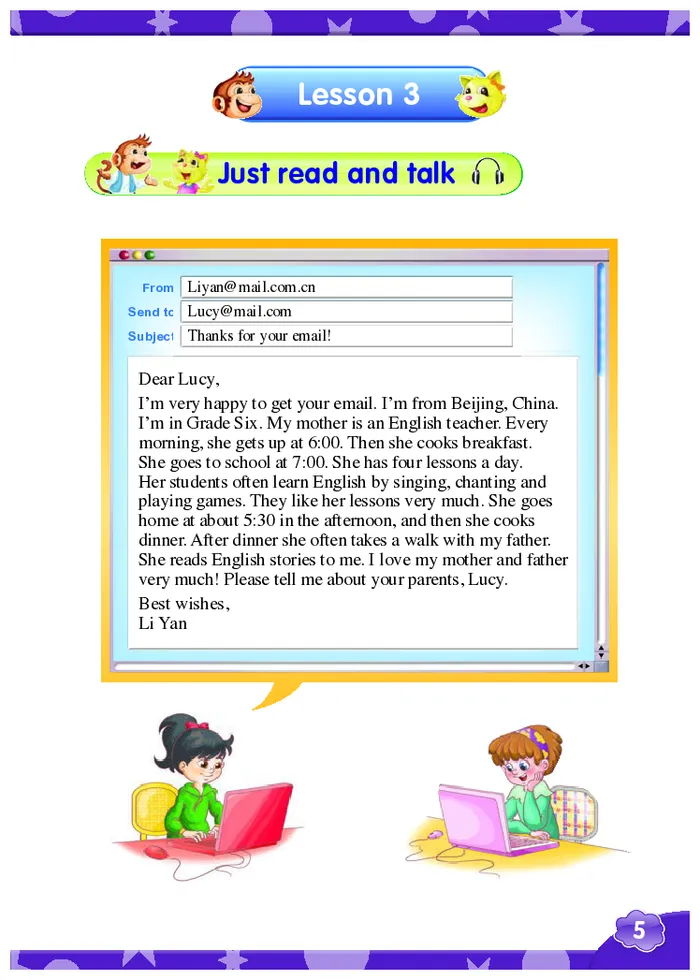
Dear Lucy,
I’m very happy to get your email. I’m from Beijing, China.
I’m in Grade Six. My mother is an English teacher. Every
morning, she gets up at 6:00. Then she cooks breakfast.
She goes to school at 7:00. She has four lessons a day.
Her students often learn English by singing, chanting and
playing games. They like her lessons very much. She goes
home at about 5:30 in the afternoon, and then she cooks
dinner. After dinner she often takes a walk with my father.
She reads English stories to me. I love my mother and father
very much! Please tell me about your parents, Lucy.
Best wishes,
Li Yan
Lucy@mail.com
Liyan@mail.com.cn
Thanks for your email!
Lesson 3
Just read and talk
6
cook breakfast
teach English
take a walk
read stories
Lesson 4
Just practise
Just write
She gets up at 6:00 in the morning.
She doesn’t get up at 6:30 in the morning.
walk
every morning
afternoon
evening
7
Let’s talk
Bring a few photos of your family or your friends.
Talk about them in groups.
Let’s chant
My brother gets up
at 7:30 am.
Ted has a headache.
What’s for his breakfast?
Some bread is for Ted.
He wants a cake instead.
8
Lesson 5
Kate: Hi, Peter! Tomorrow is
Saturday. What do you do on
Saturdays?
Peter: I often go and see a film
with my parents. How
about you?
Kate: I usually have piano
lessons.
Peter: Is it diffi cult to play the piano?
Kate: Yes. But Zhou Pei always
helps me.
Peter: Does she play the piano on Saturdays?
Kate: Yes, she practises it at home. But
sometimes she helps her mum to do
the housework.
Peter: Really?
Kate: Sure. We should learn from her!
Just read and talk
9
Lesson 6
see a fi lm
play the piano
clean the window clean the door
clean the fl oor
see a film
pla
the piano
l
th
i d
l
th
d
l
th
fl
Just practise
Just write
What does Kate do on Saturdays?
She usually plays the piano.
What do you do on Saturdays?
I often go and see a fi lm.
often
see a fi lm
clean the window
door/fl oor
easy
diffi cult
What do you do on Saturdays?
I often go and see a fi lm.
10
Let’s act
What do you do
on Sundays?
Do you read
stories on
Sundays?
No, I don’t. I often
play the piano.
I often read
stories.
Let’s chant
I see a sheep,
Sitting on a jeep.
I know the sheep,
Is going to sleep.
11
Revision
Mimi takes a walk in the evening.
Dancing Cat is still dancing.
At 6:30, Micky comes to Mimi’s house.
They watch TV.
Where is your
new friend?
Dancing Cat is still
practising at school.
3
4
Dancing Cat is from London. Every
morning, she starts to dance at 7:30.
Mimi eats a big lunch at 11:45. Dancing
Cat doesn’t eat lunch.
Hi, Dancing Cat.
Nice to meet you.
Hello, Mimi. I’m
Dancing Cat.
1
2
Fun story
Read and act.
They always see Dancing Cat at the
school. She dances day and night.
Dancing Cat and Micky dance at the
party. Who is a good dancer?
Is it diffi cult
to dance?
Yes, it is.
No, it isn’t.
Look! Dancing Cat is
dancing very well.
How
beautiful !
Practice makes perfect.
6
7
9
8
10
5
12
Let’s listen and number
A
B
SKILLS:
Listen
Speak
Read
Write
12
12
SKILLS:
SKILLS:
Listen
Listen
Speak
Speak
Read
Read
Write
Write
Language Focus
Language Focus
Language Focus
Language Focus
I don’t have breakfast at 7:00 in the morning.
She gets up at 6:00 in the morning.
She doesn’t get up at 6:30 in the morning.
What does Kate do on Saturdays?
She usually plays the piano.
get up go to school
School begins. School is over.
go home go to bed cook breakfast
teach English take a walk
read stories play the piano
I have breakfast at 7:30.
I have lunch at 12:00.
I have dinner at 6:00.
What do you do on Saturdays?
I often go and see a film.
have breakfast lunch
dinner walk every
morning afternoon
evening
often see a film
clean the window/door/floor
easy difficult
Fun Facts
R
e
a
d
i
ng for
kno
wle
dg
e
Do you usually have lunch in school?
Children in New Zealand bring their own lunch to school. T ey have small lunch
boxes. Ben is in a primary school in New Zealand. Let’s look inside his lunch box. It is
quite interesting. T ere is no hot
food.
Children in China have their
lunch in school or at home. T ey
usually have rice, vegetables, some
pork or chicken in their school
lunch.
Children in England also have
lunch in school. But some English
children bring their own lunch
boxes, too. Children in Australia
usually bring lunch boxes to
school. T ey often eat their lunch
outside the classroom.
a sandwich
a cereal bar
a cup of
yogurt
an apple
popcorn
Would you like this food for lunch?
Thinking tasks
➊ What do children in New Zealand
often have for lunch?
➋ What do children in China usually
have for their school lunch?
➌ What do you usually have for lunch?
Where do you have it?
➍ Look at the pictures below. T ese children are having their lunch. Where do they
come from? Australia, China or England?
Look Them Up
• usually
• inside
• outside
...
1)
2)
3)
13
Unit 2
What’s your hobby?
14
Lesson 7
Bob: Hi, Peter. I have a new toy car.
Peter: Can I have a look, please?
Bob: Sure! Open the box and see.
Peter: Wow! What a super car! Do you like toy cars?
Bob: Yes. I like collecting them. What’s your hobby, Peter?
Peter: My hobby is collecting stamps.
Bob: How about you, Kate and Li Yan?
Kate: My hobby is collecting maps.
Li Yan: I like collecting picture cards. Look!
Bob & Peter: Oh! They’re so colourful and beautiful!
Just read and talk
15
Lesson 8
What’s your hobby?
My hobby is collecting maps.
Just practise
Just write
open
hobby
collect
map
box
colour
What’s your hobby?
My hobby is collecting maps.
collect toy cars
collect stamps
collect maps
collect picture cards
16
Let’s talk
What’s your hobby?
My hobby is reading.
What’s your hobby?
My hobby is collecting stamps.
Let’s chant
There’s a swimming pool,
In my primary school.
I like swimming in the pool.
I think swimming is cool.
i
i
17
Lesson 9
Jim: Hi, Gao Wei! Do you want to look at my family photos?
Gao Wei: Sure! Wow! What’s he doing?
Jim: My grandpa is fishing.
Gao Wei: Is that his hobby?
Jim: Yes. What’s your
grandpa’s hobby?
Gao Wei: His hobby is planting
fl owers.
Just read and talk
Gao Wei: That’s interesting!
And what’s your
mum’s hobby?
Jim: Her hobby is singing.
In this photo, she’s
singing at her
birthday party.
Gao Wei: That’s wonderful!
Jim: Look here at my grandma.
Her hobby is drinking
Chinese tea.
Gao Wei: That’s great! What’s your
dad’s hobby?
Jim: Look at this photo! His
hobby is cooking.
18
Lesson 10
cook meals
plant fl owers
go fi shing
Just practise
Just write
What’s your dad’s hobby?
His hobby is planting fl owers.
dad
mum
plant fl ower
drink tea
What’s your dad’s hobby?
His hobby is planting fl owers.
What’s your grandpa’s hobby?
His hobby is fi shing.
19
Name
Date
People
Hobbies
grandpa
grandma
father
mother
uncle
aunt
brother
sister
teacher
friend
you
What’s your
father’s
hobby?
My father’s
hobby is
cooking.
My father’s
hobby is
fi shing.
His hobby
is reading.
Let’s chant
Cook shows me a good book.
The book is about a good cook.
His hobby is collecting books.
Look! Look! Have a look.
Let’s do a survey
20
Lesson 11
Yang Ming: Really?
Lisa: Yes. I have two photos
here. Look at this one!
Yang Ming: How cute! The kid is
feeding the baby.
Lisa: Yes, the baby is hungry.
He’s crying.
Lisa: And now look at this
photo. The baby is
smiling.
Yang Ming: What a super kid! She
takes good care of the
baby.
Yang Ming: What are you doing, Zhou Pei?
Zhou Pei: I’m making a doll. I’m
interested in making dolls.
How about you?
Yang Ming: I’m interested in playing
computer games. What are
you interested in, Lisa?
Lisa: I’m interested in
taking photos.
Just read and talk
21
Lesson 12
play computer games make dolls
take photos
Just practise
Just write
take
photo
kid
baby
hungry
cry
What are you interested in?
I’m interested in taking photos.
22
Let’s interview
1. What’s your hobby?
2. Are you interested
in taking photos?
3. Are you interested in
cooking?
4. How about your father?
5. What’s your mother’s
hobby?
6. Is she/he interested in
singing/dancing …?
Name
Date
People
Hobbies/Interests
Are you
interested in
making dolls?
No, I’m interested in playing
computer games.
What’s your
father’s hobby?
His hobby is
taking photos.
Let’s chant
I see a small goat,
On a fl oating boat.
I see Old Noah,
Wearing a thick coat.
mall goa
l
23
Revision
The animals are talking about their
hobbies.
Mimi says, “My hobby is fishing.” But
Micky says, “I don’t like fishing.”
The elephant says, “My hobby is
playing basketball.” But Micky says,
“
.”
The bird says, “My hobby is singing.”
But Micky says, “
.”
The rabbit says, “My hobby is cooking.”
But Micky says, “
.”
The animals ask Micky, “
?”
Fun story
Read and act.
24
Let’s listen and number
SKILLS:
Listen
Speak
Read
Write
SKILLS:
SKILLS:
Listen
Listen
Speak
Speak
Read
Read
Write
Write
Language Focus
Language Focus
Language Focus
Language Focus
What’s your grandpa’s hobby?
His hobby is fi shing.
What are you interested in?
I’m interested in taking photos.
collect toy cars collect stamps
collect picture cards go fi shing
cook meals
play computer games make dolls
What’s your hobby?
My hobby is collecting maps.
What’s your dad’s hobby?
His hobby is planting fl owers.
open hobby collect map
box colour dad
mum plant fl ower
drink tea take photo kid
baby hungry cry
Fun Facts
R
e
a
d
i
ng for
kno
wle
dg
e
Mr Kent is a science teacher. His hobby is bird-watching.
Mr Kent wants people to care more about birds.
In a science lesson, Mr Kent takes his class to a big field.
Birds are looking for food.
He asks his students, “What will birds eat in winter? Can
birds find food to eat?”
Many birds fl y to another place in winter. Chinese cranes
will fl y from
Heilongjiang to
Jiangsu every winter.
T ey fl y together in
small groups. T ey often fl y at night.
Mr Kent’s students are very interested in birds.
In winter, his students give birds seeds to eat.
T ey like bird-watching.
Thinking tasks
J
➊ What is Mr Kent’s hobby?
➋ What does Mr Kent want to do?
➌ Look at the birds above. Are they all Chinese birds?
T ere are only a few red-
crowned cranes left in the
world.
We do not often see this
beautiful bird.
We can see this bird in
many parks.
Look Them Up
• care
• crane
• another
...
25
Unit 3
Would you like to come to
my birthday party?
26
Lesson 13
6
Just read and talk
Lisa: Hi, Kate, Gao Wei and Peter.
Tomorrow is my birthday.
Would you like to come to my
birthday party?
Peter: Sure. I’d love to.
Lisa: What about you, Gao Wei?
Gao Wei: What time does your party
begin?
Lisa: It begins at about 5:30 after
school.
Gao Wei: That’s good! I can come then.
Kate: Me, too. We can all celebrate
your birthday!
Lisa: Thanks! Here are my
invitation cards for all of you.
Peter, Kate
& Gao Wei: Thanks! Goodbye! See you tomorrow!
Lisa: Bye-bye!
27
Lesson 14
give a birthday card
to your friend
invite your friends
to your party
celebrate your birthday
with your friends
Would you like to come to my birthday party?
Sure. I’d love to.
Just practise
Just write
time
after
then
me
bye
Would you like to come to my
birthday party?
Sure. I’d love to.
Goodbye!/Bye-bye!/Bye!
28
Let’s make and act
Make an invitation card. Then give it to a friend. Don’t forget
to write your friend’s name, and sign your name, too.
Thank you!
Please come to my party.
Here’s a card for you!
1
2
3
Let’s chant
I like bows, you know.
I have a bow to show.
I hold the bow high and low.
To shoot a yellow arrow.
29
Lesson 15
Mum: What kind of cake would you
like, Lisa?
Lisa: I’d like a chocolate cake.
Mum: What shape would you like?
How about this star-shaped
cake?
Lisa: Well, Mum. I really like that
heart-shaped cake.
Mum: That’s wonderful! It can show
our love for you.
Lisa: Thank you, Mum! It can also
show my love for you and Dad.
Mum: Good girl!
Lisa: Mum, can I have some
ice cream and some
jelly, please?
Mum: Sure. And I’ll get
some candy and
fruit pies for
you, too.
Lisa: Thanks, Mum!
I’ll have a great
birthday party.
Just read and talk
30
Lesson 16
star-shaped cake
heart-shaped cake
jelly
fruit pie
Just practise
Just write
kind
ice cream
candy
Can I have some ice cream?
Sure.
What kind of cake would you like?
I’d like a heart-shaped cake.
Can I have some ice cream?
Sure.
31
Let‛s act
Let‛s chant
Can I help you?
Yes, we’d like
some ice cream
and apple pies.
I’d like a heart-
shaped cake.
What kind of
cake would
you like?
How is Howe?
Howe is powerful.
How are Howe’s cows?
The cows are wonderful.
32
Lesson 17
Kate, Gao Wei
& Peter: Happy birthday, Lisa!
Lisa: Thank you! Welcome
to my birthday party.
Kate: Here’s a teddy bear for
you!
Gao Wei: I have a new storybook
for you!
Peter: Look! Here are some
chocolates for you!
Lisa: Thank you very much!
Mum: Shall we begin the party?
All: Yeah!
Mum: Let’s light the candles and sing
the birthday song.
All: OK!
All: Make a wish and blow
out the candles, Lisa.
Lisa: All right. Let me make
a wish!
All: And now cut the cake,
Lisa!
Lisa: OK. Have a piece of
cake, please!
All: Thank you!
Just read and talk
33
Lesson 18
light the candles sing the birthday song
make a wish
blow out the candles
cut the cake
eat the cake
Just practise
Just write
light
Here is a birthday cake for you.
Here’s a birthday cake for you.
How do they celebrate the birthday?
First, they light the candles and then ...
34
I want to have
a computer.
Let’s light the candles.
Let me blow out the candles.
Here you are.
Thanks.
Let’s act and sing
day to you.
day to you.
day to you.
day to you.
hd
hd
hd
hd
irth
irth
irth
irth
bi
bi
bi
bi
Happy birthday
Happy birthday
Happy birthday
Happy birthday
H
d
b
h
i
H
t
t
H
h a
a
d
o
o
p
pp
u
a
h
a
i
y
r
u
a
a
th
th
th
th
t
ir
ir
ir
ir
p
u
y
pp
pp
pp
ppy
py
py
py
H
y
.
H
you.
you.
you.
you.
a
r
Hap
Hap
Hap
Hap
y
y
y birthday
birthday
birthday
birthday
Happy
Happy
Happy
Happy
to
to
to
to you.
you.
you.
you.
o
o
day to you.
day to you.
day to you.
day to you.
hd
hd
hd
hd
irth
irth
irth
irth
bi
bi
bi
bi
Happy birthday
Happy birthday
Happy birthday
Happy birthday
Happy birth
Happy birth
Happy birth
Happy birth
H
d
b
h
i
H
t
t
H
hd
o
o
p
pp
u
a
h
a
i
y
r
u
a
a
o
o
th
th
th
th
t
ir
ir
ir
ir
p
u
y
pp
pp
pp
ppy
py
py
py
H
.
H
you.
you.
you.
you.
r
Hap
Hap
Hap
Hap
y
y
y birthday
birthday
birthday
birthday
Happy
Happy
Happy
Happy
to
to
to
to you.
you.
you.
you.
o
o
a
u
d.
d.
d.
d.
ld
ld
ld
ld
Arnol
Arnol
Arnol
Arnol
day, dear Arnold.
day, dear Arnold.
day, dear Arnold.
day, dear Arnold.
hd
hd
hd
hd
irth
irth
irth
irth
bi
bi
bi
bi
Happy birthday
Happy birthday
Happy birthday
Happy birthday
H
ld
d
d
b
A
h
i
H
t
H
h
d
e
d
d
o
p
pp
r
a
a
h
a
i
n
r
r
r
n
r
r
r
a
a
a
e
th
th
th
th
A
ir
ir
ir
ir
r
b
p
d
y
pp
pp
pp
pp
e
py
py
py
py
H
,
.
H
y,
y,
y,
y,
e
r
Hap
Hap
Hap
Hap
y
y
p
,
Arnold.
Arnold.
Arnold.
Arnold.
dear
dear
dear
dear
birthday,
birthday,
birthday,
birthday,
Happy
Happy
Happy
Happy
A
o d
d
day to you.
day to you.
day to you.
day to you.
hd
hd
hd
hd
irth
irth
irth
irth
bi
bi
bi
bi
Happy birthday
Happy birthday
Happy birthday
Happy birthday
H
d
b
h
i
H
t
t
H
h a
a
d
o
o
p
pp
u
a
h
a
i
y
r
u
a
a
th
th
th
th
t
ir
ir
ir
ir
p
u
y
pp
pp
pp
ppy
py
py
py
H
y
.
H
you.
you.
you.
you.
a
r
Hap
Hap
Hap
Hap
y
y
y birthday
birthday
birthday
birthday
Happy
Happy
Happy
Happy
to
to
to
to you.
you.
you.
you.
o
o
Let’s chant
Roy is a little boy.
Troy gives him a little toy.
Roy looks at the toy with joy.
He has many games to enjoy.
35
Revision
The elephant says, “This Saturday is
my birthday party, too. Let’s celebrate
it together.”
So they have a big birthday party. How
old are they? Do you know?
Micky asks the panda and the rabbit,
“Will you come to my birthday party?”
Micky asks the elephant, “
?”
Me, too.
I’ll come.
Micky’s birthday is on Saturday. He is
writing invitation cards for his friends.
Mimi reads the invitation card. She
likes cake, jelly and ice cream at the
party.
Please come to my
BIRTHDAY
Party
on Saturday at 5:00
Fun story
Read and act.
36
Let’s listen and number
SKILLS:
Listen
Speak
Read
Write
36
36
SKILLS:
SKILLS:
Listen
Listen
Speak
Speak
Read
Read
Write
Write
Language Focus
Language Focus
Language Focus
Language Focus
What kind of cake would you like?
I’d like a heart-shaped cake.
How do they celebrate the birthday?
First, they light the candles and then ...
invite your friends to your party
celebrate your birthday with your friends
give a birthday card to your friend
star-shaped cake
heart-shaped cake jelly
fruit pie light the candles
sing the birthday song
make a wish blow out the candles
cut the cake eat the cake
Would you like to come to my
birthday party?
Sure. I’d love to.
Good bye! /Bye-bye! /Bye!
Can I have some ice cream?
Sure.
Here’s a birthday cake for you.
time after then me bye
kind ice cream candy
light
Fun Facts
R
e
a
d
i
ng for
kno
wle
dg
e
David is celebrating his birthday today. His
mother brings a birthday cake to his class.
David is going to share the cake with his
friends.
First, the teacher helps David to light the
candles. Why do we put candles on a birthday
cake?
Candles make our day bright and happy. T e
candles also show our
age. David’s cake has
eleven small candles, because he is eleven years old. For old
people, one big candle shows ten years. Eight big candles will
show that a person is eighty years old.
T e children play games. T en, everyone sings the birthday
song. David makes a wish. He blows out the candles.
Everyone claps. He cuts the cake and gives each of his friends
a piece of cake. Everyone is happy.
Thinking tasks
➊ Why do people put candles on a
birthday cake?
➋ What does a big candle on a birthday
cake show?
➌ We celebrate a birthday to show time. Count the time and write it down.
Look Them Up
• share
• blow
• clap
...
37
3
Let’s count time!
Write your answers here.
1. How old are you? Count the years.
2. How old are you? Count the months.
3. How old are you? Count the days.
4. How old are you? Count the hours.
Fun Time 1
38
Recycle 1
Let’s check
A. Listen to the story. Then listen again to number the
pictures.
B. Read the sentences below. Listen to the story again
and number the sentences.
He likes to plant vegetables, too.
He also enjoys playing hockey.
Bill has many hobbies.
He has many tomato and cucumber plants.
Bill is good at football.
He collects invitation cards.
He has stamps from China, America and Australia.
B
I
L
L
L
L
L
L
L
L
L
L
L
L
L
L
L
L
L
L
L
L
L
L
L
’
S
H
O
H
O
H
O
H
O
H
O
H
O
H
O
H
O
H
O
H
O
H
O
H
B
O
B
O
B
O
B
O
B
O
B
O
B
O
B
O
B
O
B
O
B
O
B
B
B
B
B
B
B
B
B
B
B
B
B
B
B
B
B
B
B
B
B
B
I
E
S
39
Let’s listen and draw
A. Listen and draw the time in the clocks.
B. Read the sentences below. Listen to the story again
and number the sentences.
Jim often plays basketball at 6:30 in the evening.
On weekends, he gets up a little later, at 8:00.
Then he walks to school at 7:45.
He has English lessons on Tuesday at 9:40.
Every morning, Jim gets up at 6:15.
He usually has breakfast at 7:00.
40
Let’s talk
Recycle 2
Let’s draw and talk
Are you interested in …?
What’s your hobby?
6. making dolls
2. planting fl owers
1. collecting stamps
4. playing computer games
5. taking photos
3. fi shing
Draw on these cards.
When is your
birthday?
My Birthday
is on
41
celebrate
birthday
party
always
play
basketball
sometimes
go fi shing
play
computer
games
have
lunch
dinner
toy cars
picture cards
stamps
open
window
door
usually
go to school
go home
cook
breakfast
dinner
often
watch
TV
blow out
candles
cake
7:30
10:00
9 o’clock
see a fi lm
take a walk
play the piano
Let’s play
Are you interested in collecting
stamps? Oh, I get 5 points.
All players start at one o’clock.
Say a sentence or ask a question with one of the
words or phrases there.
Score 5 points.
Lose a turn if you can’t say a sentence or ask a question.
Throw one dice to move up to six o’clock.
Throw two dices to move after six o’clock.
The winner is the player to reach 12 o’clock with the highest
score.
Oh, no!
42
Shan Shan loves to read good books. She is interested in famous people.
She tells these stories to her friend, Winnie. Today, she tells Winnie about
the American president, Lincoln.
Let’s read and act a story
Fun Reading
So his family
is not rich.
I’m going to tell you
about a poor boy. His
name is Lincoln.
Every morning, Lincoln got up at five o’clock. He washed his face with
cold water. He helped his father to cut some wood. Then he helped his
mother to cook the breakfast.
What did Lincoln have for
breakfast? Can you guess?
● egg
● cake
● milk
● rice
● bread
● chicken
● noodles
● fruit
● tea
● coffee
43
Time
Get up:
Breakfast:
Study:
Lunch:
Take a walk:
Dinner:
Lincoln didn’t
have a watch. Can
you write the time in
his daily timetable?
Every afternoon, Lincoln studied under a tree. He didn’t go to school.
There was no school near his home. He didn’t have a teacher.
In the evening, he went for a walk. He
usually took a walk at four o’clock. Then he
went home for dinner.
Cultural link
Take-away Lunches Around the World
3. a sushi lunch box
in Japan and a tiffin
carrier in India
1. a school lunch box
in China
2. a sandwich
in the USA
Unit 4
January is the first month.
44
Lesson 19
Just read and talk
There are twelve months
in a year. January is the
first month. The first day,
January 1st, is called New
Year’s Day. People have a
holiday and they celebrate
New Year’s Day!
February is the second month of the
year. In China, Spring Festival is
usually in January or February. Now
people call it Chinese New Year. For
Chinese New Year, all people in China
have a holiday. They go back home
to celebrate the festival with their
families.
On the eve of the festival, people
usually have dumplings. People in
the south of China have rice cakes.
They all enjoy the festival at home.
4
45
Lesson 20
New Year’s Day
Spring Festival
the fi rst month
of the year
the second month
of the year
Just practise
Just write
January February back their
Y
’ D
1. January
2. February
3.
4.
5.
6.
7.
8.
9.
10.
11.
12.
Months
January is the fi rst month of the year.
February is the second month of the year.
46
Let‛s talk
Let‛s chant
It’s January.
The children
are making a
snowman.
Look at this
picture. It’s
January. The
children are
skating.
It’s February.
People are
shopping
in the
supermarket.
It’s February.
They are
celebrating
Spring
Festival.
Today is a sunny day.
We can play all the way.
Let’s play by the bay.
We’re happy all the day.
47
Just read and talk
Lesson 21
March is the third month
of the year. People can
see green trees and
green grass everywhere.
In China, Tree Planting
Day is on March 12th.
People plant trees on that
day. They want to stop
the sand on windy days
and make the air clean.
They want to make the
country greener.
April is the fourth month
of the year. Easter is
in March or April. It is
always on a Sunday. For
school children in America,
the Easter holidays are a
week long. During Easter,
children get colourful
Easter eggs.
48
Lesson 22
grass
Tree Planting Day
Easter
the third month
of the year
the fourth month
of the year
Just practise
1. January
2. February
3. March
4. April
5.
6.
7.
8.
9.
10.
11.
12.
Months
Just write
March
April
tree
grass
stop
egg
March is the third month of the year.
April is the fourth month of the year.
49
Let‛s talk
Let‛s chant
They are
taking a
photo.
It’s March.
Look, the
students
are planting
trees.
It’s a sunny
day in April.
We are
going on a
trip.
It’s April.
Children get
colourful
Easter eggs.
Gall is very very tall.
He’s walking out of the hall.
He’s holding a basketball,
But he can’t play it at all!
50
Lesson 23
Just read and talk
May is the fifth month of the
year. Labour Day, or May
Day, is on May 1st. People
sing and dance to celebrate
May Day. Mother’s Day is
also in May. We give gifts
to our mothers to show our
love.
June is the sixth month of the
year. The first day of June is
Children’s Day in China. Many
children perform to celebrate.
Father’s Day is in June, too. We
also give gifts to our fathers to
show our love.
51
Lesson 24
the fi fth month
of the year
the sixth month
of the year
Mother’s Day
Labour Day
Children’s Day
Father’s Day
Just practise
1. January
2. February
3. March
4. April
5. May
6. June
7.
8.
9.
10.
11.
12.
Months
Just write
May June Mother’s Day
Father’s Day Children’s Day
May is the fi fth month of the year.
June is the sixth month of the year.
Mother’s Day
52
Let‛s talk
It’s February
now. Look! The
children are
celebrating
Spring Festival.
Look at this
picture. It’s
January. She’s
skating.
In March,
the children
are planting
trees.
It’s April. Easter
is usually in April.
It’s May Day.
They’re celebrating
Labour Day.
The fi rst day of June
is Children’s Day.
Look! They’re singing
and dancing.
Let‛s chant
We’re looking at the train.
We’re waiting for the train.
The train’s running on the plain.
The train’s running in the rain.
king at th
53
Do you like Tree Planting Day? It’s on
March 12th.
I like to plant trees with my
friends, but
.
Revision
Micky and Mimi are talking about the
festivals in the year.
Micky asks Mimi, “Do you like New
Year’s Day? It’s in January.”
Do you like Spring Festival? It is often in
February. Sometimes it is in January.
Micky doesn’t know Mimi’s favourite
festival. Can you guess?
Fun story
Read and act.
I like festivals. What is
your favourite festival?
I like it, but it is not
my favourite one.
I like to eat
during Spring
Festival. But it’s not
my favourite festival.
Do you like Easter? It’s in March or April.
I like to eat Easter eggs,
but
.
This is my favourite festival.
54
SKILLS:
Listen
Speak
Read
Write
SKILLS:
SKILLS:
Listen
Listen
Speak
Speak
Read
Read
Write
Write
Language Focus
Language Focus
Language Focus
Language Focus
January is the fi rst month of the year.
February is the second month of the year.
March is the third month of the year.
April is the fourth month of the year.
May is the fi fth month of the year.
June is the sixth month of the year.
New Year’s Day Spring Festival
Tree Planting Day Easter
Labour Day
January February
back their
March April
tree grass
stop egg
May June
Mother’s Day Father’s Day
Children’s Day
Let‛s listen and number
To:
The President of the USA
The White House
1600 Pennsylvania Avenue NW
Washington, DC 20500
Dear Mr President,
I wish we could have a Children’s
Day in America ...
Fun Facts
R
e
a
d
i
ng for
kno
wle
dg
e
Children’s Day in China is on June 1st. On this day all children have a holiday.
T ere are many interesting activities for them. Children put on beautiful clothes.
T ey sing and dance in shows. T eir parents and teachers enjoy the shows. Some
parents take their children to the cinema. Some go to the park. Children’s Day is a
happy holiday for all children.
Do you know there was no Children’s Day in America?
One day, a little boy wrote a letter to the president of the USA. T e boy was only
six years old. He asked the president to give a special holiday to all the children of
America. T e president was very happy to read this letter. He decided that Children’s
Day in America would be on October 8th for that year. Many Americans still say
Children’s Day is every day of the year, not just one special day.
Thinking tasks
➊ When is Children’s Day in China?
➋ Why did the American boy write a
letter to the president?
➌ Let’s compare some holidays in China
and America. Write three holidays we have in China.
55
Look Them Up
• special
• decide
• wish
...
5
5
Festivals in China
Festivals in America
1.
1. Easter
2.
2. T anksgiving Day
3.
3. Christmas
Unit 5
July is the seventh month.
56
Just read and talk
Lesson 25
August is the eighth
month of the year. The
People’s Liberation Army
(PLA) Day is on August
1st. In August, school is
out. Students have their
summer holidays.
July is the seventh
month of the year. July
1st is the birthday of
the Communist Party
of China (CPC). Party
members celebrate
the day when it was
founded.
57
Lesson 26
Just practise
Just write
July August month year
1. January
2. February
3. March
4. April
5. May
6. June
7. July
8. August
9.
10.
11.
12.
Months
Army Day
A
D
July is the seventh month of the year.
August is the eighth month of the year.
the seventh month
of the year
the eighth month
of the year
the Party’s birthday
h
P
t ’ bi thd
58
1. Draw your own picture.
2. Write the name of a month.
3. Ask each other questions.
4. See who can do best.
JAN
It’s August. What
festival is in August?
AUG
MAY
FEB
APR
JUN
JUL
It’s March. What
festival is in March?
MAR
Tree Planting Day
is in March.
Let‛s make and talk
Let‛s chant
Army Day is
in August.
There’re tall trees around.
They stand on the ground.
Nobody else can be found.
Let’s listen to the sound.
trees ar
59
Lesson 27
Just read and talk
September is the ninth
month of the year. Students
go back to school. They
celebrate Teachers’ Day on
September 10th. Look, the
students are giving their
teachers flowers to show
their love.
October is the tenth
month of the year.
China’s National Day
is on October 1st.
Look, the children are
celebrating National
Day.
60
Lesson 28
1. January
2. February
3. March
4. April
5. May
6. June
7. July
8. August
9. September
10. October
11.
12.
the ninth month
of the year
the tenth month
of the year
Teachers’ Day
National Day
Months
Just practise
Just write
September October Teachers’ Day
September is the ninth month of the year.
October is the tenth month of the year.
61
October, October,
Is the tenth month.
National Day, National Day,
Is on October 1st!
October October
September, September,
Is the ninth month.
Teachers’ Day, Teachers’ Day,
Is on September 10th!
Let‛s chant
The boy was told,
The cat was old.
The cat was cold.
I kept it in my hold.
Let‛s chant and sing
62
Lesson 29
Just read and talk
November is the
eleventh month of
the year. In America,
Thanksgiving Day is
on the 4th Thursday
of November. In
this picture, the
family is celebrating
Thanksgiving.
N
e
t
T
o
o
t
f
T
December is the
twelfth and last
month of the
year. Christmas
is on December
25th. Look! The
children have
presents from
Santa Claus.
63
Lesson 30
1. January
2. February
3. March
4. April
5. May
6. June
7. July
8. August
9. September
10. October
11. November
12. December
the eleventh
month of the year
the twelfth
month of the year
Christmas
Thanksgiving
Just practise
Months
Just write
November
December
December is the
last month of the year.
November is the eleventh month of the year.
December is the twelfth and last month of the year.
64
Names
Months
Holidays
How many months are there in a
year? What are they?
What are some of the festivals in
the twelve months?
Let‛s chant
At a bright moonlight night,
I had a wonderful sight.
I saw two birds fl ying high.
One turned left, one turned right.
Let‛s interview
65
Revision
Mimi’s favourite holiday is on June 1st.
She and her friends watch the children
dancing and singing.
In September, the animals go back to
school. They are happy. They have a
lovely teacher.
It is cool in October and November. The
animals have lessons at school.
One day in December, the rabbit and
Mimi go to Micky’s house.
Micky doesn’t know what day it is. The
rabbit and Mimi want Micky to celebrate
it with them.
Look at Mimi’s house. What can you see
there? Do you know what day it is?
My favourite
holiday is
.
OK.
Let’s have
a party.
Do you know
what day it is
today?
We have presents
for everybody.
Fun story
Read and act.
It’s 10
o’clock!
Thanks, Santa.
Let’s give a present
to our teacher.
Let’s learn English
together.
Hi, Micky. Get
up. Please open
the door.
66
Let‛s listen and number
66
66
Language Focus
Language Focus
Language Focus
Language Focus
July is the seventh month of the year.
August is the eighth month of the year.
September is the ninth month of the year.
October is the tenth month of the year.
November is the eleventh month of the year.
December is the twelfth and last month of the year.
the Party’s birthday
Army Day
National Day
Thanksgiving
Christmas
July
August
month
year
September
October
Teachers’ Day
November
December
December is the last
month of the year.
SKILLS:
Listen
Speak
Read
Write
Fun Facts
People eat turkey on T anksgiving Day in America.
Do you know why?
T anksgiving is a day to remember some American people in
history. T ey sailed from Britain to reach America. T ey called
it the New World. It was a long time ago.
Americans worked hard to make a new life in the New
World, but it was diffi cult. Many of them died in the
winter. But they were successful. In the
next autumn, they had a celebration on
T anksgiving Day to celebrate the harvest
and other blessings of the past year.
T ey went to the forest to hunt and they got some turkeys. T en
they roasted the turkeys for dinner.
Today, people in America still enjoy eating turkeys during
T anksgiving.
Thinking tasks
➊ T anksgiving is an American festival.
Do you celebrate T anksgiving?
➋ Why do people celebrate T anksgiving in America?
➌ Do a survey in your class about Chinese festivals. What is the favourite festival in
your class?
Look Them Up
• successful
• forest
• roast
...
67
6
Festivals
Favourite Festival
1 Spring Festival
2 Mid-Autumn Festival
3 Mother’s Day
4 Children’s Day
R
e
a
d
i
ng for
kno
wle
dg
e
Unit 6
68
There are four seasons in a year.
Lesson 31
There are four seasons in a year.
Spring is the first season. In
China, springtime begins around
March. It is still a little cold, but
it gets warmer and warmer, and
the days get longer and longer.
What is spring like? Spring
is the green season. The trees
have new green leaves. There
are a lot of flowers on apple
trees, pear trees and peach
trees. Some animals wake up
from their long sleep. Birds
sing to welcome the spring.
What do people do in
spring? Farmers are
busy. They farm the
land. People go on
outings. Children fly
kites. Everyone enjoys
the spring.
8
Just read and talk
69
Lesson 32
Trees have
new green
leaves.
There are a lot
of fl owers on the
peach trees.
Birds sing
to welcome
the spring.
farm the land
go on spring outings
fl y kites
Spring is the fi rst season.
What‛s spring like?
What do people do in spring?
Just write
season
spring
little
green
Spring is the fi rst season.
bird
fl y
Just practise
70
Let‛s sing
Two little spring birds,
Singing in the sky.
One named Peter,
One named Guy.
Spring comes,
And birds come.
Spring comes,
And birds come.
Come here, Peter.
Come here, Guy.
Have some pie.
Have some pie.
Let‛s chant
A few new places.
A few new faces.
A few new friends.
A few new lessons.
71
Just read and talk
Lesson 33
Summer is the second and the
hottest season of the year. In
China, summer begins around
June. The weather is very hot
and there’s often a lot of rain.
Sometimes there is heavy rain.
In summer, schools close and
students have their holidays.
Some of them go on trips with
their parents, some go camping
with their teachers, and some
have summer classes. They all
enjoy the summer holidays.
72
Lesson 34
go on a trip
go to a
summer camp
have summer
holidays
Summer is the second season of the year.
What do students do on summer holidays?
Just practise
Just write
begin
close
summer
weather
heavy
rain
Summer is the
second season.
73
Let‛s talk
What‛s summer like?
What do you do on
summer holidays?
It‛s very hot. People
often go swimming. And
there‛s a lot of rain.
Some of us go to a
summer camp. And
some go on trips.
Let‛s chant
My grandma grows grass.
She grows green grass.
The grass makes the ground green.
The grass makes the world green.
74
Just read and talk
Lesson 35
Autumn is the third season
of the year. It begins around
September. The weather gets
colder and colder. The days get
shorter and shorter.
Autumn is the golden season.
The leaves on the trees are yellow
and brown. The farmers are busy
harvesting. Look! This farmer is
picking apples.
Winter is the fourth and the last
season of the year. It begins
around December. The weather
is cold and it often snows.
Winter is the white season.
When it snows, everything
is white. It looks beautiful!
Children make snowmen.
What beautiful snow!
Wi t
i th f
th
d th l
t
A
o
S
c
s
Wi t
i th
hit
75
Lesson 36
pick apples
cut rice
make a snowman
sweep the snow
Autumn is the third season.
Winter is the fourth season.
What do people do in autumn and winter?
Just practise
Just write
autumn yellow
brown white
winter
snowman
Autumn is the third season.
Winter is the fourth season.
76
Let‛s talk
What’s
spring like?
Let’s talk
about
summer.
Hello, boys and girls!
Let’s talk about the
four seasons.
Let‛s chant
We have summer
holidays. Some of us
go on trips. Some ...
Winter is cold
and it often
snows.
Autumn is the
third season.
What do you do
in the summer
holidays?
It’s very
hot.
Summer is
the second
season.
Please come to the place.
The place is warmer.
Please play a game,
With great pleasure.
come to
77
Revision
It is June. It is already summer. The peach
tree has a lot of fruit. Micky is picking
peaches. He isn’t reading the book.
It is October. Autumn is here. The
leaves are red, yellow and brown.
Micky is looking for a bird. He isn’t
reading the book.
It is January 1st. Spring is coming. There
is still snow on the windows. Mimi gives
Micky a nice book as a New Year’s gift.
It is March 1st. It is spring. Micky is
climbing a tree. He is having fun.
It is December 31st. It is the last day of
the last month of the year. It is snowing.
It is winter time. Micky is still playing.
What is the book about? What is Micky
thinking of? Tell your friend.
You aren’t reading the
book. When do you
want to read it?
I will read it
tomorrow.
Mimi is reading.
But I will read it
tomorrow.
You didn’t do any
reading the whole year!
What is the
book about?
It’s about you.
Fun story
Read and act.
78
Let‛s listen and number
SKILLS:
Listen
Speak
Read
Write
78
SKILLS:
SKILLS:
Listen
Listen
Speak
Speak
Read
Read
Write
Write
Language Focus
Language Focus
Language Focus
Language Focus
What’s spring like?
What do people do in spring?
Trees have new green leaves.
There are a lot of fl owers on the peach trees.
Birds sing to welcome the spring.
What do students do on summer holidays?
What do people do in autumn and winter?
farm the land go on spring outings fl y kites
go on a trip go to a summer camp
have summer holidays
pick apples cut rice
make a snowman
sweep the snow
Spring is the fi rst season.
Summer is the second season.
Autumn is the third season.
Winter is the fourth season.
season spring little
green bird fl y
begin close summer
weather heavy rain
autumn yellow brown
white winter snowman
Thinking tasks
Fun Facts
R
e
a
d
i
ng for
kno
wle
dg
e
Do you know what children do at Easter?
Easter is a festival in Western countries. Children often play a game called the Easter
egg-hunt. It is an old English game. T e children take little baskets to a field. T ey
look for Easter eggs in the grass. T ey try to fill their baskets with eggs. Most English
and American children like to play this game. T ey all love to eat the real eggs and the
chocolate eggs.
➊ In what season is Easter?
➋ What game do American children play at
Easter?
➌ How do people make Easter eggs?
➍ What do you do in spring? Tick your springtime activities.
Look Them Up
• fill
• basket
...
Easter is in spring. It celebrates the start of new life. An egg is the best way to show
this.
Paul is a little boy in England. Paul’s mother makes Easter eggs for an egg-hunt.
It is the day before Easter. She cooks some eggs. T en she colours them. T ere are
red, green, yellow and blue eggs. Paul’s mother also buys some chocolate eggs in the
supermarket. T ey are colourful. Paul loves the chocolate eggs.
79
a Celebrate Spring Festival.
□
b Look at beautiful fl owers.
□
c Play in the park.
□
d Fly kites.
□
e Go to the zoo.
□
Fun Time 2
80
Recycle 1
A. Listen and tick (√) in the table.
B. Ask the students in your class.
Who has a birthday in this month? Write the short forms.
Months
Short forms
Boys
Girls
Total
1
January
Jan.
2
February
3
March
4
April
5
May
6
June
7
July
8
August
9
September
10 October
11 November
12 December
Most students have their birthdays in
.
Names of
Students
What season do they like?
spring
summer
autumn
winter
Peter
Lisa
Kate
Yang Ming
Li Yan
Gao Wei
Wu Jing
The season the students like best is
.
Let‛s do a survey
81
Listen to the tape and circle the correct words or pictures.
Let‛s check
It is 1 January/June/October again! Lucy is
very happy. It’s 2 his/her/your birthday! Lucy’s
mother says she can have a 3 party/visit/field
trip on her birthday.
Today is January 4 19th/21st/30th. Lucy has a
big 5
/
/
birthday cake.
There are twelve 6
s /
s / s on it. All
her friends 7 ask/dance/sing Lucy the birthday
song. Lucy makes a 8 cake/wish/toy and blows
out the candles.
82
Let‛s talk
Recycle 2
Let‛s do
1. What holiday
is on May
1st?
Each group writes fi ve
questions about holidays
and festivals. Then ask
the other group.
What date is it?
What month is it?
What season is it?
I have some
greeting cards. Let’s
talk about them.
83
Let‛s play
Find the answers. Write them in the puzzle.
What’s the weather like in summer?
What’s this shape?
My grandpa has his 70th birthday party.
How old is he?
What is the 12th month of the year?
What is the hottest season of the year?
What is the short form for the 2nd month of the year?
Which country is New York in?
What is the fi rst season of the year?
The fi rst group that
fi nds the 9th answer
will get fi ve
s.
You must fi nd all
the answers fi rst!
I know the
second answer!
9th
I know the
fi rst answer!
Find the 9th
answer!
84
84
84
84
Mimi’s birthday is on July 5th. Mimi wants to have a nice birthday party.
Let‛s listen and read a story
Mimi’s party is going to be fun. Where is her party?
Mimi gives the elephant an invitation card.
Micky is watching TV. Mimi gives a card to him.
5
th
July
is
my birthday.
Please
come to
my party!
It is at
3:00 pm.
Where is Mimi’s birthday party?
Can you guess?
·in the park
·at the swimming pool
·in the playground
·at the cinema
What will Mimi
have at her party?
·cake
·hamburger
·candies ·Coke
·jelly
·French fries
·fruit pie ·ice cream
Fun Reading
85
Equator
ATLANTIC OCEAN
PACIFIC OCEAN
SOUTH AMERICA
NORTH AMERICA
A S I A
EUROPE
AFRICA
AUSTRALIA
ANTARCTICA
Cultural link
Seasons around the world
Seasons in the world are not the same in the northern and
the southern hemispheres. Many Western countries like Britain,
France, Germany, Russia, USA and Canada often have a
“White Christmas” because it often snows in December.
Did you guess right? Mimi’s party is at the swimming pool. Her friends light
the candles and sing the birthday song to Mimi.
In the southern hemisphere,
December 25th is in the
summertime. Countries like
Australia, New Zealand and
South Africa celebrate Christmas
in warm, sunny weather.
Northern Hemisphere
Southern Hemisphere
It’s a sunny Christmas
in Australia, so Santa
is on the beach.
Christmas is in
summer in New
Zealand, so Santa
has a barbeque.
Britain often
has a white
Christmas.
Canada often
has a snowy
Christmas.
86
86
get up
起床
have breakfast
吃早餐
go to school
去上学
School begins.
开始上课。
have lunch
吃午饭
School is over.
放学。
go home
回家
have dinner
吃晚饭
go to bed
睡觉
breakfast
早餐
lunch
午餐
dinner
晚餐
cook breakfast
做早餐
teach English
教英语
take a walk
散步
read stories
读故事
walk
走;步行
every
每一个
morning
早晨
afternoon
下午
evening
晚上;傍晚
see a fi lm
看电影
play the piano
弹钢琴
clean the window
擦窗户
clean the door
擦门
clean the fl oor
擦地板
often
时常;常常
easy
容易
diffi cult
困难
collect toy cars
收集玩具汽车
collect stamps
收集邮票
collect maps
收集地图
collect picture cards
收集图片
open
开;打开
hobby
爱好
collect
收集
map
地图
box
盒子
colour
颜色
go fi shing
去钓鱼
plant fl owers
种花
cook meals
做饭
dad
爸爸
mum
妈妈
plant
植物;种植
fl ower
花
drink
喝
tea
茶
play computer games
玩电脑游戏
make dolls
做布娃娃
take photos
照相
photo 照片
kid
小孩
baby
婴儿
hungry
饿的
cry
哭
Unit 1
Words in each unit
单元词汇表
d
o
(注:黑体单词要求学生能听、说、读、写;白体单词只作听、说、认读要求)
Unit 2
87
87
invite your friends to your party
邀请朋友参加聚会
celebrate your birthday with your
friends 与朋友庆祝生日
give a birthday card to your friend
向朋友赠送生日贺卡
time
时间
after
在⋯⋯后
then
那时
me
我 (I的宾格)
bye
再见
star-shaped cake
星形蛋糕
heart-shaped cake
心形蛋糕
jelly
果冻
fruit pie
水果派;水果馅饼
kind 种类
ice cream
冰激凌
candy
糖果
sure
当然
light the candles
点蜡烛
sing the birthday song
唱生日歌
make a wish
许愿
blow out the candles
吹蜡烛
cut the cake
切蛋糕
eat the cake
吃蛋糕
light
点燃
the fi rst month of the year
一年里的第一个月
the second month of the year
一年里的第二个月
New Year’s Day
元旦
Spring Festival 春节
January
一月
February
二月
back
回原处;后面
their
他(她、它)们的
the third month of the year
一年里的第三个月
the fourth month of the year
一年里的第四个月
Tree Planting Day
植树节
Easter
复活节
March
三月
April
四月
tree
树;树木
grass
草;草地
stop (使)停止
egg
蛋;卵
the fi fth month of the year
一年里的第五个月
the sixth month of the year
一年里的第六个月
Labour Day
劳动节
May
五月
June
六月
Mother’s Day
母亲节
Children’s Day
儿童节
Father’s Day
父亲节
the seventh month of the year
一年里的第七个月
the eighth month of the year
一年里的第八个月
the Party’s birthday 党的生日
Army Day 建军节
July 七月
August
八月
Unit 3
Unit 4
Unit 5
88
88
month
月
year
年
the ninth month of the year
一年里的第九个月
the tenth month of the year
一年里的第十个月
National Day
国庆节
September
九月
October
十月
Teachers’ Day
教师节
the eleventh month of the year
一年里的第十一个月
the twelfth month of the year
一年里的第十二个月
Thanksgiving
感恩节
Christmas
圣诞节
November
十一月
December
十二月
farm the land
种地;种田
go on spring outings
去春游
fl y kites
放风筝
season
季节
spring
春天
little
一点
green
绿色(的)
bird
鸟
fl y
飞
go on a trip
去旅游
go to a summer camp
去夏令营
have summer holidays
过暑假
begin
开始
close
关;关闭
summer
夏天
weather
天气
heavy
重的
rain
雨;下雨
pick apples 摘苹果
cut rice
割稻子
make a snowman
堆雪人
sweep the snow
扫雪
autumn
秋天
yellow
黄色(的)
brown
棕色(的)
white
白色(的)
winter
冬天
snowman
雪人
Unit 6
89
89
Vocabulary
词汇表
V
(注:黑体单词要求学生能听、说、读、写;白体单词只作听、说、认读要求)
A
after 在⋯⋯后
afternoon
下午
April 四月
Army Day 建军节
August 八月
autumn 秋天
B
baby 婴儿
back 回原处;
后面
begin 开始
bird 鸟
blow out the candles
吹蜡烛
box 盒子
breakfast
早餐
brown
棕色(的)
bye 再见
C
candy 糖果
celebrate your birthday
with your friends 与朋
友庆祝生日
Children’s Day 儿童节
Christmas
圣诞节
clean the door 擦门
clean the fl oor 擦地板
clean the window
擦窗户
close 关;关闭
collect 收集
collect maps 收集地图
collect picture cards
收集图片
collect stamps 收集邮票
collect toy cars 收集玩具
汽车
colour 颜色
cook breakfast 做早餐
cook meals 做饭
cry 哭
cut rice 割稻子
cut the cake 切蛋糕
D
dad 爸爸
December
十二月
diffi cult 困难
dinner 晚餐
drink 喝
E
Easter 复活节
easy 容易
eat the cake 吃蛋糕
egg 蛋;卵
evening
晚上;傍晚
every 每一个
F
farm the land
种地; 种田
Father’s Day 父亲节
February 二月
fl ower 花
fl y 飞
fl y kites 放风筝
fruit pie
水果派;水果馅饼
G
get up 起床
give a birthday card to
your friend 向朋友赠
送生日贺卡
go fi shing 去钓鱼
go home 回家
go on a trip 去旅游
go on spring outings
去春游
go to a summer camp
去夏令营
go to bed 睡觉
go to school 去上学
grass 草;草地
green 绿色(的)
H
have breakfast 吃早餐
have dinner 吃晚饭
have lunch 吃午饭
have summer holidays
过暑假
heart-shaped cake
心形蛋糕
heavy 重的
hobby 爱好
hungry 饿的
I
ice cream 冰激凌
invite your friends to your
party 邀请朋友参加
聚会
J
January 一月
jelly 果冻
90
90
July 七月
June 六月
K
kid 小孩
kind 种类
L
Labour Day 劳动节
light 点燃
light the candles
点蜡烛
little 一点
lunch 午餐
M
make a snowman 堆雪人
make a wish 许愿
make dolls 做布娃娃
map 地图
March 三月
May 五月
me 我 (I的宾格)
month 月
morning 早晨
Mother’s Day 母亲节
mum 妈妈
N
National Day 国庆节
New Year’s Day 元旦
November
十一月
O
October 十月
often 时常;常常
open 开;打开
P
photo 照片
pick apples 摘苹果
plant
植物;种植
plant fl owers 种花
play computer games
玩电脑游戏
play the piano 弹钢琴
R
rain 雨;下雨
read stories 读故事
S
School begins.
开始上课。
School is over. 放学。
season 季节
see a fi lm 看电影
September
九月
sing the birthday song
唱生日歌
snowman
雪人
spring // 春天
Spring Festival 春节
star-shaped cake
星形蛋糕
stop (使)停止
summer 夏天
sure 当然
sweep the snow 扫雪
T
take a walk 散步
take photos 照相
tea 茶
teach English 教英语
Teachers’ Day
教师节
Thanksgiving
感恩
节
the Party’s birthday
党的生日
the eighth month of the year
一年里的第八个月
the eleventh month of the
year 一年里的第十一
个月
the fi fth month of the year
一年里的第五个月
the fi rst month of the year
一年里的第一个月
the fourth month of the year
一年里的第四个月
the ninth month of the year
一年里的第九个月
the second month of the year
一年里的第二个月
the seventh month of the year
一年里的第七个月
the sixth month of the year
一年里的第六个月
the tenth month of the year
一年里的第十个月
the third month of the year
一年里的第三个月
the twelfth month of the
year 一年里的第十二
个月
their
他(她、它)们的
then 那时
time 时间
tree 树;树木
Tree Planting Day 植树节
W
walk 走;步行
weather 天气
white // 白色(的)
winter 冬天
Y
year 年
yellow 黄色(的)
本册教科书是由人民教育出版社课程教材研究所英语课程教材研究开
发中心依据教育部《义务教育英语课程标准》(2011年版)与新加坡泛太
平洋教育出版有限公司合作编写的,经国家基础教育课程教材专家工作委
员会2013年审查通过。
本册教科书集中反映了基础教育教科书研究与实验的成果,凝聚了参
与课改实验的教育专家、学科专家、教研人员以及一线教师的集体智慧。
我们感谢所有对教科书的编写、出版提供过帮助与支持的同仁和社会各界
朋友,以及整体设计艺术指导吕敬人等。
本册教科书出版之前,我们通过多种渠道与教科书选用作品(包括照
片、画作)的作者进行了联系,得到了他们的大力支持。对此,我们表示
衷心的感谢!但仍有部分作者未能取得联系,恳请入选作品的作者与我们
联系,以便支付稿酬。
我们真诚地希望广大教师、学生及家长在使用本册教科书的过程中提
出宝贵意见,并将这些意见和建议及时反馈给我们。让我们携起手来,共
同完成义务教育教材建设工作!
联系方式
电 话:010-58758275
电子邮箱:jcfk@pep.com.cn
人民教育出版社 课程教材研究所
英语课程教材研究开发中心
2013年5月
后 记