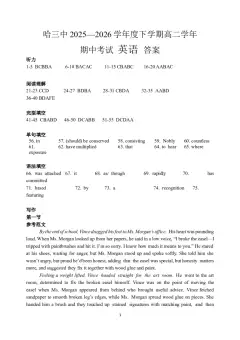
英语试题
第1 页共11 页
哈三中2025-2026 学年度下学期高二学年
期末考试英语试卷
本试卷共150 分,共11 页。考试结束后,将本试卷和答题卡一并交回。
注意事项:1. 答题前,考生先将自己的姓名、准考证号码填写清楚,将条形码准确粘贴
在条形码区域内。
2. 选择题必须使用2B 铅笔填涂;非选择题必须使用0.5 毫米黑色字迹的签字
笔书写,字体工整、笔迹清楚。
3. 请按照题号顺序在答题卡各题目的答题区域内作答,超出答题区域书写的
答案无效;在草稿纸、试卷上答题无效。
4. 作图可先使用铅笔画出,确定后必须用黑色字迹的签字笔描黑。
5. 保持卡面清洁,不要折叠、不要弄破、弄皱,不准使用涂改液、修正带、
刮纸刀。
第一部分
听力(共两节,满分30 分)
做题时,先将答案标在试卷上,录音内容结束后,你将有两分钟的时间将试卷上的
答案转涂到答题卡上。
第一节(共5 小题;每小题1.5 分,满分7.5 分)
听下面5 段录音。每段录音后有一个小题,从题中所给的A、B、C 三个选项中选出
最佳选项。听完每段录音后,你都有10 秒钟的时间回答有关小题和阅读下一小题。每段
录音播放两遍。
1. What will Susan do today?
A. Decorate a house with balloons.
B. Conduct an experiment in a lab.
C. Prepare materials for an experiment.
2. When will the speakers’ flight take off?
A. On December 23rd.
B. On December 24th.
C. On December 25th.
3.What are the speakers mainly talking about?
A. Their favorite courses.
B. Their career planning.
C. Their current jobs.
4. What is the man doing?
A. Making a complaint.
B. Asking for information.
C. Renting an apartment.
5. What is the man?
A. A doctor.
B. A driver.
C. A patient.
第二节(共15 小题;每小题1.5 分,满分22.5 分)
听下面5 段录音。每段录音后有几个小题,从题中所给的A、B、C 三个选项中选出
英语试题
第2 页共11 页
最佳选项。听每段录音前,你将有时间阅读各个小题,每小题5 秒钟;听完后,每小题
将给出5 秒钟的作答时间。每段录音播放两遍。
听第6 段录音,回答第6、7 题。
6. What does Henry think of growing peas?
A. Peas are low-yield vegetables
B. It’s very easy to grow them.
C. Peas are unpopular with gardeners.
7. What stops the woman from growing peas now?
A. The hot climate.
B. The limited space.
C. The lack of containers.
听第7 段录音,回答第8 至10 题。
8. What does the woman suggest Calvin do at first?
A. Relax at home.
B. Do some studies.
C. Learn about a museum.
9. What can visitors do in the museum?
A. Play with a robot.
B. Create a video.
C. Design some exhibits.
10. What is the relationship between the speakers?
A. Friends.
B. Classmates.
C. Brother and sister.
听第8 段录音,回答第11 至13 题。
11. Why does David make the call?
A. To consult about a camping project.
B. To discuss the choice of the sessions.
C. To negotiate a contract with the woman.
12. How many kinds of sessions are offered?
A. Three.
B. Four.
C. Five.
13. What do we know about the activities?
A. They are colorful.
B. There’s no age limit.
C. Participants don’t need guidance.
听第9 段录音,回答第14 至16 题。
14. Why did Fiona ask for leave?
A. She’s feeling unwell.
B. She’s moving house.
C. She’ll attend a wedding.
15. How does the man feel about Fiona’s leave?
A. Pleased.
B. Annoyed.
C. Grateful.
16. What will the man do tonight?
A. Cook dinner.
B. Return the tickets.
C. See the musical alone.
听第10 段录音,回答第17 至20 题。
17. How was the American chestnut in the past?
A. Rare.
B. Common.
C. Unpopular.
18. What threatens the American chestnut?
A. The soil.
B. Humans’ activities.
C. A kind of disease.
英语试题
第3 页共11 页
19. What do scientists do to save the trees?
A. Change their genes.
B. Plant more varieties.
C. Improve the living environment.
20. How does Linda McGuigan feel about the research?
A. It is hard to keep going.
B. It will be successful soon.
C. It is meaningful in the long term.
第二部分阅读理解(共两节,满分50 分)
第一节(共15 小题;每小题2.5 分,满分37.5 分)
阅读下列短文,从每题所给的A、B、C、D 四个选项中选出最佳选项。
A
2026 China International Youth Innovation & Culture Exchange Week
Organized by the China Youth Development Foundation and supported by the Ministry of
Culture and Tourism, the 2026 China International Youth Innovation & Culture Exchange
Week is scheduled to be held in Hangzhou from November 14 to 20, 2026. This event aims to
build a global platform for young people aged 16-25 to exchange cultural insights, showcase
innovative projects, and build cross-border friendships.
Event Arrangements
Opening Ceremony & Keynote Forum (Nov 14)
The opening ceremony will feature speeches by renowned cultural scholars and young
innovators from 15 countries. The forum will focus on the theme “Youth Power in
Cultural Inheritance and Global Communication”, with live streaming available on the
official website.
Cultural Experience Workshops (Nov 15-17)
We offer 18 themed workshops, including Chinese calligraphy, silk weaving,
traditional paper-cutting, and global folk music exchange. Each workshop is limited to
25 participants, and free pre-registration is required via the official WeChat
mini-program.
Global Youth Innovation Competition (Nov 18-19)
The competition welcomes innovative projects related to cultural inheritance,
low-carbon development, and public welfare. The top 3 projects will be awarded a
total prize pool of 300,000 yuan, along with entrepreneurship support from Chinese
tech enterprises.
Closing Ceremony & Cultural Gala (Nov 20)
The closing ceremony will end with a gala featuring traditional and modern
performances from participating countries. All registered participants are welcome to
attend for free.
Registration Notes
All participants must complete online registration before November 1, 2026. For overseas
英语试题
第4 页共11 页
participants, we provide free accommodation during the event. For more details, please
visit https://www.cycweek2026.com.
21. What is the main purpose of the 2026 Exchange Week?
A. To promote Hangzhou’s tourism resources to global youth.
B. To offer a platform for youth cultural exchange and innovation.
C. To award young innovators for their environmental efforts.
D. To provide free cultural courses for overseas students.
22. Which activity requires pre-registration through the WeChat mini-program?
A. The opening ceremony keynote forum.
B. The cultural experience workshops.
C. The global youth innovation competition.
D. The closing ceremony cultural gala.
23. What benefit can overseas participants get from the event?
A. Free accommodation during the event.
B. A guaranteed award in the competition.
C. Free round-trip air tickets to Hangzhou.
D. Long-term support from enterprises.
B
I have always been the quiet type. In class, I would shrink into my seat whenever the
teacher looked around for someone to answer a question. My face would flush, my palms
would sweat, and my voice would drop to barely a whisper. Public speaking was my greatest
fear.
So when my English teacher recommended me for the school’s annual English speech
contest in my second year of high school, I felt as if the ground had opened beneath my feet.
The contest was a big deal — students from all grades would be watching, and the pressure felt
unbearable. I seriously considered refusing, but my teacher saw my hesitation and sat down
with me.
“I’m not asking you to be the loudest speaker,” she said gently. “I’m asking you to share
what you truly care about. Stop thinking about how you appear to others. Instead, focus
completely on the message you want to deliver. If you believe in your words, the audience will
feel it.”
Those words struck me deeply. I decided to write about my grandmother’s struggle with
losing her eyesight and how she taught me to “see” the world through patience and kindness.
For weeks, I practiced alone in my room, then in the park in front of strangers. At first, my
voice trembled and I stumbled over my lines. But gradually, as I fixed my mind on my
grandmother’s story rather than my own anxiety, the words began to flow more naturally.
On the day of the contest, standing backstage, I felt the familiar wave of panic. My legs
felt weak and my heart was racing. But as I walked onto the stage and saw the crowd, I took a
deep breath and reminded myself: This is not about me. This is about her story.
英语试题
第5 页共11 页
I spoke for five minutes. When I finished, the hall erupted into applause — not because I
had delivered a perfect performance, but because I had shared something real. I didn’t win the
first prize, but I won something far greater: the courage to step beyond my comfort zone. That
experience taught me that growth does not come from avoiding fear, but from moving through
it with a purpose larger than oneself.
24. Why did the author want to refuse the contest?
A. He had little experience in writing formal speeches.
B. He cared too much about how others’ judgement.
C. He thought the contest was not worth his time.
D. He had a poor relationship with his English teacher.
25. What was the teacher’s key advice to the author?
A. To practice in front of as many strangers as possible.
B. To write a speech about a family member.
C. To prioritize the content over performance.
D. To memorize the speech before the contest.
26. What can we know about the author?
A. He calmed himself by focusing on the story.
B. He performed perfectly on the day of contest.
C. He won the first prize in the speech contest.
D. He stumbled over because his leg felt weak.
27. What is the main lesson the author learns from the experience?
A. Winning first prize is the only measure of success.
B. True courage is found when we have no fear at all.
C. Personal growth means facing fears with a purpose.
D. Teachers’ recommendations should never be rejected.
C
For decades, urban planners have operated under a simple assumption: more roads mean
less traffic. The logic seems unquestionable — if you build more infrastructure for cars,
congestion ( 拥堵) should decrease. Yet a growing body of evidence suggests that this
assumption is not only wrong but dangerously counterproductive. This phenomenon, known as
“induced demand,” reveals that building more roads actually encourages more driving,
ultimately worsening the very problem it was meant to solve.
The mechanism is deceptively simple. When a new highway is constructed or an existing
one is expanded, travel times initially decrease. This improved efficiency attracts new drivers
— people who previously avoided the route, chose alternative transportation, or traveled at
different times. Over time, as more drivers flock to the improved road, congestion returns,
often to levels worse than before. It is a classic case of a solution creating its own failure.
Consider the case of Houston, Texas, which expanded its Katy Freeway from six to
twenty-six lanes — one of the widest highways in the world. The project cost nearly $3 billion
英语试题
第6 页共11 页
and was glorified as a cure for the city’s traffic jams. Within a few years, however, commute
times on the expanded freeway were longer than they had been before the construction began.
The implications of this phenomenon extend far beyond traffic congestion. Induced
demand has significant environmental consequences. More driving means more carbon
emissions, undermining efforts to combat climate change. It also encourages urban sprawl(蔓
延), as improved road access makes it feasible to live farther from city centers, which in turn
creates more dependence on automobiles. This cycle of expansion and congestion locks cities
into an unsustainable pattern of development.
So what is the alternative? A growing number of urban planners are advocating for a shift
away from the car-centric model toward investment in public transportation, cycling
infrastructure, and pedestrian-friendly design. The key, these planners argue, is to recognize
that transportation is not merely about moving vehicles — it is about connecting communities.
The challenge, of course, is political. Road expansion projects are visible, tangible, and
easy to celebrate. Public transit investments, by contrast, are often less fascinating and take
longer to show results. But as the evidence against induced demand continues to mount,
policymakers may find it increasingly difficult to justify the old approach. The road to better
cities, it seems, does not lie in building more roads.
28. What does the term “induced demand” in Paragraph 1 refer to?
A. The public’s demand for better public transportation.
B. The increase in driving caused by expanded road capacity.
C. The government’s demand for more road construction funds.
D. The decrease in traffic after new highways are built.
29. Why does the author mention the Katy Freeway in Houston?
A. To show that highway expansion can successfully reduce traffic.
B. To argue that Texas has the worst traffic in the world.
C. To provide an example of the induced demand phenomenon.
D. To suggest that $3 billion was wasted on the project.
30. Which is one environmental consequence of induced demand?
A. Reduced carbon emissions due to better traffic flow.
B. Decreased dependence on automobiles in cities.
C. Less urban sprawl because of improved road access.
D. More driving leading to increased carbon emissions.
31. What’s the author’s attitude toward road expansion projects?
A. Critically doubtful.
B. Cautiously optimistic.
C. Strongly supportive.
D. Completely neutral.
D
Scientists have given artificial intelligence the capacity to “feel” surfaces for the first time,
opening up a new dimension for applying the technology in the real world.
Tapping into quantum (量子) science, the researchers combined a scanning laser (激光)
英语试题
第7 页共11 页
with a new AI model trained to distinguish different surfaces from laser images. The system
sends very brief light signals onto a surface and analyses the reflected light, which contains
grain-like noise, a type of imperfection that emerges in imagery. This is normally considered
detrimental to imaging, but in this case the researchers used AI to interpret them, allowing the
system to identify the surface structure. “This is a marriage of AI and quantum,” said Daniel
Tafone of New Jersey’s Stevens Institute of Technology.
The team tested 31 types of industrial sandpaper with roughness ranging from 1 to 100
micro metres, with the roughest about the width of a human hair. They then set up the system,
which used a laser that sent out extremely short light bursts — one trillion (兆) of these bursts
equal one second. The light signals passed through sending and receiving units, hit the
sandpaper, and bounced back for AI analysis. The reflected light came from different points on
the surface and was counted by a highly sensitive light detector. The system achieved an
average error of roughly 8 micro metres — but this improved to just 4 micro metres after the
AI
worked
with
multiple
samples.
This
is
roughly
in
line
with
the
accuracy
of
surface-measuring devices currently in use. “Interestingly, our system performed best on the
finest surfaces, such as diamond polishing film,” Tafone said. These materials are often used
on sand paper for specific applications.
The scientists said that the new method could serve multiple purposes, including in
medical contexts to detect the thickness of moles (痣) that may be the indicator of skin cancer.
“Tiny differences in mole roughness, too small to see with the human eye but measurable with
our proposed quantum system, could distinguish between those conditions,” said Yuping
Huang, director of the Stevens’ Centre for Quantum Science and Engineering. “Quantum
interactions provide a wealth of information; using AI to quickly understand and process it is
the next logical step.”
32. What does the underlined word “detrimental” in Paragraph 2 mean?
A. Identical.
B. Crucial.
C. Damaging.
D. Relevant.
33. What can we learn about the system?
A. It had highly improved accuracy.
B. It greatly enhanced AI’s sensitivity.
C. It worked hard on polishing surfaces.
D. It analysed sandpaper more efficiently.
34. What does the author try to illustrate by mentioning moles in Paragraph 4?
A. The underlying cause of skin cancer.
B. The visual limitation of the human eye.
C. The high effectiveness of medical assistance.
D. The potential application of the new method.
35. What can be a suitable title for the text?
A. Quantum Unlocks Massive Possibilities in Medicine
B. Quantum-Powered AI Feels and Measures Surfaces
C. New Laser Technology Enhances Sandpaper Quality
D. AI-Driven Technology Transforms the Imaging Field
英语试题
第8 页共11 页
第二节(共5 小题;每小题2.5 分,满分12.5 分)
阅读下面短文,从短文后的选项中选出能填入空白处的最佳选项。选项中有两项为
多余选项。
Pay close attention to how you describe your daily life. I am not referring to your formal
presentations; rather, I mean those casual, throwaway complaints. “My luck is absolutely
terrible.” “I cannot handle this anymore.”
____36____ In reality, you are casting dark spells
over your own life path.
You think acting like a pessimistic loser protects you from disappointment. ____37____
And your brain does not understand self-deprecating ( 自嘲), nor can it tell when you are
simply joking. Your subconscious mind is a perfectly obedient (顺从的) servant. It listens to
every single word coming out of your mouth. Then it treats it as a direct command, and
immediately searches for evidence to prove you right. You are repeatedly complaining “I am
completely stuck.” ____38____ So it stops looking for the exit because you have already
announced that there isn’t one.
____39____ Instead of saying “I am dying of stress”, they say “I am operating at high
capacity.” They replace “Why is this happening to me?” with “What is this trying to teach
me?” This subtle shift in language is far more than just cheap self-help phrases. It is a
fundamental reshape of your mindset, shifting your identity from a passive victim to an active
creator.
It is time to take what you say seriously. ____40____ Stop using your voice to curse (诅
咒) the promising life you are trying to build. You must cultivate the courage to speak highly of
yourself, your capabilities, and your future. Speak like a winner, and the world will eventually
have no choice but to agree!
A. When your current reality looks depressing, use negative.
B. You are putting huge pressure on your friends around you.
C. Many brilliant people live by a value system of self-encouragement.
D. Your words function as the invisible architecture shaping your reality.
E. Accordingly, your brain shuts down its creative problem-solving centers.
F. You might assume you are merely complaining to your friends or to yourself.
G. Nevertheless, negative language patterns fail to make the suffering hurt less.
第三部分语言运用(共二节,满分30 分)
第一节(共15 小题;每小题1 分,满分15 分)
阅读下面短文,从每题所给的A、B、C、D 四个选项中选出最佳选项。
As a psychology professor, I’ve studied the happiness curve ( 曲线) for years. But
looking at the ____41____ faces in my classroom, I felt my research wasn’t helping. Young
adults increasingly report lower levels of ____42____ than middle-aged and older adults.
英语试题
第9 页共11 页
One day, I tried something ____43____. I asked my class: “Do you think the students
around you are ____44____?” Most hands went up. Then I asked: “Do you think others see
you as cold too?” Nearly every hand ____45____.
Then I showed them our survey results: 92% of those surveyed wanted deeper
____46____, and 85% were ready to help a classmate in need. The room went quiet. The
results had surprised them. A girl whispered, “But Professor, everyone wears headphones and
always looks ____47____.”
“We usually ____48____ how friendly and kind we all are,” I explained.
So we ____49____ the Connection Project. We put posters up in dormitories and also
____50____ students to take chances on each other. Mark, a silent freshman, dined with three
unfamiliar ____51____. Soon they became a learning circle. “We weren’t really enjoying being
alone — we were just too ____52____ to reach out,” Mark told us. Six months later
participants reported 30% higher happiness and, ____53____, four new friends.
On the last day of my course, I closed my notebook and said, “Happiness isn’t a fruit
you enjoy ____54____, but a garden we grow together. We must jump into the social waters,
even when staying on ____55____ is safer.”
41.A.excited
B.blank
C.angry
D.smiling
42.A.anxiety
B.pressure
C.education
D.happiness
43.A.fun
B.different
C.easy
D.risky
44.A.cruel
B.proud
C.unfriendly
D.smart
45.A.stayed up
B.reached out
C.pulled out
D.went off
46.A.investigations B.connections
C.thoughts
D.learning
47.A.tired
B.concerned
C.busy
D.alert
48.A.highlight
B.impress
C.appreciate
D.underestimate
49.A.supported
B.modified
C.assumed
D.launched
50.A.forced
B.allowed
C.encouraged
D.challenged
51.A.volunteers
B.professors
C.classmates
D.relatives
52.A.shy
B.lazy
C.modest
D.polite
53.A.for instance
B.in total
C.as usual
D.on average
54.A.alone
B.most
C.secretly
D.freely
55.A.stage
B.shore
C.site
D.campus
第二节(共10 小题;每小题1.5 分,满分15 分)
阅读下面短文,在空白处填入1 个适当的单词或括号内单词的正确形式。
Having a personal plot to grow fresh and pesticide-free vegetables has long been a dream
for urban residents. ____56____ was once a getaway particularly for retirees is even becoming
a desirable way for young citizens to escape the busy urban life, step into the farmland and
fully bury ____57____ (they) in the labor of farming.
Nowadays, this dream has been turned into reality with the rise of “shared farms”, a
英语试题
第10 页共11 页
concept that ____58____ (explode) in popularity across a host of cities throughout China in
recent years.
The term refers to a practice where rural landowners rent out their unused plots to urban
residents and provide professional ____59____ (assist) to help them cultivate and manage
crops. In return, urban residents assume the daily responsibilities of sowing seeds and caring
for the crops, ____60____ (ultimate) harvesting the produce for their own consumption.
Through shared farms, participants can gain access ____61____ both material and
spiritual abundance. Beyond individual satisfaction, this model holds far ____62____ (great)
significance. As agricultural culture integrates with modern life, shared farms also boost
consumption and narrow the urban-rural gap, thus ____63____ (facilitate) rural revitalization.
By fulfilling people’s deeper and more essential needs, brand-new consumption settings
and innovative business models are opened up, ____64____ are rooted in the pursuit of
sustainable development.
Today, organic living has evolved into a lifestyle philosophy, connecting urban people
with nature and promoting ____65____ more sustainable way of life.
第四部分写作(共两节,满分40 分)
第一节(满分15 分)
假定你是红星中学学生会主席李华,学生会准备开展一次“人工智能与未来教育”
的专家讲座活动。请你写一则英语通知发布到学校英文网站,要求所有同学们都要积极
参加。
内容包括:1.活动的时间和地点;2.专家简介和讲座内容。
注意:
1.
写作词数应为80 个左右;
2.
请按如下格式在答题卡的相应位置作答。
NOTICE
The Student Union of Hongxing Middle School
第二节(满分25 分)
阅读下面材料,根据其内容和所给段落开头语续写两段,使之构成一篇完整的短文。
I stared at the messy pile of bamboo strips (竹片) on the table, my fingers sore and stiff,
my heart flooded with sinking frustration. For weeks, I’d been trying patiently to learn
traditional bamboo weaving from Grandma, yet every single careless attempt ended in a
tangled (缠绕的), disorderly mess.
英语试题
第11 页共11 页
Grandma was a well-known master weaver in our small community; her rough aged hands
moved nimbly ( 灵巧地) and skillfully, turning plain ordinary bamboo strips into delicate
baskets, beautiful folding fans, and even vivid cute small animal figurines ( 小雕像). The
time-honored craft had been passed down in our family for generations, carrying plain simple
warmth and precious traditional folk wisdom.
“Patience, little one,” Grandma would always say softly, smiling gently as she patiently
reworked my failed clumsy pieces little by little. “Bamboo listens only to a calm and peaceful
heart.” But I was far too eager and restless to prove myself. The school’s Cultural Heritage Fair
was coming in just three days, and I had proudly promised my classmates that I would bring a
fine unique handwoven bamboo artwork to share. The moment I thought about those expecting
eyes, my eyes burned hot with gathering helpless tears.
That afternoon, I stormed angrily into the quiet yard, throwing my rough half-finished
basket heavily on the green grass. “It’s useless! I’ll never get it right no matter how hard I try!”
I shouted loudly, kicking a thin bamboo strip across the soft lawn. Surprisingly, Grandma did
not scold my bad temper at all. She just sat quietly on her old wooden chair, weaving a lovely
small bamboo bird with steady, unhurried fingers. After a long peaceful silence, she raised her
head, looked at me gently and said in a warm soft voice, “Let’s walk by the stream behind our
house. The bamboo growing there has much to teach you.”
注意:
(1)
续写词数应为150 个左右;
(2)
请按如下格式在答题纸的相应位置作答。
We walked slowly to the stream, where tall green bamboo danced gracefully in the wind.
At the Cultural Heritage Fair, my bamboo basket drew lots of attention.