Tiger Times 01
九千年前的女狩猎者被发现,意味着什么?
讲师丨Connie       来源丨Live Science    日期丨2020.11.25 Wed.
▶    为何秘鲁常常有考古新发现?
▶    远古人类是如何狩猎的?他们使用什么工具狩猎?
▶    为什么说这次发现颠覆了我们对性别角色的假设?
▶    羊驼有多少种说法?
▶    一次考古挖掘得以进行要付出哪些努力?
扫码听课
听课笔记
Ancient burial of fierce female hunter (and
her weapons) discovered in Peru
讲解正文
Early hunter-gatherer women in the ancient Americas hunted big
game just as much as men did, a new study suggests.
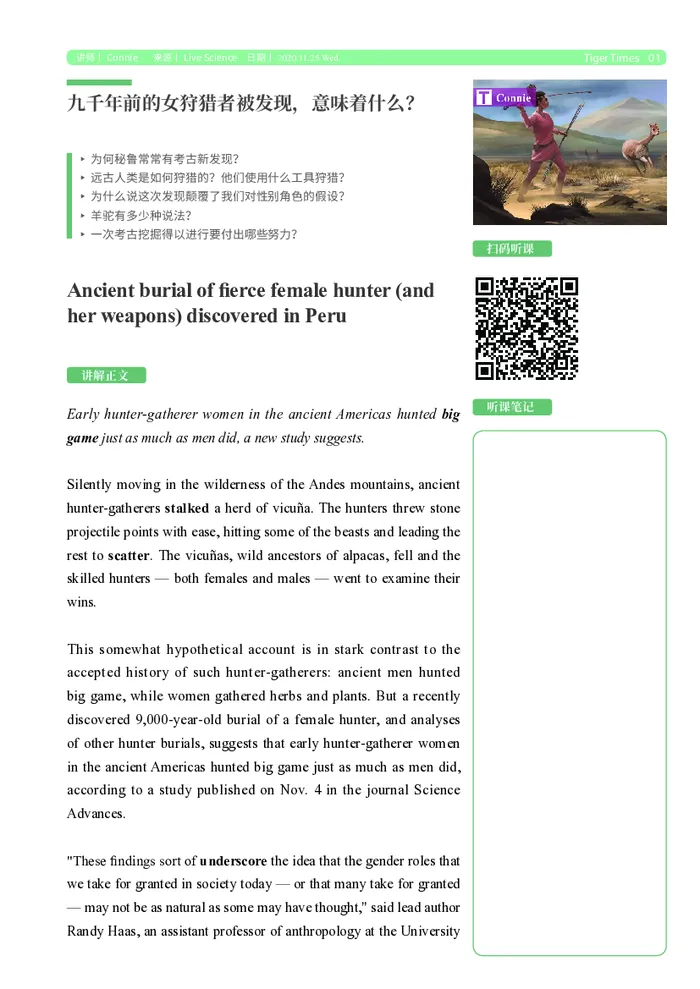
Silently moving in the wilderness of the Andes mountains, ancient
hunter-gatherers stalked a herd of vicuña. The hunters threw stone
projectile points with ease, hitting some of the beasts and leading the
rest to scatter. The vicuñas, wild ancestors of alpacas, fell and the
skilled hunters — both females and males — went to examine their
wins.
This somewhat hypothetical account is in stark contrast to the
accepted history of such hunter-gatherers: ancient men hunted
big game, while women gathered herbs and plants. But a recently
discovered 9,000-year-old burial of a female hunter, and analyses
of other hunter burials, suggests that early hunter-gatherer women
in the ancient Americas hunted big game just as much as men did,
according to a study published on Nov. 4 in the journal Science
Advances.
"These findings sort of underscore the idea that the gender roles that
we take for granted in society today — or that many take for granted
— may not be as natural as some may have thought," said lead author
Randy Haas, an assistant professor of anthropology at the University
of California, Davis.
In 2013, Haas was working on a different excavation in the
Andes Mountains when a local from the nearby southern Peruvian
community of Mulla Fasiri reported there were hundreds of ancient
stone tools scattered nearby. Five years later, after securing funding
and in collaboration with the locals, Haas and his team started
excavating the site, which became known as Wilamaya Patjxa.
In 2018, the researchers discovered six human burials at Wilamaya
Patjxa (they later discovered more in 2019). Two of the six burials
also contained hunting tools, but one was particularly interesting.
In the sixth burial, dating back around 9,000 years, "we started to
uncover this really rich artifact assemblage" including a hunting
toolkit with projectile points and flakes, Haas told Live Science.
The burial is thought to belong to a hunter-gatherer who, based on
examination of tooth development, died between the ages of 17 and
19. As the excavation continued, "people began to speculate 'Wow,
he must've been a great hunter, a really important person in the
community,'" Haas said.
The bias that colors history
James Watson, an associate professor of anthropology at the
University of Arizona, and co-author of the study, was the first to
suggest this was not a man at all. Watson examined the hunter-
gatherers' bones and said that because they were smaller compared
with others found in the region, the skeleton could be a female.
Indeed, a detailed analysis of proteins in the young hunter-gatherer's
teeth confirmed that she was a female.
But then Haas and his team began to wonder: Is this a one-off female
hunter, or is she part of a larger behavioral pattern among ancient
Americans? To figure this out, they combed through the literature
for reports of other hunter-gatherer burials from the late Pleistocene
(which ended around 11,700 years ago) and the early Holocene
Tiger Times
02
(which began around 12,000 to 11,500 years ago.)
The team identified 429 skeletons from 107 ancient burial sites across
the Americas; 27 of those individuals —11 female (including the
newly discovered female) and 15 male — were buried with big-game
hunting tools. Further statistical analysis suggested that between 30%
and 50% of hunters in these populations were female. "What we see
is that female and male burials are just as likely to be associated with
big-game hunting tools," Haas said.
"The authors make a compelling argument that the female skeleton
in question was likely a big-game hunter and that such a finding is
not entirely unusual throughout Indigenous populations," said Marin
Pilloud, an associate professor in the Department of Anthropology
at the University of Nevada, Reno, who was not a part of the study.
"If the same artifacts had been associated with a male skeleton, there
would be no questions that the individual was a hunter."
Many cultures did not — and still do not — have the gender binary
"that dominates our modern Western culture," Pilloud told Live
Science. "When we step back from our own gendered biases can
we explore the data in nuanced ways that are likely more culturally
accurate."
It's not clear whether hunter-gatherer females in other parts of the
world also partook regularly in hunting, but it's absolutely possible
to discover similar findings elsewhere, she said.
Tiger Times
03
Tiger Times
04
big game n. 大猎物(如大象和狮子)
 ○ large wild animals that people hunt for sport, for example
elephants and lions
 ○ e.g. a big game hunter 猎捕巨兽的猎人
 ○ game /ɡeɪm/ n. 猎物;野禽;野味
 ○ wild animals or birds that people hunt for sport or food
 ○ e.g. men who shot game for food 靠捕猎获取食物的人
stalk /stɔːk/ v. 偷偷接近,潜近(猎物或人)
 ○ to move slowly and quietly towards an animal or a person,
in order to kill, catch or harm it or them
 ○ e.g. The lion was stalking a zebra. 狮子偷偷接近斑马。
scatter /ˈskætər/ v. 散开;四散;使分散;驱散
 ○ to move or to make people or animals move very quickly
in different directions
 ○ e.g. At the first gunshot, the crowd scattered. 枪声一响,
人群便逃散了。
underscore /ʌndə'skɔː/ v. 强调,突出;在(词语等下)画线,
画底线标出
 ○ (especially NAmE) (= underline) to emphasize or show that
sth. is important or true
 ○ e.g. The report underscores the importance of pre-school
education. 这份报告强调学前教育的重要性。
 ○ to draw a line under a word, sentence, etc.
excavation /ˌekskəˈveɪʃn/ n.(对古建筑或古物的)发掘,
挖掘
 ○ the activity of digging in the ground to look for old
buildings or objects that have been buried for a long time
 ○ e.g. The methods of excavation have to be extremely
rigorous. 挖掘方法必须极其严格
 ○ excavate /ˈekskəveɪt/ v. 发掘,挖出(古建筑或古物)
 ○ to dig in the ground to look for old buildings or objects
that have been buried for a long time; to find sth. by digging
in this way
 ○ e.g. The site has been excavated by archaeologists. 这个遗
址已被考古学家发掘出来。
secure /sɪˈkjʊər/ v.(尤指经过努力)获得,取得,实现
 ○ to obtain or achieve sth., especially when this means using
a lot of effort
 ○ e.g. to secure a contract/deal 订立合同;达成协议
 ○ e.g. The team managed to secure a place in the finals. 球队
拼得了决赛的一席之地。
artifact /ˈɑːtɪfækt/ n. 人工制品,手工艺品(尤指有历史或
文化价值的)
 ○ (especially in NAmE) (= artefect) an object that is made by
a person, especially sth. of historical or cultural interest
 ○ e.g. ancient Egyptian artifacts 古埃及手工艺品
assemblage /əˈsemblɪdʒ/ n.(人、物的)聚集,集聚
 ○ (formal or specialist) a collection of things; a group of
people
 ○ e.g. Tropical rainforests have the most varied assemblage
of plants in the world. 热带雨林聚集了世界上种类最繁多
的植物。
speculate /ˈspekjuleɪt/ v. 推测;猜测;推断
 ○ to form an opinion about sth. without knowing all the
details or facts
 ○ e.g. We all speculated about the reasons for her resignation.
我们大家都推测过她辞职的原因。
词汇
one-off /ˌwʌn ˈɒf/ 一次性的;非经常性的
 ○ [only before noun] made or happening only once and not
regularly
 ○ e.g. a one-off payment 一次性付款
comb through(在大量物件、信息中)仔细搜寻
 ○ to search through a lot of objects or information in order to
find a specific thing or piece of information
 ○ e.g. We spent weeks combing through huge piles of old
documents. 我们在大堆大堆的旧文件里仔细翻找了好几
个星期。
 ○ comb /kəʊm/ v. 彻底搜寻,四处搜查
 ○ to search a place thoroughly
 ○ e.g. Police are still combing the woods for the missing boy.
警方仍在树林里四处搜寻那名失踪的男孩。
Pleistocene /ˈplaɪstəsiːn/ adj. 更新世的(约两百万年前至
一万年前,其时地球表面多被冰层覆盖)
 ○ belonging to the period in the Earth's history that started
about two million years ago and ended about 10,000 years
ago, when much of the Earth was covered with ice
 ○ the Pleistocene 更新世;更新世沉积物
 ○ the Pleistocene epoch or the system of deposits laid down
during it
Holocene /ˈhɒləsiːn/ adj.【地质】全新世的,全新统的(第
四纪的第二个纪元,在更新世之后)
 ○ Geology of, relating to, or denoting the present epoch,
which is the second epoch in the Quaternary period and
followed the Pleistocene
 ○ the Holocene 全新世,全新统;全新世沉积物体系
 ○ the Holocene epoch or the system of deposits laid down
during this time
compelling /kəmˈpelɪŋ/ adj. 令人信服的
 ○ that makes you think it is true
 ○ e.g. There is no compelling reason to believe him. 没有令
人信服的理由让人相信他。
 ○ e.g. compelling evidence 有说服力的证据
binary /ˈbaɪnəri/ adj. 由两部分组成的;二元的;双重的 n.
由两部分组成的事物,一双,双体
 ○ consisting of two parts
 ○ e.g. a binary star system 双星系
 ○ something having two parts
 ○ e.g. a binary star 双星
gendered /ˈdʒendəd/ adj. 男性(或女性)的;因性别而异的;
有性别偏向的
 ○ of, specific to, or biased towards the male or female sex
 ○ e.g. gendered occupations 有性别特点的职业
nuanced /'njuːɑːnst/ adj.(在外表、意义、声音等上)有细
微差别的
 ○ made slightly different in appearance, meaning, sound, etc.
 ○ e.g. His London accent is very slightly nuanced by an
occasional Russian pronunciation. 他的伦敦口音因时而夹
杂的俄语发音而略显不同。
partake /pɑːˈteɪk/ v. 参加;参与
 ○ (old-fashioned) to take part in an activity
 ○ e.g. They preferred not to partake in the social life of the
town. 他们不想参加这个镇的社交活动。
Tiger Times
05
今日习题
1. 根据英文释义写出文中出现的对应词
______: to form an opinion about sth. without knowing all the details or facts
______: (old-fashioned) to take part in an activity
2. 一词多义
Which of the following underlined words is closest in meaning to the one in the sentence "Five years later,
after securing funding and in collaboration with the locals, Haas and his team started excavating the site,
which became known as Wilamaya Patjxa."?  ____
A. The windows were secured with locks and bars.
B. Negotiators are still working to secure the hostages' release.
C. He used his house to secure the loan.
D. John secured the boat firmly to the jetty.
3. 翻译:根据给定中文回译英文
狩猎者们轻松地抛出石头制成的投掷用尖器,击中了一些野兽,其余的野兽四散而去。
_____________________________________________________________________________________
_________________________________________________________________
习题答案
1. speculate; partake
2. B
3. The hunters threw stone projectile points with ease, hitting some of the beasts and leading the
rest to scatter.
编辑丨童雨欣