Tiger Times 01
美国对中国留学生突然say no 的背后:一份核
心的台后报告(2)
讲师丨林伯虎    来源丨Australian Strategic Policy Institute    日期丨2020.06.04 Thur.
▶    “国防七子”和“兵工七子”分别是哪几所高校?ta 们的学生有多吃香?
ta 们的研究经费有多高?在中国国防建设起到了多大作用?
▶      军地“共建”到底什么意思?意味着什么?
▶    几所知名的地方高校为什么会“中枪”?登上这份报名的名单对于我们
填报志愿和考虑出国有何参考意义?
扫码听课
听课笔记
The China Defence Universities Tracker
讲解正文
China's civilian defence universities
Many of China's universities originated as military institutions but have
since been developed into civilian universities that are increasingly
competitive in global research rankings. However, developments over
the past decade highlight the military and security links of more than 60
universities in particular.
The Seven Sons of National Defence
The 'Seven Sons of National Defence' ( 国防七子) are a group of leading
universities with deep roots in the military and defence industry. They're
all subordinate to the Ministry of Industry and Information Technology
( 工业和信息化部), which oversees China's defence industry through its
subordinate agency, SASTIND.
The depth of the Seven Sons' integration with the military suggests that
it would be more accurate to describe them as defence universities than
as civilian universities. In fact, they call themselves 'defence science,
technology and industry work units' or parts of the 'defence system'.
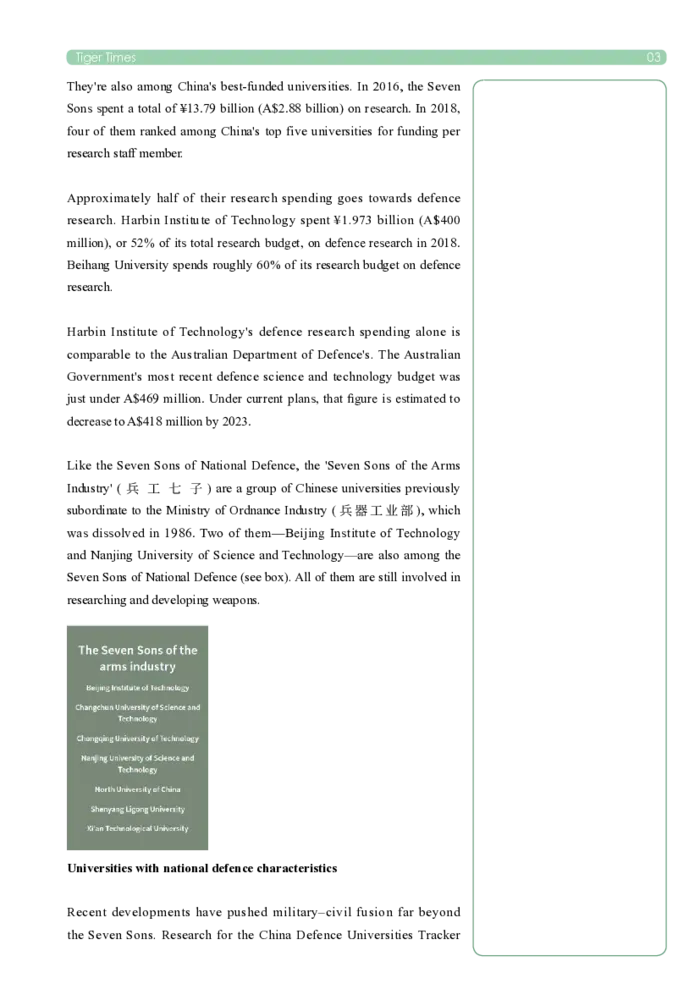
Each year, more than 10,000 graduates from the Seven Sons join the
defence research sector—just under 30% of their employed graduates. PhD
graduates from these universities are particularly sought after, and as many
as half of them go into the defence sector (Figure 1). State-owned defence
conglomerates specialising in aircraft, missiles, warships, armaments and
military electronics are among their top employers, alongside high-tech
companies such as Huawei and ZTE.
Figure 1: The percentage of employed 2017 or 2018 graduates of the
Seven Sons working in the defence system
Note: Figures for Northwestern Polytechnical University and Harbin
Engineering University are for 2017. The remaining figures are for 2018.
Source: university graduate employment quality reports ( 毕业生就业质量
年度报告).
The Seven Sons stand at the forefront of defence research in China.
Hundreds of their scientists sit on PLA expert advisory committees and
assist or even serve in major military projects, such as fighter jet or aircraft
carrier programs. They dominate the ranks of defence research prize and
defence technology patent recipients. One Chinese study of military–civil
fusion in the university sector estimated that more than half the academics
at the Seven Sons have been involved in defence projects. All seven have
been accredited at the institutional level to participate in research into and
the production of top-secret weapons and defence equipment.
Tiger Times
02
They're also among China's best-funded universities. In 2016, the Seven
Sons spent a total of ¥13.79 billion (A$2.88 billion) on research. In 2018,
four of them ranked among China's top five universities for funding per
research staff member.
Approximately half of their research spending goes towards defence
research. Harbin Institute of Technology spent ¥1.973 billion (A$400
million), or 52% of its total research budget, on defence research in 2018.
Beihang University spends roughly 60% of its research budget on defence
research.
Harbin Institute of Technology's defence research spending alone is
comparable to the Australian Department of Defence's. The Australian
Government's most recent defence science and technology budget was
just under A$469 million. Under current plans, that figure is estimated to
decrease to A$418 million by 2023.
Like the Seven Sons of National Defence, the 'Seven Sons of the Arms
Industry' ( 兵工七子) are a group of Chinese universities previously
subordinate to the Ministry of Ordnance Industry ( 兵器工业部), which
was dissolved in 1986. Two of them—Beijing Institute of Technology
and Nanjing University of Science and Technology—are also among the
Seven Sons of National Defence (see box). All of them are still involved in
researching and developing weapons.
Universities with national defence characteristics
Recent developments have pushed military–civil fusion far beyond
the Seven Sons. Research for the China Defence Universities Tracker
Tiger Times
03
has identified 101 agreements signed between defence industry agency
SASTIND (or its predecessor, COSTIND) and other agencies since 1999
to 'jointly construct' ( 共建) 61 universities subordinate to those agencies
(see appendix). These agreements encompass leading national universities,
such as Tsinghua University and Peking University, as well as provincial
universities with strong foundations for defence research.
The Tracker also identifies similar agreements that show how defence
industry conglomerates, such as China's leading ballistic missile
manufacturer, supervise nine universities. SASTIND's joint-construction
agreements have become far more common in recent years.
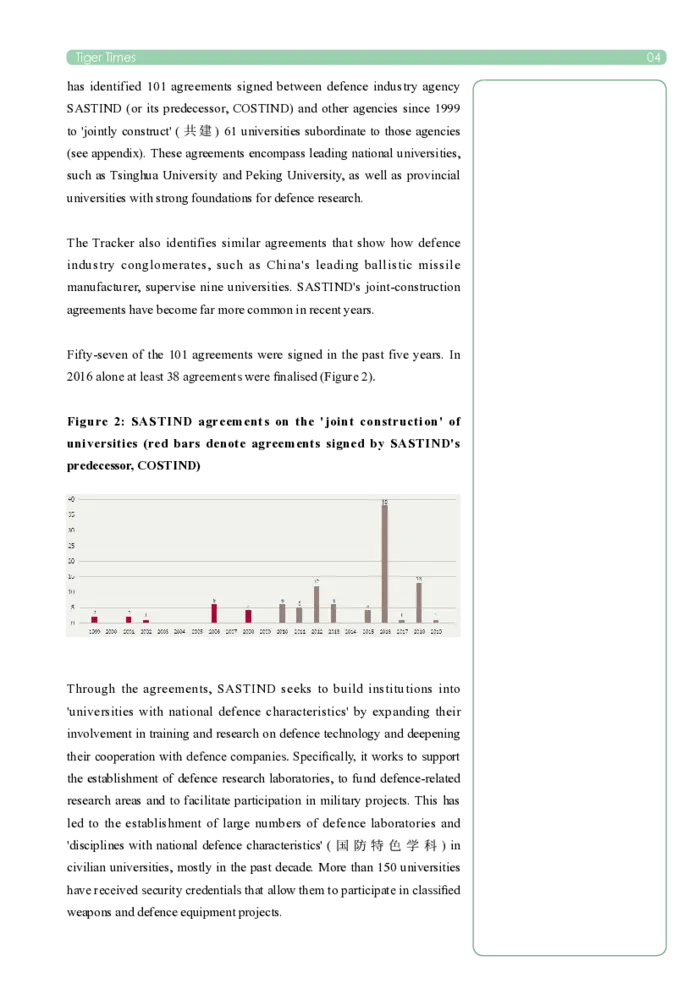
Fifty-seven of the 101 agreements were signed in the past five years. In
2016 alone at least 38 agreements were finalised (Figure 2).
Figure 2: SASTIND agreements on the 'joint construction' of
universities (red bars denote agreements signed by SASTIND's
predecessor, COSTIND)
Through the agreements, SASTIND seeks to build institutions into
'universities with national defence characteristics' by expanding their
involvement in training and research on defence technology and deepening
their cooperation with defence companies. Specifically, it works to support
the establishment of defence research laboratories, to fund defence-related
research areas and to facilitate participation in military projects. This has
led to the establishment of large numbers of defence laboratories and
'disciplines with national defence characteristics' ( 国防特色学科) in
civilian universities, mostly in the past decade. More than 150 universities
have received security credentials that allow them to participate in classified
weapons and defence equipment projects.
Tiger Times
04
According to a university supervised by SASTIND, the agency aims to
support five to eight defence disciplines and establish one or two defence
labs in each university it supervises by 2020 (the end of the 13th Five-Year
Plan). This hasn't yet come to fruition and is unlikely to be fully achieved.
Nonetheless, it may be the largest push to integrate universities into the
defence research system since the beginning of China's reform and opening,
covering as many as 53 universities.
Developing talent for China's defence industry is an important objective
of military-civil fusion in universities. In 2007, the Chinese government
established the National Defence Science and Technology Scholarship to
encourage high-achieving university students to join the defence sector.
Every year, the scholarship is given to 2,000 'national defence technology
students' who are each sponsored by defence conglomerates or China's
nuclear weapons program to study in designated fields. After graduating,
they are required to work for their sponsor for five years.
Tiger Times
05
Tiger Times
06
originate /əˈrɪdʒəneɪt/ v. 发源;开始;起源
 ○ to come from a particular place or start in a par-
ticular situation
 ○ e.g. How did the plan originate? 这个计划最早是怎
么想到的?
subordinate /səˈbɔːdənət/ adj. 下级的;从属的
 ○ in a less important position than someone else
 ○ e.g. It is subordinate to the national administra-
tive system. 这是从属于国家行政管理体制的。
aeronautics /ˌeərəˈnɔːtɪks/ n. 航空学;飞行学
 ○ the science of designing and flying planes
 ○ e.g. NASA, the National Aeronautics and Space
Administration is calling taxi. 美国国家航空和宇宙航
行局NASA 正在预定出租车服务。
astronautics /ˌæstrəˈnɔːtɪks/ n. 太空航空学
 ○ the science and technology of space flight
maritime /ˈmærətaɪm/ adj. 海上的,海事的;与船舶有
关的
 ○ relating to the sea or ships
 ○ e.g. San Francisco has lost nearly all of its mari-
time industry. 旧金山几乎失去了所有海运业。
seek /siːk/ v. 寻找,寻求
 ○ to look for someone or something
 ○ e.g. new graduates seeking employment 正在求职
的刚毕业的大学生
sought after 广受欢迎的,吃香的(但罕有或难以得到)
 ○ wanted by a lot of people but rare or difficult to
get
 ○ e.g. a much sought after defense lawyer 一个很吃
香的辩护律师
specialize /ˈspeʃəlaɪz/ v. 专门研究,专门从事,专攻
 ○ to limit all or most of your study, business, etc. to
a particular subject or activity
 ○ e.g. Simmons specialized in contract law. 西蒙斯
专攻合同法。
armament /ˈɑːməmənt/ n. 军备,武器
 ○ the weapons and military equipment used by an
army
 ○ e.g. nuclear armaments 核武器
forefront /ˈfɔːfrʌnt/ n. 位于(某事物的)最前列,处于(某
事物的)领先地位
 ○ to be in a leading position in an important activ-
ity that is trying to achieve something or develop
new ideas
 ○ e.g. The company has always been at the fore-
front of science and technology. 该公司在科学技术方
面始终处于领先地位。
advisory /ədˈvaɪzəri/ adj. 顾问的;咨询的
 ○ having the purpose of giving advice
词汇
 ○ e.g. He was employed in a purely advisory role.
他纯粹以顾问身份受聘。
recipient /rɪˈsɪpiənt/ n. 接受者,领受者
 ○ someone who receives something
 ○ e.g. the recipient of the Nobel Peace Prize 诺贝尔
和平奖得主
accredited /əˈkredɪtɪd/ adj. 鉴定合格的,达到标准的
 ○ having official approval to do something, espe-
cially because of having reached an acceptable
standard
 ○ e.g. an accredited language school 一所鉴定合格
的语言学校
roughly /ˈrʌfli/ adv. 粗略地,大致上
 ○ not exactly
 ○ e.g. There were roughly 200 people there. 那儿大
约有200 人。
ordnance /ˈɔːdnəns/ n. 军械(如武器、弹药、军车等)
 ○ weapons, explosives, and vehicles used in fight-
ing
dissolve /dɪˈzɒlv/ v. 解散(议会);解除(商业协定、婚
姻关系等)
 ○ to formally end a parliament, business arrange-
ment, marriage, etc.
 ○ e.g. The monarch had the power to dissolve par-
liament. 君主有权解散议会。
encompass /ɪnˈkʌmpəs/ v. 包含,包括
 ○ to include a wide range of ideas, subjects, etc.
 ○ e.g. The study encompasses the social, political,
and economic aspects of the situation. 这项研究涵盖
了这一局势的社会、政治和经济三方面。
ballistic /bəˈlɪstɪk/ adj. 弹道(学)的;发射的
 ○ connected with ballistics
supervise /ˈsuːpəvaɪz/ v. 监督;管理;指导
 ○ to be in charge of an activity or person, and
make sure that things are done in the correct way
 ○ e.g. Griffiths closely supervised the research. 格
里菲思密切指导该项研究。
finalise /ˈfaɪnəl-aɪz/ v. 最后定下,使(计划、交易等)
确定
 ○ to finish the last part of a plan, business deal,
etc.
 ○ e.g. Jo flew out to Thailand to finalize the details
of the deal. 乔乘飞机去往泰国,敲定这笔生意的具体事
宜。
facilitate /fəˈsɪlɪteɪt/ v. 促进;使便利
 ○ to make it easier for a process or activity to hap-
pen
 ○ e.g. Computers can be used to facilitate language
learning. 用电脑可使语言学习更方便。
Tiger Times
07
credentials /krɪˈdenʃəlz/ n. 资格;资历
 ○ someone's education, achievements, experience,
etc. that prove they have the ability to do some-
thing
 ○ e.g. She had excellent credentials for the job. 她
具备做这份工作的出色资历。
discipline /ˈdɪsɪplɪn/ n.(尤指大学的)专业,科目
 ○ an area of knowledge or teaching, especially one
such as history, chemistry, mathematics, etc. that
is studied at a university
 ○ e.g. engineering discipline 工程学科
fruition /fruˈɪʃən/ n.(计划、项目等的)实现,完成
 ○ if a plan, project, etc. comes to fruition, it is suc-
cessfully put into action and completed, often after
a long process
 ○ e.g. His proposals only came to fruition after the
war. 他的提议直到战后才得以实现。
designate /ˈdezɪɡneɪt/ v.(为特定工作或目的)任命,选
定,指派
 ○ to choose someone or something for a particular
job or purpose
 ○ e.g. The lake was recently designated a conserva-
tion area. 这个湖最近被指定为保护区。
Tiger Times
08
今日习题
1. 根据英文释义写出文中出现的对应单词
_________: in a less important position than someone else
_________: to choose someone or something for a particular job or purpose
2. 一词多义
Which of the following underlined words is closest in meaning to the one in the sentence "…are a group
of Chinese universities previously subordinate to the Ministry of Ordnance Industry, which was dissolved
in 1986."?  ____
A. Stir until the sugar dissolves.
B. She dissolved into fits of laughter.
C. The election was announced and parliament was dissolved.
D. Her enthusiasm dissolved his shyness.
3. 翻译:根据给定中文回译英文
光是哈工大的国防研究支出就相当于整个澳大利亚国防部的科研支出了。
_____________________________________________________________________________________
_________________________________________________________________
习题答案
1. subordinate; designate
2. C
3. Harbin Institute of Technology's defence research spending alone is comparable to the Australian
Department of Defence's.
编辑丨Mazling