文档文本内容
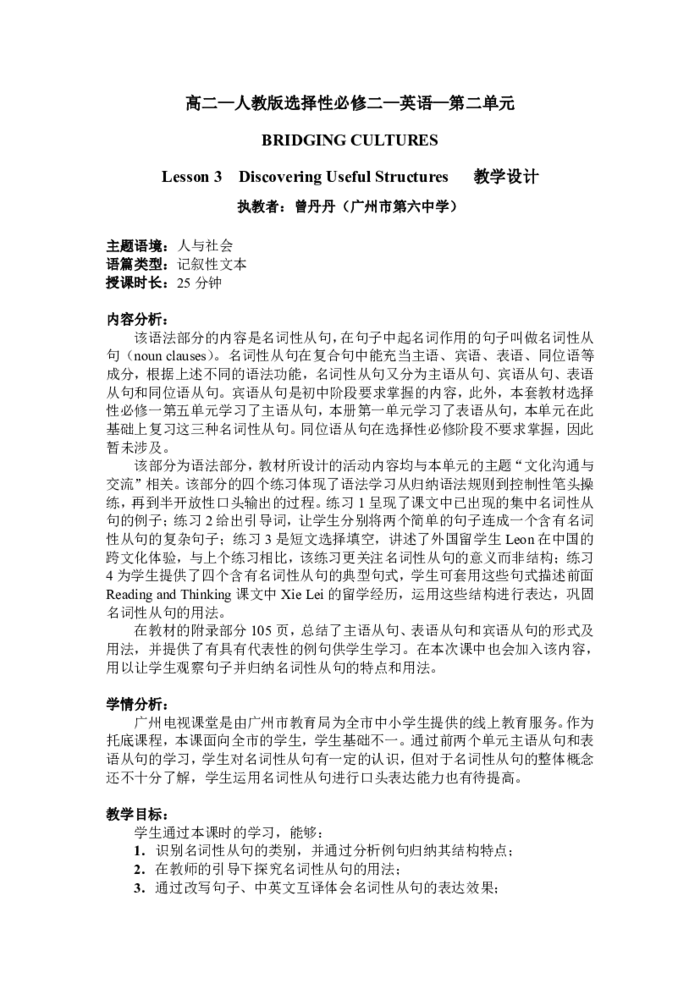
高二—人教版选择性必修二—英语—第二单元
BRIDGING CULTURES
Lesson 3
Discovering Useful Structures
教学设计
执教者:曾丹丹(广州市第六中学)
主题语境:人与社会
语篇类型:记叙性文本
授课时长:25 分钟
内容分析:
该语法部分的内容是名词性从句,在句子中起名词作用的句子叫做名词性从
句(noun clauses)。名词性从句在复合句中能充当主语、宾语、表语、同位语等
成分,根据上述不同的语法功能,名词性从句又分为主语从句、宾语从句、表语
从句和同位语从句。宾语从句是初中阶段要求掌握的内容,此外,本套教材选择
性必修一第五单元学习了主语从句,本册第一单元学习了表语从句,本单元在此
基础上复习这三种名词性从句。同位语从句在选择性必修阶段不要求掌握,因此
暂未涉及。
该部分为语法部分,教材所设计的活动内容均与本单元的主题“文化沟通与
交流”相关。该部分的四个练习体现了语法学习从归纳语法规则到控制性笔头操
练,再到半开放性口头输出的过程。练习1 呈现了课文中已出现的集中名词性从
句的例子;练习2 给出引导词,让学生分别将两个简单的句子连成一个含有名词
性从句的复杂句子;练习3 是短文选择填空,讲述了外国留学生Leon 在中国的
跨文化体验,与上个练习相比,该练习更关注名词性从句的意义而非结构;练习
4 为学生提供了四个含有名词性从句的典型句式,学生可套用这些句式描述前面
Reading and Thinking 课文中Xie Lei 的留学经历,运用这些结构进行表达,巩固
名词性从句的用法。
在教材的附录部分105 页,总结了主语从句、表语从句和宾语从句的形式及
用法,并提供了有具有代表性的例句供学生学习。在本次课中也会加入该内容,
用以让学生观察句子并归纳名词性从句的特点和用法。
学情分析:
广州电视课堂是由广州市教育局为全市中小学生提供的线上教育服务。作为
托底课程,本课面向全市的学生,学生基础不一。通过前两个单元主语从句和表
语从句的学习,学生对名词性从句有一定的认识,但对于名词性从句的整体概念
还不十分了解,学生运用名词性从句进行口头表达能力也有待提高。
教学目标:
学生通过本课时的学习,能够:
1. 识别名词性从句的类别,并通过分析例句归纳其结构特点;
2. 在教师的引导下探究名词性从句的用法;
3. 通过改写句子、中英文互译体会名词性从句的表达效果;
4. 通过实践运用巩固名词性从句的用法,学会在口头和笔头表达中恰当运
用名词性从句。
教学重点与难点:
1. 引导学生探究和归纳名词性从句的语法特点。
2. 用半开放性的活动,引导学生在口头上用名词性从句进行表达。
教学资源:
教材、多媒体课件
教学流程:
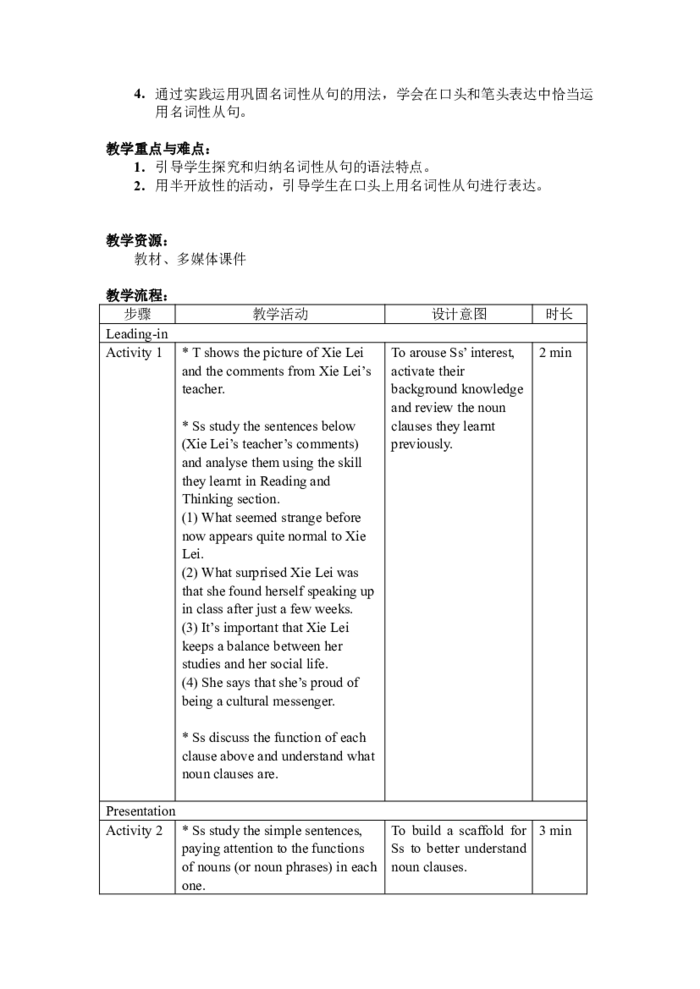
步骤
教学活动
设计意图
时长
Leading-in
Activity 1
* T shows the picture of Xie Lei
and the comments from Xie Lei’s
teacher.
* Ss study the sentences below
(Xie Lei’s teacher’s comments)
and analyse them using the skill
they learnt in Reading and
Thinking section.
(1) What seemed strange before
now appears quite normal to Xie
Lei.
(2) What surprised Xie Lei was
that she found herself speaking up
in class after just a few weeks.
(3) It’s important that Xie Lei
keeps a balance between her
studies and her social life.
(4) She says that she’s proud of
being a cultural messenger.
* Ss discuss the function of each
clause above and understand what
noun clauses are.
To arouse Ss’ interest,
activate their
background knowledge
and review the noun
clauses they learnt
previously.
2 min
Presentation
Activity 2
* Ss study the simple sentences,
paying attention to the functions
of nouns (or noun phrases) in each
one.
To build a scaffold for
Ss to better understand
noun clauses.
3 min
(1) The flowers are beautiful.
(2) She is an excellent singer.
(3) Nobody knows these
questions.
(4) The question, a difficult math
problem, hasn’t been solved yet.
* T replaces the nouns (or noun
phrases) of the above sentences
with noun clauses. Ss observe,
discuss and draw the conclusion
of the functions and classification
of noun clauses.
Observation and Discovery
Activity 3
* Ss go through the sentences on
Page 105 of the textbook. (They
are supposed to pay attention to
the noun clauses and the
conjunctions before each noun
clause.) Then finish the table
below.
Conjunctions of Noun Clauses
连词
that, whether, if
连接代词
what/whatever,
who/whoever,
which/whichever,
whose
连接副词
when, where, how,
why
To help Ss to
summarize the
conjunctions of noun
clauses.
4 min
Activity 4
* Ss look at the provided
examples and analyse the
functions of each conjunction in
the noun clauses.
* Ss study the provided examples
with the conjunction that and
analyse when that can be omitted
from a noun clause.
* Ss study the provided examples
and analyse the noun clauses
structures with it.
* To help Ss to
summarize the
difference between
that, if, whether and
other conjunctions.
* To help Ss
summarize the
omission of the
conjunction that.
* To help Ss to analyse
the form of noun
clauses with it.
6min
Practice
Activity 4
* Ss combine the sentences in
Exercise 2 on Page 17.
* Ss read the sentences they wrote
and translate them into Chinese.
* Ss read the Chinese translation
and translate the sentences back
into English. Compare the English
translation with the sentences they
rewrote just now.
To practise and
consolidate the noun
clauses. English and
Chinese bidirectional
translation helps Ss
realize the difference of
English and Chinese
sentence patterns.
4 min
Activity 5
*Ss complete the passage in
Exercise 3 on Page 17 using the
sentences A-D from the box. Then
read the passage aloud and
understand the function of noun
clauses in the passage.
*Ss answer the question to
understand the main idea of the
passage: What are the things that
attract Leon to China?
To practice noun
clauses in the context.
2 min
Activity 6
* Ss study the sentences in
Exercise 4 on Page 17. And
complete sentences with their own
words by referring to the text in
Reading and Thinking section.
*Ss link the sentences together
and make a little story.
To practice noun
clauses orally.
3 min
Summary and Homework
T summarizes what has been taught in the
lesson.
To summarize what Ss
have
learned
in
this
lesson.
0.5
min
T assigns homework.
To consolidate what Ss
have
learned
and
ensure they can use it
to do new tasks.
0.5
min