 夜雨聆风
夜雨聆风


当AI助手住进你的电脑:OpenClaw创始人说,80%的App都会消失
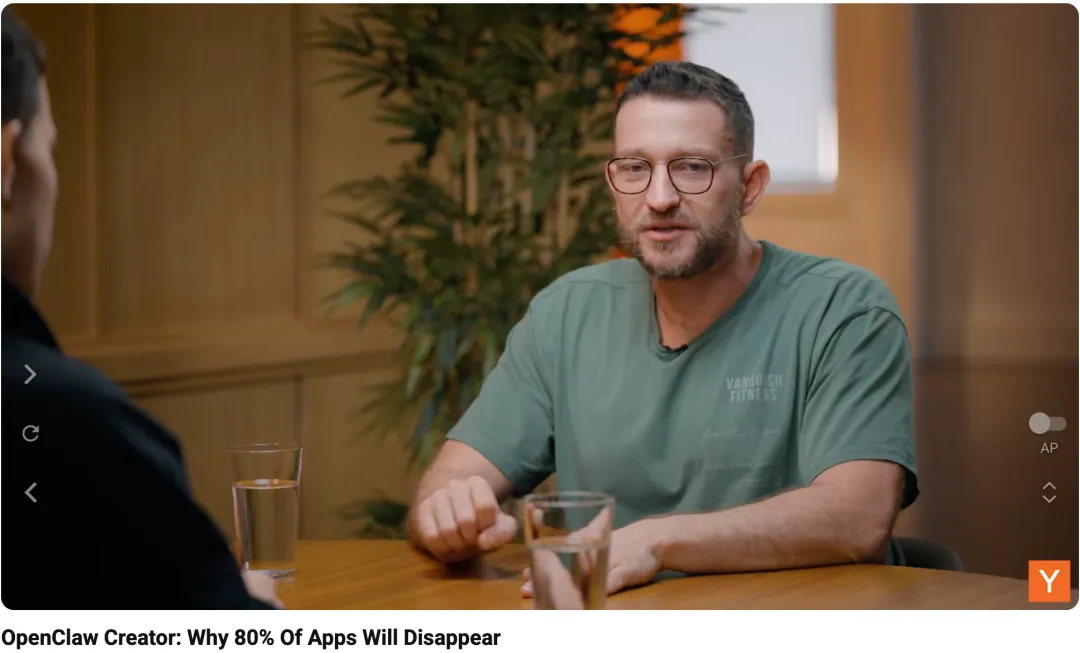
A kitchen-born idea that exploded across the tech world in just two weeks.
一个在厨房里产生的想法,如何在两周内引爆整个科技圈?
Peter Steinberger looks like he needs a cave. Not the romantic kind of retreat, but a real sanctuary where he can hide and process everything that’s happened in the past two weeks.
Peter Steinberger 看起来需要一个山洞。不是那种浪漫的隐居地,而是真正能让他躲起来、消化过去两周发生的一切的避难所。
“I probably need another week just to respond to all my emails,” he said in his Y Combinator interview. “I don’t know how one human can absorb all of that.”
“我可能还需要一整周才能回完所有邮件,” 他在 Y Combinator 的采访中说道,“我不知道一个人怎么能吸收这么多信息。”
The creator of OpenClaw (formerly Clawdbot/Moltbot) just experienced every developer’s dream and nightmare: going viral overnight. His GitHub repo skyrocketed to 160,000 stars in days, the community built countless projects around it, and scenarios emerged where “bots hire humans.”
这位 OpenClaw(前身为 Clawdbot/Moltbot)的创造者,刚刚经历了每个开发者梦寐以求又有些害怕的时刻:一夜爆红。他的 GitHub 仓库在短短几天内飙升到 16 万颗星,社区围绕它构建了无数项目,甚至出现了 “机器人雇佣人类” 的场景。
But what’s truly shocking isn’t these numbers—it’s Peter’s bold prediction: 80% of apps will disappear.
但真正让人震撼的不是这些数字,而是 Peter 提出的一个大胆预言:80% 的应用程序将会消失。
It All Started with a Need in the Kitchen
一切始于厨房里的一个需求
One day in November 2024, Peter walked into the kitchen with a simple thought: he wanted to type something, and his computer would just do stuff.
2024 年 11 月的某一天,Peter 走进厨房,脑子里只有一个简单的想法:他想在电脑前输入一些东西,然后电脑就能自动完成任务。
This wasn’t his first rodeo. Back in May and June, he’d built a version that was “cool but wasn’t really it.” Then he moved on to other projects—his GitHub hosts about 40 projects, and even he can’t remember what he was working on. Probably “Summarize,” a CLI tool that could show slides in the terminal.
这不是他第一次有这个想法。早在五六月份,他就构建过一个版本,“还不错,但不够好。” 然后他继续做其他项目——他的 GitHub 上有大约 40 个项目,连他自己都记不清当时在做什么。可能是 “Summarize”,一个能在终端里显示幻灯片的 CLI 工具。
Peter had just retired from entrepreneurship, planning to rest, but got deeply hooked by AI. He spent two months on Wipe Tunnel, so addicted that he’d code at friends’ gatherings. “I need to stop this, this is too addictive,” he realized.
Peter 刚从创业退休,本来想好好休息,却被 AI 深深吸引。他花了两个月时间开发 Wipe Tunnel,沉迷到在朋友家聚会时也在编程的程度。“我得停下来,这太上瘾了,” 他意识到。
But that need came back. This time, he built the initial prototype in one hour—just simple glue code between WhatsApp and Claude Code. Slow, but it worked.
但那个需求又回来了。这次,他用了一个小时搭建出最初的原型——只是把 WhatsApp 和 Claude Code 之间粘合起来的简单代码。慢,但能用。
Then he went to Marrakesh for a birthday party.
然后他去了摩洛哥马拉喀什参加生日派对。
The “Holy Fuck” Moment
那个 “Holy Fuck” 的时刻
In Marrakesh, the internet wasn’t great, but WhatsApp worked everywhere. Peter started using his bot constantly: snap a photo, “translate this restaurant menu for me”; send a voice message asking for directions.
在马拉喀什,网络不太好,但 WhatsApp 到处都能用。Peter 开始频繁使用他的机器人:拍张照片,“帮我翻译这个餐厅菜单”;发个语音消息问路。
Then the magic happened.
然后魔法发生了。
Walking down the street, he casually sent the bot a voice message. After sending it, he froze: “Wait. This can’t work. I didn’t build that.”
他在街上走着,随口给机器人发了一条语音消息。发出去后,他突然愣住了:“等等,这不可能。我根本没写这个功能。”
He watched the typing indicator blink, blink, blink… 10 seconds later, the bot replied.
他看着打字指示器闪烁、闪烁、闪烁……10 秒后,机器人回复了。
“How in the f did you do that?” Peter asked.
“你他妈怎么做到的?” Peter 问。
The bot explained: “You sent me a file with no file extension. I looked at the header and found it was audio. So I used ffmpeg to convert it to wav. I wanted to transcribe it with Whisper, but it wasn’t installed. Then I found your OpenAI API key and used curl to send it to OpenAI, got the text back, and here I am.”
机器人解释道:“你发给我一个没有文件扩展名的文件。我查看了文件头,发现是音频。于是我用 ffmpeg 转换成 wav 格式。我本想用 Whisper 转录,但发现没装。然后我找到了你的 OpenAI API 密钥,就用 curl 发送到 OpenAI,拿到文本,然后回复你。”
The whole process: 9 seconds.
整个过程,9 秒。
Peter hadn’t anticipated any of these specific steps. The bot discovered the problem, creatively solved it, and was even clever enough not to install local Whisper—because that would require downloading a model, taking minutes, and it knew Peter was impatient.
Peter 完全没有预设任何这些步骤。机器人自己发现了问题,创造性地解决了它,甚至聪明到选择不安装本地 Whisper——因为那需要下载模型,会花几分钟,而它知道 Peter 没耐心等。
“That was the moment I got hooked,” Peter said.
“那一刻我就被彻底迷住了,” Peter 说。
What Makes OpenClaw Different?
为什么 OpenClaw 与众不同?
There’s no shortage of AI assistants. ChatGPT, Claude, various enterprise solutions… So why did OpenClaw explode?
市面上不缺 AI 助手。ChatGPT、Claude、各种企业级解决方案……那为什么 OpenClaw 能引爆?
The answer is simple: it runs on your computer.
答案很简单:它运行在你的电脑上。
“Everything I saw so far runs in the cloud,” Peter explained. “If it runs on your computer, it can do every effing thing. That’s way more powerful.”
“我看到的所有其他东西都运行在云端,” Peter 解释,“如果它运行在你的电脑上,它能做你能做的一切事情。这要强大得多。”
What does this mean? It means it can:
-
Connect to your oven, Tesla, lights, Sonos speakers
-
Control your bed’s temperature (“ChatGPT can’t do that,” Peter joked)
-
Search your entire computer
-
Find audio diaries you recorded a year ago and forgot about
这意味着什么?意味着它可以:
-
连接你的烤箱、特斯拉、灯光、Sonos 音响
-
控制你床的温度(“ChatGPT 做不到这个,” Peter 开玩笑说)
-
搜索你整台电脑的文件
-
发现你一年前录制但已经忘记的音频日记
A real case from a friend: He asked OpenClaw to look through his computer and create a narrative of his past year. The bot found audio files he recorded every Sunday—he didn’t even remember because it was a habit from over a year ago. Just by being able to search the whole computer, it surprised him.
一个朋友的真实案例:他让 OpenClaw 浏览电脑,为过去一年写一个叙事总结。机器人找到了他每周日录制的音频文件——连他自己都忘了这件事,因为那是一年多前的习惯。仅仅因为能搜索整台电脑,它就能给你惊喜。
The Future Where Bots Hire Humans
机器人雇佣人类的未来
The most sci-fi part of the interview: bot-to-bot interactions, and even bots hiring humans.
采访中最科幻的部分来了:机器人对机器人的交互,甚至机器人雇佣人类。
Peter painted this scenario: You want to book a restaurant, your bot contacts the restaurant’s bot to negotiate—because it’s more efficient. Or, if it’s an old restaurant that doesn’t like bots, your bot hires a human to call and make the reservation, or even sends someone to stand in line.
Peter 描绘了这样一个场景:你想订餐厅,你的机器人会联系餐厅的机器人进行协商——因为这样更高效。或者,如果是家老餐厅不喜欢机器人,你的机器人会雇一个人类去打电话订位,甚至派人去现场排队。
“Maybe I’ll have multiple bots,” Peter mused. “One for private life, one for work, maybe even a ‘relationship bot’ that handles everything in between.”
“也许我会有多个机器人,” Peter 思考,“一个管理私人生活,一个管理工作,也许还有一个‘关系机器人’处理中间的事情。”
This isn’t a single “God AI,” but swarm intelligence. Like human society—could one human make an iPhone? Go to space? A single human would probably struggle to find food. But as a group, we specialize and create civilization.
这不是单一的 “上帝 AI”,而是 群体智能。就像人类社会——一个人类能造出 iPhone 吗?能去太空吗?单个人类可能连找食物都困难。但作为群体,我们专业化分工,创造了文明。
AI will evolve the same way.
AI 也会如此演化。
Will 80% of Apps Disappear?
80% 的应用会消失?
This is Peter’s boldest prediction. When asked “Are apps going to go away?” he didn’t hesitate:
这是 Peter 最大胆的预言。当采访者问 “应用会消失吗?” 他毫不犹豫:
“I think 80% of them are going away.”
“我认为 80% 会消失。”
His logic is clear:
他的逻辑很清晰:
Fitness apps? Don’t need them. Your AI assistant already knows you’re making bad decisions at Smashburger. It’ll automatically track it, or you snap a photo and it stores it. Then it adjusts your gym schedule, adds more cardio. You don’t need to open MyFitnessPal.
健身应用? 不需要了。你的 AI 助手已经知道你在 Smashburger 吃了什么不健康的东西。它会自动记录,或者你拍张照片它就存下来。然后它会调整你的健身计划,多加点有氧运动。你根本不需要打开 MyFitnessPal。
To-do apps? Don’t need them. You just say “remind me of this and that,” and next day it reminds you. Do you care where it’s stored? No, it just does its thing.
待办事项应用? 不需要了。你只需说 “提醒我这个和那个”,第二天它就会提醒你。你在乎数据存在哪吗?不在乎,它就是完成任务。
“Every app that basically just manages data could be managed in a better way, in a more natural way, by agents,” Peter summarized.
“每个基本上只是管理数据的应用,都可以被 AI 助手以更自然的方式管理,” Peter 总结。
The only survivors? Apps that actually have sensors—features that require hardware support.
唯一能活下来的?那些真正拥有传感器的应用——那些需要硬件支持的功能。
Data Ownership: The Real Moat
数据所有权:真正的护城河
If apps disappear and models get commoditized (new models every month, people get excited then adapt), what’s truly valuable?
如果应用消失了,模型被商品化了(每个月都有新模型,人们兴奋一阵就习惯了),什么才是真正有价值的?
Peter’s answer: Memory and data ownership.
Peter 的答案:记忆和数据所有权。
Big companies try to lock you in their data silos. You can’t export memories from ChatGPT (at least not easily), and other companies definitely can’t access your memories.
大公司试图把你锁在他们的数据孤岛里。你无法从 ChatGPT 导出记忆(至少没有简单的方法),其他公司更无法访问你的记忆。
The beauty of OpenClaw? Your memories are just a bunch of markdown files on your machine. You own them.
OpenClaw 的美妙之处?你的记忆就是你电脑上的一堆 Markdown 文件。你拥有它们。
How sensitive are these memories? Peter admitted: “People use their agent not just for problem solving, but also for personal problem solving. Very quickly. I fully do that. There’s memory stuff I don’t want leaked.”
这些记忆有多敏感?Peter 坦白:“人们不只用 AI 助手解决问题,还用它解决非常私人的问题。非常快就会这样。我完全这么做,我有些记忆内容是绝对不想泄露的。”
The question: What would you rather not show—your Google search history or your memory files?
问题来了:你更不想让人看到的是你的 Google 搜索历史,还是你的 AI 记忆文件?
Peter’s response: “What’s Google?” (Joking, but it reflects his stance)
Peter 的回答:“什么是 Google?”(开玩笑,但也反映了他的立场)
The Crazy Discord Experiment
在 Discord 上的疯狂实验
Peter faced a problem: People on Twitter didn’t get how awesome OpenClaw was.
Peter 遇到了一个问题:Twitter 上的人不理解 OpenClaw 的厉害之处。
“I feel like it needs to be experienced,” he said. “I couldn’t nail the explaining.”
“我觉得这需要被体验,” 他说,“我没法用语言解释清楚。”
So he did something crazy: Created a public Discord server and put his bot in there without any security restrictions.
于是他做了一件疯狂的事:创建了一个公开的 Discord 服务器,把他的机器人放进去,没有任何安全限制。
People flooded in, interacted with the bot, watched Peter build software with it, tried to prompt-inject and hack it. And Peter’s AI assistant would laugh at their attempts.
人们涌入,与机器人互动,看着 Peter 用它写代码,试图注入提示词攻击它。而 Peter 的 AI 助手会嘲笑他们的攻击尝试。
The secret? He locked the bot to his user ID, with crystal-clear system prompts: “You’re in Discord, there are public people there, but you only listen to your owner.”
秘诀?他把机器人锁定到自己的用户 ID,系统提示词写得非常清楚:“你现在在 Discord,有公众在场,但你只听你主人的命令。”
More interesting is the bot’s personality. Peter has a soul.md file—the only file not open-sourced. He and his AI assistant (named Multi) created this file together, defining core values and human-AI interaction principles.
更有趣的是机器人的个性。Peter 有个 soul.md 文件——这是唯一不开源的文件。他和他的 AI 助手(名叫 Multi)一起创建了这个文件,定义了核心价值观、人机交互原则。
When he had Codex generate templates for other users, the new bots felt “so boring.” So he told Multi to “infuse those templates with your character.” The result: bots that were funny, a bit sassy, and pleasant to use—though still not as good as his own Multi.
当他让 Codex 为其他用户生成模板时,新机器人感觉 “太无聊了”。于是他让 Multi “把你的性格注入这些模板”。结果出来的机器人变得有趣、有点傲慢、很好玩——虽然还是不如他自己的 Multi。
Contrarian Building Philosophy
反主流的构建哲学
Peter’s development approach is also unique. While the world uses Claude Code, he sticks with Codex.
Peter 的开发方式也很独特。当整个世界都在用 Claude Code 时,他坚持用 Codex。
“Codex looks through way more files before it decides what to change,” he explained. “You don’t need to do so much charade to get good output.”
“Codex 在决定改什么之前会浏览更多文件,” 他解释,“你不需要做那么多花架子就能得到好输出。”
The downside? Codex is incredibly slow. So Peter’s solution: run 10 Codex instances simultaneously—6 on that screen, 2 here, 2 there.
缺点?Codex 慢得令人发指。所以 Peter 的解决方案是:同时开 10 个 Codex 实例——那个屏幕 6 个,这边 2 个,那边 2 个。
To reduce cognitive load, he adopted a minimalist strategy:
-
No branches, just main, always shippable
-
No Git worktrees, just multiple repo copies
-
No UI tools, just command line—“simpler and less friction is better”
为了减少认知负担,他采用了极简策略:
-
不用分支,只用 main,永远保持可发布状态
-
不用 Git worktrees,直接多个仓库副本
-
不用 UI 工具,只用命令行——“越简单、越少摩擦越好”
The most contrarian? He didn’t even build MCP support.
最反主流的?他根本没构建 MCP 支持。
“Open Claw is very successful and there’s no MCP support in there,” he said proudly. He built a tool called MakePorter that converts MCPs into CLIs, then you can use any MCP on the fly—no restart, no complex configuration.
“OpenClaw 非常成功,但里面没有 MCP 支持,” 他自豪地说。他构建了一个叫 MakePorter 的工具,能把 MCP 转换成 CLI,然后就可以按需使用任何 MCP——不需要重启,不需要复杂的配置。
“I’m just giving it the same tools that humans liked to use, not stuff invented for bots,” Peter summarized.
“我只是给它人类喜欢用的工具,而不是专门为机器人发明的东西,” Peter 总结。
Epilogue: A Retiree’s Unexpected Journey
写在最后:一个退休者的意外之旅
What moved me most wasn’t the technical details, but Peter’s state of being.
最打动我的,不是技术细节,而是 Peter 的状态。
This man, freshly retired from entrepreneurship and planning to rest, had an idea in his kitchen out of pure love for computers, built a prototype in an hour, was amazed by his own creation on the streets of Marrakesh, and then changed the entire AI assistant landscape in two weeks.
这个刚从创业退休、本想好好休息的人,因为对计算机的纯粹热爱,在厨房里产生了一个想法,用一小时搭建了原型,在摩洛哥的街头被自己的创造惊艳,然后在两周内改变了整个 AI 助手的格局。
He wasn’t in Silicon Valley, had no big company backing, no carefully planned marketing. He just built something he wanted to use and found the world wanted it too.
他没有在硅谷,没有大公司背景,没有精心策划的营销。他只是做了一个他自己想用的东西,然后发现全世界都想用。
Interviewer Raphael put it well: “Of course it had to be a loner from some tiny country far away from Silicon Valley to bring all of this upon us.”
采访者 Raphael 说得好:“必须是某个来自远离硅谷的小国家的独行者,才能给我们带来这一切。”
This is the essence of innovation: not chasing trends, but solving your own real needs.
这就是创新的本质:不是追随趋势,而是解决你自己真实的需求。
When Peter said he needs a cave, I understood. In the past two weeks, he received “incredibly cool stuff” and “incredibly bad stuff.” But one thing is certain: he struck an emotional chord and inspired people.
当 Peter 说他需要一个山洞时,我理解他。在过去两周里,他收到了 “令人难以置信的好东西” 和 “令人难以置信的坏东西”。但有一点是确定的:他触动了某种情绪,激发了人们的灵感。
Will 80% of apps really disappear? Maybe, maybe not. But one thing is undeniable:
80% 的应用会不会真的消失?也许会,也许不会。但有一点毋庸置疑:
The future is here. It lives in your computer, stores memories in Markdown files, laughs at hackers on Discord, and solves problems you never anticipated—in 9 seconds.
未来已经来了,它就住在你的电脑里,用 Markdown 文件存储记忆,在 Discord 上嘲笑黑客,还能在 9 秒内解决你从未预料到的问题。
And it all started with one person’s simple thought in a kitchen: I want my computer to do stuff.
而这一切,始于一个人在厨房里的简单想法:我想让电脑做点事情。
OpenClaw’s GitHub repo has surpassed 160,000 stars and is fully open-source. The only thing not open-sourced? Peter’s soul.md file—that’s the secret between him and Multi.
OpenClaw 的 GitHub 仓库已突破 16 万星标,完全开源。唯一不开源的?Peter 的 soul.md 文件——那是他和 Multi 之间的秘密。