ARTICLE · 1174004
英文进阶课——动词(配套习题)
一、动词的分类与基本用法(第 1–5 题)
1. 下列哪个动词是及物动词(必须带宾语)?
A. arrive B. discuss C. happen D. rise
2. The soup ______ delicious. Would you like some?
A. tastes B. eats C. cooks D. makes
3. 下列哪个词是助动词?
A. do B. run C. take D. hope
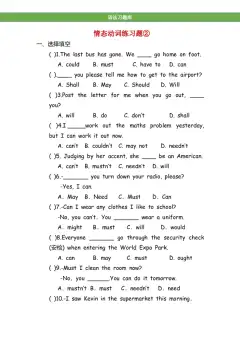
4. You ______ finish it today. There's no hurry.
A. mustn't B. needn't C. can't D. shouldn't
5. He ______ be at home. I saw him in the library just now.
A. must B. can't C. may D. should
二、动词时态(第 6–15 题)
6. My father ______ to work by bus every day.
A. go B. goes C. going D. went
7. We ______ the science museum last Sunday.
A. visit B. visited C. have visited D. will visit
8. Listen! Someone ______ in the next room.
A. sings B. sang C. is singing D. has sung
9. Don't worry. I ______ you as soon as I get there.
A. call B. called C. will call D. am calling
10. If it ______ tomorrow, we'll stay at home.
A. will rain B. rains C. rained D. is raining
11. — Would you like to see the film with us? — Sorry, I ______ it already.
A. see B. saw C. have seen D. had seen
12. — Have you ever been to Shanghai? — Yes. I ______ there last year.
A. have been B. went C. have gone D. go
13. By the time we arrived at the cinema, the film ______.
A. began B. has begun C. had begun D. begins
14. At nine o'clock last night, I ______ TV with my family.
A. watch B. watched C. was watching D. have watched
15. Look at the dark clouds. It ______ rain soon.
A. is going to B. was going to C. has D. would
三、动词的语态(第 16–20 题)
16. English ______ all over the world.
A. speaks B. is spoken C. spoke D. is speaking
17. The bridge ______ in 1990.
A. built B. was built C. is built D. has built
18. The work ______ already. Let's go home.
A. has finished B. has been finished C. is finishing D. was finishing
19. This must ______ today. We have no time to waste.
A. do B. be done C. be doing D. done
20. This kind of shirt ______ well and it's very popular.
A. is sold B. sells C. sold D. is selling
四、非谓语动词(第 21–25 题)
21. He got up early ______ the first bus.
A. catch B. to catch C. catching D. caught
22. My brother enjoys ______ to music after school.
A. listen B. listening C. to listen D. listened
23. The boy ______ Tom is my best friend.
A. calling B. called C. to call D. calls
24. The man ______ under the tree is our English teacher.
A. stand B. stood C. standing D. to stand
25. She wants ______ a teacher when she grows up.
A. be B. being C. to be D. been
五、主谓一致(第 26–28 题)
26. The number of students in our school ______ about 1,000.
A. is B. are C. were D. be
27. Neither Tom nor his parents ______ at home now.
A. is B. are C. was D. has been
28. There ______ a pen and two books on the desk.
A. is B. are C. have D. has
六、动词短语与固定搭配(第 29–30 题)
29. Don't ______! You're almost there.
A. give up B. give in C. give out D. give away
30. He is good at ______ and he wants to join the swimming club.
A. swim B. swimming C. to swim D. swam
附加题 ______ books is his hobby.
A. Read B. Reading C. To reading D. Reads
参考答案与解析
1、B,discuss 是及物动词,必须带宾语(discuss the plan)。arrive、happen、rise 都是不及物动词,不能直接带宾语;
2、A,taste 在此作感官系动词,后接形容词 delicious,不用被动、不用副词;
3、A,do 可作助动词构成疑问句和否定句(Do you...? / I don't...)。run、take、hope 都是实义动词;
4、B,needn't = 不必(There's no hurry 提示无必要)。mustn't 表"禁止",与语境不符;
5、B,否定推测用 can't(不可能):既然刚才在图书馆见过,他不可能在家。must 只用于肯定推测。对比:He must be at home.(他一定在家);
6、B,every day 提示一般现在时;主语 My father 是第三人称单数 → goes;
7、B,last Sunday 是确指过去时间,只能搭配一般过去时;
8、C,Listen! 提示动作正在进行 → 现在进行时 is singing;
9、C,as soon as 引导时间状语从句用一般现在时表将来,主句用一般将来时 → will call(主将从现);
10、B,if 引导条件状语从句,"主将从现":从句用一般现在时 rains;
11、C,already 与"对现在的影响"(已经看过,不用再看)→ 现在完成时 have seen;
12、B,last year 是确指过去时间 → 一般过去时。这是"现在完成时 vs 一般过去时"的经典考点:现在完成时不能与 last year、yesterday 等连用;
13、C,By the time + 过去时,主句表示"过去的过去"→ 过去完成时 had begun;
14、C,at nine last night 是过去某一时刻 → 过去进行时 was watching;
15、A,有迹象(乌云)预示即将发生 → be going to(区别于 will 的单纯预测);
16、B,English 是动作的承受者 → 被动 is spoken。语言类主语用被动是固定考法;
17、B,桥是"被建造"的,且时间是 1990 → 一般过去时的被动 was built;
18、B,现在完成时被动:has been + 过去分词 → has been finished;
19、B,情态动词被动:must be + 过去分词 → must be done;
20、B,描述商品的性能特征用主动形式表被动意义:This shirt sells well。(对比:The shirt was sold yesterday. 表"被卖出"的动作);
21、B,不定式作目的状语:早起的目的是赶上第一班车 → to catch;
22、B,enjoy 后只接动名词:enjoy doing。同类:finish, mind, practise, suggest, keep;
23、B,boy 和 call 是被动关系(被叫做)→ 过去分词作定语 called Tom;
24、C,man 和 stand 是主动关系(他站着)→ 现在分词作定语 standing;
25、C,want 后接不定式:want to do。同类:hope, decide, plan, would like;
26、A,the number of(……的数量)作主语,谓语用单数 is。对比:a number of(许多)作主语用复数;
27、B,neither... nor... 遵循就近原则:靠近谓语的 parents 是复数 → are;
28、A,There be 句型同样遵循就近原则:靠近的 a pen 是单数 → is;
29、A,give up 放弃(You're almost there 提示是"别放弃")。give in 屈服、give out 分发/耗尽、give away 送掉/泄露;
30、B,be good at 后接动名词:be good at doing;
附加:B,动名词作主语:Reading books is his hobby(谓语用单数 is);
五条核心规律总结
every day, usually, often | 一般现在时 | |
last week, in 1990, ago | 一般过去时 | |
Listen! / Look! / now | ||
tomorrow, next week, in two days | ||
already, yet, ever, since, for, so far | ||
by the time + 过去时 | ||
at 9 last night |
2. 两个必考时态陷阱
- 主将从现:
- 现在完成时不与确指过去时间连用:
3. 被动语态的公式:be + 过去分词,be 的时态跟着主语走
4. 非谓语动词的"三选一"判断法
表目的、将来(want, hope, decide, 作目的状语)→ to do
与逻辑主语是主动关系(正在做)→ doing
与逻辑主语是被动关系(被做)→ done
记住只接 doing 的动词:enjoy, finish, mind, practise, keep, suggest
5. 主谓一致的两个"陷阱点"
- the number of → 单数;a number of → 复数
- 就近原则:There be 句型、neither...nor... / either...or... / not only...but also... 以靠近谓语的那个主语为准