ARTICLE · 1177084
AI机柜冷却:每英寸多少片翅片?
AI机柜冷却:每英寸多少片翅片?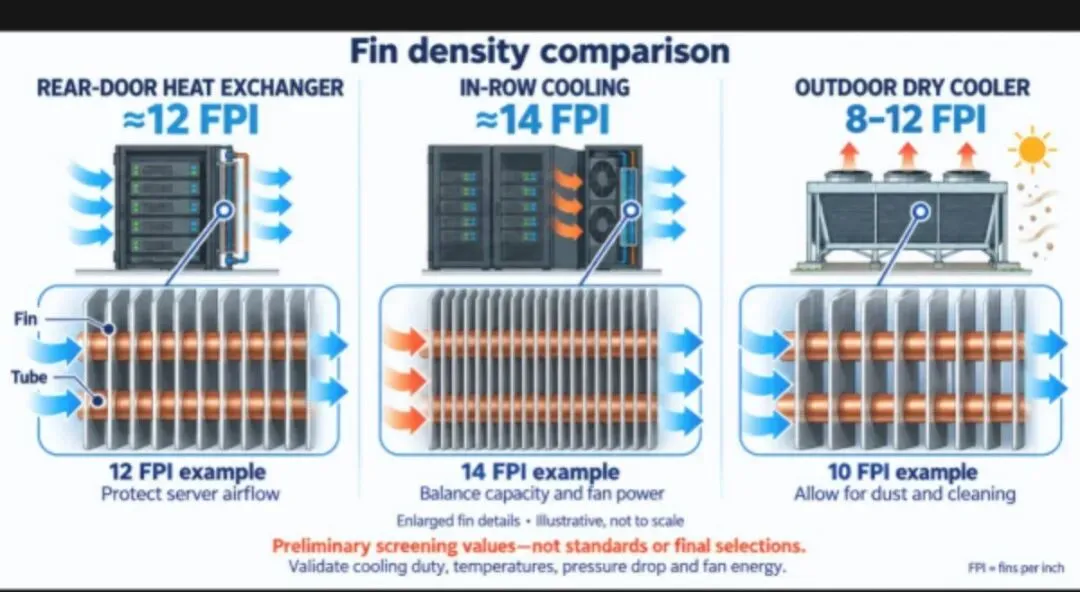
AI Rack Cooling: How Many Fins per Inch? AI机柜冷却:每英寸多少片翅片? More fins do not automatically mean better cooling. 翅片数量更多,并不自动代表冷却效果更好。 Fin density—measured in fins per inch (FPI)—affects heat-transfer area, airflow resistance, fan energy, and cleaning requirements. 翅片密度,单位为每英寸翅片数(FPI),会影响换热面积、气流阻力、风机能耗以及清洁维护要求。 For an initial supplier comparison, consider these starting points. 在初步对比供应商时,可以参考以下基准参数。 These are engineering screening values, not industry standards or validated final specifications. 这些只是工程筛选参考值,并非行业标准或是经过验证的最终技术规格。 Rear-door heat exchanger: start around 12 FPI 后门式换热器:初始参考值约12 FPI Compare 10, 12, and 14 FPI. 对比10、12、14 FPI这几个参数。 The priority is removing rack exhaust heat while preserving server airflow. 优先目标是带走机柜排出的热量,同时保证服务器的气流正常。 Passive rear doors depend on server fans, making coil pressure drop especially important. 被动式后门依靠服务器自带风机,因此盘管的压降尤为关键。 Active doors add dedicated fans, changing the available pressure budget. 主动式后门配置独立风机,会改变可用压力余量。 Evaluate heat removal, airflow, and combined server-and-door fan power. 需要评估散热能力、气流状态,以及服务器+后门风机的总功耗。 In-row cooling coil: start around 14 FPI 列间冷却盘管:初始参考值约14 FPI Compare 12, 14, and 16 FPI. 对比12、14、16 FPI这几个参数。 Dedicated fans and a compact footprint can make higher fin density practical. 独立风机加上紧凑占地空间,让更高翅片密度具备可行性。 However, additional surface area must justify the increased airflow resistance. 但是增加的换热面积,必须能够抵消气流阻力上升带来的负面影响。 Check cooling capacity and fan power with filter loading included. 计算冷却容量与风机功耗时,要把滤网积尘的工况纳入考量。 If condensation occurs, assess wet-coil pressure drop, drainage, and moisture carryover. 如果出现凝露,需要评估湿盘管压降、排水能力以及水汽夹带问题。 Outdoor dry cooler: initially evaluate 8–12 FPI 室外干冷器:初步评估范围8–12 FPI Compare 8, 10, and 12 FPI. 对比8、10、12 FPI这几个参数。 Outdoor exposure makes dust, pollen, and cleaning access major design considerations. 设备露天布置,灰尘、花粉以及清洁可达性是主要设计考量因素。 Wider fin spacing can improve fouling tolerance, but may require a larger coil to meet the same cooling duty. 更大的翅片间距可以提升抗积污能力,但可能需要更大尺寸盘管才能满足同等制冷负荷。 Select against actual summer ambient temperature, coolant temperature, glycol concentration, noise limits, and maintenance conditions. 选型需要依据夏季实际环境温度、冷却液温度、乙二醇浓度、噪音限值以及维护条件。 These components serve different roles. 这些部件承担着不同的功能。 Rear-door and in-row units collect heat inside the data hall. 后门冷却单元与列间单元在数据机房内部收集热量。 Outdoor dry coolers reject heat to the environment. 室外干冷器将热量排放到外界环境。 They can operate within the same cooling architecture, with different fin densities selected for each duty. 它们可以在同一套冷却架构下运行,针对不同负荷选用不同的翅片密度。 For hybrid AI racks, size the air-side coil for the heat remaining in the air after direct-to-chip cooling. 对于混合式AI机柜,风侧盘管需要按照芯片直冷之后空气中剩余的热量来选型。 The selection target: required cooling capacity at acceptable pressure drop, energy use, and serviceability. 选型目标:在可接受的压降、能耗以及可维护性前提下,满足所需制冷容量。 #DataCenter #AIInfrastructure #Cooling #数据中心 #AI基础设施 #冷却 #ThermalManagement #LiquidCooling #热管理 #液冷 重点词汇和短语(美式音标) - fin /fɪn/ n. 翅片 - fin density /fɪn ˈdensəti/ n. 翅片密度 - heat-transfer /hiːt trænsˈfɜːr/ n. 传热,换热 - airflow resistance /ˈerfloʊ rɪˈzɪstəns/ n. 气流阻力 - rear-door heat exchanger /rɪr dɔːr hiːt ɪksˈtʃeɪndʒər/ n. 后门式换热器 - in-row cooling /ɪn roʊ ˈkuːlɪŋ/ n. 列间冷却 - coil /kɔɪl/ n. 盘管 - pressure drop /ˈpreʃər drɑːp/ n. 压力损失,压降 - dry cooler /draɪ ˈkuːlər/ n. 干冷器 - fouling /ˈfaʊlɪŋ/ n. 积污,结垢 - condensation /ˌkɑːndenˈseɪʃn/ n. 凝露,冷凝 - glycol /ˈɡlaɪkɔːl/ n. 乙二醇 - ambient temperature /ˈæmbiənt ˈtemprətʃər/ n. 环境温度 - serviceability /ˌsɜːrvɪsəˈbɪləti/ n. 可维护性 - thermal management /ˈθɜːrml ˈmænɪdʒmənt/ n. 热管理 - direct-to-chip /dəˈrekt tu tʃɪp/ adj. 芯片直冷的