ARTICLE · 1183591
高中英语句型转换全攻略(六大类型+公式+练习,建议收藏!)
英语考试中,有一类题让无数同学又爱又恨:
爱它,因为只要掌握规律,10秒就能写出答案; 恨它,因为一个细节写错,整道题就全扣光了。
它就是——句型转换。
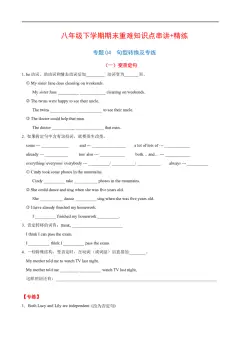
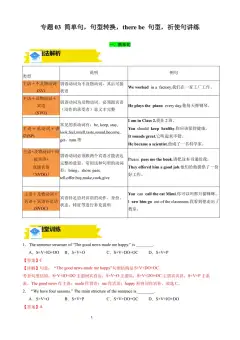
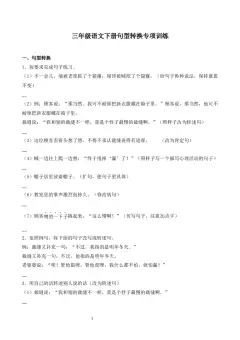
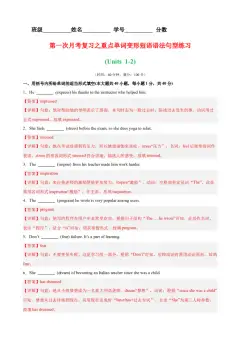
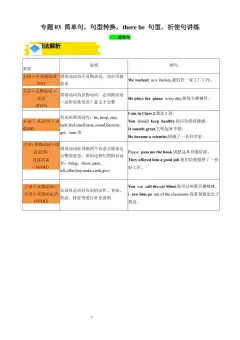
句型转换是高考英语和各地模拟考的必考题型,也是提升写作水平的核心技能。一个能把句子"翻来覆去"说的人,无论在阅读、完形还是写作中,都能游刃有余。
本文系统整理了高中阶段六大句型转换类型,每种都给出转换公式 + 大量实例 + 易错提示。收藏这篇,句型转换从此不再丢分!

📖 本文内容导航
📌 第一型:主动句 ↔ 被动句(及物动词的语态转换)
📌 第二型:直接引语 → 间接引语(宾语从句的综合应用)
📌 第三型:肯定句 ↔ 否定句(否定转移与否定形式的切换)
📌 第四型:陈述句 ↔ 疑问句(含一般/特殊/反意疑问句三大类)
📌 第五型:简单句 ↔ 复合句(合并与拆分)
📌 第六型:特殊句型转换(There be / It / 感叹句 / 虚拟语气句型)
📌 第一型:主动句 ↔ 被动句
这是最基础、最常见的句型转换。记住"主宾互换,动词变 be + 过去分词,时态保持不变"。
🔑 核心转换公式
主动句 → 被动句:
原宾语 + be + 过去分词 + by + 原主语(by 可省略)
被动句 → 主动句:
原主语(原by后的名词)+ 谓语动词(还原)+ 原宾语
📝 各时态被动语态公式一览
| 时态 | 主动句谓语 | 被动句谓语 |
|---|---|---|
💡 详细例句讲解
1. 一般现在时
主动: The teacher teaches us English every day. 被动: We are taught English by the teacher every day.
🔸 翻译:老师每天教我们英语。→ 我们每天被老师教英语。 🔸 分析:teaches → are taught(主宾互换,动词 be 化)
2. 一般过去时
主动: Someone stole my bike last night. 被动: My bike was stolen by someone last night.
🔸 翻译:昨晚有人偷了我的自行车。→ 昨晚我的自行车被人偷了。 🔸 分析:stole → was stolen,last night 提示一般过去时
3. 现在完成时
主动: They have built a new bridge. 被动: A new bridge has been built by them.
🔸 翻译:他们建了一座新桥。→ 一座新桥已经被他们建好了。
4. 含情态动词
主动: We must finish the work today. 被动: The work must be finished today.
🔸 翻译:我们必须今天完成这项工作。→ 这项工作必须今天被完成。 🔸 分析:情态动词 + 动词原形 → 情态动词 + be + 过去分词
5. 双宾语动词(两个方向)
有些动词带两个宾语(直接宾语 + 间接宾语),变被动时两个宾语都可以作主语:
主动: She gave me a book.
被动方向①(人作主语):I was given a book by her. 被动方向②(物作主语):A book was given to me by her.
🔸 注意:give 类动词(give, send, show, tell, offer, bring)用 to 连接;buy, make, get, find 用 for 连接。 🔸 例:She bought me a dress. → I was bought a dress by her. / A dress was bought for me by her.
6. 宾补句型(谓语动词 + 宾语 + 宾补)
主动: We call him Tom. 被动: He is called Tom by us.
🔸 翻译:我们叫他Tom。→ 他被我们叫Tom。 🔸 注意:感官动词和使役动词在主动句中省略 to,但变被动后要还原 to:
主动:We saw him enter the room.(see sb. do → 省略 to)
被动:He was seen to enter the room.(by us 省略)
7. 短语动词的被动
主动: We must look after the children. 被动: The children must be looked after by us.
🔸 注意:短语动词(look after)变被动,整个短语不能拆分,必须作为一个整体。
⚠️ 被动语态易错清单
| 易错点 | 错误写法 | 正确写法 |
|---|---|---|
📌 第二型:直接引语 → 间接引语
直接引语变间接引语,本质上是把"人说的话"用"叙述者的口吻"转述,核心规则是——人称、时态、时间状语、地点状语、方向"四游移"。
🔑 核心转换公式
引述动词 + that + [人称变化] + [时态退后] + [状语调整]
💡 人称"游移"规则
| 直接引语 | 间接引语 | 规则 |
|---|---|---|
💡 记忆口诀:“一随主,二随宾,三不变”
谁说的"我",引述者转述时就变成"他/她"
谁说的"你",引述者转述时就变成"我"
提到第三方,不变
例: Tom said, “I am happy.” → Tom said that he was happy.
例: She said to me, “You are right.” → She told me that I was right.
💡 时态"退后"规则(如果引述动词是过去时)
| 直接引语时态 | 间接引语时态 | 条件 |
|---|---|---|
⚠️ 不变规则:如果直接引语描述客观事实、普遍真理,或引述动词是现在时/现在完成时,时态不变。
例:The teacher said, “The earth moves around the sun.” → The teacher said that the earth moves around the sun.(普遍真理,时态不变)
💡 时间状语"游移"规则
| 直接引语(说这句话时) | 间接引语(转述时) |
|---|---|
💡 详细例句讲解
1. 陈述句(that 引导)
She said, “I am reading a book.” → She said that she was reading a book.
🔸 翻译:她说:“我在读书。” → 她说她当时在读书。
2. 一般疑问句(if / whether 引导)
He asked me, “Do you know her?” → He asked me if / whether I knew her.
🔸 翻译:他问我:“你认识她吗?” → 他问我是否认识她。 🔸 规则:一般疑问句变间接引语,用 if 或 whether 引导,疑问语序变为陈述语序。
3. 特殊疑问句(疑问词引导)
The teacher asked, “Where did you go yesterday?” → The teacher asked where I had gone the day before.
🔸 翻译:老师问:“你昨天去哪里了?” → 老师问我前一天去哪里了。 🔸 规则:保留疑问词(where/when/what/who 等),语序变为陈述语序。
4. 祈使句(to do 形式)
Mother said to me, “Don’t play with fire.” → Mother told me not to play with fire.
🔸 翻译:妈妈对我说:“不要玩火。” → 妈妈告诉不要玩火。 🔸 规则:肯定祈使句 → to do;否定祈使句 → not to do;引述动词用 tell / ask / order / command / warn 等。
肯定祈使句例: “Please help me,” he said. → He asked me to help him.
5. 选择疑问句(whether…or 引导)
He asked, “Will you go by train or by bus?” → He asked me whether I would go by train or by bus.
🔸 规则:选择疑问句用 whether…or 引导,不用 if。
6. 含情态动词的陈述句
“I can speak English,” she said. → She said that she could speak English.
🔸 注意:could/might/should/would 在间接引语中通常不变,因为它们本身已经是过去形式。
⚠️ 直接引语变间接引语易错清单
| 易错点 | 错误 | 正确 |
|---|---|---|
📌 第三型:肯定句 ↔ 否定句
肯定句变否定句,是初中到高中都必考的题型。核心是找准否定词的位置,以及"否定转移"现象。
🔑 核心转换规则
1. 加 not 否定谓语(最基础)
| 谓语动词类型 | 否定方式 | 例句 |
|---|---|---|
2. 部分否定与全部否定
| 结构 | 含义 | 例句 |
|---|---|---|
⚠️ 易混淆:
All that glitters is not gold.(闪闪发光的不一定都是金子。——部分否定)
None of them came.(他们都没来。——全部否定)
3. 否定转移(肯定句变否定句的特殊情况)
某些表示"推测/相信/认为"的动词,变否定时否定意义会转移到主句,而不是从句:
I think he is right. → I don’t think he is right.(我以为他不对。)
I believe she will come. → I don’t believe she will come.(我以为她不会来。)
I suppose they know the truth. → I don’t suppose they know the truth.
🔸 类似的词:think / believe / expect / imagine / feel / suppose / guess
4. no 与 not 的区别
| 结构 | 用法 | 例句 |
|---|---|---|
5. hardly / never / seldom 等半否定词
| 词 | 含义 | 程度 |
|---|---|---|
🔸 半否定词 + 肯定动词 ≠ 完全否定,但在句中语气已经很强烈。 🔸 半否定词 + 半否定词 = 完全否定:Hardly anyone came. = Almost no one came. = 几乎没人来。
6. too…to 与 not…enough to 的互换
肯定句 → 否定句:
He is too young to go to school.(他太小了不能上学。) → He is not old enough to go to school.(他不够大到可以上学。)
否定句 → 肯定句:
She cannot speak French.(她不会说法语。) → She is unable to speak French.(她无法语说法语。)
7. 复合句中的否定转移
| 原句(肯定) | 否定句转换 |
|---|---|
| No one | |
| Nothing |
📌 第四型:陈述句 ↔ 疑问句
疑问句分为三类:一般疑问句(Yes/No问)、特殊疑问句(疑问词问)、反意疑问句(前肯后否/前否后肯)。
🔑 核心转换规则
1. 陈述句 → 一般疑问句
规则: 把 be 动词 / 情态动词 / 助动词(do/did/does/will/would/have/has/had)提前到句首,句末加问号。
| 陈述句 | 一般疑问句 |
|---|---|
| Is | |
| Can | |
| Does | |
| Have | |
| Was |
2. 特殊疑问句
| 陈述句 | 特殊疑问句(用疑问词) |
|---|---|
| When | |
| What | |
| Where | |
| Who | |
| How much | |
| How | |
| How long |
疑问词分类:
| 疑问词 | 问什么 | 例句 |
|---|---|---|
3. 反意疑问句
核心规则:前肯后否,前否后肯。
规则一:基本规则
| 前半句 | 后半句 | 例子 |
|---|---|---|
规则二:祈使句后的反意疑问
| 祈使句类型 | 反意疑问 | 例句 |
|---|---|---|
| will you / would you / can you | ||
| will you | ||
| shall we | ||
| will you |
规则三:含否定词的陈述句
I have no money, do I?(前否后肯) Nothing is impossible, is it?(前否后肯)
规则四:must/have to 的反意疑问
| 句型 | 反意疑问 | 例句 |
|---|---|---|
规则五:I think/believe 等后的反意疑问
I think she is right, isn’t she?(注意:反意疑问针对的是宾语从句,不是主句) I don’t think he knows, does he?(前否后肯,且否定前移了)
4. 复合句的反意疑问
规则:反意疑问针对主句的谓语部分。
What he said is true, isn’t it?(主句的主语是 What,指代一件事) That is the man who helped me, isn’t he?(主句 is the man,从句 who helped me 是定语从句)
📌 第五型:简单句 ↔ 复合句
把两个简单句合并成一个复合句,或把一个复合句拆分成简单句,是句型转换的高阶题型。
🔑 核心转换方式
1. 用并列连词合并(简单句 → 复合句)
| 并列连词 | 含义 | 公式 |
|---|---|---|
例: He is tall. He is not strong. → He is tall but not strong.
例: Study hard. You will fail. → Study hard, or you will fail.(用 or 表示"否则")
2. 用从属连词合并(简单句 → 复合句)
| 从属连词 | 类型 | 公式 |
|---|---|---|
例: He didn’t go to school. He was ill. → He didn’t go to school because he was ill.
例: It was raining. We still went out. → Although it was raining, we still went out.
3. 定语从句合并
规则:找两个句子中指代同一事物/人的名词→ 用关系代词连接。
例: The girl is my sister. She is wearing a red dress. → The girl who is wearing a red dress is my sister.
例: This is the school. I studied there. → This is the school where I studied.
4. 名词性从句合并
规则:把一个陈述句变为 that 引导的从句,充当主语/宾语/表语。
例: He is honest. Everyone knows it. → Everyone knows that he is honest.
例: The earth moves around the sun. It is known. → That the earth moves around the sun is known.
5. 状语从句合并
例: I got up early. I caught the first bus. → I got up early so that I caught the first bus. → I got up early in order to catch the first bus. → So that I could catch the first bus, I got up early.
6. 复合句 → 简单句(使用非谓语动词)
把含 because / although / if / when 等从句的复合句,转换为简单句:
| 复合句 | 简单句转换 |
|---|---|
| Being ill | |
| Working hard | |
🔸 转换技巧:
because + 主语 + was/were → Being + …(主动/进行)
because + 主语 + 动词 → Having + 过去分词(被动/完成)
so…that… → enough to do / too…to…
If + 主语 + will/would → 祈使句 + and/or + 含 will 的句子
📌 第六型:特殊句型转换
🔑 1. There be 句型
基本结构
There is / are + 主语 + 地点/时间状语
与 have 的区别
| 句型 | 含义 | 例句 |
|---|---|---|
转换规则
There be → It is…(强调具体事物):
There is a beautiful park in our city. → It is a beautiful park in our city.(it 强调地点) → The park in our city is beautiful.(名词提前)
There be 的时态变化:
| 时态 | 句型 |
|---|---|
There be 复合句:
There are many people who like music. → Many people who like music are there.(不常用) → Those who like music are many.(用 those 替代)
🔑 2. It 句型转换
it 作形式主语
To learn English is important. → It is important to learn English. → It is important that we learn English.
🔸 翻译:学英语很重要。
it 作形式宾语
I find it difficult to learn English. → I find that it is difficult to learn English.
🔸 翻译:我发现学英语很难。
it 表时间/距离/天气
Three years have passed since we met. → It is three years since we met.(It is + 时间段 + since…) → It has been three years since we met.
🔸 翻译:我们见面已经三年了。
🔑 3. 感叹句 ↔ 陈述句
what 感叹句
What a beautiful flower (it is)! → It is a beautiful flower. → The flower is beautiful.
🔸 公式:What + (a/an) + 形容词 + 名词 + (it is)! = 主语 + be + 形容词 + (名词)!
how 感叹句
How hard he works! → He works hard.
🔸 公式:How + 形容词/副词 + 主语 + 谓语!
转换练习
| 陈述句 | how 感叹句 | what 感叹句 |
|---|---|---|
🔑 4. 虚拟语气句型转换
if 条件句 → 含蓄虚拟
If I had time, I would help you. → With time, I would help you.(含蓄虚拟,用 with) → If I had time, I would help you. = I would help you if I had time.(语序调整)
🔸 公式:
与现在相反:if + 主语 + were/did → would/could/might + do
与过去相反:if + 主语 + had done → would/could/might + have done
与将来相反:if + 主语 + were to do / should do → would/could/might + do
省略 if 的倒装句
If I were you, I would take the job. → Were I you, I would take the job.(were 提前,省略 if)
If I had studied harder, I would have passed. → Had I studied harder, I would have passed.(had 提前)
If it should rain, we would stay home. → Should it rain, we would stay home.(should 提前)
动词后的虚拟(should)+ do
He suggested that we (should) go early. → He suggested going early.(动名词形式,should 省略)
🔸 接 (should) + 动词原形 的动词: suggest, demand, insist, require, request, order, recommend, advise
🔸 口诀:“一坚持(insist)二命令(order, command)三建议(suggest, advise, recommend)四要求(require, demand, request)”
🔑 5. 倒装句转换
部分倒装 → 陈述语序
| 部分倒装 | 陈述语序 |
|---|---|
完全倒装 → 主谓正常语序
| 完全倒装 | 正常语序 |
|---|---|
🔸 完全倒装的条件:地点副词(here/there/in/out/up)放句首 + 主语是名词(不是代词)→ 主谓完全倒置。 🔸 如果主语是代词,不倒装:Here it comes.(不说 Comes it here.)
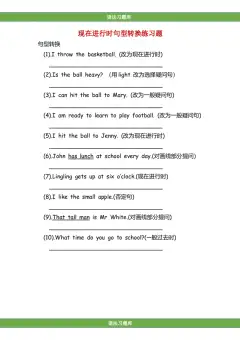
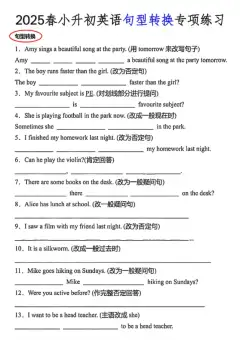
📝 综合练习(20题·含答案)
学完全部六大类型,来检验一下学习成果吧!
【第一型·主动句变被动句】
1. The teacher praised Tom for his hard work. → ________________________________________
2. Someone is using the computer now. → ________________________________________
3. We should finish the task before 6 pm. → ________________________________________
【第二型·直接引语变间接引语】
4. “I will come tomorrow,” she said. → She said ________________________________________
5. He asked, “Where did you buy this book?” → He asked ________________________________________
6. “Don’t be late again!” the boss said to him. → The boss told him ________________________________________
【第三型·肯定句变否定句】
7. Both of them are clever. → ________________________________________(改为全部否定)
8. I think he is right. → I ________________________________________ right.(否定转移)
【第四型·陈述句变疑问句】
9. She likes playing the piano. → ________________________________________?(一般疑问句)
10. He has lived here since 2020. → ________________________________________?(对划线部分提问)
【第五型·简单句合并为复合句】
11. He was tired. He still kept walking. → He was tired, ________________________________________
12. She studied hard. She could pass the exam. → ________________________________________
【第六型·特殊句型】
13. The movie is so interesting. Everyone likes it. → The movie is ________________________________________
14. I have never seen such a beautiful flower. → ________________________________________ seen such a beautiful flower.(部分倒装变陈述)
15. If I were you, I would accept the offer. → ________________________________________(省略 if,用倒装)
【综合转换题】
16. The rain prevented us from going out.(改为被动句) → ________________________________________
17. “Are you coming to the party?” he asked me.(变为间接引语) → He asked me ________________________________________
18. It is necessary that every student takes the exam seriously. → Every student ________________________________________ necessary to take the exam seriously.(改为真实语气)
19. He didn’t come because he was ill.(改为复合句,用 although) → ________________________________________
20. How beautiful the sunset is!(改为 what 感叹句) → ________________________________________
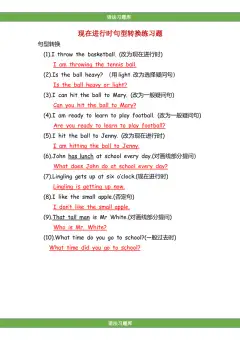
✅ 参考答案
1. Tom was praised by the teacher for his hard work.
2. The computer is being used now.(现在进行时被动:is/are + being + done)
3. The task should be finished before 6 pm.
4. She said that she would come the next/following day.
5. He asked where I had bought that book.
6. The boss told him not to be late again.
7. Neither of them is clever. / None of them is clever.
8. I don’t think he is right.
9. Does she like playing the piano?
10. How long has he lived here?
11. He was tired, yet/but he still kept walking.
12. If she studied hard, she could pass the exam. / She studied hard so that/in order that she could pass the exam.
13. interesting enough for everyone to like
14. I have never such a beautiful flower seen.(倒装还原:I have never seen such a beautiful flower.)
15. Were I you, I would accept the offer.
16. We were prevented from going out by the rain.
17. He asked me if/whether I was coming to the party.
18. Every student is considered/regarded as necessary to take…(It is necessary that… 本身就是虚拟语气用 should,但转陈述语气直接 is)
19. Although he was ill, he didn’t come.
20. What a beautiful sunset (it is)! / What beautiful scenery!
🏆 句型转换核心技巧总结
1. 先判断类型:主动/被动?直引/间引?肯定/否定?陈述/疑问?简单句/复合句?先读句子,判断属于哪种转换,再回忆对应规则。
2. 主宾互换 + 动词变位:主动变被动,最核心是"主语变宾语,宾语变主语,动词变成 be + 过去分词"。
3. 间引语的"四游移":人称随引述者移动,时态退后(过去时引述动词),时间地点状语相应调整(now→then, here→there)。
4. 反意疑问"前肯后否":牢记前肯后否、前否后肯的基本原则,祈使句后用 will you,I think 类针对宾语从句提问。
5. 合并简单句看关键词:and/but/or/so → 并列连词;because/although/if/when → 从属连词;who/which/where/when → 定语从句;that → 名词性从句。
6. 倒装还原三步法:①找句首的否定词/Only/So;②还原到正常位置;③调整 be/助动词/情态动词顺序。
喜欢今天的文章,别忘了在文末右下角点个“在看”,并转发给更多人看。
声明:本文来自网络。以上图、文、视频,贵在分享,版权归原作者及原出处所有,内容为作者观点,并不代表本公众号赞同其观点和对其真实性负责。如涉及版权等问题,请及时与我们联系.
喜欢今天的文章,别忘了在文末右下角点个“在看”,并转发给更多人看。
声明:本文来自网络。以上图、文、视频,贵在分享,版权归原作者及原出处所有,内容为作者观点,并不代表本公众号赞同其观点和对其真实性负责。如涉及版权等问题,请及时与我们联系.
中小学生英语学习必备的公众号
微信扫一扫或长按二维码即可识别关注