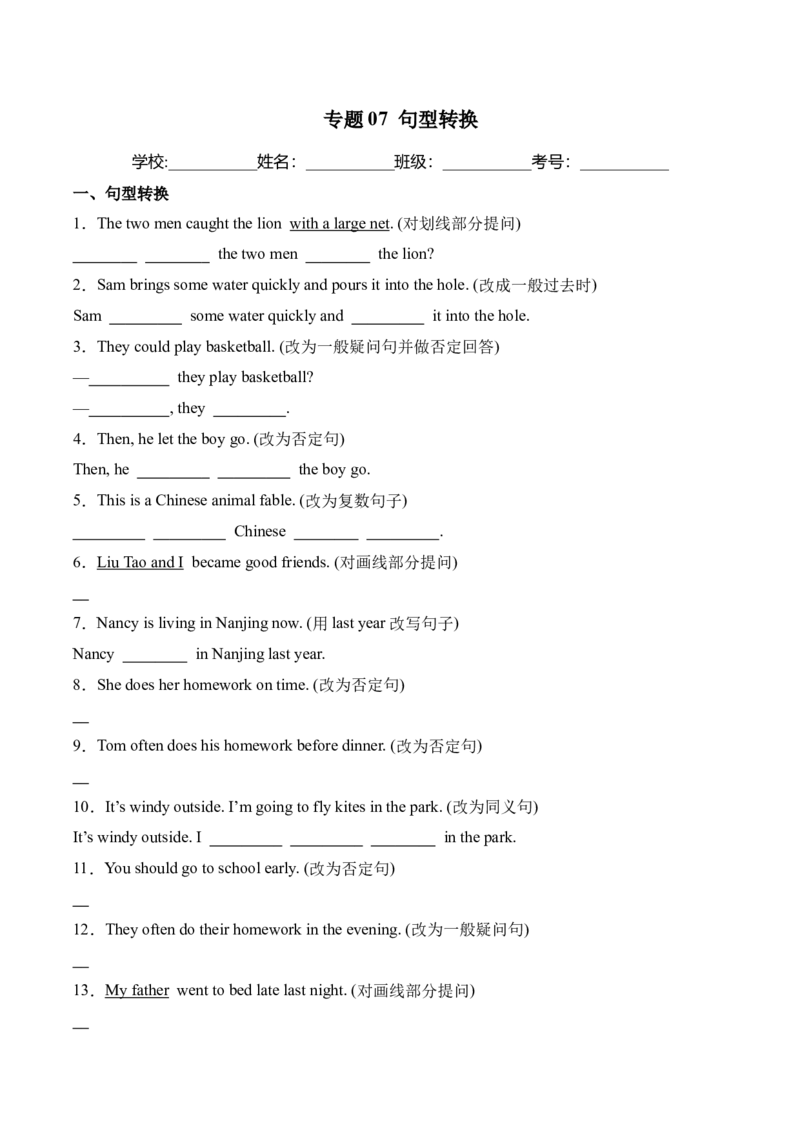
文档文本内容
专题07 句型转换
学校:___________姓名:___________班级:___________考号:___________
一、句型转换
1.The two men caught the lion with a large net. (对划线部分提问)
the two men the lion?
2.Sam brings some water quickly and pours it into the hole. (改成一般过去时)
Sam some water quickly and it into the hole.
3.They could play basketball. (改为一般疑问句并做否定回答)
— they play basketball?
— , they .
4.Then, he let the boy go. (改为否定句)
Then, he the boy go.
5.This is a Chinese animal fable. (改为复数句子)
Chinese .
6.Liu Tao and I became good friends. (对画线部分提问)
7.Nancy is living in Nanjing now. (用last year改写句子)
Nancy in Nanjing last year.
8.She does her homework on time. (改为否定句)
9.Tom often does his homework before dinner. (改为否定句)
10.It’s windy outside. I’m going to fly kites in the park. (改为同义句)
It’s windy outside. I in the park.
11.You should go to school early. (改为否定句)
12.They often do their homework in the evening. (改为一般疑问句)
13.My father went to bed late last night. (对画线部分提问)14.We do well at home. (改为一般疑问句,并作否定回答)
15.Tom often helps his mother at home. (对画线部分提问)
16.There are a few pies on the table. (对划线部分提问)
pies are there on the table?
17.There is a little mouse in her house. (对画线部分提问)
18.He has some eggs for dinner every day. (改为否定句)
19.Sometimes he eats an apple too. (改为同义句)
20.I have a lot of food every day. (改为一般疑问句,并作肯定回答)
21.Mike has a little milk for breakfast. (对画线部分提问)
22.She usually drinks a lot of water. (用yesterday改为过去式)
23.Do you want to come with me? (同义句转换)
24.Western people eat bread and milk for breakfast. (对画线部分提问)
Western people eat for breakfast?
25.We mustn’t play football on the road. (对划线部分提问)
you not on the road?
26.You mustn’t go to school because you’re sick. (对画线部分提问)
I go to school?
27.I must go to see the doctor, because I am sick. (对画线部分提问)
28.I must read quietly in the library. (对画线部分提问)29.You must not read on the road. (对画线部分提问)
30.You must play on the road. (改为否定句)
31.I often go to the park. (用 yesterday 替换 often)
32.Mike must follow the school rules. (改为一般疑问句并做肯定回答)
— Mike the school rules?
— , he .
33.Tom often goes for a walk in the park. (改为否定句)
34.My grandma often does housework at home. (改为一般疑问句)
35.There are a lot of sweets on the table. (对画线部分提问)
36.Nancy is going to the library this weekend. (对画线部分提问)
37.Nancy would like to bring some snacks to your party. (改为同义句)
38.The students are going to the park this holiday. (改成一般疑问句并做否定回答)
the students to the park this holiday?
No, they .
39.We are going to bring some snacks. (改为一般疑问句)
going to snacks?
40.Do you watch TV after school? (改为一般将来时)
you watch TV after school?
41.Please do it like that! (改为否定句)
it like that, please!
42.I’m going to school at 6:00 tomorrow. (改为一般疑问句)43.He will ask Mr Green tomorrow. (改为一般疑问句)
Mr Green tomorrow?
44.She is going to wear new clothes. (改为一般过去时)
45.I must follow the traffic rules on the road. (对画线部分提问)
46.My father will take me to Beijing. (对画线部分提问)
47.I saw many animals in Beijing Zoo. (对画线部分提问)
48.Harry Potter will be on this afternoon. (对画线部分提问)
49.My father is going to visit Ocean Park next week. (对画线部分提问)
50.I’ll show you some photos after the holiday. (改为一般疑问句,并作否定回答)
51.My father is reading a newspaper in the study now. (用last night替换now)
52.I did my homework just now. (用 tomorrow 替换 just now)
my homework tomorrow.
53.She will do her homework. (改为否定句)
She her homework.
54.David will go to the British Museum in the UK next month. (用often 替代next month)
David to the British Museum in the UK.
55.My brother is going to read books at home tonight. (对画线部分提问)
56.What does your best(最好的) friend want to do in the future? (根据实际情况回答)
57.Will the men do more sport? (改为陈述句)
58.There were some potatoes in the kitchen. (改为否定句)59.I often do well at home. (把often替换成tomorrow)
60.I want to be an astronaut in the future. (改为一般疑问句)
参考答案
1.How did catch
【详解】原句句意:那两个人用一张大网抓住了狮子。本题考查句型转换。划线部分是方式,用how提问,句子是一般过去时,助动词用did,caught变原形catch,故答案为How,
did,catch。
2.brought poured
【详解】原句句意:山姆很快带来一些水,倒进洞里。本题考查句型转换。题干要求改为一
般过去时,谓语动词改为过去式,将brings改为brought,pours改为poured,故答案为
brought;poured。
3.Could No couldn’t
【详解】原句句意:他们会打篮球。本题考查句型转换。含有助动词could的陈述句改为一
般疑问句,把could提前,其它不变;做否定回答时,用No来回答,主语they后加could
not,缩写形式为couldn’t,故答案为Could,No,couldn’t。
4.didn’t let
【详解】原句句意:然后,他让男孩走了。本题考查句型转换。题目要求改为否定句。句子
时态为一般过去时,let是实义动词,变否定句要借助助动词didn’t,是did not的缩写,let变
回原形let,故答案为didn’t,let。
5.These are animal fables
【详解】句意:这是一个中国动物寓言。本题考查句型转换。改为复数句,This的复数是
These,is的复数是are,a去掉,animal fable的复数是animal fables。故答案为These;are;
animal;fables。
6.Who became good friends?
【详解】原句句意:刘涛和我成为了好朋友。本题考查句型转换。句子是陈述句,时态为一
般过去时,画线部分是人,提问用who,放在句首,首字母要大写,其余不变,故答案为
Who became good friends?
7.lived
【详解】原句句意:南希现在住在南京。本题考查句型转换。题干要求用last year改写句
子,时态变为一般过去时,谓语动词改为过去式,将is living改为lived,故答案为lived。
8.She doesn’t do her homework on time.
【详解】原句句意:她按时做作业。本题考查句型转换。原句谓语动词does是第三人称单
数,助动词用doesn’t,does变原形do,故答案为She doesn’t do her homework on time.
9.Tom doesn’t often do his homework before dinner.
【详解】原句句意:汤姆经常晚饭前做作业。本题考查句型转换。原句谓语动词does是第三人称单数,改为否定句,助动词用doesn’t,does变原形do,故答案为Tom doesn’t often do his
homework before dinner.
10.will fly kites
【详解】原句句意:外面有风。我打算去公园放风筝。本题考查句型转换,时态是一般将来
时,结构是be going to+动词原形或will+动词原形,故答案为will,fly,kites。
11.You shouldn’t go to school early.
【详解】原句句意:你应该早点去上学。本题考查句型转换。含有情态动词should的陈述句
变为否定句,在should后加not,其它不变,should not缩写形式为shouldn’t,故答案为You
shouldn’t go to school early.
12.Do they often do their homework in the evening?
【详解】原句句意:他们经常在晚上做家庭作业。本题考查句型转换。句子是陈述句的肯定
形式,时态为一般现在时,主语是第三人称复数They,改为一般疑问句,需要借助助动词
do,故答案为Do they often do their homework in the evening?
13.Who went to bed late last night?
【详解】原句句意:我爸爸昨晚睡觉很晚。本题考查句型转换。画线部分是人,用who替
代,故答案为Who went to bed late last night?
14.Do you do well at home? No, we don’t.
【详解】原句句意:我们在家做得很好。本题考查句型转换。原句主语是we,谓语动词是
do,改为一般疑问句,主语we变you,助动词用do,否定回答是No, we don’t. 故答案为Do
you do well at home? No, we don’t.
15.What does Tom often do at home?
【详解】原句句意:汤姆经常在家帮助妈妈。本题考查句型转换。画线部分是做的事情,用
what提问,主语Tom是单数,助动词用does,做do,故答案为What does Tom often do at
home?
16.How many
【详解】原句句意:桌子上有一些馅饼。本题考查句型转换。划线部分物品数量,pies是可
数名词复数,用how many提问,故答案为How,many。
17.What is in her house?
【详解】原句句意:她家里有一只小老鼠。本题考查句型转换。画线部分是“一只小老
鼠”,用疑问词what提问,后接一般疑问句,即问:她家里有什么?be用is,故答案为What is in her house?
18.He doesn’t have any eggs for dinner every day.
【详解】原句句意:他每天晚饭吃一些鸡蛋。本题考查句型转换。句中实义动词has是第三
人称单数,所以要借助助动词does,后加not构成否定,可缩写为doesn’t ,后接动词原形,
has的原形是have,把some改为any,故答案为He doesn’t have any eggs for dinner every day.
19.Sometimes he also eats an apple.
【详解】原句句意:有时他也吃一个苹果。本题考查同义句转换。too也,用在句末,可替换
为also也,放在实义动词之前,故答案为Sometimes he also eats an apple.
20.Do you have a lot of food every day? Yes, I do.
【详解】原句句意:我每天吃很多食物。本题考查句型转换。原句主语是I,时态是一般现在
时,改为一般疑问句,I变you,助动词用do,肯定回答是Yes, I do. 故答案为Do you have a
lot of food every day? Yes, I do.
21.What does Mike have for breakfast?
【详解】句意:迈克早餐喝了一点牛奶。本题考查句型转换。画线部分是物品,对物品提问
用what,原句是一般现在时,且有实义动词has,主语是Mike是第三人称单数,因此需借助
助动词does构成疑问句,后面的动词has需还原为原形 have。故答案为What does Mike have
for breakfast?
22.She drank a lot of water yesterday.
【详解】句意:她通常喝很多水。本题考查句型转换。题干要求用yesterday改写,句子时态
改为了一般过去时,原句中的动词drinks改为过去式drank,usually通常表示习惯性动作,一
般过去时中后应去掉,句子最后加yesterday,故答案为She drank a lot of water yesterday.
23.Would you like to come with me?
【详解】句意:你想和我一起去吗?本题考查句型转换。原句“Do you want to…”是询问对
方意愿的常见句型,want与would like是同义词,其同义表达可用“Would you like to…”,故
答案为Would you like to come with me?
24.What do
【详解】原句句意:西方人吃面包和牛奶作为早餐。本题考查句型转换。由画线部分可知要
提问吃什么,用what提问。句意是:西方人吃什么作为早餐?句子是一般现在时。什么
what,句子含有实义动词,主语是Western people,在特殊疑问句中需要借助助动词do,故答
案为What;do。25.What must do
【详解】原句句意:我们不能在路上踢足球。本题考查句型转换。划线部分是不能做的事
情,用what提问,后跟must引导的一般疑问句,故答案为What,must,do。
26.Why mustn’t
【详解】原句句意:你不能去上学,因为你病了。本题考查句型转换。划线部分是“因为你
病了”,对原因提问用疑问句why,后接情态动词mustn’t,故答案为Why,mustn’t。
27.Why must you go to see the doctor?
【详解】原句句意:我一定要去看医生,因为我生病了。本题考查句型转换。题目要求对划
线部分提问。划线部分是原因,故用why提问,后跟情态动词引导的一般疑问句,故答案为
Why must you go to see the doctor?
28.What must you do in the library?
【详解】句意:我必须在图书馆里安静地阅读。本题考查句型转换。划线部分是做的事,应
用what提问,后跟情态动词must,主语you换成I,其结构为特殊疑问词+情态动词+主语+其
他。故答案为What must you do in the library?
29.What must not I do on the road?
【详解】句意:你禁止在路上看书。本题考查句型转换。划线部分是做的事,应用what提
问,并放句首大写,后跟情态动词must和not,主语you要换成I,其结构为:特殊疑问词
+情态动词+主语+其他。故答案为What must not I do on the road?
30.You mustn’t play on the road.
【详解】句意:你必须在路上玩。本题考查句型转换。改为否定句需在情态动词must后加上
not,可缩写成mustn’t,其余不变。故答案为You mustn’t play on the road。
31.I went to the park yesterday.
【详解】原句句意:我经常去公园。本题考查句型转换。原句时态为一般现在时,用
yesterday替换often,句子时态变为一般过去时,谓语动词要用动词的过去式,go的过去式为
went,yesterday昨天,做时间状语,放句尾,其余不变,故答案为I went to the park yesterday.
32.Must follow Yes must
【详解】原句句意:麦克要遵守校规。本题考查句型转换。题目要求改为一般疑问句并做肯
定回答。该句有情态动词must,变一般疑问句只需要把其放在句首,其余不变,其肯定回答
是Yes, he must.故答案为Must,follow,Yes,must。
33.Tom doesn’t often go for a walk in the park.【详解】原句句意:汤姆经常在公园里散步。本题考查句型转换。原句谓语动词goes是第三
人称单数,改为否定句,助动词用doesn’t,goes变原形go,故答案为Tom doesn’t often go for
a walk in the park.
34.Does your grandma often do housework at home?
【详解】原句句意:我奶奶经常在家做家务。本题考查句型转换。原句谓语动词does是第三
人称单数,改为一般疑问句,助动词用does,谓语动词does变原形do,my变your,故答案
为Does your grandma often do housework at home?
35.What’s on the table?
【详解】原句句意:桌子上有很多糖果。本题考查句型转换。画线部分是桌子上有的,用
what提问,问句为:桌子上有什么?故答案为What’s on the table?
36.Where is Nancy going this weekend?
【详解】原句句意:南茜这周末要去图书馆。本题考查句型转换。画线部分是地点,用
where提问,后跟is引导的一般疑问句,故答案为Where is Nancy going this weekend?
37.Nancy wants to bring some snacks to your party.
【详解】原句句意:南希想给你的聚会带些零食。本题考查同义句转换。would like可替换为
want,主语Nancy是第三人称单数,want用第三人称单数形式wants,故答案为Nancy wants
to bring some snacks to your party.
38.Are going aren’t
【详解】原句句意:学生们这个假期要去公园。本题考查句型转换。含有are的陈述句,主
语是the students,改为一般疑问句,把are提前,否定回答是No, they aren’t. 故答案为Are,
going,aren’t。
39.Are you bring any
【详解】句意:我们打算带一些零食。 本题考查句型转换,题干要求将陈述句改为一般疑问
句,可知需要将be动词are提前至句首,we变成you,some变成any,其他部分不变,故答
案为Are;you;bring;any。
40.Are going to
【详解】原句句意:你放学后看电视吗?本题考查句型转换。一般将来时结构为主语+be
going to+动词原形,主语是you,be动词用are,注意首字母大写,故答案为Are,going,
to。
41.Don’t do【详解】原句句意:请这样做!本题考查句型转换。原句是祈使句的肯定形式,改为否定
句,句子结构为:Don’t+动词原形+其他!故答案为Don’t,do。
42.Are you going to school at 6:00 tomorrow?
【详解】原句句意:我明天6点要去上学。本题考查句型转换。含有be的陈述句改为一般疑
问句,把be提前,am变are,I变you,故答案为Are you going to school at 6:00 tomorrow?
43.Will he ask
【详解】句意:他明天将问格林先生。本题考查句型转换。改为一般疑问句,把助动词will
提前放在句首,主语是he,动词ask用原形。故答案为Will;he;ask。
44.She wore new clothes.
【详解】句意:她打算穿新衣服。本题考查句型转换。原句中is going to wear是一般将来时
的结构,一般过去时动词用过去式,is going to wear改为过去式为wore。故答案为wore。
45.What must you do on the road?
【详解】句意:在路上我必须遵守交通规则。本题考查句型转换。划线部分是动词短语,用
what提问,情态动词must提前放在特殊疑问词之后,第一人称I改为第二人称you,动词短
语用do代替。故答案为What must you do on the road?
46.Who will take you to Beijing?
【详解】原句句意:我的爸爸将带我去北京。本题考查句型转换。由画线部分可知要提问是
谁,用who提问。句意是:谁将带你去北京?句子是一般将来时。谁who,将will,你you。
will后接动词原形,故答案为Who will take you to Beijing?
47.How many animals did you see in Beijing Zoo?
【详解】原句句意:我在北京动物园里看到许多动物。本题考查句型转换。由画线部分可知
要提问数量,用how many提问。句意是:你在北京动物园里看到了多少动物?句子是一般过
去时。你you,看到see,多少how many。该句是特殊疑问句,需要借助助动词did,did后接
动词原形。故答案为How many animals did you see in Beijing Zoo?
48.When will Harry Potter be on?
【详解】句意:哈利波特将在今天下午上映。本题考查句型转换,题干要求对时间状语this
afternoon进行提问,用when引导,后跟一般疑问句。故答案为When will Harry Potter be on?
49.What is your father going to do next week?
【详解】原句句意:我爸爸下周要参观海洋公园。本题考查句型转换。画线部分是将要做的
事情,用what提问,后跟is引导的一般疑问句,my变your你的,故答案为What is yourfather going to do next week?
50.Will you show me any photos after the holiday?,No, I won’t.
【详解】原句句意:我将在假期后向你展示一些照片。本题考查一般疑问句的提问及其回
答。题干含有will,变成一般疑问句将will提到句首,主语I变成you,宾语you变成me,
some变成any。will you引导的一般疑问句的否定回答是:No, I won’t.故答案为Will you show
me any photos after the holiday?;No, I won’t.
51.My father read a newspaper in the study last night.
【详解】原句句意:我的爸爸现在正在书房里看报纸。本题考查句型转换。last night“昨晚”
是一般过去时的标志,is reading变成read的过去式read,now变成last night,其余不变。故
答案为My father read a newspaper in the study last night.
52.I’ll do
【详解】原句句意:我刚才做了我的家庭作业。本题考查句型转换。根据要求用 tomorrow
替换just now,原句时态是一般过去时,改成一般将来时,结构是will+动词原形,I will缩写
成I’ll,did改成do,故答案为I’ll,do。
53.won’t do
【详解】原句句意:她将做她的家庭作业。本题考查句型转换,时态是一般将来时。变否定
句时,will变成won't,其余不变,故答案为won’t,do。
54.often goes
【详解】句意:大卫下个月将去英国的大英博物馆。本题考查句型转换,题干要求用 often
替代 next month,可知需将一般将来时改为一般现在时并调整频度副词位置,句子主语
David是第三人称单数,后面需用动词的第三人称单数goes,故答案为often;goes。
55.What is your brother going to do at home tonight?
【详解】原句句意:我的哥哥(弟弟)今晚打算在家读书。本题考查句型转换。句子是陈述
句,时态为一般将来时,画线部分是动词短语,提问用what,放在句首,首字母要大写,后
跟be动词引导的一般疑问句,my要变为your,动词短语用do代替,其余不变,故答案为
What is your brother going to do at home tonight?
56.She wants to be a teacher.
【详解】句意:你最好的朋友将来想做什么?本题考查特殊疑问句的答语。题干要求根据实
际情况回答,本题答案不唯一,答语可为:她想成为一名教师。故答案为She wants to be a
teacher.57.The men will do more sport.
【详解】原句句意:这些男士会进行更多的体育运动吗?本题考查句型转换。句子是一般将
来时,改为陈述句时,把will放在主语the men之后,其余不变,故答案为The men will do
more sport.
58.There weren’t any potatoes in the kitchen.
【详解】原句句意:在厨房里有一些土豆。本题考查句型转换。句子是there be句型的肯定形
式,变为否定句时,在be动词were后加not,缩写形式为weren’t,some变为any,其它不
变,故答案为There weren’t any potatoes in the kitchen.
59.I will do well at home tomorrow.
【详解】句意:我经常在家表现得好。本题考查句型转换。把often替换成tomorrow即把时
态改为一般将来时,结构是will+动词原形,do动词,做,用原形,故答案为I will do well at
home tomorrow.
60.Do you want to be an astronaut in the future?
【详解】原句句意:我未来想成为一名宇航员。本题考查句型转换。原句主语是I,时态是一
般现在时,改为一般疑问句,助动词用do,I变you,故答案为Do you want to be an astronaut
in the future?