ARTICLE · 1206347
2029届某师大高一10月月考试卷
命题特点:
题型对标新高考,没有短文改错,把改错的考点转化为语法填空 + 单句语法填空,夯实高一语法基础; 写作采用应用文 + 读后续写,对接新高考写作模式; 话题贴近高一学生生活,渗透情感态度价值观。
二、各板块深度分析
✅ 第一部分 听力(20 分)
话题:电影评价、校园竞选、购物、就医借书、球赛、城市旅游、电子产品采购、脱发健康科普、太空科技馆活动。 场景覆盖日常生活、校园、购物、科普独白,语速适合高一刚开学水平,每段播放两遍,降低入门难度。 考点:细节获取、数字计算、地点推断、观点态度、主旨理解。 难点:第 17‑20 独白题(科技馆介绍),信息量大,包含数字、规则、主旨,容易混淆。
✅ 第二部分 阅读理解(40 分)
A 篇(应用文)—— 酒店服务介绍
题型:广告信息类,高考阅读 A 篇经典体裁。 考点:细节理解、数字计算、文章出处推断。 第 22 题计算题:双人间一晚 + 两个成人午餐 + 10 岁儿童半价午餐,训练学生快速定位信息、处理数字。
适合刚上高一,训练快速检索信息。
B 篇(记叙文)——60 岁独自旅行追逐梦想
主题:勇敢追梦,什么时候都不晚。 题型:推理判断、细节理解、主旨大意、观点态度。 长句较多,考查对人物心理的解读,选项干扰性较强,区分度高。
C 篇(科普说明文)—— 动物的色觉
科普话题:狗、猫为色盲,猴子猿类有色觉;进化角度解释感官代偿。 考点:词义猜测(compensates for)、细节理解、事实判断。
生词有进化、感官类,训练科普文阅读能力。
D 篇(议论文)—— 完美主义的危害与自我接纳
热点话题:学生完美主义、父母施压、社交媒体攀比,非常贴合高中生现实。 考点:人物情感、细节排除、推理、标题选择。
35 题标题题是阅读难点,需要概括全文,不能只抓局部细节。
七选五(家庭会议常见错误)
主题:家庭沟通,说明文。 考点:段落主旨句、逻辑衔接代词、转折 / 因果逻辑。 干扰项迷惑性较强,重点考查段落小标题的概括能力。
✅ 第三部分 语言知识运用(30 分)
完形填空(15 分)
故事:男孩 Alex 重病失去行走能力,陷入绝望,妹妹一幅受伤小鸟的画激励他,转向绘画,战胜恐惧重新站起来。
主题:挫折、心态转变、自我相信。 词汇:必修一高频词:blow, quit, consider, concentrate, take up, overcome, define 等。 考点:动词、名词、形容词、短语、连词。 难度:中等,侧重情感逻辑,很多空需要读懂人物心理变化,而不是单纯考单词意思。
语法填空 + 单句语法填空(15 分)
语篇语法填空主题:青少年手机成瘾,合理使用电子产品。 考查点:
词性转换: addict‑addiction;anxiety;reduce非谓语;voluntary‑voluntarily;value‑have valued;spend动名词;固定搭配: find it hard to do;away from;not…but…; 单句语法填空全部是必修一 Unit1‑Unit2 核心变形:curious‑curiosity;obvious‑obviously;fright‑frightened;behave‑behaviour;responsible‑responsibility
这套语法填空非常贴合高一刚开学教学进度,重点训练词性转换,是高一上册核心重难点。
✅ 第四部分 写作(30 分)
第一节 应用文(10 分)回信
情景:李华,校英文报编辑,给 Jack 回信。Jack 高一压力大,失眠,影响学习生活。 要点:①理解安慰;②2‑3 条建议 + 理由;词数 100 左右。
体裁:建议信,必修一重点书信。 考查:安慰句式、提建议句型,逻辑连贯。
第二节 读后续写(20 分)
原文梗概:Jacky 羡慕同学名牌衣物包袋,向父母索要被拒;老师 Mrs Shirley 开导他,物质只能带来短暂快乐,鼓励参加英语演讲比赛。给出两段开头续写,150 词左右。
Para1:The next morning, Jacky made a decision. Para2:Weeks later, Jacky stood on the school stage, holding a medal. 主题:拒绝物质攀比,追求内在自我价值。
考查:心理描写、动作描写,情节逻辑闭环,情感升华。 要求:两段衔接,结尾升华主题,是新高考的典型题型。
三、试卷重难点总结
🔴 重点
阅读:应用文信息定位;记叙文人物情感推理;议论文主旨标题题;七选五逻辑。 完形:上下文情感逻辑,动词短语辨析(take up 等)。 语法:词性转换(名词、形容词、副词),固定句型 find it…,not…but…,非谓语动词。 写作:建议信格式、表达;读后续写心理与动作描写。
🟠 难点
听力独白长信息抓取; 阅读 B/D 篇推理判断题、标题题; 完形填空情感类空,需要读懂故事人物心理; 读后续写:情节合理,避免跑题,把 “放弃物质攀比、投入演讲比赛” 写完整。
四、学情与备考启示(针对高一学生)
这套卷是初高中衔接检测卷,很多学生刚上高一容易在:阅读长句、词性转换、读后续写丢分; 词汇:大量必修第一册核心词汇,做完试卷要整理完形、阅读里面的生词短语; 语法:这套卷反复考词性转换,是高一上册最大痛点,要专门练习; 阅读注意:做标题题,不能选局部细节,要覆盖全文; 读后续写:本篇要抓住主线:Jacky 不再追求名牌,投入演讲比赛,获奖,感悟内在价值。
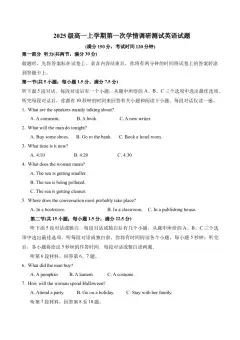
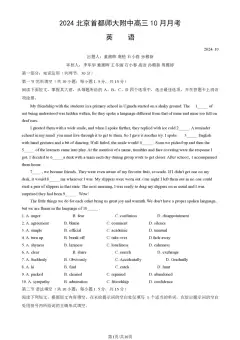
陕西师大附中2026—2027学年度第一学期
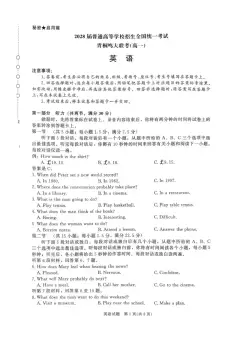
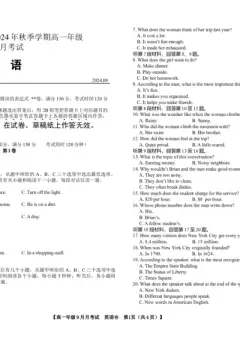
第一次月考高一年级英语试题
(考试时间:120分钟试卷满分:120分)
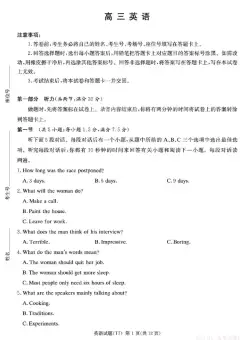
第一部分听力(共两节,满分20分)
第一节(共5小题;每小题1分,满分5分)
听下面5段录音。每段录音后有一个小题,从题中所给的A、B、C三个选项中选出最佳选项。听完每段录音后,你都有5秒钟的时间来回答有关小题和阅读下一小题。每段录音播放两遍。
1. What does the woman think of the film?
A. Boring.B. Frightening.C. Warm.
2. What is the woman doing?
A. Praising her student.
B. Attending a job interview.
C. Running for monitor.
3. How much will the man pay for each flower if he buys two?
A. 8 yuan.B. 10 yuan.C. 20 yuan.
4. Where does the conversation probably take place?
A. In a hospital.B. In a shoe store.C. In a bag shop.
5. What does the woman mean about the book?
A. She’d like the man to return it tomorrow.
B. She’s angry with the man for forgetting it.
C. She didn’t realize the man had borrowed it.
第二节(共15小题;每小题1分,满分15分)
听下面5段录音。听每段录音前,你将有时间阅读各个小题,每小题5秒钟;听完后,每小题都有5秒钟的作答时间。每段录音播放两遍。
听第6段录音,回答第6、7题。
6. Why did the woman miss the first half of the game?
A. She had to do her homework.
B. She needed to take a math class.
C. She was watching another TV show.
7. Which team will play tonight?
A. England.B. Germany.C. Argentina.
听第7段录音,回答第8、9题。
8. Where did the man see the introduction of Boston?
A. From a magazine.B. From TV.C. From a website.
9. What is the man most interested in about Boston?
A. The light traffic.B. The natural beauty.C. The rich history.
听第8段录音,回答第10至12题。
10. What does the woman want to buy?
A. Laptops.B. Printers.C. Desktops.
11. How much will the man cut off the price for the woman?
A. 15%.B. 12%.C. 10%.
12. How does the man feel at last?
A. Sorry.B. Confused.C. Satisfied.
听第9段录音,回答第13至16题。
13. What’s the probable relationship between the speakers?
A. Friends.B. Father and daughter.C. Husband and wife.
14. What problem do the speakers have in common?
A. They have problems with the paper.
B. They have headaches during their showers.
C. They are suffering from hair loss.
15. What is the doctor’s advice to the woman finally?
A. Check out her family history.
B. Take some preventive drugs.
C. Turn to online professionals.
16. How does the woman deal with the problem?
A. By taking medicine.
B. By changing her diet.
C. By talking to her father about it.
听第10段录音,回答第17至20题。
17. What can people do in the “Gravity Chair”?
A. Paint a rocket taking off.
B. Sleep in a special bed.
C. Experience the space walk.
18. What is a rule of the programs?
A. Children must build a rocket.
B. Children under nine can’t take part.
C. People are not allowed to take food in.
19. How much is the ticket for a family
A. $550.B. $875.C. $1,500.
20. What is the speaker mainly talking about?
A. Space travel.B. Camp activities.C. Astronauts’ life.
第二部分阅读(共两节,满分40分)
第一节(共15小题;每小题2分,满分30分)
阅读下列短文,从每题所给的A、B、C、D四个选项中选出最佳选项,并在答题卡上将该选项涂黑。
A
Welcome to Sunshine Hotel. To make your stay as pleasant as possible, we have prepared the following information for your reference.
Hotel Services | Details |
Front Desk | 24-hour service, luggage storage, safe deposit box |
Room Service | Available from 7:00 to 22:00 daily |
Laundry Service | Same-day service if collected before 9:00 a.m. |
Transportation | Airport pick-up ($30 each way), taxi booking |
Internet | Free Wi-Fi in all rooms and public areas |
Charges
- Single Room: $120 per night
- Double Room: $180 per night
- Breakfast: Included in room price
- Lunch & Dinner: $35 per adult, half price for children under 12.
Things to Remember
- Check-in: After 2:00 p.m. (Please present your ID card or passport.)
- Check-out: Before 12:00 noon
- Meal Times: Breakfast 6:30–9:30, Lunch 11:30–14:00, Dinner 18:00–21:00
21. What service does Sunshine Hotel offer to its guests?
A. Free airport pick-up.
B. 24-hour front desk service.
C. Free lunch for children.
D. Same-day dry cleaning.
22. How much should a couple with a 10-year-old child pay for one night in a double room and three lunches?
A. $215.
B. $232.5.
C. $250.
D. $267.5.
23. Where is this text most likely to be found?
A. In a history book.
B. In a travel guide.
C. In a science magazine.
D. In a fashion journal.
B
I have always wanted to travel alone, letting my adventurous spirit lead me. That desire stayed for several years, but family, work and duties quieted that inner voice until it was no longer heard, drowned out by routine life. I told myself I’d go “someday”, but that day never arrived, hidden under work deadlines and the comfort of a familiar life.
At 60, that voice grew louder, filled with the quiet fear that I had missed my chance to explore faraway places. Around the same time, I worked with Jack, a 30-year-old client (客户) full of the same restless energy I’d kept deep inside for a long time. He dreamed of quitting his boring job, leaving his unhappy marriage and traveling around the world to rediscover himself. Talking with him every week felt like looking in a mirror, making me face my own fears: being laughed at, being judged and giving up my safe, predictable life. Jack’s determination finally encouraged me to make plans for a six-week solo trip along Australia’s wild western coast.
When my finger hovered (悬停) over the booking button, I secretly hoped the payment would fail, giving me one more excuse to hesitate. But I knew this mix of excitement and fear was normal — something I’d seen in my clients, especially older ones who held on to safety even when it was no longer good for them. As the booking confirmation (确认) popped up, I knew stepping into uncertainty, at any age, could bring growth, confidence and joy. My family’s different reactions reminded me: courage doesn’t fade with age; it deepens, and it’s never too late to chase the dreams I once put away.
24. What can we infer about the author from the text?
A. She used to give up her dreams for daily duties.
B. She disliked talking with different clients at work.
C. She believed travelling is only for the young people.
D. She felt nothing but calm when booking the trip.
25. What can we learn about Jack from the passage?
A. He refused to make any change in his daily life.
B. He disagreed with the author’s travel decisions.
C. He travelled across Australia many times.
D. He shared similar inner feelings with the author.
26. What is the main idea of the passage?
A. Ways to plan a safe solo trip in distant countries.
B. The author’s story of chasing dreams at sixty.
C. Survey results about travelling after retirement.
D. Advice on how to help young people with life choices.
27. Which of the following statement would the author most likely agree with?
A. Fear stands in the way of one’s pursuit of dreams.
B. Youth is the only time for adventure.
C. Safety is better than all adventures.
D. It’s never too late to dream.
C
Can dogs see colors?
Man’s best friend is colorblind, but, luckily, his survival does not depend on the ability to see colors. His sharp sense of smellcompensates for his inability to see color, and enables him to tell the differences between things.
Lots of scientific tests on dogs support the idea that they live in a colorless world. The tests done mainly focused on the dogs’ responses to colors for food. Dogs could not tell the difference between one color, a signal for food, and other colors that were not for food. Similar tests that were done on cats produced similar results, which caused scientists to conclude that they, too, are colorblind and live in a gray world.
The inability of most animals to see colors, from an evolutionary (进化的) standpoint, is quite simple to understand. Many colorblind animals have dull-colored coats, and hunt for or look for food in the dark of night. Their other senses have developed to the point where the lack of color vision in no way weakens them. For them, life in a colorless world is neither a difficulty, nor a threat to their survival.
The only animals, other than man, which scientists can say for sure have color vision are monkeys and apes. Both can be trained to open a colored door, behind which is food, and man can be trained to open a refrigerator door of any color!
28. The underlined phrase “compensates for” probably means ________.
A. be different fromB. make up forC. depend onD. give in to
29. According to ________, scientists found that dogs and cats are colorblind.
A. what food they intend to eat
B. their sharp sense of smell
C. an evolutionary standpoint
D. the reaction to colors for food
30. All the following animals can tell apart different colors, EXCEPT ________.
A. lions
B. humans
C. monkeys
D. apes
31 Which of the following is NOT true about colorblind animals?
A. They often have dull-colored coats.
B. They usually hunt for food in the dark of night.
C. They can survive without any threat.
D. Their other senses may be very sensitive.
D
Hailey Magee rushed home from school crying after seeing that she’d received an A-minus on her grade report card. Growing up, she had learned that the way to receive recognition and love from family members and teachers was to be a high achiever. So to Magee, that A-minus felt like a failure. “I was heart-broken,” she said. “In that moment, I felt like my self-worth as a human had fallen far below what it would have been if I’d gotten an A or an A-plus.”
Magee’s turning a good grade into a cause of her inferiority (自卑) is a textbook example of a growing trend in recent years: perfectionist (完美主义者) behavior. Perfectionism is now a growing cultural phenomenon. High levels of perfectionism were linked with depression, anxiety, eating disorders and self-harm. The constant stress of attempting to be perfect can also leave people stressed and suffering from headaches and insomnia (失眠).
Many parents today feel a sense of competitiveness that they may push onto their kids, whether by pressuring them to get perfect grades so they can get into top schools or engaging them in after-school activities that might look good on a college application. But if a child is only rewarded for high achievement, over time they learn that their value as a person depends on being perfect. Instagram, Facebook and other social media platforms also increase unhealthy comparisons.
“It’s a real problem — those social media images end up serving as standards that people can compare themselves to and a perfectionist is always trying to be as good as others,” Sherry, a clinical psychologist, said. And it’s never been harder to keep up with other people, because today we are constantly bombarded (轰炸) with seemingly perfect images of other people’s lives. Eventually Magee learned that she had to let go a little and allow herself to show up with all her imperfections. She eventually learned to trust that she could show up, not being perfect, and still feelvalued. She said, “I can be imperfect and everything can be fine!”
32. How did Hailey Magee feel when she got an A-minus?
A. Satisfied.B. Excited.C. Disappointed.D. Uninterested.
33. Perfectionism may result in the following problems EXCEPT ________.
A. negative feelingsB. high work efficiencyC. increased stress levelsD. physical problems
34. What can we infer from Sherry’s words?
A. Social media users should avoid posting perfect-looking photos online.
B. Perfectionists tend to measure themselves against others’ online images.
C. People can easily live up to the perfect lives shown on social media.
D. Social media is designed to bring people closer to their real-life friends.
35. What is the best title for the passage?
A. Parental Pressure: The Root of All Student Anxiety
B. Hailey Magee’s Story: From Straight A’s to Failure
C. The Role of Social Media in Creating Feelings of Imperfection
D. The Dangers of Perfectionism and the Road to Self-Acceptance
第二节(共5小题,每小题2分,共10分)
阅读下面短文,从短文后的选项中选出可以填入空白处的最佳选项。选项中有两项为多余选项。
Family meetings are a good way to improve communication among all family members. To hold a successful family meeting, you need to avoid the following common mistakes.
Giving up too soon. 36 . It may take some time for everyone to grow comfortable with family meetings. But if you hold them regularly (定期) and try to make them better, your meetings can become helpful to everyone in the family.
37 . Don’t use your meetings to single out one person for creating a problem and don’t lecture the kids about tho way they act. You might take a problem-solving approach by saying, “The house has been pretty messy lately. What can we do about that?”
Letting kids have too much power. While you want to ask for the kids’ opinions, make it clear that they don’t have an equal say in important family matters, like whether you’re going to move. 38 . Then they know you are interested inhearing their thoughts on the matters.
Going too far off the topic. Your kids may begin to get off the topic and if you don’t bring the conversation back to the task at hand, you may feel the meeting is pointless. 39
Getting into arguments (争吵). 40 . Family meetings are a great time to introduce socially proper ways to deal with disagreements. If the kids start to argue noisily or someone crosses the line, stop them at once.
A. Turning a meeting into a lecture
B. They always get the better of an argument
C. If your first meeting doesn’t go well, don’t give up
D. Lecturing your children about making too much noise
E. In this case, step in and tell them to get to the main topic
F. Even so, let them know the adults are open to their opinions
G. At times, a family meeting ends up with an endless argument
第三部分语言知识运用(共两节,满分30分)
第一节完形填空(共15小题;每小题1分,满分15分)
阅读下面短文,从短文后各题所给的A、B、C和D四个选项中,选出可以填入空白处的最佳选项。
Alex was an active boy who loved running in the sun. However, a sudden serious illness completely 41 his life, taking away his ability to walk, and the doctor said that he might never stand up again. The news was a heavy 42 to him and his family.
During the long days in the hospital, Alex often felt sad. The pain was so unbearable that he wanted to 43 , and he even 44 the idea of refusing the further treatment. “Why me?” he asked himself every night. Despite the doctors and nurses trying their best, Alex’s heart remained 45 .
One day, his little sister brought him a painting of a bird with a broken wing. “Look, it can’t fly, but it still sings,” she said. Her simple words 46 touched his heart, making him realize that his situation seemed 47 , yet he could still change his attitude.
Slowly, he began to 48 on what he could do rather than what he had lost, and he 49 a new hobby—painting, which gradually gave him a sense of
achievement. Although his hands trembled at first, he steadily kept painting. Whenever he felt less 50 , he would think of the little bird and keep going.
Months later, 51 he couldn’t run like before, Alex could walk with a cane. Having 52 his fears and adapted to a new life, he began to express himself through painting. Finally, his paintings were even shown in a local exhibition, which filled his family with pride. Looking back, Alex realized that his illness didn’t 53 his future but taught him the true meaning of 54 . He learned that we don’t have to be perfect to be strong; we just need to believe in ourselves and 55 .
41. A. endedB. damagedC. changedD. formed
42. A. expenseB. blowC. stressD. threat
43. A. quitB. restC. sleepD. fight
44. A. keptB. stoppedC. avoidedD. considered
45. A. warmB. lightC. coldD. calm
46. A. barelyB. merelyC. deeplyD. slightly
47. A. hopelessB. uselessC. helplessD. meaningless
48. A. takeB. concentrateC. dependD. insist
49. A. took upB. put upC. set upD. made up
50. A. contentB. curiousC. confusedD. confident
51. A. ifB. unlessC. whenD. though
52. A. forgottenB. showedC. hiddenD. overcome
53. A. describeB. defineC. exploreD. plan
54. A. powerB. forceC. strengthD. energy
55. A. look aheadB. look upC. look downD. look through
第二节语法填空(共15小题;每小题1分,满分15分)
阅读下面短文,在空白处填入1个适当的单词或括号内单词的正确形式。
In today’s digital age, smartphones have become an 56. __________ (addict) for many teenagers. While they offer convenience, they can also be 57. __________ source of distraction if not used wisely. Many teenagers find 58. __________ hard to concentrate on their studies when their phones are constantly buzzing. Some even feel 59. __________ (anxiety) when they are away 60. __________ their devices.
61. __________ (reduce) screen time, students can set specific “no-phone” hours. For example, students can put their phones 62. __________ (voluntary) in a drawer while doing homework. Turning off unnecessary notifications can help reduce the urge to check the screen every few minutes.
Moreover, experts 63. __________ (value) offline activities such as sports or reading in recent years, recommending 64. __________ (spend) at least one hour on them regularly. By doing so, they can gradually become more confident in managing their own time. Remember, the goal is not to abandon technology, 65. __________ to control it.
单句语法填空
66. The guy often asks questions with __________ (curious) and makes an impression on his teachers.
67. __________ (obvious), using flash cards in class is a good way to teach Chinese.
68. The sudden loud noise __________ (fright) the child so he ran to his mother at once.
69. We must mind our own __________ (behave) at senior high school, or we will be punished.
70. It is my __________ (responsible) to help those young men and women in the company.
第四部分写作(共两节,满分30分)
第一节应用文写作(满分10分)
假如你是李华,是学校英文报“Advice”栏目的编辑。你收到一封署名为Jack的来信。信中该同学诉说了自己的困扰:进入高中后经常感到压力大,晚上睡不好,使正常的学习和生活受到了影响。请用英文给该同学写一封回信。
内容包括:
1.表示理解并给予安慰;
2.提出建议并说明理由(2-3条建议)。
注意:
1.词数100左右;
2.可以适当增加细节,以使行文连贯。
Dear Jack,
____________________________________________________________________________________________________________________________________________________________________________________________________________________________________________________________________________________________________________________________________________________________________________________________________________________________________________________________________________________________________________________________________________________________________________________________________________________________________________________________________________________________________________________________________________________________________________________________________________________________________________________________
Yours,
Li Hua
第二节读后续写(满分20分)
阅读下面材料,根据其内容和所给段落开头语续写两段,使之成为一篇完整的短文。
Jacky was a high school student who often felt pressured by his classmates’ fantastic clothes and expensive shoes. One Monday morning, he arrived at school wearing a new pair of sneakers (运动鞋) he’d saved up for months. “Look at Jacky’s shoes!” someone shouted, and a group of boys came to examine the brand. Jacky’s face turned red with pride.
During lunch break, Jacky heard two girls talking, “Did you see Diana’s new handbag? It must cost a fortune!” He looked at his own bag, a simple cloth one his mother had made. Suddenly, he didn’t want to eat anything. That evening, he begged his parents for a designer bag, but they gently refused, explaining money should be spent on more important things.
The next day, Jacky’s English teacher, Mrs Shirley, noticed his upset. After class, she pulled him aside and said, “I’ve observed (观察) you these days. Material things can bring short-term happiness, but it isn’t true happiness.” She showed him a photo of herself as a student, wearing a patched-up (打补丁的) coat but holding a medal for winning a national writing competition. “This coat was my favorite because it kept mewarm when I wrote,” she smiled. “Why not spend more time on meaningful things? The English Speech Contest is coming.” she added.
Jacky was silent. That night, he lay in bed, staring at his sneakers. He thought about the way Mrs Shirley’s eyes widened when she shared her own experiences.
注意:
1.续写词数应为150左右;
2.请按如下格式在答题卡的相应位置作答。
Para1: The next morning, Jacky made a decision.____________________________________________________
____________________________________________________________________________________________________________________________________________________________________________________________________________________________________________________________________________________________________________________________________________________________________________________________________________________________________________________________________________________________________________________________________________________________________________________________________________________________________________________________________
Para 2: Weeks later, Jacky stood on the school stage, holding a medal.___________________________________
____________________________________________________________________________________________________________________________________________________________________________________________________________________________________________________________________________________________________________________________________________________________________________________________________________________________________________________________________________________________________________________________________________________________________________________________________________________________________________________________________