ARTICLE · 1365347
初中英语语法----句子和句子种类
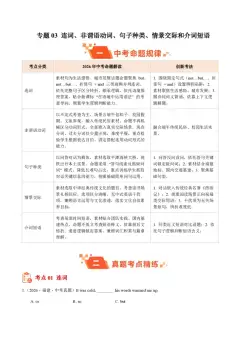
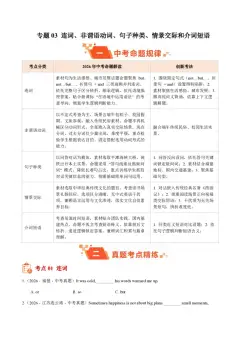
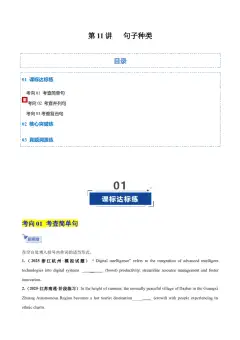
中考考点 | 考查频率 | 新课标要求 |
句子成分 | ★★ | 掌握主语、谓语、宾语、表语、定语、状语、补语、同位语等句子成分。 |
基本句型 | ★★★ | 掌握五种基本句型。 |
句子种类 | ★★★ | 掌握陈述句的肯定形式及否定形式;掌握一般疑问句、特殊疑问句、反意疑问句和选择疑问句;掌握不同类型祈使句;掌握由what或how引导的感叹句。 |
特殊句式 | ★★ | 掌握倒装句和强调句的用法。 |
掌握句子成分和英语基本句型是准确理解句意的基础。阅读理解,完形填空,语法填空和写作等题型要求对英语句子成分和基本句型的熟练掌握。感叹句是历年中考常考题型,通常以单项选择的形式呈现。祈使句、倒装句和强调句的考查在单项选择等题型中也有所体现。 |

一、句子成分
英语句子由多个部分构成,各部分在句子中起着不同的作用,这些构成句子的不同部分被称为句子成分。
1.主语
主语是句子要说明的人或事物,是句子的主体,通常位于句首。通常由名词、代词、数词、不定式、动名词和主语从句等充当。
(1)名词:My flightwill take off soon. Do contact me when you're in Sydney.
(2)代词:He told a joke but it fell flat.
(3)数词:Three is enough.
(4)不定式:To findyour way can be a problem.
(5)动名词:Smoking is bad for you.
(6)it形式主语:It is certain that he will win the match.
2. 谓语
谓语表示主语的动作或状态,一般位于主语之后。由动词、动词短语、“情态动词/助动词+实义动词”结构等充当。
(1)We are Chinese.(单一动词作谓语)
(2)He looked for his bag.(动词短语作谓语)
(3)She can speak English well.(情态动词+动词原形作谓语)
3. 宾语
宾语表示及物动词的动作对象或内容,位于及物动词之后。通常由名词、代词、数词、动词不定式、动名词或从句等充当。
(1)I accepted her wise advice.(名词或名词词组作宾语)
(2)All of us like him.(代词作宾语)
(3)Give me six.(数词作宾语)
(4)They began to learn English a year ago.(不定式或不定式短语作宾语)
(5)He enjoys working at night.(动名词或动名词短语作宾语)
(6)I think that she is right./I wonder if you’d like to go with us.(从句作宾语)
4. 表语
表语说明主语的性质、特征、状态或身份,位于系动词之后,与系动词一起构成复合谓语。通常由形容词、代词、名词、数词、副词、介词短语、动词不定式、动名词或从句等充当。
(1)I feel much better today.(形容词作表语)
(2)The pen is mine.(代词作表语)
(3)They are his students.(名词词组作表语)
(4)His father is sixty-five.(数词作表语)
(5)They are over there.(副词词组作表语)
(6)We are in trouble.(介词短语作表语)
(7)Her dream is to go to college.(不定式短语作表语)
(8)My hobby is collecting stamps.(动名词短语作表语)
(9)The truth is what she said just now.(从句作表语)
5. 定语
修饰或限定名词或代词的成分叫定语。通常由形容词、形容词性物主代词、名词或名词所有格、副词、介词短语、动词不定式或从句等充当。定语有前置定语和后置定语。形容词、数词、代词、名词等作定语时一般放于被修饰词之前,但是在修饰any-,some-,no-,every-等构成的单词,如something 等时,应放于这些复合不定代词之后进行修饰。动词不定式、副词、介词短语、从句等作定语时一般放于被修饰词之后。
充当:
(1)He is a kind man./He is a 15-year-old student.(形容词或相同于形容词的结构作定语)
(2)The boy was Dave./My father was washing his car.(冠词或代词作定语)
(3)I bought a coffee cup yesterday./He is Sam’s father.(名词或名词所有格作定语)
(4)Three children are running along the bank./You are the first one here.(数词作定语)
(5)The woman there needs a pen.(副词作定语)
(6)Do you know the boy in the first row?/The girl in a dress is his sister.(介词短语作定语)
(7)I have a lot of work to do.(不定式作定语)
(8)The meeting that you have missed yesterday was very important.(从句作定语)
6. 状语
状语修饰动词、形容词、副词或全句,可表示时间、地点、原因、目的、结果、方式、比较、伴随、条件、程度、让步等。通常由副词、介词短语、动词不定式短语或从句等充当。
(1)I’m very glad to meet you here.(副词作状语,修饰形容词)
(2)My brother goes to school by bike.(介词短语作方式状语)
(3)The boy needs a pen to do his homework.(不定式短语作目的状语)
(4)You can’t leave until your work is finished.(从句作时间状语)
7. 补语
补语有两种,分别是主语补足语和宾语补足语。常由形容词、名词、动词不定式、分词、介词短语等充当。
(1)New methods make the job easy. (形容词作宾补)
(2)The war made him a soldier. (名词作宾补)
(3)The teacher asks the students to close the windows. (不定式短语作宾补)
(4)I saw a cat running across the road. (分词短语作宾补)
(5)I often find him at work. (介词短语作宾补)
8. 同位语
同位语是对前面的名词或代词做进一步解释、说明,通常由名词、数词、代词或从句等充当。
(1)We students should study hard.(名词students是we的同位语,都是指同一批“学生”)
(2)We all are students.(代词all是we的同位语,都指同样的“我们”)
(3)The fact that his father is an actor made us surprised.(that引导的从句作同位语)
1.Whoever answers this question correctly will get this gift.
A. 主语B. 状语C. 宾语D. 谓语
【答案】A
2.Peter didn’t go anywhere interesting this weekend.
A. 定语B. 谓语C. 状语D. 表语
【答案】B
3.Putting up a tent at the beach is an enjoyable activity.
A. 状语B. 表语C. 定语D. 宾语
【答案】B
4.My father bought me a new bicycle last week.
A. 真正主语B. 形式主语C. 直接宾语D. 间接宾语
【答案】C
5.When we read words, we should get the pronunciation right.
A. 宾语补足语B. 宾语C. 表语D. 状语
【答案】A
6.This show gave people a way to make their dreams come true.
A. 谓语B. 宾补C. 定语D. 状语
【答案】B
7.The girlsinging under the tree is my sister Tina.
A. 定语B. 谓语C. 状语D. 宾语
【答案】A
8.Although my grandpa is eighty now, he is in good health.
A. 表语B. 谓语C. 状语D. 宾语
【答案】C

一、基本句型
英语句子的基本结构可以归纳成五种基本句型,掌握这五种基本句型,是掌握各种英语句子结构的基础。五种基本句型如下:
基本句型一:S+V(主+谓)
基本句型二:S+V+P(主+系+表)
基本句型三:S+V+O(主+谓+宾)
基本句型四:S+V+IO+DO(主+谓+间宾+直宾)
基本句型五:S+V+O+OC(主+谓+宾+宾补)
1.主+谓:S+V(主语+不及物动词)
My brother works in a bank.
2.主+系+表:S+link-V+P(主语+系动词+表语)
He looked tired.
常见系动词如下:
类别 | 系动词 |
状态类 | be |
感官类 | look, sound, taste, smell, feel |
表象性 | seem, appear |
变化类 | get, turn, grow, become, go, fall |
持续性 | stay, remain, keep, stand |
结果性 | prove, turn out |
1.主+谓+宾:S+V+O(主语+及物动词+宾语)
Who knows the answer?
2.主+谓+双宾:S+V+IO+DO(主语+及物动词+间宾+直宾)
可接双宾语的常见动词有:give, offer, send, bring, pass, tell, show, teach, promise等。
Mr Johnson taught us German last year.
Grandma told us an interesting story last night.
3.主+谓+宾语+宾补: S+Vt.+O+O.C(主语+及物动词+宾语+宾补)
The sun keeps us warm.
You must get your hair cut.
1.The sentence structure of “She is walking along the lake.” is ________.
A. S+V+OB. S+VC. S+V+DO+OCD. S+V+P
【答案】B
2.The sentence pattern of “I really love English.” is ________.
A. S+VB. S+V+PC. S+V+OD. S+V+IO+DO
【答案】C
3.Choose the correct structure of this sentence “Lily gave Betty a nice toy.”
A. S+V+PB. S+V+IO+DOC. S+V+OD. S+V+DO+OC
【答案】B
4.The main structure of the sentence “Hobo built Eddie a tent.” is ________
A. S + V + OB. S + V + PC. S + V + IO + DOD. S + V + DO + OC
【答案】C
5.The sentence structure (结构) of “He is ringing someone to come and help us at the moment.” is ________.
A. S+V+PB. S+V+DO+OCC. S+V+DOD. S+V+IO+DO
【答案】B

一、句子种类
英语句子按使用目的和交际功能分为陈述句、疑问句、祈使句和感叹句。
1.陈述句
陈述句主要分为肯定句和否定句。
(1)陈述句的肯定句式
基本句型 | 例句 |
①主语+谓语(不及物动词) | The rain stopped. 雨停了 |
②主语+谓语(及物动词)+宾语 | Children are playing basketball. 孩子们在打篮球。 |
③主语+连系动词+表语 | Leaves turn yellow in autumn. 秋天树叶变黄。 |
④主语+谓语(及物动词)+间接宾语+直接宾语 | My father bought me a computer. 我爸爸给我买了台电脑。 |
⑤主语+谓语(及物动词)+宾语+宾语补足语 | He made his sister cried just now. 他刚刚把他妹妹弄哭了。 |
⑥There be句型的结构及用法 “There be+主语(人或物+地点/时间状语”,表示“某处(或某时)有某人(或某物)”。 用法:遵循就近原则。be动词必须和邻近主语在数上保持一致。 | There is a pen and some books on the desk.桌子上有一支笔和一些书。 There are some books and a pen on the desk.桌子上有一些书和一支笔。 |
(1)陈述句的否定句式
①若句中有连系动词be、情态动词或助动词,则分别在它们的后面加上not。
His mother has already called the police for help. 他的母亲已经报警求助了。
→His mother hasn’t called the police for help yet. 他的母亲还没有报警求助。
②原句中没有连系动词be、助动词或情态动词时,要在行为动词前加助动词(do,does,did)与否定副词not。并且要注意这时的行为动词要用原形。另外,还需要将原句中的some改为any,too改为either,already改为yet。
The old man hurt his leg last Wednesday. 这位老人上周三腿受伤了。
→The old man didn’t hurt his leg last Wednesday. 这位老人上周三腿没有受伤。
③There be句型
否定句式:There be+not/no+主语+地点/时间状语。如:There isn’t any water in the glass.
1.疑问句
疑问句提出问题,句末用问号。疑问句通常分为四种:一般疑问句、特殊疑问句、选择疑问句和反意疑问句。
(1)一般疑问句
一般疑问句以be,have,情态动词或助动词开始,通常要求以yes或no回答。
①Be+主语+其他?→Is Mr. Wang an English teacher?
②情态动词+主语+动词原形+其他?→Can we bring music players to school?
③助动词+主语+动词原形/现在分词/过去分词+其他?→Have they been living here for 20 years?
(2)特殊疑问句
特殊疑问句通常以特殊疑问词开头,常见疑问词有:疑问代词who, whom, whose, which, what和疑问副词when, where, why, how以及how引出的词组how many, how long等。
①特殊疑问句有两种语序:
如疑问词作主语或主语的定语,其语序是陈述句的语序:疑问词(+主语)+谓语动词+其他成分?如Who is singing in the room? Whose bike is broken?
如疑问词作其他成分,其语序是:疑问词+一般疑问句语序?如What class are you in?
②特殊疑问句的回答:
①回答特殊疑问句时,不能用yes/no,即问什么答什么,尤其是简略回答。
—Who is from Canada?—Helen (is).
②特殊疑问句一般读降调(↓)。
(2)选择疑问句
提出两种或两种以上的情况,要求对方选择一种情况回答的问句叫选择疑问句。选择疑问句中的两种或两种以上的情况用or连接,回答时不能使用yes或no,而要用一个完整的句子或其省略形式。选择疑问句可以分为一般选择疑问句和特殊选择疑问句两种。
①一般选择疑问句:一般疑问句+or+被选择部分?
—Do you like apples or pears?——你喜欢苹果还是梨?
—I like pears.——我喜欢梨。
②特殊选择疑问句:特殊疑问句+A or B?
—Which would you like better, tea or coffee?——你比较喜欢哪个,茶还是咖啡?
—I like coffee.——我喜欢咖啡。
(4)反意疑问句
反意疑问句一般由两部分组成:“肯定的陈述句,+否定的简略问句”或“否定的陈述句,+肯定的简略问句”。
①两大原则
前肯后否:She is nice, isn’t she?
前否后肯:She can’t sing, can she?
②反意疑问句的回答(根据事实回答)
回答反意疑问时,如果事实是肯定的,则用yes;若事实是否定的,则用no。其回答方式与一般疑问句的回答方式完全一致。
【注意】
①祈使句(即以动词原形起首的句子)出现时,通常以will you构成反问;
②以Let’s起首的祈使句出现时,以shall we构成反问;
如果陈述部分为Let us...时,问句部分习惯上用will you。
③陈述句含有hardly, little, few, never, seldom, nobody, nothing等否定副词或短语时,该陈述句视为否定句,问句部分用肯定形式。
④反意疑问句的陈述部分含有由un-, im-, in-, dis-等否定意义的前缀构成的词语时,陈述部分要视为肯定含义,问句部分用否定形式。
2.祈使句
祈使句用于表示命令、建议、请求或劝告等。通常省略主语,谓语动词用原形。其具体结构如下:
类型 | 肯定结构及例句 | 否定结构及例句 |
Do型 | 动词原形+其他:Open the door. | Don’t +动词原形+其他:Don’t stand up! |
Be型 | Be+表语:Be quiet! | Don’t+be+表语:Don’t be late for class! |
Let型 | Let+宾语+动词原形+其他:Let’s have another try. | Don’t+let+宾语+动词原形+其他:Don’t let the boy draw here. Let+宾语+not+动词原形+其他:Let’s not wait outside the gate. |
Never型 | —— | Never+动词原形:Never leave today’s work till tomorrow. |
No型 | —— | No+名词/动名词:No parking! |
1.感叹句
感叹句用来表示说话人强烈的喜、怒、哀、乐等感情,由what或how引导,具体用法如下:
类别 | 结构 | 例句 |
what引导 | What + a/an +形容词+单数可数名词(+主语+谓语)! | What a kind girl (she is)! (她是)一个多么善良的女孩啊! |
What +形容词+复数可数名词/不可数名词(+主语+谓语)! | What beautiful flowers (they are)! 多么漂亮的花! What bad weather (it i )! 多么糟糕的天气! | |
how引导 | How +主语 +谓语! | How time flies! 时间飞逝! |
How +形容词/副词(+主语+谓语)! | How brave (the hero is )!(这个英雄)真勇敢! How slowly he walks! 他走得多慢啊! | |
How +形容词+ a/an +单数可数名词(+主语+谓语)! | How clever (a boy he is)! (他是)一个多么聪明的男孩啊! |
1.(2024·黑龙江绥化·中考真题)“Li Ming, ________ your homework first, and you can watch TV for 30 minutes.” said his mum.
A. doesB. didC. do
【答案】C
2.(2024·甘肃临夏·中考真题)—________ wonderful experience our family had in the Mogao Caves!
—I’m glad you had a good time.
A. WhatB. HowC. How aD. What a
【答案】D
3.(2024·四川遂宁·中考真题)—Hi, guys! Our team won the first place in the table tennis match.
—________ exciting news it is! We are so happy about it.
A. WhatB. HowC. What anD. How an
【答案】A
4.(2024·吉林长春·中考真题)________ helpful the speech is! It tells us to use the Internet safely.
A. WhatB. What aC. HowD. What an
【答案】C
5.(2023·江苏淮安·中考真题)The C919, China’s self-made large plane, is now in use. ________ exciting the news is!
A. HowB. How anC. WhatD. What an
【答案】A
6.(2023·江苏南通·中考真题)________ it was to see the main sights of the world in the World Park!
A. How amazing dayB. How an amazing day
C. What amazing dayD. What an amazing day
【答案】D
7.Growing up is not easy, Tom. ________ calm when you’re facing serious problems in life.
A. StayingB. StaysC. StayD. To stay
【答案】C
8.Let’s wait and see what will happen, ________?
A. shall weB. why notC. will youD. let us
【答案】A
9.—________ do you go to the science museum?
—Once a week. I’m interested in science.
A. How longB. How farC. How soonD. How often
【答案】D
10.The cat ________ climb trees but it ________ swim.
A. can; can’tB. can; don’tC. does; isn’tD. can; isn’t
【答案】A

四、特殊句式
1. 倒装句
倒装句是英语中常见的句式,主要考查学生在特定的结构中正确使用部分倒装和完全倒装,以及"so+助动词/情态动/系动词+主语"的用法。
(1)部分倒装
倒装条件 | 例句 |
一般疑问句中,将助动词放到主语之前,构成部分倒装。 | Do you like eating apples?你喜欢吃苹果吗? |
特殊疑问句中,疑问词作宾语、表语或状语,需要将其置于句首,将助动词置于主语前构成部分倒装。 | Where have you been these days?这些天你到哪里去了? |
"only+状语/状语从句"位于句首时,句子要用部分倒装。 | Only in this way can you improve your grade. 只有用这种方法你才能提高自己的成绩。 |
表示否定意义的词或短语,如little, hardly, never, in no case, seldom等,放在句首时,句子要用部分倒装。 | Hardly a day goes by without a visit from someone. 几乎没有一天没有来访者。 |
表示"也(不) ……"的句式,即"so/neither/nor+助动词/情态动词/be+主语"形式。 | I don’t like it; neither do I care it. 我不喜欢它,也不在意它。 |
某些含有否定含义的词位于句首时,如not only…but also,hardly…when,no…sooner…than, not…until等,主句用部分倒装。 | Not until the teacher came in did the students stop talking.直到老师进来学生们才停止讲话。 |
may表示祝愿时用部分倒装。 | May you have a good time! 祝你玩得愉快! |
(2)完全倒装
倒装条件 | 例句 |
表示方位、地点、时间、次序的词,如in, out, up, there, then, here, first等放在句首,若主 语是名词而不是代词时,句子用完全倒装。 | Here comes the bus. 公交车来了。 |
分词短语置于句首时,句子用完全倒装。 | Lying on the couch is an old lady. 躺在睡椅上的是一位老太太。 |
There be句型是完全倒装的一种。 | There are a number of teachers and students in the school. 在这所学校有很多老师和学生。 |
作表语的such位于句首时,句子用完全倒装。 | Such are the most powerful voices of our times!这些就是我们时代的最强音! |
1.强调句
强调句是对句子中除谓语以外的某个部分进行强调,从而起到修辞的作用,是人们为了表达自己的意愿或情感而使用的一种形式。其结构为:It is/ was…+被强调的部分+that/who...。当It is/was...that/who删除时,句子结构依旧完整。
普通句:He met an old friend in the park yesterday. 他昨天在公园碰见一个老朋友。
上述句子可以通过强调句型对除谓语以外的不同成分进行强调。
①It was he who/that met an old friend in the park yesterday.(强调主语))
②It was an old friend that/who he met in the park yesterday.(强调宾语)
③It was in the park that he met an old friend yesterday.(强调地点状语)
④It was yesterday that he met an old friend in he park.(强调时间状语)
(1)强调句的陈述句句型:
It is /was+被强调的部分+that/who引导的从句+原句其他部分。
It is because he is ill that he can’t come.是因为生病他才没有来。
(2)强调句的一般疑问句型:
Is / Was +it+被强调的部分+that/who引导的从句+原句其他的部分?
Is it because he is ill that he can’t come? 是因为生病他才没有来吗?
(3)强调句的特殊疑问句型:
被强调部分特殊疑问词(When /Where/ Why/ Who/ What/ How)+is/ was +it +that从句+原句的其他部分。
Why is it that he can’t come? 他为什么不能来?
1.(2024·黑龙江齐齐哈尔·中考真题)—Tom will have a birthday party next Sunday. Do you want to go?
—If you go, ________.
A. so I willB. so will IC. neither will I
【答案】B
2.(2023·黑龙江·中考真题)—It was the Dragon Boat Festival last Thursday. I watched the boat races by the lake.
—________, but I didn’t see you there.
A. So did IB. So I didC. Neither did I
【答案】A
3.—I will not give up my dreams though there are many difficulties.
—________.
A. So will IB. Neither will IC. Neither won’t I
【答案】B
4.—Only in this way ________ our task in such a short time.
—Yes. Let’s try our best to do it well.
A. we can finishB. we can be finished
C. can we finishD. can we be finished
【答案】C
5.—Would you like to go shopping with me, Bob?
—If Jack doesn’t go, ________.
A. neither will IB. so will IC. neither do ID. so do I
【答案】A
6.—When did you get to know her?
—It was in 1998 ________ we worked together.
A. thatB. sinceC. whichD. when
【答案】A
7.It is the ability to do the job ________ matters not where you come from or what you are.
A. whichB. thatC. whatD. where
【答案】B
8.It was the culture, rather than the language, ________made it hard for him to get used to the new life abroad.
A. whereB. whyC. thatD. what
【答案】C
9.It is in 1960 ________ Chinese first put out flag on Mount Qomolangma.
A. whenB. thatC. whichD. in which
【答案】B
10.It was in this small village ________ my father spent his childhood.
A. which B. where C. when D. that
【答案】D