高考英语语法词汇专项突破:02 从交际用途例谈英语句子分类+巩固训练+答案
英语句子的构成根据不同标准有不同的分类。按交际用途分为:陈述句、疑问句、祈使句、感叹句、
THERE-BE存在句;按句子结构分为:简单句、并列句、复合句、并列复合句。在近年的高考试题中,对
于句式的考查主要是融合在对其他语法考查的试题中,而对句式的正确理解成为解题的关键。本文根据交
际用途,结合考例进行讲解,分析句式在高考试题中的命题思路,找寻最佳解题策略。
一、陈述句
陈述句说明一个事实或陈述一个看法,有肯定式和否定式,语序是主语在前,谓语在后。陈述句又可
以分为:肯定句;否定句(全否定句和半否定句),有时还要注意否定转移。如:
1. Shakespeare’s play Hamlet has been made into at least ten different films over the past years.
在过去的几年里,莎士比亚的戏剧《哈姆雷特》至少被改编成十部不同的电影。
2. George said that he would come to school to see me the next day, but he didn’t.
乔治说他第二天要来学校看我,但他没有。
3.I don't think that would do you much good since we are already working on next week's schedule.
我认为那样做不会对你有什么好处,因为我们已经在按照下周的时间表工作了。
注意:表面上是否定的主句I don't think,实际上否定的是宾语从句的谓语动词,即that would do you
much good...,此处的宾语从句的引导词 that省略了,因为引导宾语从句的that在句子里不作任何成分,可
以省去,句中的that是指示代词,是宾语从句的主语,省掉的那个that是引导宾语从句的连词。
【考例】 _____it rain tomorrow, we would have to put off the visit to the Yangpu Bridge.
A. Were B. Should C. Would D. Will
答案与解析:B。根据句尾的句号看出本题是一个陈述句,不是疑问句,所以不能想当然的依据句首
是情态动词或助动词就认为是疑问句。根据后面句子的谓语动词 would have to和句意看出是虚拟语气,虚
拟的条件从句中有were, had, should时, 可把if省略,而把were, had, should放在主语前, 用部分倒装结构。
故选B。
★有关否定转移小结:
(1)形式上否定主句的谓语,实际上是否定从句的谓语
当动词think, believe, suppose, imagine, expect, feel的主语是第一人称、谓语动词为没有任何副词修饰的
一般现在时,它们的否定式实际上是对宾语从句的否定。表示说话者提出一种委婉的看法或主张。
如:I think that he will help us. —I don’t think that he will help us. 我认为它不会帮助我们.I believe that he is right. —I don’t believe that he is right. 我认为他不对.
I suppose that he likes it. —I don’t suppose that he likes it. 我想他不喜欢它.
2. 形式上否定谓语动词,实际上否定复合宾语
当动词think, believe, suppose, imagine, expect, feel, find的主语是第一人称、谓语动词为没有任何副词
修饰的一般现在时,它们前面的否定式实际上是对复合宾语的否定。表示说话者所提出的一种委婉的看法
或主张。如:
I think math difficult. — I don’t think math difficult. 我认为数学不难。
I find the story interesting. — I don’t find the story interesting. 我认为这个故事没有趣。
I expect so. —I don’t expect so. 我认为不会.
3. 状语的否定转移
有些句子形式上否定谓语动词,实际上是对句子后面状语进行否定。如:
Let’s not talk about it here. 我们别在这里谈吧。
Don’t read in the sun. 不要在阳光下看书。
Don’t talk with your mouth full of food. 不要口里含着食物说话。
注意:
动词think, believe, suppose, imagine, expect, feel在下列情况下,否定不转移:
(1) 这些动词跟其他另一个动词一起做并列谓语时,否定不转移。如:
I believe and hope he won’t do that. 我相信并且也希望他将不会那样做.
I feel and admit that we are not foolish. 我觉得并且也承认我们并不愚蠢。
(2) 用于疑问句时,否定不转移。如:
Do you think it is not going to rain? 你认为天不会下雨吗?
Don’t you believe that he has done a good thing? 难道你不相信他做了一件好事?
(3) 用作插入语时,否定不转移。如:
Li Lei, I think, won’t be angry with you. 我想李蕾不会生你的气。
Tom, I suppose, won’t be against it. 我猜想汤姆不会反对。
Mike, I believe, hasn’t seen the film. 我认为迈克没有看这场电影。
(4) 动词前有其他副词修饰时,否定不转移。如:
I really don’t think it’s necessary for us to go there now. 我的确不认为我们有必要去那儿。
I feel strongly that he shouldn’t do such a thing. 我强烈地认为他不应该做那样的事。
(5) 动词为非一般现在时或主语不是第一人称时,否定不转移。
I thought that he wouldn’t come back soon. 我原以为他不会回来得这么快。She didn’t believe that he became a good boy. 她不相信它变成了一个好孩子。
He thinks that he isn’t fit for the job. 他认为他不适合这件工作。
He doesn’t believe that what we told him is true. 他不相信我们告诉他的事是真的。
(6) 当宾语从句中含的否定为not…at all, not a little, not a few, not enough, can’t help等固定搭配时,否定
不转移。如:
I think that he doesn’t know it at all. 我想他对那一点也不知道。
I suppose that it is not enough to remember the words if you want to learn the language well.
我认为如果你想把这门语言学好,那么只记单词是不够的。
I believe that you can’t help singing our national anthem when you win the first place in the Olympic Games.
我相信当你在奥运会上获得第一名时你会情不自禁地唱起国歌来。
(7) 当宾语从句中含no, nothing, nobody, nowhere, hardly, seldom, little, few等否定词或半否词时,否定
不转移。如:
I believe that nothing can make me give it up. 我想任何事情也不能使我放弃。
I think that no one can escape if the ship sinks in the sea.
我认为如果这艘船沉入海底的话,那么谁也逃不掉。
I suppose that he is a man of few words. 我猜想他是一个言语不多的人。
★有关部分否定句小结:
否定分为部分否定与完全否定。
1、完全否定:百分之百地否认一个事物的存在、成立或真实性。表示完全否定的否定词有no,not,
nothing,nobody,none,nowhere,never,neither,nor,nowise等。如:Nothing ever pleases her. / My pen
is nowhere to be seen.
用 not+any/anyone/anybody/anything/anywhere/either 或not+half也可表示完全否定(=not at all),通常
在口语中使用。如:I don't like either of the films。
2、部分否定:当含有全体意义的代词或副词如:all,each,every,both,always,often,entirely,
wholly等用于否定式谓语的句子中的时候,构成部分否定句。如:All the answers are not right。答案并非全
对。
英语和汉语在否定的表达形式上存在着许多差异,我国学生往往会以中国人的思维方式和习惯用法去
套英语,这样在汉译英时难免会出现一些错误。部分常见的错误举例如下:
1、未经允许,任何人不得入内。
误:Anybody can not come in without permission.正:Nobody can come in without permission.
解读:“任何……不”是汉语中常用的否定句式,而在英语中与 any构成的合成词或被any修饰的词
语作主语时,谓语动词不能用否定式,因此any ... not的表达形式不符合英语的习惯。翻译这类句子时须
用"否定形式的主语+肯定形式的谓语"。但当any的合成词或any所修饰的词带有后置定语时,谓语可以用
否定式,如: 干那种事的人都是不诚实的。 Anyone who does that isn't honest.
2、听到这个消息后,没有一个人不感到兴奋。
误:Having heard the news, nobody did not feel excited.
正:Having heard the news, everybody felt excited.
解读:汉语中常用"没有+主语+不+谓语"这一双重否定的结构,而英语中否定形式的主语习惯上不能
与否定形式的谓语连用。因此nobody... not的结构不符合英语的表达习惯。翻译这类句子时,(1)可把主
语和谓语都改成肯定形式;(2)也可用另一结构的双重否定式:there be +否定的主语 + 否定形式的定语从
句,如: There was nobody who did not feel excited. 或:There was nobody but felt excited.
3、(1)这两本书都不是英国出版的。
误:Both of the books are not published in England.
正:Neither of the books is published in England.
(2)我不同意所有这些方案。
误:I don't agree to all these projects.
正:I agree to none of these projects. 或:I don't agree to any of these projects.
解读:英语中的概括词all, every, both, 以及与every 构成的合成词,用语否定句式时,只表示部分否
定,常译成"并非……都",因此两个错误译句的含义分别为:并非两本书都是英国出版的,并非所有这些
方案我都同意。要表达全部否定意义时,英语须用全否定词语,如 none neither, no, nobody, nothing, not…
any, not…either等。
二、疑问句
疑问句有一般疑问句、特殊疑问句、选择疑问句、反义疑问句。
(一)一般疑问句
又称“Yes-No”问句,通常用部分倒装句式,就是把助动词、情态动词或者 be动词置于主语之前。回
答的时候要注意主语人称、时态等的一致性,避免答非所问。一般疑问句常用在对时态、语气和交际英语
的考查的题干中,或者是通过间接引语考查。如:
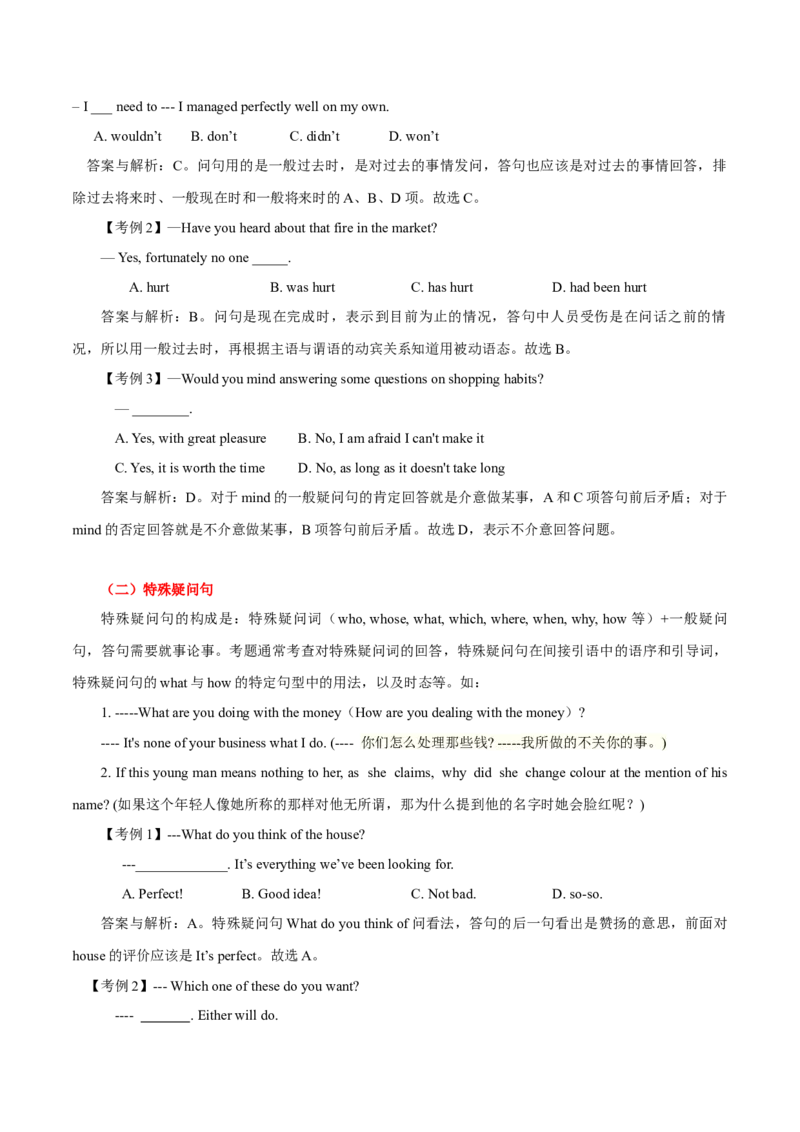
【考例1】– Did you ask Sophia for help?– I ___ need to --- I managed perfectly well on my own.
A. wouldn’t B. don’t C. didn’t D. won’t
答案与解析:C。问句用的是一般过去时,是对过去的事情发问,答句也应该是对过去的事情回答,排
除过去将来时、一般现在时和一般将来时的A、B、D项。故选C。
【考例2】—Have you heard about that fire in the market?
— Yes, fortunately no one _____.
A. hurt B. was hurt C. has hurt D. had been hurt
答案与解析:B。问句是现在完成时,表示到目前为止的情况,答句中人员受伤是在问话之前的情
况,所以用一般过去时,再根据主语与谓语的动宾关系知道用被动语态。故选B。
【考例3】—Would you mind answering some questions on shopping habits?
— ________.
A. Yes, with great pleasure B. No, I am afraid I can't make it
C. Yes, it is worth the time D. No, as long as it doesn't take long
答案与解析:D。对于mind的一般疑问句的肯定回答就是介意做某事,A和C项答句前后矛盾;对于
mind的否定回答就是不介意做某事,B项答句前后矛盾。故选D,表示不介意回答问题。
(二)特殊疑问句
特殊疑问句的构成是:特殊疑问词(who, whose, what, which, where, when, why, how 等)+一般疑问
句,答句需要就事论事。考题通常考查对特殊疑问词的回答,特殊疑问句在间接引语中的语序和引导词,
特殊疑问句的what与how的特定句型中的用法,以及时态等。如:
1. -----What are you doing with the money(How are you dealing with the money)?
---- It's none of your business what I do. (---- 你们怎么处理那些钱? -----我所做的不关你的事。)
2. If this young man means nothing to her, as she claims, why did she change colour at the mention of his
name? (如果这个年轻人像她所称的那样对他无所谓,那为什么提到他的名字时她会脸红呢?)
【考例1】---What do you think of the house?
---_____________. It’s everything we’ve been looking for.
A. Perfect! B. Good idea! C. Not bad. D. so-so.
答案与解析:A。特殊疑问句What do you think of问看法,答句的后一句看出是赞扬的意思,前面对
house的评价应该是It’s perfect。故选A。
【考例2】--- Which one of these do you want?
---- . Either will do.A. I don't mind B. I'm sure C. No problem D. Go ahead
答案与解析:A。根据特殊疑问词“哪一个”和答句“哪一个都行”看出“不介意”。故选A。
(三)选择疑问句
选择疑问句指的是提问者提供两种或两种以上情况让对方从中作出选择的疑问句。其表现形式可以是
一般疑问句形式,也可以是特殊疑问句形式,选项之间要用连词 or连接。不能用Yes或No来回答,应根
据问句的实际问题用完整句子来或根据选项部分用一个短语来回答。考题中主要考查比较级,或者考查像
具有选择意义的词汇,如prefer, would rather, favour等。如:
1. Which would you rather do - go dancing or go to the movies?
2. —Are you going by train or by plane? —I’m going by train.
3. Do you prefer conducted tours or independent travel? (你是喜欢导游还是喜欢独立地去旅行?)
4. Which is more important for you, your job or your marriage?
(四)反义疑问句
反义疑问句由“陈述部分+反意疑问部分”构成,通常是“肯定+否定”或“否定+肯定”,间或有
“肯定+肯定”形式,答句是“肯定+肯定”或“否定+否定”。反义疑问句要注意附加问句的主语和助动
词或情态动词与陈述部分的对应关系。如:
【考例1】There is little doubt in your mind that he is innocent, _______________?
A. is there B. isn't there C. is he D. isn't he
答案与解析:A。根据主句陈述部分的little表明是否定句,问句部分用肯定形式,排除B和D。there
be句型反意疑问部分的主语用there。故选A。
【考例2】It doesn’t matter if they want to come to your party, _________?
A. doesn’t it B. does it C. don’t they D. do they
答案与解析:B。陈述部分是否定句,反意疑问部分用肯定,主语是it。故选B。
【考例3】(2007北京卷)When you’ve finished with that book, don’t forget to put it back on the shelf,____?
A. do you B. don’t you C. will you D. won’t you
答案与解析:C。主从复合句的反义疑问句根据主句,本题主句是祈使句,反意疑问部分用will you。
故选C。
三、祈使句
祈使句表达命令、要求、请求、劝告等,用谓语用动词原形,省掉的主语是 you,有时候为了强调也会把you带上,但是后面依然用的是动词原形,为了强调还可以用“Do+动词原形”。考题中主要考查祈
使句在反义疑问句中用法、在特定句型“祈使句+and(or)+陈述句”结构、与非谓语动词辨析等。如:
Do give your shoes a polish before you go out.(出门前把皮鞋擦亮。)
【考例1】Every day ________ a proverb aloud several times until you have it memorized.
A. read B. reading C. to read D. reads
答案与解析:A。根据until看出前面是一个句子,B和C是非谓语动词,不能构成句子。D项的谓语
动词一般现在时形式没有主语,只有A是动词原形,可以构成祈使句。故选A。
【考例2】Don’t turn off the computer before closing all programs , you could have problems.
A. or B. and C. but D. so
答案与解析:A。本题是句型“祈使句+and(or)+陈述句”,祈使句表示条件,肯定句用and,否定
句用or连接。
四、感叹句
感叹句构成形式是“How+形容词+主语+动词/How+形容词+a(an)+名词+主语+动词”或“What+a/an
+名词+主语+动词”。what后接复数名词或不可数名词时,即使名词前面有形容词,也要用 what,即
“What+形容词 +复数名词时或不可数名词+主语+动词”。考题中主要考查what和how在感叹句的用法、
感叹句在宾语从句的用法、感叹句的语序、一些带有不定冠词固定短语用在感叹句等。如:
【考例1】 a strange plant! I've never seen it before.
A. Which B. What C. How D. Whether
答案与解析:B。根据感叹号看出是感叹句,符合“What+a/an +名词+主语+动词”结构,题干的it is
被省掉。故选B。
【考例2】The little boy came riding full speed down the motorway on his bicycle. _____ it was!
A. What a dangerous scene B. What dangerous a scene
C. How a dangerous scene D. How dangerous the scene
答案与解析:A。根据感叹句构成形式 “What+a/an +名词+主语+动词”得出A正确。可以改为How
dangerous a scene。
但在口语中,还有一些特殊的感叹句表达形式。
1.以副词here, there, in开头的感叹句。Here comes the bus! 公共汽车来了!There they are! 他们在那
儿呢!
2.以疑问词who开头,表示惊奇。Who else will read such a book! 谁还会读这样的书!
3.以情态动词may开头,表示愿望。May you both be happy! 祝二位幸福。May you succeed! 祝你成功!May god bless you! 愿上帝保佑你!
4.一些短语用作感叹句。Dear me!/ My goodness! 哎呀(天哪)!None of your nonsense! 不要胡说
了!
五、there be存在句
“there be...”句型是存在句的常用基本结构,there在句中处于主语位置,真正的主语是随后的名词词
组。其谓语动词通常是be的各种形式。可以与情态动词连用,也可以用there be likely to be,happen to
be,seem(to be)。在正式文体中,某些表示存在、发生、出现、坐落等意义的不及物动词也可以与there
连用,如:appear, seem, come, remain, exist, live, stand, lie, arise, enter, follow, occur, rise, grow, happen, arrive,
fly等。对于there be句型的考查主要有:there与it区别、可用于该句型的动词辨析、there be句型的反义疑
问句、非谓语动词的there being(there to be)、倒装句等。如:
【考例】John opened the door. There _____ he had never seen before.
A. a girl did stand B. a girl stood C. did a girl stand D. stood a girl
答案与解析:D。there be句型在倒装句中是全部倒装。故选D。
【强化训练】
一、从所给的A、B、C、D四个选项中选出最佳答案。
1. At present, there ______ an important opportunity for further improvement and growth of the US-China
relations.
A. stands B. lies C. exists D. lives
2. Shadow-boxing? _________! Do you think it really helpful for your health?
A. What interested B. What interesting C. How interested D. How interesting
3. _______ to a coeducational school, the marriage problem would have been solved long ago.
A. Had she gone B. Would she go C. Should she go D. May she go
4. ______ me with this maths problem. You know, now there is no one else I could turn to for help.
A. Did help B. Helped C. Helping D. Do help
5. — Alvin, are you coming with us?
— I’d love to, but something unexpected _______.
A. has come up B. was coming up C. had come up D. would come up
6. You seem to be dissatisfied with your present post. I don’t think you judged your ability objectively when you
applied for it, ______ you?A. do B. did C. don’t D. didn’t
二、语法填空
阅读下列材料,在空白处填入适当的内容(不多于3个单词)或括号内单词的正确形式。
As to where to go, you ____1___ (decide) yet. ___2___ (make) a decision quickly, or you’ll miss your
opportunity. ___3___ a foolish boy you are! ____4__ are too many places of interest in Beijing. What___5__ the
Great wall and the Summer Palace? If you agree, I’ll be your guide.
三、翻译填空,每空一词。
1. 近来鱼似乎比较少,也许是因为钓鱼的人太多。
______ ______ _____ _____ fewer fish around these days, perhaps because so many people go fishing.
2. 我从远处望着伦敦,觉得它真是一个令人惊异的地方。
______ _______ _______ _______ London was to me when I saw it in the distance.
3. 那时你不大分得清谁是你的朋友,谁是你的敌人,不是吗?
Then, You little knew______ _____ ______ _______ and _____ ____ your enemy, _____ _____?
参考答案:
一、1. C 2. D 3. A 4. D 5. A 6. B
二、1. haven't decided 2. Make 3. What 4. There 5. about
三、1. There seem to be 2. What an amazing place 3. who was your friend; who was; did you