2023 年上半年高中《英语》教师资格证笔试真题及答案解析
1.单选题
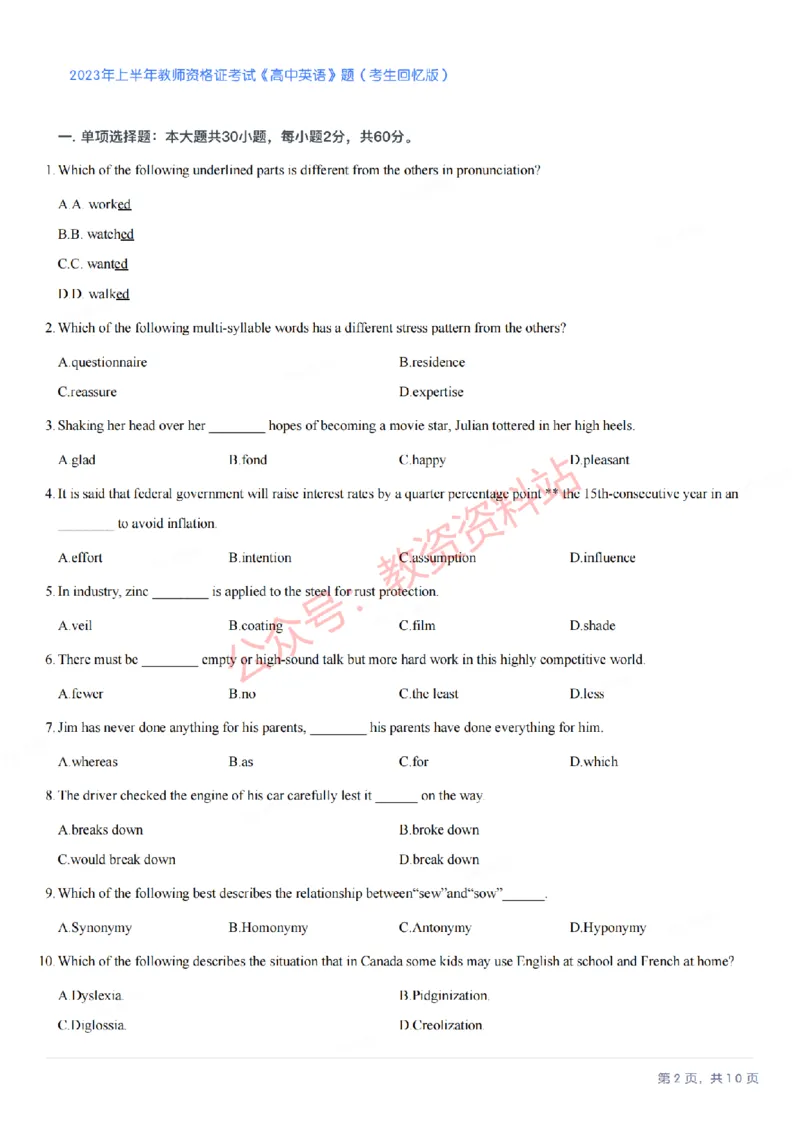
Which of the following underlined parts is different from the others in pronun
ciation?
A. worked
B. watched
C. wanted
D. walked
正确答案是: C
o
解析
本题考查字母组合的发音。题干意为:下列画线部分,哪一项与其
他项发音不同”。规则动词的过去式词尾ed 的读音有以下三种:①
在浊辅音和元音后读[d],如 lived, watered, listened;②在清辅音
后读 [ t],如 liked, helped;③在 [ t], [ d] 音后读 [ ɪd],如
planted, waited。C 项:wanted 中的ed 读作[ɪd],与其他三项不
同,故C 项正确。
A 项:worked 中的ed 读作[t];与题干不符,排除。
B 项:watched 中的ed 读作[t];与题干不符,排除。
D 项:walked 中的ed 读作[t];与题干不符,排除。
故正确答案为C。
o
考点
语音
2.单选题
Which of the following multi-
syllable words has a different stress pattern from the others?
A. questionnaire
B. residence
C. reassure
D. expertise
正确答案是: B
o
解析
本题考查单词重音。题干意为:以下哪个多音节单词的重音模式与
其他单词不同?B 项:residence 的音标为/ˈrezɪdəns/重音在第一个
音节,与其他三项重音不同,故B 项与题干相符,当选。
A 项:questionnaire /ˌkwestʃəˈneə(r)/,重音在第三个音节;与题
干不符,排除。
C 项:reassure /ˌri:əˈʃʊə(r)/,重音在第三个音节;与题干不符,排
除。
D 项:expertise /ˌekspɜ:ˈti:z/,重音在第三个音节;与题干不符,
排除。
故正确答案为B。
o
考点
语音
3.单选题
Shaking her head over her ________ hopes of becoming a movie star, Julian tottered
in her high heels.
A. glad
B. fond
C. happy
D. pleasant
正确答案是: B
o
解析
本题考查形容词辨析。题干意为:朱利安对成为电影明星的美好希
望摇摇头,踩着高跟鞋踉踉跄跄地离开。fond 位于名词前,意为
“难以实现的,痴想的”a fond hope,为固定用法,意为:不大可能
实现的美好的愿望。根据“摇头”和“踉跟跄跄”可知,Julian 对于这个
愿望实现不抱希望。故B 项正确。
A 项:意为“高兴的;感激的;乐意的”;与题干不符,排除。
C 项:意为“快乐的;幸福的,使人高兴的”;与题干不符,排除。
D 项:意为“令人愉快的,惬意的;礼貌而友善的,和蔼可亲的;与
题干不符,排除。
故正确答案为B。
o
考点
词汇
4.单选题
It is said that federal government will raise interest rates by a quarter percentage
point ** the 15th-consecutive year in an ________ to avoid inflation.
A. effort
B. intention
C. assumption
D. influence
正确答案是: A
o
解析
本题考查名词辨析。题干意为:据说联邦政府将连续第15 年加息
四分之一个百分点,以避免通货膨胀。根据句意可知,加息的目的
是为了避免通货膨胀。effort 意为:努力,尽力;
in an effort to do sth 为固定搭配,意为:为了...,故A 项正确。
B 项:intention 意为:意图,目的,打算;与题干不符,排除。
C 项:assumption 意为:假定,臆断;与题干不符,排除。
D 项:influence 意为:影响,势力;与题干不符,排除。
故正确答案为A。
o
考点
词汇
5.单选题
In industry, zinc ________ is applied to the steel for rust protection.
A. veil
B. coating
C. film
D. shade
正确答案是: B
o
解析
本题考查名词辨析。题干意为:在工业上,镀锌层用于钢铁的防
锈。zinc 意为:锌,coating 意为:涂层,zinc coating 意为:镀锌
层,符合句意,故B 项正确。
A 项:veil 意为:面纱;与题干不符,排除。
C 项:film 意为:电影;与题干不符,排除。
D 项:shade 意为:阴影;与题干不符,排除。
故正确答案为B。
o
考点
词汇
6.单选题
There must be ________ empty or high-sound talk but more hard work in this
highly competitive world.
A. fewer
B. no
C. the least
D. less
正确答案是: D
o
解析
本题考查形容词、副词比较级。题干意为:在这个竟争激烈的世
界,空谈一定会越来越少,而努力工作会越来越多。
empty or high-sound talk 意为:空谈或高谈阔论,为不可数名词
短语,用less 修饰,故D 项正确。
A 项:fewer 意为:更少的,修饰可数名词;与题干不符,排除。
B 项:no 意为:没有;与题干不符,排除。
C 项:the least 意为:最少的;与题干不符,排除。
故正确答案为D。
o
考点
词汇
7.单选题
Jim has never done anything for his parents, ________ his parents have done
everything for him.
A. whereas
B. as
C. for
D. which
正确答案是: A
o
解析
本题考查连词辦析。题干意为:吉姆没有给他的父母做过任何事
情,反而,他的父母为他做了所有的事情。通过分析句意可知,前
后形成对比,whereas 意为:然而,表转折,故A 项正确。
B 项:as 意为:当...时候;像...一样;尽管。但当“尽管”讲时,引导
让步状语从句需要倒装;与题干不符,排除。
C 项:for 意为:因为;与题干不符,排除。
D 项:which 意为:哪个;与题干不符,排除。
故正确答案为A。
o
考点
词汇
8.单选题
The driver checked the engine of his car carefully lest it ______ on the way.
A. breaks down
B. broke down
C. would break down
D. break down
正确答案是: D
o
解析
本题考查虚拟语气。题干:司机仔细地检查了汽车的发动机,以防
路上抛锚。break down 意为:发生故障;此处为lest(唯恐)引导
目的状语从句,从句的谓语动词需要用虚拟语气(should)+动词
原形。故D 项正确。
A、B、C 三项:形式错误;与题干不符,排除。
故正确答案为D。
o
考点
语法
9.单选题
Which of the following best describes the relationship between“sew”and“sow”
______.
A. Synonymy
B. Homonymy
C. Antonymy
D. Hyponymy
正确答案是: B
o
解析
本题考查同音异义词。题干意为:“sew”和“sow”是什么关系?根据
句意,sew/soʊ/意为“缝”,sow/soʊ/意为“播种”,二者发音相同,
但意义不同,属于同音异义词。B 项homonymy 意为“同音/同形异
义词”,故B 项正确。
A 项:synonymy 意为:同义词;与题干不符,排除。
C 项:antonymy 意为:反义关系;与题干不符,排除。
D 项:hyponymy 意为:上下义关系;与题干不符,排除。
故正确答案为B。
o
考点
语言学
10.单选题
Which of the following describes the situation that in Canada some kids may
use English at school and French at home?
A. Dyslexia
B. Pidginization
C. Diglossia
D. Creolization
正确答案是: C
o
解析
本题考查社会语言学。题干意为:下列哪一项描述了在加拿大,一
些孩子可能在学校使用英语,在家里使用法语的情況?题干描述的
现象属于双语制,指并存于同一语言社区的同一语言的两种不同的
变体,这两种变体各有其自己的社会功能,在自己特定的交际场合
中使用。C 项:Diglossia 意为“使用两种语言或方言,双语制”;故
C 项正确。
A 项:Dyslexia 意为“读写困难,读写障碍”;与题干不符,排除。
B 项:Pidginization 意为“洋泾浜化”;与题干不符,排除。
D 项:Creolization 意为“克里奥尔化(尤指当地语与欧洲语言的混
合)”;与题干不符,排除。
故正确答案为C。
o
考点
语言学
11.单选题
“Like” and “bike”, “bat” and “pat”, “look” and “book” are examples of ____ used
in teaching pronunciation.
A. alliteration
B. rhythm
C. weak forms
D. minimal pairs
正确答案是: D
o
解析
本题考查语音教学的方法。题干意为:like 和bike,bat 和pat,
look 和book 是在语音教学中使用的________例子。like 的发音为
/laɪk/,bike 的发音为/baɪk/;bat 的发音为/bæt/,pat 的发音为
/pæt/;look 的发音为/lʊk/,book 的发音为/bʊk/;根据三组单词
的发音可知,每组单词只有在相同的位置上有一个音不同,除此以
外其他音都相同,这三组词属于最小对立体(minimal pair),故
D 项正确。
A 项:alliteration 意为:头韵;与题干不符,排除。
B 项:rhythm 意为:节奏,韵律;与题干不符,排除。
C 项:weak forms 意为:弱读;与题干不符,排除。
故正确答案为D。
o
考点
语言知识教学
12.单选题
When students are asked to listen to a recording and read after it, they are
doing ______.
A. free practice
B. guided practice
C. meaningful practice
D. controlled practice
正确答案是: D
o
解析
本题考查口语教学。题干意为:当学生被要求听录音并跟读时,他
们正在做________。题干中描述的教学活动“听录音并跟读”属于控制
性活动(controlled practice),即重视语言的形式和准确性。使学
生关注语言的结构或功能,以便他们能够准确地说出语言。常见的
控制性活动有阅读、背通、模仿、重复、复述、分角色朗读等。故
D 项正确。
A 项:free practice 意为:自由操练;与题干不符,排除。
B 项:guided practice 意为:指导性操练;与题干不符,排除。
C 项:meaningful practice 意为:意义性操练;与题干不符,排
除。
故正确答案为D。
o
考点
语言技能教学
13.单选题
When designing a task, teachers should take the following aspects into
consideration EXCEPT ______.
A. pacing and grouping
B. materials and sources
C. learning skills and strategies
D. teachers’ interest and preferences
正确答案是: D
o
解析
本题考查教学活动的设计。题干意为:在设计任务时,老师应考虑
以下内容,除了________。当设计教学活动时,考虑的主体应是学
生,而不应该是老师的兴趣和偏好。D 项意为:老师的兴趣和偏
好,故D 项与题干相符,当选。
A 项:意为:节奏和分组;与题干不符,排除。
B 项:意为:材料和资源;与题干不符,排除。
C 项:意为:学习能力和策略;与题干不符,排除。
本题为选非题,故正确答案为D。
o
考点
教学设计
14.单选题
Which of the following activities is suitable to be conducted at
the “production” step?
A. Debating
B. Mimicking
C. Reciting
D. Repeating
正确答案是: A
o
解析
本题考查教学模式。题干意为:下面哪一项活动适合用在产出环
节。A 项意为:辨论,考查学生对语言的运用,为开放性的练习,
适合用在产出环节,故A 项正确。
B 项:意为:模仿,适合用在新授或练习环节;与题干不符,排
除。
C 项:意为:背诵,适合用在练习环节;与题干不符,排除。
D 项:意为:重复,适合用在新授或练习环节;与题干不符,排
除。
故正确答案为A。
o
考点
语言知识教学
15.单选题
Which of the following might be the most appropriate in developing students’
critical thinking through reading?
A. Students read a story and study grammar rules.
B. Students listen to a story and read it aloud.
C. Students read a story and evaluate it.
D. Students read a story and recite it.
正确答案是: C
o
解析
本题考查阅读教学。题干意为:下面哪一项更适合通过阅读锻炼学
生的批判性思维?C 项意为“学生读故事,并评价它”,其中“评价故
事”涉及学生对故事内容的思考,能够帮助培养学生的批判性思
维。故C 项正确。
A 项:意为:学生读故事,并学习语法规则;与题干不符,排除。
B 项:意为:学生听故事,并大声读;与题干不符,排除。
D 项:意为:学生读故事,然后背诵;与题干不符,排除。
故正确答案为C。
o
考点
语言技能教学
16.单选题
When a teacher says,“Sorry, I didn't get what you said.Can you say it again?” ,
he/she is ______.
A. offering an opinion
B. asking for advice
C. asking for clarification
D. checking instruction
正确答案是: C
o
解析
本题主要考查课堂教学。
题干意为:当老师说:“对不起,我不明白你说的话。你能再说一
遍吗?”,他/她是______。根据语境可知,老师没有明白学生的意
思,需要学生再次说明/澄清自己的看法。C 项正确。
A 项:意为“发表意见”。与题干不符,排除。
B 项:意为“征求意见”。与题干不符,排除。
D 项:意为“检查指令”。与题干不符,排除。
故正确答案为C。
o
考点
教学反馈
教学提问
17.单选题
When students take an end-of-term exam to assess how well they have learnt
in the past term, they are taking a(n) ______.
A. aptitude test
B. proficiency test
C. placement test
D. achievement test
正确答案是: D
o
解析
本题主要考查语言测试类型。
题干意为:当学生参加期末考试以检验他们在上一学期学习的情况
时,他们是在参加______。D 项意为“成绩测试”,旨在了解一段时间
内学生对所学内容的掌握情况,以便对学生的学习成绩作出评定。
测试的内容为该阶段所学内容。例如,学校的期中考试、期末考
试。D 项正确。
A 项:意为“潜能测试”,旨在预测学生学习某一新语言的能力倾向
的测试,能衡量学生在学习该语言时是否具有较强的学习能力。与
题干不符,排除。
B 项:意为“水平测试”,旨在评价学生现有的语言水平能否达到胜
任某一新的学习任务或工作的程度。水平测试的区分度较高,能够
区分不同水平的学生。与题干不符,排除。
C 项:意为“分级测试”,是一种综合性的英语水平测试及心理测试
项目,一般用于分班测试,用来对学生的学习水平进行快速评估,
为学生选择一个适当的学习起点。与题干不符,排除。
故正确答案为D。
o
考点
教学评价
18.
单选题
Which of the following is least important in developing school-based teaching
materials?
A. Students' level and interest.
B. Teachers' professional expertise.
C. The aim and need of your school.
D. The form of the teaching materials.
正确答案是: D
o
解析
本题主要考查课程资源开发与利用。
题干意为:以下哪一项在开发校本教学资料时最不重要?积极开发
与合理利用课程资源是有效实施英语课程的重要保证。英语课程资
源包括教材及有利于学生学习和教师教学的其他教学材料、支持系
统和教学环境,还包括人的资源。教材是英语课程的核心资源。为
了充分利用和有效开发教材资源,教师应深入分析教材,准确把握
教材设计理念和内容,熟悉教材编排特点。教师要深入研读教材,
在教学中根据学生的水平和教学需要,有效利用和开发教材资源,
激发学生的学习兴趣,开阔学生的视野,拓展学生的思维。学校还
可以适当选用或开发教材之外的优质教学资源,以补充教材的教学
内容。校本教材是以校为本的教材,是学校自己开发的校本课程所
用的教学材料的统称。 校本教材的编制以学校教师为主体。 结合
以上内容可知,教学资源的形式是最不重要的。D 项与题干相符,
当选。
A 项:意为“学生的水平和兴趣”。与题干不符,排除。
B 项:意为“教师的专业知识”。与题干不符,排除。
C 项:意为“学校的目的和需要”。与题干不符,排除。
故正确答案为D。
o
考点
义务教育阶段课程标准
19.单选题
Which of the following strategies would best facilitate peer learning in
writing?
A. Asking students to grade their peers' writing.
B. Providing students with an evaluation checklist.
C. Encouraging students to give only positive feedback.
D. Instructing students to focus on only one type of error.
正确答案是: A
o
解析
本题主要考查写作教学
题干意为:以下哪种策略最有利于促进学生写作时的同伴学习?A
项意为“要求学生给同伴的作文打分”,在给同伴作文打分时,需要
仔细分析同伴作文,才能给出合理的分数。A 项正确。
B 项:意为“为学生提供一份评分表”。与题干不符,排除。
C 项:意为“鼓励学生只给予积极的反馈”。与题干不符,排除。
D 项:意为“指导学生只关注一种类型的错误”。与题干不符,排
除。
故正确答案为A。
o
考点
语言技能教学
20.单选题
According to the Input Hypothesis, a teacher should ______.
A. provide students with whatever materials he/she can find
B. choose language materials lower than student current level
C. provide students with as much authentic language as possible
D. choose language materials a little higher than students' current
level
正确答案是: D
o
解析
本题主要考查语言输入假说。
题干意为:根据语言输入假说,教师应该______。语言输入假说是
克拉申语言习得理论的核心部分,它指的是只有当习得者接触到可
理解的语言输入,即略高于他现有语言技能水平的第二语言输入,
而且他又能把注意力集中于对意义或对信息的理解而不是对形式的
理解时,才能产生习得。D 项意为“选择比学生当前水平稍高一点的
语言材料”,D 项正确。
A 项:意为“为学生提供他/她能找到的任何材料”。与题干不符,排
除。
B 项:意为“选择低于学生当前水平的语言材料”。与题干不符,排
除。
C 项:意为“为学生提供尽可能多的真实的语言”。与题干不符,排
除。
故正确答案为D。
o
考点
语言学
材料
请阅读 Passage 1,完成第 21 ~ 25 小题。
Passage 1
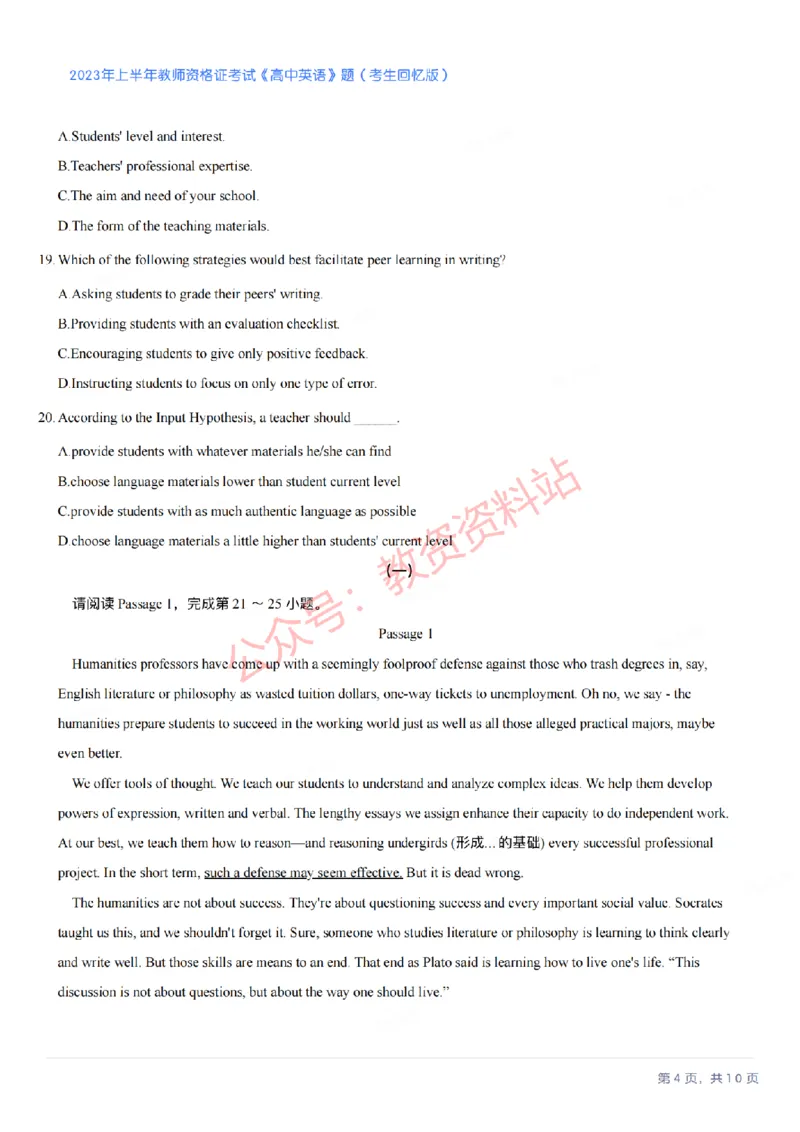
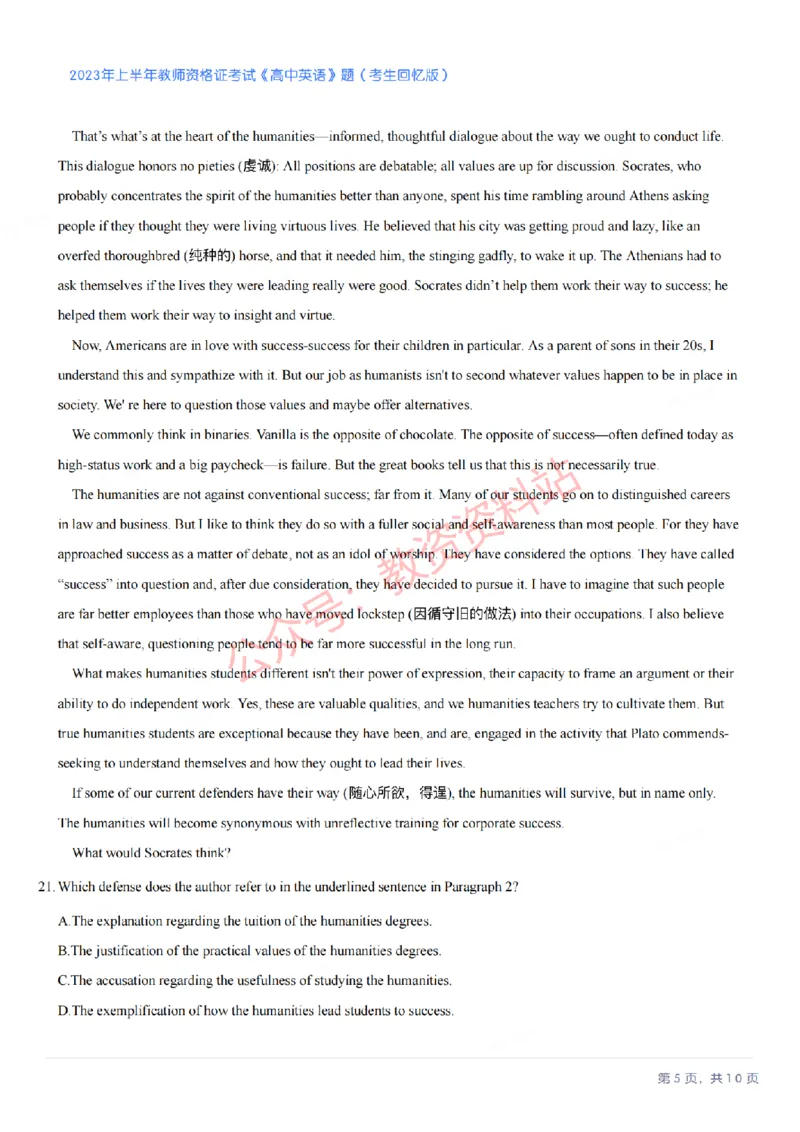
Humanities professors have come up with a seemingly foolproof defense
against those who trash degrees in, say, English literature or philosophy as
wasted tuition dollars, one-way tickets to unemployment. Oh no, we say
- the humanities prepare students to succeed in the working world just
as well as all those alleged practical majors, maybe even better.
We offer tools of thought. We teach our students to understand and an
alyze complex ideas. We help them develop powers of expression, writte
n and verbal. The lengthy essays we assign enhance their capacity to do
independent work. At our best, we teach them how to reason—and reas
oning undergirds (形成…的基础) every successful professional project. In
the short term, such a defense may seem effective. But it is dead wrong.
The humanities are not about success. They're about questioning success
and every important social value. Socrates taught us this, and we shouldn't
forget it. Sure, someone who studies literature or philosophy is learning
to think clearly and write well. But those skills are means to an end. That
end as Plato said is learning how to live one's life. “This discussion is not
about questions, but about the way one should live.”
That’s what’s at the heart of the humanities—informed, thoughtful dialogue
about the way we ought to conduct life. This dialogue honors no pieties
(虔诚): All positions are debatable; all values are up for discussion.
Socrates, who probably concentrates the spirit of the humanities better than
anyone, spent his time rambling around Athens asking people if they
thought they were living virtuous lives. He believed that his city was
getting proud and lazy, like an overfed thoroughbred (纯种的) horse, and
that it needed him, the stinging gadfly, to wake it up. The Athenians had
to ask themselves if the lives they were leading really were good. Socrates
didn’t help them work their way to success; he helped them work their
way to insight and virtue.
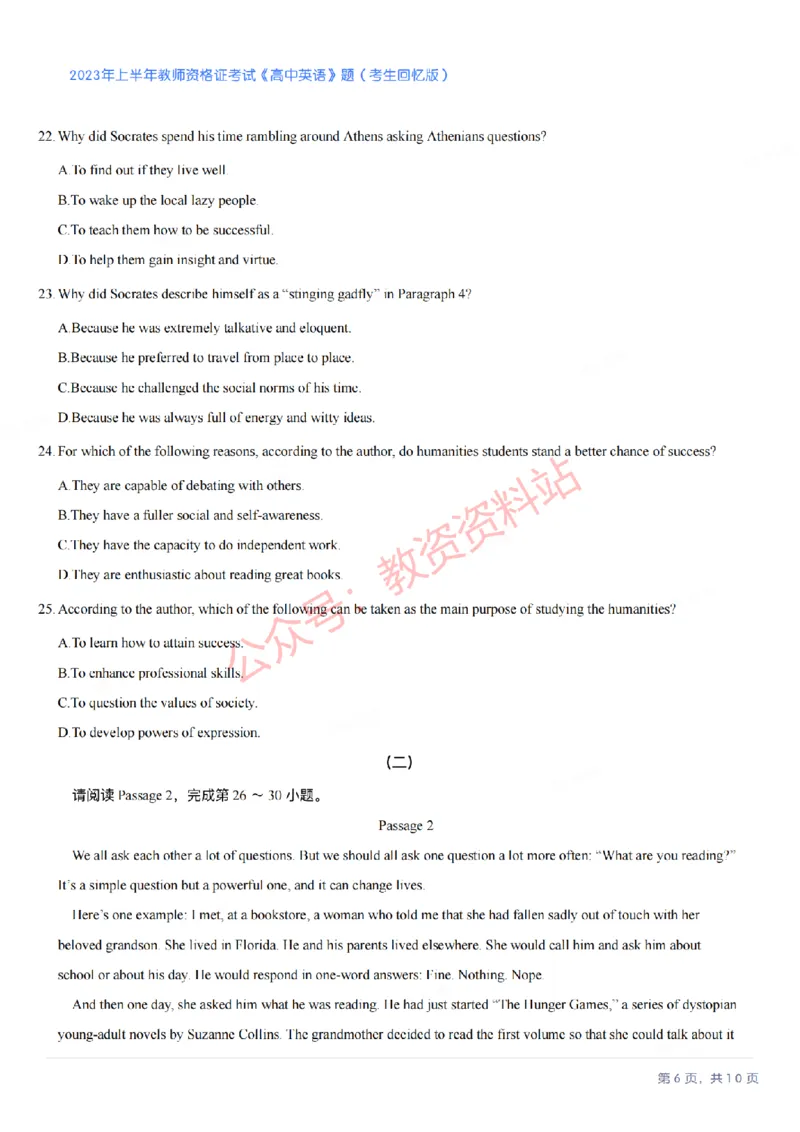
Now, Americans are in love with success-success for their children in particular.
As a parent of sons in their 20s, I understand this and sympathize with it.
But our job as humanists isn't to second whatever values happen to be in
place in society. We' re here to question those values and maybe offer
alternatives.
We commonly think in binaries. Vanilla is the opposite of chocolate. The
opposite of success—often defined today as high-status work and a big
paycheck—is failure. But the great books tell us that this is not necessarily
true.
The humanities are not against conventional success; far from it. Many of
our students go on to distinguished careers in law and business. But I
like to think they do so with a fuller social and self-awareness than most
people. For they have approached success as a matter of debate, not as
an idol of worship. They have considered the options. They have called “
success” into question and, after due consideration, they have decided to
pursue it. I have to imagine that such people are far better employees
than those who have moved lockstep (因循守旧的做法) into their
occupations. I also believe that self-aware, questioning people tend to
befar more successful in the long run.
What makes humanities students different isn't their power of expression,
their capacity to frame an argument or their ability to do independent
work. Yes, these are valuable qualities, and we humanities teachers try to
cultivate them. But true humanities students are exceptional because they
have been, and are, engaged in the activity that Plato commends-seeking
to understand themselves and how they ought to lead their lives.
If some of our current defenders have their way (随心所欲,得逞), the
humanities will survive, but in name only. The humanities will become
synonymous with unreflective training for corporate success.
What would Socrates think?
21.单选题
Which defense does the author refer to in the underlined sentence in Paragraph 2?
A. The explanation regarding the tuition of the humanities degrees.
B. The justification of the practical values of the humanities
degrees.
C. The accusation regarding the usefulness of studying the
humanities.
D. The exemplification of how the humanities lead students to
success.
正确答案是: B
o
解析
本题考查细节理解题。根据第一段最后一句: “Oh no, we say - the
humanities prepare students to succeed in the working world just
as well as all those alleged practical majors, maybe even better.”
(哦,不,我们会说—人文学科为学生在工作中取得成功做准备,
就像所有那些所谓的实用专业一样,甚至更好。)可知,有些人诋
毁英语文学或哲学等学科的学位,说这是浪费学费,但是人文学科
的教授辩解说人文学科是实用的。作者认为这种辩解也许看似有
效,实则大错特错。B 项意为:人文学科学位实践价值的论证。故
B 项正确。
A 项:意为:关于人文学科学位学费的解释。与题干不符,排除。
C 项:意为:关于学习人文学科无用的指责。与题干不符,排除。
D 项:意为:这是人文学科如何引导学生走向成功的例证。与题干
不符,排除。
故正确答案为B。
o
考点
阅读理解
22.单选题
Why did Socrates spend his time rambling around Athens asking Athenians
questions?
A. To find out if they live well.
B. To wake up the local lazy people.
C. To teach them how to be successful.
D. To help them gain insight and virtue.
正确答案是: D
o
解析
本题考查细节理解题。根据第四段最后一句: “Socrates didn't help
them work their way to success: he helped them work their way to
insight and virtue.”(苏格拉底并没有帮助他们走上成功之路,而是
帮助他们获得洞察力和美德。)可知,苏格拉底经常在雅典四处漫
步,是为了帮助他们获得洞察力和美德。故D 项正确。
A 项:意为:看看他们是否生活得很好。与题干不符,排除。
B 项:意为:唤醒当地的懒人。与题干不符,排除。
C 项:意为:教他们如何成功。与题干不符,排除。
故正确答案为D。
o
考点
阅读理解
23.单选题
Why did Socrates describe himself as a “stinging gadfly” in Paragraph 4?
A. Because he was extremely talkative and eloquent.
B. Because he preferred to travel from place to place.
C. Because he challenged the social norms of his time.
D. Because he was always full of energy and witty ideas.
正确答案是: C
o
解析
本题考查推理判断题。根据第四段第四句: “He believed that his
city was getting proud and lazy, like an overfed thoroughbred
horse, and that it needed him, the stinging gadfly, to wake it up.”
(他相信他的城市正在变得骄傲和懒惰,就像一匹被过度喂养的纯
种马,而它需要他,这只刺人的牛虻,来唤醒它。)可知,他认为
他的城市变得傲慢而懒情,他挑战了当时傲慢而懒惰的社会规范,
所以他称自己为蛰痛的牛虻,来唤醒他们。C 项意为:因为他挑战
了当时的社会规范。故C 项正确。
A 项:意为:因为他非常健谈。与题干不符,排除。
B 项:意为:因为他喜欢到处旅行。与题干不符,排除。
D 项:意为:因为他总是充满活力和机智的想法。与题干不符,排
除。
故正确答案为C。
o
考点
阅读理解
24.单选题
For which of the following reasons, according to the author, do humanities
students stand a better chance of success?
A. They are capable of debating with others.
B. They have a fuller social and self-awareness.
C. They have the capacity to do independent work.
D. They are enthusiastic about reading great books.
正确答案是: B
o
解析
本题考查细节理解题。根据第七段第二句至第四句: “Many of our
students go on to distinguished careers in law and business. But I
like to think they do so with a fuller social and self-awareness than
most people. For they have approached success as a matter of
debate, not as an idol of worship.”(我们的许多学生在法律和商业
领域都有杰出的职业生涯。但我认为他们这样做比大多数人有更充
分的社会和自我意识。因为他们把成功当作争论的话题,而不是崇
拜的偶像。)可知,作者认为人文学科的学生有更好的成功机会,
是因为他们有更全面的社会意识和自我意识。故B 项正确。
A 项:意为:他们有能力与他人辩论。与题干不符,排除。
C 项:意为:他们有独立工作的能力。与题干不符,排除。
D 项:意为:他们热衷于阅读伟大的书籍。与题干不符,排除。
故正确答案为B。
o
考点
阅读理解
25.单选题
According to the author, which of the following can be taken as the main
purpose of studying the humanities?
A. To learn how to attain success.
B. To enhance professional skills.
C. To question the values of society.
D. To develop powers of expression.
正确答案是: C
o
解析
本题考查推理判断题。根据第八段: “What makes humanities
students different isn't their power of expression, their capacity to
frame an argument or their ability to do independent work. Yes,
these are valuable qualities, and we humanities teachers try to
cultivate them. But true humanities students are exceptional
because they have been, and are, engaged in the activity that
Plato commends-seeking to understand themselves and how they
ought to lead their lives.”(让人文学科的学生与众不同的不是他们
的表达能力,不是他们提出论点的能力,也不是他们独立工作的能
力。是的,这些都是宝贵的品质,我们人文学科的老师努力培养这
些品质。但是真正的人文学科的学生是特殊的,因为他们已经并且
正在从事柏拉图所赞扬的活动——寻求了解自己以及他们应该如何
过他们的生活。)可知,学习人文科学的目的,是勇于质疑社会,
力图理解自己,并搞明白自己应该怎样生活。C 项意为:质疑社会
的价值。故C 项正确。
A 项:意为:学习如何获得成功。与题干不符,排除。
B 项:意为:提升专业技能。与题干不符,排除。
D 项:意为:培养表达的能力。与题干不符,排除。
故正确答案为C。
o
考点
阅读理解
材料
请阅读 Passage 2,完成第 26 ~ 30 小题。
Passage 2
We all ask each other a lot of questions. But we should all ask one question
a lot more often: “What are you reading?” It’s a simple question but a
powerful one, and it can change lives.
Here’s one example: I met, at a bookstore, a woman who told me that she
had fallen sadly out of touch with her beloved grandson. She lived in Florida.
He and his parents lived elsewhere. She would call him and ask
him about school or about his day. He would respond in one-word answers:
Fine. Nothing. Nope.
And then one day, she asked him what he was reading. He had just start
ed “The Hunger Games,” a series of dystopian young-adult novels by
Suzanne Collins. The grandmother decided to read the first volume so
that she could talk about it with her grandson the next time they chatted
on the phone. She didn’t know what to expect, but she found herself
hooked from the first pages.
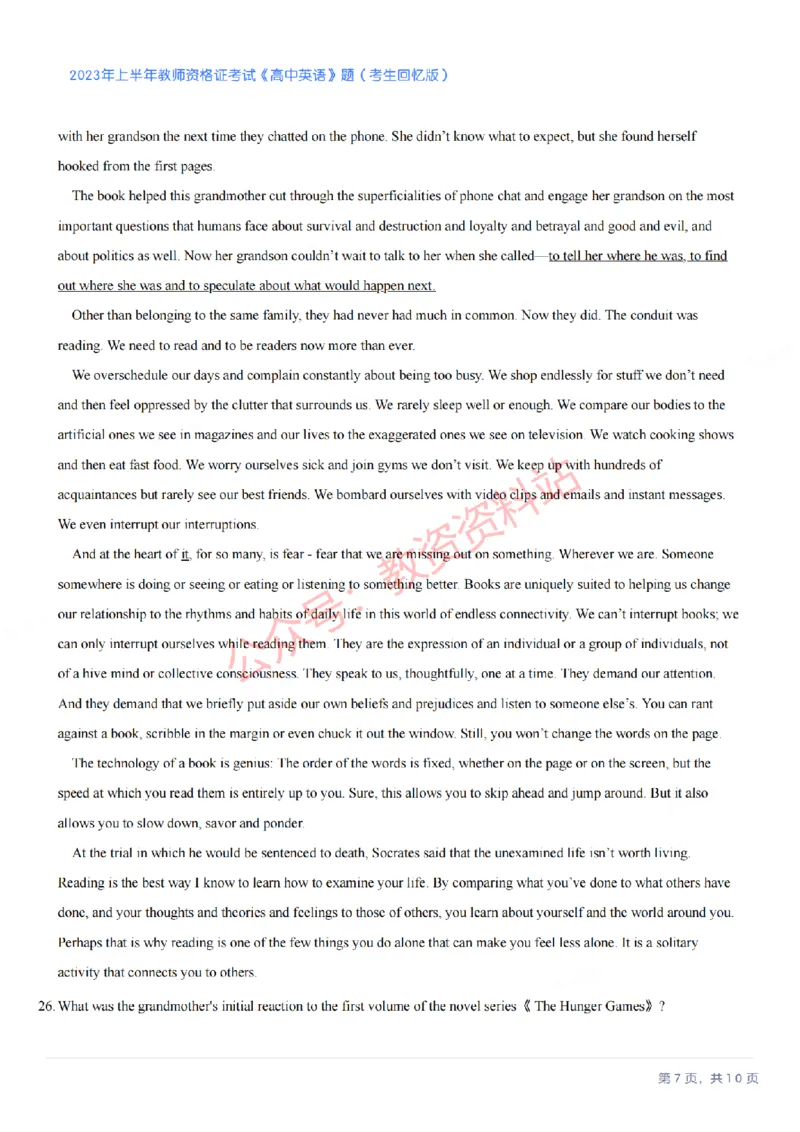
The book helped this grandmother cut through the superficialities of pho
ne chat and engage her grandson on the most important questions that
humans face about survival and destruction and loyalty and betrayal and
good and evil, and about politics as well. Now her grandson couldn’t wait
it to talk to her when she called—to tell her where he was, to find out
where she was and to speculate about what would happen next.
Other than belonging to the same family, they had never had much in
common. Now they did. The conduit was reading. We need to read and
to be readers now more than ever.
We overschedule our days and complain constantly about being too busy
. We shop endlessly for stuff we don’t need and then feel oppressed by
the clutter that surrounds us. We rarely sleep well or enough. We compa
re our bodies to the artificial ones we see in magazines and our lives to
the exaggerated ones we see on television. We watch cooking shows and
then eat fast food. We worry ourselves sick and join gyms we don’t visit.
We keep up with hundreds of acquaintances but rarely see our best
friends. We bombard ourselves with video clips and emails and instant
messages. We even interrupt our interruptions.
And at the heart of it, for so many, is fear - fear that we are missing out
on something. Wherever we are. Someone somewhere is doing or seeing
or eating or listening to something better. Books are uniquely suited to
helping us change our relationship to the rhythms and habits of daily life
in this world of endless connectivity. We can’t interrupt books; we can on
ly interrupt ourselves while reading them. They are the expression of an
individual or a group of individuals, not of a hive mind or collective
consciousness. They speak to us, thoughtfully, one at a time. They demand
our attention. And they demand that we briefly put aside our own beliefs
and prejudices and listen to someone else’s. You can rant against a book
, scribble in the margin or even chuck it out the window. Still, you won’t
change the words on the page.
The technology of a book is genius: The order of the words is fixed,
whether on the page or on the screen, but the speed at which you read
them is entirely up to you. Sure, this allows you to skip ahead and jump
around. But it also allows you to slow down, savor and ponder.
At the trial in which he would be sentenced to death, Socrates said that
the unexamined life isn’t worth living. Reading is the best way I know to
learn how to examine your life. By comparing what you’ve done to what
others have done, and your thoughts and theories and feelings to those
of others, you learn about yourself and the world around you. Perhaps
that is why reading is one of the few things you do alone that can make
you feel less alone. It is a solitary activity that connects you to others.
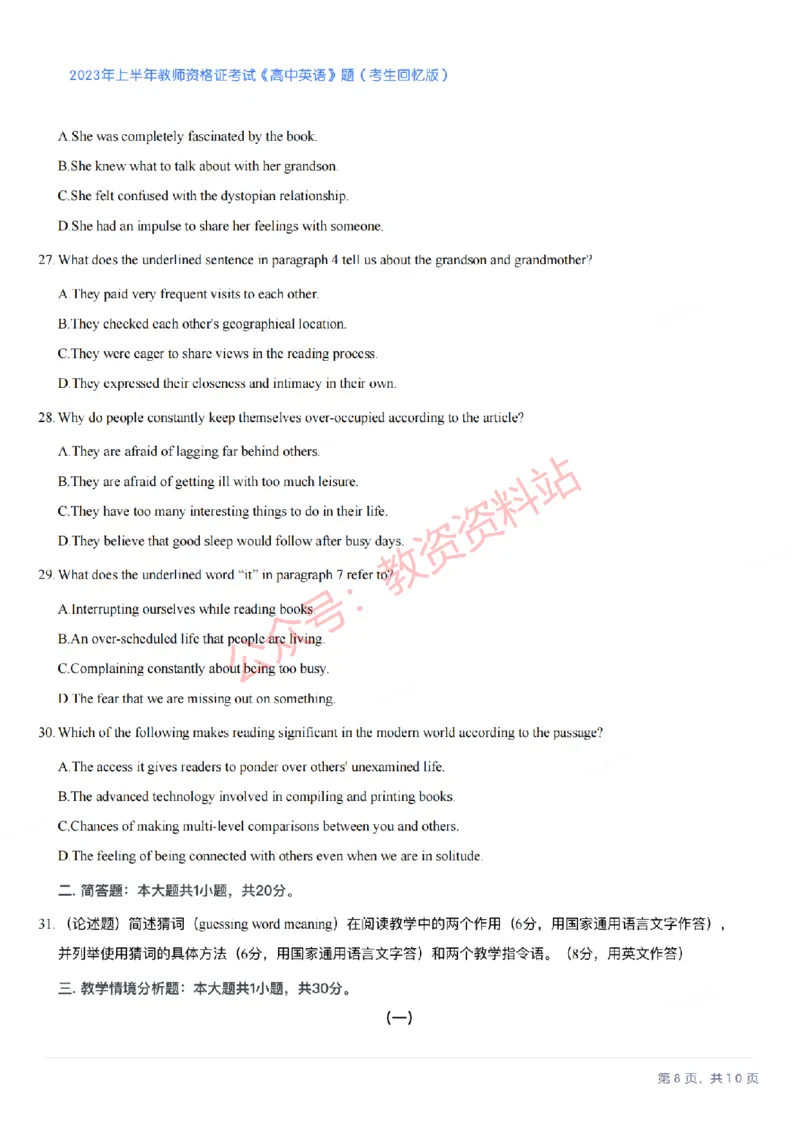
26.单选题
What was the grandmother's initial reaction to the first volume of the novel
series《 The Hunger Games》?
A. She was completely fascinated by the book.
B. She knew what to talk about with her grandson.
C. She felt confused with the dystopian relationship.
D. She had an impulse to share her feelings with someone.
确答案是: A
o
解析
本题考查细节理解。根据第三段的最后一句: “but she found herself
hooked from the first pages.”(但她发现自己从第一页就被吸引住
了。)可知,她刚读了几页就迷上了。故A 项正确。
B 项:意为:她知道该和孙子说些什么。与题干不符,排除。
C 项:意为:她对这种反乌托邦式的关系感到困惑。与题干不符,
排除。
D 项:意为:她有一种冲动想和某人分享她的感受。与题干不符,
排除。
故正确答案为A。
o
考点
阅读理解
27.单选题
What does the underlined sentence in paragraph 4 tell us about the grandson
and grandmother?
A. They paid very frequent visits to each other.
B. They checked each other's geographical location.
C. They were eager to share views in the reading process.
D. They expressed their closeness and intimacy in their own.
正确答案是: C
o
解析
本题考查细节理解题。根据第四段的第一句: “The book helped this
grandmother cut through the superficialities of phone chat and
engage her grandson on the most important questions ......”(这本
书帮助这位祖母克服了电话聊天的肤浅之处,让她的孙子在最重要
的问题上参与进来)可知,书籍帮助这对祖孙重新交流,这些讨论
的内容都是阅读中的观点。C 项:“在阅读过程中,他们热切地分享
自己的观点。”故C 项正确。
A 项意为:他们经常互相拜访。与题干不符,排除。
B 项意为:他们互相查看了对方的地理位置。与题干不符,排除。
D 项意为:他们表达了自己的亲密和亲昵。与题干不符,排除。
故正确答案为C。
o
考点
阅读理解
28.单选题
Why do people constantly keep themselves overoccupied according to the
article?
A. They are afraid of lagging far behind others.
B. They are afraid of getting ill with too much leisure.
C. They have too many interesting things to do in their life.
D. They believe that good sleep would follow after busy days.
正确答案是: A
o
解析
本题考查细节理解题。根据第七段的第一句: “..fear that we are
missing out on something. Wherever we are. Someone
somewhere is doing or seeing or eating or listening to something
better.(害怕我们错过了一些东西。不管我们在哪里。有人在某个
地方做着、看着、吃着或听着更好的东西。)可知,人们让自己过
于繁忙是因为害怕自己错过了什么。担心自己落后于人。故A 项正
确。
B 项:意为:他们害怕休闲过多而生病。与题干不符,排除。
C 项:意为:他们在生活中有太多有趣的事情要做。与题干不符,
排除。
D 项:意为:他们相信忙碌的日子过后会有好的睡眠。与题干不
符,排除。
故正确答案为A。
o
考点
阅读理解
29.单选题
What does the underlined word “it” in paragraph 7 refer to?
A. Interrupting ourselves while reading books.
B. An over-scheduled life that people are living.
C. Complaining constantly about being too busy.
D. The fear that we are missing out on something.
正确答案是: B
o
解析
本题考查词义猜测。联系上文可知,人们过于繁忙的生活是由于害
怕错过,因此此处的it 指的是忙碌的生活。故B 项正确。
A 项:意为:读书时打断自己。与题干不符,排除。
C 项:意为:不停地抱怨自己太忙。与题干不符,排除。
D 项:意为:担心我们错过了什么。与题干不符,排除。
故正确答案为B。
o
考点
阅读理解
30.单选题
Which of the following makes reading significant in the modern world according
to the passage?
A. The access it gives readers to ponder over others' unexamined
life.
B. The advanced technology involved in compiling and printing
books.
C. Chances of making multi-level comparisons between you and
others.
D. The feeling of being connected with others even when we are in
solitude.
正确答案是: D
o
解析
本题考查细节理解。根据最后一句: “It is a solitary activity that
connects you to others.”(这是一项将你与他人联系起来的单独活
动。)可知,阅读是一项孤独的活动,却能和他人联系。D 项:“即
使我们孤独时也能与他人联系在一起的感觉。”故D 项正确。
A 项:意为:它让读者有机会去思考别人未经审视的生活。与题干
不符,排除。
B 项:意为:编印书籍所涉及的先进技术。与题干不符,排除。
C 项:意为:你和其他人进行多层次比较的机会。与题干不符,排
除。
故正确答案为D。
o
考点
阅读理解
31.论述题
简述猜词(guessing word meaning)在阅读教学中的两个作用(6 分,用国家
通用语言文字作答),并列举使用猜词的具体方法(6 分,用国家通用语言文
字答)和两个教学指令语。(8 分,用英文作答)
正确答案是:
(1)猜词在阅读教学中的作用:
①猜词能够帮助学生在阅读过程中很快通过上下文提供的线索或生词
本身的结构特点推断出词义来,从而提高阅读速度和阅读能力。
②有效的猜词技巧能够提高学生的阅读学习兴趣。阅读文本中所涉及
的词汇及句式较为复杂,内容较多,致使阅读理解较困难,若使用有
效的猜词技巧,则会清除很大一部分阅读障碍,从而提升学生的阅读
兴趣,促进阅读教学效果。
(2)使用猜词的具体方法:
①构词法猜词
阅读中常常会遇到一些由熟悉的单词派生或合成的新词。掌握构词法
对猜测词义很有帮助。如:unforeseeable 这个词,可以根据构词法把
它拆成un, fore, see, able; 其中see 是词根,fore 是“先,前,预”的含
义,un 是否定,able 是“能...的,可...的”,因此unforeseeable 是“未能
预见到的”意思。
②利用同义、近义词猜词
在生词所出现的上下文中,有时会出现与之同义或近义的词语或结
构,这时可从熟悉的词语中推知生词的含义。统称在词或短语之间有
并列连词and 或or,这些词语或短语在句中作相同的成分,并且and
或or 连接的两项内容在含义上是接近的或递进的,由此确定同等关系
中的某个生词所属的义域,甚至推出它的大致词义。
③利用反义词猜词
对比是描述,说明事物的常用方式。在对比中,对比的事物是互为相
反的,因此根据反义或对比关系可从已知推出未知。利用反义词来说
明生词的意义,如反义词hot and cold; perfect and imperfect,甚至
前、后句为肯定与否定或是与不是等,在句内词与词之间,在段内句
与句之间的关系上起着互为线索的作用。
(3)两个教学指令:
①
Guys, look at this word. Who can tell me the meaning of it through
analyzing the context?
②
Now, guys, look at this sentence. Can you replace this word with
another word or phrase similar in meaning?
o
解析
同上。
o
考点
阅读教学设计
材料
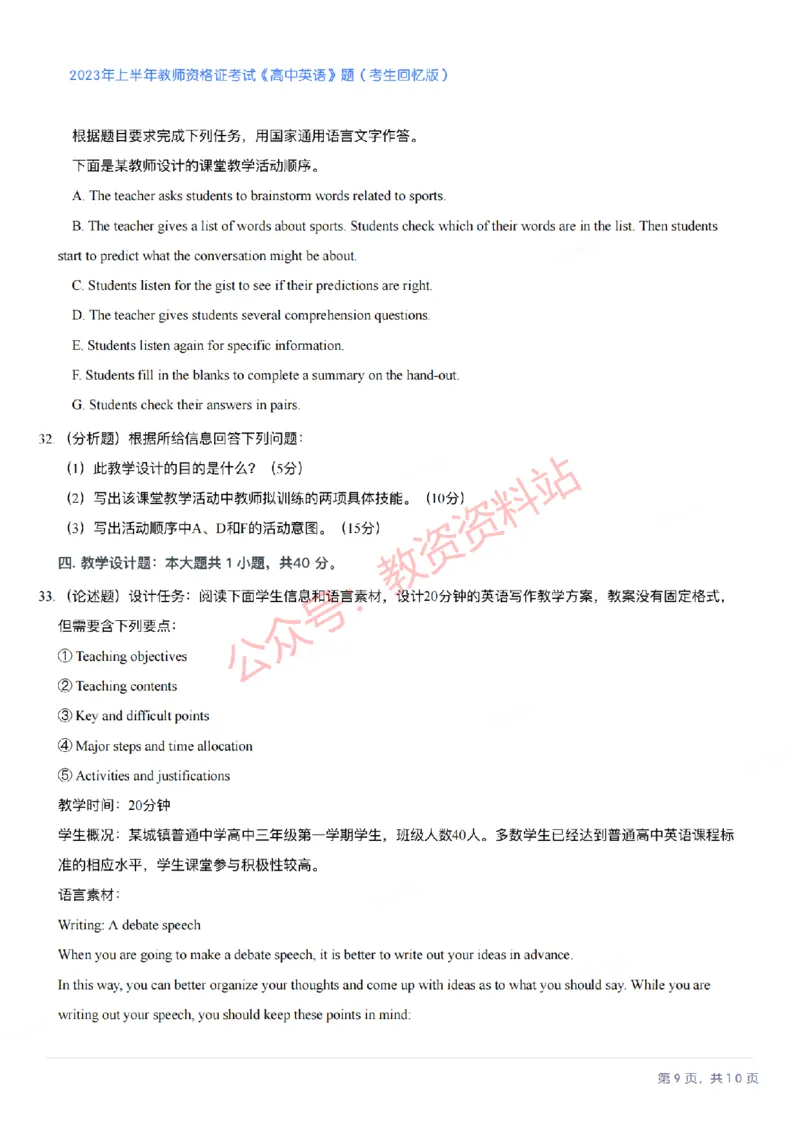
根据题目要求完成下列任务,用国家通用语言文字作答。
下面是某教师设计的课堂教学活动顺序。
A. The teacher asks students to brainstorm words related to sports.
B. The teacher gives a list of words about sports. Students check which
of their words are in the list. Then students start to predict what the
conversation might be about.
C. Students listen for the gist to see if their predictions are right.
D. The teacher gives students several comprehension questions.
E. Students listen again for specific information.
F. Students fill in the blanks to complete a summary on the hand-out.
G. Students check their answers in pairs.
32.分析题
根据所给信息回答下列问题:
(1)此教学设计的目的是什么?(5 分)
(2)写出该课堂教学活动中教师拟训练的两项具体技能。(10 分)
(3)写出活动顺序中A、D 和F 的活动意图。(15 分)
正确答案是:
(1)教学目的:
通过听前预测以及听中泛听、精听等多层次任务,提高学生的听力技
能,掌握与体育相关的词汇、语篇知识。
(2)两项具体技能:
技能一:根据提示词预测对话大意的技能;
技能二:泛听获取对话大意的技能;
技能三:精听获取对话具体信息的技能;
技能四:总结材料信息的技能。
(答出任意二点即可)
(3)活动意图:
活动A:通过与运动相关主题词汇的回顾和积累,铺垫背景知识,并
为学生预测文本大意做好知识准备。
活动D:通过听前布置相关细节信息的问题,以促进学生英语学科核
心素养的发展为目标,围绕主题语境,通过学习理解类活动,帮助学
生有目的地在听力文章中抓住关键细节信息,提高相关话题的听力技
能,同时引导学生加深对主题意义的理解。
活动F:通过文章小结的填空,提高学生的概括归纳能力同时充分发挥
学生在课堂的主体地位。
o
解析
同上。
o
考点
教学情境的评价
33.论述题
设计任务:阅读下面学生信息和语言素材,设计20 分钟的英语写作教学方案,
教案没有固定格式,但需要含下列要点:
① Teaching objectives
② Teaching contents
③ Key and difficult points
④ Major steps and time allocation
⑤ Activities and justifications
教学时间:20 分钟
学生概况:某城镇普通中学高中三年级第一学期学生,班级人数40 人。多数学
生已经达到普通高中英语课程标准的相应水平,学生课堂参与积极性较高。
语言素材:
Writing: A debate speech
When you are going to make a debate speech, it is better to write out your
ideas in advance.
In this way, you can better organize your thoughts and come up with ideas as
to what you should say. While you are writing out your speech, you should
keep these points in mind:
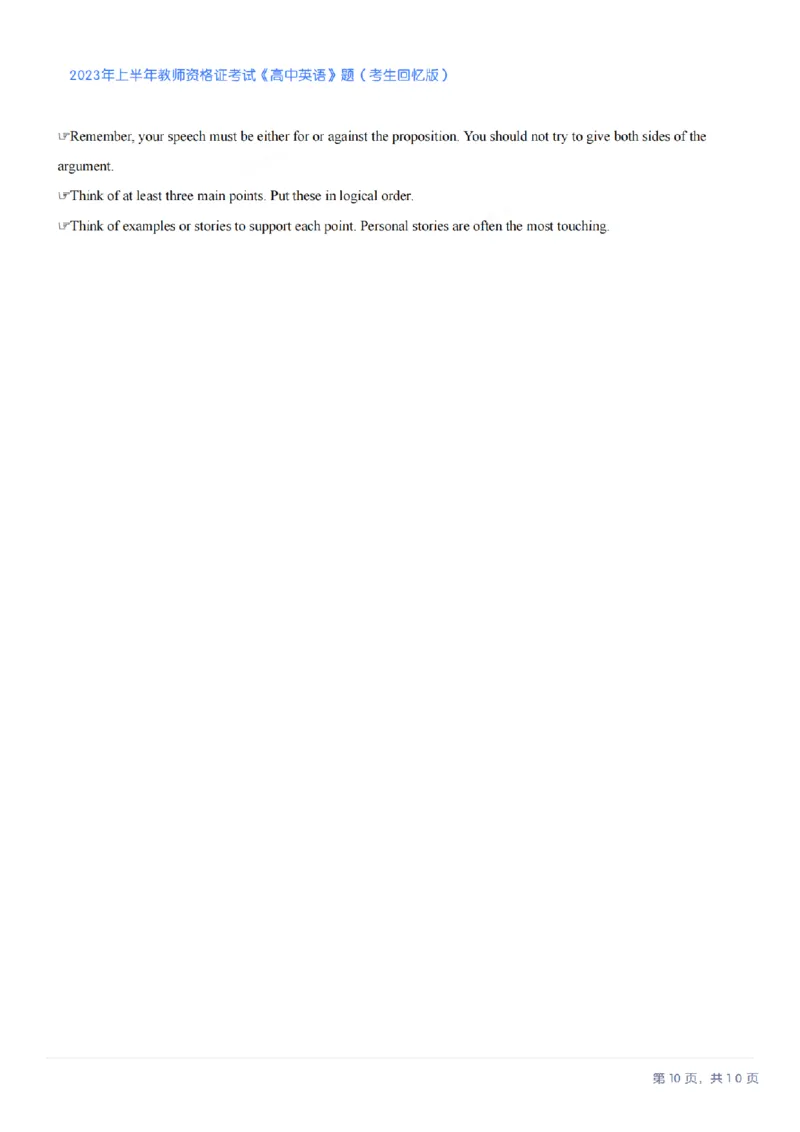
☞Remember, your speech must be either for or against the proposition. You
should not try to give both sides of the argument.
☞Think of at least three main points. Put these in logical order.
☞Think of examples or stories to support each point. Personal stories are
often the most touching.
正确答案是:
I. Teaching contents
This is a writing lesson, which talks about how to write a debate speec
h.
II. Teaching objectives
①Language competence
Students can learn how to make a debate speech and write it out.
②Cultural Awareness
Students can have good qualities of self-confidence and self-
improvement.
③Thinking quality
Students can use English to think independently and creatively.
④Learning ability
Students will be willing to take part in the class activities and
cooperate with other group members.
III. Key and difficult points:
①Key point
Let students write a passage with a certain topic.
②Difficult point
To improve the confidence of learning English.
IV. Major steps
Step 1: Pre-writing(8 mins)
①Do a brainstorming
Let students do a brainstorming. The topic is Whether good deeds
should be known. Students will be given several minutes to work in
groups to talk about it and write down some ideas, including their
propositions, reasons (at least three main points) and other detailed
information like examples or stories to support each point. After that,
representatives from each group will share their results, including so
me useful phrases, sentences and so on. Each answer will get a
positive feedback.
②Structure learning
The teacher will stress the key points when students are going to
make a debate speech and students should also pay attention to the
topic sentences, transitional words, logical relations and so on.
Justification: Through the above activities, students will be prepared
to write their own compositions. They will know what to write and
how to write it.
Step 2: While-writing (7 mins)
Drafting
Students will write their own compositions, and the teacher will walk
around to offer help and remind students to pay attention to the
spelling, grammar, punctuation and so on.
Justification: Through the activity, students will finish their writing and
their writing ability will be improved.
Step 3: Post-writing (5 mins)
(1) Editing
①Self-editing
The teacher will give students a short time to go through their
compositions to correct the mistakes in spelling and grammar.
②Peer-editing
Students will exchange their compositions with each other and
correct the mistakes in spelling and grammar. They can also make
suggestions about polishing their writings.
(2) Displaying and evaluating
The teacher will invite some students to share their compositions with
the whole class and guide other students to evaluate these
compositions, and then the teacher will make a conclusion.
Justification: Through these activities, students will regulate their
language and work out better ideas or expressions, and they will
improve their writing skills.
o
解析
同上。
o
考点
教学设计