年 全 国 教 师 资 格
2 0 2 4
理 论 精 讲 -句 法 3
讲师:李婉君
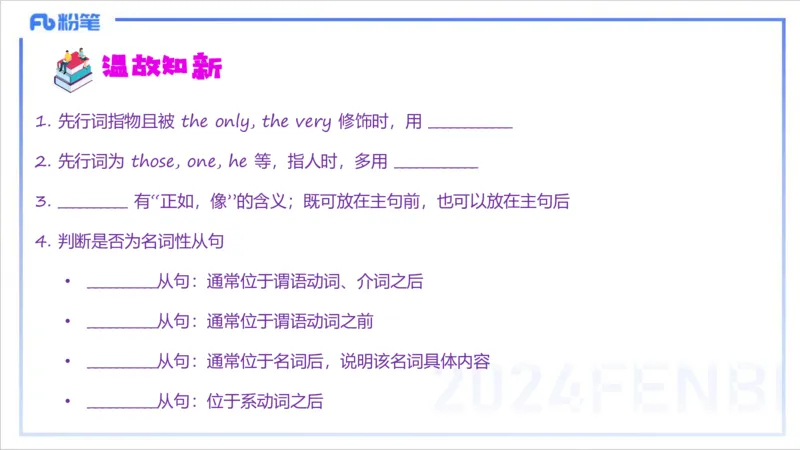
更多干货关注 粉笔教师教育 粉笔教师温 故知 新
先行词指物且被 修饰时,用
1. the only, the very ____________
先行词为 等,指人时,多用
2. those, one, he ____________
有 正如,像 的含义;既可放在主句前,也可以放在主句后
3. __________ “ ”
判断是否为名词性从句
4.
• 从句:通常位于谓语动词、介词之后
__________
• 从句:通常位于谓语动词之前
__________
• 从句:通常位于名词后,说明该名词具体内容
__________
• 从句:位于系动词之后
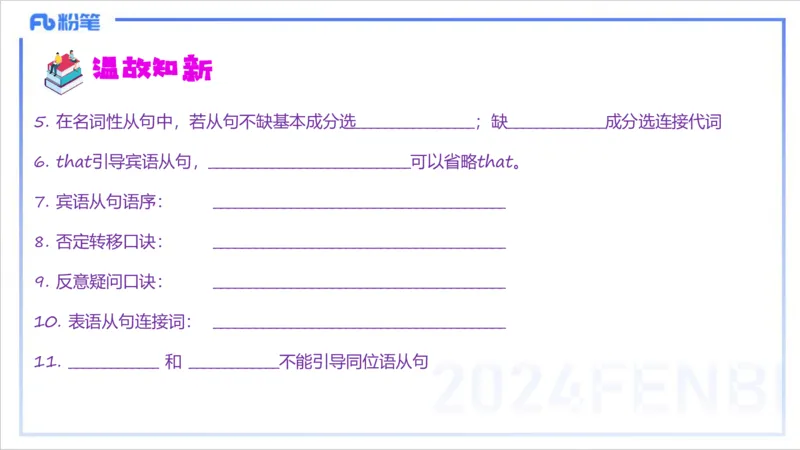
__________温 故知 新
在名词性从句中,若从句不缺基本成分选 ;缺 成分选连接代词
5. _________________ ______________
引导宾语从句, 可以省略 。
6. that _____________________________ that
宾语从句语序:
7. __________________________________________
否定转移口诀:
8. __________________________________________
反意疑问口诀:
9. __________________________________________
表语从句连接词:
10. __________________________________________
和 不能引导同位语从句
11. _____________ _____________回 顾上 节 课
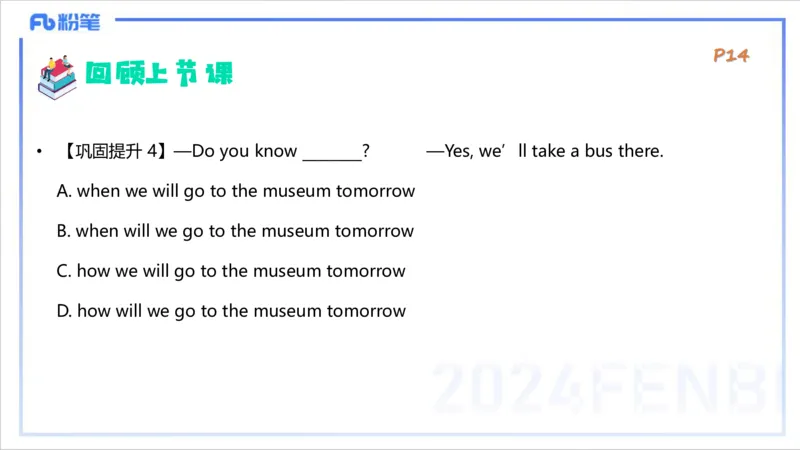
• 【巩固提升 4】—Do you know ________? —Yes, we’ll take a bus there.
A. when we will go to the museum tomorrow
B. when will we go to the museum tomorrow
C. how we will go to the museum tomorrow
D. how will we go to the museum tomorrow状 语 从 句
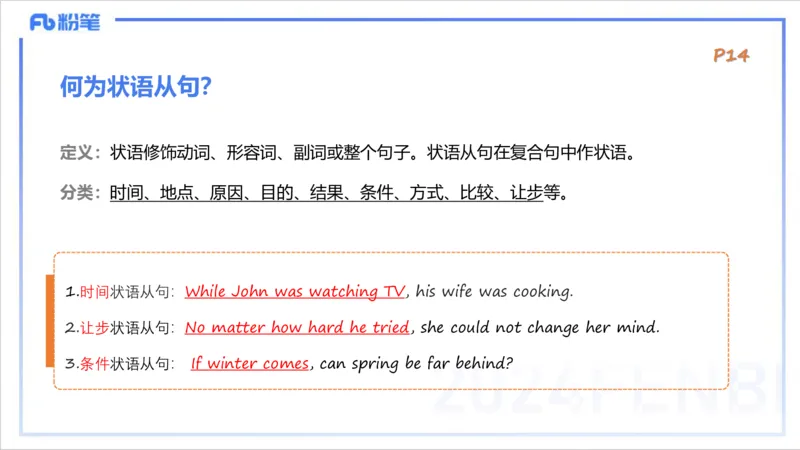
Adverbial clauses何为状语从句?
定义:状语修饰动词、形容词、副词或整个句子。状语从句在复合句中作状语。
分类:时间、地点、原因、目的、结果、条件、方式、比较、让步等。
时间状语从句:
1. While John was watching TV, his wife was cooking.
让步状语从句:
2. No matter how hard he tried, she could not change her mind.
条件状语从句:
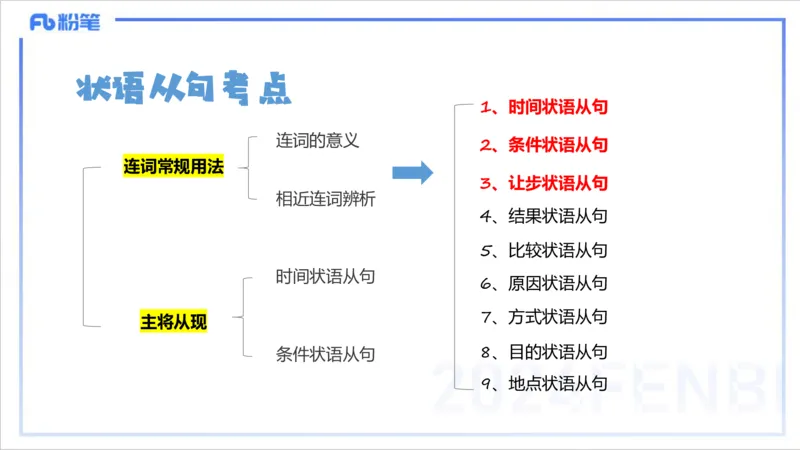
3. If winter comes, can spring be far behind?状语 从句 考 点
、时间状语从句
1
连词的意义
、条件状语从句
2
连词常规用法
、让步状语从句
3
相近连词辨析
、结果状语从句
4
、比较状语从句
5
时间状语从句
、原因状语从句
6
、方式状语从句
主将从现 7
条件状语从句 8 、目的状语从句
、地点状语从句
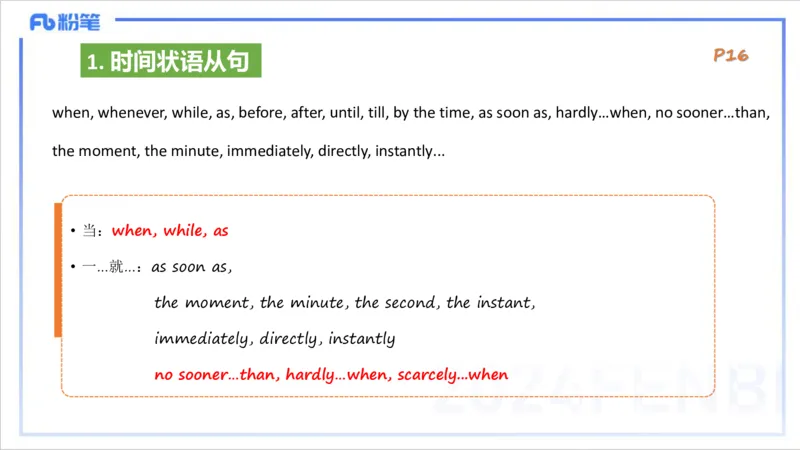
91. 时间状语从句
when, whenever, while, as, before, after, until, till, by the time, as soon as, hardly…when, no sooner…than,
the moment, the minute, immediately, directly, instantly...
当:
•
when, while, as
一 就 :
•
… … as soon as,
the moment, the minute, the second, the instant,
immediately, directly, instantly
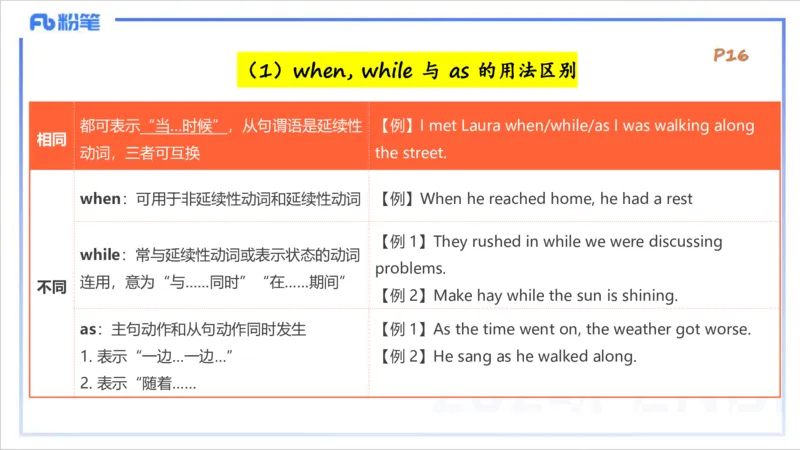
no sooner…than, hardly…when, scarcely...when( ) 与 的用法区别
1 when, while as
都可表示“当…时候”,从句谓语是延续性 【例】I met Laura when/while/as I was walking along
相同
动词,三者可互换 the street.
when:可用于非延续性动词和延续性动词 【例】When he reached home, he had a rest
【例 1】They rushed in while we were discussing
while:常与延续性动词或表示状态的动词
problems.
连用,意为“与……同时”“在……期间”
不同
【例 2】Make hay while the sun is shining.
as:主句动作和从句动作同时发生 【例 1】As the time went on, the weather got worse.
1. 表示“一边…一边…” 【例 2】He sang as he walked along.
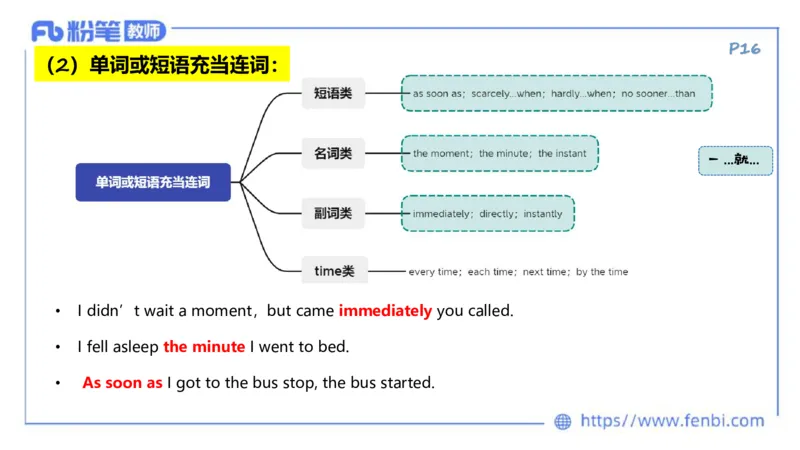
2. 表示“随着……( )单词或短语充当连词:
2
一 ...就...
• I didn’t wait a moment,but came immediately you called.
• I fell asleep the minute I went to bed.
• As soon as I got to the bus stop, the bus started.( )连词 用法:
3 no sooner…than, hardly/scarcely...when
① 搭配
② 语序: 置于句首时,其后要进行部分倒装
hardly/ scarcely/ no sooner
③ 时态:
Hardly/Scarcely/No sooner+ had done..., when/when/than+ did...
【例 】
1 Hardly had I reached home when it began to rain.
【例 】
2 Scarcely had the doctor got into bed when he was called out again.
【例 】
3 No sooner had we sat down than we found it was time to go.
我就是路过,你们继续~勤学 勤练
1. The machine is so advanced that it will start ________ you press the button.
A.the instant B.the instantly
C.on the instant D.for an instant
2. He wanted to sleep, but no sooner _________ his eyes than the desire to sleep left him.
A. had he closed B. he had closed
C. did he close D. he closed2. 条件状语从句
if, unless (除非), in case (万一), so/as long as (只要), on condition that (在...条件下),
supposing(假设,假定, 如果,只要)...当主句为将来时,从句通常用一般现在时表示将来。
【例 1】Unless we have enough evidence, we can’t win the case.
【例 2】In case I'm late, start without me.
【例 3】You won’t find paper cutting difficult as long as you keep practicing it.
【例 4】I can tell you the truth on condition that you promise to keep it a secret.
【例 5】Providing/Supposing/Given/Provided (that) you promise not to tell anyone else, I'll
explain the secret.特殊用法:主将从现
定义:在时间状语从句、条件状语从句、让步状语从句中,如果主句表达将来含义,从句用一
般现在时(表示将来含义)
• 【例 1】Unless we have enough evidence, we can’t win the case.
• 【例 2】You won’t find paper cutting difficult as long as you keep practicing it.勤学 勤练
1. They could not afford to live in such an expensive apartment _______ they were rich.
A. but B. unless C. so D. for
2. You may use the office as you like, ________ you clean it up afterwards.
A. as far as B. as well as C. as soon as D. so long as勤学 勤练
3. You have my word ________ I won the lottery one day, I would buy you a new car.
A.if B.that C.if that D.that if
4. ---Do you know if he _______ to play basketball with us?
---I think he will come if he ______ free tomorrow.
A.comes; is B.comes; will be C.will come; is D.will come; will be3. 让步状语从句
(1)as, although, though, while, even though, even if, however, whatever, whoever, whenever,
wherever,no matter what, no matter how, no matter when等
尽管:
as, although, though, while,
无论 都 :
... ... however, whatever, whoever, whenever, wherever
no matter what, no matter how, no matter when( )连词 的用法区别:
2 as, although, though, while
although :不倒装;
though: 可倒可不倒;
as:一定倒。( 名词、形容词、副词、分词、实义动词提前)
【例 】
【例1】__________ he works hard, he makes little progress.
2 Hard ________ he works, he makes little progress.
, 不能与 连用,但可以与 连用。
【例】
although though but yet
Though I believe it, yet I must consider.
引导让步状语从句时,通常放在句首,意为“尽管”。
while
【例】
While I like the colour, I don't like the shape.( ) 疑问词 和 疑问词 的用法区别:
3 no matter+ +ever
however=no matter how
① 都可以引导让步状语从句
whomever=no matter whom
No matter what he said, I believe him.
whenever=no matter when
wherever=no matter where...
Whatever he said, I believe him.
② 只能用 疑问词 引导名词性从句
+ever
I believe whatever he said.
注意: 用法
however/no matter how
However/No matter how much she eats, she never gets fat.
However/No matter how cold it is, he always goes swimming.勤学 勤练
【巩固提升 3】This is a very interesting book. I’ ll buy it, ________.
A. how much may it cost B. no matter how it may cost
C. however much it may cost D. whatever may it cost
【巩固提升 4】I don’t really like the author, ________ I have to admit his books are very exciting.
A. although B. unless C. until D. once4. 结果状语从句
so...that, such...that
【例 1】He is so clever that everyone likes him.
【例 2】He is such a clever boy that everybody likes him.
注意 名词前 many, much, few, little 等修饰,表达数量,用 so
【例1】There are so many stones that no one can move them away.
【例2】He is __________ a little boy that he can’t control his own emotion.勤学 勤练
【巩固提升 1】My brother stayed up late last night ________ he got up late this morning and
was late for work.
A. so as to B. in order to
C. so that D. as a result of5、比较状语从句
常用引导词:than, as…as, not so/as…as, the + 比较级 ..., the+ 比较级 ...
• He is taller than his brother (is).
• My hometown is as beautiful as Hangzhou (is).
• He does not work as hard as his brother (does).
• The harder you work, the more progress you will make.6、原因状语从句
常用引导词:because, as, since,
because:语气最强,回答why的问题。【未知原因】
since: 语气较弱【已知原因,句首】
as:语气次之【已知原因,句首】
• He couldn’t have seen me, because I was not there.
• Since he had a certain talent for composition, his English master encouraged him to write a lot.
• As Chile is a long and narrow country, the temperature varies considerably from north to south.in that 既然,因为。
【例 1】I’m in a slightly awkward position in that he has not arrived.
now that 既然,由于。
【例 2】Now that John is poor and unfortunate, his friends have left him in the lurch.
considering/seeing (that ) 鉴于…事实,考虑
【例 3】Seeing (that) you live next door to Mrs. Blake, you ought to be able to recognize her.勤学 勤练
• 【巩固提升 5】—How do you find your new boss, you guys?
—Oh, I think he has earned our wide respect ________ he treats everyone fairly.
A. in that B. so that C. even though D. as though
• 【2022上初中-4】Men differ from animals __________ they can think and speak.
A. for which B. in which C. in that D. for that7、方式状语从句
as,as if/as though 好像
用虚拟语气表示现在不符的或与事实相反的情况
He looks sad as if he lost money.勤学 勤练
• 【2019下高中】The experienced writer is skilled in handling his words, just ______ the
builder is skilled in handling his bricks.
A. as B. so C. thus D. like8. 目的状语从句
为了 ;目的是 目的是
so that ( ... …), in order that ( ...)
免得,以防 , ( )(唯恐,以免,生怕 , ( 唯恐 ,以免,生怕)
in case ( ) for fear that ) lest ...
n 和 引导目的状语从句时后常接 等情态动词
so that in order that may, should, could, would
【例 】
1 John spoke through a microphone so that/in order that he could be heard in every room.
【例 】
2 In order that he could be heard in every room, John spoke through a microphone.
注意
【例 】 位置
3 We left the building ahead of time so that we could catch the last bus.勤学 勤练
• 【2018上高中】We must improve the farming method ________ we may get high yields.
A. in case B. in order that
C. now that D. even if9. 地点状语从句
(1)地点状语从句通常由 where 引导,并且一般放在主句后边。
【例】A driver should slow down where there are schools.
(2)地点状语从句也可由 wherever, anywhere 和 everywhere 引导。
【例】Everywhere they appeared, there were ovations.
(3)地点状语从句若放在句首,往往失去“地点”含义,翻译时要灵活处理。
【例】Wherever there is love, there is also wealth and success.只要有爱,就会有财富和成功。
不要和where引导的定语从句混淆。
Make a mark __________ you don’t understand.
A. why B. in which C. what D. where勤学 勤练
• 【巩固提升 2】You’d better not leave the medicine ________ kids can get at it.
A. even if B. which
C. where D. so that
2. You can still find bones of the birds ______ they used to live.
A. in which B. in the place C. where D. that整 体 回 顾