义
务
教
育
教
义务教育教科书
科
书
English
英语
英
语
( 衔接三年级起点 )
(
衔
接
三
年
级
起
九年级
点
)
九
年
级
n!
u
It’s
f
asy!
It’s
e
绿绿色色印印刷刷产产品品
定价:11.30元
全国价格举报电话:12315义务教育教科书
English
英语
( 衔接三年级起点 )
九年级
[中 国] 河 北 教 育 出 版 社
合作编写
[加拿大] DC加拿大国际交流中心致 同 学
亲爱的同学们,转眼就是义务教育阶段最后一学年了,欢迎大家继续使
用这套《英语》教材!
本册《英语》教材供九年级使用。
九年级教材不再分上册和下册,而是合为了一本,供同学们全学年使
用。全书共十个单元,后面两个单元不再安排新的语法项目,对新词汇的数
量也进行了控制,以便同学们能更有效地复习。
本学年我们将徜徉在文学的殿堂,体验和欣赏一些诗歌、寓言、电影与
戏剧等文学作品。我们还将学习关于安全和救护的生活常识,探讨健康的生
活方式。你们知道如何在生活中运用沟通技巧、得体地进行社会交往吗?这
也许是渐渐长大的你们将不断面临的困惑和问题,本册内容将给予你们更多
的思索和启迪。另外,语言与文化密不可分,学习语言就要学习语言所依存
的文化。因此,在交流中要时刻保持文化意识。我们将专门介绍一些世界各
地的文化特点,帮助同学们开阔视野,了解更多东西方文化的异同。
在初中阶段的最后一段时光中,我们要更多地参与、交流,并经常反思
和总结。相信自己,只要不断付出就会有所收获。祝大家学习之旅愉快!Contents
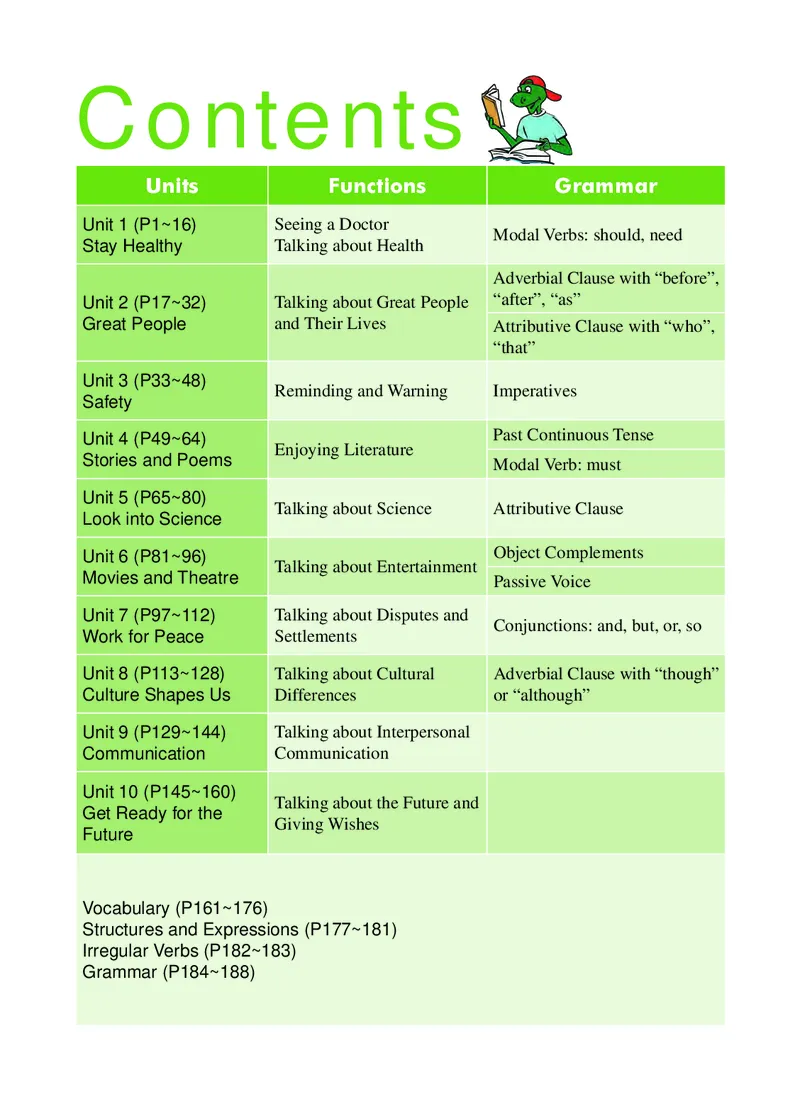
Units Functions Grammar
Unit 1 (P1~16) Seeing a Doctor
Modal Verbs: should, need
Stay Healthy Talking about Health
Adverbial Clause with “before”,
Unit 2 (P17~32) Talking about Great People “after”, “as”
Great People and Their Lives Attributive Clause with “who”,
“that”
Unit 3 (P33~48)
Reminding and Warning Imperatives
Safety
Past Continuous Tense
Unit 4 (P49~64)
Enjoying Literature
Stories and Poems Modal Verb: must
Unit 5 (P65~80)
Talking about Science Attributive Clause
Look into Science
Object Complements
Unit 6 (P81~96)
Talking about Entertainment
Movies and Theatre Passive Voice
Unit 7 (P97~112) Talking about Disputes and
Conjunctions: and, but, or, so
Work for Peace Settlements
Unit 8 (P113~128) Talking about Cultural Adverbial Clause with “though”
Culture Shapes Us Differences or “although”
Unit 9 (P129~144) Talking about Interpersonal
Communication Communication
Unit 10 (P145~160)
Talking about the Future and
Get Ready for the
Giving Wishes
Future
Vocabulary (P161~176)
Structures and Expressions (P177~181)
Irregular Verbs (P182~183)
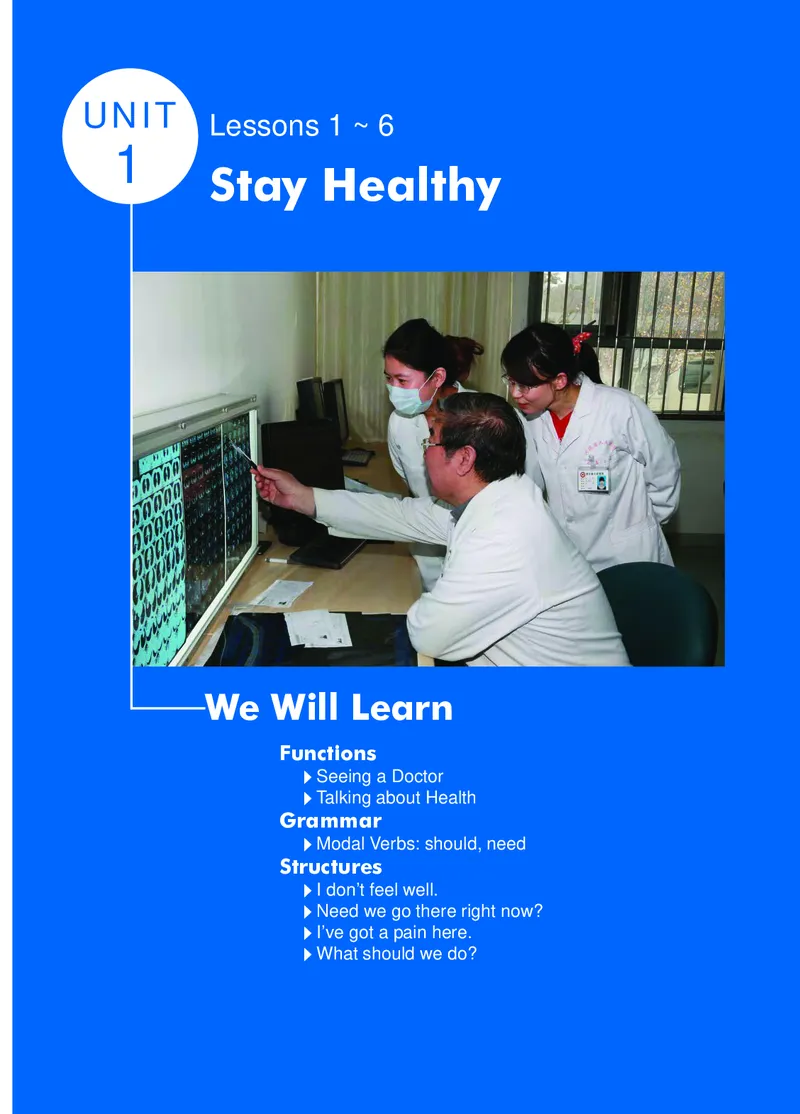
Grammar (P184~188)UNIT
Lessons 1 ~ 6
1
Stay Healthy
We Will Learn
Functions
Seeing a Doctor
Talking about Health
Grammar
Modal Verbs: should, need
Structures
I don’t feel well.
Need we go there right now?
I’ve got a pain here.
What should we do?
1Lesson 1: What’s Wrong, Danny?
N K ABO U
T
HI T
IT
• When you don’t feel well, what do you usually do?
• What is the worst illness you’ve ever had?
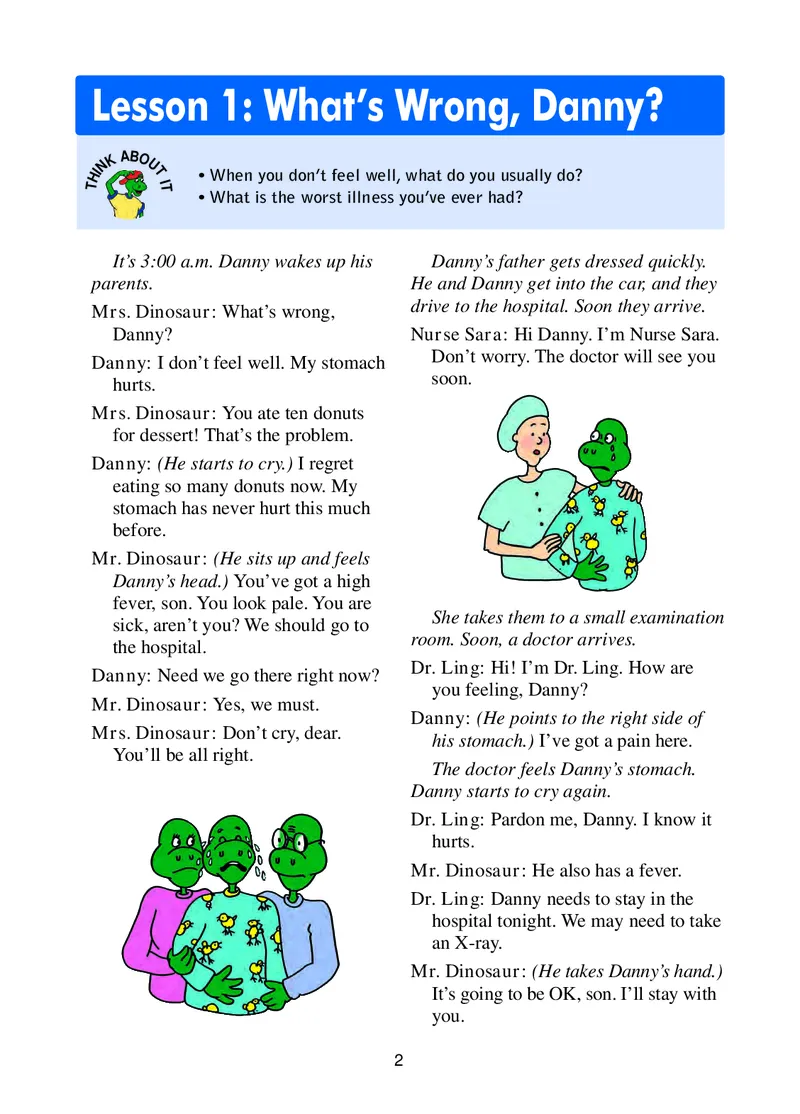
It’s 3:00 a.m. Danny wakes up his Danny’s father gets dressed quickly.
parents. He and Danny get into the car, and they
drive to the hospital. Soon they arrive.
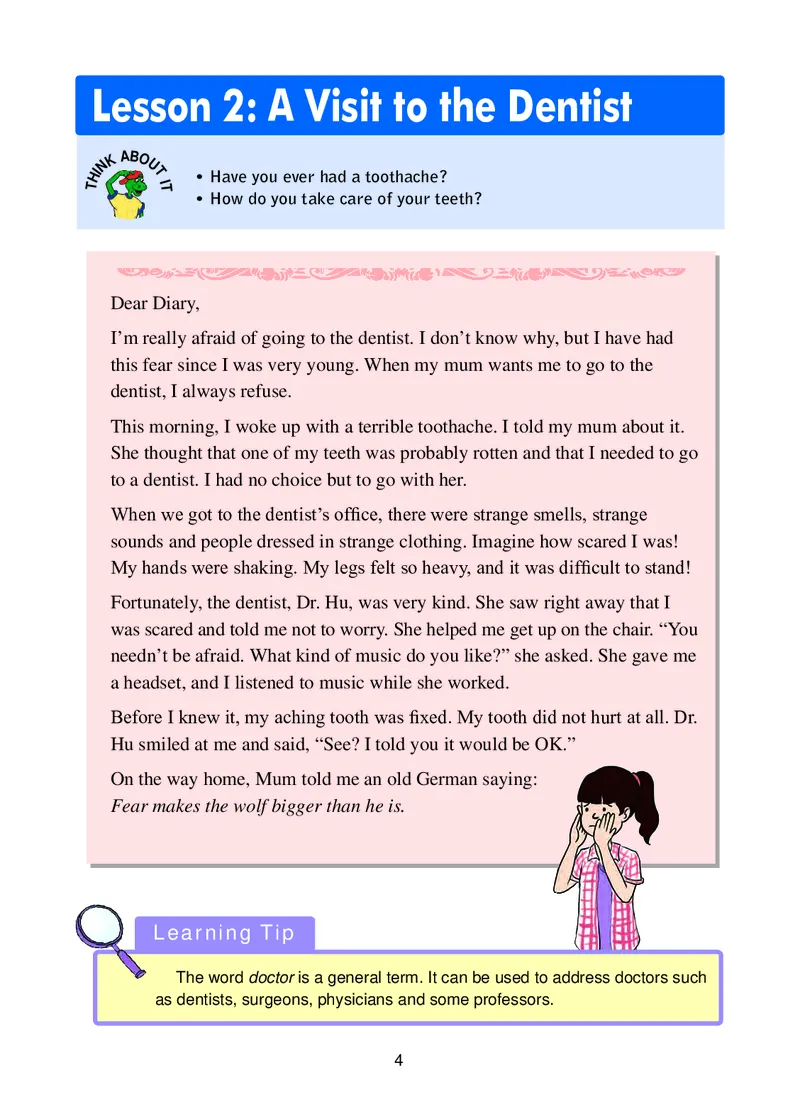
Mrs. Dinosaur: What’s wrong,
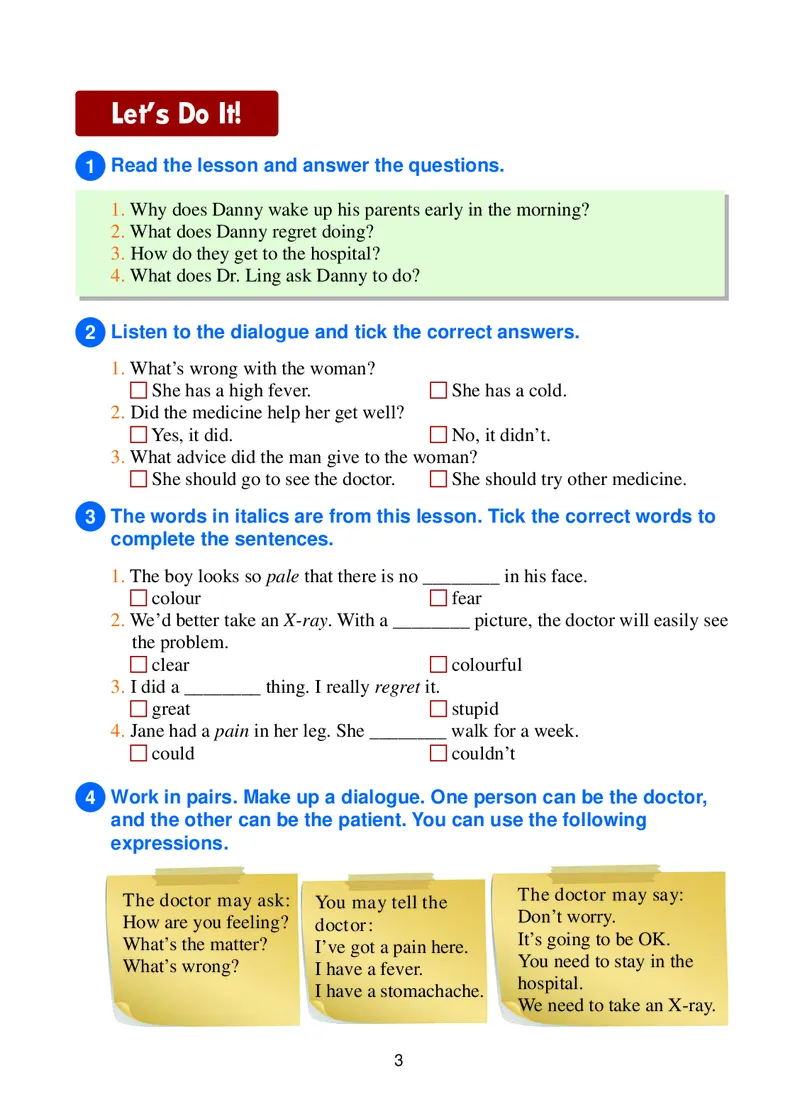
Danny? Nurse Sara: Hi Danny. I’m Nurse Sara.
Don’t worry. The doctor will see you
Danny: I don’t feel well. My stomach
soon.
hurts.
Mrs. Dinosaur: You ate ten donuts
for dessert! That’s the problem.
Danny: (He starts to cry.) I regret
eating so many donuts now. My
stomach has never hurt this much
before.
Mr. Dinosaur: (He sits up and feels
Danny’s head.) You’ve got a high
fever, son. You look pale. You are
She takes them to a small examination
sick, aren’t you? We should go to
room. Soon, a doctor arrives.
the hospital.
Dr. Ling: Hi! I’m Dr. Ling. How are
Danny: Need we go there right now?
you feeling, Danny?
Mr. Dinosaur: Yes, we must.
Danny: (He points to the right side of
Mrs. Dinosaur: Don’t cry, dear.
his stomach.) I’ve got a pain here.
You’ll be all right.
The doctor feels Danny’s stomach.
Danny starts to cry again.
Dr. Ling: Pardon me, Danny. I know it
hurts.
Mr. Dinosaur: He also has a fever.
Dr. Ling: Danny needs to stay in the
hospital tonight. We may need to take
an X-ray.
Mr. Dinosaur: (He takes Danny’s hand.)
It’s going to be OK, son. I’ll stay with
you.
2Let’s Do It!
1 Read the lesson and answer the questions.
1. Why does Danny wake up his parents early in the morning?
2. What does Danny regret doing?
3. How do they get to the hospital?
4. What does Dr. Ling ask Danny to do?
2 Listen to the dialogue and tick the correct answers.
1. What’s wrong with the woman?
She has a high fever. She has a cold.
2. Did the medicine help her get well?
Yes, it did. No, it didn’t.
3. What advice did the man give to the woman?
She should go to see the doctor. She should try other medicine.
3 The words in italics are from this lesson. Tick the correct words to
complete the sentences.
1. The boy looks so pale that there is no ________ in his face.
colour fear
2. We’d better take an X-ray. With a ________ picture, the doctor will easily see
the problem.
clear colourful
3. I did a ________ thing. I really regret it.
great stupid
4. Jane had a pain in her leg. She ________ walk for a week.
could couldn’t
4 Work in pairs. Make up a dialogue. One person can be the doctor,
and the other can be the patient. You can use the following
expressions.
The doctor may say:
The doctor may ask: You may tell the
Don’t worry.
How are you feeling? doctor:
It’s going to be OK.
What’s the matter? I’ve got a pain here.
You need to stay in the
What’s wrong? I have a fever.
hospital.
I have a stomachache.
We need to take an X-ray.
3Lesson 2: A Visit to the Dentist
N K ABO U
T
HI T
IT
• Have you ever had a toothache?
• How do you take care of your teeth?
Dear Diary,
I’m really afraid of going to the dentist. I don’t know why, but I have had
this fear since I was very young. When my mum wants me to go to the
dentist, I always refuse.
This morning, I woke up with a terrible toothache. I told my mum about it.
She thought that one of my teeth was probably rotten and that I needed to go
to a dentist. I had no choice but to go with her.
When we got to the dentist’s office, there were strange smells, strange
sounds and people dressed in strange clothing. Imagine how scared I was!
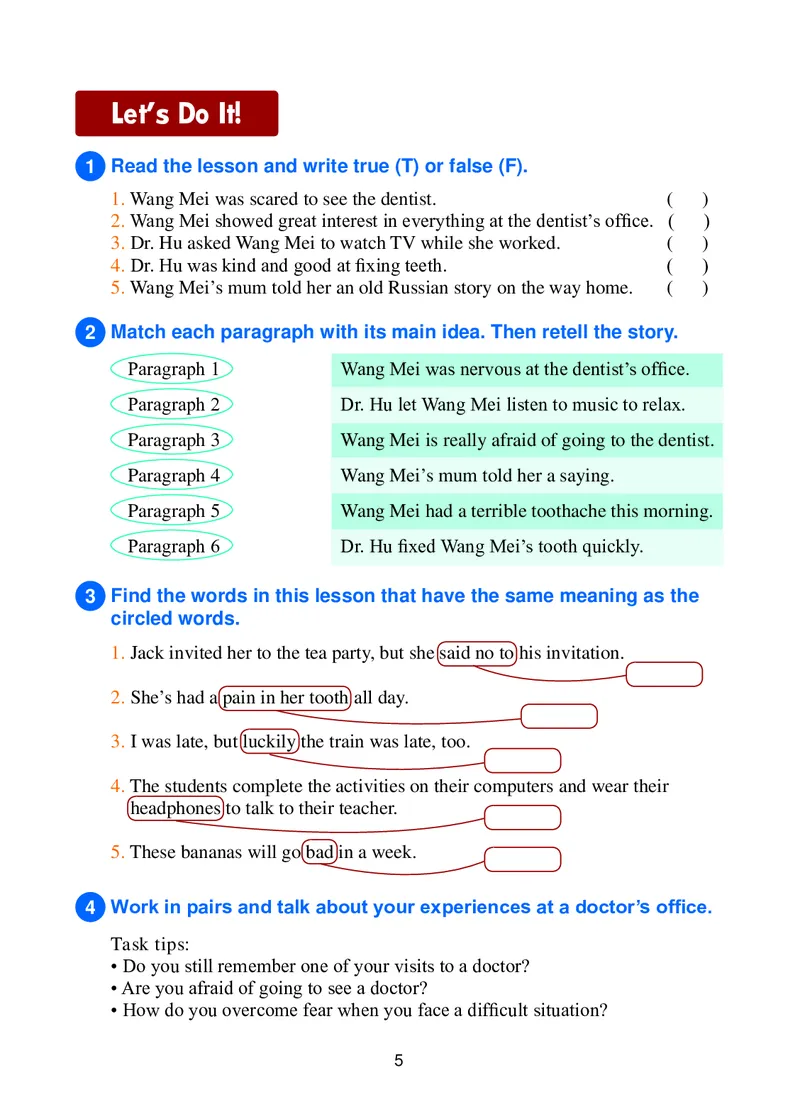
My hands were shaking. My legs felt so heavy, and it was difficult to stand!
Fortunately, the dentist, Dr. Hu, was very kind. She saw right away that I
was scared and told me not to worry. She helped me get up on the chair. “You
needn’t be afraid. What kind of music do you like?” she asked. She gave me
a headset, and I listened to music while she worked.
Before I knew it, my aching tooth was fixed. My tooth did not hurt at all. Dr.
Hu smiled at me and said, “See? I told you it would be OK.”
On the way home, Mum told me an old German saying:
Fear makes the wolf bigger than he is.
Learning Tip
The word doctor is a general term. It can be used to address doctors such
as dentists, surgeons, physicians and some professors.
4Let’s Do It!
1 Read the lesson and write true (T) or false (F).
1. Wang Mei was scared to see the dentist. ( )
2. Wang Mei showed great interest in everything at the dentist’s office. ( )
3. Dr. Hu asked Wang Mei to watch TV while she worked. ( )
4. Dr. Hu was kind and good at fixing teeth. ( )
5. Wang Mei’s mum told her an old Russian story on the way home. ( )
2 Match each paragraph with its main idea. Then retell the story.
Paragraph 1 Wang Mei was nervous at the dentist’s office.
Paragraph 2 Dr. Hu let Wang Mei listen to music to relax.
Paragraph 3 Wang Mei is really afraid of going to the dentist.
Paragraph 4 Wang Mei’s mum told her a saying.
Paragraph 5 Wang Mei had a terrible toothache this morning.
Paragraph 6 Dr. Hu fixed Wang Mei’s tooth quickly.
3 Find the words in this lesson that have the same meaning as the
circled words.
1. Jack invited her to the tea party, but she said no to his invitation.
2. She’s had a pain in her tooth all day.
3. I was late, but luckily the train was late, too.
4. The students complete the activities on their computers and wear their
headphones to talk to their teacher.
5. These bananas will go bad in a week.
4 Work in pairs and talk about your experiences at a doctor’s office.
Task tips:
• Do you still remember one of your visits to a doctor?
• Are you afraid of going to see a doctor?
• How do you overcome fear when you face a difficult situation?
5Lesson 3: Good Food, Good Health
N K ABO U
T
HI T
IT
• What foods do you often eat every day?
• In your opinion, what’s a healthy and balanced diet?
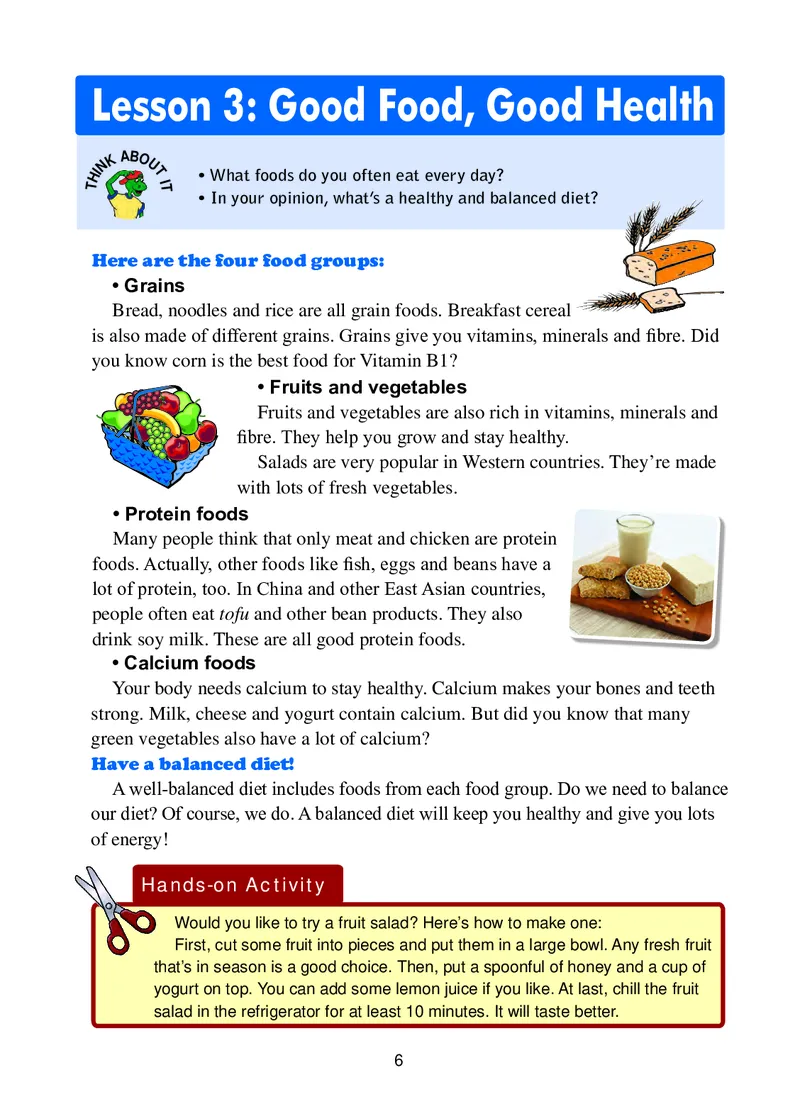
Here are the four food groups:
• Grains
Bread, noodles and rice are all grain foods. Breakfast cereal
is also made of different grains. Grains give you vitamins, minerals and fibre. Did
you know corn is the best food for Vitamin B1?
• Fruits and vegetables
Fruits and vegetables are also rich in vitamins, minerals and
fibre. They help you grow and stay healthy.
Salads are very popular in Western countries. They’re made
with lots of fresh vegetables.
• Protein foods
Many people think that only meat and chicken are protein
foods. Actually, other foods like fish, eggs and beans have a
lot of protein, too. In China and other East Asian countries,
people often eat tofu and other bean products. They also
drink soy milk. These are all good protein foods.
• Calcium foods
Your body needs calcium to stay healthy. Calcium makes your bones and teeth
strong. Milk, cheese and yogurt contain calcium. But did you know that many
green vegetables also have a lot of calcium?
Have a balanced diet!
A well-balanced diet includes foods from each food group. Do we need to balance
our diet? Of course, we do. A balanced diet will keep you healthy and give you lots
of energy!
Hands-on Activity
Would you like to try a fruit salad? Here’s how to make one:
First, cut some fruit into pieces and put them in a large bowl. Any fresh fruit
that’s in season is a good choice. Then, put a spoonful of honey and a cup of
yogurt on top. You can add some lemon juice if you like. At last, chill the fruit
salad in the refrigerator for at least 10 minutes. It will taste better.
6Let’s Do It!
1 Choose the food words from the lesson and put them in the correct
food group.
grains fruits and protein foods calcium foods
vegetables
2 Match each word with its definition. Then complete the passage
using the four words.
corn a thick, white and creamy dairy food
yogurt a tall plant with yellow seeds that can be eaten
beans the food that you eat and drink regularly
diet a good source of protein
It’s important for us to keep a balanced ________. To do this, we must
eat many different kinds of foods. Bread, noodles, ________ and rice are
all grains. Grain foods give us vitamins, minerals and fibre. Fish, meat and
________ are full of protein. Calcium, which can be found in cheese, milk
and ________, is good for our bones and teeth.
3 What do you usually eat at every meal? Do a survey and compare
your eating habits with those of your classmates.
Grains Fruits and vegetables Protein foods Calcium foods
Breakfast
Lunch
Supper
7Lesson 4: Don’t Smoke, Please!
N K ABO U • Do you know when World No Tobacco Day is?
T
HI T
IT • Do people in your family smoke? If so, what do you advise them
to do?
Smoking is a bad habit. As a student, you should
never smoke.
Why is smoking harmful?
• Smoking is bad for your health. It can cause diseases of the heart and lungs.
Every year, millions of people around the world die as a result of smoking.
That’s terrible!
• If you smoke, you harm yourself, and you’re also harming the people
around you with your second-hand smoke.
• Smoking pollutes the environment, too. Everyone wants to live in a clean
environment and breathe fresh air. In many countries, smoking in public places
is now against the law.
What should we do?
• Never touch cigarettes. Whenever someone offers you a cigarette, you
should always say no. Don’t take that risk.
• When somebody talks about smoking, change the topic.
• If your family members smoke, encourage
them to stop smoking. It will be hard for them,
but you should try explaining how important it
is for their health.
• Eat more fruits and vegetables, do more
exercise, and form good habits.
Once you get into the habit of smoking, it’s not
easy to give it up. Stay away from cigarettes and
you can live a long, healthy and happy life.
8Let’s Do It!
1 Fill in the chart with the information from the lesson.
Harmful effects of smoking Advice to stay away from cigarettes
• Smoking is bad for your ________. • Never ________ cigarettes.
It can cause ________ of the heart • When somebody talks about
and lungs. smoking, change the ________.
• Smoking ________ the environment. • ________ your family members to
• Second-hand smoke is ________ to stop smoking.
people who don’t smoke. • Eat more fruits and ________. Do
more ________. Form good ________.
2 Read the following sentences and pay attention to the modal verb
should. Then give advice for each problem using should.
• We should go to the hospital right now.
• As a student, you should never smoke.
1. I have a very bad toothache!
You should go to see a dentist.
2. My new bicycle was stolen.
_____________________________________________________________.
3. My bedroom is a mess.
_____________________________________________________________.
4. My computer is broken. I can’t work without it.
_____________________________________________________________.
5. I was late for school this morning, and my teacher was angry with me.
_____________________________________________________________.
PROJECT
POSTERS AGAINST SMOKING
Many people smoke. Smoking is a bad habit! It causes cancer and
heart disease. In 1988, the World Health Organization (WHO) decided
to celebrate World No Tobacco Day (WNTD) on May 31 of each year to
draw global attention to the negative effects of tobacco.
Let’s help people stay healthy! In a small group, make a poster that
shows why smoking is bad.
Present your posters to the class. Put them up on the bulletin board
in your school!
9Lesson 5: Jane’s Lucky Life
N K ABO U
T
HI T
IT
• When you have a problem, what do you do first?
• Can disabled people live a happy life? Why or why not?
When Jane was ten years old, she became ill with a
terrible disease. This disease damaged Jane’s body. She
couldn’t move her arms or legs.
Jane is forty years old now. She is unable to do many
things. She can’t brush her teeth. She can’t put on her
shoes. She can’t run or jump. She can’t make breakfast.
But she dares to try many things. She has a wheelchair.
She controls her wheelchair with her mouth. She writes
letters without her hands. How does she do it? She talks to
a special computer. She has a special telephone that is hers Disabled people can do
many things.
alone. She can answer it just by saying “hello”.
Jane is married and has two children. She likes to watch her eleven-year-old son
play soccer. From her wheelchair, Jane cheers as her son runs and kicks the ball.
Her daughter likes to play the piano. Jane will never play the piano, but she knows
a lot about music. She enjoys encouraging her daughter.
Jane speaks to people about the things she has learned as a disabled person.
“Everyone faces problems. If you only focus on your problems, you’ll have a
life full of them. I don’t need any pity. I think about all the good things in my life.
I have a life full of good things.
“Do you know who is really disabled? People who don’t know how lucky they are.”
1 Could you open the 2 Oh no! I can’t 4
door for me, please? open it! Oh! Thanks!
Sure!
3
The sign says
“Pull”, Danny,
not “Push”.
No problem.
Thank you!
10Let’s Do It!
11 Read the lesson and answer the questions.
1. What happened to Jane when she was ten years old?
2. How does Jane move around?
3. What special thing does Jane have?
4. Who does Jane think is really disabled?
21 Complete the sentences with the clues given and do the crossword.
1. The traffic lights are ________ by a central computer.
2. The ________ rang, and Peter answered it.
3. These are not her gloves. ________ 4
are on the table. 1
4. Let’s go to see the basketball game 6
and ________ for our team. 2
5. The boy is ________ a ball in the yard. 5
6. What a ________ it is that you missed 3
the concert!
13 Make sentences using the given information.
Example A: millions of people die/smoking
→ Millions of people die as a result of smoking.
1. thousands of people lost their homes/the fire
→ _______________________________________________________
2. he lost his job/his big mistake
→ _______________________________________________________
Example B: my life/good things
→ My life is full of good things.
1. his room/history books
→ _______________________________________________________
2. Danny’s mind/funny ideas
→ _______________________________________________________
14 Work in pairs. Which of these things do you think is the most
important: money, family, a good job, health, good looks or
friends? Why? Talk about your choices.
You can use this expression:
I think that… is the most important because…
11Lesson 6: Stay Away from the Hospital
N K ABO U
T
HI T
IT
• Have you ever visited someone in the hospital?
• What do you want to do when you are sick?
Dear Li Ming,
I had a very interesting week! I had appendicitis. I don’t have it anymore, but I
don’t have an appendix, either! The doctor took it out!
I slept all day after my appendix was taken out. The next day, when I woke up,
I felt terrible and very sleepy. I didn’t want to eat, but I was very thirsty. My
doctor said I had a fever. She told me to drink plenty of water and have a good
rest. So I stayed in bed and rested. Sometimes the nurses gave me pop to drink!
Now I’m feeling much better. My mother brought me some new books to read
(but no homework). I also have a television in my room!
I will write to you again soon.
Your friend,
Danny
Hi Danny,
I’m sorry to hear that you were sick this week. Now that you mention it, Wang
Mei also had a bad day. One of her teeth was rotten, so she had to go to the
dentist.
Fortunately, you and Wang Mei are both getting much better
now. I think we should try hard to form good habits so that we
can stay healthy and stay away from the hospital!
Yours,
Li Ming
12Let’s Do It!
1 Read the lesson and answer the questions.
1. Why did Danny stay in the hospital?
2. What advice did the doctor give to Danny?
3. Is Wang Mei getting much better now?
4. What’s Li Ming’s advice for staying healthy?
2 Fill in the blanks with the correct forms of the phrases in the box.
millions of now that have no choice but to be rich in
1. The boy’s mother is very ill. He ____________ get a job and earn money.
2. ____________ people take the subway every day.
3. With plenty of water and oil, our country ____________ natural resources.
4. ____________ you have seen how it works, why not try it yourself?
3 Complete the passage with the sentences in the box.
What is a heart attack? Your heart is a muscle. It
moves blood around your body. To do its job, your
heart muscle needs blood, too. ____________ Then
you have a heart attack.
To keep your heart well, you need to take care of
your heart. ____________ They are good for your
heart. Eggs, meat, cheese, butter and ice cream have
a lot of fat, which is bad for your heart. Don’t eat too
much of these foods. Also, exercise every day. Do not
smoke. ____________
A. Eat lots of fruits, vegetables, grains and fish.
B. Smoking is very bad for your heart and your lungs.
C. If it doesn’t get blood, it can’t work.
13Unit Review
Building Your Vocabulary
I. Fill in the blanks with the correct forms of the words in the box.
sleepy whenever pale mention include X-ray regret telephone risk cheer
1. If we don’t act now, we’ll ________ it in the future.
2. We all ________ as the team came onto the field.
3. Lily ________ in her letter that she might be moving abroad.
4. If you take a ________, you’re doing something that you know might be
dangerous.
5. You can ask for help ________ you need it.
6. The ________ showed that her leg was not broken.
7. He looks ________ from his long illness.
8. She picked up the ________ and dialed a number.
9. He was so ________ that he could hardly keep his eyes open.
10. The test ________ three parts: listening, speaking and writing.
II. Complete the passage with the words in the box.
may harmful dangerous refuse stomach
Drinking too much alcohol is a bad habit. It is ________ to
one’s health. It can cause diseases of the liver and ________. Every year, many
people die of alcohol poisoning. People who always drink ________ have a bad
temper. It is also very ________ to drive after drinking. Drinking and driving can
cause serious accidents. Teenagers, in particular, should ________ to drink as
their bodies are growing.
Grammar in Use
I. Need can be used as a modal verb as well as an ordinary verb. Read the
following sentences and circle need where it is used as a modal verb.
• Danny needs to stay in the hospital tonight. We may need to take an X-ray.
• She thought that I needed to go to a dentist.
• You needn’t be afraid.
• Need we balance our diet and eat foods from each food group?
14• A: Need we go there right now?
B: Yes, we must./No, we needn’t./No, we don’t have to.
II. Complete the passage with should or need.
Some teenagers are overweight. That means they are eating too much of the
wrong foods. If you want to keep fit, you ________ have a balanced diet. Things
like cake and cookies are high in calories and fat, but you ________ not stop
eating them completely. Just make sure you don’t eat too much of them. You
________ avoid drinking too much soda and juice.
Listening and Speaking
I. Listen to the dialogue and answer the questions.
1. What’s the relationship between the man and the woman?
2. Where does the conversation take place?
3. What’s the matter with the man?
4. Who will come to help them?
II. Complete the following dialogue.
(Bob is at the doctor’s office.)
Bob: Good morning, Doctor.
Doctor: Good morning. ____________________
Bob: ____________________
Doctor: Have you taken your temperature?
Bob: No, I haven’t.
Doctor: Let me see. Well, you have caught a bad cold. Take some medicine, and
you’ll be all right in a few days.
Bob: ____________________
Doctor: Three times a day, after each meal.
Bob: I’ll do as you say. Thank you. Goodbye!
Doctor: Bye!
Putting It All Together
This is Emily. What’s wrong with her? Use the chart to find out.
Yesterday my dad felt sick. Today I feel sick. My stomach
doesn’t feel well. Does my stomach hurt? No, there’s no
pain. But I don’t want to eat, and I have a headache and a
fever. What do you think I’ve got?
15Has anyone in your family
No No Yes No
been sick?
Do you have a fever? Yes or No (sometimes) Yes or No (usually) Yes No
Yes or No
Do you have a headache? Yes or No (sometimes) No No
(usually)
Do you have any other pain? Yes Yes No Yes
On the right side
Where is the pain? In the abdomen. -- In the stomach.
of the abdomen.
After a few hours, does the No. It always gets
Yes or No (usually) -- Yes
pain get better? worse.
Do you want to eat? No No No No
You might have You might have You might have You might have
What do you have?
food poisoning. appendicitis. the stomach flu. a stomachache.
Self-Evaluation
Find more examples from this unit. Then mark your stars.
I. Seeing a Doctor I can talk about health in English.
I’ve got a pain here.
III. Modal Verbs: should, need
I can talk about seeing a doctor in
As a student, you should never
English.
smoke.
II. Talking about Health I can use “should” and “need” properly.
They help you grow and stay healthy.
Move Your Whole Body
Move your feet! Move your arms!
Move your feet! Move your arms!
Move your whole body. Move your whole body.
Move your feet! Move your arms!
The more you move your feet, The more you move your arms,
The more healthy you will be. The more healthy you will be.
Move your feet! Move your arms!
16UNIT
Lessons 7 ~ 12
2
Great People
We Will Learn
Functions
Talking about Great People and Their Lives
Grammar
Adverbial Clause with “before”, “after”, “as”
Attributive Clause with “who”, “that”
Structures
Einstein is most famous for his Theory of Relativity.
He signed his last letter before he passed away.
She had a high fever that made her blind and deaf.
As Helen grew older, she made a lot of progress
and learned to read.
17Lesson 7: What Is the Meaning of Life?
N K ABO U • Do you know any successful people? What does success mean
T
HI T
IT to you?
• What are your dreams for the future?
After the history class, Li Ming sits in the classroom, deep in thought. Wang
Mei comes in and the two start a dialogue.
Wang Mei: Hi Li Ming. What are you thinking about?
Li Ming: Oh, hi Wang Mei. I was just thinking… What is the meaning of life?
Do you ever wonder about that?
Wang Mei: Oh, I see. You are thinking about your purpose in life. Yes, I think
about that sometimes. But I also wonder about other things. For example,
why are great people so successful? And how can we succeed in life?
Li Ming: Those are good questions, too. But… what is success? And how do
you know if you’ve succeeded? Does it mean that you have a good job? Does
it mean that you are rich and famous?
Wang Mei: Those are all really important questions and very difficult to answer.
I’m not sure how to answer them, but I think we should try our best to live a
good and happy life.
Li Ming: That sounds right to me. My dad always says that we should be good
to others.
Wang Mei: Exactly! If we are living a happy life, but the people around us
aren’t, is that a good life? I’m not so sure… It seems like something is
missing.
Li Ming: I agree. I have an idea,
Wang Mei. Let’s write these
questions down and then survey
our parents, friends and neighbours
about their thoughts.
Wang Mei: Great idea, Li Ming!
Let’s do it!
18Let’s Do It!
1 Read the lesson and fill in the blanks.
After the history class, Li Ming sits in the classroom, deep in thought. Wang
Mei comes in, and they start a ________. Li Ming wonders about the ________
of life. He has many questions about his purpose in life. Wang Mei thinks those
questions are ________ to answer. They decide to ________ their questions
________, and then ________ some people about their thoughts.
2 Listen to the passage and tick the ideas mentioned.
Become famous. Have a happy family.
Attend a good university. Make other people happy.
Have a satisfying job. Be rich.
3 Fill in the blanks with the correct forms of the words in the box.
success purpose survey wonder neighbour
1. Work hard and you will be ________ in the future.
2. I ________ who he was, but nobody could tell me.
3. What is the ________ of your visit?
4. One of our ________ helped us look after our dog while we were away.
5. We ________ 500 people and 75% of them were in favour of the plan.
4 It’s said that happy people can live longer. What do you need to be
happy? Fill in the mind map. Then give a reason for each thing you
list.
health
happiness
Example:
Health is important for living a full and active life. You need to be healthy to
work and play.
19Lesson 8: A Universe of Thought
N K ABO U
T
HI T
IT
• What is your attitude towards making mistakes?
• What have you learned from some of your past mistakes?
Albert Einstein was one of the greatest minds of the
last century. During his lifetime, Einstein thought about
the universe and solved many problems in physics.
Einstein is most famous for his Theory of Relativity.
Einstein’s early years
Einstein was born in Germany in 1879. After
he finished school, he went on to study physics in
Switzerland. In 1905, Einstein began to write articles and
What do you do with your
became a pioneer in the field of modern physics. For one
mind? You think! This is what
of those articles, he received the Nobel Prize in 1921. I think: E=MC2.
Einstein, the teacher
Einstein taught at universities in Switzerland and
Germany. He left Germany in 1933 and went to teach
at Princeton University in the United States.
Einstein died in 1955. He signed his last letter before
he passed away. The letter asked people to give up
This is Princeton University,
nuclear weapons.
a famous university in the
Einstein’s sayings United States.
“The important thing is not to stop questioning.”
“Anyone who has never made a mistake has never tried anything new.”
“I think and think for months and years. Ninety-nine times, the conclusion is
false. The hundredth time I am right.”
Culture Tip
The Nobel Prize is widely regarded as the most important award in
the fields of literature, medicine, physics, chemistry and peace. It was
established by the will of the Swedish inventor Alfred Nobel in 1895. A
sixth prize, for economics, was created in 1968. The 2012 Nobel Prize in
Literature was awarded to Mo Yan, a famous Chinese writer.
20Let’s Do It!
1 Read the lesson and fill in the blanks.
Ei
n st ei n w a s b o r n i n _ _ _ E _ i _ n _ s
h
_ t e
e
_ i . fi n e b l e d c o a f m _ e _ a _ _ p _ i
E
o _ n _
i
n e _ s e _ t r e _ i i _ n n . r e c E e i i n v
P
s e t
r
d e
i
n i _ n c _ e w _ t o _ e n _ n _ t U _ t o n _ i _ _ v _ _ e _ _ r . s _ i _ t y _ . _
E
_
i
n a s t t ei n _ _ _ _ _ _ _ _.
t
1879 1905 1921 1933 1955
2 Read the lesson again and answer the questions.
1. In what field did Einstein solve many problems during his lifetime?
2. What is Einstein most famous for?
3. In what countries did Einstein teach?
4. What did he ask people to do in his last letter?
3 Fill in the blanks with the correct forms of the words or phrases in
the box.
solve pioneer be famous for go on in the field of
1. Our country is outstanding ____________ modern science.
2. Hainan ____________ its fresh air and beautiful beaches.
3. The boy was very excited when he ____________ the crossword puzzle.
4. He was a ____________ of the May Fourth Movement.
5. He ____________ to study for his master’s degree after he finished university.
4 Work in groups. Who is your favourite Nobel Prize winner? What
is his/her main achievement? Talk about him/her with your group
members.
Task tips:
• When and where was he/she born?
• What did he/she do?
• What was he/she most famous for?
21Lesson 9: China’s Most Famous “Farmer”
N
KABO
U
HI T • Did you have a dream when you were a child? What was it?
T IT
•What do you think the life of a great person is like?
A scientist in China had a dream when
he was a child. In the dream, he grew a new
type of rice that was as big as a peanut. The
plant allowed farmers to rest in its shade.
That child was Yuan Longping. Yuan grew
up and became the “Father of Hybrid Rice”.
In the 1960s, a few years after he
finished his studies in agriculture at
university, he came up with an idea for
hybrid rice. Since then, he has spent much
of his time researching and developing new
Dr. Yuan goes to the field twice a day.
varieties.
In 1973, together with other scientists, he succeeded in developing hybrid rice.
The introduction of this new product made China a leader in rice production. For
this, he became known as the “Father of Hybrid Rice”. In 1980, the technology for
hybrid rice was introduced to the United States and, later, to many other countries
around the world.
Dr. Yuan’s success with hybrid
rice has helped farmers produce
much more rice than before.
Now Dr. Yuan is working on
developing super hybrid rice. In
How nice it would be
his spare time, Dr. Yuan loves
to have a rice tree!
playing the violin and listening
to music. Every night, he reads
for half an hour before he goes to
sleep. He likes swimming, too.
22Let’s Do It!
1 Read the lesson and write true (T) or false (F).
1. He grew a new type of rice as a child. ( )
2. He had an idea for hybrid rice in the 1960s. ( )
3. He studied agriculture at university. ( )
4. He is working hard on developing super hybrid rice. ( )
5. He plays the violin for half an hour before he goes to bed. ( )
2 Read the lesson again and fill in the blanks.
People call Yuan Longping the “Father of Hybrid Rice”. In 1973, together
with other scientists, he succeeded in ________ hybrid rice. The ________ of
this new product made China a leader in rice production. Dr. Yuan’s success
with hybrid rice has helped farmers ________ much more rice than before.
He also has many other interests. He loves playing the ________, listening to
music, reading and swimming.
3 Match and complete the sentences.
1. Einstein signed a letter they launch the rocket.
2. The boy became famous before he goes to bed.
3. The scientists are doing
she finishes school.
the final test
4. Mum often tells the boy
he won that prize.
after
a story
5. Cici wants to be a painter he passed away.
4 Work in groups. Can you think of an invention
or a good way to make life better? What is it?
Talk about it with your group members.
23Lesson 10: Touch the World
T
HI N K ABO U T
IT
•
•
H
Do
a v
y
e
o u
yo
k
u
n
h
o
e
w
a r
a
d
n y
o f
s i
H
gn
e l
l
e
a
n
n g
K
u
e
a
ll
g
e
e
r
?
? What can you learn from her?
THE PLANETARY POST • JUNE 2, 1968
Helen Keller Dies at 88
Anne Sullivan, began to help Helen.
She spelled words on Helen’s hand
with her fingers. At first, the words
didn’t mean anything to Helen. Then,
one day, while Helen was playing in
some water, Anne spelled W-A-T-E-R
on Helen’s hand. Suddenly, Helen
understood. That day, she learned
many more words: mother, father,
sister and teacher. Anne was filled with
pride.
As Helen grew older, she made a
lot of progress and learned to read.
She had special books with letters that
Helen Keller, the well-known writer she could feel with her fingers. She
and educator, died yesterday at the age also learned to write and even speak.
of 88. Helen Keller was a model for When Helen studied at university,
people around the world. Anne sat beside her. She listened to
Helen was born in 1880 in the the professors’ words and spelled them
United States. When she was nineteen on Helen’s hand.
months old, Helen fell ill. She had a After Helen finished university,
high fever that made her blind and she visited many countries. She spoke
deaf. Before her illness, Helen was a about her life. She was very famous for
bright and happy girl. After she lost her courage and hard work. She did her
her ability to see and hear, she became best to help others in the community
difficult and wild. She often shouted who were deaf or blind. She tried to
and cried. live her life without any regret.
In 1887, a young teacher named She will be greatly missed.
24Let’s Do It!
1 Read the lesson and answer the questions.
1. Who is Helen Keller?
2. What happened to Helen Keller when she was nineteen months old?
3. How did Anne Sullivan teach Helen Keller?
4. What was the first word that Helen Keller learned?
5. What was Helen Keller famous for?
2 Fill in the blanks with the words in the box.
ability community writer progress illness
1. Mo Yan is a famous ________ who received the Nobel Prize in 2012.
2. The medicine did not help, and her ________ got worse.
3. She is excellent, and we trust her ________.
4. Keep on trying and you will make ________.
5. My aunt is a nurse and works in the ________ clinic.
3 Write sentences. Use the example as a guide.
She did her best to help others in the community who were deaf or blind.
She did her best to help others in the community.
They were deaf or blind.
1. Those students who study hard will pass the exam.
________________________________________________________
2. We know that woman who is an English teacher.
________________________________________________________
3. The basketball that you are looking for is behind the door.
________________________________________________________
Each of these sentences can be made into two sentences. Find the words
that are modified by the attributive clauses. Can you find any rules?
4 Work in groups. Have you heard of Stephen Hawking, Zhang Haidi
or Huang Yangguang? What do you know about them? What can
you learn from them? Talk about them.
25Lesson 11: To China, with Love
N K ABO U
T
HI T
IT
• What makes a good doctor?
• Why do some doctors go to work in poor areas?
Norman Bethune was born in Canada in 1890.
He was a famous doctor and a nice man.
In 1916, Norman Bethune graduated from the
University of Toronto. With a lot of hard work,
he found new ways to help people with T.B. — a
disease that damages the lungs. He also invented
tools that remain in use today.
Norman Bethune is well known for helping the
Chinese people in the Anti-Japanese War. In 1938,
he made a decision to go to northern China because
he knew many people were dying in the war.
Bethune organized hospitals, taught doctors and nurses, and showed people how
to give first aid.
In China, Norman Bethune is a hero. People
remember how hard he worked day after day
in the worst possible conditions to help others.
He once operated for sixty-nine hours straight
without stopping.
Norman Bethune died in Hebei. To
remember him, the government set up Bethune
Medical School and Bethune International
Peace Hospital in Shijiazhuang.
Dig In
Did you know that Bethune was not only an excellent doctor, but also
an inventor and a political activist? He invented medical instruments and
proposed reforms of medical care and health services in Canada.
26Let’s Do It!
1 Read the lesson and write true (T) or false (F).
1. Bethune was an American doctor. ( )
2. He finished university in 1916. ( )
3. He came to northern China to help people in the war. ( )
4. The Chinese government set up a school to remember him. ( )
2 What did Bethune do? Read the lesson and complete the list.
• He found new ways to _________________________________.
• He invented _________________________________________.
• He _________________________________________________.
• He _________________________________________________.
• He _________________________________________________.
• He once ____________________________________________.
3 Fill in the blanks with the words or phrases in the box.
remain decision condition first aid set up
1. He made a ________ to accept the challenging task.
2. The volunteers ________ an organization to protect the environment.
3. Teenagers should have some knowledge about ________.
4. They live far away from each other, but they ________ close friends.
5. This plant can grow in the worst ________. It’s amazing!
4 Let’s do a quick quiz!
1. Who wrote The Story of My Life, a book that is translated into fifty
languages?
2. Who was chosen as a great man of the century by The Times?
3. Who was the first on the list of rich-in-soul people in China in 2010?
4. What was the cause of Bethune’s death?
.gninosiop doolB .4 .gnipgnoL nauY .3 .nietsniE treblA .2 .relleK neleH .1
Now, try to find more facts about great people.
27Lesson 12: Guess My Hero!
T
HI N K ABO U T
IT
•
• W
In
h
y
o
o u
is
r
y
o
o
p
u
i
r
n i
h
o
e
n
r
,
o
w
?
h
W
at
h
m
at
a
d
k
o
e s
y o
a
u
h
k
e
n
ro
o
?
w about him/her?
Dear Danny,
This week in class, we talked about success. We studied famous people and
talked about our heroes.
On Monday, Ms. Liu asked us to make crossword puzzles based on facts
about our heroes. I thought it would be fun because I did a lot of crossword
puzzles when I was in Canada.
But whom should my puzzle be about? I thought about it as I walked to and
from school.
Then I had a great idea. My hero wouldn’t be anybody
famous. It would be somebody who I like very much.
I’m sending you the puzzle so you can try to guess who it is.
Li Ming
Hi Li Ming,
I love your puzzle! You chose a very good hero. I hope he will be famous
someday!
I showed the puzzle to Jenny and Brian after the chemistry class today. I told
them that the puzzle was about a great person. I said that this person was the
same age as them.
They couldn’t guess, so I helped them. I said that the
person’s favourite food was donuts. Five minutes later,
they finished the whole puzzle. I told them that you made
it for me.
Thanks, Li Ming. Your puzzle was fun!
Danny
28Let’s Do It!
1 Read the lesson and answer the questions.
1. What did Ms. Liu ask the class to do?
2. What did Danny think of Li Ming’s puzzle?
3. What did Danny say to help Jenny and Brian solve the puzzle?
4. How long did it take Jenny and Brian to solve the puzzle?
2 Fill in the blanks with the words in the box.
whom anybody chemistry government medical
1. A: For ________ is this book written?
B: It’s written for young kids.
2. The ________ is making great efforts to help people live better.
3. I don’t want to be ________ else. I just want to be myself.
4. Many ________ teams entered Wenchuan after the earthquake.
5. In ________ experiments, interesting things can happen.
PROJECT
WHO’S YOUR HERO?
Write a short paragraph about your hero. Then use words from
your paragraph to make a crossword puzzle. Give your paragraph and
crossword puzzle to a friend. Can your friend solve your puzzle?
Here is Li Ming’s puzzle as an example.
ACROSS
1. 2.
1. This is his favourite food. (It’s sweet
and round.)
3. 3. His skin is this colour.
5. He likes this sweet drink.
6. I laugh because he’s __________.
4.
7. Since he’s tall, he’s good at this game.
5.p o p DOWN
6. 1. He’s this kind of animal.
2. He’s not short. He’s __________.
4. He comes from this country.
5. He also likes this food. (It’s round and
7. delicious!)
29Unit Review
Building Your Vocabulary
Fill in the blanks with the correct forms of the given words.
1. Hebei Province lies in the ________ (north) part of China.
2. Could you please tell me the ________ (mean) of this word?
3. Will you go or stay? What is your ________ (decide)?
4. There were more wild animals living on the earth ________ (century) ago.
5. That factory ________ (produce) two types of new machines last year.
6. As the ________ (lead) of this office, he can work with everyone.
Grammar in Use
I. Complete the sentences in your own words.
1. The children sang happily as _____________________________.
2. _____________________________ before I went to bed last night.
3. _____________________________ after he arrived home from school.
II. Replace the circled words with the expressions in the box.
who has that was filled with that is flying
1. Brian showed us a book filled with stamps.
2. Can you see the yellow kite flying in the sky?
3. Nancy is a Canadian girl with blue eyes and blond hair.
Listening and Speaking
I. Listen to the dialogue and tick the correct answers.
1. What title did Kate win in her city?
Great Kid. Super Kid.
2. Why was she chosen as that?
Because she helped other students. Because she helped the homeless.
3. What does she like to do in her spare time?
To buy food. To play basketball.
30II. Make up a dialogue with your partner based on Marie Curie’s file.
Marie Curie’s File
Name: Marie Curie
Date and place of birth: November 7, 1867, Poland
Achievements: won her first Nobel Prize for physics along with her husband
in 1903; won a second Nobel Prize for chemistry in 1911
Date and cause of death: July 4, 1934, died of radiation poisoning
What is her name?
When and where was she born?
What are her achievements?
Putting It All Together
Read the passage and write true (T) or false (F).
See with Her Eyes
Margaret Bourke-White was one of the world’s greatest photo journalists.
Bourke-White was born in New York in 1904. Her father liked photography,
and she liked to help him. Later, she began taking her own pictures. In 1935,
she began working for Life Magazine. The magazine soon became famous
around the world because of her remarkable photography.
Bourke-White was fearless and hardworking. When she first began
working, few North American women had jobs, as most people thought
women should stay at home. But Bourke-White had a job, and it was a
dangerous job. In her mind, it didn’t matter. She said, “If you banish fear,
nothing terribly bad can happen to you.”
Bourke-White took many famous pictures of important people and events
in the twentieth century. Here are some of the things she photographed:
• The Great Depression. The Great Depression happened in the 1930s. In
the United States, many people were very poor then. Bourke-White’s pictures
showed the lives, hopes and fears of those people.
• World War II. She was the first woman to report on a war. For some of her
photographs, she rode in airplanes as they bombed Germany.
• The independence of India. She photographed the famous Indian leader
Gandhi a few hours before he was killed.
• Apartheid in South Africa. Her photographs showed the world how black
people lived with apartheid, day after day.
Bourke-White died in 1971. Museums around the world have collected her
photographs.
311. Bourke-White was one of the world’s greatest painters. ( )
2. Life Magazine became famous because of Bourke-White’s remarkable
photography. ( )
3. When she began to work, many North American women had jobs. ( )
4. Bourke-White’s pictures showed the hopes and fears of people in the Great
Depression. ( )
5. She was the first woman to report on a war. ( )
Self-Evaluation
Find more examples from this unit. Then mark your stars.
I. Talking about Great People and I can use adverbial clauses with
Their Lives “before”, “after”, “as” properly.
Albert Einstein was one of the
greatest minds of the last century.
III. Attributive Clause with “who”,
I can introduce people in English. “that”
She had a high fever that made her
blind and deaf.
II. Adverbial Clause with “before”,
“after”, “as”
I can use attributive clauses with
Every night, he reads for half an hour
“who”, “that” properly.
before he goes to sleep.
Make the World a Better Place
You can make the world,
A better place to live.
You can make the world,
A better place.
You become a hero,
Then you will make the world,
When you care for those around you.
A better place to live.
Set a good example,
You will make the world,
Day after day.
A better place.
32UNIT
Lesson 13 ~ 18
3
Safety
We Will Learn
Functions
Reminding and Warning
Grammar
Imperatives
Structures
Don’t use water to put out kitchen fires.
Be careful with scissors and knives!
If you see a fire, quickly move outdoors to an
open area.
33Lesson 13: Be Careful, Danny!
N K ABO U • Have you ever climbed onto a chair or a desk to reach something?
T
HI T
IT Was it safe?
• What should you do if you see someone fall?
Danny, Jenny and Brian are decorating the art classroom.
Danny: Look at this yellow star, Brian and Jenny! Isn’t it beautiful? I’m going to
hang it from the ceiling over the desk.
Brian: Let me get the ladder for you.
Danny: I don’t need a ladder. I think I’m tall enough.
(Danny can’t reach the ceiling, so he climbs onto Mr.
Jones’ chair.)
Danny: Almost… Almost… Aaaaaaahhhh!
(Danny falls.)
Mr. Jones: What was that noise?!
(He sees Danny lying on the floor.)
Mr. Jones: Danny, are you all right? Are you hurt?
Danny: Hmm… My tail hurts a little, but it’s not serious.
Brian: (He whispers.) Help!
(They hear Brian’s cry for help, but
his voice is very weak.)
Mr. Jones: Brian? Where are you?
Brian: I’m under Danny!
Danny: Oh no! (He jumps up.) I’m
really sorry! Are you OK, Brian?
Brian: No, I’m not OK. I tried to catch you, but you landed on top of me. My
arm hurts.
Jenny: Shall I call an ambulance?
Brian: No, that’s not necessary. I don’t think my arm is broken.
Mr. Jones: Jenny, please call Brian’s mother. Tell her we are taking Brian to the
hospital.
34Let’s Do It!
1 Read the lesson and answer the questions.
1. What were Danny, Jenny and Brian doing?
2. What did Danny climb onto?
3. Did Brian need an ambulance?
4. Who is Jenny going to call?
2 Read the lesson again and fill in the blanks.
Beginning
Danny was going to ________ a star from
What happened
the ceiling. He thought he was tall ________
today in the art
and didn’t need a ladder.
classroom?
Middle
Danny fell down from the chair. Brian tried
to ________ Danny, but Danny ________
on top of him.
End
Danny’s tail hurt a little, but it was not
________. Brian’s ________ hurt, too.
3 Fill in the blanks with the correct forms of the words in the box.
safe hang serious necessary
1. There is a beautiful painting ________ on the wall.
2. It’s ________ to drink eight glasses of water every day.
3. The school is concerned about the ________ of the children.
4. The damage caused by the thunderstorm is ________.
4 Work in groups of five. One of you can be the narrator. The others
can be Danny, Brian, Mr. Jones and Jenny. Role-play the story.
35Lesson 14: Accidents Happen
N K ABO U • What do you need to do when you cross the street?
T
HI T
IT • What should you do when you see someone badly hurt in an
accident?
Northern News, December 7
Girl, 13, Hit by Car
NORTH TOWN, Alberta: Thirteen-year-old
Ann Brown was hit by a car at 15 Park Road.
The accident happened at about 7:30 a.m. She
and her brother, James, were on their way to
an early basketball practice.
“We were in a hurry,” James told the reporter.
“We didn’t want to be late for practice. Ann
dropped her basketball, and it rolled onto the
street. She raced to get it.”
Mrs. Andrews, who was walking several steps
behind the two students, saw it happen. “I don’t know whose fault it was,”
Mrs. Andrews said. “The girl didn’t see the car. And the street was icy — the
car couldn’t stop in time. It was terrible.”
Mrs. Andrews said that she could see what was going to happen. “I shouted
to the girl. I wanted to stop her from running after the ball, but she didn’t hear
me.” After the accident, the car stopped, and the driver, Bill Morin, jumped out.
He called an ambulance.
Mr. Morin knows first aid. He did not move Ann. He stopped traffic on the
road until the ambulance came. Then the ambulance took both students to the
hospital.
Ann has a broken leg and an ugly shoulder wound. She is recovering in the
hospital. Doctors say she can expect to return to school in about a week.
36Let’s Do It!
1 Read the lesson and match the actions with the right person.
shouted a warning. knows first aid.
Ann Brown
called an ambulance. stopped traffic on the road.
James
was hit by a car. dropped the basketball and
raced to get it.
was on the way to a Mrs. Andrews
basketball practice wanted to stop the girl from
with Ann. Bill Morin running after the ball.
2 Fill in the blanks with the words in the box.
ugly wound recover expect town
1. “Don’t worry! You will ________ soon,” the doctor says.
2. The ________ duckling grew into a beautiful swan.
3. We went on a holiday to a small ________ in France.
4. “Please show me your ________,” the doctor says.
5. We all ________ the foreign teachers to visit our school next week.
PROJECT
REPORT ON AN ACCIDENT
Imagine you are a reporter. You are going to report on an accident.
What are you going to write?
You can answer these questions:
• When and where did the accident happen?
• How did the accident happen? Who was the victim?
• Who was there when the accident happened? Did they help?
• How did the doctor save the victim?
• What was the result of the accident?
You can interview these people:
• the victim
• the witness
• the doctor
37Lesson 15: My Helmet Saved My Life!
N K ABO U • How do you get to school?
T
HI T
IT • Are you always careful when you ride your bicycle? Why or
why not?
It was a beautiful fall day. I was out riding my bicycle.
I guess I rode over a hole in the road. All of a sudden,
WHAM! I went down hard on my right side. That really
hurt!
My head hit the ground. I lay there for a few minutes. I
tried to get up, but I couldn’t! “There’s something wrong
with me,” I thought. I felt so terrible that I lay down again.
Then I saw blood on my shoe. My hand and knee were
bleeding.
As I lay there, I took off my helmet. There was a sharp
rock sticking out of it. It was pretty scary to look at. Thank
My name is Jackie. I like
goodness I wore my helmet!
cycling.
I shouted for help. A stranger stopped his truck and came
to help me. He put my bike in the back of his truck and drove me to the hospital.
When my mother got to the hospital, she gave me a big hug. “I’m so glad you
were wearing your helmet,” she said. She knew I was careless and did not always
wear my helmet.
But I’ll never be careless again! My bicycle helmet saved my life!
Dig In
Cycling is fun. But before getting on a bicycle, you should double check
the following things:
1. You have a helmet. A helmet protects your head, which can get hurt in
a bicycle accident.
2. The brakes work OK. No brakes, no cycling.
3. The light is still working. Being able to see is
really important at night.
4. The tyres are neither too full nor too flat. This
will ensure that you have a pleasant trip.
38Let’s Do It!
1 Read the lesson and write true (T) or false (F).
1. She was riding her bicycle when she fell. ( )
2. Her head hit the ground. ( )
3. She stood up and shouted for help. ( )
4. Her friend came to help and drove her to the hospital. ( )
5. Her bicycle helmet saved her life. ( )
2 Listen to the passage and tick the sentences mentioned.
Check the brakes, light and tyres.
Ride on the sidewalk.
Make a way for people walking.
Don’t play with others.
Wear light-coloured clothes.
Follow the traffic signs and rules.
Always wear your helmet.
Everything ready? Go!
3 Fill in the blanks with the correct forms of the words in the box.
blood knee stick stranger careless
1. I hurt my ________, and it’s painful when I walk.
2. Although they were ________, they got on very well with each other.
3. He stopped the car and found a nail ________ in the tyre.
4. It is an honour for everyone to give ________.
5. He failed the exam because he was so ________ with his spelling.
4 Work in groups. Discuss what you should do to keep safe when
you ride a bicycle. Then write a short passage and present it to the
class.
39Lesson 16: How Safe Is Your Home?
N K ABO U
T
HI T
IT
• What place makes you feel the most comfortable?
• Do you think your home is a safe place? Why or why not?
Your home is a safe place, right?
Think again!
Many serious accidents happen in people’s homes.
The kitchen and the bathroom are the two most dangerous rooms in the house.
Why? Because most accidents happen in the kitchen and the bathroom.
Can people prevent certain accidents? Yes. Many accidents happen because
people are careless. So be careful!
Safety tips for preventing accidents in the kitchen
• Don’t stand on chairs. Many people hurt
themselves by falling off chairs.
• Don’t use water to put out kitchen fires. Use
baking soda or salt instead.
• Be careful with scissors and knives! Many
people cut themselves in the kitchen.
• Don’t keep poisons in the kitchen.
• Be careful with fire and heat when you cook.
Some things catch fire easily.
You don’t want to burn yourself.
Don’t put them near the stove!
Safety tips for preventing
accidents in the bathroom
• Never use electricity in the shower
or bathtub. It can hurt you!
• It’s easy to slip and fall on a wet
floor. Be sure to keep the bathroom floor
dry after you have a shower or bath.
Accidents happen suddenly. Never leave
small children alone in a bathtub.
40Let’s Do It!
1 Read the lesson and complete the table.
Safety tips for preventing accidents Safety tips for preventing accidents
in the kitchen in the bathroom
Dos Don’ts Dos Don’ts
2 Fill in the blanks with the correct forms of the words from the lesson.
The first letter is given.
1. Tom won’t drive to Beijing. He’ll take a bus i________.
2. We should eat less s________ to prevent heart disease.
3. Take the k________ away. The little boy may cut himself.
4. A hot coal fell out the fire and b________ the shoes.
5. Grandma likes to sit in the sun. She enjoys the h________ of the sun.
3 Read the passage and fill in the blanks with the words in the box.
Scalding Cuts Falls Burns
Be Careful!
Here are some of the most common accidents that happen at home:
Scalding — Hot water or drinks can scald you badly. Be careful when you
smell your coffee and want to drink it right away!
________ — Every year, quite a lot of children fall and hurt themselves.
They fall off furniture or down the stairs. Climbing trees, high walls or
fences can be dangerous, too.
________ — Many people are badly burnt or even die in house fires. A
cigarette can easily start a fire. People can be burnt by a hot iron or matches.
________ — Glass causes the most serious cuts. So do knives and scissors.
These things should be kept away from children.
4 Make a poster. What should you do to stay safe at home? Give
more tips for home safety.
Example:
Be careful with hot water.
Don’t climb trees or high walls.
41Lesson 17: Staying Safe in an Earthquake
N K ABO U • Have you ever experienced an earthquake? When and where?
T
HI T
IT • What is the first thing you should do when an earthquake
happens?
Earthquakes usually come without
warning. What should you do if this
happens to you? Stay calm as the earth
begins to shake and move. An earthquake
is dangerous, but there are things you can
do to protect yourself.
If you are inside when the earthquake
starts, get under a table or a bed. You
need to have something strong around
Earthquakes are terrible.
you to protect you from falling objects.
Do not stand near walls or windows and stay out of the kitchen. The kitchen is
dangerous because there are so many glass objects. Also, never get into a lift
during an earthquake.
If you are outside, get to an open area as fast as you can. Stay away from
buildings and trees. If you are in a car, pull over to a place where there are no
trees or tall buildings and stay in the car. If you are close to the sea, try to get as
far away from the water as possible. Earthquakes can cause huge waves that can
really harm the people nearby.
When the earthquake is over, there is still plenty of danger. If you see a fire,
quickly move outdoors to an open area. Keep an eye out for things that can fall on
you. If you have a phone, use it only once to call your family or a friend. Too many
calls will bring down the phone system. Your chances of survival in an earthquake
go up if you stay calm. Staying calm is not easy, but it can save your life.
Learning Tip
An earthquake is a sudden shaking of the ground.
It happens because there is movement in the earth’s
crust.
42Let’s Do It!
1 Read the lesson and match the sentences.
use it once to call your family or a friend.
1. If you are inside,
get as far away from the water as possible.
2. If you are in a car,
get under a table or a bed.
3. If you are near the sea,
move outdoors to an open area.
4. If you have a phone,
pull over to a place where there are no
5. If there is fire,
trees or tall buildings.
2 How can you stay safe in an earthquake? Complete the chart.
Inside Outside After the earthquake
• ________ an open • ________ to an open area
• ________ a table area as fast as you can. if you see a fire.
Dos
or a bed. • ________ to a safe • ________ things that can
place if you are in a car. fall on you.
• ________ near
• ________ from the
walls or windows.
buildings and trees.
• ________ the • ________ your phone
Don’ts • ________ from the
kitchen. more than once.
water if you are
• Never ________
close to the sea.
a lift.
3 Fill in the blanks with the phrases in the box.
pull over stay calm protect… from keep an eye out
1. When there is an emergency, it is important to ____________.
2. The volunteers make great efforts to ____________ the animals
____________ going extinct.
3. He had to ____________ because he was so tired after three hours of driving.
4. The sign said: _____________ for falling rocks.
4 Work in pairs. What can you do to help after an earthquake?
Discuss your ideas.
Example:
We can donate some money to help people rebuild their homes.
We can help people by offering some psychological treatment.
43Lesson 18: Never Catch a Dinosaur
N K ABO U • Have you ever learned a lesson from an accident?
T
HI T
IT • Is it important to listen to other people’s warnings? Why or
why not?
Dear Brian,
I got your e-mail. I like your new rule. I will never try to catch a falling
dinosaur. It isn’t safe!
Danny also wrote to me about the accident. He felt bad because he was
careless. You advised him to use a ladder, but he didn’t listen. He was lucky
you were there to catch him. But I guess you weren’t so lucky.
Accidents happen so suddenly. I remember when I was seven years old, my
mother took me to the park one day. I saw a big tree. My mother tried to stop
me, but I really wanted to climb the tree. I told her I would be careful.
“Don’t climb too high,” she warned.
She watched me climb higher and higher. “Look at me, Mother!” I shouted. “I
can almost touch the sky!”
“That’s too high,” she called. “Be careful, Li Ming!”
Suddenly, the branch broke. I fell. My mother tried to catch me, but she
couldn’t. I hit the ground very hard.
There was something wrong with my leg. It hurt! I couldn’t move it. My
mum took me to the hospital. At the hospital, the doctor said my leg was
broken.
It took me three months to recover. I couldn’t attend ping-pong training that
year!
Now, I always listen to my mother’s
warnings about safety.
By the way, do you like the gift I sent you?
Take care,
Li Ming
Wow! I’ll wear it with
this T-shirt from Danny!
44Let’s Do It!
1 Read the lesson and write true (T) or false (F).
1. Danny felt terrible because of his carelessness. ( )
2. Li Ming broke his leg at the age of seven. ( )
3. Li Ming tried to climb a ladder, but he fell down. ( )
4. Li Ming’s mother caught him and saved him. ( )
5. It took Li Ming about 90 days to recover. ( )
2 Read the lesson again and fill in the blanks.
One day, Li Ming went to the park with his mother. He ________ a big tree
even though his mother tried to ________ him. When he got ________ and
________, he became so excited that he thought he could almost ________ the
sky. But suddenly, the ________ broke, he fell and ________ the ground very
hard. He couldn’t ________ his leg. It ________. He couldn’t attend ping-pong
________ that year. Poor Li Ming!
3 Here are some safety rules for teenagers. Read them and fill in the
blanks with the words in the box.
money number parents evening
When you are going out, please remember the following things:
• Always tell your ________ where you are going and when you expect to
be home.
• Don’t carry a lot of ________ with you.
• Try not to walk on quiet and dark streets in the ________.
• Make sure you know what ________ to call for the police, ambulance and
so on.
side leave cigarettes pocket
When you are at school, you should follow these rules:
• Walk on the right-hand ________ of the stairs.
• Don’t bring ________ or alcohol to school.
• Don’t carry sharp things like knives or scissors in your ________.
• Report to your teacher if you want to ________ during school hours.
45Unit Review
Building Your Vocabulary
I. Find and circle the words from this unit.
a n d h h a n g s v
b e x p e c t r a c
k c e i a m p u l a
n e f j t n q l t r
i s t r a n g e r e
f s h o u l d e r l
e a r t h q u a k e
t r a i n i n g t s
c y g k l o r s u s
II. Complete the passage with the correct words. The first letter is given.
It is not safe when people are not c________. S________ accidents often
happen and injure many people. A lot of people lose their lives. For example,
many people drive after drinking. They don’t care about the r________.
Society must work together to p________ drunk drivers f________ harming
others and themselves.
Grammar in Use
A new library will soon open
in your school. Help the
librarian write a notice to Notice to students
the students.
1. Show your library card to the librarian.
2. Don’t talk in the reading room.
3. Never…
4. Please…
5.
6.
7.
8.
9.
10.
46Listening and Speaking
I. Listen to the dialogues and tick the correct answers.
1. What does Tom mean?
He is going to fall. He will be fine.
2. What happened to the man?
He fell off the ladder. He fell off the fence.
3. Why is Tony driving so fast?
He is rushing to the hospital. He is rushing to the airport.
II. What would you say if the following things happened?
1. Someone is climbing up high.
2. Your friend often plays computer games through the night.
3. There is heavy traffic, and a little boy runs into the street to get his ball back.
4. The floor is wet, and someone is walking by.
5. A man is smoking in the non-smoking area.
Putting It All Together
I. Look at the rules for different groups of people. Match the rules with the
correct groups.
• Always wear a seatbelt.
• Follow the traffic signs and rules.
A. Rules for pedestrians
• Don’t drive after drinking.
• Don’t make phone calls while driving.
• Walk on the sidewalk.
B. Rules for cyclists and • Cross the street at the crosswalk.
motorcyclists • Pay attention to the traffic lights.
• Don’t read while walking.
• Always wear a helmet.
C. Rules for drivers • Check your bicycle or motorcycle often.
• Don’t play with others while riding.
47II. Make a poster.
In a group of four, make a poster about how to prevent accidents inside or outside
school. What should students do to be safe? What should they NOT do?
Self-Evaluation
Find more examples from this unit. Then mark your stars.
I. Reminding and Warning II. Imperatives
Be careful with scissors and knives! Don’t stand on chairs.
I can remind or warn people in English. I can use imperatives properly.
Please Take Care!
Be careful when you
ZOOM down the waterslide,
CLIMB up the mountainside,
RACE on a bike ride.
To take an ambulance is not a happy ride.
Have fun, but please take care!
Be careful when you
GO at the green light,
TURN your bike left or right,
JUMP from too high a height.
So don’t be careless when you
go to ride your bike.
Have fun, but please take care!
48UNIT
Lessons 19 ~ 24
4
Stories and Poems
We Will Learn
Functions
Enjoying Literature
Grammar
Past Continuous Tense
Modal Verb: must
Structures
Each line has a set number of words.
One day, when he was cutting wood beside a lake,
he lost his axe in the water.
A good story must have great characters and an
interesting plot.
49Lesson 19: A Story or a Poem?
N K ABO U
T
HI T
IT
• Do you have a favourite poem or story? What is it?
• Have you ever tried to write a poem?
Jenny: Have you finished your Danny: I know, but I still think it’s
English homework yet, Brian? easier to write a short poem.
Brian: No. I just started writing my Jenny: Although a poem has fewer
poem. Ms. Cox said we could write words, it’s not always easier to write.
a story or a poem, right? Every word must have power and
meaning. If you think about it, it can
Jenny: Yes. I haven’t decided which
take a long time to come up with the
one to write yet. I feel that it’s
right words. Sometimes writing less
easier to write a story. You should
takes more effort than writing more.
write one, too.
Danny: It is hard, but I did it. I
Danny: I don’t think so. Compared
described something I love. Would
with poems, stories usually have
you like to hear my poem?
longer passages. Every story must
have a beginning, a middle and an Brian: You’ve already finished?
end. It takes too much time to write
Danny: Yes! It was easy!
a story.
Jenny: We’d love to hear your poem,
Jenny: That’s true. But a story doesn’t
Danny.
limit you like a poem does. With
poems, you need to think about
format, rhyme and meaning. You
must use words very carefully
because so few words are used in
poems.
The Donut
When I wake up on a warm sunny morning in spring,
A hot, fresh and fat donut is my favourite thing.
The smell of it gets me up on my feet,
Like it’s calling me aloud to eat!
With this sweet circle in my mouth,
I like to think about going south.
There, with my parents, I can go for a short stay,
To sit in the sunshine eating donuts all day!
50Let’s Do It!
1 Read the lesson and fill in the blanks with the correct words.
Brian, Jenny and Danny learned about poems and stories this week. Their
teacher, Ms. Cox, told them to write a ________ or a poem. Brian started
writing his ________. Jenny thought it was easier to write a story than to write
a poem. But Danny didn’t think so. He said, “________ with poems, stories are
usually longer.” Jenny said, “A story doesn’t limit you like a ________ does.
With poems, every word must have ________ and meaning. Sometimes writing
less takes ________ effort than writing more.”
2 Read the lesson again and compare poems with stories.
poems stories
a. It must have a beginning, a middle and an end.
b. Although it is short, every word must have power and meaning.
c. Usually fewer words are used.
d. It is longer and has more words.
e. You have to think about the format.
3 Try to change Danny’s poem with words you like. Share your new
poem with your classmates.
When I wake up on a warm sunny morning in spring,
A _________ (adjective), _________ (adjective) and
_________ (adjective) _________ (food) is my favourite thing.
The smell of it gets me up on my feet,
Like it’s calling me aloud to eat!
With this _________ (adjective) ________ (noun) in my mouth,
I like to think about going south.
There, with my _________ (person), I can go for a short stay,
To sit in the sunshine eating _________ (food) all day!
51Lesson 20: Say It in Five
N K ABO U
T
HI T
IT
• Read a few old Chinese poems. Do they follow a pattern?
• What pattern does a five-line poem follow?
Look at the poem on the right. It has five lines of text. This style was created
in the nineteenth century by an American poet. This kind of poem always talks
about a single topic. Each line has a set
Computer
number of words. The first line has one
Bright screen
word. The second line has two words.
Humming with information
The third, or middle line has three words.
Show me the world
The fourth line has four words. The last
Connect
line has one word.
Let’s look at another two poems as
examples.
Cat
Smooth fur
Sleeping, waking, stretching
You are like water Happiness
Liquid Light, bright
Smiling quickly, laughing
What colour are you?
Sunshine!
Here is how you can write your own five-line poem.
Line 1: In one word, state the topic of your poem. Use a noun.
Line 2: Describe your topic in two words. Use a noun and an adjective or two
adjectives.
Line 3: Choose three words that describe what your topic does.
Line 4: Express a thought or a feeling about your topic in four words. You can
use any type of words here.
Line 5: Say something about your topic in one word.
52Let’s Do It!
1 Match and complete the format of a five-line poem.
Line 1 three words
Line 2 four words (any kind)
Line 3 one noun
Line 4 one noun and one adjective or two adjectives
Line 5 one word
2 Choose something around you or in a picture. Collect some words
to describe it.
nouns verbs
adjectives adverbs
3 Work in pairs. Choose words from your word collection above in
Activity 2, and write a five-line poem. Share your poem with your
classmates.
________
________ ________
________ ________ ________
________ ________ ________ ________
________
53Lesson 21: The Fable of the Woodcutter
N K ABO U
T
HI T
IT
• Do you like reading fables? What fables have you read?
• Do you think it is important to be honest? Why?
Long ago, there was a good and honest woodcutter. One day, when he was
cutting wood beside a lake, he lost his axe in the water. The water was deep, and
he could not get his axe back. He had only one axe, and he needed it to make his
living. He sat down and began to cry. As he cried, a spirit appeared. She asked
the man what was wrong. She listened to the woodcutter and felt sorry for him.
But what could she do to help? Suddenly she came up with a great idea. The spirit
dove into the lake and brought back a gold axe.
“Is this the axe you lost?” asked the good spirit. The man looked at the gold
axe, knowing it wasn’t his. Because he was honest, he admitted to the spirit that it
wasn’t his axe.
So the spirit dove into the
water again and brought back a
silver axe. Once again, the man
said that was not his axe. The
spirit went down a third time and
returned with the woodcutter’s old
axe. “That is the right one!” said
the woodcutter. The spirit was
so happy with the woodcutter’s
honesty that she gave him the
other two axes as presents.
Honesty truly is the best policy.
Learning Tip
This story is adapted from a European fable. A fable is a fictional story about
animals, plants, forces of nature, etc. It always has a moral lesson.
54Let’s Do It!
1 Read the lesson and answer the questions.
1. What happened to the woodcutter when he was cutting wood beside a lake?
2. Who appeared as the woodcutter cried?
3. How did the woodcutter get back his old axe?
4. Why did the spirit give the woodcutter the other two axes as presents?
2 Read the lesson again. Think about the spirit and the woodcutter.
Match each person with the words that describe them.
helpful warm-hearted
clever dishonest
honest kind
foolish poor
3 Fill in the blanks with the correct forms of the words or phrases in
the box.
silver admit make one’s living come up with dive into
1. He ____________ to his parents that he broke the window. They were happy
with his honesty.
2. That old lady is very poor. She ____________ by selling newspapers.
3. I’m afraid to ____________ the swimming pool.
4. He ____________ a fun way to learn maths.
5. She wore a ____________ chain around her neck.
4 Work in groups to learn more about fables. You can do one of the
following tasks:
• Find the rest of the fable on the Internet. Act it out.
• Find another fable and act it out. You can search on the Internet or look in
books. Don’t forget to find the moral in your fable.
55Lesson 22: The Giant ( I )
N K ABO U
T
HI T
IT
• Do you like reading fairy tales?
• Do you know any famous fairy tales? What are they?
Once upon a time, there was a large, lovely garden. Its grass was soft and
green. Its trees were filled with singing birds. Every afternoon, children would
play in the garden after school. They ran in the grass and climbed the trees. They
loved to listen to the singing of the birds. How happy they were!
One day the children were playing in the garden
when a giant appeared. “What are you doing here?”
the giant cried in a loud voice. “This is my garden!
You must leave immediately!” The children were
frightened. They ran away and dared not come back.
The next day, the giant built a high wall around his
garden and put a notice on a board: DO NOT ENTER!
The poor children no longer had a place to play.
Summer turned to fall and fall turned to winter.
When spring came, flowers blossomed and the birds began to sing across the land.
But in the giant’s garden, it was still winter. The green grass was covered with
snow, and the cold winds kept the birds away. “I don’t understand why spring is
so late coming to my garden this year,” said the giant. He felt sad as he looked
through the window at his frozen, white garden.
One morning as the giant was lying awake in
his bed, he heard lovely music coming through
the window. He thought it must be the king’s
musicians passing by. “Perhaps spring has come
at last,” he said as he jumped out of his bed and
looked outside.
What did the giant see?
Learning Tip
A fairy tale is a story that often has characters like fairies, dwarfs, giants or
mermaids. This fairy tale is adapted from The Selfish Giant by Oscar Wilde.
He was one of London’s most popular playwrights in the early 1890s.
56Let’s Do It!
1 Read the lesson and number the scenes in the correct order.
The children were playing in the giant’s garden.
The giant built a high wall around his garden and put a notice on a board:
DO NOT ENTER!
Spring came, but it was still winter in the giant’s garden.
The giant came back and drove the children away.
2 Fill in the blanks with the correct forms of the words or phrases in
the box.
run away pass by enter awake
1. I see them ________ my house every day.
2. They were not allowed to ________ the theatre without tickets.
3. I’m so sleepy that I can hardly stay ________.
4. The fox ________ before the hunter could shoot it.
3 Complete the answers with the information given and find out who
the criminal is in the story.
Mary Sheep lost her child. Detective Monkey thinks the baby was stolen
between 9:30 and 10:00 last night. He is questioning some suspects.
What were you doing between 9:30 and 10:00 last night?
Well, we had a birthday party for Panda last night.
I was talking with (talk with) Fox at that time. We
were also helping Panda clean the room.
Let me think. I went to Panda’s Party at 7:00, and I left at 9:30.
Between 9:30 and 10:00, I ____________ (take a walk) with Fox.
I ____________ (clean) my room at that time. Yesterday was
my birthday. Lots of friends came to my home. Most of them
left at 9:30. But Tiger and Fox stayed late and helped me.
I was at Panda’s home with Tiger. We ____________ (help)
Panda while we were talking. At about 10:00, I left the party.
On my way home, I met Wolf and we took a walk together.
57Let’s Do It!
11 Read the lesson and write true (T) or false (F).
1. The giant saw something wonderful after he jumped out of his bed. ( )
2. The children entered the garden by way of the gate. ( )
3. The giant let only one little boy play in his garden. ( )
4. Along with the children came the spring. ( )
12 Read Danny’s diary about The Selfish Giant and fill in the blanks.
The first letter is given.
I really enjoyed The Selfish Giant when I first read it. This story is about
a selfish g________ who later changed. At first he thought only about
himself. He didn’t care about others at all. He didn’t like the children playing
in his g________, and he drove them away. The following spring, his garden
was c________ with snow, and the cold winds kept the birds away.
The giant was sad. He didn’t know why spring hadn’t come. One day, to his
surprise, he saw some children coming back to his garden through a
h________ in the garden wall. As soon as the children came back to the
garden, spring returned with them. It was lovely! The giant’s heart melted.
He k________ down the wall. E________ since that day the children have
always had a place to play. It’s a really moving story with a wonderful moral.
13 Match the titles with the key words. Choose one of the tales and
describe it.
The Little Mermaid the wicked queen, the magic mirror,
seven dwarfs, a poisoned apple
The Ugly Duckling
a mother duck, an ugly bird, the lake,
Little Red Riding Hood
swans
Snow White and the Seven
grandmother, the woods, a big wolf,
Dwarfs
hunter, heavy stones
Alice in Wonderland
the sea, five sisters, the prince, the Sea
Witch, a spirit
a talking rabbit, a hole, the Queen of
Hearts, Mad Hatter
59Lesson 24: Writing a Poem
N K ABO U
T
HI T
IT
• Which do you prefer to write, poems or stories?
• Why do you think Danny was afraid to write a poem?
Dear Diary,
We learned to write stories and poems this week. We read many
different kinds of poems. We also learned about fables and fairy tales.
I like reading stories, but they are very hard to write. I think a good
story must have great characters and an interesting plot. Jenny thinks
stories are easier to write than poems, but I don’t think so.
At the beginning, I was afraid to try writing a poem. I tried to write
one about my favourite place beside a lake. But it was too hard to write
that poem! Then my teacher encouraged me to write a humorous poem
because I am always saying funny things. So I wrote a funny poem
about a donut. Later I decided to write a poem about a cat! Here it is.
Cat
I once saw a very small cat,
It was wearing a big yellow hat.
I jumped really high, and then I said quietly,
Don’t you think you look funny in that?
60Let’s Do It!
1 Read the lesson and write true (T) or false (F).
1. Danny learned how to write songs last week. ( )
2. Danny likes reading stories. ( )
3. Danny thinks stories are easier to write. ( )
2 Use “must” to complete the dialogues. Then practice the dialogues
with a partner.
Son: Mum, may I watch TV for a while?
Mum: No. It’s 10:00 in the evening. You ________ go to sleep now.
Student: Sorry, Mr. Hill. I am late for school.
Headmaster: Come to school on time tomorrow. As a student, you ________
follow the rules of the school.
Policeman: You ________ slow down when you pass by a school.
Driver: Sorry, sir!
PROJECT
WRITE A POEM
As a class, think of words that describe things like age, size,
temperature, feelings and colour. Then think of words that describe
how things move. Make lists of these words on the blackboard. In small
groups, ask your groupmates for words to fill in the blanks.
• Some lines are easy! You can use only one type of word. For these
blanks, say “I need a ________.”
• In some blanks, you can use two different kinds of words. For these
blanks, say “I need either a ________ or a ________.”
• Some lines have two blanks. For these lines, say “I need both a
________ and a ________.”
On a piece of paper, write down a word for each blank. Read the
poem to your group.
Nature
Night, so ________ and ________ (feelings and colour), ________,
________ (size and colour) stars.
A ________ (temperature) wind blows ________ (adverb) on my face.
It makes me want to sing ________ (adverb) a ________, ________
(feelings and age) song.
61Unit Review
Building Your Vocabulary
I. Complete the sentences with the correct words. The first letter is given.
1. Please read a________ so that everyone can hear you.
2. There wasn’t a s________ person left in the theatre after the show.
3. Which l________ comes last in this poem?
4. If you eat too much chocolate, you’ll get f________.
5. Words could not e________ her feelings at that moment.
6. Jim sat up when he heard someone k________ on his door.
II. Fill in the blanks with the correct forms of the phrases in the box.
compared with at once come up with
a set number of make one’s decision
1. You’d better think it over before you ____________.
2. The programmer ____________ a solution to the system problem yesterday.
3. ____________ my father’s handwriting, mine is poor.
4. If anything happens to him, let the doctor know ____________.
5. There are ____________ questions in the test.
Grammar in Use
I. Fill in the blanks with the proper tenses of the given words.
1. Just as I ________ (leave) the house, the phone rang.
2. I ________ (do) my homework at this time yesterday.
3. The girl ________ (cry) when the policeman came.
4. Lynn ________ (watch) TV while her mum was cooking.
5. They ________ (play) computer games from 7:00 to 9:00 last night.
II. Fill in the blanks with the modal verbs “must” or “can’t”.
1. Jane doesn’t look well today. She ________ be ill.
2. You ________ be feeling tired after that long walk.
3. Danny ________ be playing on the playground. I saw him in the library just now.
4. The textbook ________ be yours. It has Li Tao’s name on it.
62Listening and Speaking
I. Listen to the passage and tick the correct answers.
1. The passage is about writing ________.
a story a poem a character
2. Each story needs ________.
a thing an animal a main character
3. Every story needs to take place somewhere. This is called the ________ of the
story.
character setting question
II. Work in pairs. Think about an unforgettable experience in your life and talk
about it with your partner.
• Introduction: Introduce the story by saying what kind of story it is.
• Beginning: How does the story start?
• Main Body: Describe the main events to your partner.
• The End: How does the story end?
• Moral: Make some final comments or moral conclusions about the story.
Putting It All Together
Read the passage and answer the questions.
Writing Poems
We often think that writing or understanding poems is hard. But nothing
could be further from the truth. Actually, you have been listening to poems for
most of your life.
Are you a fan of the latest pop group? Do you like to listen to music? Did
your mother ever sing a song to you as she tried to get you to sleep? In fact,
songs are just poems set to music. They combine the wonderful words of
poems with the sweet sound of music.
Writing poems is not really all that hard. When you write poems, you learn
how to use a language well. You have to use your imagination. You have to
choose the best words to describe exactly what you feel or what you see. For
example, if you’re trying to describe a beautiful sunset, you might come up
with “melting in the distance” or “dropping quietly against the sea”. Now you
have to decide which phrase is better. Would you like to write a poem? Go
ahead. It’s really not that difficult.
631. In what ways are songs and poems related?
2. How does writing poems help you learn a language?
3. Brainstorm words or phrases to describe a rising sun.
Self-Evaluation
Find more examples from this unit. Then mark your stars.
I. Enjoying Literature I can use the past continuous tense
With poems, you need to think about correctly.
the format, rhyme and meaning.
III. Modal Verb: must
He thought it must be the king’s
I can write a simple poem in English
musicians passing by.
and enjoy different kinds of stories.
II. Past Continuous Tense I know how to use “must” properly.
Birds were flying about and singing.
Let’s Write a Poem
Let’s write a poem. Let us try. Fish and dish, cat and bat,
What do we see when we look up high? Wish and swish, mat and hat,
White clouds and a clear blue sky, Sad and bad, cat and flat,
One little bird that’s flying by. These words rhyme — how about
that?
Is a poem like a song?
Can it be short? Can it be long? Writing a poem can be fun.
Yes, a poem is like a song. Share your poem with everyone.
It can be short. It can be long.
Writing a poem can be fun.
Share your poem with everyone.
64UNIT
Lessons 25 ~ 30
5
Look into Science
We Will Learn
Functions
Talking about Science
Grammar
Attributive Clause
Structures
That’s called the scientific method.
Well, it’s worth a try, even if I don’t find a planet.
In general, a blueprint is a drawing that shows how
to put a house together with many different parts.
Scientific discoveries are making our lives better
and better.
65Lesson 25: Let’s Do an Experiment!
T
HI N K ABO U T
IT
•
•
W
If
h
y
a
o
t
u
k
h
i
o
n
l
d
d
s
a
o f
j a
e
r
x
t
p
h
e
a
r
t
i m
is
e
fi
n
l
t
l
s
e
h
d
a
w
ve
it h
yo
w
u
a
d
t
o
e
n
r
e
u p
in
s i
s
d
c
e
i e
d
n
o
c
w
e
n
c
,
l
w
as
h
s
a
?
t will
happen?
Danny, Jenny and Brian are in the Jenny: Brian, take your hand off the
lab. cardboard.
Brian: Let’s do an experiment. I fill a
jar with water. I cover the top with a
piece of cardboard and hold it there.
Then I turn the jar upside down and
take my hand off the cardboard.
Can you guess what will happen?
Danny: I think the floor will get wet.
We should do this experiment
outside, Brian.
Jenny: I think the cardboard will hold
Danny: No!
the water.
(Danny closes his eyes tightly, and
Danny: I don’t think so.
Brian takes his hand off the cardboard.
Jenny: You think the water will pour The water stays in the jar.)
out, Danny. I think the water will
Jenny: See, Danny!
stay in the jar. Let’s test which
theory is correct. Danny: How is that possible?
Brian: Good idea, Jenny. That’s called Brian: The force of the air keeps the
the scientific method. water in the jar. It is strong enough to
hold the water.
Jenny: I am so sure of my theory that
Brian can do the experiment over Danny: Wow!
your head and I know you won’t
Brian: So what have we discovered?
get wet.
Jenny: We have discovered that the air
Danny: Well, let’s try it!
pressure helps the cardboard hold the
Brian: Are you ready, Danny? water in the jar.
Danny: No! Wait! (He puts on a Brian: Right. What do you conclude,
raincoat and sits down.) Now I Danny?
think I’m ready.
Danny: I conclude that air is stronger
than I thought.
66Lesson 25: Let’s Do an Experiment!
Let’s Do It!
1 Read the lesson and answer the questions.
1. Where does Danny think they should do the experiment?
2. What keeps the water in the jar?
3. Is Jenny sure of her theory? How do you know?
4. Why does Danny put on his raincoat?
5. What does Danny conclude?
2 Read the experiment. Put the sentences in the correct order.
Put a piece of cardboard over the jar.
The jar of water is upside down, but the water stays in the jar. This is because
air pressure pushes the cardboard onto the jar.
Fill the glass jar with water.
Turn the glass jar over quickly. Hold your hand on the
cardboard for a few seconds.
Remove your hand from underneath the jar. What
happens?
There is more air outside the jar than inside, so there is
more air pressure outside than inside.
3 Try to do the experiment in this lesson yourself.
Task tips: What happens when you use less water, more water, wet cardboard,
or different kinds and sizes of jars?
4 Listen and sing along.
What Is Science?
What is science?
Can you explain?
Please make it easy for my brain.
It’s about making observations. It’s about matter — the universe.
Why do onions make me cry? Why does a car stay on the road?
Why do clouds go by? Why is there green all over a toad?
What keeps the birds in the sky? Why can’t I carry a heavy load?
That’s just science. That’s just science.
67Lesson 26: Keep the Candle Burning
N K ABO U • Do you like doing science experiments? Why or why not?
T
HI T
IT • What will happen if you put a jar upside down over a burning candle?
Science is so interesting!
I’m sure you’ll like this
experiment!
What do you need?
• a candle
• a candle holder
• a big glass jar
• a shallow dish
• some water
• a lighter or matches
What do you do?
1. Put the candle in the candle holder.
2. Put the candle holder on the dish.
Can you see the candle holder in
3. Fill the dish half full with water.
this picture? The candle is pink. The
candle holder is grey. The candle 4. Light the candle.
holder is “holding” the candle!
5. Let the candle burn for two or three minutes.
6. Carefully put the jar over the candle until the top of the jar rests on the dish.
7. Examine the water in the jar. What can you see?
What is happening?
As the candle burns, it uses the oxygen in the air. When the candle stops
burning, it has used up all the oxygen
Can you do this
in the air. The water inside the jar rises.
experiment?
How far does the water rise? Because
about one fifth of the air is made up of
oxygen, the water rises and fills about
one fifth of the jar.
68Lesson 26: Keep the Candle Burning
Let’s Do It!
1 Read the lesson and fill in the blanks.
Let’s do the experiment together! Put the candle in the candle holder. Put the
candle holder on the dish. Fill the dish half full with water. Light the candle with
a ________ or a lighter. What can you see? The candle is burning. ________
the candle burn for two or three minutes. Then carefully put the jar over it until
the top of the jar rests on the dish. As the candle
burns, it ________ the oxygen in the air. When
the candle stops ________, it has used up all
the oxygen in the air. The water inside the jar
________ and fills about ________ of the jar.
This is because about one fifth of the air is
made up of oxygen.
2 Circle the correct words to complete the sentences.
1. Don’t (use up/push up) all of the ink. Leave some for me.
2. The medical team (is made of/is made up of) five experienced doctors.
3. Please fill the hole (with/in) sand and water.
4. They didn’t realize their mistake (until/as) we told them.
5. My brother wasn’t (strong enough/enough strong) to lift the box.
PROJECT
SCIENCE? THAT’S INTERESTING!
Read about the experiment in this
lesson. With a group of classmates,
practice the experiment. Do your
experiment in front of the class. Don’t
forget the following things:
• First, describe your experiment.
• Second, ask the class what they
think will happen.
• Third, do the experiment.
• Finally, ask the class if the result
is what they expected.
69Lesson 27: Planet Danny
T
HI N K ABO U T
IT
•
• W
Do
h a
y
t
o u
w
k
o
n
u
o
ld
w
y
a
o
n
u
y
l i
o
k
f
e
t
t
h
o
e
l
p
o
l
o
a
k
n e
a
t
t
s
w
in
it h
th
a
e
t
s
e
o
l
l
e
a
s
r
c
s
o
y
p
s
e
t
?
e m?
It’s Saturday afternoon. Jenny and Danny: Great. You two can help me.
Brian go to visit Danny. When they
Brian: Help you? What are you trying
arrive, Danny is outside in the yard.
to do?
Brian: Hi Danny. What do you have
Danny: I want to discover a new planet.
there?
Brian: I don’t think you can find one
Danny: It’s a telescope. I told my
unless you have a bigger telescope.
father that we were studying the
Scientists use huge telescopes when
solar system. He said that I could
they look for planets.
use his telescope. (He looks through
Danny: Bigger than mine?
the telescope.) That’s funny! I can
see only a tiny circle of light. Jenny: Bigger than your whole house!
Actually, double the size of your house!
Jenny: (She laughs.) You’re looking
through the wrong end, Danny! Try Danny: Well, it’s worth a try, even if I
looking through the other end. don’t find a planet.
(Danny turns the telescope around Brian: We can try tonight. The universe
and looks through it again.) is a mystery. Maybe we’ll find other
amazing things!
Danny: That’s better! But I still can’t
see any stars or planets.
Brian: You certainly can’t, Danny!
The sun is shining. The stars come
out at night.
Jenny: The sunset today is around 7:00
p.m. Maybe Brian and I can join you
after supper. I would love to look
through your telescope.
Dig In
The earth, the sun and the moon all belong to the solar system. Our
solar system is in a galaxy called the Milky Way. The Milky Way has more
than five hundred billion stars. Scientists say the universe contains billions
of galaxies. Do you think there is life on other planets?
70Lesson 27: Planet Danny
Let’s Do It!
1 Read the lesson and write true (T) or false (F).
1. Danny is studying the solar system at school. ( )
2. Danny is looking through the telescope when Jenny and Brian
come to visit. ( )
3. During the day, Danny can see many stars in the sky through
the telescope. ( )
4. Jenny and Brian will join Danny after supper. ( )
5. Danny has discovered a new planet. ( )
2 Listen to the dialogue and tick the correct answers.
1. What did Danny do last night?
He tried to study the moon. He tried to find a new planet.
2. What did Danny use?
A telescope. A book.
3. What did Danny need?
More sleep. More stars.
3 Read the lesson and fill in the blanks.
On Saturday afternoon, Brian and Jenny visited Danny at his house. When
they arrived, Danny was outside looking ________ a telescope. Brian and
Jenny laughed at Danny because he was using the wrong ________ of the
telescope. Of course, Danny couldn’t see the ________ during the day. Brian
and Jenny also wanted to join Danny. They decided to come back after supper.
After the sun went down, they could see the stars. Danny hoped to ________ a
new planet.
4 What interests you about the solar system? If you had a chance to
go to space, would you go? Share your ideas with a partner.
71Lesson 28: The Study of Living Things
T
HI N K ABO U T
IT
•
•
W
W
o
h
u
a
l
t
d
m
y
y
o
s
u
t e
li
r
k
ie
e
s
t o
o f
b
n
e
a
a
tu
b
r
i
e
o l
d
o
o
g i
y
s
o
t
u
w
k
h
n
e
o
n
w
y o
a
u
b o
g
u
r
t
o
?
w up? Why or why not?
Dr. Chip Taylor teaches biology
at a university in the United States.
He studies one kind of North
American butterfly. Just like a
migrating bird, this butterfly travels
about 4 000 kilometres south in fall.
Fantastic facts about the butterfly
have been drawing Dr. Taylor’s
attention.
In Mexico, the butterflies always
return to the same small piece of
Butterflies are beautiful. What do you know
forest, which is only 20 kilometres about them?
wide. Here, as many as 230 million butterflies spend the winter. They can cover
some trees almost completely. The butterflies that return to the south are the
great-great grandchildren of the butterflies that left for the north. When they begin
to travel north in spring, the females lay eggs. They lay eggs on only one plant:
milkweed.
But in Mexico, people cut down the trees that the butterflies need to rest on
because they want more land for farming. In the United States and Canada,
farmers use chemicals that kill milkweed. This worries Dr. Taylor a lot.
Now things are improving. Mexico has begun to protect parts of its forests. The
United States and Canada have encouraged farmers to use fewer chemicals.
Scientists still don’t understand how the butterflies know when to fly south.
If they are even a few days late, they will freeze. And how do all the great-great
grandchildren find the same forest in Mexico every year? This is both puzzling
and interesting for many scientists.
There are many mysteries yet to be discovered by those interested in science.
Would you like to study biology?
72Lesson 28: The Study of Living Things
Let’s Do It!
1 Read the lesson and complete the table.
Fantastic • The butterflies always ________ to the same small piece
facts about of forest and ________ the winter there.
butterflies • The butterflies that return to the south are the great-great
grandchildren of the butterflies that left for the north.
• The females ________ eggs on only one plant: milkweed.
Things that Dr. • In Mexico, people cut down the trees that the butterflies
Taylor worries need to ________ on.
about • In the U.S. and Canada, farmers use chemicals that
________ milkweed.
Things that • How do the butterflies know when to fly south?
scientists can’t • How do the great-great grandchildren of the butterflies
understand ________ the same forest?
2 Join the sentences to make attributive clauses.
Example:
We did some experiments yesterday. The experiments were fantastic.
The experiments that we did yesterday were fantastic.
1. I asked him to mail the letter. I wrote the letter to my cousin.
_____________________________________________________________
2. Yesterday I met a boy. The boy is a new member in our art club.
_____________________________________________________________
3. Mary was carrying a bag. The bag cost her a lot of money.
_____________________________________________________________
4. Football is a team sport. Football is popular all over the world.
_____________________________________________________________
3 Work in groups of three to play a game.
Task tips: Each group should prepare some pieces of paper and divide them
into three columns. Student A writes a person’s name in the first column, folds
the paper and passes it to Student B. Student B writes a statement beginning
with “who”, folds the paper and passes it to Student C. Student C must finish
the sentence and read it out loud.
Example:
Mr. Brown who is a biologist will give us a talk
73Lesson 29: DNA — The Story of You
N K ABO U
T
HI T
IT
• What do you know about DNA?
• What can scientists do with DNA?
When you build a house, you use a blueprint.
What’s a blueprint? In general, a blueprint is a
drawing that shows how to put a house together
with many different parts. DNA is the blueprint
of life.
But building a living thing is far more
complex than building a house. It takes millions
of years for nature to change the DNA in living This is the shape of DNA. Do you
think it’s magic?
things to make them fit the world they live in.
How tall are you? What colour are your eyes? What size are your feet? All
these things are strongly influenced by your DNA before you are born!
DNA is fantastic!
• Except for some twins, every living thing has its own unique DNA.
• Some health problems can be caused by problems in your DNA. Scientists
can look for these problems and, sometimes, help you before you become sick. In
the future, scientists might be able to change your DNA.
• There are copies of your DNA in every part of your body. For example, your
finger has the same DNA as your hair.
• You have your own unique DNA, but
it repeats patterns from your parents’ DNA.
From your DNA, scientists can identify not
only you, but also people who are related
to you. Your parents and grandparents are
related to you, and you have their DNA.
When you have a grandson or granddaughter,
Your DNA comes from your parents.
he or she will have your DNA.
Your DNA has billions of instructions that explain why you are the way you
are. It’s one of the most amazing things on the earth!
74Lesson 29: DNA — The Story of You
Let’s Do It!
1 Read the lesson and answer the questions.
1. What is a blueprint?
2. Which is more complex, building a living thing or building a house?
3. Do some twins have the same DNA?
4. Is it possible to change your DNA?
5. Whose DNA is related to yours?
2 Fill in the blanks with the phrases in the box.
in general except for not only… but also
related to even if the same… as
1. Your homework is quite good ____________ a few spelling mistakes.
2. ____________ the young ____________ the old like pop music.
3. Kate’s hair is ____________ colour ____________ her sister’s.
4. ____________, women live longer than men.
5. ____________ many difficulties remain, we can overcome them.
6. Is wealth ____________ happiness?
3 Complete the passage with the sentences in the box.
Changing DNA
Do you know DNA can be changed? Have you ever seen a pig with a dog’s
body? Of course not! Pigs and dogs can’t have babies together. ________ But
now, scientists can do it. Scientists can take DNA from one kind of animal and
put it into another kind of animal. They can design new plants by combining
the DNA of other plants. ________ Some scientists are worried. They say we
need to know more about DNA before we start changing it. ________ But what
if the plants are bad for humans, too?
A. Their DNA can’t combine.
B. We can make plants that are bad for pests.
C. They can even combine the DNA of a plant and an animal.
4 Is it a good idea to change the DNA of the food we eat? Some
people say doing this makes our food better. Others think it’s too
dangerous. Search the Internet for information and write down your
ideas.
75Lesson 30: Science Affects Us
N K ABO U • Have you ever done any interesting experiments? Can you
T
HI T
IT
describe one of them?
• What would life be like without computers or mobile phones?
Hi Wang Mei,
How are you? Everyone here is fine.
Do you want to surprise your friends? Brian, Danny and I did an experiment
in science class this week. I suggest you try it, too! First, get a jar full of water
and a piece of cardboard. Cover the jar with the cardboard and turn the jar over.
Next, take your hand off. Can you guess what happens? The cardboard holds the
water in the jar! The air pressure pushing up on the cardboard is higher than that
of the water pushing down from inside the jar. The higher air pressure outside
the jar holds the cardboard in place.
Science is interesting. Don’t you think so?
Jenny
Dear Jenny,
I’m very well. Thanks! The experiment you did sounds
interesting.
Yes, science is interesting, and it affects our everyday lives. Our lives would
surely be very different without scientific developments. I always wonder what
life would be like without computers or mobile phones. Scientific discoveries
are making our lives better and better.
This week we had some science lessons, too. I enjoyed learning about DNA. It’s
really one of the most amazing things on the earth! Scientists are doing so many
new things with DNA. I think it will change the world. It will be interesting to
see what happens.
Wang Mei
76Lesson 30: Science Affects Us
Let’s Do It!
1 Read the lesson and fill in the blanks.
Science affects people’s ________ lives. Without the scientific developments
of recent years, our lives would be very different. Can you imagine life without
computers or ________? Scientific ________ are making our lives better and
better. DNA is really one of the most amazing things on the earth. Many people
think it will ________ the world.
2 Fill in the blanks with the correct forms of the words in the box.
discover affect suggest place develop
1. Jenny ________ they use a stronger piece of cardboard for the experiment.
2. The air pressure ________ the result of the experiment.
3. The experiment led to a wonderful ________.
4. What are your plans for the ________ of your company?
5. They used a rock to hold the map in ________.
3 Here are some inventions. How do they affect our everyday lives?
Talk about them with your partner.
TV camera radio computer telephone
light bulb clock washing machine compass
telescope X-ray eyeglasses
Example:
With TV Without TV
I watch TV to get information. I would spend more time talking with
_____________________________ my family.
_____________________________ _____________________________
_____________________________ _____________________________
_____________________________ _____________________________
_____________________________ _____________________________
77Unit Review
Building Your Vocabulary
Fill in the blanks with the correct forms of the words in the box.
force method correct unless discovery
repeat double everyday
1. The teacher asked the students to circle the ________ answers.
2. I think it is a new ________ of solving the problem.
3. The metal is not a new ________ — people have known about it for years.
4. He didn’t know what could hit him with such ________.
5. Retelling her experiences is part of her ________ life.
6. It has the ________ advantages of being both easy and cheap.
7. You can never play well ________ you practice more.
8. She kept ________ the words over and over again.
Grammar in Use
I. Circle the correct relative pronouns.
1. Have you ever spoken to the people (who/which) live next door?
2. Here is the book (who/that) you were looking for.
3. There is a program on TV (that/what) you might like.
4. What is the name of that woman (who/whom) just came in?
5. The girl to (who/whom) the teacher is talking is my younger sister.
6. Here are the pens (which/who) I bought yesterday.
II. Combine the sentences to make attributive clauses.
1. I have a friend. My friend enjoys listening to music.
______________________________________________________________
2. This is the boy. The boy won the singing competition.
______________________________________________________________
3. The book is very interesting. Li Ming lent me the book.
______________________________________________________________
4. Brian gave me a bag. The bag was full of books.
______________________________________________________________
5. I’ll show you around the park. I like the park best.
_______________________________________________________________
78Listening and Speaking
I. Listen to the passage and put the sentences in the correct order.
Students also learn the right scientific attitude — a respect for truth.
They do experiments in the lab.
Later, they discuss problems with their teachers and classmates.
In science classes, students learn about scientific research and methods.
How do students learn science in school?
They study theories and methods in textbooks.
Science classes are important for high school students.
II. How does science affect our everyday lives? Talk about it with a partner.
Putting It All Together
Complete the experiment instructions with the questions in the box.
Weird Mud
In this experiment, you make something that’s sometimes a liquid and
sometimes a solid.
________
• a bowl • a spoon • cornstarch • water
________
1. Put eight spoonfuls of cornstarch into a bowl.
2. Add four to five spoonfuls of water.
3. Mix the cornstarch and water together.
4. Pour the mud into your hand. cornstarch
5. Open and close your hand.
________
Some things dissolve in water. Sugar dissolves in water. Salt dissolves in
water. But cornstarch does not. It only mixes with water. When you close your
hand and press, some of the water is pushed out. The mud becomes solid.
When you open your hand, the water mixes in again. Now the mud is liquid!
________
Put some of the mud in a bowl. Now hit the mud with your open hand.
What happens? Now do the same thing with water. Are the mud and water
the same when you hit them?
A. What else can you do? B. What do you do?
C. What do you need? D. What is happening?
79Self-Evaluation
Find more examples from this unit. Then mark your stars.
I. Talking about Science II. Attributive Clause
Scientific discoveries are making The butterflies that return to the south
our lives better and better. are the great-great grandchildren of
the butterflies that left for the north.
I know how to express thoughts about
science in English. I can use attributive clauses properly.
Thanks to Technology
Inventions and discoveries Inventions and discoveries
Have changed the modern world. Have changed the modern world.
Developing technologies Developing technologies
Have changed the modern world. Have changed the modern world.
I will turn on the light, I will shoot you with my camera,
Thanks to electricity. Thanks to technology.
I will turn on the light, I will shoot you with my camera,
Thanks to electricity. Thanks to technology.
Inventions and discoveries
Have changed the modern world.
Developing technologies
Have changed the modern world.
I will phone one of my friends,
Thanks to technology.
I will phone one of my friends,
Thanks to technology.
80UNIT
Lessons 31 ~ 36
6
Movies and Theatre
We Will Learn
Functions
Talking about Entertainment
Grammar
Object Complements
Passive Voice
Structures
What do you think is needed to make a movie or
a play?
Thousands of people can be involved in making
a movie.
Some research was done in order to make the play.
Their movie made the whole class laugh.
81Lesson 31: A Movie or a Play
N K ABO U
T
HI T
IT
• Have you ever been in a theatre? What did you watch?
• What do you know about making movies?
Ms. Cox always tries to find interesting information and
projects for her class to work on. She believes that students
learn best when they are interested in a topic.
Ms. Cox: Today let’s talk about Ms. Cox: Yes, those
movies and plays. Have you ever are all important.
seen a movie or a play in a theatre? What else is
needed?
(Most students raise their hands.)
Brian: We need someone to take care
Ms. Cox: Most of you have seen
of costumes, sound and music.
movies or plays in a theatre, but
have you ever been involved in Ms. Cox: Very good! Maybe we can
making a movie or a play? do some research first. To do good
research, you need to ask good
(A few students raise their hands.)
questions. Here are a few: What are
Ms. Cox: Some of you have. Great! some different kinds of movies and
Do you want to make one in class? plays? Have movies always been
made in the same way?
Students: (They are all excited.) Yes!
Danny: Hmmm… I have no
Ms. Cox: Excellent! What do you
background in movie making! I
think is needed to make a movie or
don’t know the answer to any of
a play?
those questions.
Jenny: A good script needs to be
Ms. Cox: Don’t worry, Danny. That’s
written.
what group work is for! OK, class.
Danny: Good actors…
Let’s get to work in groups. Do some
Steven: A good director to direct the research, decide what you will make,
movie… then divide up the tasks.
Learning Tip
Theatre is a form of art that presents a story to a live audience in a specific
place. The performers may communicate with the audience through gesture,
speech, song, music or dance.
82Lesson 31: A Movie or a Play
Let’s Do It!
1 Read the lesson and write true (T) or false (F).
1. Most of the students in Ms. Cox’s class have been to a theatre before. ( )
2. Ms. Cox thinks making a short movie or a play will interest the students.
( )
3. We have to take care of lots of things when making a movie or a play. ( )
4. Actors are the people who direct movies. ( )
5. Some background research is necessary before making a movie. ( )
2 Fill in the blanks with the correct forms of the given words.
1. Do you know that ________? She ________ many songs in the past.
(sing/singer)
2. Our English ________ also ________ us Chinese in our school.
(teach/teacher)
3. ________ should be careful when they ________ in the dark. (drive/driver)
4. James Cameron, a famous ________, ________ Avatar. (direct/director)
5. The director tells the ________ what to do and how to ________ in the
movie. (act/actor)
PROJECT
HAVE A FILM AND THEATRE FESTIVAL
Divide your class into big groups. Throughout this unit, you will work with the
same group to make a movie or a play for this special film and theatre festival.
As a group, choose a topic and brainstorm the main plot.
Decide what each student in the group will do. You will need:
• One or two students to write the script.
• One student to be the director.
• One student to be the camera person
(only if you’re making a movie).
• One student for costumes.
• One or two to take care of sound and
music.
• Three or more actors and actresses.
Make the movie or play and have fun!
Present your movie or play and have a classroom awards show like the
Oscars.
83Lesson 32: Moving Pictures
T
HI N K ABO U T
IT
•
•
W
W
h
h
a
a
t
t
m
ki
o
n
v
d
i e
o
s
f
h
m
a
o
v
v
e
i e
y
s
o u
d o
s e
y
e
o
n
u
?
l i
N
ke
a m
to
e
w
so
a
m
tc
e
h
.
? Why?
Jenny, Brian and Danny are outside Jenny: Do you like Titanic, Danny?
the library. They have just finished
Danny: No. I like action movies. I love
doing some research.
Bruce Lee and kung fu movies. I hope
Danny: It’s hard to believe movies are to learn kung fu someday.
just over 100 years old.
Jenny: I prefer science fiction. I learn a
Jenny: Yes. But like the Internet or lot of interesting things from science
other similar technologies, movies fiction movies. What about you, Brian?
have had such a big effect on us.
Brian: I like comedies. I especially like
Brian: I love watching movies. A Charlie Chaplin’s movies. He was a
movie is really an amazing piece of great actor. Comedies make people
art and technology. I just found out laugh and feel happy. I also like
the very first movies were made in cartoons.
France and Germany.
Danny: Watching a great movie while
Jenny: That’s true. When movies eating popcorn is a wonderful thing.
were first created, they were not I haven’t watched a movie for a long
in colour. They were just moving time. I hear Kung Fu Dinosaur III
pictures. Do you know that for is on. Why not go and see it this
those first movies, only a couple weekend?
of people would act in front of the
camera?
Danny: Wow, that’s interesting! Movie
making is so complex these days.
Thousands of people can be involved
in making a movie. And some
movies, like Titanic, can take years
to make and cost a lot of money.
Learning Tip
There are many types of movies: comedy, horror (scary), action,
cartoon, suspense (thriller), fantasy, documentary, romance, science fiction,
mystery, disaster, war, musical and more.
84Lesson 32: Moving Pictures
Let’s Do It!
1 Read and tick the kinds of movies that are mentioned in the lesson.
action science fiction comedy war
horror documentary musical cartoon
2 Read the lesson again and answer the questions.
1. How long is the history of movie making?
2. Where were the first movies made?
3. What were the first movies like?
4. How are movies today different from movies in the past?
3 What are their favourite types of movies? Listen to the dialogue
and fill in the table.
Name Wang Mei Li Ming Yang Hao Li Lin
Favourite
movie type
4 Do you know the types of the following movies? You can search
the Internet for help.
Avatar
Kung Fu Panda
Farewell Atlantis (2012)
Saving Private Ryan
The Lion King
Titanic
The Sound of Music
Crouching Tiger, Hidden Dragon
5 Choose one of your favourite movies and write a movie review for it.
Example:
I really like the movie Titanic. The director, James Cameron, made it in the
year… I like Jack and Rose in the movie. A famous line in the movie is...
85Lesson 33: The Fisherman and the Goldfish ( I )
HI N
KABO
U T • Have you ever acted in a class or school play?
T IT
• Have you read the story T h e F i s h e r m a n a n d t h e G o l d fi s h ?
Director: Brian
Script: Steven, Jenny and Kim
Characters: Fisherman — Danny, Fisherman’s Wife — Jenny, Goldfish — Kim
Sound & Set: Brian, Kate and Danny
Costumes: Kate and Steven
Fisherman: Oh my goodness! A talking
Scene 1: On the Sea
fish! Please go back to your family. I
(A fisherman wearing a hat is
don’t want anything.
fishing on the sea. Waves can be heard
(The goldfish swims back into the
in the background.)
sea.)
Fisherman: I am a fisherman. My
Scene 2: A Poor House
wife and I lead a poor life.
(The fisherman’s wife, who has grey
(He pulls out his net and opens it
hair and old, dirty clothing, is sitting at
up. A goldfish jumps out of the net.)
the table. The fisherman walks in.)
Fisherman: Can you believe it?
I caught a talking goldfish today.
Wife: Really? What did it say?
Fisherman: It asked me to let it go.
It said it could give me whatever I
wished for.
Wife: What did you ask for?
Fisherman: I asked for nothing and let
it go.
Fisherman: Oh, a goldfish!
Wife: How did I marry such a fool! Why
didn’t you ask it for a new house?
Goldfish: Dear Mr. Fisherman, please
Ours is so old.
let me go. I will give you whatever
you want.
Fisherman: Don’t be angry, dear. I will
ask for a house.
86Lesson 33: The Fisherman and the Goldfish ( I )
Let’s Do It!
1 Read the lesson and number the sentences in the correct order.
The fisherman told his wife about catching a goldfish.
A poor fisherman with a hat went out fishing.
The wife wanted the fisherman to ask for a new house.
The fisherman let the talking fish go.
The fisherman caught a talking fish.
2 Complete the dialogue with the words or phrases in the box.
whatever wish for open… up jump
A: This is a magic box. You can find ____________ you want in it.
B: Really? Can I ____________ it ____________ now?
A: Sure. What do you ____________?
B: I wish a little dog would ____________ out of the box.
A: No problem. Wait and see! It’s time to witness a miracle.
3 Choose a play and make a big poster for it. Try to make the poster
attractive. Here is an example.
A Dancing Dinosaur
Director: Jenny
Characters: Dancing Dinosaur — Danny,
Dancing Coach — Brian
Sound & Set: Steven
Main Plot: This is a story about a dinosaur who became
a dancer. It tells about his journey from an ordinary
dinosaur to a famous dancer and all the challenges he
had to overcome along the way.
Come and see Danny’s very first dance performance!
87Lesson 34: The Fisherman and the Goldfish ( II )
N K ABO U • Which characters in the play do you like? Which do you dislike?
T
HI T
IT
• What happened in the last lesson? Can you guess what will happen
in this lesson?
Fisherman: Goldfish! Are you there?
Scene 3: On the Sea
Goldfish: Yes. What else can I do for
(The fisherman is standing on the
you, Mr. Fisherman?
coast, looking out towards the sea.
Waves can be heard.) Fisherman: Could you please make my
wife a rich lady?
Fisherman: Goldfish, are you there?
Goldfish: OK.
Goldfish: (It jumps out.) Yes, Mr.
Fisherman. What can I do for you? (The lights come back on. The wife
is wearing beautiful new clothes and
Fisherman: Could I have a new
sitting among servants and guards.)
house? My wife really wants one.
Wife: Go and see that goldfish at once!
Goldfish: No problem. You will have
I want to be Queen of the Sea and all
a new house very soon.
the fish should serve me!
Scene 4: A New House
Fisherman: You are mad! It’s too much.
(The wife is looking around the new
Wife: You are old and stupid! Go right
house. The fisherman enters.)
now, or I will punish you!
Wife: How stupid you are! Look at
Scene 5: On the Sea
me! I have no good clothes and
no beautiful handbags. Go back at (The lights go off. Strong waves can
once! I want to be a rich lady! be heard.)
Fisherman: Don’t be angry, my dear. Fisherman: Goldfish! Are you there?
I will go back and ask for that.
Goldfish: Yes, Mr. Fisherman.
Fisherman: I am sorry, but could you
make my wife Queen of the Sea? She
also wants all the fish to serve her.
(There is no reply — only the sound
of the waves crashing on the coast.
The lights go on. The fisherman’s wife
is back in the old house wearing poor
clothes again.)
(The lights go off. Waves can be
heard.)
88Lesson 34: The Fisherman and the Goldfish ( II )
Let’s Do It!
1 Read the lesson and tick the correct answers.
1. What does the wife not ask for?
To be rich. To be a queen. To be a beautiful lady.
2. What happens in the end when the wife keeps asking for more things?
She gets everything she wants.
The fisherman leaves her.
Everything is taken away.
3. How many times does the fisherman go to see the goldfish?
Once. Twice. Three times.
2 Fill in the blanks with correct prepositions or adverbs.
1. A man is running ________ us! What’s happening?
2. All the lights in the building go ________ after 11:00 p.m.
3. The lights came back ________ when the actor went on stage.
4. A: Where is your grandfather?
B: Look! He’s working ________ the trees.
5. A: What can you hear ________ the background?
B: The sound ________ waves.
3 Complete the passage with the correct forms of the words in the
box.
queen among mad guard enter serve
________ all the types of movies, I like fantasies best. Recently I saw a
movie called The Chronicles of Narnia, which is based on a series of novels.
There are four children in the movie. By chance, they ________ a fantastic
world called Narnia. There, they meet the White Witch, who has a lot of
________ and servants. She tries to control Narnia and orders people to
________ and obey her. She is ________ at the children and wants to kill
them. In the end, the four brave children beat the White Witch and succeed in
protecting Narnia. They also become the kings and the ________ of Narnia.
4 Work in groups and act out a play. You can act out The Fisherman
and the Goldfish or any other play you like.
89Lesson 35: Theatres Are Fun!
T
HI N K ABO U T
IT
•
•
C
W
an
h a
y
t
o
k
u
i n
n
d
a
s
m
o
e
f
s
p
o
l
m
ay
e
s
f
d
a
o
m
y
o
o
u
u
s
l
p
ik
la
e
y
?
w
W
ri
h
g
y
h
?
ts? Who are they?
It’s Saturday evening. Li Ming is talking to Jenny and Danny online.
Li Ming: Guess what? I saw a big poster for the new Kung Fu Dinosaur movie
on my way home. Kung Fu Dinosaur really looks like Danny.
Jenny: Did you know that Danny is a good actor, Li Ming? We performed a play
in class. It was so much fun!
Li Ming: Really? What play did you perform?
Danny: The Fisherman and the Goldfish. I played the poor but handsome
fisherman, and Jenny was the fisherman’s wife. I will send you the photos we
took in class later.
Li Ming: Please do! I can’t wait to see them.
Jenny: Everyone in our group did a good job. Some research was done in order
to make the play. We learned about some good plays and famous playwrights!
Li Ming: I know William Shakespeare is a great playwright. I watched his
Hamlet last year.
Jenny: Yes, many famous works in English were written by him.
Li Ming: Are his works all tragedies? I prefer comedies.
Jenny: Actually, his early plays were mainly comedies and historical pieces. But
most of his famous works are tragedies. They are well known around the world.
Li Ming: We have some excellent playwrights and famous plays in China. Cao
Yu’s Thunderstorm and Lao She’s Teahouse have been on stage for many years
— and still are today.
Danny: Interesting! I would love to go to the teahouse one day.
Jenny: I guess Teahouse is a play, not a place.
Li Ming: You are right, Jenny. But we do have a Lao She Teahouse in Beijing.
People can have tea and watch plays or operas there.
Jenny: What a wonderful theatre! People can enjoy tea and plays at the same time.
Danny: Great! I hope to go to the Teahouse and watch Teahouse.
90Lesson 35: Theatres Are Fun!
Let’s Do It!
1 Read the lesson and write true (T) or false (F).
1. William Shakespeare is a world-famous playwright. ( )
2. Shakespeare’s works are all comedies and historical pieces. ( )
3. Hamlet is a famous comedy. ( )
4. Teahouse was written by Lao She. ( )
5. Cao Yu wrote the play Thunderstorm. ( )
6. In Lao She Teahouse Theatre, you can drink tea while enjoying
a play. ( )
2 Match each play with its playwright. You can search the Internet for
help.
Romeo and Juliet
Hamlet
Cao Yu
Sunrise
Lao She Longxu Slum
Teahouse
William Shakespeare
Thunderstorm
Camel Xiangzi
3 Choose one of the above plays and complete the table.
Example:
Play Hamlet
Playwright
Type of play
One of the main characters
Famous line To be, or not to be — that is the question.
4 Use the table above and write a short passage about your
favourite play or playwright.
91Lesson 36: Making Plays Is Fun
N K ABO U • Who’s your favourite actor or actress?
T
HI T
IT • Can you name some people who work behind the scenes on movies
and plays?
Jenny's blog
Today we finished our two-week study of movies and plays. It was the best
two weeks, and we learned a lot.
When we began these lessons, all I knew was that movies and plays are fun
to watch. Like most people, I always focused on the actors or actresses. I
thought they were the most important people in the show. Now I know that
this is not true.
Actors are only a small part of a movie or a play. It can take hundreds of
people to make a movie or put on a play. We seldom think about the people
who work behind the scenes. But without them, making a movie or a play
would be almost impossible. Without their hard work, we would never get to
know so many great stories and stars!
For the group project, some of my classmates shot short movies. They all
did wonderful work. One group made a movie that was a comedy. Their
movie made the whole class laugh. They are talented
movie makers. My group performed a play called The
Fisherman and the Goldfish.
Ms. Cox was really happy with our projects. And
we really enjoyed learning about movies and plays.
Writing, creating, directing and acting in our own show
was an experience we will never forget.
Jenny
92Lesson 36: Making Plays Is Fun
Let’s Do It!
1 Read the lesson and answer the questions.
1. For how long did Jenny and her classmates learn about movies and plays?
2. Who do most people focus on when they watch movies?
3. Did Jenny’s class like the comedy one group made? How do you know that?
4. What was the name of the play that Jenny’s group wrote?
2 Listen to the passage and tick the correct answers.
1. How long was Jack’s holiday?
Three days. Two days.
2. What did Jack do during the holiday?
He watched an action movie. He watched a cartoon.
3. What did the actor and actress do in the movie?
They found a new world. They fought some bad men.
3 Fill in the blanks with the correct forms of the words in the box.
active action activity act actress actor
1. Mountain climbing and fishing are my favourite outdoor ________.
2. Audrey Hepburn was an ________, and she was very pretty.
3. He comes from a family of ________. His parents are well-known movie
stars.
4. We’ve ________ in many school plays.
5. Is your brother still an ________ member of the chess club?
6. People should take ________ to protect the environment.
4 Read Jenny’s blog and write some comments
about it.
Task tips:
You can agree or disagree with Jenny, or you can just
add your own thoughts on the subject to the blog.
93Unit Review
Building Your Vocabulary
I. Fill in the blanks with the correct forms of the words in the box.
marry couple mad direct serve action whatever
1. I was there for only a ________ of weeks, but it felt like I was there for a month.
2. James Cameron ________ the movies Titanic and Avatar.
3. She is a waitress. Her job is to ________ people with food and drinks.
4. I like all colours, so you can choose ________ you like.
5. He’ll go ________ if he is asked the same thing again and again.
6. Romeo wanted to ________ Juliet but his parents did not agree with that.
7. Jackie Chan is my favourite actor. He has acted in many ________ movies.
II. Choose the correct phrases to complete the sentences. Use the correct forms.
1. This cake can be ________ (divide up/make up) into ten pieces.
2. Without thinking, he ________ (jump into/jump out of) the river to save the boy.
3. These exercises ________ (look out/focus on) different points of the text.
4. The light ________ (take off/go off) suddenly and we couldn’t see anything.
5. I’ve got ________ (a couple of/a couple) questions to ask you.
Grammar in Use
Fill in the blanks using the passive voice.
1. A talk on Chinese culture ________ (give) in the hall next Monday.
2. ________ many orange trees ________ (plant) last year?
3. The door ________ (knock) down and people ran out.
4. Don’t go to the party if you ________ (not invite).
5. Every person should ________ (treat) equally and fairly.
Listening and Speaking
I. Listen to the passage and write true (T) or false (F).
1. Charlie Chaplin wanted to work in show business when he was young. ( )
2. Chaplin’s comedies make people laugh to tears. ( )
3. Chaplin’s films were silent, and his actions were funny. ( )
4. He died in America on Christmas Day in 1977. ( )
94II. Work in groups. Have an awards show like the Oscars.
Task tips: Choose one student to act as the host of the awards show. That student
will announce and give out the awards. To decide who should get the awards,
have a class vote. Here are some categories your class can vote on: best script,
best director, best actor and actress, best costume design, best set design, best
camera operator and best sound operator.
Putting It All Together
Read the passage and fill in the table.
People Behind the Scenes
Usually when a movie comes out, the actors get all the glory. But they are
only a small part of the movie-making process. Thousands of people work
behind the scenes to make a great movie. Without them, movies would not
be possible.
Director: Movie directors direct the movies. They are like the top
managers in an office or a factory. The directors choose the actors and tell
them how to perform their roles. They work with almost everyone in the
movie, telling them what to do and how to do it. The directors are supposed
to know everything that goes on in the movie, from music and costumes to
lights and sound.
Camera operator: Camera operators are experts at using movie cameras.
They work long hours, making sure the pictures and actors look really good
in every scene.
Costume designer: Costume designers are responsible for designing or
making costumes. Sometimes costume designers have to work late into the
night so that actors can have their clothes ready for the next day of filming.
Sound operator: Sound operators are in charge of production sound.
They record the dialogue between the actors on the movie set. Later, in
production, they add sound effects. They also mix music into the movie.
They make sure every sound in the movie is produced clearly and fits in
nicely.
Set designer: A movie set is the place where all the action happens in a
movie. Set designers work hard to build sets for the movie. Without them,
movies would not look as real.
95Who What they do
Director
Camera operator
Costume designer
Sound operator
Set designer
Self-Evaluation
Find more examples from this unit. Then mark your stars.
I. Talking about Entertainment I can use object complements properly.
A movie is really an amazing piece of
art and technology.
______________________________ III. Passive Voice
______________________________ Thousands of people can be involved
I know how to discuss entertainment in in making a movie.
English. ______________________________
______________________________
I can use the passive voice properly.
II. Object Complements
She also wants all the fish to serve her.
______________________________
______________________________
She Went Down
Titanic was a great big ship She went down, she went down,
That sailed off England’s coast. That great ship went down.
Who was to know its destiny? And no one knew her destiny,
That calm spring day, that calm spring day. That calm spring day, that calm spring day.
They built the ship Titanic Many people took a trip,
To sail the ocean blue. Titanic, that great ship,
It was the biggest ever, Not so many finished it,
The strongest too, the strongest too. That calm spring day, that calm spring day.
96UNIT
Lessons 37 ~ 42
7
Work for Peace
We Will Learn
Functions
Talking about Disputes and Settlements
Grammar
Conjunctions: and, but, or, so
Structures
I tried calling you, but your phone was out of
service.
We are all friends, so we try hard to understand
each other.
It helps the situation, but sometimes it is not
successful.
Did you ever have a fight with a good friend?
97Lesson 37: Don’t Fight!
N K ABO U • Have you ever missed a big event like a basketball game, a concert
T
HI T
IT or a movie? Why did you miss it?
• When there is a dispute, how do you deal with it?
After a basketball game, Danny,
Jenny and Brian are talking happily.
Brian: That was quite a victory,
Danny! The other team was strong,
but you beat them.
Danny: Thanks, Brian. It’s fun to win,
but I just love to play. Everyone
Danny: Well, I was too busy all day,
played so well!
and I am NOT your secretary!
Jenny: By the way, where was Steven
Steven: What?!
today? Is there anything wrong
(Steven throws his ball on the ground.
with him?
It bounces and hits Danny’s head.)
(Danny is just about to say
Danny: Ouch! Are you crazy?
something when he sees Steven running
towards them carrying a basketball.) (Danny almost hits Steven, but Brian
and Jenny jump in to separate them.)
Steven: Danny! Why didn’t you tell
me the game time was changed? Jenny: Don’t fight, you two! You are
good friends, not enemies. You should
Danny: I did! I sent you an e-mail.
behave like gentlemen. Let’s talk!
Steven: Well, my computer broke
down the day before yesterday and
I have nothing to
it’s still being repaired. Why didn’t
say to a wild man!
you call me?
Danny: I tried calling you, but your Me neither!
phone was out of service. I sent
you a text message.
Steven: I didn’t check my messages!
We live close to each other, so
why didn’t you come over and
knock at my door! You knew how
important the game was to me!
Now I’ve missed it!
98Let’s Do It!
1 Read the lesson and answer the questions.
1. Did Steven come to the basketball game?
2. How did Danny try to reach Steven?
3. Why did Danny get so angry with Steven?
2 The words in italics are from this lesson. Tick the correct answers to
complete the sentences.
1. He is a gentleman. He is always ________.
polite rude
2. The cards of ________ colours are mixed together. Can you separate them?
same different
3. This TV ________. We need someone to repair it.
worked well broke down
4. Li Ling leaves you a message. This means she wants to ________.
tell you something meet you at once
5. He beat me at chess. I ________.
lost won
6. I’m very ________ because I missed lunch.
hungry full
3 Listen to Jack’s diary and complete it.
Dear Diary,
I felt bad today. I had a ________ with my friend Tom. Our baseball team
________ the other team, and everyone was happy. But Tom missed the game
because he did not get my ________. He was mad at me. I tried to explain,
but he wouldn’t listen. He almost ________ me. I became ________, too. We
haven’t talked to each other since our fight. I am not happy at all.
4 Have you ever had a serious dispute with a
friend? What happened? Talk about it with
your partner.
99Lesson 38: Making School a Better Place
N K ABO U
T
HI T
IT
• Is there a student council in your school? What does it do?
• Who do you think can work towards peace? Can you do it too?
My name is Danielle. I’m in Grade 9 this
year, and I’m president of the student council at
my school. Most junior high schools in Canada
have a student council. Members of the councils
are chosen by students.
Student councils work to make schools
better places to learn. In the council, we share
our ideas, interests and concerns with teachers
I think we should all work for peace. and others. Sometimes, we plan school-wide
Each of us can make a difference.
activities. In December, we decided to raise
money for an organization that provides food for poor people in our city. How did
we get the money? We organized a special basketball game in the school gym.
Lots of students and their parents came to watch. We sold tickets and, in the end,
we made about $300.
During student council meetings, we have to work together, but it’s not always
easy for us to reach an agreement. The students are from many different cultures.
We have different religions, wear different clothes or speak different languages at
home. Sometimes there are serious disputes. Anyway, we are all friends, so we try
hard to understand each other.
I think we should work together towards peace in our schools and in the world.
We need to learn about different countries and make friends with people from
other cultures.
Dig In
A student council is a group of students that shares ideas, interests and
concerns with teachers and school principals. It raises funds for school-
wide activities, including social events, community projects and school
reforms.
100Let’s Do It!
1 Read the lesson and write true (T) or false (F).
1. Danielle is president of the student council at her school. ( )
2. The teacher chooses students as members of the student council. ( )
3. The purpose of student councils is to make schools better places to learn. ( )
4. It is easy for everyone in the student council to agree with each other. ( )
2 Make sentences with “provide… for” using the given information.
1. this organization/food/poor people
→ This organization provides food for poor people.
2. the hotel/a shoe-cleaning service/guests
→ ___________________________________________________
3. the rich land/enough food/the people
→ ___________________________________________________
3 Fill in the blanks with “and”, “but”, “or” or “so”.
1. The Spring Festival is usually in January ________ February.
2. I have two new classmates. One is Sandra ________ the other is Mary.
3. She doesn’t like the colour, ________ she likes the style.
4. Go right now, ________ I will punish you!
5. We have Mother’s Day and Father’s Day here, ________ no Children’s Day.
6. A tablet has no keyboard ________ mouse, ________ it is easy to carry.
7. The bud will open up ________ turn into a flower.
8. I have no brothers ________ sisters.
A conjunction is a part of speech that connects two words, phrases,
clauses or sentences. Look for more sentences using “and”, “but”,
“or” or “so”. Can you find some rules?
4 Work in groups of three to complete this activity. Student A writes
the first part, Student B writes the second part, and Student C
combines the two parts with a conjunction (and, but, or, so).
Example:
Student A We are friends.
Student B Sometimes we have disputes.
Student C We are friends, but sometimes we have disputes.
101Lesson 39: Having Good Relationships in Your Community
N K ABO U • What should you do to get along with the people around you?
T
HI T
IT • How should you communicate with people who are doing things
you don’t like or understand?
To work towards a peaceful life, you should always try to develop good
relationships with the people around you. Be kind and help those in need. Do
this not only for family and friends, but also for the people who live in your
neighbourhood.
People in your community might have different ways of living and thinking.
This doesn’t mean that they’re wrong and you’re right. If everyone had the same
ideas, the world would be a boring place.
Today, in many cities, people usually lock their doors after work and don’t
see their neighbours much. Social interactions are often limited to a “Hi!” on
the street. However, there may be times when someone does something that
upsets you. If this happens, discuss the matter in a friendly way. This allows you
to express your ideas without damaging your relationship. Avoid arguments,
especially ones that judge the nature of the person rather than the actions. For
example, your neighbours are playing loud music while you try to fall asleep.
Should you politely suggest they lower the volume? Or should you angrily shout
at them? The first option is clearly better. By calmly examining any problems,
you create a relationship of mutual respect and understanding. After all, good
neighbours are better than distant relatives.
102Let’s Do It!
1 Read the lesson and tick the things that help develop good
relationships in your community.
Offer help to those in need.
Respect your neighbours and be kind to them.
If your neighbours have different ways of living, tell them they are wrong.
If your neighbours do something that upsets you, discuss the matter in a
friendly way.
If your neighbours play loud music, force them to turn it off immediately.
2 Circle the correct prepositions to complete the sentences.
1. He is always ready to help those (in/with) need.
2. We wish to develop a long-term business relationship (with/for) you.
3. I have to limit my talk (of/to) 20 minutes.
4. As a matter of fact, most disputes can be solved (in/to) a friendly way.
5. One of the best ways (on/of) learning a foreign language is to use it in
practice.
3 There is one mistake in each sentence. Can you find and correct it?
1. The task wasn’t as bored as I first thought.
_____________________________________________________________
2. I left the day away without do anything at all.
_____________________________________________________________
3. His parents won’t allow him staying out late.
_____________________________________________________________
4. He put the animals — dogs, cats, birds and snakes on the ship and lock the
door.
_____________________________________________________________
5. There are time when my neighbour asks me to look after her pet dog.
_____________________________________________________________
4 Work in pairs. Suppose you are asked to give some tips about
working towards peace in the community. Please list 3 to 5 “Do’s
and Don’ts” for people in your community.
103Lesson 40: The UN — The Power of Words
N K ABO U • Words or war — which do you think is more powerful?
T
HI T
IT • Do you know there is an international organization which tries to
prevent war? What is its name?
In the early twentieth century, people suffered
through many wars. When World War II was over, an
organization called the United Nations (the UN) was
formed to help countries talk about their problems
instead of fighting. That was in 1945.
Today there are 193 member states in the UN. The
headquarters of the UN is in New York City. The
head of the UN, chosen by all the member states, is
called the Secretary-General. The UN Security Council has fifteen members, five
of which are permanent members — China, France, Russia, the U.K. and the U.S.
Many times since 1945, the UN has sent armies to keep peace between two
fighting countries. It helps the situation, but sometimes it is not successful.
It is not always easy for the members to reach an agreement. Just imagine how
difficult it is to satisfy all 193 members! However, the UN is still the best way for
the world to solve its problems. Let’s hope that the great idea they had in 1945 to
prevent war will last forever.
Words — even angry words — are always better than war!
Dig In
Besides the Security Council, there are other important parts of the
UN. For example, the United Nations Educational, Scientific and Cultural
Organization (UNESCO) is a specialized agency. One of its jobs is to protect
important cultural sites. It has recognized many famous places in China. Can
you name some of these places?
104Let’s Do It!
1 What do you know about the UN? Read the lesson and fill in the
mind map.
the Secretary-General
the UN
to keep peace between
two fighting countries
2 Here is a speech that was given at a UN meeting. Read the speech
and fill in the blanks with the words in the box.
situation agreement satisfy Secretary-General
Mr. ________, my fellow delegates, ladies and gentlemen,
It is a great honour for me to stand here and speak to you all. We know
this is no ordinary time for our people. Each of us comes here with our
own problems. Sometimes we cannot reach an ________. Sometimes the
________ is very serious. And most of the time, we cannot ________
everyone. But it is not impossible! We should work together to make the
world a better place to live. More peace, less war!
PROJECT
A SPEECH ABOUT PREVENTING WAR
We all love peace and hate war. War brings suffering to people.
How can we put an end to war? Imagine you are representing China
at the United Nations. Make a speech about how the United Nations
should work to prevent war.
Present your speech to a small group of classmates and listen to
their speeches. Talk about your speeches in groups. Ask each other
questions about your opinions and other information you learned.
105Lesson 41: Jenny’s Good Advice
N K ABO U • What do you do when your friends misunderstand you?
T
HI T
IT
• When you get into a fight with a friend, which of you usually says
sorry first?
Danny and Steven haven’t talked Jenny: What do you have to say about
to each other for a few days. Will they that, Danny?
ever be friends again?
Danny: Some of our teammates had to
Jenny: I’m glad you agreed to come go to the Old Age Home and help the
to my house. Would either of you elders that morning. Everyone else
like a cookie? agreed on the new time. I tried to let
Steven know.
Steven: Yes, please! You make great
cookies, Jenny. Steven: But I didn’t see the message!
Danny: I agree. Jenny: Steven, I think Danny really
tried to reach you.
Jenny: Thank you. I’m glad you can
agree on something. Danny: (Danny looks at Steven.) Well,
next time, I guess I will go to you
directly. I’m sorry you missed the
game.
Steven: Well, I didn’t check my
messages carefully. And I am sorry I
hit you with the basketball. I didn’t
mean to do it, Danny.
(Slowly, a smile comes across Danny’s
face. Then they both begin to laugh.)
Jenny: It’s good to see you are friends
again. After all, it’s just a game!
Danny and Steven eat their cookies Danny: And it’s only my head!
in silence. They won’t look at each
other, and neither of them wants to talk.
Jenny: Now, do you two want to keep
silent forever? Do you really want
to stop being friends?
Steven: (He looks down at the floor.)
When everyone agrees on a time, it
shouldn’t be changed.
106Let’s Do It!
11 Listen to the dialogue and answer the questions.
1. Is Danny free on Saturday afternoon?
2. Who else does Jenny invite?
3. Why does Jenny invite them?
12 Fill in the blanks with the correct forms of the phrases in the box.
mean to agree on keep silent after all
Danny and Steven didn’t talk to each other for a few days. That Saturday,
they both went to Jenny’s house, but they all ____________ at first. Jenny
encouraged them to talk about the problem. Steven complained that Danny
shouldn’t change the time they ____________. Danny explained the situation.
He felt sorry that Steven missed the game. Steven said sorry to Danny because
his basketball hit Danny on the head. But he didn’t ____________ do it. It was
an accident. The two boys became friends again. ____________, friends are
more important than a game.
13 Work in groups of three. Pretend there is a dispute between two
friends. Can you think of something to say to keep them from fighting?
Dispute: Ben and Tim planned to go to the movie theatre together this Saturday.
Tim arrived at the theatre on time, but Ben didn’t show up the whole evening.
Ben thought their plan was for Sunday. Now, Tim is upset and he hasn’t spoken
to Ben for a week.
Your advice:
• __________________________________________________
__________________________________________________
• __________________________________________________
__________________________________________________
• __________________________________________________
__________________________________________________
107Lesson 42: Peace at Last
N K ABO U
T
HI T
IT
• What is the meaning of “peacemaker”?
• Do you know any sayings about friendship? What are they?
Dear Li Ming,
Did you ever have a fight with a good friend? It is a really
bad feeling if friends don’t talk to each other for a couple of
days. That’s how I felt last week.
You see, I had a big fight with Steven. He and I play on the same basketball
team. Our last game was moved to an earlier time, but Steven didn’t get
my message, so of course he missed the game. He was angry. He threw his
basketball, and it hit me. Steven and I were ready to beat each other!
Thanks to Jenny, everything is OK now. We held a meeting yesterday. We had a
good talk and solved our problems. We said sorry to each other.
I’m happy we are friends again. Friendship is important, and we should not
fight over such a small matter.
I have to go now — Steven is knocking at my door. Talk to you soon.
Danny
Dear Danny,
I am happy that you and Steven are friends again. Remember the old saying:
A good friendship makes life happier!
I have had similar experiences. Sometimes friends don’t agree with each
other. But if we can sit down and talk about the problems together, many of
them can be solved. We all want peace rather than fighting.
Jenny is a good peacemaker. We need more peacemakers in the world.
Li Ming
108Let’s Do It!
1 Read the lesson and write true (T) or false (F).
1. Danny was feeling bad last week. ( )
2. Li Ming had a fight with Steven. ( )
3. Many problems can be solved if friends talk about them. ( )
2 Fill in the blanks with the correct forms of the phrases in the box.
hold a meeting thanks to rather than knock at
1. ____________ the kind-hearted couple, the homeless boy has a new family.
2. Tom! Go and see who is ____________ the door.
3. We ____________ to answer all questions yesterday.
4. I would like to ride a bicycle ____________ drive a car.
3 Choose the correct answers.
Group A:
1. When two dogs ________ a bone, a third one takes the bone and carries it
away.
2. All countries should work together to ________ global warming.
3. I don’t want to ________ my cousin because she’s my best friend.
A. fight with B. fight against C. fight over
Group B:
1. This is the time we all ________. You cannot change it.
2. I usually ________ you, but this time I disagree.
3. We all ________ help her, but we don’t know what to do.
A. agree with B. agree to C. agree on
4 Read the following proverbs about friendship. Translate them into
Chinese and discuss some of them with your friends.
A friend in need is a friend indeed.
A good friend is like a mirror.
Tell me about your friends, and I’ll tell you who you are.
A true friend reaches for your hand and touches your heart.
The friends of our friends are our friends.
109Unit Review
Building Your Vocabulary
I. Complete the sentences with the correct words. The first letter is given.
1. Look out for spelling mistakes when you c________ your homework.
2. A s________ is a kind of animal that has no legs to move.
3. With a lot of practice, we finally b________ that strong team.
4. The children were s________ into groups for the game.
5. When you leave the house, make sure to l________ the door.
II. Fill in the blanks with the correct forms of the phrases in the box.
out of service provide… for in silence prepare for reach an agreement
1. Yesterday I called you, but your phone was ____________.
2. The final examination is coming. All the students are busy ____________ it.
3. It’s very kind of him to ____________ food ____________ the poor.
4. After a long discussion, we finally ____________.
5. She sat alone ____________ for a long time.
Grammar in Use
Join the clauses using “and”, “but”, “or” or “so”.
He can understand French, will you just watch?
and
I fell off my bike she stayed in bed.
I know her face, we will be late for school.
but
Hurry up, nobody likes to talk with him.
Do you want to play the game or I can’t remember her name.
That man never tells the truth, he can’t speak it.
so
June had a bad headache, hurt my knees.
Listening and Speaking
Listen to the dialogue and complete it. Then act it out.
A: Hi! I’m a journalist from China Daily. Can I interview your band?
110B: No problem.
A: Your band has wonderful musicians. _______________________
B: Not always. Sometimes we have different ideas.
A: _______________________
B: We sit and talk.
A: _______________________
B: Yes. Sometimes we argue with each other. Once, I didn’t talk to Sam for three
days after a fight. When we cooled down, we discussed the problem.
A: _______________________
A. Discussion is always a good way to solve disagreements.
B. How do you solve those problems?
C. Do you always agree with each other?
D. Do you sometimes argue?
Putting It All Together
Read the passage and answer the questions.
Get Together and Talk Things Over!
Sometimes even best friends have fights. They disagree with each other
and begin to argue. Sometimes they even stop talking to each other. If they are
really good friends, though, they will try to fix things up. There are usually two
sides to every story, so it is helpful if you can get someone else to listen to both
sides.
Maybe you have a good friend who knows both of you. You can ask him or
her to have a meeting with you and listen to what each of you has to say. The
main thing is for the two of you to get together and talk things over.
When you get together, try not to be angry. Listen to what your friend has
to say. Then tell your point of view. You might be surprised. Sometimes all it
takes is talking together to work things out. After all, a disagreement is just
that. You might even forget the whole thing. You might even make friends with
your old friend all over again!
1. Why do best friends have fights and begin to argue?
2. Who should you find to listen to both sides?
3. What are some key things to keep in mind when you get together to talk
things over?
111Self-Evaluation
Find more examples from the unit. Then mark your stars.
I. Talking about Disputes and II. Conjunctions: and, but, or, so
Settlements I’m in Grade 9 this year, and I’m
We are all friends, so we try hard to president of the student council at my
understand each other. school.
______________________________ ______________________________
______________________________ ______________________________
I can talk about disputes and I can use “and”, “but”, “or” and “so”
settlements in English. properly.
Please Let There Be Peace
The army gathered — they prepared to fight.
Out of war, please let there come peace.
They held their guns, smoke hid the light.
Out of war, please let there come peace.
The soldiers stood beside each other.
They must obey, do as they’re told.
Battle rages — no heroes.
Out of war, please let there come peace.
The leaders hold so many meetings.
After war, please let there be peace.
We hope they agree to do something.
After war, please let there be peace.
They talk together, then make a speech.
The war must end, they all agree.
Put the guns down — no heroes.
After war, please let there be peace.
112UNIT
Lessons 43 ~ 48
8
Culture Shapes Us
We Will Learn
Functions
Talking about Cultural Differences
Grammar
Adverbial Clause with “though” or “although”
Structures
Although sayings are usually simple and easy to
remember, they are full of deep meaning.
Human beings share similar hopes and fears.
Though I have lived here for a long time, I still don’t
feel Canadian.
I think understanding cultural differences really helps
us to understand each other, live together and work
together.
113Lesson 43: A Visit to Chinatown
T
HI N K ABO U T
IT
•
•
W
W
h
h
a
a
t
t W
do
e
y
st
o
e
u
r n
u s
f
u
e
a
s
l
t
l
i
y
v a
d
l
o
s a
to
r e
p r
c
e
e
p
le
a
b
r
r
e
a
f
t
o
e
r
d
t
i
h
n
e
C
S
h
p
in
ri
a
n
?
g Festival?
It’s Saturday evening. Li Ming, Jenny and Brian are chatting online.
Jenny: Hi Li Ming! Guess what we Li Ming: That’s interesting. I hope we
did today! have a North American town here.
Li Ming: I have no idea. Did you go Brian: Then you can celebrate
shopping? I know Christmas is Christmas and get gifts from Santa
coming. Claus.
Brian: You are smart. But did you Li Ming: I love Santa Claus. Do you
know that we went shopping in believe it’s Santa Claus who brings
Chinatown? you gifts, Brian?
Li Ming: Really? Did you have a Brian: Of course not. Only little kids
good time? believe that. But we do have lots of
fun.
Brian: Yes. We bought a big Christmas
tree, some decorations and gifts. Jenny: What do you usually do during
I really enjoyed the lunch we had the Spring Festival, Li Ming?
there. I had a bowl of noodles, and I
Li Ming: There are so many special
used chopsticks and a spoon instead
things about the Spring Festival.
of a fork and a knife.
Young children usually get gifts —
Jenny: My parents love to have lunch lucky money. We eat dumplings
and shop there, although parking is and many other delicious foods. We
a problem. My dad had to park his have temple fairs and all kinds of
car in the underground parking lot. performances. It’s the most important
festival in China.
Li Ming: Do they speak Chinese there?
Brian: I hope I can go to Chinatown
Brian: In the stores and restaurants,
again to see the Spring Festival.
people spoke English to me, but
many of them speak Chinese to
each other. And there were red
lanterns everywhere.
Jenny: Danny and I watched
a wonderful dragon dancing
performance during the Spring
Festival last year.
114Let’s Do It!
1 Read the lesson and write true (T) or false (F).
1. Jenny and Brian went shopping in Chinatown. ( )
2. Jenny and her parents live in Chinatown. ( )
3. There’s a North American town in China. ( )
4. Some Chinese people eat dumplings during the Spring Festival. ( )
2 What utensils do you usually use? Look at the pictures and fill in
the blanks.
__c_u_p__ ______ ______ ______ ______ ______ ______ ______
When you eat noodles, you usually use ____________.
When you eat steak, you usually use ____________.
When you eat porridge, you usually use ____________.
When you drink milk, you usually use ____________.
When you drink tea, you usually use ____________.
PROJECT
THE SPRING FESTIVAL AND CHRISTMAS
How do Chinese people celebrate the Spring Festival? How do Western
people celebrate Christmas? Read the following facts and use them to fill in
the circles. Think about what facts can go in the middle. What else do you
know about these holidays?
• make dumplings • buy new clothes • clean up the house
• give lucky money to children • hang red lanterns • sing Christmas songs
• visit relatives and friends • go to a temple fair • decorate a Christmas tree
• buy some Christmas gifts • attend a family get-together
The Spring Festival Christmas
115Lesson 44: Popular Sayings
N K ABO U
T
HI T
IT
•
•
D
D
o
o
y
y
o
o
u
u
k
u
n
se
o w
sa
a
y
n
in
y
g
E
s
n
in
g l
y
is
o
h
u r
o r
d a
C
i
h
ly
i n
li
e
f
s
e
e
?
s
G
a
i
y
v
i
e
n g
a
s
n
?
e
W
xa
h
m
at
p
a
le
re
.
they?
Seeing is believing.
Where there is a will, there is a way.
An apple a day keeps the doctor away.
Have you ever heard these old sayings? Sayings are an important part of the
language and culture of every society. Although sayings are usually simple and
easy to remember, they are full of deep meaning. They come from the experience
of generations of people, and from different walks of life. Take a look at these
sayings:
Early to bed and early to rise makes a man healthy, wealthy and wise.
A journey of a thousand miles begins with a single step.
Well begun is half done.
Don’t be penny wise and pound foolish.
Actions speak louder than words.
Many hands make light work.
These sayings help people understand the world and form good habits, or
encourage people to work hard and as a team. Whether the sayings are in Chinese,
English, or any other language, they share something in common.
Do you know the English for the
Chinese saying “ai wu ji wu”? That’s
“Love me, love my dog”. And “Every
dog has his day” is similar to the
Chinese saying “shi nian he dong, shi
nian he xi”. Although Chinese sayings
use images of animals or things other
than dogs, the meanings are almost the
same. Human beings share similar hopes
and fears.
116Let’s Do It!
1 Read the Chinese sayings below and find the matching English
expressions from the lesson.
爱屋及乌。 Love me, love my dog.
眼见为实。
十年河东,十年河西。
行动重于言辞。
千里之行,始于足下。
众人拾柴火焰高。
不要小事聪明,大事糊涂。
有志者事竟成。
2 Fill in the blanks using the sayings from the lesson.
1. Seeing is believing. We warmly welcome you to visit our factory.
2. ______________________________. It is very important to make a
good start.
3. Cleaning the room will not take long if we all help. You know,
______________________________.
4. ______________________________. We should do more and speak less.
5. Although you failed the exam, you shouldn’t give up. Remember
______________________________.
3 Work in pairs. Discuss the meanings of the following sayings. Can
you find the matching Chinese sayings? Then make sentences
with the sayings you have learned.
• When in Rome, do as the Romans do.
• First come, first served.
• It is never too late to mend.
• No pain, no gain.
117Lesson 45: Different Manners
N K ABO U
T
HI T
IT
• In your opinion, what are good manners?
• Do you think cultures shape manners?
My name is Wu Zhou. I have lived in Canada for
twenty-three years. In Canada, I call myself Joe Wu.
Joe is an English name that sounds like Zhou.
Though I have lived here for a long time, I still
don’t feel Canadian. This is probably because North
American manners and Chinese manners are so
different.
In China, being modest is a virtue. If someone
praises you and says that your English is excellent,
you should be modest and say, “No, no. My English
I have many good friends in
is still poor.” But in North America, this is usually
Canada, though Canadian
culture is different from a sign of being weak and not confident. You should
Chinese culture.
just say, “Thank you.”
In Canada, people only ask children about their age. It’s not polite to ask an
adult’s age. They think it is private. But this is common in many places in China.
In both China and North America, it is polite to offer an elderly person a seat
on the bus. In North America, however, an elderly person may feel embarrassed
about being offered a seat.
When Chinese people eat out in restaurants, they may take turns paying for the
meal. In Canada, however, people often share the cost of a meal.
In China, if your guests have no food on their plates, it’s polite to put food on
their plates. In Canada, you pass food to guests, but you don’t usually put food on
their plates.
In China, people seldom give extra money to waiters, waitresses, taxi drivers or
hotel workers. In North America, this is always done. It is called “tipping”.
It’s interesting to experience two different cultures. I think understanding
cultural differences really helps us to understand each other, live together and
work together.
118Let’s Do It!
1 Read the lesson and match the behaviours with the correct
countries.
asking an adult’s age
Canada putting food on a guest’s plate
giving a tip to waiters and hotel workers
China
sharing the cost of a meal in a restaurant
2 Match and complete the sentences.
Although people have different but he has already made
cultures and customs, many friends there.
Brian hasn’t been to China, they have the same
feelings.
He has been at the new school for only
a few days, he still feels lonely.
Though Liu Feng has many friends but he knows a lot
in America, about our country.
Note that we should not use “although/though” and “but” together in
the same sentence.
3 Fill in the blanks with the words or phrases in the box.
pay for praise take turns modest private
1. We should ________ little Debbie for her courage.
2. It’s a long way. We can ________ driving.
3. They asked him to ________ the damage, but he refused.
4. Don’t talk about other people’s ________ things. It’s not polite.
5. Jack is a ________ man who is admired by many people.
4 What cultural differences, besides the ones already discussed,
have you noticed between China and English-speaking countries?
Share your ideas with your classmates.
119Lesson 46: Home to Many Cultures
N K ABO U • Why are there different cultures in one country?
T
HI T
IT • What are some of the cultural differences between different people
and places in China?
Canada is home to many
cultures. Three percent of all
Canadians are First Nations
people. The people of the First
Nations were there before other
people came to North America.
Now more than half of Canadians
have British or French blood.
The rest are from every part of
In Canada, people from many cultures live together.
the world: Asia, Africa, Central
America, South America, Australia and other European countries.
Canada became a country in 1867, and for more than a hundred years, most
immigrants in the country were from Europe. In the 1970s and 1980s, that
changed. According to a survey, the number of European immigrants dropped
from 90 percent to 25 percent, and the number of Asian immigrants rose from 3
percent to 48 percent.
Although Canada has two official languages — English and French, most
Canadians do not speak both. Many immigrants speak two languages — the
language of their first country and English or French. Canada welcomes cultural
differences in the people who live there.
So what is a Canadian? That’s a little hard to describe. Canada does not have
one culture — it has many. It is important that people from different cultures can
live together in one country.
Is there a Canadian food? Not really. Is there a Canadian religion? No. Is there
a Canadian kind of music? No again. Is there a Canadian way of understanding
the world? Yes. It’s that people should respect and accept one another and help
one another. It’s important to keep different languages, religions and customs
alive.
120Let’s Do It!
1 Read the lesson and answer the questions.
1. What percent of Canadians are from the First Nations?
2. What languages do most immigrants to Canada speak?
3. Why are there many cultures in Canada?
4. What’s the Canadian way of understanding the world?
2 Fill in the blanks with the correct forms of the given words.
1. He came back from ________ (Canada) three years ago, but he keeps in
touch with his ________ (Canada) friends.
2. If you could travel to only one ________ (Europe) country, which one would
you choose?
3. He wonders what this means for the future of ________ (Asia) markets.
4. Understanding cultural ________ (difference) is very important for
companies involved in international business.
5. I’d like to take you to our city’s ________ (centre) park.
3 Make sentences using the given information.
1. the number of websites/22 in 2009/315 in 2013/the report
(rise from… to, according to)
The number of websites rose from 22 in 2009 to 315 in 2013, according
to the report.
2. the price of it/$25 a kilogram in 2003/$250 this year/the research
(rise from… to, according to)
____________________________________________________________
3. David’s weight/150 pounds last month/120 pounds this month/his doctor
(drop from… to, according to)
____________________________________________________________
4 Work in groups. List some traditional
Chinese customs. Try to find the similarities
and differences between Chinese and other
cultures.
121Lesson 47: Good Manners
N K ABO U
T
HI T
IT
•
•
H
H
o
o
w
w
d
a
o
re
y
y
o
o
u
u
u
t
s
r
u
e
a
a
l
t
l
e
y
d
t r
w
ea
h
t
e n
a
y
g
o
u
u
e s
v
t
i s
in
it
y
y
o
o
u
u
r
r
h
fr
o
i
m
en
e
d
?
’s house?
Mr. Manners,
I’m a Grade 9 student. My Australian
pen pal is coming to Beijing next
week. I invited him for dinner at my
home, and he accepted. What should
I do to make him feel welcome? How
Mr. Manners,
can I be a good host?
I’m a student visiting Russia. I’m going
Li Ming
to stay for three months. One of my
classmates invited me to stay overnight
Dear Li Ming, at her house. It will be my first time
visiting a Russian house. What should I
A good host always tries to make
do to be a polite guest?
guests feel welcome. Here are some
tips for you. Dong Fang
Tidy up your house before your guest
arrives.
Dear Dong Fang,
Open the door for your guest and
Here are some small suggestions for
hang up his coat. It will make him feel
you.
welcome.
Bring a small gift, such as sweets or
Offer your guest something to drink or
flowers.
eat like tea, fruit and snacks.
Follow the rules of your host’s home.
Don’t ask your guest to go to the
Do what your host asks you to do.
kitchen and serve himself! Serve your
Don’t be noisy, especially at bedtime.
guest at the table.
Offer to help prepare the dinner.
Make him feel at home. Talk to your
guest. That’s why you invited him. Write a thank-you note after your visit.
Don’t turn on the television. It’s OK Visiting a local family is a great way to
in China, but it’s considered rude in experience another culture. Remember
Western cultures. to be yourself and have fun.
Mr. Manners Mr. Manners
122Let’s Do It!
11 Read the lesson and fill in the table.
Mr. Manner’s tips for Li Ming Mr. Manner’s tips for Dong Fang
12 Circle the correct words to complete the sentences.
1. I said sorry for being too (noisy/noise).
2. The book I read was written in (Russian/Russia).
3. Please (tidy up/divide up) your closet. It’s a mess.
4. Big lights (hung/hanged) from the ceiling. They looked beautiful.
31 Imagine you visited a Canadian friend’s house yesterday. Write a
short letter to your host.
Task tips:
You can thank him for the kind things he did for you. You can also mention
some of the cultural differences you experienced in his home.
14 Listen and sing along.
So We Can Be Friends
We welcome you to our home. We try to keep our culture.
You are all our guests. We don’t find it strange.
We’d like to offer you some dinner, I would like to learn about your ways,
Then a bed to rest. So we can be friends.
You may find that our home is different from yours.
Would you like something to eat or drink?
Would you like some more?
123Lesson 48: Supper with the Bradshaws
N K ABO U
T
HI T
IT
• How do you react when you receive a gift you don’t like?
• When your family visits another, what do you usually take as a gift?
Dear Danny,
How are you these days? Are you ready for Christmas?
My Australian pen pal, Bruce, and his father, came to visit me the day before
yesterday. Last night, my parents invited them to our home for dinner. At the
end of the meal, Mr. Bradshaw opened a box of cookies he had brought from
home. He then passed the box to everyone. We each took a cookie and ate it.
The cookie tasted like chalk to me! But in good Chinese tradition, I told Mr.
Bradshaw that I enjoyed it.
At the airport today, Mr. Bradshaw gave me a big box of the same cookies as a
gift. I don’t know what we’ll do with them.
Merry Christmas and Happy New Year!
Li Ming
Hi Li Ming,
I am so busy with Christmas these days.
I couldn’t help but laugh when I read your e-mail. I can imagine your reaction
when you received the cookies. Maybe you can send them to me. I love all kinds
of cookies. But I think you were polite to react that way. I love Chinese culture.
I wish everyone here, especially Debbie, could learn some Chinese manners.
Debbie dreams of being a police officer. She once said that she hoped to have a
toy gun as a Christmas gift, so I bought one for her. But when I gave it to her, she
said she wanted a doll! She changes her mind so quickly!
Though I was a little hurt, I still enjoyed Christmas very much. We had a lot
of fun. We are planning another trip to Chinatown during the Spring Festival. I
love festivals.
Danny
124Lesson 48: Supper with the Bradshaws
Let’s Do It!
1 Read the lesson and write true (T) or false (F).
1. Li Ming liked Mr. Bradshaw’s cookies. ( )
2. Li Ming accepted Mr. Bradshaw’s gift although he didn’t like it. ( )
3. Debbie liked the toy gun that Danny gave her as a Christmas gift. ( )
4. Danny is planning another trip to Chinatown. ( )
2 Complete the passage with the correct forms of the words in the box.
officer gun praise catch react
There was a robbery yesterday afternoon. Two men rushed into the City Bank
with ________ in their hands. All the people were scared except a smart clerk.
She ________ quickly and pushed the alarm immediately. Soon the robbers
________ by the police ________. Luckily, there was no loss or injuries. This
clerk ________ by the mayor.
3 Let’s do a quick quiz!
You know about Santa Claus, don’t you? He’s that man in red clothes.
He has a long, white beard. He wears black boots. He says, “Ho! Ho! Ho!”
He and Christmas go together. Over the years, the stories about Santa Claus
have grown. He has an address, a special type of transportation and a special
way to get into children’s houses. Do you know what they are? Let’s do a
quiz!
1. Where does Santa Claus live?
2. Santa rides in a sleigh. What animals pull his sleigh?
3. Children believe that Santa visits them on Christmas Eve. How does he get
into their houses?
.yenmihc eht pu seog eh ,sevael eh nehW .yenmihc eht nwod semoc atnaS .3
.hgiels s’atnaS llup reednieR .2
.eloP htroN eht ta sevil sualC atnaS taht dias si tI .1
125Unit Review
Building Your Vocabulary
Fill in the blanks with the correct forms of the words in the box.
human gun private tidy chalk hang rule praise
1. ________ cannot be owned or carried in many countries.
2. Though personal letters are ________, some parents open their children’s
letters.
3. In some public places, there are ________ against making any noise.
4. The mother ________ her kid for ________ the table after the meal.
5. ________ can make tools, but animals can’t.
6. The teacher drew a horse on the blackboard with ________.
7. The branches of the trees along the river ________ down and touched the
water.
Grammar in Use
Combine the sentences with “though” or “although”.
1. It’s late. The teacher is still working in his office.
2. It’s blowing hard. They will go out to repair the street lamps.
3. He didn’t know the poor old man. He bought lunch for him.
4. He made a serious mistake. His parents finally forgave him.
5. Bill is dead. He will be remembered by his friends.
Listening and Speaking
I. Listen to the passage and fill in the blanks.
1. In Western countries, people usually have ________ names.
2. Brian James Smith is Brian’s ________ name.
3. In Western countries, people talk about their “________”, “________” and
“________” names.
4. In Western countries, people usually call a person’s ________ name.
126II. Imagine that a Canadian friend comes to visit your house. What should
you do to make him or her feel comfortable? Make up a dialogue with
your partner and act it out.
Putting It All Together
Read the passage and follow the instructions.
Table Manners
All societies have customs about how
to eat politely. In English, we call these
customs “table manners”. Based on culture
and location, table manners can be quite
different from place to place. It’s very
interesting! Here are some examples:
• In some cultures, it’s polite to serve
food to guests, while in other cultures,
people don’t do this because it makes the guests feel like they are being
forced to eat.
• In most East Asian countries, people use chopsticks at the table. In
Western countries, people usually eat with a knife and a fork. Do you know
that in some places people simply use their hands to eat? And in some
places, only their right hand?
• In Russia, it’s polite to leave a bit of food on your plate to show the host
that there was plenty to eat. But in India, finishing the food on your plate is
considered polite. It means you enjoyed the food.
Throughout the world, you will find many different table manners and
customs. So when you visit another place or another country, take the time
to learn the local customs and manners. Remember, “When in Rome, do as
the Romans do”.
What are some good manners in your hometown? What else do you know
about table manners? Write about it.
Example:
• In my hometown, it’s polite to serve food to our guests.
• It’s rude to put your elbows on the table in my city.
• Talking when you have food in your mouth is really rude.
• It’s not polite to use a toothpick at the table.
127Self-Evaluation
Find more examples from this unit. Then mark your stars.
I. Talking about Cultural Differences II. Adverbial Clause with “though” or
I think understanding cultural differences “although”
really helps us to understand each other, Though I was a little hurt, I still
live together and work together. enjoyed Christmas very much.
______________________________ ______________________________
______________________________ ______________________________
I know how to express cultural I can use “though” and “although”
differences in English. properly.
Where I Come From
I come from a foreign country.
I am so much different from you.
So if I make
A cultural mistake,
Would you please tell me what to do?
Where I come from, we shake hands in greeting,
And ask, “How are you?”
We say “please” and “thank you”
During a meeting
And forgive a mistake or two.
What’s one of the special customs
Your society likes to use?
Something you say
To your friends each day
That you could teach me, too?
128UNIT
Lessons 49 ~ 54
9
Communication
We Will Learn
Functions
Talking about Interpersonal Communication
Structures
Friendship requires good communication.
Smiling can be a passport to good communication.
Somehow, he had to adapt to this new environment.
She realizes that talking about problems is better
than keeping them as secrets.
129Lesson 49: Get Along with Others
T
HI N K ABO U T
IT
•
• W
Do
h a
y
t
o u
d o
h a
y
v
o
e
u
g
th
o
i
o
n
d
k
r
i
e
s
l a
m
t
o
io
s
n
t
s
i
h
m
ip
p
s
o r
w
ta
it
n
h
t
t
f
h
o
e
r
p
a
e
g
o
o
p
o
le
d
i
f
n
ri e
yo
n
u
d
r
s h
l
i
i
p
fe
?
?
Ms. Liu: Hi class! We have an interesting topic for
this unit. First, let me ask you a question: How do
you get along with others in school or at home?
Li Ming: I think I’m doing well. I have many friends.
Wang Mei: I have many friends, too. We have a lot of
fun together.
Ms. Liu: Do you always get along well with your
friends?
Wang Mei: Well, not always… Sometimes friends have misunderstandings.
Sometimes a friend really hurts you without realizing it.
Li Ming: That’s true. Friendship requires
good communication.
Ms. Liu: Very good point. If we can’t
communicate well, we can hardly get
along with our friends. It’s the same
with family relationships.
Yang Hao: I guess that people who know
how to communicate well with others
are happier and more satisfied with their
lives. They are more likely to succeed in
their jobs.
Ms. Liu: Exactly! That’s why communication is very important. It’s always
better to get things out in the open — talk about a problem, come to a solution
or move on. Bad feelings like hate and anger can make you seriously ill. This
week we’ll talk more about communication. Hopefully, we’ll all learn to get
along better with each other!
130Let’s Do It!
1 Read the lesson and match the people with their statements.
Friendship requires good communication.
People who know how to communicate well with
others are more likely to succeed in their jobs.
It’s always better to get things out in the open.
Sometimes friends have misunderstandings.
2 Rewrite the sentences below with the correct forms of the phrases
from the lesson.
1. It took them more than an hour to solve the problem.
→ It took them more than an hour to ____________.
2. We had a wonderful time in the park.
→ We had ____________ in the park.
3 Change the following adjectives into adverbs and use them to
complete the sentences.
easy ________ hopeful ________ exact ________
real ________ serious ________
1. Using the search engines, you can ________ find books in this library.
2. Here is a book on grammar. ________, it will help you with your study.
3. The old lady walked ________ slowly. It took her a long time to get there.
4. I’m sorry to hear that. Was she ________ hurt?
5. Jim must have copied Paul’s work because they made ________ the same
mistakes.
4 Work in groups. Share your ideas about communication. You can
use “I think…”, “I guess…”, “That’s for sure!”, “That’s true!” or
“Good point!”.
131Lesson 50: Tips for Good Communication
T
HI N K ABO U T
IT
•
•
H
In
o
y
w
o u
d
r
o
o
y
p
o
i
u
n i
c
o
o
n
m
, w
m
h
u
a
n
t
i c
a
a
r
t
e
e
t
w
he
it h
b e
a
s t
n
w
ew
a y
f
s
r i
t
e
o
n
c
d
o
?
mmunicate?
Do you have many friends? Do you have fun together? Do you feel
comfortable when talking to others? Have you ever found it hard to make new
friends? Here are some tips for good interpersonal communication:
● Remember other people’s names. Make a great effort to do this when you
first meet someone new. Then when you meet again, you will easily make that
person feel comfortable if you remember his or her name. It shows you care.
● Smile. Make sure you smile and greet others in a friendly way, especially
the first time you meet them. Smiling can be a passport to good communication.
● Find a proper topic. Talk about the weather, sports or news. You can
also ask questions or tell jokes. The main thing is to find a topic you are both
interested in.
● Be a good listener. Good listeners show others that they are interested
in the conversation. People will be happy to talk to you if you are listening
carefully. One simple way to show you are a good listener is to make eye
contact.
● Be honest. Tell people the truth. No one wants to waste time talking to
someone who is not honest.
● Keep your promises. Try
not to be late. If you set a time
to meet your friends, do your
best to be on time. If you have
to change your plan or cancel
it, let your friends know ahead
of time. People will trust those
who always keep their promises.
132Let’s Do It!
1 Some people are talking about ways to communicate well. Listen
to the interview and match the names with their suggestions.
Jane Be aware of your body language.
Dan Always keep a smile on your face.
Chrissy Make eye contact.
Julie Don’t interrupt others when they are talking.
2 Here are some tips for good communication. Group them into the
baskets below.
A Talk about the weather, sports or other news.
B Tell an interesting story. C Listen carefully.
D Tell jokes. E Don’t break your promises.
F Don’t tell lies. G Don’t interrupt others. H Try not to be late.
Find a proper
Be a good Be honest. Keep your
topic.
listener. promises.
3 Fill in the blanks with the words in the box.
promise cancel proper passport
1. If you want to ________ the meeting, you must inform us a week before.
2. She could not find a ________ solution to this problem.
3. Zhang Jian plans to go abroad but he needs to get a ________ first.
4. I can’t make a ________, but I’ll try my best.
4 Work in pairs. Think about your family and friends. What makes
you happy in the way they communicate with others? Talk about it.
133Lesson 51: What Could Be Wrong?
N K ABO U • Have you had any problems with your friends?
T
HI T
IT • When you have a problem with a friend, what do you usually do?
Dear Sue,
There is a problem between me and my good friend. We used
to study and play together, but ever since last Friday, she
hasn’t spoken to me. I considered all the things that could be
wrong, but I still can’t figure out what the problem is. I tried
to call her, but she didn’t answer. What should I do?
A Lost Girl
Dear Lost Girl,
Many people have had the same experience as you.
Sometimes it’s pretty hard to tell what’s wrong
in a friendship. Try writing to your friend or you
can ask another friend for help. If neither of these
things works, just leave your friend alone. She may
need some time to cool down and think about the
situation herself.
If you figure out what the problem is, think about it. Did you really hurt
your friend? If yes, go directly to her and say sorry. Maybe it was just a big
misunderstanding.
If your friend wants to end the friendship, there’s nothing you can do about
it. Both of you can move on and find new friends. But even if you’re not
friends anymore, you should still be friendly. Say hi to her when you pass her
at school. Maybe one day she will realize what a good friend you are.
Sue
134Let’s Do It!
1 Read the lesson and answer the questions.
1. What has happened to the Lost Girl?
2. What are Sue’s suggestions if a friend wants to end the friendship?
2 Listen to the reply from the Lost Girl and fill in the blanks.
Dear Sue,
Thanks for your advice. I wrote my friend a letter and told her I wouldn’t
want to lose her as a friend. I asked her what was wrong. She wrote back to
me after she ________. There was a ________. I didn’t go home with her
last Thursday as we had planned. She ________ me, but I missed the call.
I ________ it was all my fault. I went to her and said sorry. We are now
friends again. I’m very happy.
The Lost Girl
3 Read the lesson again and tick the advice Sue gave to the Lost Girl.
Say sorry if you hurt your friend.
Give your friend some time to cool down.
Clearly express how you feel.
Write to your friend and ask what’s wrong.
Talk to your friend directly as soon as possible.
You can still be friendly even if you are not friends anymore.
Be aware of your body language.
PROJECT
DOCTOR SUE SAYS
Work in groups. Write about a problem between two friends on a piece
of paper. The problem should be short and clear.
• Collect all the paper in the class.
• Shuffle the paper.
• Each group draws a piece of paper.
Read the problem in your group and write some advice to that person.
135Lesson 52: The Power of a Smile
T
HI N K ABO U T
IT
•
•
H
H
a
o
v
w
e
c
y
a
o
n
u
y
e
o
v
u
e r
m
f
a
e
k
lt
e
l o
n
n
ew
el y
f
?
ri
W
en
h
d
y
s
?
?
Students often gather together in small, closed groups. If you are not part of a
group, it can be difficult for you to be accepted. This is especially true if you can’t
speak to the members of the group in their language.
This was the situation Sam faced each day as he went to class. Sam and his
family moved to France last month. Before he arrived, he knew there would be
many difficulties. But they were even worse than he imagined.
Every lunch hour, after arriving at his new school, Sam sat alone in the dining
hall. He looked at all the different groups of students around him. But he had no
way to let them know that he was a good person. He simply couldn’t find the right
words to reach them.
Sam knew he had to find a way to change the situation. Somehow, he had
to adapt to this new environment. He did a little research on the Internet and
discovered that smiling is a universal language — it is understood everywhere.
One morning, as Sam was walking by a group of students, he smiled at them. A
boy in the group smiled back at him. For Sam, that was a good beginning. Later,
he noticed the boy coming towards him in the hall with a warm smile on his face.
Sam returned the smile.
Soon the boy asked Sam to join him and his group of friends for lunch.
Although Sam wasn’t able to say much in French, everyone smiled and laughed.
Before he knew it, Sam had
a group of friends, and they
all wanted to help him learn
French.
That day he experienced
the power of a smile.
136Let’s Do It!
1 Read the lesson and number the sentences in the correct order.
( ) Sam was really lonely in his new school.
( ) Sam was worried before he arrived in France.
( ) When Sam smiled at another student, he received a warm smile back.
( ) Sam tried his best to find a way to change the situation.
( ) Sam was invited to have lunch with a group of students.
2 Complete each passage using the information from the list below.
I’ve been at my new school ________ and I still haven’t made any friends.
I’ve joined clubs, but I usually end up alone at the club while other kids
gather in small groups. I don’t know who to talk to or ________.
This is the perfect question for me to answer because I have changed
schools six times ________ and have had to make new friends each
time! Yes, it’s always hard to make new friends in a new school because
________. Well, here’s how I usually do it — find a person ________.
Start a conversation with that person. I find this works very well. Good
luck!
A. since primary school B. for six weeks
C. who seems nice and friendly D. what to do
E. the students are a close group
3 Have you ever had to adapt to a new environment? How did you
adapt to it? Interview your group members.
Task tips:
If “Yes”, what did you do to adapt to it? Did you try any of these ways?
• Smile at others.
• Make friends.
• Communicate well.
• Take part in group activities.
If “No”, do you have any suggestions for those who need to adapt to a new
environment?
137Lesson 53: Working in Groups
N K ABO U
T
HI T
IT
• Do you like group work?
• What can you do to help your group work well together?
“OK class,” says Ms. Liu. “It’s time for our group project. Let’s get to work!”
Yi Han is the leader of one group. She is not looking forward to working with
her group because a boy named Li Tian is always absent from the group meetings.
He doesn’t follow the rules, and he refuses to do any work. This slows the whole
group down.
Yi Han considers telling Ms. Liu about
these problems, but she doesn’t want to get
Li Tian in trouble. Instead, she decides to
talk to him and find out what the problem
is. She says, “Everyone is working hard
on our project. But so far, you have done
nothing. Is there something wrong?”
Li Tian is quiet for a few seconds, and
finally says, “It’s not that I don’t want to be in the group. Sometimes, I don’t
really understand the things we’re learning. I know it’s not fair, but I don’t want
to say something stupid, so I do nothing.”
Now Yi Han understands. Li Tian isn’t lazy — he just needs help! “From now
on,” she says, “I will do my best to help you feel more confident. Then you can
do your share, and it will be fair for
everyone.” “Thank you! I’ll try hard to
do my part,” says Li Tian.
Yi Han feels happy. She realizes that
talking about problems is better than
keeping them as secrets.
138Let’s Do It!
1 Read the lesson and tick the correct answers to the questions below.
1. The group is working slowly. Yi Han wants to solve the problem. What does
she do?
Tell the teacher.
Talk to Li Tian.
2. Li Tian has some difficulties. What are they?
He doesn’t want to be in the group.
He doesn’t understand the things they’re learning.
3. Knowing Yi Han decides to help him, what will Li Tian do?
He will try hard to do his part.
He thinks it’s not fair to do his part.
2 Fill in the blanks with the correct forms of the words or phrases in
the box.
so far trouble be absent from secret look forward to
1. Don’t miss “Gardening with Mary” on Saturday afternoons. Mary Green
will share her rose growing ____________ with you.
2. Cathy ____________ school because she had a bad headache.
3. I wrote a letter to Rose. I’m ____________ her reply.
4. — How is your second-hand laptop?
— ____________, so good.
5. He always gets himself into ____________ by doing things carelessly.
3 Have you ever had any problems while
working in a group? How did you solve
them? Does communication play an
important role? Discuss it in your group.
A group works well if every member works hard. To make a group
work well, it’s best to give each member a role. Take a group of four as
an example. In the group, there should be an organizer, a recorder, a
speaker and a rule keeper. Then each member can do his/her share.
139Lesson 54: How Embarrassing!
T
HI N K ABO U T
IT
• H
re
o
m
w
e
d
m
o
b
y
e
o
r
u
y
f
o
e
u
e
r
l
n
if
a m
yo
e
u
?
m eet an old friend and he or she can’t
• Have you ever gotten back in touch with an old friend?
Dear Diary,
This week I had an embarrassing moment at a bookstore. I ran into an
old friend named Gao Yuan. When he tapped me on the shoulder and
said my name, I couldn’t figure out who he was. He seemed familiar but
I forgot his name. I felt awful. We chatted for a while. Finally I had to
admit that I couldn’t remember his name. Before I could say sorry, he
said he had to go and waved goodbye.
I felt bad, so I talked with Wang Mei about it. She said that she once
had a similar experience. She forgot an old friend’s name when that
friend returned to China after many years abroad. Wang Mei was a little
embarrassed, too, but her friend didn’t mind. She just reminded Wang
Mei of her name and they had a good, long chat.
After talking to Wang Mei, I felt better. I called Gao Yuan that evening.
He was happy to hear from me, and we had a good conversation. We also
made plans to play ping-pong together next weekend.
Yay, I got back an old friend!
140Let’s Do It!
1 Read the diary entry and retell Li Ming’s embarrassing experience
using the hints below.
run into… familiar… couldn’t remember…
awful… chat…
2 Fill in the blanks with the correct forms of the phrases in the box.
run into return to hear from make plans
1. After living abroad for 30 years, the couple ____________ the small town.
2. We’d love to go to the party, but we ____________ for that day.
3. They ____________ their son yesterday. They were very happy.
4. I ____________ an old friend on my way to school yesterday.
3 Listen to some kids talking about their most embarrassing
moments and fill in the blanks.
One day I was in class. The whole class was very quiet.
________ my cell phone rang. Many heads ________ my
direction. The teacher walked up to me. My face turned
red. I felt so nervous that I could ________ breathe. Then
I heard myself say in a shaking voice “You want it?” How
embarrassing!!!
My most embarrassing moment was during an award
ceremony at the end of the year. I was sitting at the front.
The host announced a special ________ and I heard my
name, so I went up on the ________. It turned out that it
was the other girl. The ________ part was walking back to
my seat in front of everyone! Imagine how embarrassed I
was!
4 Have you had any embarrassing moments? Write about them.
141Unit Review
Building Your Vocabulary
I. Complete the sentences with the correct forms of the given words.
1. In the past two years, they have gone through many _______ (difficult).
2. It’s good for friends to speak _______ (direct) to one another.
3. We need to be a good ________ (listen) if we want to ask right questions.
4. They don’t talk to each other anymore. There might be some ________
(understand) between them.
5. We are learning from each other. We need good ________ (communicate).
II. Fill in the blanks with the phrases in the box.
figure out get along with succeed in keep one’s promise adapt to
1. You’d better ____________ to meet your cousin at the airport.
2. If you can ____________ the problem, try to find a way to solve it.
3. You have to be happy with yourself before you can ____________ others.
4. I hope you can ____________ the new environment quickly.
5. All of us want to ____________ life.
Grammar in Use
I. Fill in the blanks with “who”, “that” or “what”.
1. He is telling the police ________ he saw last
night on the street.
2. Do you like the book ________ I gave you
yesterday?
3. The girl ________ you saw last night is my little
cousin.
II. Fill in the blanks with “when”, “before”, “because”, “if” or “though”.
1. You should clean your house carefully ________ the guests arrive.
2. ________ it rains, the football game will be cancelled.
3. He had to leave _________ he wanted to stay.
4. We cannot go on a picnic today ________ the wind is too strong.
5. The young mother saw her baby playing with a new doll ________ she came home.
142Listening and Speaking
I. Listen to the passage and fill in the blanks.
There are a few different reasons why people use small talk. The most obvious
is to break an uncomfortable ________. Another reason, however, is simply to
________ time. That is why it is so ________ to make small talk when you are
waiting for something. Some people make small talk in order to be ________.
You may not feel like ________ with anyone at a party, but it is rude to just sit in
a corner by yourself. After being ________ to someone new, you probably don’t
know much about this person. So to show a polite ________, you have to start
with some small talk.
II. Work in groups. Talk about your opinions on making new friends.
Putting It All Together
I. Read the passage and answer the questions.
It is useful to learn how to make small talk. It is an important social skill.
It helps to make people feel relaxed and start a conversation when they
meet for the first time.
The topics for small talk are different in different countries. But usually
the topics are general rather than personal. In the U.S., people sometimes
talk about the weather when they make small talk. “It’s a nice day today,
isn’t it?” This kind of questions helps you begin a conversation because
they are general questions that anyone can
reply to.
Next time when you want to make small
talk, turn a statement into a question. You are
sure to get an answer and a conversation starter.
1. Why is small talk an important social skill?
______________________________________________________________
2. Why is the weather a good topic for small talk?
______________________________________________________________
3. What is a good way to make small talk?
______________________________________________________________
143II. Interview your classmates about different situations where they started a
conversation with small talk. Write down their responses.
Self-Evaluation
Find more examples from this unit. Then mark your stars.
Talking about Interpersonal Communication
It’s always better to get things out in the open — talk about a problem, come to a
solution or move on.
I know how to carry on interpersonal communication.
I Am Sorry
If I could turn the clock back, And so, my friend, I’m sorry.
Or erase our terrible fight, When we fight, we never win.
I’d do it in an instant, Let’s meet and talk it over,
And find a way to make it right. And let’s be friends again.
Sometimes, my friend, we say things, My mum says communication,
That we do not mean to say. And talking is the way.
So we had a fight, So here’s my hand of friendship.
Because of the words I said today. Will you be my friend today?
I remember once, when we were small,
You helped when I was sad.
You stayed and played with me,
In good times and in bad.
144UNIT
Lessons 55 ~ 60
10
Get Ready
for the Future
We Will Learn
Functions
Talking about the Future and Giving Wishes
Structures
What do you want to be when you grow up?
I think I’d like to be a pilot.
Though we are going to part, our friendship will
always remain.
I wish you the best in everything you do.
145Lesson 55: Look into the Future
N K ABO U • What do you want to be when you grow up?
T
HI T
IT • What should you do now if you want to make your dream
come true?
In Ms. Cox’s class, the students are working on a group project. They are
discussing their plans for the future.
Brian: What do you want to be when you grow up, Jenny?
Jenny: I think I’d like to be a pilot. I love to travel, and it would be fun to fly an
airplane. What do you want to be?
Brian: I want to be a boss and manage a big company. I could make a lot of
money.
Jenny: Well, I don’t doubt you would be a good boss, but I don’t think wealth
is the most important thing in life. We should do things we enjoy. You like
painting, and you are good at it.
Brian: That’s true. Perhaps I can be a painter. How about you, Steven?
Steven: Me? I’d like to be a transportation engineer. I would invent things that
help improve the environment. Maybe I could invent a solar-powered plane.
Kate: That’s a cool idea! I think I would enjoy being a cook. I love cooking, and I
like creating new dishes myself.
Danny: Great! I’ll go to your restaurant! As for me, I’m going to choose the most
fun and exciting job in the
world. I’m going to be an
astronaut!
Brian: Astronauts need to know
a lot about science, Danny.
Science isn’t your best
subject in school. I think you
should be a basketball player.
Danny: Hmm… I think I’m
going to be an astronaut, but
maybe I can play basketball
in the spaceship!
146Let’s Do It!
1 Read the lesson and fill in the blanks.
Some students are having a discussion about their future. Jenny wants to be
a pilot. She loves to ________. Brian wants to be a ________, but Jenny thinks
Brian should do something that he enjoys. Steven wants to be an ________.
He wants to invent something that won’t harm the environment. Kate likes
________ meals and enjoys trying different kinds of food. As for Danny, he is
going to choose the most fun and ________ job in the world. He is going to be
an astronaut.
2 How many job words can you find? Write them down.
________________
t e a c t o r p c s i n g e r
w d i t h r i i i o j a u c e ________________
o e r e i o s l y d o c t o r
________________
r n e a s t r o n a u t t o e
________________
k t t c e c e t n u r s e k p
________________
e i o h v h e n g i n e e r o
r s r e e e d o u f a r m e r ________________
a t o r n f e t a i l o r a t
________________
p o l i c e h o f f i c e r e
________________
e u l b u s i n e s s m a n r
________________
a c t r e s s m a r t i s t a
PROJECT
WHAT DO YOU WANT TO BE?
Look at the job words you found above in Activity 2. Think about these
questions:
• Are some jobs better than other jobs?
• What job do you like best in the list? Why?
• What job do you dislike in the list? Why?
In small groups, organize a list of jobs. Then present your list to the class
or to another group of students.
Next, choose a job that you want when you grow up. Choose a job that
matches your talents and interests. You can choose any job — it doesn’t
have to be on the list.
Now think! What do you need to do to get this job? How can you get
ready for it? Make a plan.
147Lesson 56: Manage Your Time
N K ABO U
T
HI T
IT
• How much time do you spend on your homework every day?
• Do you think you manage your time well?
Dear Sue,
I have so many things to do every day. Besides my schoolwork every
weekday, I go to a chess club twice a week. I often have to help my younger
cousin. She just started primary school and has some difficulties in maths.
On top of all that, I have classes in dance, piano, art… I like doing lots of
different things, but I’m so busy! Yesterday, I fell asleep during class. I was
so embarrassed!
What should I do? Can you help me?
A Tired Girl
Dear Tired Girl,
Sorry to hear about your trouble. You are such a busy kid!
I think you should take some time to think carefully about your plan. You
can list all the things you need to do each week in a notebook. Can you do
all of these things and get enough rest to stay healthy? If not, decide what
things must be done and what can be dropped from your list.
Here are some other tips that may help you:
● Plan your study time for each subject and do a review every weekend.
● Organize your notes right after classes.
● Take a few minutes every evening to check
how your plan is going.
Making a good plan is half the work itself.
Best of luck!
Sue
148Let’s Do It!
1 Read the lesson and tick the suggestions mentioned by Sue.
Organize your notes right after classes.
Make a timetable of all your regular activities.
Make a list of all the things you need to do each week.
Plan your study time for each subject.
Have a few minutes every evening to check how your plan is going.
Record all the activities you decide to do on a regular basis.
Do a weekly review of each subject.
2 Fill in the blanks with the words in the box.
itself asleep review weekday primary
1. When the class began, the teacher did a quick ________ of the last lesson.
2. After a whole day’s hard work, he fell ________ without eating supper.
3. The dog found ________ lying in the field when it woke up.
4. Slow down! There are some ________ school students ahead.
5. This company holds a short meeting every ________ morning.
3 Listen to the Tired Girl’s timetable and fill in the table.
My Timetable
MON. TUES. WED. THUR. FRI. SAT. SUN.
morning CT CT CT CT CT Dance Review
afternoon Science Play Dance
Help my Chess Help my Chess Help my
evening Review
cousin Club cousin Club cousin
(CT: Class Time)
4 Do you have problems managing your time?
Think about all the things you do and make
your own timetable.
149Lesson 57: Best Wishes
N K ABO U
T
HI T
IT
• What will you miss most about junior high school?
• What would you like to say to your best friend when you graduate?
We’ve shared so much together over
We laugh, we cry, and
our junior high years. I remember the day
when Brian and I found a wallet in the sometimes we fight. Whatever we
park. We waited there for hours to get it
do in the future, we will always
back to its owner. I also remember the
have great memories of our time
day we rowed boats in the rain. I’ll never
together. I’ll miss all of you. Be
sure to always stay in touch!
forget Danny’s Desk-Cycle. Did you
— Jenny
really think it would work, Danny? Good
luck with your inventions in the future!
— Steven
It’s time to move on to the next level. I’ll never
forget the time Danny tried to move to the next level…
by standing on a chair in the classroom. It won’t be
easy to forget all my friends in Canada. Though we are
going to part, our friendship will always remain.
— Brian
I can’t believe that we’ve
Going to
senior high
i W c h t a n i r i l m a g m i s l z h c e l o y i I n e fl s e t n h o i x e c fi a w p s e v n , ! e e i c a r I s l i n t ’ h a m o m d e s e d w s I g n a e j w o t u g a s i o n a r n w n i i g m o n d e r ? t y ’ e o l h r B l r i s w a d g e e i s o h n h n t . i a c t o o H h t o r f e a o r t w e. s c v c b o F h e e n o r o s fi y l o t l d o l w i n e w i e n s e l t y a l v . t o e h n I u r a e y w r t w t d w i h s r s i h e n e ta ’ a g y l r m l o t y . a u s o I l , l u ’ t m m h d d e o y o .
luck, everyone!
friends!
—
Kim
— Danny
150Let’s Do It!
1 Everyone has a lot to say at graduation. Read the lesson and
match the names with the sentences.
Steven I wish you the best in everything you do.
Jenny Best of luck, everyone!
Though we are going to part, our friendship will
Brian
always remain.
Danny Be sure to always stay in touch!
Kim Good luck with your inventions in the future!
2 Listen to more graduation messages and fill in the blanks.
How time flies! We enjoyed We are going to graduate. We’ve
so much together. Remember the been best friends, and I’ll never forget
sports meet? We worked hard your smile. It was the key to opening
together, and we won many prizes. my heart when I was a newcomer.
____________________! ____________________!
— Mike — Kim
I hope we both meet some very Though we are going to part,
nice people and make many good our friendship will always remain.
friends. ____________________! Please let’s not forget each other.
— Paul ____________________!
— Lucas
3 What would you like to say to your classmates? Write it down.
151Lesson 58: Ms. Liu’s Speech
N K ABO U
T
HI T
IT
• How did you do in junior high school?
• What is your most unforgettable memory from junior high school?
Good morning. I’m very happy to be here
today. It is a great honour to be invited to speak
to you and to wish you well in the future. On my
way to the hall just now, I stopped by some of
your classrooms and read the notes you left for
one another. Some of them made me laugh and
some almost brought tears to my eyes. All of you
have some great memories of this period of your
life, and so do I!
Time has gone by quickly. Three years have
already passed. You had valuable experiences in the past and you have bright
futures ahead of you. I know all of you have your own dreams. Whatever you
want to be, you need to work hard to achieve it. And I do think you will.
Sometimes life is not easy. At times it can be very hard. No matter how high
you rise, there will be times when you fall down. When this happens, remember
this: there is no such thing as true failure. Failure is an opportunity to try
something new. Pick yourself up and take a new road. Remember to be brave.
Remember to be your best. And always remember that you have your family and
friends to support you.
At last, on behalf of all the teachers, I’d like to give our best wishes and
congratulations to the graduating class!
152Let’s Do It!
1 Read the lesson and write true (T) or false (F).
1. The students are having an English lesson. ( )
2. Some of the notes almost made Ms. Liu cry. ( )
3. Ms. Liu spent two years with this group of students. ( )
4. Ms. Liu thinks there is no such thing as true failure. ( )
2 Read the lesson again and match each paragraph with its main idea.
Ms. Liu hopes the students will be brave in the
future.
Paragraph 1
Ms. Liu gives the students best wishes and
Paragraph 2
congratulations.
Paragraph 3 Ms. Liu shares some great memories with the
students.
Paragraph 4
Ms. Liu encourages the students to work hard to
achieve their dreams.
3 The words in italics are from this lesson. Tick the correct answers
to complete the sentences.
1. Our English teacher praises us for working hard for the first period, and she
hopes we will do well next ________, too.
day term
2. When running for president, the speech you give is a formal ________.
talk article
3. When you achieve your dream, you ________ in doing what you want.
succeed failed
4. He is so ________. He brought honour to his family.
stupid brave
5. Failures can be quite ________ if you look at them in another way.
helpful successful
4 Imagine you will represent all the students in your school. Write a
speech for the graduating ceremony.
Task tips: Your speech can include your feelings, achievements, progress,
mistakes you have made in the past three years, and thanks to all the teachers.
153Lesson 59: Keep Your Choices Open
N K ABO U • Do you know any graduation songs? What are they?
T
HI T
IT • What things do you consider when you have to make an important
decision?
You want to keep your choices open.
Your education keeps your choices open.
So when you grow up, you can be what you want.
Do well in school, and the decision will be yours!
Do you want to work for the
government?
You may decide to be a professor.
Your education keeps your choices open.
Or maybe a merchant is the job for you.
Do well in school, and the decision will be yours!
You could be a successful farmer. Do you want to be a pilot?
Your education keeps your choices open.
So when you graduate, you can be what you want.
Do well in school, and the decision will be yours!
Dig In
There are certain rules for job words. Look at these words:
• farmer, teacher, singer, reporter, printer, waiter, photographer
• professor, director, actor, tailor
• musician, librarian
• artist, chemist, scientist, dentist, biologist
Can you guess the meaning of “lawyer”, “inventor”, “politician” and
“specialist”? Can you find more words ending with “er”, “or”, “ian” or “ist”?
154Let’s Do It!
11 Listen and tick the statements that are mentioned.
Education keeps your choices open.
When you grow up, you can be a merchant.
Do well in school, and the decision will be yours.
Study hard, and you will do well.
You may decide to be a professor.
Maybe a police officer is the job for you.
You could be a successful cook.
You could be a successful farmer.
12 Read the song and tick the meaning that best describes each word.
1. professor
a title for a university teacher a title for a high school teacher
2. merchant
a person who works in a store a business person in trade
3. farmer
one who works in a factory one who grows food and raises animals
4. pilot
a person who flies a plane a person who works in a spaceship
13 Fill in the blanks with the correct forms of the words or phrases in the box.
successful do well in choice decide graduate
1. They have different dishes on the menu. There are so many ____________.
2. If you want to ____________ school, you must study hard.
3. She ____________ from high school and went to university last year.
4. The most ____________ people are those who fail the most, but try the most!
5. I know that you ____________ to leave here, but please reconsider.
14 Work in groups. Do a survey and find out what your classmates
want to do in the future. Make a list of possible professions and
then interview your classmates.
Task tips:
• What do you want to do/be in the future?
• Why do you want to be a/an...?
155Lesson 60: Get a Good Education
N K ABO U
T
HI T
IT
• Have you ever met any famous people? Who?
• What do you think of being an astronaut?
Dear Diary,
Guess what? I met a famous astronaut! I have
always wanted to be an astronaut. Imagine how
I felt when I saw Jack Hall in the mall. He was
the first Canadian astronaut in space, and now, here he was in
Edmonton!
At first I was nervous, but finally I decided to introduce myself. I
said hello, and he immediately held out his hand to me. When he
shook my hand, I almost fainted! I told him that he was my hero
and that I wanted to be an astronaut someday. He invited me to
have a cup of tea with him. Can you believe it?
We sat and talked for half an hour. I asked him how he became an
astronaut. He said that he dreamed of visiting space when he was
young. To get ready, he studied hard in school. After he graduated
from university, he became a pilot. Twelve years later, he got a
job with the Canadian Space Agency. After so many years of hard
work, his big chance arrived!
I asked him for advice on how to become an astronaut. “Well,”
he replied, “it’s not easy. You have to get a good education and
keep your eye on your goal.” Now I see how important it is to do
well in school. Sometimes I don’t work hard, but in the future, I
definitely will!
156Let’s Do It!
1 Read the lesson and write true (T) or false (F).
1. Danny met Jack Hall in a restaurant. ( )
2. Danny and Jack Hall had some coffee together. ( )
3. Jack Hall dreamed of visiting space when he was young. ( )
4. Jack Hall got a job with the Canadian Space Agency. ( )
5. Jack Hall thinks it is easy to become an astronaut. ( )
2 This is Danny’s interview with Jack Hall. Read the lesson again
and answer the questions. Then role-play it.
Danny: Why did you want to be an astronaut?
Jack Hall: _____________________________________________
Danny: What did you do to get ready?
Jack Hall: _____________________________________________
Danny: What job did you get after you graduated from university?
Jack Hall: _____________________________________________
Danny: How did you get a chance to go into space?
Jack Hall: _____________________________________________
3 Fill in the blanks with the correct forms of the phrases in the box.
at first have to dream of hold out graduate from
1. What do you want to be when you ____________ university?
2. ____________, he didn’t agree with me, but later he accepted my idea.
3. My grandpa ____________ becoming a professor when he was a child.
4. I ____________ go to work now. I must prepare for my next speech.
5. He said hello to the visitor and ____________ his hand.
4 Work in pairs. What do you think we need to do to make our
dreams come true? Write your ideas down and share them with
your classmates.
_____________________________________________________________
_____________________________________________________________
_____________________________________________________________
157Unit Review
Building Your Vocabulary
I. Complete the sentences with the correct forms of the given words.
1. Both Li Kai and Zhang Li were the ________ (boss) of the company at that
time.
2. The dog hurt ________ (it) when it ran out of the door.
3. The first thing in ________ (achieve) your goal is getting started.
4. He is very busy. We ________ (doubt) that he will come to the party.
5. I think his suggestion is quite ________ (value).
6. Who is giving a ________ (speak) over there?
II. Fill in the blanks with the correct forms of the phrases in the box.
fall asleep pick oneself up bring tears to one’s eyes
on top of that keep one’s eye on on behalf of
1. ____________________ my group members, thank you very much for all the
support.
2. If you can ____________________ after you fail, and learn from the
experience, you’ll be a better person.
3. That movie was really touching. It ____________________.
4. ____________________ the goal and work hard! Your dream will come true.
5. The baby turned over in bed and ____________________ again.
6. He lost his job. ____________________, his leg was hurt in an accident.
Grammar in Use
This is part of a speech by a student for graduation day. Complete it with the
correct forms of the given words.
Standing here today, I ________ (fill) with memories of my first school tour. It
feels like we just ________ (arrive) here yesterday, and now it’s time to leave.
I remember just after we ________ (begin) high school here three years ago,
I came to love our school. It ________ (is) my home for the past few years. I
________ (make) friends here who have brought laughter and joy into my life.
I have progressed so much. Here I ________ (realize) that there are no limits to
learning.
158Listening and Speaking
I. Listen to the passage and tick the correct answers.
1. What does Bob’s mother do?
She is a musician. She is an astronaut. She is a cook.
2. What does Bob look forward to?
Becoming a pilot. Studying music. Flying into space.
3. Why don’t Bob’s parents agree with him?
Because they think Bob won’t be happy.
Because they think the job is dangerous.
Because they think Bob isn’t clever enough.
4. Where is Bob studying now?
At a music school. At a space school. At a middle school.
5. How much does Bob like music?
Very much. Just so-so. Not at all.
II. Work in groups. Discuss what Bob should do and give him some advice.
Putting It All Together
Read the passage and follow the instructions.
When You Grow Up
All children will grow up one day. That is the way it has always been. You,
too, are growing up. Even as you attend your daily classes, you are growing
up. ________ But you must not forget that you have responsibilities.
You might not know exactly what you want to be when you grow up. And
that’s OK. You should try to find out as much as you can about future job
opportunities. ________
Do you know anyone who could give you some good advice? What about
your teachers? How about your parents, your uncles or your aunts? If you’d
like to become a doctor, why don’t you meet with a doctor and discuss what
it takes to become one? ________ It’s good to be ready for the future.
1. Fill in the blanks with the sentences below.
A. Discover what you’d like to do when you grow up.
B. You should have fun as you are growing up.
C. You are only in junior high school, but the years go by quickly.
1592. Translate the following sentences into Chinese.
a. Even as you attend your daily classes, you are growing up.
______________________________________________________________
b. You might not know exactly what you want to be when you grow up.
______________________________________________________________
Self-Evaluation
Find more examples from this unit. Then mark your stars.
I. Talking about the Future II. Giving Wishes
I’m going to be an astronaut. I’d like to give our best wishes and
congratulations to the graduating class!
I can talk about the future in English.
I can give wishes in English.
When I Grow Up
When I grow up, I’ll be a fireman. When I grow up, I’ll be a policeman.
Saving people, that’s what I’ll do. Keeping people safe, that’s what I’ll do.
Honk, honk, the fire engine’s coming. Honk, honk, the police car’s coming.
What do you want to do? What do you want to do?
When I grow up, I’ll be a doctor. When I grow up, I’ll be a soccer player.
I’ll make people better, that’s what I’ll do. Helping my team, that’s what I’ll do.
Ding, ding, the doctor is coming. Yeah, yeah, the soccer player’s coming.
What do you want to do? What do you want to do?
What do you want to do?
160Vocabulary ( I )
Vocabulary Ⅰ
注 本词汇表中的黑体词为要求掌握的词汇 其余单词为接触 n 大豆 作物 大豆食物
【 】 ; soy /sɔI/ . ( ); ( 3 )
词汇
。 n. 钙
calcium /ˈkælsIəm/ ( 3 )
UUnnitit 11 n 骨头 骨
bone /bəʊn/ . ; ( 3 )
n. 酸奶
stomach n 胃 腹部 yogurt /ˈjɒət/ ( 3 )
/ˈstʌmək/ . ; ( 1 )
v. 包含
regret v. n. 惋惜 懊悔 contain /kənˈteIn/ ( 3 )
/rIˈret/ & ; ( 1 )
adj. 均衡的
fever n. 发烧 发热 balanced /ˈbælənst/ ( 3 )
/ˈfi∶və/ ; ( 1 )
n. 日常饮食 日常食物
pale adj. 苍白的 浅色的 diet /ˈdaIət/ ; ( 3 )
/peIl/ ; ( 1 )
include v. 包括 包含
莎拉 人名 /Inˈklu∶d/ ; ( 3 )
Sara /ˈs∶rə/ ( ) ( 1 )
smoke v. 吸烟
examination n. 检查 /sməʊk/
/IˌzæmIˈneIʃn/ ;
n 烟
考试 . ( 4 )
( 1 )
harmful adj 尤指对健康
pain n. 疼痛 /ˈh∶mfl/ . (
/peIn/ ( 1 )
或环境 有害的 导致损害的
pardon v. n. 原谅
) ; ( 4 )
/ˈp∶dn/ & ( 1 )
n. 病 疾病
X-ray /
ˈeks reI/
n
. X
光
;X
射线
( 1 )
disease /dIˈzi∶z/ ; ( 4 )
n. 牙医 n. 肺
dentist /ˈdentIst/ ( 2 ) lung /lʌ/ ( 4 )
refuse v. 拒绝 回绝 v. n 伤害 损害
/rIˈfju∶z/ ; ( 2 ) harm /h∶m/ & . ; ( 4 )
toothache n 牙痛 v. 呼吸
/ˈtu∶eIk/ . ( 2 ) breathe /bri∶ð/ ( 4 )
adj 腐烂的 腐败的 public adj 公共的 大众的
rotten /ˈrɒtn/ . ; ( 2 ) /ˈpʌblIk/ . ; ( 4 )
adv 幸运地 law n 法律 法规
fortunately /ˈfɔ∶tʃənətlI/ . ( 2 ) /lɔ∶/ . ; ( 4 )
n 尤指带麦克风的 n 香烟 卷烟
headset /ˈhedset/ . ( ) cigarette /ˌsIəˈret/ . ; ( 4 )
耳机 头戴式受话器 whenever conj 在任何
; ( 2 ) /wenˈevə/ . ……
adj 疼痛的 的时候 无论何时
aching /ˈeIkI/ . ( 2 ) ; ( 4 )
German adj. 德国的 risk n 危险 风险
/ˈdʒɜ∶mən/ /rIsk/ . ; ( 4 )
n. 德国人 德语 somebody pron. 有人 某人
; ( 2 ) /ˈsʌmbədI/ ; ( 4 )
n 狼 v. 损害 损坏
wolf /wʊlf/ . ( 2 ) damage /ˈdæmIdʒ/ ; ( 5 )
n. 谷物 粮食 adj. 不能的
grain /reIn/ ; ( 3 ) unable /ʌnˈeIbl/ ( 5 )
n. 维生素 v. 敢 敢于 挑战
vitamin /ˈvItəmIn/ ( 3 ) dare /deə/ ; ; ( 5 )
n. 矿物质 矿物 n. 轮椅
mineral /ˈmInərəl/ ; ( 3 ) wheelchair /ˈwi∶ltʃeə/ ( 5 )
n. 食物中的 纤维素 control v. 控制 管理 支配
fibre /ˈfaIbə/ ( ) ( 3 ) /kənˈtrəʊl/ ; ; ( 5 )
corn n. 玉米 telephone n 电话 电话机
/kɔ∶n/ ( 3 ) /ˈtelIfəʊn/ . ; ( 5 )
n. 蛋白质 hers / pron. 她的
protein /ˈprəʊti∶n/ ( 3 ) hɜ∶z/ ( 5 )
bean n. 豆子 cheer v 欢呼 喝彩 加油
/bi∶n/ ( 3 ) /tʃIə/ . ; ;
Asian adj. 亚洲的 n 欢呼声 喝彩声
/ˈeIʃn/ . ; ( 5 )
n. 亚洲人 kick v. 踢
( 3 ) /kIk/ ( 5 )
1 16611adj. 肢体有残疾的 n. 杂交植物 动物
disabled /dIsˈeIbld/ ( 5 ) ( ) ( 9 )
v 集中 聚集 n. 品种 变化
focus /ˈfəʊkəs/ . ; variety /vəˈraIətI/ ; ( 9 )
n. 焦点 introduction n 采用
( 5 ) /ˌIntrəˈdʌkʃn/ . ;
pity n. 同情 怜悯 遗憾 引进 推行
/ˈpItI/ , ; ( 5 ) ; ( 9 )
n. 阑尾炎 leader n 领导者 领袖
appendicitis /əˌpendIˈsaItIs/ ( 6 ) /ˈli∶də/ . ; ( 9 )
n. 阑尾 附录 n 生产 制造
appendix /əˈpendIks/ ; ( 6 ) production /prəˈdʌkʃn/ . , ( 9 )
sleepy adj. 困倦的 瞌睡的 produce v. 生产 出产
/ˈsli∶pI/ , ( 6 ) /prəˈdju∶s/ ; ( 9 )
mention v. 提到 写到 adj. 超级的
/ˈmenʃn/ ; super /ˈsju∶pə/ ( 9 )
某人或某事
( ) ( 6 ) adj 行星的
planetary /ˈplænətrI/ . ( 10 )
海伦 凯勒
UUnnitit 22
Helen Keller /ˈhelən ˈkelə/ · ( 10 )
writer n. 作家
/ˈraItə/ ( 10 )
meaning n 意义 意思
/ˈmi∶nI/ . ; ( 7 ) n. 教育家 教育工作者
educator /ˈedʒʊkeItə/ ;
dialogue n 对话 对白
/ˈdaIəlɒ/ . ; ( 7 )
( 10 )
successful adj. 获得成功的
blind adj. 失明的 瞎的
/səkˈsesfl/ ;
/blaInd/ ; ( 10 )
有成就的
deaf adj. 失聪的 聋的
( 7 )
/def/ ; ( 10 )
missing adj 缺少的 丢失的
illness n. 疾病
/ˈmIsI/ . ; ( 7 )
/ˈIlnIs/ ( 10 )
survey v 调查
ability n 能力
/səˈveI/ .
/əˈbIlItI/ . ( 10 )
n 调查
安妮 沙利文
/ˈsɜ∶veI/ . ( 7 )
Anne Sullivan /æn ˈsʌlIvən/ · ( 10 )
neighbour n 邻居 progress n. 进步 进展
/ˈneIbə/ . ( 7 ) /ˈprəʊres/ ; ( 10 )
n. 宇宙 万象 community n 社区 社会
universe /ˈju∶nIvɜ∶s/ ; ( 8 ) /kəˈmju∶nItI/ . ; ( 10 )
adv. 非常 很
Albert Einstein /ˈælbət ˈaInstaIn/ greatly /ˈreItlI/ ; ( 10 )
艾伯特 爱因斯坦
· ( 8 ) Norman Bethune /ˈnɔ∶mən beˈju∶n/
n. 一生 终生
诺尔曼 白求恩
lifetime /ˈlaIftaIm/ ; ( 8 )
· ( 11 )
solve v. 解决 解答
/sɒlv/ ; ( 8 ) v. 毕业
graduate /ˈrædʒʊeIt/ ( 11 )
n. 理论 学说
theory /ˈIərI/ ; ( 8 ) 多伦多 地名
Toronto /təˈrɒntəʊ/ ( ) ( 11 )
n. 相对性
relativity /ˌreləˈtIvItI/ ( 8 ) remain v 仍然是 保持不变
/rIˈmeIn/ . ; ( 11 )
瑞士
Switzerland /ˈswItsələnd/ ( 8 ) prefix 反 反对
anti- /ˈæntI/ ; ( 11 )
pioneer n 先锋 先驱
/ˌpaIəˈnIə/ . ; ( 8 ) decision n. 决定
/dIˈsIʒn/ ( 11 )
诺贝尔 人名
Nobel /ˈnəʊbel/ ( ) ( 8 ) n. 帮助 援助
aid /eId/ ; ( 11 )
普林斯顿 地名
Princeton /ˈprInstən/ ( ) ( 8 ) worst adj adv 或
/wɜ∶st/ .& . (bad badly
adj. 核能的
nuclear /ˈnju∶klIə/ ( 8 ) 的最高级 最坏的 地 最糟的 地
) ( ); ( ) ( 11 )
n. 武器
weapon /ˈwepən/ ( 8 ) condition n 环境 条件
/kənˈdIʃn/ . ; ;
n. 结论
conclusion /kənˈklu∶ʒn/ ( 8 ) 状态 状况
, ( 11 )
adj. 错误的 假的 v. 动手术 做手术
false /fɔ∶ls/ ; ( 8 )
operate /ˈɒpəreIt/ , ( 11 )
n. 花生 government n. 政府
peanut /ˈpi∶nʌt/ ( 9 ) /ˈʌvənmənt/ ( 11 )
adj. 杂交的 medical adj 医学的 医疗的
hybrid /ˈhaIbrId/ /ˈmedIkl/ . ; ( 11 )
162
162n. 纵横字谜 n 头盔 防护帽
crossword /ˈkrɒswɜ∶d/ ( 12 ) helmet /ˈhelmIt/ . ; ( 15 )
n. 谜 智力游戏 sudden n. adj. 突然 的
puzzle /ˈpʌzl/ ; ( 12 ) /ˈsʌdn/ & ( ) ( 15 )
adj. 以 为基础 onom. 突然的重击声
based /beIst/ ( ……) , wham /wæm/ ( )
以 为根据 砰 嘭
( ……) ( 12 ) ; ( 15 )
whom pron. 用作动词或介词 blood n. 血
/hu∶m/ ( /blʌd/ ( 15 )
的宾语 谁 knee n 膝 膝盖 膝关节
) ( 12 )
/ni∶/ . ; ; ( 15 )
anybody pron. 任何人 v 流血 失血
/ˈenIbɒdI/ ( 12 ) bleed /bli∶d/ . ; ( 15 )
chemistry n. 化学 adj 锋利的 锐利的
/ˈkemIstrI/ ( 12 ) sharp /ʃ∶p/ . ; ( 15 )
rock n. 碎石 岩石
UUnnitit 33 /rɒk/ ; ( 15 )
stick v. 插入 穿入
/stIk/ (stuck/stuck) ; ( 15 )
safety n. 安全 平安 adj 恐怖的 吓人的
/ˈseIftI/ ; ( 13 ) scary /ˈskeərI/ . ; ( 15 )
careful adj. 小心的 仔细的 n 善良 美德
/ˈkeəfl/ ; ( 13 ) goodness /ˈʊdnəs/ . ; ( 15 )
v. 装饰 stranger n 陌生人
decorate /ˈdekəreIt/ ( 13 ) /ˈstreIndʒə/ . ( 15 )
hang v. 悬挂 垂下 careless adj. 粗心的
/hæ/ (hung/hung) ; /ˈkeəlIs/ ( 15 )
v. 阻止 预防
( 13 ) prevent /prIˈvent/ ; ( 16 )
n. 天花板 certain adj. 某些 某个
ceiling /ˈsi∶lI/ ( 13 ) /ˈsз∶tn/ ; ( 16 )
lie v 平躺 躺 themselves pron. 他 她 它
/laI/ . (lay/lain) ; /ðəmˈselvz/ ( 、 )
v. 说谎 们自己
(lied/lied) ( 16 )
n. 谎言 谎话 n 烘焙
, ( 13 ) baking /ˈbeIkI/ . ( 16 )
serious adj. 严重的 严肃的 n. 苏打
/ˈsIərIəs/ ; ( 13 ) soda /ˈsəʊdə/ ( 16 )
n. 救护车 salt n. 食盐
ambulance /ˈæmbjʊləns/ ( 13 ) /sɔ∶lt/ ( 16 )
necessary adj 必需的 scissors n 剪刀
/ˈnesIsərI/ . ( 13 ) /ˈsIzəs/ . ( 16 )
n. 事故 意外 knife n 刀
accident /ˈæksIdənt/ ; ( 14 ) /naIf/ . ( 16 )
town / n. 城镇 n. 毒药 毒物
taʊn/ ( 14 ) poison /ˈpɔIzn/ ; ( 16 )
阿尔伯塔 地名 heat n. 高温 热 炉灶
Alberta /ælˈbɜ∶tə/ ( ) ( 14 ) /hi∶t/ ; ;
詹姆斯 人名 v. 加热
James /dʒeImz/ ( ) ( 14 ) ( 16 )
n. 记者 burn / v. 或
reporter /rIˈpɔ∶tə/ ( 14 ) bз∶n/ (burned/burned burnt/burnt)
v. 滚动 使 翻滚 烧伤 烫伤 燃烧
roll /rəʊl/ ;( ) ( 14 ) ; ; ( 16 )
安德鲁斯 姓氏 n 浴缸 浴盆
Andrews /ˈændru∶s/ ( ) ( 14 ) bathtub /ˈb∶tʌb/ . ; ( 16 )
n. 缺点 过错 v. 滑倒
fault /fɔ∶lt/ ; ( 14 ) slip /slIp/ ( 16 )
adj. 结满冰的 earthquake n 地震
icy /ˈaIsI/ ( 14 ) /ˈɜ∶kweIk/ . ( 17 )
ugly adj 丑陋的 难看的 adj 镇静的 沉着的
/ˈʌlI/ . ; ( 14 ) calm /k∶m/ . ; ( 17 )
shoulder n 肩 肩膀 object n. 物体 对象 目标
/ˈʃəʊldə/ . ; ( 14 ) /ˈɒbdʒIkt/ ; ; ( 17 )
wound n 伤 伤口 n. 系统
/wu∶nd/ . ; ( 14 ) system /ˈsIstəm/ ( 17 )
v. 恢复 n 生存 存活 幸存
recover /rIˈkʌvə/ ( 14 ) survival /səˈvaIvəl/ . ; ; ( 17 )
expect v. 期待 盼望 rule n. 规则 规章
/Ikˈspekt/ ; ( 14 ) /ru∶l/ ; ( 18 )
163
163n. 树枝 loud adj 大声的 喧哗的
branch /bræntʃ/ ( 18 ) /laʊd/ . ; ( 22 )
training n. 训练 培养 adj. 惊吓的 受惊的
/ˈtreInI/ ; ( 18 ) frightened /ˈfraItnd/ ; ;
害怕的
UUnniitt 44 ( 22 )
board n 板 木板
/bɔ∶d/ . ; ( 22 )
compare v. 比较 awake adj. 醒着的
/kəmˈpeə/ ( 19 ) /əˈweIk/ ( 22 )
passage n 章节 段落 musician n 音乐家 乐师
/ˈpæsIdʒ/ . ; ( 19 ) /mju∶ˈzIʃən/ . ; ( 22 )
v 限制 限定
limit /ˈlImIt/ . ; ( 19 ) perhaps adv. 也许 可能
/pəˈhæps/ ; ( 22 )
n 格式 版式
format /ˈfɔ∶mæt/ . ; ( 19 ) v. 偷看 窥视
peek /pi∶k/ ; ( 23 )
n 韵 韵脚
rhyme /raIm/ . ; adv 轻轻地
softly /ˈsɒftlI/ . ( 23 )
v. 押韵
( 19 ) n. 场景 景色 风景
scene /si∶n/ ; ; ( 23 )
although conj. 虽然 尽管 不过
/ɔ∶lˈðəʊ/ , ; , v 爬行 匍匐行进
然而
crawl /krɔ∶l/ . ; ( 23 )
( 19 ) adj 自私的
n. 精力 努力 selfish /ˈselfIʃ/ . ( 23 )
effort /ˈefət/ ; ( 19 ) knock v. 敲 敲打 碰撞
fat adj. 胖的 厚的 /nɒk/ ; ; ( 23 )
/fæt/ ; spread v
n. 脂肪 肥肉 /spred/ . (spread/spread)
; ( 19 ) 张开 扩展
aloud adv 出声地 大声地 ; ( 23 )
/əˈlaʊd/ . ; ( 19 ) neck n 颈 脖子
line n 诗 行 路线 /nek/ . ; ( 23 )
/laIn/ . ( ) ; ( 20 ) adj 邪恶的
text n 正文 文字材料 wicked /ˈwIkId/ . ( 23 )
/tekst/ . ; ( 20 ) n. 仙子 小精灵
n. 诗人 fairy /ˈfeərI/ ; ( 24 )
poet /ˈpəʊIt/ ( 20 ) / n. 故事 童话
single adj. 单一的 单独的 tale /teIl ; ( 24 )
/ˈsIl/ ; ( 20 ) n 小说 戏剧当
screen n. 屏幕 荧光屏 character /ˈkærəktə/ . ( 、
/skri∶n/ ; ( 20 ) 中的 人物 特点 特色
v. 发嗡嗡声 ) ; ; ( 24 )
hum /hʌm/ ( 20 ) n 情节
v. 伸展 plot /plɒt/ . ( 24 )
stretch /stretʃ/ ( 20 ) humorous adj. 幽默的
adj. 清澈的 晶莹的 /ˈhju∶mərəs/ ;
liquid /ˈlIkwId/ ; 诙谐的
n. 液体 ( 24 )
( 20 )
state v. 陈述 说明 UUnnitit 55
/steIt/ ; ( 20 )
n 名词
noun /naʊn/ . ( 20 ) n. 实验 试验
n. 形容词 experiment /IkˈsperImənt/ ; ( 25 )
adjective /ˈædʒIktIv/ ( 20 )
n. 广口瓶 罐子
express v 表达 jar /dʒ∶/ ; ( 25 )
/Ikˈspres/ . ( 20 )
n. 上部 上边
n 寓言 upside /ˈʌpsaId/ ; ( 25 )
fable /ˈfeIbl/ . ( 21 )
v. 倒出 倾倒
woodcutter /ˈwʊdkʌtə/
n
.
伐木工
( 21 )
pour /pɔ∶/ ; ( 25 )
n 斧子 correct adj 正确的 恰当的
axe /æks/ . ( 21 ) /kəˈrekt/ . ; ( 25 )
v. 或 adj. 科学的
dive /daIv/ (dived dove/dived) scientific /ˌsaIənˈtIfIk/ ( 25 )
跳水 俯冲 method n 方法 办法
; ( 21 ) /ˈmeəd/ . ; ( 25 )
v 承认 赞同 n 雨衣
admit /ədˈmIt/ . ; ( 21 ) raincoat /ˈreInkəʊt/ . ( 25 )
silver adj. n. 银 的 force n. 力量
/ˈsIlvə/ & ( ) ( 21 ) /fɔ∶s/
n. 原则 政策 v. 迫使 强迫
policy /ˈpɒləsI/ ; ( 21 ) ; ( 25 )
164
164n. 压力 压强 挤压 repeat v 重复 复述 背诵
pressure /ˈpreʃə/ , ; ( 25 ) /rIˈpi∶t/ . ; ; ( 29 )
v. 得出结论 断定 n. 模式 形式
conclude /kənˈklu∶d/ ; ( 25 ) pattern /ˈpætn/ ; ( 29 )
n 支托物 持有者 v. 确认 鉴别
holder /ˈhəʊldə/ . ; ( 26 ) identify /aIˈdentIfaI/ ; ( 29 )
adj. 浅的 adj 有关的 相关的
shallow /ˈʃæləʊ/ ( 26 ) related /rIˈleItId/ . ; ( 29 )
n 打火机 点火器 grandson n 孙子 外孙
lighter /ˈlaItə/ . ; ( 26 ) /ˈrænsʌn/ . ; ( 29 )
match n 火柴 granddaughter n 孙女
/mætʃ/ . /ˈrændɔ∶tə/ . ;
v. 相称 相配 外孙女
; ( 26 ) ( 29 )
v. 检查 instruction n. 指示 说明
examine /IˈzæmIn/ ( 26 ) /Inˈstrʌkʃn/ ; ( 29 )
n. 氧气 v 影响
oxygen /ˈɒksIdʒən/ ( 26 ) affect /əˈfekt/ . ( 30 )
n. 望远镜 suggest v 建议 提议 暗示
telescope /ˈtelIskəʊp/ ( 27 ) /səˈdʒest/ . , ; ( 30 )
adj. 太阳的 关于太阳的 development n 发展
solar /ˈsəʊlə/ ; ( 27 ) /dIˈveləpmənt/ . ( 30 )
certainly adv. 当然 确定 mobile phone n
/ˈsɜ∶tnlI/ ; ( 27 ) /ˌməʊbaIlˈfəʊn/ .
unless conj. 除非 如果不 移动电话
/ənˈles/ ; ( 27 ) ( 30 )
double n. adj. adv. 两倍 的 discovery n. 发现 发觉
/ˈdʌbl/ & & ( ); /dIsˈkʌvərI/ ; ( 30 )
双倍 的
( ) ( 27 ) UUnnitit 66
n. 神秘事物 奥秘
mystery /ˈmIstərI/ ; ( 27 )
奇普 泰勒 v 使 参加 包含
Chip Taylor /tʃIp ˈteIlə/ · ( 28 ) involve /Inˈvɒlv/ . ( ) ; ( 31 )
n. 生物学 生物 n 剧本
biology /baIˈɒlədʒI/ ; ( 28 ) script /skrIpt/ . ( 31 )
n. 蝴蝶 director n. 导演 院长 校长
butterfly /ˈbʌtəflaI/ ( 28 ) /dIˈrektə/ ; ; ;
v. 移居 迁徙 主任 负责人
migrate /ˈmaIreIt/ ; ( 28 ) ; ( 31 )
fantastic adj. 奇异的 direct v 导演 指导 指示
/fænˈtæstIk/ ; /dIˈrekt/ . ; ; ( 31 )
了不起的 极好的 n 服装 戏装
; ( 28 ) costume /ˈkɒstju∶m/ . ; ( 31 )
adv. 完全地 background n 背景
completely /kəmˈpli∶tlI/ ( 28 ) /ˈbækraʊnd/ . ;
n 孙子 孙女 背景资料
grandchild /ˈræntʃaIld/ . ; ; ( 31 )
外孙 外孙女 task n. 任务 工作
; ( 28 ) /t∶sk/ ; ( 31 )
n. 雌性的动物或植物 n 影响 效果
female /ˈfi∶meIl/ ; effect /Iˈfekt/ . ; ( 32 )
女子 France 法国
( 28 ) /fr∶ns;fræns/ ( 32 )
n. 植 马利筋 couple n 几个人 事物
milkweed /ˈmIlkˈwi∶d/ ( ) ( 28 ) /ˈkʌpl/ . ( );
n. 化学物质 两个人 事物
chemical /ˈkemIkl/ ( 28 ) ( ) ( 32 )
adj. 令人费解的 adj 巨大的
puzzling /ˈpʌzlI/ ( 28 ) titanic /taIˈtænIk/ . ;
脱氧核糖核酸 泰坦尼克号
DNA ( 29 ) (Titanic) ( 32 )
n. 蓝图 action n. 行动 活动 作用
blueprint /ˈblu∶prInt/ ( 29 ) /ˈækʃn/ ; ; ( 32 )
李小龙 功夫明星
general adj 一般的 普遍的
/ˈdʒenərəl/ . ;
Bruce Lee /bru∶s li∶/ ( )
( 29 ) ( 32 )
adj 复杂的 v. 更喜欢
complex /ˈkɒmpleks/ . ( 29 ) prefer /prIˈfɜ∶/ ( 32 )
n. 双胞胎之一 n 小说 虚构 编造
twin /twIn/ ( 29 ) fiction /ˈfIkʃn/ . ; ; ( 32 )
165
165n 喜剧 repair v. 修理 修补
comedy /ˈkɒmIdI/ . ( 32 ) /rIˈpeə/ ; ( 37 )
service n 服务
Charlie Chaplin /ˈtʃ∶lI ˈtʃæplIn/ /ˈsɜ∶vIs/ . ( 37 )
查理 卓别林 message n 信息 消息
· ( 32 ) /ˈmesIdʒ/ . ; ( 37 )
n 爆米花 check v 检查 检验
popcorn /ˈpɒpkɔ∶n/ . ( 32 ) /tʃek/ . ; ( 37 )
n 金鱼 secretary n. 秘书 干事
goldfish /ˈəʊldfIʃ/ . ( 33 ) /ˈsekrətrI/ ; ( 37 )
wife n 妻子 v. 球 弹起
/waIf/ . ( 33 ) bounce /baʊns/ ( ) ( 37 )
n 网 网络 onom. 表示突然的疼痛
net /net/ . ; ( 33 ) ouch /aʊtʃ/ ( )
whatever pron. 无论什么 哎呦
/wɒtˈevə/ ; ( 37 )
不管什么 任何 每样 事物 separate v 使 分开 分离
; ( ) ( 33 ) /ˈsepəreIt/ . ( ) ,
grey adj n. 灰色 的
/reI/ .& ( ) ( 33 ) ( 37 )
marry v. 结婚 嫁 娶 v. 表现
/ˈmærI/ ; ; ( 33 ) behave /bIˈheIv/ ( 37 )
ours pron. 我们的 gentleman n. pl.
/ˈaʊəz/ ( 33 )
/ˈdʒentlmən/ ( gentlemen)
coast n. 海岸 海滨
绅士 君子
/kəʊst/ ; ( 34 )
; ( 37 )
handbag n. 手提包
丹妮尔 人名
/ˈhændbæ/ ( 34 )
Danielle /dænˈjel/ ( ) ( 38 )
among prep. 在 中间 被
/əˈmʌ/ …… ; …… president n 会长 总统
/ˈprezIdənt/ . ; ;
所围绕
国家主席 董事长
( 34 )
; ( 38 )
n 仆人 雇工
servant /ˈsɜ∶vənt/ . ; ( 34 ) n. 委员会 议会
council /ˈkaʊnsl/ ; ( 38 )
guard n 卫兵 看守
/∶d/ . ; ( 34 ) n. 组织 机构
organization /ˌɔ∶ənaIˈzeIʃn/ ;
queen / n. 女王 王后
kwi∶n/ ; ( 34 )
( 38 )
serve v. 为 服务
/sɜ∶v/ …… ( 34 ) provide v. 提供 供给
/prəˈvaId/ ; ( 38 )
mad adj. 疯的 发怒的
/mæd/ ; ( 34 ) agreement n 协议 同意
/əˈri∶mənt/ . ; ( 38 )
v. 撞击 坠落
crash /kræʃ/ ; ( 34 ) n. 宗教
handsome adj. 好看的 英俊的
religion /rIˈlIdʒən/ ( 38 )
/ˈhænsəm/ ; n. v 争论 辩论
dispute /dIˈspju∶t/ & . ; ( 38 )
( 35 ) lock v 用锁 锁上 被锁上
n. 剧作家 /lɒk/ . ( ) ;
playwright /ˈpleIraIt/ ( 35 ) n 锁
. ( 39 )
William Shakespeare /ˈwIljəm ˈʃeIkspIə/ n 一起活动 合作
威廉 莎士比亚 英国诗人 作家 interaction /ˌIntərˈækʃn/ . ;
· ( 、 ) ( 35 )
哈姆雷特 莎士 ( 39 )
Hamlet /ˈhæmlIt/ ( v 使 某人 苦恼或心烦
比亚悲剧剧名及该剧的主人公 upset /ˌʌpˈset/ . ( )
) ( 35 )
n 悲剧 ( 39 )
tragedy /ˈtrædʒIdI/ . ( 35 )
n 争论 争辩 争吵
n 茶馆 argument /ˈ∶jʊmənt/ . ; ;
teahouse /ˈti∶haʊs/ . ( 35 )
actress n 女演员 ( 39 )
/ˈæktrIs/ . ( 36 )
asleep adj 睡着的
/əˈsli∶p/ . ( 39 )
UUnniitt 77
v 使 某事物 减少
lower /ˈləʊə/ . ( ) ( 39 )
victory n. 胜利 n 音量 响度
/ˈvIktərI/ ( 37 ) volume /ˈvɒlju∶m/ . ; ( 39 )
beat v. 击败 胜过 打 n 选择
/bi∶t/ (beat/beaten) ; ; option /ˈɒpʃn/ . ( 39 )
adj 相互的
( 37 ) mutual /ˈmju∶tʃʊəl/ . ( 39 )
166
166adj 遥远的 adj. 愚蠢的 傻的
distant /ˈdIstənt/ . ( 39 ) foolish /ˈfu∶lIʃ/ ; ( 44 )
snake n 蛇 whether conj. 是否 不管 无论
/sneIk/ . ( 39 ) /ˈweðə/ ; ; ( 44 )
v 受苦 受难 human n. adj. 人 的
suffer /ˈsʌfə/ . , ( 40 ) /ˈhju∶mən/ & ( );
n. 总部 人类 的
headquarters /ˌhedˈkwɔ∶təz/ ( 40 )
( ) ( 44 )
n. 安全 保证 n. 礼仪 习俗 礼貌
security /sIˈkjʊərətI/ ; ( 40 ) manners /ˈmænəs/ ; ; ( 45 )
adj 永久的 though conj. 虽然 尽管 即使
permanent /ˈpɜ∶mənənt/ . ( 40 ) /ðəʊ/ ; ; ;
situation n. 状况 形势 然而
/ˌsItʃʊˈeIʃn/ ; ( 40 ) ( 45 )
satisfy v 使满意 使满足 adj 谦虚的 谦恭的
/ˈsætIsfaI/ . ; ( 40 ) modest /ˈmɒdIst/ . ; ( 45 )
adv 永远 n 美德
forever /fərˈevə/ . ( 40 ) virtue /ˈvɜ∶tʃu∶/ . ( 45 )
silence n 沉默 无声状态 praise v.& n. 称赞 赞扬
/ˈsaIləns/ . ; ( 41 ) /preIz/ ; ( 45 )
silent adj 沉默的 寂静的 private adj 私人的 私有的
/ˈsaIlənt/ . ; ( 41 ) /ˈpraIvət/ . ; ( 45 )
n. 老人 长辈 adj 上了年纪的 较老的
elder /ˈeldə/ ; ( 41 )
elderly /ˈeldəlI/ . ;
adv 直接地
directly /dIˈrektlI/ . ( 41 ) ( 45 )
adv. 相当 宁可 guest n. 客人
rather /ˈr∶ðə/ ; ( 42 )
/est/ ( 45 )
n 调解人 adj 额外的 另外的
peacemaker /ˈpi∶sˌmeIkə/ . ( 42 ) extra /ˈekstrə/ . ; ( 45 )
n 餐馆的 男服务员
UUnnitit 88 waiter /ˈweItə/ . ( ) ( 45 )
v 给小费
tip /tIp/ . ( 45 )
n. 唐人街 n. 百分之
Chinatown /ˈtʃaInətaʊn/ ; percent /pəˈsent/ …… ( 46 )
中国城 adj 中部的 中间的
( 43 ) central /ˈsentrəl/ . ; ( 46 )
n 装饰品 n. 移民
decoration /ˌdekəˈreIʃn/ . ( 43 ) immigrant /ˈImIrənt/ ( 46 )
bowl n 碗 according to prep. 根据
/bəʊl/ . ( 43 ) /əˈkɔ∶dI tə/ ;
chopstick n 筷子 依照
/ˈtʃɒpstIk/ . ( 46 )
一般用复数 adj 官方的 正式的
( ) ( 43 ) official /əˈfIʃəl/ . ; ( 46 )
spoon n. 匙勺 n. 习惯 习俗 风俗
/spu∶n/ ( 43 ) custom /ˈkʌstəm/ ; ; ( 46 )
fork n. 叉子 tidy v 使整洁 使整齐 整理
/fɔ∶k/ ( 43 ) /ˈtaIdI/ . ; ;
underground adj adj 整洁的 整齐的
/ˈʌndəraʊnd/ . . ; ( 47 )
地下的 Russian adj. 俄罗斯的
( 43 ) /ˈrʌʃn/
n 灯笼 n. 俄罗斯人 俄语
lantern /ˈlæntən/ . ( 43 ) ; ( 47 )
n 龙 noisy adj. 喧闹的 吵闹的
dragon /ˈdræən/ . ( 43 ) /ˈnɔIzI/ ; ( 47 )
圣诞老人 chalk n. 粉笔
Santa Claus /ˈsæntə klɔ∶z/ ( 43 ) /tʃɔ∶k/ ( 48 )
n 庙宇 n. 传统
temple /ˈtempl/ . ( 43 ) tradition /trəˈdIʃn/ ( 48 )
society n. 社会 n 反应
/səˈsaIətI/ ( 44 ) reaction /rIˈækʃn/ . ( 48 )
n 一代 人 v 反应
generation /ˌdʒenəˈreIʃn/ . ( )( 44 ) react /rIˈækt/ . ( 48 )
adj 富有的 富裕的 officer n 政府官员
wealthy /ˈwelI/ . ; ( 44 ) /ˈɒfIsə/ . ( 48 )
n. 便士 gun n. 枪
penny /ˈpenI/ ( 44 ) /ʌn/ ( 48 )
pound n. 镑 磅 n. 洋娃娃 玩偶
/paʊnd/ ; ( 44 ) doll /dɒl/ ; ( 48 )
167
167UUnnitit 99 UUnnitit 1100
unit n 单元 单位 boss n 老板
/ˈju∶nIt/ . ; ( 49 ) /bɒs/ . ( 55 )
n v 管理 负责
misunderstanding /ˌmIsʌndəˈstændI/ . manage /ˈmænIdʒ/ . ; ( 55 )
误解 doubt v. 怀疑
( 49 ) /daʊt/ ( 55 )
require v. 需要 wealth n. 钱财 财富
/rIˈkwaIə/ ( 49 ) /wel/ ; ( 55 )
communication n n. 宇航员
/kəˌmju∶nIˈkeIʃn/ . astronaut /ˈæstrənɔ∶t/ ( 55 )
交流 沟通 prep. 除 之外 还
; ( 49 ) besides /bIˈsaIdz/ …… ( )( 56 )
hardly adv. 几乎不 几乎没有 weekday n 工作日 星期一
/ˈh∶dlI/ ; ( 49 ) /ˈwi∶kdeI/ . (
n 解决办法 答案 至星期五的任何一天
solution /səˈlu∶ʃn/ . ; ( 49 ) ) ( 56 )
n 怒 怒火 怒气 primary adj 小学的 基本的
anger /ˈæə/ . ; ; ( 49 ) /ˈpraImərI/ . ;
adj 人际的
interpersonal /ˌIntəˈpɜ∶sənl/ . ; ( 56 )
notebook n 笔记本
人际关系的
/ˈnəʊtbʊk/ . ( 56 )
( 50 )
review n 复习 回顾 评论
passport n 途径 手段 护照
/ˈp∶spɔ∶t/ . , ; ( 50 )
/rIˈvju∶/ . ; ;
v 回顾 反思 评论
proper adj 正确的 恰当的
. ; ; ( 56 )
/ˈprɒpə/ . ; ( 50 )
itself / pron. 它本身 自己
n 听者
Itˈself/ ( ) ( 56 )
listener /ˈlIsnə/ . ( 50 )
wallet n. 钱包
n. v. 接触 联系
/ˈwɒlIt/ ( 57 )
contact /ˈkɒntækt/ & ; ( 50 )
n. 主人
promise n. 承诺 许诺
owner /ˈəʊnə/ ( 57 )
/ˈprɒmIs/ ; ( 50 )
row / v. 划 船
cancel v 取消
rəʊ/ ( ) ( 57 )
/ˈkænsəl/ . ( 50 )
adj 级别高的
v 计算 认为
figure /ˈfIə/ . ; ( 51 )
senior /ˈsi∶niə/ . ( 57 )
difficulty n 困难 speech n. 发言 演讲
/ˈdIfIkəltI/ . ( 52 ) /spi∶tʃ/ ; ( 58 )
dining n 用餐 period n 时期 一段时间
/ˈdaInI/ . ( 52 ) /ˈpIərIəd/ . , ;
adv. 只是 节 学时
simply /ˈsImplI/ ( 52 ) ; ( 58 )
adv 以某种方式 valuable adj 宝贵的
somehow /ˈsʌmhaʊ/ . /ˈvæljʊəbl/ . ( 58 )
或方法 achieve v. 做成 获得
( ) ( 52 ) /əˈtʃi∶v/ ; ( 58 )
adapt v 使适应 改编 n 代表 或代替 某人
/əˈdæpt/ . ; ( 52 ) behalf /bIˈh∶f/ . ( ) ( 58 )
adj 通用的 n
universal /ˌju∶nIˈvɜ∶sl/ . ; congratulation /kənˌrætʃʊˈleIʃən/ .
全世界的 普遍的 祝贺 恭祝 贺词
; ( 52 ) ; ; ( 58 )
absent adj 缺席的 不在的 n. 商人
/ˈæbsənt/ . ; ( 53 ) merchant /ˈmɜ∶tʃənt/ ( 59 )
trouble n. 麻烦 困难 n. 商场
/ˈtrʌbl/ ; ( 53 ) mall /mɔ∶l/ ( 60 )
secret n. adj 秘密 的 v. 昏倒
/ˈsi∶krIt/ & . ( ) ( 53 ) faint /feInt/ ( 60 )
n 片刻 瞬间 n. 机关 代理机构
moment /ˈməʊmənt/ . ; ( 54 ) agency /ˈeIdʒənsI/ ; ( 60 )
v 轻拍 轻敲 adv. 肯定
tap /tæp/ . ; ( 54 ) definitely /ˈdefInətlI/ ( 60 )
adj 熟悉的
familiar /fəˈmIljə/ . ;
常见到的
( 54 )
168
168Vocabulary
Vocabulary ( II )
Ⅱ
注 本词汇表中的黑体词为要求掌握的词汇 其余单词为接触 n. 阑尾炎
【 】 ; appendicitis /əˌpendIˈsaItIs/ ( 6 )
词汇
。 n. 阑尾 附录
AA appendix /əˈpendIks/ ; ( 6 )
n 争论 争辩 争吵
argument /ˈ∶jʊmənt/ . ; ;
ability n 能力
/əˈbIlItI/ . ( 10 )
( 39 )
absent adj 缺席的 不在的
/ˈæbsənt/ . ; ( 53 ) Asian adj. 亚洲的
/ˈeIʃn/
n. 事故 意外
accident /ˈæksIdənt/ ; ( 14 ) n. 亚洲人
( 3 )
according to prep. 根据
/əˈkɔ∶dI tə/ ; asleep adj 睡着的
/əˈsli∶p/ . ( 39 )
依照
( 46 ) n. 宇航员
achieve v. 做成 获得
astronaut /ˈæstrənɔ∶t/ ( 55 )
/əˈtʃi∶v/ ; ( 58 ) awake adj. 醒着的
adj 疼痛的
/əˈweIk/ ( 22 )
aching /ˈeIkI/ . ( 2 ) n 斧子
axe /æks/ . ( 21 )
action n. 行动 活动 作用
/ˈækʃn/ ; ; ( 32 ) BB
actress n 女演员
/ˈæktrIs/ . ( 36 )
background n 背景
adapt v 使适应 改编 /ˈbækraʊnd/ . ;
/əˈdæpt/ . ; ( 52 )
背景资料
n. 形容词 ( 31 )
adjective /ˈædʒIktIv/ ( 20 )
n 烘焙
v 承认 赞同 baking /ˈbeIkI/ . ( 16 )
admit /ədˈmIt/ . ; ( 21 )
adj. 均衡的
v 影响 balanced /ˈbælənst/ ( 3 )
affect /əˈfekt/ . ( 30 )
adj. 以 为基础
n. 机关 代理机构 based /beIst/ ( ……) ,
agency /ˈeIdʒənsI/ ; ( 60 )
以 为根据
agreement n 协议 同意 ( ……) ( 12 )
/əˈri∶mənt/ . ; ( 38 )
n 浴缸 浴盆
n. 帮助 援助 bathtub /ˈb∶tʌb/ . ; ( 16 )
aid /eId/ ; ( 11 )
bean n. 豆子
/bi∶n/ ( 3 )
Albert Einstein /ˈælbət ˈaInstaIn/
艾伯特 爱因斯坦 beat v. 击败 胜过
· ( 8 )
/bi∶t/ (beat/beaten) ; ;
阿尔伯塔 地名 打
Alberta /ælˈbɜ∶tə/ ( ) ( 14 ) ( 37 )
aloud adv 出声地 大声地 n 代表 或代替 某人
/əˈlaʊd/ . ; ( 19 )
behalf /bIˈh∶f/ . ( ) ( 58 )
although conj. 虽然 尽管 v. 表现
/ɔ∶lˈðəʊ/ , ; behave /bIˈheIv/ ( 37 )
不过 然而 prep. 除 之外 还
, ( 19 )
besides /bIˈsaIdz/ …… ( )
n. 救护车
( 56 )
ambulance /ˈæmbjʊləns/ ( 13 )
among prep. 在 中间 n. 生物学 生物
/əˈmʌ/ …… ;
biology /baIˈɒlədʒI/ ; ( 28 )
被 所围绕 v 流血 失血
…… ( 34 )
bleed /bli∶d/ . ; ( 15 )
安德鲁斯 姓氏 blind adj. 失明的 瞎的
Andrews /ˈændru∶s/ ( ) ( 14 ) /blaInd/ ; ( 10 )
n 怒 怒火 怒气 blood n. 血
/blʌd/ ( 15 )
anger /ˈæə/ . ; ; ( 49 )
安妮 沙利文 n. 蓝图
Anne Sullivan /æn ˈsʌlIvən/ ·
blueprint /ˈblu∶prInt/ ( 29 )
board n 板 木板
( 10 ) /bɔ∶d/ . ; ( 22 )
prefix 反 反对 n 骨头 骨
anti- /ˈæntI/ ; ( 11 ) bone /bəʊn/ . ; ( 3 )
anybody pron. 任何人 boss n 老板
/ˈenIbɒdI/ ( 12 ) /bɒs/ . ( 55 )
1 16699v. 球 弹起 n 喜剧
bounce /baʊns/ ( ) ( 37 ) comedy /ˈkɒmIdI/ . ( 32 )
bowl n 碗 communication n
/bəʊl/ . ( 43 ) /kəˌmju∶nIˈkeIʃn/ .
n. 树枝 交流 沟通
branch /bræntʃ/ ( 18 ) ; ( 49 )
v. 呼吸 community n 社区 社会
breathe /bri∶ð/ ( 4 ) /kəˈmju∶nItI/ . ; ( 10 )
李小龙 功夫明星 compare v. 比较
Bruce Lee /bru∶s li∶/ ( ) /kəmˈpeə/ ( 19 )
adv. 完全地
( 32 ) completely /kəmˈpli∶tlI/ ( 28 )
burn / v. 或 adj 复杂的
bз∶n/ (burned/burned burnt/burnt) complex /ˈkɒmpleks/ . ( 29 )
烧伤 烫伤 燃烧 v. 得出结论 断定
; ; ( 16 ) conclude /kənˈklu∶d/ ; ( 25 )
n. 蝴蝶 n. 结论
butterfly /ˈbʌtəflaI/ ( 28 ) conclusion /kənˈklu∶ʒn/ ( 8 )
CC condition n 环境 条件
/kənˈdIʃn/ . ; ;
n. 钙 状态 状况
calcium /ˈkælsIəm/ ( 3 ) , ( 11 )
adj 镇静的 沉着的 n
calm /k∶m/ . ; ( 17 ) congratulation /kənˌrætʃʊˈleIʃən/ .
祝贺 恭祝 贺词
cancel v 取消
; ; ( 58 )
/ˈkænsəl/ . ( 50 )
n. v. 接触 联系
careful adj. 小心的 仔细的
contact /ˈkɒntækt/ & ; ( 50 )
/ˈkeəfl/ ; ( 13 )
v. 包含
careless adj. 粗心的
contain /kənˈteIn/ ( 3 )
/ˈkeəlIs/ ( 15 )
control v. 控制 管理 支配
n. 天花板
/kənˈtrəʊl/ ; ; ( 5 )
ceiling /ˈsi∶lI/ ( 13 )
corn n. 玉米
adj 中部的 中间的 /kɔ∶n/ ( 3 )
central /ˈsentrəl/ . ; ( 46 )
correct adj 正确的 恰当的
certain adj. 某些 某个
/kəˈrekt/ . ; ( 25 )
/ˈsз∶tn/ ; ( 16 )
n 服装 戏装
certainly adv. 当然 确定 costume /ˈkɒstju∶m/ . ; ( 31 )
/ˈsɜ∶tnlI/ ; ( 27 )
n. 委员会 议会
chalk n. 粉笔 council /ˈkaʊnsl/ ; ( 38 )
/tʃɔ∶k/ ( 48 )
couple n 几个人 事物
n 小说 戏剧 /ˈkʌpl/ . ( );
character /ˈkærəktə/ . ( 、 两个人 事物
当中的 人物 特点 特色 ( ) ( 32 )
) ; ; ( 24 ) v. 撞击 坠落
crash /kræʃ/ ; ( 34 )
Charlie Chaplin /ˈtʃ∶lI ˈtʃæplIn/ v 爬行 匍匐行进
查理 卓别林 crawl /krɔ∶l/ . ; ( 23 )
· ( 32 ) n. 纵横字谜
check v 检查 检验 crossword /ˈkrɒswɜ∶d/ ( 12 )
/tʃek/ . ; ( 37 )
n. 习惯 习俗 风俗
cheer v 欢呼 喝彩 加油 custom /ˈkʌstəm/ ; ; ( 46 )
/tʃIə/ . ; ;
n 欢呼声 喝彩声
DD
. ; ( 5 )
n. 化学物质 v. 损害 损坏
chemical /ˈkemIkl/ ( 28 ) damage /ˈdæmIdʒ/ ; ( 5 )
chemistry n. 化学 丹妮尔 人名
/ˈkemIstrI/ ( 12 ) Danielle /dænˈjel/ ( ) ( 38 )
n. 唐人街 v. 敢 敢于 挑战
Chinatown /ˈtʃaInətaʊn/ ; dare /deə/ ; ; ( 5 )
中国城 deaf adj. 失聪的 聋的
( 43 ) /def/ ; ( 10 )
奇普 泰勒 decision n. 决定
Chip Taylor /tʃIp ˈteIlə/ · ( 28 ) /dIˈsIʒn/ ( 11 )
chopstick n 筷子 v. 装饰
/ˈtʃɒpstIk/ . decorate /ˈdekəreIt/ ( 13 )
一般用复数 n 装饰品
( ) ( 43 ) decoration /ˌdekəˈreIʃn/ . ( 43 )
n 香烟 卷烟 adv. 肯定
cigarette /ˌsIəˈret/ . ; ( 4 ) definitely /ˈdefInətlI/ ( 60 )
coast n. 海岸 海滨 n. 牙医
/kəʊst/ ; ( 34 ) dentist /ˈdentIst/ ( 2 )
170
170development n 发展 adj 额外的 另外的
/dIˈveləpmənt/ . ( 30 ) extra /ˈekstrə/ . ; ( 45 )
dialogue n 对话 对白 FF
/ˈdaIəlɒ/ . ; ( 7 )
n. 日常饮食 日常食物
diet /ˈdaIət/ ; ( 3 ) n 寓言
fable /ˈfeIbl/ . ( 21 )
difficulty n 困难
/ˈdIfIkəltI/ . ( 52 ) v. 昏倒
faint /feInt/ ( 60 )
dining n 用餐
/ˈdaInI/ . ( 52 ) n. 仙子 小精灵
fairy /ˈfeərI/ ; ( 24 )
direct v 导演 指导 指示
/dIˈrekt/ . ; ; ( 31 ) adj. 错误的 假的
adv 直接地
false /fɔ∶ls/ ; ( 8 )
directly /dIˈrektlI/ . ( 41 ) adj 熟悉的
director n. 导演 院长 校长 familiar /fəˈmIljə/ . ;
/dIˈrektə/ ; ; ; 常见到的
主任 负责人 ( 54 )
; ( 31 ) fantastic adj. 奇异的
adj. 肢体有残疾的 /fænˈtæstIk/ ;
disabled /dIsˈeIbld/ ( 5 ) 了不起的 极好的
discovery n. 发现 发觉 ; ( 28 )
/dIsˈkʌvərI/ ; ( 30 ) fat adj. 胖的 厚的
n. 病 疾病 /fæt/ ;
disease /dIˈzi∶z/ ; ( 4 ) n. 脂肪 肥肉
; ( 19 )
n. v 争论 辩论
dispute /dIˈspju∶t/ & . ; ( 38 ) n. 缺点 过错
fault /fɔ∶lt/ ; ( 14 )
adj 遥远的
distant /ˈdIstənt/ . ( 39 ) n. 雌性的动物或植物
v. 或
female /ˈfi∶meIl/ ;
dive /daIv/ (dived dove/dived) 女子
跳水 俯冲 ( 28 )
; ( 21 ) fever n. 发烧 发热
脱氧核糖核酸 /ˈfi∶və/ ; ( 1 )
DNA ( 29 ) n. 食物中的 纤维素
n. 洋娃娃 玩偶 fibre /ˈfaIbə/ ( ) ( 3 )
doll /dɒl/ ; ( 48 ) n 小说 虚构 编造
double n. adj. adv. fiction /ˈfIkʃn/ . ; ; ( 32 )
/ˈdʌbl/ & & v 计算 认为
两倍 的 双倍 的 figure /ˈfIə/ . ; ( 51 )
( ); ( ) ( 27 ) v 集中 聚集
doubt v. 怀疑 focus /ˈfəʊkəs/ . ;
/daʊt/ ( 55 ) n. 焦点
n 龙 ( 5 )
dragon /ˈdræən/ . ( 43 ) adj. 愚蠢的 傻的
EE foolish /ˈfu∶lIʃ/ ; ( 44 )
force n. 力量
earthquake n 地震
/fɔ∶s/
/ˈɜ∶kweIk/ . ( 17 ) v. 迫使 强迫
; ( 25 )
n. 教育家
educator /ˈedʒʊkeItə/ ; adv 永远
forever /fərˈevə/ . ( 40 )
教育工作者
( 10 ) fork n. 叉子
n 影响 效果
/fɔ∶k/ ( 43 )
effect /Iˈfekt/ . ; ( 32 ) n 格式 版式
n. 精力 努力 format /ˈfɔ∶mæt/ . ; ( 19 )
effort /ˈefət/ ; ( 19 ) adv 幸运地
n. 老人 长辈 fortunately /ˈfɔ∶tʃənətlI/ . ( 2 )
elder /ˈeldə/ ; ( 41 ) France 法国
adj 上了年纪的 较老的 /fr∶ns;fræns/ ( 32 )
elderly /ˈeldəlI/ . ;
adj. 惊吓的 受惊的
frightened /ˈfraItnd/ ; ;
( 45 )
害怕的
examination n. 检查 ( 22 )
/IˌzæmIˈneIʃn/ ;
考试
GG
( 1 )
v. 检查 general adj 一般的 普遍的
examine /IˈzæmIn/ ( 26 ) /ˈdʒenərəl/ . ;
expect v. 期待 盼望
/Ikˈspekt/ ; ( 14 ) ( 29 )
n. 实验 试验 n 一代 人
experiment /IkˈsperImənt/ ; ( 25 ) generation /ˌdʒenəˈreIʃn/ . ( )( 44 )
express v 表达 gentleman n. pl.
/Ikˈspres/ . ( 20 ) /ˈdʒentlmən/ ( gentlemen)
171
171绅士 君子 n 头盔 防护帽
; ( 37 ) helmet /ˈhelmIt/ . ; ( 15 )
German adj. 德国的 hers / pron. 她的
/ˈdʒɜ∶mən/ hɜ∶z/ ( 5 )
n. 德国人 德语 n 支托物 持有者
; ( 2 ) holder /ˈhəʊldə/ . ; ( 26 )
n 金鱼 v. 发嗡嗡声
goldfish /ˈəʊldfIʃ/ . ( 33 ) hum /hʌm/ ( 20 )
n 善良 美德 human n. adj. 人 的
goodness /ˈʊdnəs/ . ; ( 15 ) /ˈhju∶mən/ & ( );
government n. 政府 人类 的
/ˈʌvənmənt/ ( 11 ) ( ) ( 44 )
v. 毕业 humorous adj. 幽默的
graduate /ˈrædʒʊeIt/ ( 11 ) /ˈhju∶mərəs/ ;
n. 谷物 粮食 诙谐的
grain /reIn/ ; ( 3 ) ( 24 )
n 孙子 孙女 adj. 杂交的
grandchild /ˈræntʃaIld/ . ; ; hybrid /ˈhaIbrId/
外孙 外孙女 n. 杂交植物 动物
; ( 28 ) ( ) ( 9 )
granddaughter n 孙女 II
/ˈrændɔ∶tə/ . ;
外孙女 adj. 结满冰的
( 29 ) icy /ˈaIsI/ ( 14 )
grandson n 孙子 外孙 v. 确认 鉴别
/ˈrænsʌn/ . ; ( 29 ) identify /aIˈdentIfaI/ ; ( 29 )
adv. 非常 很 illness n. 疾病
greatly /ˈreItlI/ ; ( 10 ) /ˈIlnIs/ ( 10 )
grey adj n. 灰色 的 n. 移民
/reI/ .& ( ) ( 33 ) immigrant /ˈImIrənt/ ( 46 )
guard n 卫兵 看守 include v. 包括 包含
/∶d/ . ; ( 34 ) /Inˈklu∶d/ ; ( 3 )
guest n. 客人 instruction n. 指示 说明
/est/ ( 45 ) /Inˈstrʌkʃn/ ; ( 29 )
gun n. 枪 n 一起活动 合作
/ʌn/ ( 48 ) interaction /ˌIntərˈækʃn/ . ;
HH
( 39 )
adj
哈姆雷特 莎士 interpersonal /ˌIntəˈpɜ∶sənl/ .
Hamlet /ˈhæmlIt/ (
人际的 人际关系的
比亚悲剧剧名及该剧的主人公 ; ( 50 )
) ( 35 )
introduction n 采用
handbag n. 手提包 /ˌIntrəˈdʌkʃn/ . ;
/ˈhændbæ/ ( 34 )
引进 推行
handsome adj. 好看的 英俊的 ; ( 9 )
/ˈhænsəm/ ;
v 使 参加 包含
involve /Inˈvɒlv/ . ( ) ; ( 31 )
( 35 )
itself / pron. 它本身 自己
hang v. 悬挂 垂下 Itˈself/ ( ) ( 56 )
/hæ/ (hung/hung) ; ( 13 )
J
hardly adv. 几乎不 几乎没有 J
/ˈh∶dlI/ ;
詹姆斯 人名
( 49 )
James /dʒeImz/ ( ) ( 14 )
n. 广口瓶 罐子
v. n 伤害 损害 jar /dʒ∶/ ; ( 25 )
harm /h∶m/ & . ; ( 4 )
K
harmful adj 尤指对健康 K
/ˈh∶mfl/ . (
或环境 有害的 导致损害的 kick v. 踢
) ; ( 4 ) /kIk/ ( 5 )
n. 总部 knee n 膝 膝盖 膝关节
headquarters /ˌhedˈkwɔ∶təz/ ( 40 ) /ni∶/ . ; ; ( 15 )
n 尤指带麦克风的 knife n 刀
headset /ˈhedset/ . ( )
/naIf/ . ( 16 )
knock v. 敲 敲打 碰撞
耳机 头戴式受话器
/nɒk/ ; ; ( 23 )
; ( 2 )
heat n. 高温 热 炉灶
LL
/hi∶t/ ; ;
v. 加热 n 灯笼
( 16 ) lantern /ˈlæntən/ . ( 43 )
海伦 凯勒 law n 法律 法规
Helen Keller /ˈhelən ˈkelə/ · ( 10 ) /lɔ∶/ . ; ( 4 )
1 17722leader n 领导者 领袖 mobile phone n
/ˈli∶də/ . ; ( 9 ) /ˌməʊbaIlˈfəʊn/ .
lie v 平躺 躺 移动电话
/laI/ . (lay/lain) ; ( 30 )
v. 说谎 adj 谦虚的 谦恭的
(lied/lied) modest /ˈmɒdIst/ . ; ( 45 )
n. 谎言 谎话 n 片刻 瞬间
, ( 13 ) moment /ˈməʊmənt/ . ; ( 54 )
n. 一生 终生 musician n 音乐家 乐师
lifetime /ˈlaIftaIm/ ; ( 8 ) /mju∶ˈzIʃən/ . ; ( 22 )
n 打火机 点火器 adj 相互的
lighter /ˈlaItə/ . ; ( 26 ) mutual /ˈmju∶tʃʊəl/ . ( 39 )
v 限制 限定 n. 神秘事物 奥秘
limit /ˈlImIt/ . ; ( 19 ) mystery /ˈmIstərI/ ; ( 27 )
line
/laIn/
n
. (
诗
)
行
;
路线
( 20 )
NN
adj. 清澈的 晶莹的
liquid /ˈlIkwId/ ; necessary adj 必需的
n. 液体 /ˈnesIsərI/ . ( 13 )
( 20 ) neck n 颈 脖子
n 听者 /nek/ . ; ( 23 )
listener /ˈlIsnə/ . ( 50 ) neighbour n 邻居
lock v 用锁 锁上 被锁上 /ˈneIbə/ . ( 7 )
/lɒk/ . ( ) ; n 网 网络
n 锁 net /net/ . ; ( 33 )
. ( 39 ) 诺贝尔 人名
loud adj 大声的 喧哗的 Nobel /ˈnəʊbel/ ( ) ( 8 )
/laʊd/ . ; ( 22 ) noisy adj. 喧闹的 吵闹的
v 使 某事物 减少 /ˈnɔIzI/ ; ( 47 )
lower /ˈləʊə/ . ( ) ( 39 )
n. 肺 Norman Bethune /ˈnɔ∶mən beˈju∶n/
lung /lʌ/ ( 4 ) 诺尔曼 白求恩
MM · ( 11 )
notebook n 笔记本
/ˈnəʊtbʊk/ . ( 56 )
mad adj. 疯的 发怒的
/mæd/ ; ( 34 ) n 名词
noun /naʊn/ . ( 20 )
n. 商场
mall /mɔ∶l/ ( 60 ) adj. 核能的
nuclear /ˈnju∶klIə/ ( 8 )
v 管理 负责
manage /ˈmænIdʒ/ . ; ( 55 ) OO
n. 礼仪 习俗 礼貌
manners /ˈmænəs/ ; ; ( 45 )
object n. 物体 对象 目标
marry v. 结婚 嫁 娶 /ˈɒbdʒIkt/ ; ; ( 17 )
/ˈmærI/ ; ; ( 33 )
officer n 政府官员
match n 火柴 /ˈɒfIsə/ . ( 48 )
/mætʃ/ .
adj 官方的 正式的
v. 相称 相配 official /əˈfIʃəl/ . ; ( 46 )
; ( 26 )
v. 动手术 做手术
meaning n 意义 意思 operate /ˈɒpəreIt/ , ( 11 )
/ˈmi∶nI/ . ; ( 7 )
n 选择
medical adj 医学的 医疗的 option /ˈɒpʃn/ . ( 39 )
/ˈmedIkl/ . ; ( 11 ) n. 组织 机构
mention v. 提到 写到 organization /ˌɔ∶ənaIˈzeIʃn/ ; ( 38 )
/ˈmenʃn/ ;
onom. 表示突然的疼痛
某人或某事 ouch /aʊtʃ/ ( )
( ) ( 6 )
哎呦
n. 商人 ( 37 )
merchant /ˈmɜ∶tʃənt/ ( 59 )
ours pron. 我们的
message n 信息 消息 /ˈaʊəz/ ( 33 )
/ˈmesIdʒ/ . ; ( 37 )
n. 主人
method n 方法 办法 owner /ˈəʊnə/ ( 57 )
/ˈmeəd/ . ; ( 25 )
n. 氧气
v. 移居 迁徙 oxygen /ˈɒksIdʒən/ ( 26 )
migrate /ˈmaIreIt/ ; ( 28 )
PP
n. 植 马利筋
milkweed /ˈmIlkˈwi∶d/ ( ) ( 28 )
n. 矿物质 矿物 pain n. 疼痛
mineral /ˈmInərəl/ ; ( 3 ) /peIn/ ( 1 )
missing adj 缺少的 丢失的 pale adj. 苍白的 浅色的
/ˈmIsI/ . ; ( 7 ) /peIl/ ; ( 1 )
n pardon v. n. 原谅
misunderstanding /ˌmIsʌndəˈstændI/ . /ˈp∶dn/ & ( 1 )
误解 passage n 章节 段落
( 49 ) /ˈpæsIdʒ/ . ; ( 19 )
1 17733passport n 途径 手段 护照 n. 蛋白质
/ˈp∶spɔ∶t/ . , ; ( 50 ) protein /ˈprəʊti∶n/ ( 3 )
n. 模式 形式 provide v. 提供 供给
pattern /ˈpætn/ ; ( 29 ) /prəˈvaId/ ; ( 38 )
n 调解人 public adj 公共的 大众的
peacemaker /ˈpi∶sˌmeIkə/ . ( 42 ) /ˈpʌblIk/ . ; ( 4 )
n. 花生 n. 谜 智力游戏
peanut /ˈpi∶nʌt/ ( 9 ) puzzle /ˈpʌzl/ ; ( 12 )
v. 偷看 窥视 adj. 令人费解的
peek /pi∶k/ ; ( 23 ) puzzling /ˈpʌzlI/ ( 28 )
n. 便士 QQ
penny /ˈpenI/ ( 44 )
n. 百分之
percent /pəˈsent/ …… ( 46 ) queen / n. 女王 王后
kwi∶n/ ; ( 34 )
perhaps adv. 也许 可能
/pəˈhæps/ ; ( 22 ) RR
period n 时期 一段时间
/ˈpIərIəd/ . , ;
n 雨衣
节 学时
raincoat /ˈreInkəʊt/ . ( 25 )
; ( 58 )
adj 永久的 adv. 相当 宁可
permanent /ˈpɜ∶mənənt/ . ( 40 ) rather /ˈr∶ðə/ ; ( 42 )
pioneer n 先锋 先驱 v 反应
/ˌpaIəˈnIə/ . ; ( 8 ) react /rIˈækt/ . ( 48 )
pity n. 同情 怜悯 遗憾 n 反应
/ˈpItI/ , ; ( 5 ) reaction /rIˈækʃn/ . ( 48 )
adj 行星的 v. 恢复
planetary /ˈplænətrI/ . ( 10 ) recover /rIˈkʌvə/ ( 14 )
n. 剧作家 refuse v. 拒绝 回绝
playwright /ˈpleIraIt/ ( 35 ) /rIˈfju∶z/ ; ( 2 )
n 情节 regret v. n. 惋惜 懊悔
plot /plɒt/ . ( 24 ) /rIˈret/ & ; ( 1 )
n. 诗人
adj 有关的 相关的
poet /ˈpəʊIt/ ( 20 )
related /rIˈleItId/ . ; ( 29 )
n. 毒药 毒物
n. 相对性
poison /ˈpɔIzn/ ; ( 16 )
relativity /ˌreləˈtIvItI/ ( 8 )
n. 原则 政策
policy /ˈpɒləsI/ ; ( 21 ) n. 宗教
religion /rIˈlIdʒən/ ( 38 )
n 爆米花
popcorn /ˈpɒpkɔ∶n/ . ( 32 ) remain v 仍然是 保持不变
/rIˈmeIn/ . ; ( 11 )
pound n. 镑 磅
/paʊnd/ ; ( 44 ) repair v. 修理 修补
/rIˈpeə/ ; ( 37 )
v. 倒出 倾倒
pour /pɔ∶/ ; ( 25 ) repeat v 重复 复述 背诵
/rIˈpi∶t/ . ; ; ( 29 )
praise v.& n. 称赞 赞扬
/preIz/ ; ( 45 ) n. 记者
v. 更喜欢 reporter /rIˈpɔ∶tə/ ( 14 )
prefer /prIˈfɜ∶/ ( 32 ) require v. 需要
president n 会长 总统 /rIˈkwaIə/ ( 49 )
/ˈprezIdənt/ . ; ; review n 复习 回顾 评论
国家主席 董事长 /rIˈvju∶/ . ; ;
; ( 38 )
v 回顾 反思 评论
n. 压力 压强 挤压 . ; ; ( 56 )
pressure /ˈpreʃə/ , ; ( 25 )
n 韵 韵脚
v. 阻止 预防 rhyme /raIm/ . ;
prevent /prIˈvent/ ; ( 16 )
v. 押韵
primary adj 小学的 基本的 ( 19 )
/ˈpraImərI/ . ;
risk n 危险 风险
/rIsk/ . ; ( 4 )
( 56 )
rock n. 碎石 岩石
普林斯顿 地名
/rɒk/ ; ( 15 )
Princeton /ˈprInstən/ ( ) ( 8 )
v. 滚动 使 翻滚
private adj 私人的 私有的
roll /rəʊl/ ;( ) ( 14 )
/ˈpraIvət/ . ; ( 45 )
produce v. 生产 出产 adj 腐烂的 腐败的
rotten /ˈrɒtn/ . ; ( 2 )
/prəˈdju∶s/ ; ( 9 )
row / v. 划 船
n 生产 制造
rəʊ/ ( ) ( 57 )
production /prəˈdʌkʃn/ . , ( 9 )
progress n. 进步 进展 rule n. 规则 规章
/ˈprəʊres/ ; ( 10 ) /ru∶l/ ; ( 18 )
promise n. 承诺 许诺 Russian adj. 俄罗斯的
/ˈprɒmIs/ ; ( 50 ) /ˈrʌʃn/
proper adj 正确的 恰当的 n. 俄罗斯人 俄语
/ˈprɒpə/ . ; ( 50 ) ; ( 47 )
174
174SS society n. 社会
/səˈsaIətI/ ( 44 )
n. 苏打
safety n. 安全 平安 soda /ˈsəʊdə/ ( 16 )
/ˈseIftI/ ; ( 13 )
adv 轻轻地
salt n. 食盐 softly /ˈsɒftlI/ . ( 23 )
/sɔ∶lt/ ( 16 )
adj. 太阳的 关于太阳的
圣诞老人 solar /ˈsəʊlə/ ; ( 27 )
Santa Claus /ˈsæntə klɔ∶z/ ( 43 ) n 解决办法 答案
莎拉 人名 solution /səˈlu∶ʃn/ . ; ( 49 )
Sara /ˈs∶rə/ ( ) ( 1 ) solve v. 解决 解答
satisfy v 使满意 使满足 /sɒlv/ ; ( 8 )
/ˈsætIsfaI/ . ; ( 40 ) somebody pron. 有人 某人
adj 恐怖的 吓人的 /ˈsʌmbədI/ ; ( 4 )
scary /ˈskeərI/ . ; ( 15 ) adv 以某种方式
n. 场景 景色 风景 somehow /ˈsʌmhaʊ/ .
scene /si∶n/ ; ; ( 23 ) 或方法
( ) ( 52 )
adj. 科学的
scientific /ˌsaIənˈtIfIk/ ( 25 ) n 大豆 作物 大豆食物
soy /sɔI/ . ( ); ( 3 )
scissors n 剪刀
/ˈsIzəs/ . ( 16 ) speech n. 发言 演讲
/spi∶tʃ/ ; ( 58 )
screen n. 屏幕 荧光屏
/skri∶n/ ; ( 20 ) spoon n. 匙勺
/spu∶n/ ( 43 )
n 剧本
script /skrIpt/ . ( 31 ) spread v
/spred/ . (spread/spread)
secret n. adj 秘密 的
/ˈsi∶krIt/ & . ( ) ( 53 ) 张开 扩展
; ( 23 )
secretary n. 秘书 干事
state v. 陈述 说明
/ˈsekrətrI/ ; ( 37 )
/steIt/ ; ( 20 )
n. 安全 保证
stick v. 插入 穿入
security /sIˈkjʊərətI/ ; ( 40 )
/stIk/ (stuck/stuck) ; ( 15 )
adj 自私的 stomach n 胃 腹部
selfish /ˈselfIʃ/ . ( 23 )
/ˈstʌmək/ . ; ( 1 )
adj 级别高的 stranger n 陌生人
senior /ˈsi∶niə/ . ( 57 )
/ˈstreIndʒə/ . ( 15 )
separate v 使 分开 分离 v. 伸展
/ˈsepəreIt/ . ( ) , ( 37 ) stretch /stretʃ/ ( 20 )
serious adj. 严重的 严肃的 successful adj. 获得成功的
/ˈsIərIəs/ ; ( 13 ) /səkˈsesfl/ ;
n 仆人 雇工 有成就的
servant /ˈsɜ∶vənt/ . ; ( 34 ) ( 7 )
serve v. 为 服务 sudden n. adj. 突然 的
/sɜ∶v/ …… ( 34 ) /ˈsʌdn/ & ( ) ( 15 )
service n 服务 v 受苦 受难
/ˈsɜ∶vIs/ . ( 37 ) suffer /ˈsʌfə/ . , ( 40 )
suggest v 建议 提议 暗示
adj. 浅的
/səˈdʒest/ . , ; ( 30 )
shallow /ˈʃæləʊ/ ( 26 )
adj. 超级的
sharp /ʃ∶p/
adj
.
锋利的
;
锐利的
( 15 )
super /ˈsju∶pə/ ( 9 )
survey v 调查
shoulder n 肩 肩膀 /səˈveI/ .
/ˈʃəʊldə/ . ; ( 14 )
n 调查
silence n 沉默 无声状态 /ˈsɜ∶veI/ . ( 7 )
/ˈsaIləns/ . ; ( 41 )
n 生存 存活 幸存
silent adj 沉默的 寂静的
survival /səˈvaIvəl/ . ; ; ( 17 )
/ˈsaIlənt/ . ; ( 41 )
瑞士
silver adj. n. 银 的
Switzerland /ˈswItsələnd/ ( 8 )
/ˈsIlvə/ & ( ) ( 21 )
n. 系统
adv. 只是 system /ˈsIstəm/ ( 17 )
simply /ˈsImplI/ ( 52 )
single adj. 单一的 单独的
TT
/ˈsIl/ ; ( 20 )
situation n. 状况 形势 / n. 故事 童话
/ˌsItʃʊˈeIʃn/ ; ( 40 ) tale /teIl ; ( 24 )
sleepy adj. 困倦的 瞌睡的 v 轻拍 轻敲
/ˈsli∶pI/ , ( 6 ) tap /tæp/ . ; ( 54 )
v. 滑倒 task n. 任务 工作
slip /slIp/ ( 16 ) /t∶sk/ ; ( 31 )
smoke v. 吸烟 n 茶馆
/sməʊk/ teahouse /ˈti∶haʊs/ . ( 35 )
n. 烟 telephone n 电话 电话机
( 4 ) /ˈtelIfəʊn/ . ; ( 5 )
snake n 蛇 n. 望远镜
/sneIk/ . ( 39 ) telescope /ˈtelIskəʊp/ ( 27 )
1 17755n 庙宇 victory n. 胜利
temple /ˈtempl/ . ( 43 ) /ˈvIktərI/ ( 37 )
text n 正文 文字材料 n 美德
/tekst/ . ; ( 20 ) virtue /ˈvɜ∶tʃu∶/ . ( 45 )
themselves pron. 他 她 它 n. 维生素
/ðəmˈselvz/ ( 、 ) vitamin /ˈvItəmIn/ ( 3 )
们自己 n 音量 响度
( 16 ) volume /ˈvɒlju∶m/ . ; ( 39 )
n. 理论 学说 WW
theory /ˈIərI/ ; ( 8 )
though conj. 虽然 尽管 即使
/ðəʊ/ ; ; ; n 餐馆的 男服务员
然而 waiter /ˈweItə/ . ( ) ( 45 )
( 45 ) wallet n. 钱包
tidy v 使整洁 使整齐 整理
/ˈwɒlIt/ ( 57 )
/ˈtaIdI/ . ; ; wealth n. 钱财 财富
/wel/ ; ( 55 )
adj 整洁的 整齐的
. ; ( 47 ) adj 富有的 富裕的
wealthy /ˈwelI/ . ; ( 44 )
v 给小费
tip /tIp/ . ( 45 ) n. 武器
weapon /ˈwepən/ ( 8 )
adj 巨大的
titanic /taIˈtænIk/ . ; weekday n 工作日 星期一
泰坦尼克号
/ˈwi∶kdeI/ . (
(Titanic) ( 32 ) 至星期五的任何一天
) ( 56 )
toothache n 牙痛
/ˈtu∶eIk/ . ( 2 ) onom. 突然的重击声
wham /wæm/ ( )
多伦多 地名
Toronto /təˈrɒntəʊ/ ( ) ( 11 ) 砰 嘭
; ( 15 )
town / n. 城镇
taʊn/ ( 14 ) whatever pron. 无论什么
/wɒtˈevə/ ;
n. 传统
tradition /trəˈdIʃn/ ( 48 ) 不管什么 任何 每样 事物
; ( ) ( 33 )
n 悲剧
tragedy /ˈtrædʒIdI/ . ( 35 ) n. 轮椅
wheelchair /ˈwi∶ltʃeə/ ( 5 )
training n. 训练 培养
/ˈtreInI/ ; ( 18 ) whenever conj 在任何
/wenˈevə/ . ……
trouble n. 麻烦 困难
/ˈtrʌbl/ ; ( 53 ) 的时候 无论何时
; ( 4 )
n. 双胞胎之一
twin /twIn/ ( 29 ) whether conj. 是否 不管 无论
/ˈweðə/ ; ; ( 44 )
UU
whom pron. 用作动词或介词
/hu∶m/ (
ugly adj 丑陋的 难看的 的宾语 谁
/ˈʌlI/ . ; ( 14 ) ) ( 12 )
adj. 不能的 adj 邪恶的
unable /ʌnˈeIbl/ ( 5 ) wicked /ˈwIkId/ . ( 23 )
underground adj wife n 妻子
/ˈʌndəraʊnd/ . /waIf/ . ( 33 )
地下的
( 43 ) William Shakespeare /ˈwIljəm ˈʃeIkspIə/
unit n 单元 单位 威廉 莎士比亚 英国诗人 作家
/ˈju∶nIt/ . ; ( 49 ) · ( 、 ) ( 35 )
adj 通用的 n 狼
universal /ˌju∶nIˈvɜ∶sl/ . ; wolf /wʊlf/ . ( 2 )
n 伐木工
全世界的 普遍的
woodcutter /ˈwʊdkʌtə/ . ( 21 )
; ( 52 )
worst adj adv 或
n. 宇宙 万象 /wɜ∶st/ . & . (bad badly
universe /ˈju∶nIvɜ∶s/ ; ( 8 )
的最高级 最坏的 地 最糟的 地
unless conj. 除非 如果不 ) ( ); ( ) ( 11 )
/ənˈles/ ; ( 27 )
wound n 伤 伤口
v 使 某人 苦恼或心烦 /wu∶nd/ . ; ( 14 )
upset /ˌʌpˈset/ . ( )
writer n. 作家
/ˈraItə/ ( 10 )
( 39 )
XX
n. 上部 上边
upside /ˈʌpsaId/ ; ( 25 )
VV X-ray / n 光 射线
ˈeks reI/ . X ;X ( 1 )
YY
valuable adj 宝贵的
/ˈvæljʊəbl/ . ( 58 )
n. 品种 变化 n. 酸奶
variety /vəˈraIətI/ ; ( 9 ) yogurt /ˈjɒət/ ( 3 )
176
176Structures and Expressions
Unit 1
regret doing... 后悔做了…… (1)
get/have a (high) fever 发(高)烧 (1)
get dressed 穿衣服 (1)
take an X-ray 照X光片 (1)
go to the dentist 看牙医 (2)
have no choice but to... 别无选择,只能做…… (2)
right away 立刻;马上 (2)
Fear makes the wolf bigger than he is. 恐惧让狼看起来更可怕。 (2)
be rich in... 富含…… (3)
East Asian countries 东亚国家 (3)
millions of 数以百万计的 (4)
as a result of 由于;作为……的结果 (4)
second-hand smoke 二手烟 (4)
take a risk 冒险 (4)
get into the habit of... 养成……习惯 (4)
stay away from... 远离…… (4)
be unable to... 不能做…… (5)
dare to... 敢于做…… (5)
focus on 集中于;致力于 (5)
take out 切除;摘除;带走 (6)
now that 既然;由于 (6)
so that 为了;以便 (6)
Unit 2
deep in thought 深思;沉思 (7)
succeed in 在……方面成功;顺利完成 (7)
Theory of Relativity 相对论 (8)
go on 继续 (8)
in the field of... 在……领域 (8)
the Nobel Prize 诺贝尔奖 (8)
pass away (婉辞)去世 (8)
nuclear weapon 核武器 (8)
Father of Hybrid Rice 杂交水稻之父 (9)
since then 从那时开始 (9)
together with... 同……一起 (9)
make a lot of progress 取得很大进步 (10)
177T. B. (tuberculosis 的缩写)肺结核 (11)
remain in use 仍在使用 (11)
be well known for... 因……而闻名;众所周知 (11)
Anti-Japanese War 抗日战争 (11)
make a decision 做决定 (11)
first aid 急救 (11)
day after day 一天又一天 (11)
set up 建立 (11)
crossword puzzle 纵横字谜游戏 (12)
based on... 基于……;以……为基础 (12)
Unit 3
jump up 跳起来 (13)
in time 及时 (14)
run after 追逐;追赶 (14)
jump out 跳出来 (14)
all of a sudden 突然;猛地 (15)
go down 掉下去 (15)
so... that ... 如此……以至于…… (15)
lie down 躺下 (15)
take off 摘下;脱掉 (15)
stick out of 从……伸出来 (15)
Thank goodness! 谢天谢地! (15)
put out 扑灭 (16)
baking soda 小苏打 (16)
stay calm 保持镇静 (17)
protect... from (doing)... 使……免于……;防止……遭受…… (17)
pull over (把车)开到路边 (17)
keep an eye out for 密切注意;提防;警觉 (17)
bring down 使瘫痪;降低,减少 (17)
Unit 4
compared with... 和……相比较 (19)
a set number of 一定数量的 (20)
make one’s living 谋生 (21)
dive into... 跳入……中;潜入 (21)
Honesty truly is the best policy. 诚为上策。 (21)
once upon a time 从前 (22)
run away 逃跑 (22)
no longer 不再;不复 (22)
178pass by 走过;经过 (22)
knock down 拆除;击倒;撞到 (23)
at once 立刻 (23)
break out in blossom 盛开;怒放 (23)
stretch out 伸出;伸开 (23)
ever since... 自从;从……起;自……以后 (23)
fairy tale 童话故事 (24)
Unit 5
turn... upside down 把……翻转;倒过来 (25)
pour out 涌出 (25)
scientific method 科学方法 (25)
take... off 把……拿开 (25)
use up 用光;用完 (26)
be made up of 由……组成 (26)
solar system 太阳系 (27)
at night 在夜间,在晚上 (27)
even if 即使;纵然 (27)
in general 一般而言;通常 (29)
except for 除……之外 (29)
be related to 与……相关 (29)
billions of 数十亿计的;大量 (29)
turn... over 使……翻转 (30)
push up 向上推 (30)
push down 向下按 (30)
in place 原地;在适当的位置 (30)
Unit 6
be involved in 参加;涉及;卷入 (31)
divide up 分配;划分;分割 (31)
have... effect on 对……有影响 (32)
a couple of 一些,几个;一对,一双 (32)
action movie 动作影片 (32)
science fiction 科幻;科幻小说 (32)
be on 放映;上演 (32)
go off (灯)熄灭;停止运转 (34)
in order to 为了,以便 (35)
put on 上演 (36)
179Unit 7
break down 发生故障 (37)
the day before yesterday 前天;前日 (37)
be out of service 不在服务区;有故障 (37)
text message 短信 (37)
jump in 加入;打断谈话 (37)
Me neither. 我也不。(彼此彼此。) (37)
student council 学生会 (38)
provide... for... 为……提供…… (38)
in the end 最后,最终 (38)
reach an agreement 达成一致 (38)
rather than 而不是;(宁可……) 也不愿…… (39)
fall asleep 入睡;睡着 (39)
after all 毕竟;终究;还是 (39)
suffer through 熬过;挨过 (40)
World War II 第二次世界大战 (40)
the United Nations (the UN) 联合国 (40)
the Secretary-General 秘书长 (40)
the UN Security Council 联合国安理会 (40)
permanent member 常任理事成员 (40)
agree on 对……取得一致意见 (41)
in silence 沉默地;安静地 (41)
keep silent 保持安静 (41)
mean to do… 有意做……;打算做…… (41)
thanks to… 多亏……;由于…… (42)
hold a meeting 会面;开会 (42)
fight over… 为……而争吵/争斗 (42)
Unit 8
lucky money 压岁钱 (43)
temple fair 庙会 (43)
walks of life 行业;阶层;各行各业 (44)
in common 共同的;共有的 (44)
be similar to 和……相似 (44)
other than 不;不同于;除了 (44)
human being 人类 (44)
take turns 轮流;依次 (45)
Central America 中美洲 (46)
tidy up 整理,收拾;归置 (47)
180hang up 挂上 (47)
police officer 警察,警官 (48)
Unit 9
get along with 与……相处 (49)
be satisfied with 对……满意 (49)
in the open 公开;露天;在户外 (49)
come to a solution 得出解决方案;得出解答 (49)
move on 往前走,前进 (49)
eye contact 眼神交流;目光接触 (50)
waste time doing 浪费时间做某事 (50)
keep one’s promise 遵守诺言;守信 (50)
on time 准时;按时 (50)
ahead of (时间、空间)在……前面 (50)
figure out 弄清楚;弄明白 (51)
cool down 平静下来;冷却 (51)
dining hall 餐厅,饭厅 (52)
adapt to 适应,使适应于 (52)
be absent from 缺席;不出现 (53)
so far 目前为止;迄今 (53)
do one’s share/part 尽某人的责任; 做分内工作 (53)
run into 偶然遇见;撞上,撞到 (54)
hear from 接到来电;收到信息 (54)
Unit 10
as for 至于;关于 (55)
on top of... 除……外;更重要的是 (56)
senior high (school) 高中 (57)
junior high (school) 初中 (57)
go by 流逝;过去 (58)
fall down 摔倒;跌倒;失败 (58)
pick yourself up 振作精神;站起来 (58)
on behalf of 代表 (58)
hold out 伸出 (60)
the Canadian Space Agency 加拿大国家航天局 (60)
keep one’s eye on 留神;关注;留意 (60)
181Irregular Verbs
be was/were been go went gone
babysit babysat babysat grow grew grown
beat beat beaten hang hung/hanged hung/hanged
become became become have had had
begin began begun hear heard heard
blow blew blown hide hid hidden
break broke broken hit hit hit
bring brought brought hold held held
build built built hurt hurt hurt
burn burned/burnt burned/burnt keep kept kept
buy bought bought know knew known
catch caught caught lay laid laid
choose chose chosen lead led led
come came come leave left left
cost cost cost lend lent lent
cut cut cut let let let
deal dealt dealt lie lay lain
dig dug dug light lighted/lit lighted/lit
do did done lose lost lost
draw drew drawn make made made
dream dreamed/dreamt dreamed/dreamt mean meant meant
drink drank drunk meet met met
drive drove driven mistake mistook mistaken
eat ate eaten pay paid paid
fall fell fallen put put put
feed fed fed read read read
feel felt felt ride rode ridden
fight fought fought ring rang rung
find found found rise rose risen
fit fitted/fit fitted/fit run ran run
fly flew flown say said said
forget forgot forgotten see saw seen
freeze froze frozen sell sold sold
get got got/gotten send sent sent
give gave given set set set
182shake shook shaken stick stuck stuck
shine shone shone strive strove striven
show showed shown swim swam swum
shut shut shut swing swung swung
sing sang sung take took taken
sink sank sunk teach taught taught
sit sat sat tear tore torn
sleep slept slept tell told told
smell smelled/smelt smelled/smelt think thought thought
speak spoke spoken throw threw thrown
spell spelled/spelt spelled/spelt understand understood understood
spend spent spent wake woke woken
spread spread spread wear wore worn
stand stood stood win won won
steal stole stolen write wrote written
183Grammar
情态动词(Modal Verbs)
在八年级上册,我们已经对情态动词may, might, will, would的用法进行了归纳。can, could,
need, should, must也是常见的情态动词,现就其用法归纳总结如下:
1. can/could 能,可能,可以 (can多用于指现在或将来,could多用于指过去)
1) 表示能力,相当于be able to。例如:
I can make noodles myself.
Sorry, I can’t follow you. Please say that again.
Can people prevent certain accidents?
The girl could speak English when she was a child.
The street was icy — the car couldn’t stop in time.
How could the man pull a train with his teeth!
2)表示可能。例如:
Smoking can cause diseases of the lungs.
Some of the disadvantages can become real problems if we don’t take care.
This could be a class project!
can/could用在否定句和疑问句中多表示猜测。例如:
The boy can’t be so careless.
There is someone outside. Who can it be?
It couldn’t be true.
Could it be Brian?
Where could Danny be at that time?
3) 表示允许。例如:
Can I speak to Jenny?
Can you send me a photo of yourself?
You can go.
could代替can, 语气显得更加委婉。例如:
Could you open the door for me, please?
Could you speak more loudly?
Could I help you?
2. should 应当,应该
1)表示劝告、建议。例如:
We should go to the hospital right now.
As a student, you should never smoke.
You shouldn’t be so careless.
1842) 表示征求同意或征询意见,用于主语为第一人称的疑问句。例如:
Should I open the window?
When should we have the meeting?
What should I do to be a polite guest?
3. need 必要,需要(作情态动词时只用于否定句和疑问句)
1) 用在否定句中。例如:
Danny, you needn’t get up so early.
We needn’t worry about him.
2) 用在疑问句中,肯定回答一般用must, 否定回答一般用need not。例如:
— Need we eat foods from each food group? — Yes, you must.
— Need the guests leave the place right away? — No, they needn’t.
注意:
need在肯定句中通常用作实义动词,有人称和数的变化。例如:
He needs to take an X-ray.
4. must 必须,应该
1) 表示必须。例如:
In a poem, every word must have power and meaning.
We must do everything carefully.
2) 在否定句中表示不许。 例如:
Cars mustn’t be parked here.
You mustn’t lend the book to others.
3) 表示推测,用在肯定句中,意为“一定”,“准是”。例如:
You must be tired after the long walk.
He thought it must be the king’s musicians passing by.
注意:
回答带有must 的一般疑问句时,否定回答常用need not, 而不用must not。例如:
— Must the students be back by four o’clock?
— Yes, they must. (No, they needn’t.)
状语从句(Adverbial Clause)
到目前为止,我们学习了because, when, before, after, as, if, although等连词引导的状语从句。
现在归纳总结如下:
原因状语从句
连 词 示 例
People call them Kiwis because they make the sound: keee-weee.
because(因为,由于)
The kitchen is dangerous because there are many glass objects.
185时间状语从句
连 词 示 例
when (当……时候) When she was nineteen months old, Helen fell ill.
before (在……以前) Every night, he reads for half an hour before he goes to sleep.
After Einstein finished school, he went on to study physics in
after (在……以后)
Switzerland.
I thought about it as I walked to school and later as I walked home.
as (一边……一边;
Jane cheers as her son runs and kicks the ball.
当……时候;随着)
As Helen grew older, she made a lot of progress and learned to read.
while (和……同时) I listened to music while she worked.
其他状语从句
连 词 从句类型 示 例
if
条件状语从句 If you are outside, get to an open area as fast as you can.
(如果)
(al)though Although I have lived in Canada for a long time, I still don’t feel
让步状语从句
(虽然) Canadian.
so that
目的状语从句 I’ll speak slowly so that you can understand me.
(以便)
so… that
The spirit was so happy with the woodcutter’s honesty that she
(如此…… 结果状语从句
gave him the other two axes as presents.
以至于)
定语从句(Attributive Clause)
定语从句在复合句中作定语,修饰主句中的名词或代词,被修饰的名词或者代词称为先行
词,定语从句通常位于先行词之后,由关系词引导。初中阶段我们要能辨认并理解由that, which,
who等关系代词引导的定语从句。which指代物,who指代人,that既可指物也可指人。that或
which在从句中作宾语时可以省略。
关系代词 示例(句中斜体词为先行词)
Bethune invented tools that/which remain in use today.
that
We should do things (that/which) we like.
He is reading a book which/that was written by their teacher.
which
The film (which/that) we saw last night was wonderful.
Helen did her best to help others in the community who/that were deaf or blind.
who
We never really hear about all these people who/that work behind the camera.
186过去进行时(Past Continuous Tense)
过去进行时态表示在过去某一时刻或某一段时间内进行或发生的动作。
1. 过去进行时的构成
过去进行时的构成: was/were + v-ing。过去进行时常与表示过去的时间状语连用(当上下文
有时间暗示时,也可省去时间状语)。例如:
We were having supper when the phone rang.
The giant saw that more children were crawling through a hole in the wall.
We were watching TV from seven to nine last night.
What was he doing in the countryside all day last Sunday?
2. 过去进行时的用法
1) 表示在过去某个时间点正在发生的事情。时间点可以用介词短语、副词或从句来表示,
也可由上下语境暗示。例如:
What was she doing at nine o’clock yesterday? (介词短语表示时间点)
When I saw him, he was watering his flowers in his garden. (when从句表示时间点)
2) 在复合句中,如果主要动作和背景动作都是延续的或同时发生的,那么主、从句的动词
都可以用过去进行时。例如:
While he was waiting for the bus, he was reading a newspaper. (两个动作都是延续的)
He was cleaning his car while I was cooking. (两个动作同时进行)
专有名词(Proper Nouns)
专有名词表示人、机构、场所等特有的名称。例如:
1. 人名:Helen, Einstein, Danny, Jenny, Li Ming
2. 地名:Switzerland, Princeton, Europe, Lanzhou
3. 星期、月份:Sunday, Monday, Tuesday, January, February, March
4. 节日:Christmas Day, Thanksgiving Day, May Day, the Spring Festival
5. 机构:the United Nations, Princeton University
注意:
专有名词前一般不加冠词, 但下列情况须加定冠词the。
1. 在江、河、湖、海等专有名词前:the Yellow River, the Rockies
2. 普通名词构成的专有名词前:the Silk Road, the Lanzhou Zhongshan Bridge
3. 在复数姓氏、朝代的专有名词前:the Smiths,the Ming Dynasty
宾语补足语(Object Complements)
在八年级上册,我们已经学习了简单句的五种基本句型,并接触了宾语补足语。宾语补足
语用于补充说明宾语,通常由形容词、名词、副词、介词短语、v-ing、动词不定式等担任。动
词不定式作宾语补足语时是否带to,取决于所跟动词。动词是tell, want, ask, advise, order, know,
187consider等时,接带to的不定式作宾语补足语;动词是make, let, have, see, watch, hear等时,接不
带to的动词不定式作宾语补足语。例如:
The good news made them happy.
We consider Ms. Liu a good teacher.
Jane likes to watch her son play soccer.
The doctor advised her to stay in bed for two days.
Ms. Liu asked us to make crossword puzzles of our heroes.
She made her hair stand up with the comb.
The Internet can be a useful tool, but don’t let it take up all of your time.
连词(Conjunctions)
连词是一种虚词,用来连接单词、短语、从句或句子,不能独立作句子成分。我们已学过
的and, but, or, so, however等都为并列连词,用于表示并列、转折、选择等关系。例如:
My family and friends will come and watch me play.
The Spring Festival is usually in January or February.
I asked for nothing and let it go.
You can ride a camel in the Sahara Desert or walk in the ancient markets in Cairo.
It helps the situation, but sometimes it is not successful.
The giant made a decision and went out to his garden.
并列连词可以连接简单句构成并列句。并列句常见结构是:简单句 + 并列连词 + 简单句。
我们称这种简单句为分句,连词前一般用逗号(也可以不用)。例如:
I was quite nervous at first, but I felt relaxed later.
I am sending you the puzzle and you can try to guess who it is.
One of her teeth was rotten, so she had to go to the dentist.
It will be hard for them, but try explaining how important it is for their health.
如果简单句间的关系不很紧密,并列连词可单独引导一个句子。例如:
Ms. Cox was really happy with our projects. And we were really happy that we learned about
theatre through making a theatre play.
Just imagine how difficult it is to satisfy all 193 members! However, the UN is still the best way
for the world to solve its problems.
188