2026 届高三年级 12 月考试
英 语
本试卷满分150分,考试时间120分钟。
第一部分 听力(共两节,满分30分)
第一节(共5小题;每小题1.5分,满分7.5分)
听下面5段对话。每段对话后有一个小题,从题中所给的 A、B、C三个选项中选出最佳选项。听完每段对
话后,你都有10秒钟的时间来回答有关小题和阅读下一小题。每段对话读两遍。
1. Why does the man dislike the supermarket?
A. It is far. B. It is big. C. It is expensive.
2. What are the speakers talking about?
A. A school rule. B. A music event. C. A poster design.
3. Where are the speakers?
A. At home. B. At a restaurant. C. At an office.
4. What happened to the man?
A. He lost his home key.
B. He was locked in the house.
C. He had trouble entering the house.
5. How did the woman feel last Friday?
A. Excited. B. Tired. C. Regretful.
第二节(共15小题;每小题1.5分,满分22.5分)
听下面5段对话或独白。每段对话或独白后有几个小题,从题中所给的 A、B、C三个选项中选出最佳选
项。听每段对话或独白前,你将有时间阅读各个小题,每小题 5秒钟;听完后,各小题将给出5秒钟的作答时
间。每段对话或独白读两遍。
听第6段材料,回答第6、7题。
6. What attracts the woman most at the festival?
A. The energy display. B. The scientific talks. C. The interactive activities.
7. What will the man do at the festival?
A. Present prizes. B. Attend a contest. C. Hold a workshop.
听第7段材料,回答第8、9题。
8. What does the woman think of the lecture?
A. Ordinary. B. Confusing. C. Attractive.
9. Why would the woman like to choose blue for the website?
A. It is culturally safe. B. It makes products unique. C. It is officially recommended.
听第8段材料,回答第10至12题。
10. What made the woman choose to travel by train at last?
A. The cheap ticket. B. The great convenience. C. The special experience.
11. Where did the woman stay in Paris?
A. In the city center. B. Near a subway station. C. Close to the Seine River.
12. What did the woman spend most of her money on?
A. Food. B. A boat trip. C. The hotel.
听第9段材料,回答第13 至16题。
13. What is the most probable relationship between the speakers?
A. Editor and writer. B. Friends. C. Interviewer and interviewee.
14. What does the man do when writing?
A. Use a special pen. B. Open the windows. C. Limit the interruptions.
15. What is different about the man's next book?
A. The target readers.
B. The setting in time.C. The seriousness of the message.
16. What is the man's next book like?
A. It is completely fictional. B. It is set in the countryside. C. It is mainly lighthearted.
听第10段材料,回答第17 至20题。
17. How long will the exhibition last?
A.8 days. B.10 days. C.17 days.
18. What is Sky Hotel's advantage?
A. It has sports clubs.
B. It serves healthy meals.
C. It offers ideal sleeping conditions.
19. How does the speaker suggest signing up for the competition?
A. By emailing the committee. B. By checking out the newsletter. C. By filling out the entrance ticket.
20. Why have the artificial ski runs been built?
A. There are more participants. B. There will be better publicity. C. There might be a snow shortage.
第二部分 阅读(共两节,满分50分)
第一节 (共15小题;每小题2.5分,满分37.5分)
阅读下列短文,从每题所给的A、B、C、D四个选项中选出最佳选项。
A
How often do you walk around the campus instead of getting straight onto the shuttle bus? The beauties— of-our
campus deserve to be better explored and can best be explored on foot. Walking is also a greener and healthier alternative
to using vehicles. To encourage more students and staff members to walk around the campus, our school has launched a
new“Walk for Green” initiative.
Programme
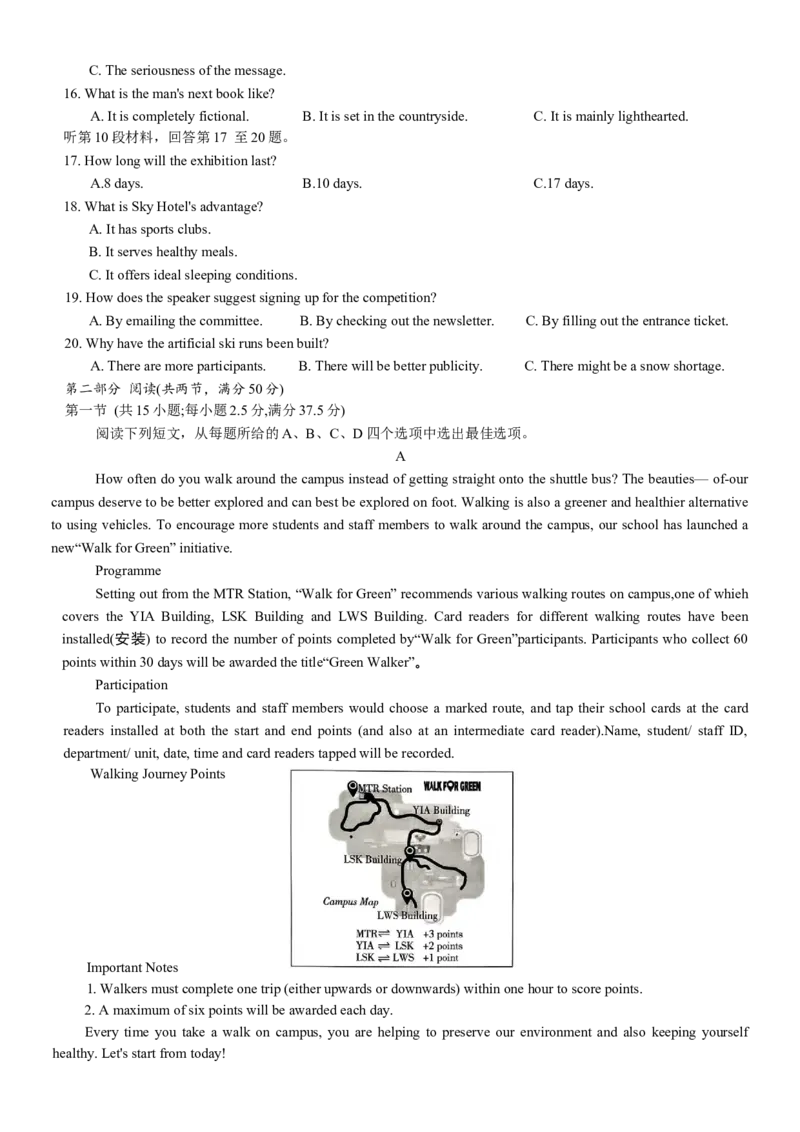
Setting out from the MTR Station, “Walk for Green” recommends various walking routes on campus,one of whieh
covers the YIA Building, LSK Building and LWS Building. Card readers for different walking routes have been
installed(安装) to record the number of points completed by“Walk for Green”participants. Participants who collect 60
points within 30 days will be awarded the title“Green Walker”。
Participation
To participate, students and staff members would choose a marked route, and tap their school cards at the card
readers installed at both the start and end points (and also at an intermediate card reader).Name, student/ staff ID,
department/ unit, date, time and card readers tapped will be recorded.
Walking Journey Points
Important Notes
1. Walkers must complete one trip (either upwards or downwards) within one hour to score points.
2. A maximum of six points will be awarded each day.
Every time you take a walk on campus, you are helping to preserve our environment and also keeping yourself
healthy. Let's start from today!21. Where does“Walk for Green” start?
A. YIA Building. B. LSK Building. C. LWS Building. D. MTR Station.
22. What are participants required to do?
A. Collect at least 6 points. B. Complete a round trip.
C. Maintain a fixed speed. D. Choose a pre-set route.
23. How many points do you get by walking from YIA Building to LWS Building?
A.1. B.2. C.3. D.6.
B
A grandmother cooks chicken. A group of kids,ages 8 to 14, watch her make the dish. This cooking class is part of
a“Summer Camp” in SouthernCalifornia. At this camp, grandmas are in charge. Each week, they teach young campers
how to cook a new dish and do crafts.
“Loneliness is something that seniors are challenged with, and they love having younger people around them,” said
Zainab, who works at Olive Community Services that brings older adults together and created the camp.
During the last week of the camp, 9-year-old Janna learned how to use a sewing machine and make pockets. The
camper pressed hard on the machine's pedal, making the needle move quickly. “Slowly,slowly,” Rahim, a grandma
teaching the sewing class, said to her. The girl smiled when she made it.Rahim said the camp is“filling a gap” for kids.
Many schools don't teach these skills like cooking and sewing.
Rahim also doesn't get to spend much time with her grandchildren because they don't live close. “It is heartwarming
to be able to interact with those who love being around you,” she said.
The summer camp was organized through a partnership with the Golden Connections Club, a club started by 14-year-
old high school student Leena to encourage teens and seniors to interact. She noticed that many students didn't have the
chance to spend as much time with their grandparents. She also learned about challenges faced by senior adults, such as
unfair treatment.
The club organizes monthly lunches at Leena's school. They invite the seniors to the school and discuss topics where
both groups can learn from each other. One of the most valuable lessons they' ve shared with her is to live in the moment,
and this has taken on new meaning for Leena. “The people we have right now, they' re not going to be with us forever,”
she said.
24. What can we know about the Summer Camp?
A. It is mainly about cooking. B. It offers jobs to teenagers.
C. It is held on a monthly basis. D. It is in the charge of the seniors.
25. What do the underlined words“filling a gap” refer to in paragraph 3?
A. Providing engaging games. B. Offering nutritious meals.
C. Teaching practical techniques. D. Organizing interactive activities.
26. What did Rahim think of teaching the sewing class at the camp?
A. Refreshing. B. Fulfilling. C. Challenging. D. Pioneering.
27. What is the main purpose of the club?
A. To pass down traditional recipes. B. To ensure an inclusive atmosphere.
C. To improve elderly people's welfare. D. To promote interaction between generations.
C
How old are your organs? The answer might not match your chronological (按时间顺序的) age—— and new
research finds that an organ's biological age might predict a person's risk of diseases.
The research analyzed data from Whitehall Ⅱ, a British study that has followed over 10,000 British adults for over 35
years. Between 1997 and 1999, the Whitehall Ⅱ study took blood samples from participants aged 45 to 69.
The current study analyzed those blood samples as well as follow-up data for 6,235 Whitehall Ⅱparticipants, by thenaged 65 to 89. The researchers used the analysis to help measure the gap between a person's age and the biological age of
nine of their body parts: heart, blood vessels, liver, immune system,pancreas, kidneys, lungs, intestines and brain. Then
they looked at follow-up data that showed the kinds of diseases participants developed as they aged over the next two
decades.
The organs aged at different rates in different people, the researchers write—— and those with“fast-ining” organs
had an increased risk of 30 of the 45 age-related diseases studied.
Some of the associations linked the faster aging organ to diseases in that organ; for example, those with accelerated
(加快的) lung aging were likelier to develop respiratory (呼吸的) diseases. But in other cases, the link was not as direct.
Faster aging of the kidneys, in particular, was linked to diseases of the kidneys and other organs, such as the liver and
pancreas, and accelerated aging of multiple organs in the body increased kidney disease risk. Surprisingly, dementia (痴呆)
was not best predicted by accelerated brain aging, but rather by the immune system's biological age.
The researchers say the study shows the promise of an organ-specific blood test, which is simpler than past methods.
In a news release, lead author Mika Kivimaki says such tests could one day“advise whether a person needs to take better
care of a particular organ, and potentially provide an early- warning signal that they may be at risk of a particular disease.”
28. What do you know about the Whitehall Ⅱ study?
A. The involved organs were healthy. B. The participants were long- lived.
C. The researching process was lengthy. D. The result was not proved already.
29. What has the new research revealed?
A. Organs fail naturally but differently as people age.
B. Faster organ aging predicts increased disease risks.
C. Healthy organs are a guarantee of one's well- being.
D. Organ aging is the leading cause of its function loss.
30. What is the surprising outcome regarding dementia?
A. It is unavoidable as one ages. B. Relevant predictions are quite accurate.
C. Science promises a cure for it. D. Faster brain aging isn't its direct cause.
31. In which way are the findings beneficial?
A. They can help prevent organ disease. B. Any particular disease can be detected.
C. Organ- specific blood tests are simple. D. Health of organs would be guaranteed.
D
For some readers, a dictionary opens up a world.Dictionaries contain multiple pleasures, such as
settling word- game wars by turning actual pages. For the rest, a dictionary is either outdated or strictly
online. In 2012, EncyclopaediaBritannica stopped printing new editions, going digital- only.
In his book, Unabridged: The Thrill of (and Threat to) the Modern Dictionary, American journalistStefan Fatsis
writes of the shift brought about by our decade- old dependence on search engines——" Definitions, good and bad, were a
click away, and most people didn't care or couldn't tell which was which: expert research, scrape d data, zombie (僵尸)
websites, whatever popped up in a search."
When I was a child, I loved dictionaries, and so did every sensible parent in Calcutta. If your child was literate, one
of the 20 volumes of the Oxford English Dictionary or an illustrated Collins was the surest way to keep them happily
occupied, setting them off on猎ens for lost or forgotten words.
Fatsis sees dictionary- making as“a human endeavor (努力) stretching back to the third millenniumBCE”. From the
Akkadians to Sanskrit scholars, what dictionary makers hoped to do went far beyond the already tricky task of writing
definitions: their job was to explain and track“the endless shifts in language”Change is inevitable, though Fatsis also asks what we lose in the name of convenience. He writes,“ the job of the
dictionary was firmly established... By the time I finished this book, it wasn't clear how much longer flesh- and- blood
lexicographers (词典编纂者) would be needed to document the march of theEnglish language. Between traditional search
engines and AI- enhanced search through LLMs (large language models), the way we look up words, and find meaning in
language itself, has changed.”
We can't claim that humanity still needs physical dictionaries. Like encyclopedias and atlases, the best of them have
long moved online. Indeed, the starting points of most search engines were the encyclopedias and dictionaries made by
experts. But I plan to hold on to my beloved, dog- eared physical dictionaries——— such priceless time capsules, the last
paradise s of freedom from the endless serolling of digital content.
32. What has reduced people's reliance on physical dictionaries?
A. The decline of the print media. B. The convenience of online lookup.
C. People's indifference to accuracy. D. Publishers' insistence on going digital.
33. What can we infer about the real- life lexicographers?
A. Their workload will double. B. They will remain in demand.
C. Their existence is threatened. D. They need to upgrade their skills.
34. Why does the author stick to physical dictionaries?
A. They boost long- term memory. B. They last longer than digital files.
C. They offer an escape from screens. D. They give more authoritative definitions.
35. What can be a suitable title for the text?
A. A Word in Favor of Dictionaries B. My Love for Looking up Words
C. A Best- seller on the Theme of Change D. Human Endeavors in Dictionary- making
第二节 (共5小题;每小题2.5分,满分12.5分)
阅读下面短文,从短文后的选项中选出可以填入空白处的最佳选项。选项中有两项为多余选项。
Martin Luther King, Jr. once said, “Only when it is dark enough can you see the stars.” 36
Darkness and fear may cloud our vision, but moments of light —— like flashes in a storm —— reveal that our goals and
dreams remain.
When we are overwhelmed by uncertainty, helplessness often takes over. Yet, as a poet teaches,“The only way out is
in.” 37 Positive psychology shows that trusting yourself depends on cultivating inner peace and
recognizing your character strengths.
Researchers studied 16,716 individuals from over 50 countries to understand traits linked to self-trust during
uncertainty. They found that those with strong trust consistently reported greater inner peace. This group excelled in three
emotional character strengths —— gratitude, love, and hope. 38
Gratitude, the most studied of the three, is particularly powerful. It focuses on what has already happened, requiring
no invention. 39 Instead of recalling only average events, asking for“three things you were grateful
for yesterday” directs the brain to seek positive experiences. Over time, this reshapes our perspective, helping us savor(享
受) moments and feel better. Daily challenges —— political,financial, or personal —— are unavoidable, but they need not
consume us. By practicing gratitude, we train our minds to notice what uplifts us. This shift in perception fosters self-trust,
reminding us that peace and strength lie within.
40 Savor them. This simple practice opens the door to inner peace, proving that storms may
happen, but stars still shine. With gratitude comes self-trust, and with self-trust comes a life of adaptability and meaning.
A. Practicing gratitude changes how our brain searches memories.
B. This reminds us even in difficult times, we can find guidance and hope.
C. Inner strength allows us to shift our focus inward and find calm in chaos.
D. Try it now: recall three experiences from the last 24 hours that made you grateful.E. They promote harmony and adaptability, and importantly, they can be taught and developed.
F. These strengths are rare as they can arise only in times of crisis and play a vital role in hardship.
G. It mainly helps people forget negative experiences, allowing the brain to erase unpleasant memories over time.
第三部分 语言运用(共两节,满分30分)
第一节 (共15 小题;每小题1分,满分15分)
阅读下面短文,从每题所给的A、B、C、D四个选项中选出最佳选项。
Alex is an ordinary high school student in a busy city, who has an extraordinary dream — to become an astronaut.
Every night, as the sky darkens, he gazes (凝视) at the stars, ___41___ with endless longing for the universe.
One day, his school announced a science ____42____ themed “Exploring the Unknown.” Alex’s dream was
____43____. Determined to seize this opportunity to showcase his ____44____ and spirit of exploration regarding the
universe, he ____45____ astronomy, reading extensively about the universe in his spare time. With limited time and
resources, he worked ____46____ on his project, gathering experimental data and ____47____ advice from teachers and
online enthusiasts. Despite challenges, Alex remained determined, ____48____ that dreams are the lighthouse guiding
life’s direction.
As the competition day approached, Alex ____49____ his project with infectious enthusiasm, winning widespread
praise and first prize. This ____50____ brought Alex honor and recognition. More importantly, it strengthened his
____51____ to pursue his dream. The experience transforms his life, ____52____ him support and attention from others,
and fueling his commitment to studying astronomy.
He realized that persistent (坚持不懈的) efforts can turn dreams into reality. ____53____ to face future challenges,
he continued his journey, holding the belief that dreams ____54____ us. Afterwards, he started an after-school astronomy
club. With each new discovery, Afex felt more ____55____ to the universe and more convinced that the sky is not the
limit but just the beginning.
41. A. mixed B. compared C. filled D. equipped
42. A. exhibition B. competition C. discussion D. exploration
43. A. inspired B. realized C. described D. suspended
44. A. support B. concern C. bravery D. passion
45. A. relied on B. set aside C. dived into D. majored in
46. A. tirelessly B. impatiently C. effortlessly D. randomly
47. A. giving B. seeking C. minding D. imagining
48. A. proving B. doubting C. admitting D. believing
49. A. accepted B. bothered C. presented D. polished
50. A. award B. belief C. dream D. spirit
51. A. skills B. resolve C. position D. network
52. A. showing B. allowing C. denying D. earning
53. A. Afraid B. Content C. Ready D. Hopeful
54. A. guide B. control C. distance D. depart
55. A. sensitive B. connected C. foreign D. accustomed
第二节 (共10 小题;每小题1.5分,满分15分)
阅读下面短文,在空白处填入1个适当的单词或括号内单词的正确形式。
The powerful people-to-people bonds between China andMalaysia are reflected in diverse forms, considering a
range of 56 (share) traditional and cultural values between the two nations. The Malay
people have taken great interest in the lion dance, a tradition 57 emerged over athousand years ago in China and has many admirers in modernMalaysia.
Among them58 (be) Adzwin Puteri Faizal, a petite young woman, who is a part
of the locally renowned Yong Jun Lion Dance Association. “In earlier generations, it was difficult for people from other
ethnic groups and women to learn the lion dance,59 things have changed. The60
(unique) and inclusiveness of the lion dance have allowed us to build a family here,” her lion dance master said. The lion
dance in Malaysia shares its roots with the Chinese lion dance,61 (specific) from the
southern lion dance style. It arrived in Malaysia with Chinese immigrants and took root. Initially, the lion dance 62
(perform) during Chinese festivals and celebrations, but 63 the blending (融合) of
Malaysia's ethnicities (种族特点) and cultures, it gradually crossed ethnic boundaries, becoming a beloved cultural
activity for all communities.Its cultural value is widely recognized by the public.
2024 marked the 50th anniversary of the establishment of diplomatic 64 (tie)
betweenChina and Malaysia. Both sides celebrated the lion dance as a form of history, jointly65
(promote) and safeguarding the heritage.
第四部分 写作(共两节,满分40分)
第一节(满分15分)
你校英文报就“是否应开设生活技能课程”发起讨论,请你以“Are Life Skills Classes Necessary?”为题,写
一篇短文投稿,内容包括:
(1)你的看法;
(2)说明理由。
注意:
(1)写作词数应为80个左右;
(2)请按如下格式作答。
Are Life Skills Classes Necessary?
第二节(满分25分)
阅读下面材料,根据其内容和所给段落开头语续写两段,使之构成一篇完整的短文。
I' ve been very fond of classical music since I was a kid. The soft piano melody or grand symphony always calms my
nerves after a stressful school week. My best friend Tom is totally different; he's a big rock music fan, with loud electric
guitars and heavy drums following him everywhere.
We'd never argued about musical tastes before, but last Friday evening, things got heated. We sat on the
neighborhood park lawn, passing headphones back and forth. After Tom listened to my favorite Chopin nocturne (肖邦夜
曲), he shrugged, saying:“It's okay, but way too slow. Where's the energy?”
I frowned, snatching the headphones back.“Energy? Your rock music is just noise! Singers shout like they' re in pain,
and instruments hurt my ears,”I said sharply. Tom's eyes widened; he leaned forward and replied in a raised voice:“You
don't get it! Rock is passion, saying how you feel freely! You' re stuck in an old-fashioned circle, scared to try new things!”
My cheeks burned with anger.“Old-fashioned? Classical music has real artistry, not just screaming and hitting!”I
stood up and kicked a pebble hard. Tom jumped up too, fists clenched.“How dare you disrespect what I love? You' re my
best friend. I thought you'd understand!” Before I could reply, he turned and stormed off, the backpack swinging. I yelled
after him:“Fine! Don't talk to me if you' re unreasonable!” But as he disappeared around the corner, regret flickered. I
quickly pushed it away, still angry.For three days, we didn't speak. We passed in the school hallway without a glance, and group chats went silent. I
missed our jokes and after-school walks, but was too stubborn to apologize. Deep down, Iknew I'd gone too far.
注意:
(1)续写词数应为150个左右;
(2)请按如下格式作答。
I realized my mistake.
With a nervous heart, I pressed the doorbell of Tom's house.英语答案
1—5 CBACA 6—10 ABCAA 11—15 BACCA 16—20 BBCBC
21—23 DDC 24—27 DCBD 28—31 CBDA 32—35 BCCA
36—40 BCEAD 41—45 CBADC 46—50 ABDCA 51—55 BDCAB
56. shared 57. that/ which 58. is 59. but 60. uniqueness 61. specifically 62. was
performed 63. with 64. ties 65. promoting
第四部分.第一节
Are Life Skills Classes Necessary?
I firmly believe life skills classes are necessary for students.
Firstly, these classes fill a gap in traditional education. Subjects like budgeting, cooking,
and basic home repairs are rarely taught in regular lessons,but they are essential for independent
living. For example, learning to manage money helps us avoid financial troubles later. Secondly,
life skills boost confidence. Completing practical tasks,such as fixing a broken lamp, helps
develop problem-solving skills, making us feel capable of handling real-life challenges.
In short, life skills classes prepare us for the future beyond exams. Schools should definitely
include them in the curriculum.
第二节
I realized my mistake. As I sat alone listening to Chopin that evening, his nocturne's gentle tune
reminded me of our friendship's harmony. My sharp words echoed in my mind —— calling
rock“noise”was unfair. Music, like friendship,shouldn't be judged by its volume but by the
feelings it carries. Tom's passion for rock mirrored my love for classical music;neither deserved
disrespect. Swallowing my pride, I grabbed my phone and typed,“I' ll go to talk with you. I owe
you an apology.”
With a nervous heart, I pressed the doorbell of Tom's house. The door swung open, revealing
Tom's hesitant face.Before I could speak, he said, “I'm sorry too! I shouldn't have stormed off. ”
Relief washed over me. “ No, I was wrong to criticize your music,” I admitted. He smiled, pulling
out his headphones.“ Wanna try my favorite rock song? I' ll explain why it moves me.” As the
energetic tunes filled my ears, I finally heard the passion he treasured —— and understood that true
friendship harmonizes different rhythms.