绝密★启用前
2022 年 7 月全国普通高等学校招生全国统一考试(上海
卷)
英语试卷
(满分140分, 考试时间120分钟)
I. Listening Comprehension
Section A
Directions: In Section A, you will hear ten short conversations between two speakers. At the end
of each conversation, a question will be asked about what was said. The conversations and the
questions will be spoken only once. After you hear a conversation and the question about it, read
the four possible answers on your paper, and decide which one is the best answer to the question
you have heard.
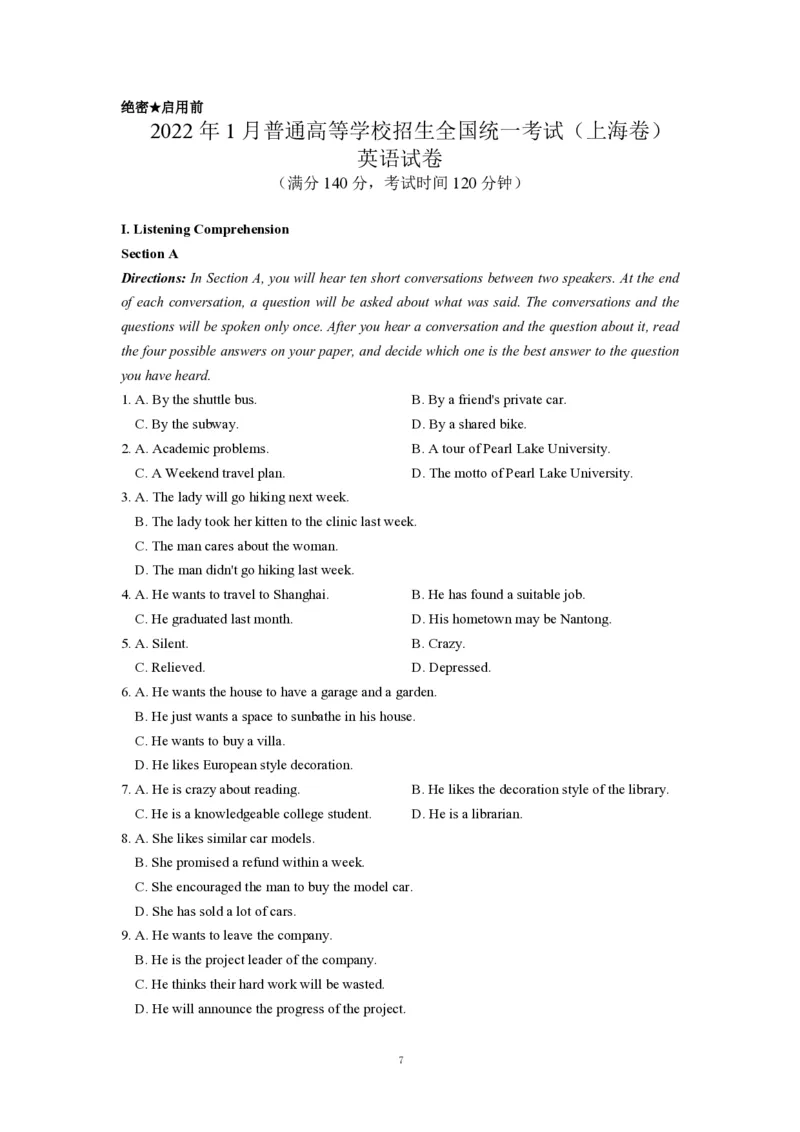
1. A. A box of cupcakes. B. A soup spoon.
C. A packet of sugar. D. A cup of coffee.
2. A. Worried. B. Excited. C. Interested. D. Crazy.
3. A. Giving awards to students. B. Buying a gift for his son.
C. Selling new toys to customers. D. Interviewing to become a train driver.
4. A. She shouldn't go out with a notebook.
B. She should have been more careful and she can only blame herself.
C. She should pay attention to the notebook on the bench.
D. She shouldn't take the loss of her notebook to heart.
5. A. Their travel plan in the city. B. Their exhibition in the gallery.
C. Their experience in the memorial hall. D. Their journey in the city map.
6. A. She is a chess teacher.
B. She is indifferent to her chess progress.
C. She signed up for the chess game.
D. She hasn't touched the chessboard for a long time.
7. A. The light settings. B. The stage background.
C. The performance style. D. The storyline.
8. A. The open-air movie in the forest park.
B. The flower show in the forest park.
C. The closing performance of sports meeting.
D. The opening performance of the forest park.
9. A. Kate is a social phobic (恐惧的) patient.
B. Kate's distinct personality is normal.
C. Kate often loses her temper with her classmates.
D. Kate's strange personality affects her daily life.
10. A. He needs to fix the budget of the hotel.B. He must get to Beijing on time.
C. He can stay at her parents’ house.
D. He wants to visit his parents in Beijing.
Section B
Directions: In Section B, you will hear two passages and one longer conversation. After each
passage or conversation, you will be asked several questions. The passages and the conversation
will be read twice, but the question will be spoken only once. When you hear a question, read the
four possible answers on your paper and decide which one is the best answer to the question you
have heard.
Questions 11 through 13 are based on the following passage.
11. A. About 1,400. B. About 3,000. C. About 1,900. D. About 2,000.
12. A. It has a long history.
B. It has not yet achieved commercial success.
C. It only sells fruit at its stall.
D. It started from nothing.
13. A. The success story of Kitten Coffee.
B. The history of Everbrown.
C. The secret of business success.
D. The advantages of diversified products.
Questions 14 through 16 are based on the following passage.
14. A. It needs scissors to be opened for use.
B. It has launched more than 30 products.
C. It is material-efficient and environmentally friendly.
D. Its reputation among sellers is very poor.
15. A. It has put forward effective initiatives.
B. It has reached the peak of product upgrading.
C. It has offered a wide range of products.
D. It only introduces the product through video clips.
16. A. Diversified design of packaging materials.
B. Working hard to promote product development.
C. Innovative initiatives of e-commerce pioneers.
D. A new way of packaging: that's frustration-free.
Questions 17 through 20 are based on the following conversation.
17. A. The man's trip in Paris as an exchange student.
B. The man's accommodation in Paris as an exchange student.
C. The man's course plan in Paris as an exchange student.
D. The man's daily diet in Paris as an exchange student.18. A. The talent apartment outside the school is cheaper.
B. The host family is willing to provide him with accommodation.
C. The roommate has shared an apartment with him.
D. The school doesn't have an on-campus dormitory for exchange students.
19. A. He may want to visit famous scenic spots.
B. He may have a tight schedule.
C. He may want his family to accompany him.
D. He may need a chauffeur to take him to school.
20. A. He likes to finish the experiment with his classmates.
B. He wants to split the rent to save money.
C. He hopes to have the same schedule with his roommate.
D. He just wants to hitchhike (搭顺风车) to class.
II. Grammar and Vocabulary
Section A
Directions: After reading the passage below, fill in the blanks to make the passages coherent and
grammatically correct. For the blanks with a given word, fill in each blank with the proper form of
the given word; for the other blanks, use one word that best fits each blank.
How to Start a New Business
An entrepreneur is a person who creates, launches, and begins a new business, typically in
response to a market demand that has not been met. Entrepreneurs are often imaginative, self
-motivated individuals who develop full-time, successful, and sustainable businesses. Successful
entrepreneurs frequently have revelant insights, expertise, and advice they may offer aspiring
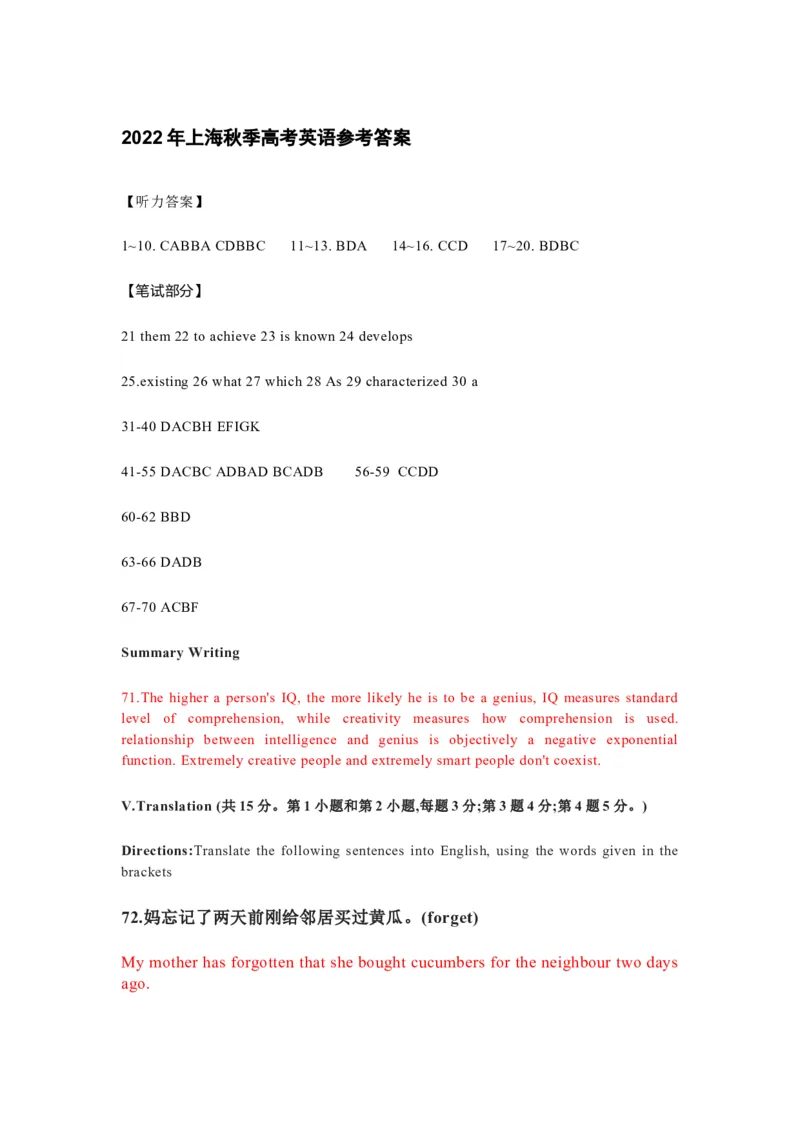
entrepreneurs to aid (21) ________ on their respective paths. Interviewing entrepreneurs might
provide insight into the steps they took (22) ________ (achieve) success. Here is the interview of
entrepreneur-related questions, and you will find more preparations for it.
Question: How would you describe an entrepreneur?
Answer: An individual who establishes and expands their own company through innovative
strategies (23) ________ (know) as an entrepreneur. During the expansion of their companies,
entrepreneurs are responsible for several important tasks in addition to cash generation. An
entrepreneur perceives a commercial need in their society, (24) ________ (develop) an idea for a
business, and then takes the initiative to start their firm. Suppose a business idea does not center
on producing a product that fills a gap in the (25) ________ (exist) market. In that case, it most
often centers on applying technical advancements to simplify the process of obtaining a product or
service.
Question: How do entrepreneurs identify business prospects?
Answer: Entrepreneurs routinely seek chances to expand or increase their company’s
revenues. They determine which product to include and which market to enter. An entrepreneurshould listen to prospective customers and look for chances to build items that meet their
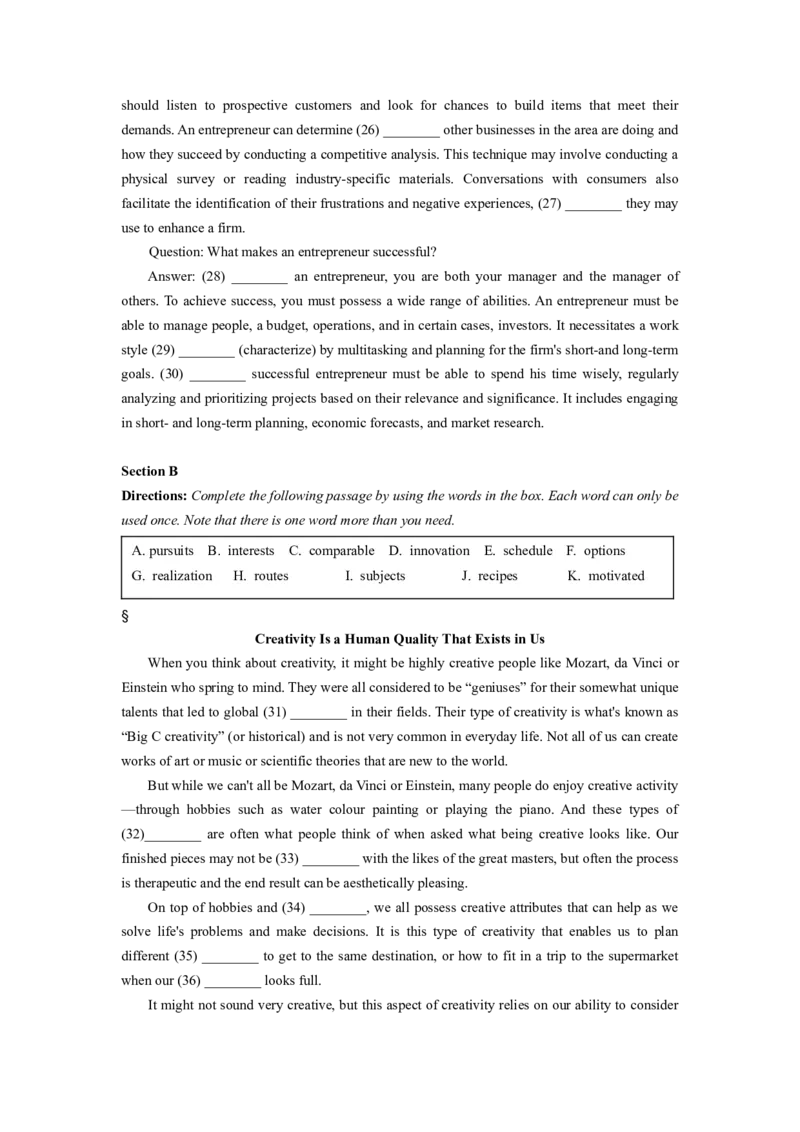
demands. An entrepreneur can determine (26) ________ other businesses in the area are doing and
how they succeed by conducting a competitive analysis. This technique may involve conducting a
physical survey or reading industry-specific materials. Conversations with consumers also
facilitate the identification of their frustrations and negative experiences, (27) ________ they may
use to enhance a firm.
Question: What makes an entrepreneur successful?
Answer: (28) ________ an entrepreneur, you are both your manager and the manager of
others. To achieve success, you must possess a wide range of abilities. An entrepreneur must be
able to manage people, a budget, operations, and in certain cases, investors. It necessitates a work
style (29) ________ (characterize) by multitasking and planning for the firm's short-and long-term
goals. (30) ________ successful entrepreneur must be able to spend his time wisely, regularly
analyzing and prioritizing projects based on their relevance and significance. It includes engaging
in short- and long-term planning, economic forecasts, and market research.
Section B
Directions: Complete the following passage by using the words in the box. Each word can only be
used once. Note that there is one word more than you need.
A. pursuits B. interests C. comparable D. innovation E. schedule F. options
G. realization H. routes I. subjects J. recipes K. motivated
§
Creativity Is a Human Quality That Exists in Us
When you think about creativity, it might be highly creative people like Mozart, da Vinci or
Einstein who spring to mind. They were all considered to be “geniuses” for their somewhat unique
talents that led to global (31) ________ in their fields. Their type of creativity is what's known as
“Big C creativity” (or historical) and is not very common in everyday life. Not all of us can create
works of art or music or scientific theories that are new to the world.
But while we can't all be Mozart, da Vinci or Einstein, many people do enjoy creative activity
—through hobbies such as water colour painting or playing the piano. And these types of
(32)________ are often what people think of when asked what being creative looks like. Our
finished pieces may not be (33) ________ with the likes of the great masters, but often the process
is therapeutic and the end result can be aesthetically pleasing.
On top of hobbies and (34) ________, we all possess creative attributes that can help as we
solve life's problems and make decisions. It is this type of creativity that enables us to plan
different (35) ________ to get to the same destination, or how to fit in a trip to the supermarket
when our (36) ________ looks full.
It might not sound very creative, but this aspect of creativity relies on our ability to consider(37) ________ and assess their suitability, as well as how to make decisions based on personal
prior experience or what we have learnt formally or informally. These examples are known as
“Small C creativity” or “personal everyday creativity”.
While Big C creativity is valued and celebrated, it is often Small C creativity that has allowed
humans to flourish over thousands of years. It sets us apart from other animals and it is also the
type of creativity which can be fostered through our education system and beyond into the
workplace.
Traditionally, research tells us that creativity has been largely associated with the arts. Our
previous research has shown that teachers are often able to give examples of creative activity in
arts (38) ________, but find it harder to do so when asked to describe creativity in subjects such as
science.
But there is a growing (39) ________ that opportunities to be creative are found across a
broader range of subjects. For instance, engineering provides opportunities to be Creative through
problem solving, and history gives the opportunity to think creatively about why events happened,
and what (40) ________ those involved.
III. Reading Comprehension
Section A
Directions: For each blank in the following passage there are four words or phrases marked A, B,
C and D. Fill in each blank with the word or phrase that best fits the context.
A filler word is an apparently meaningless word, phrase, or sound that marks a pause or
hesitation in speech. Also known as a pause filler or hesitation form. Some of the common filler
words in English are um, uh, er, ah, like, okay, right, and you know. Although filler words “may
have fairly minimal lexical (词汇的) content,” notes linguist Barbara A. Fox, “they can play a
strategic syntactic (句法的) role in a(n) (41) ________ conversation”. What appears to be a filler
word may also be a holophrase (整句字) (42) ________ the context. “Hey, hey, shh, shh, shh.
Come on. Be sensitive to the fact that other people are not comfortable talking about emotional
(43) ________. Um, you know, I am, I'm fine with that, but...other people”.
“Modern linguists led by Leonard Bloomfield in 1933 call these ‘hesitation forms’—the
sounds of stammering (uh), stuttering (um, um), throat-clearing (ahem!), stalling (well, um, that
is), interjected when the speaker is searching words or (44) ________ for the next thought.” You
know that y' know is among the most common of these (45) ________ forms. Its meaning is not
the imperious ‘you understand’ or even the old interrogatory ‘do you get it’? It is given as, and
taken to be, merely a filler phrase, (46) ________ to fill a beat in the flow of sound, not unlike
like, in its new sense of, like, a filler word…
These staples of modern filler communication—I mean, y' know, like—can also be used as
‘tee-up words'. In olden times, pointer phrases or tee-up words were get this, would you believe?
and are you ready? The (47) ________ of these rib-nudging phrases was—are you ready—tomake the point, to focus the listener's attention on what was to follow... If the (48) ________ is to
tee up a point, we should accept y' know and its friends as a mildly (49) ________ spoken
punctuation, the articulated colon (冒号) that signals ‘focus on this’… If the purpose is to grab a
moment to think, we should allow ourselves to wonder: Why are filler phrases needed at all? What
(50) ________ the speaker to fill the moment of silence with any sound at all?
Why do some people fill the air with non-words and sounds? For some, it is a sign of
nervousness; they fear silence and experience speaker (51) ________. Recent research at
Columbia University suggests another reason. Columbia psychologists guessed that speakers fill
pauses when (52) ________ for the next word. To investigate this (53) ________, they counted the
use of filler words used by lecturers in biology, chemistry, and mathematics, where the subject
matter uses scientific definitions that limit the variety of word choices (54) ________ to the
speaker. They then compared the number of filler words used by teachers in English, art history,
and philosophy, where the subject matter is less (55) ________ and more open to word choices.
41. A. undertaking B. discovering C. disliking D. unfolding
42. A. depending on B. holding up C. taking over D. arranging for
43. A. appliances B. substances C. disturbances D. finances
44. A. on the contrary B. at a loss C. at dawn D. on no account
45. A. perseverance B. complexity C. hesitation D. obligation
46. A. intended B. attended C. pretended D. extended
47. A. interest B. experience C. advantage D. function
48. A. architecture B. purpose C. completion D. random
49. A. annoying B. striking C. entertaining D. embarrassing
50. A. oppresses B. recycles C. highlights D. motivates
51. A. danger B. anxiety C. figure D. sculpture
52. A. bothering B. inspecting C. searching D. accomplishing
53. A. idea B. chance C. basis D. feedback
54. A. feasible B. credible C. considerable D. available
55. A. well-matched B. well-defined C. well-bred D. well-perceived
Section B
Directions: Read the following three passages. Each passage is followed by several questions or
unfinished statements. For each of them there are four choices marked A, B, C and D. Choose the
one that fits best according to the information given in the passage you have just read.
(A)
Contemporary artist Nick Smith creates pixelated (像素化的) works with hand placed colour-
chips, synonymous with colour swatches (色块), cleverly combining text and image to create
interesting and fascinating collaged (拼贴的) works.With a previous career in Interior Design spanning 11 years, Nick references his concept
design background throughout his work, reworking the design aesthetic using unique colour
swatches in hand-made collages, placing his work firmly in the fine art category. From his first
collage experiment back in 2011 of Warhol's ‘Marilyn', when he assembled a tessellation (镶嵌技
术) of swatches as a challenge, this eventually inspired his career as an artist and determined his
unique style he is now known for.
The multi-layered element of his work, which marries image and word, allows Nick to
explore complex art-historical concepts. The text employed is often narrative, which can be read
in sequence adding another element of intrigue and interest to the work. This additional element of
text, placed under the empty space of each swatch, creates either complimentary or subversive
meanings. Nick deliberately leaves these word/image constructions open to viewer interpretation,
sparking new debates and meanings.
Each P-series, such as Psycolourgy 2015, Purgatory 2019, explores complicatedly researched
concepts, which are always the crucial starting point for each new series of work. Producing large-
scale works to micro-chip collages, and multiple sell out print editions, Nick continues to develop
his popular and recognisable art.
PSYCOLOURGY—January 2015 Lawrence Alkin Gallery, London
Smith's debut solo exhibition with Lawrence Alkin Gallery in Soho, London, launched his
unique visual reworking of classic paintings from the 20th Century canon. Universally known
works, including David Hockney's ‘The Bigger Splash', Andy Warhol's ‘Soup Cans’ and Leonardo
da Vinci's ‘Mona Lisa’ were all recast, creating original collages that enquire ideas of depiction,
digitalisation and recognition. A sell out show, with numerous successful subsequent print
releases, Psycolourgy forged Smith's path to a place among Britain's notable contemporary artists.
PURGATORY- December 2019 Context, Art Miami
Purgatory is a shiny, sticky, glossy exploration of our societies attitude and approach to our
excess, addictions and desires.
Excerpts from Dante's Purgatory are woven through colourful works depicting popular
covetable consumables, creating symbolic representations of the seven sins. Dante explores
possible penance (忏悔) for our earthly suffering leading to spiritual growth. The results of these
pairings offer a humorous, nostalgic and subversive opportunity to question our choices, our
history and our future.
56. What made Nick launch his art career?
A. His deep love of fascinating collaged works.
B. His first collage work Warhol's ‘Marilyn’.
C. The challenge of piecing a tessellation of swatches.
D. The collage experiment dating back to 2012.
57. Which of the following statements about the text Nick uses is true?A. His text contains concepts of art.
B. His text is usually illustrative.
C. His text can be read sequentially.
D. His text elements are very simple.
58. What do we know about PSYCOLOURGY?
A. It opened Smith's unique visual reinvention of classic 21th-century paintings.
B. David Hockney's ‘Mona Lisa’ has been recreated by Lawrence Alkin Gallery.
C. The original collages affirm the ideas of depiction, digitisation and recognition.
D. It opened Smith's path to becoming one of Britain's leading contemporary artists.
59. What is the topic of this passage?
A. Some useful ways to create collaged works.
B. The life of contemporary artist Nick Smith.
C. Information about Psycolourgy and Purgatory.
D. The introduction to Nick Smith's works.
(B)
The scientific method uses a series of steps to establish facts or create knowledge. The
overall process is well established, but the specifics of each step may change depending on what is
being examined and who is performing it. The scientific method can only answer questions that
can be proven or disproven through testing.
Make an observation or ask a question. The first step is to observe something that you would
like to learn about or ask a question that you would like answered. These can be specific or
general. Some examples would be “I observe that our total available network bandwidth drops at
noon every weekday” or “How can we increase our website registration numbers?” Taking the
time to establish a well-defined question will help you in later steps.
Gather background information.
This involves doing research into what is already known about the topic. This can also
involve finding if anyone has already asked the same question.
Create a hypothesis.
A hypothesis is an explanation for the observation or question. If proven later, it can becomea fact. Some examples would be “Our employees watching online videos during lunch is using our
internet bandwidth” or “Our website visitors don't see our registration form.”
Create a prediction and perform a test.
Create a testable prediction based on the hypothesis. The test should establish a noticeable
change that can be measured or observed using empirical analysis. It is also important to control
for other variables during the test. Some examples would be “If we block video-sharing sites, our
available bandwidth will not go down significantly during lunch” or “If we make our registration
box bigger, a greater percentage of visitors will register for our website than before the change.”
Analyze the results and draw a conclusion.
Use the metrics established before the test see if the results match the prediction. For
example, “After blocking video-sharing sites, our bandwidth utilization only went down by 10%
from before; this is not enough of a change to be the primary cause of the network congestion” or
“After increasing the size of the registration box, the percent of sign-ups went from 2% of total
page views to 5%, showing that making the box larger results in more registrations.”
Share the conclusion or decide what question to ask next: Document the results of your
experiment.
By sharing the results with others, you also increase the total body of knowledge available.
Your experiment may have also led to other questions, or if your hypothesis is disproven you may
need to create a new one and test that. For example, “Because user activity is not the cause of
excessive bandwidth use, we now suspect that an automated process is running at noon every
day.”
60. What is the important role of collecting background information?
A. Make full preparation for the research questions.
B. Understand the knowledge of existing research results.
C. Provide evidence to refute the research conclusion.
D. Encourage researchers to reflect deeply on their work.
61. In which case would it be necessary to create a new hypothesis for retesting?
A. The research hypothesis has been fully proved.
B. The research results lead to other related issues.
C. The scope of test data needs to be expanded again.
D. The background investigation is not objective enough.
62. What can we infer from this passage?
A. Creating a question will help you in the following step.
B. Collecting information includes research on an unknown subject.
C. The test should establish a change that cannot be measured easily.
D. You may need to create a new hypothesis if the old one is overturned.(C)
Business innovation is an organization's process for introducing new ideas, workflows,
methodologies, services or products. Like IT innovation, which calls for using technology in new
ways to create a more efficient and agile organization, business innovation should enable the
achievement of goals across the entire organization, with sights set on accomplishing core
business aims and initiatives. Innovation often begins with idea generation, wherein ideas are
narrowed down during brainstorming sessions, after which leaders consider the business viability,
feasibility and desirability of each idea. Business innovation should improve on existing products,
services or processes; or it should solve a problem; or it should reach new customers. Recent
examples of business innovation include the introduction of the Dyson vacuum cleaner, whose
creator and namesake James Dyson declared in advertisements that he set out to build a better
product by applying industrial cyclone technologies to the household appliance.
The purpose of the business innovation process is to create value for the organization. That
value can come from creating new revenue opportunities or driving more revenue through existing
channels; from creating efficiencies that save time, money or both; or from improvements to
productivity or performance. In short, innovation should lead to higher profits. Additionally, the
results of an organization's innovation process should yield a competitive advantage; it should
help the organization to grow and reach—or, better still, exceed—strategic objectives.
Innovation and invention are closely linked, but the two terms are not interchangeable. An
invention is an entirely new creation. The process of business innovation can produce an
invention, but the term is broader in scope and includes the application of an existing concept or
practice in a new way, or applying new technology to an existing product or process to improve
upon it. To better understand the difference, consider this: The telephone is an invention, but the
smartphone is an innovation.
Business innovation can also be classified as either revolutionary or evolutionary.
Revolutionary business innovation yields a drastic change in a product, service, process, etc.,
which often destroys or supplants an existing business model. This is also known as radical
innovation. Evolutionary or incremental innovation involves smaller, more continuous
improvements that, while important, are not drastic enough to shift a company or market into a
new paradigm. Disruptive innovation is a category that emphasizes the destructive aspect of
revolutionary innovation; this term applies to business innovation that leads to the creation of a
new market that displaces an existing one or, similarly, a significant upheaval in a category of
products or services.
Business innovation, like most business initiatives, has both benefits and risks. Organizations
should recognize on the negative side that the business innovation process can be a costly
undertaking that does not always produce a return on investment (ROI); that ideas considered
likely to succeed could still fail; and that stakeholders could fight the changes required to be
successful. On the other hand, organizations need to weigh those risks against the benefits ofbusiness innovation.
63. What does the underlined word in the first paragraph mean?
A. Persuasibility. B. Scarcity. C. Generality. D. Practicability.
64. What is the purpose of business innovation?
A. Create value benefits for the enterprise.
B. Reform the management structure of enterprises.
C. Encourage staff to make more inventions.
D. Upgrade the product performance.
65. Which of the following is true about innovation and invention?
A. They are essentially the same concept.
B. They can replace each other in the context.
C. They can bring huge commercial benefits.
D. They are closely related but have different conceptual scopes.
66. What is the main content of this passage?
A. The precautions for brainstorming meetings.
B. The considerations for business innovation.
C. The difference between innovation and invention.
D. The revolutionary change in business innovation.
Section C
Directions: Complete the following passage by using the sentences in the box. Each
sentence can only be used once. Note that there are two sentences more than you need.
A. But studying the chimpanzees of Gombe was not easy.
B. Until that time, only humans were thought to create tools.
C. These observations disprove the widely held belief that chimpanzees are vegetarian.
D. So she learns to be a secretary and works for a time at Oxford University typing documents.
E. However, Jane loves the toy and names the chimpanzee Jubilee, carrying it with her
everywhere.
F. Some scholars and scientists give Jane a cold reception and criticise her for giving the
chimpanzees names.
When Leakey and Jane begin a study of wild chimpanzees on the shore of Lake Tanganyika,
British authorities resist the idea of a young woman living among wild animals in Africa. They
finally agree to Leakey's proposal when Jane's mother Vanne volunteers to accompany her
daughter for the first three months.
On July 14, 1960, Jane and Vanne arrive on the shores of Gombe Stream Chimpanzee
Reserve in western Tanzania.(67) ________ The animals fled from Jane in fear. With patience and determination she
searched the forest every day, deliberately trying not to get too close to the chimpanzees too soon.
Gradually the chimpanzees accepted her presence.
Jane observes meat-eating for the first time October 30, 1961. Later, she sees the
chimpanzees hunt for meat. (68) ________
On November 4, 1961, Jane observes David Greybeard and Goliath making tools to extract
termites (白蚁) from their mounds. They would select a thin branch from a tree, strip the leaves
and push the branch into the termite mound. After a few seconds they would pull out the termite-
covered stick and pick off the tasty termites with their lips.
This becomes one of Jane's most important discoveries. (69) ________ On hearing of Jane's
observation, Leakey famously says: “Now we must redefine tool, redefine man, or accept
chimpanzees as humans.”
Jane's work in Gombe becomes more widely known and in 1962 she is accepted at
Cambridge University as a PhD candidate, one of very few people to be admitted without a
university degree. (70) ________ “It would have been more scientific to give them numbers”, they
say.
Jane has to defend an idea that might now seem obvious: that chimpanzees have emotions,
minds and personalities.
Jane in AfricaNational Geographic decides to sponsor Jane's work and sends photographer
and filmmaker Hugo van Lawick to document Jane's life in Gombe. In August 1963, Jane
publishes her first article in National Geographic, “My Life Among Wild Chimpanzees.”
IV. Summary Writing
71. Directions: Read the following passage. Summarize the main idea and the main point(s) of the
passage in no more than 60 words. Use your own words as far as possible.
Is there a correlation between high IQ and creative genius? Really, the phrasing of the
question contradicts very much correlation, as “creativity” is in no way measured through IQ
standardized testing, and creativity is the greatest determinant of a genius as, like you say, it is a
genius. Innovation upon any subject requires a drive to create.
As ones IQ increases , there is an increased probability that they are a genius because their
level of creativity has a higher probability of ascending (升高) them to genius level. However if
the odds are against them, there is an average probability that they are a genius since they are
average percent genius. This is because genius and IQ are composed of different mental constructs
as IQ measures a standard comprehension level, while creativity measures the way in which this
comprehension is used. For example, if your IQ is 180, the percentage that you are a genius is
subtracted by the amount of creativity necessary to become a genius. This is inductive of the
influence that the brain has on awareness. The brain gains perceptive awareness upon “creating”
thoughts in a continuous cyclic process, and if you were very “intelligent” but could not generatethoughts, you could not be an intellectual being. However, one who is alive can never stop
thinking, so the correlation of IQ and genius would objectively appear as a negative exponential
function.
There are few exceptionally creative people out there, just as there are few exceptionally
intelligent people, and one does not occur with the other. Possessing a high level of intelligence is
a platform of understanding for the creative thinking skills to make up originality. When one bears
informal thinking skills, they typically occupy heightened intuitive awareness, and vivid
imaginative qualities. Critical thinking skills allow one to make sense of the resultant creative
output within its surrounding context of knowledge.
However, not all “geniuses” from our subjective intelligence range necessarily have high
levels of creativity. One's level of intelligence can be so high that their platform of understanding
generalizes ideas where a genius with lower levels of intelligence must use creativity in order to
attain a sort of qualitative equivalence. Examples of people like this throughout history include the
likes of John von Neumann and Christopher Langan.
V. Translation
Directions: Translate the following sentences into English, using the words given in the brackets.
72. 妈妈忘了两天前刚给邻居买过黄瓜。(forget)
73. 每逢节假日, 我们都会去郊区露营, 为的就是享受悠闲惬意的生活。(so that)
74. 切莫苛求运动强度和频率, 细水长流才能见效。(a different)
75. 这条运河历经数百年才修建而成, 如今虽无昔日繁荣之景, 但仍然是横跨东西的重要水路。
(as... as)
VI. Guided Writing
Directions : Write an English composition in 120- l 50 words according to the instructions given
below in Chinese.
假使你是明启中学的高三学生李华, 你的学校正在组织“走进历史”主题活动, 拟从三
个活动形式里选择一个:走访老战士、表演历史剧和制作短视频。学校正在向全体师生征
求建议。必须包含:
(1) 你的选择;
(2) 你的理由。