延庆区 2020—2021 学年第一学期期中试卷
初 三 英 语
知识运用
一、单项填空
从下面各题所给的A、B、C、D四个选项中,选择可以填入空白处的最佳选项。
,
1. Last week the twins chose a dress for _____ mother as a birthday gift.
A. her B. them C. their D. his
2. Stan Lee, the father of Marvel Comic, passed away _____ Nov. 12th, 2018.
A. on B. at C. in D. over
3. Sorry, I must go to the library. Lily _____ for me there.
A. waited B. is waiting C. waits D. was waiting
4. William Shakespeare is one of __________ writers in the world.
A. famous B. more famous C. most famous D. the most famous
5. —_____ you go to cinema with me this Saturday?
,
— Sorry I can’t. This Saturday is my mother’s birthday.
A. May B. Can C. Must D. Need
6. Wash your hands before meals, ________ you may get ill.
A. and B. but C. or D. so
7. —_____ will the talk show start?
— It will start at 8:00.
A. When B. Why C. How D. Where
8. — What were you doing this time yesterday?
— I _____ the classroom.
A. have cleaned B. was cleaning C. cleaned D. clean
9. I _____ playing this piece of music for two months, so I play it better.
A. practice B. practiced
.
C will practice D. have practiced
10. My father often _____ to the gym with me though he has lots of work to do.
A. went B. has gone C. goes D. will go
11. The 24th Winter Olympic Games ______ in Beijing and Zhangjiakou in 2022.
A. holds B. is held C. will hold D. will be held
12. —Can you tell me _____ next Sunday?—By train.
A. how we will go to Shanghai B. how did we go to Shanghai
C. how we went to Shanghai D. how will we go to Shanghai
二、完形填空
阅读下面的短文,掌握其大意,然后从短文后各题所给的A、B、C、D四个选项中,选择最
佳选项。
From paper to piano
I was 11 years old when I asked my mom for piano lessons in 2010. We were poor, so she said a polite “no”.
That didn’t ___13___ me. I Googled the measurements for a keyboard, drew the keys on a piece of paper and
stuck it on my desk. I would click notes on an online keyboard and “play” them back on my paper one—keeping
the sound they made on the computer in my head. I spent six months playing without touching a real piano. Once
my mom saw that I was ___14___, she borrowed money and bought me 10 lessons.
I still remember the first one. I was struck by how real the sound of the piano was. I ___15___ my grade one
after eight lessons. Once I started secondary school, we couldn’t afford lessons again. I passed grade three, then
grade five, practicing only on my ___16___.
One evening, when I was about 13, my mom said she had a surprise for me; it was an electronic keyboard
bought with more borrowed money. It was the first time I’d ___17___ for her. She was in shock.
My school didn’t offer music A-level. I found the Purcell School for young musicians, but the tryouts (选拔)
were difficult. To my amazement, I was offered a place.
,
At Purcell I spent two years working as ___18___ as I could. I performed to raise money and saved enough to
buy my first piano.
When I left Purcell, I was awarded the senior piano prize and senior academic music prize. I am now at the
Guildhall School in London. I feel proud: it’s been 10 years since I ___19___ my paper piano, and I’m at one of the
world’s leading music schools.
The paper piano helped spark my ___20___ about how music works, the building blocks that form the pieces.
13. A. surprise B. help C. stop D. shame
14. A. serious B. pity C. poor D. caring
15. A. failed B. begun C. changed D. sat
16. A. book B. piano C. paper D. computer
17. A. studied B. played C. thanked D. waited
18. A. hard B. nervously C. politely D. fast
19. A. searched B. borrowed C. bought D. drew20. A. value B. curiosity C. pride D. confidence
阅读理解
三、阅读下列短文,根据短文内容,从短文后各题所给的A、B、C、D四个选项中,选择最
佳选项。
A
Mountains are more than 500 meters tall and it’s not easy for plants to live on them.
The wind is strong. The soil is thin and rocky. Which plants can live there? Come and see
some of them.
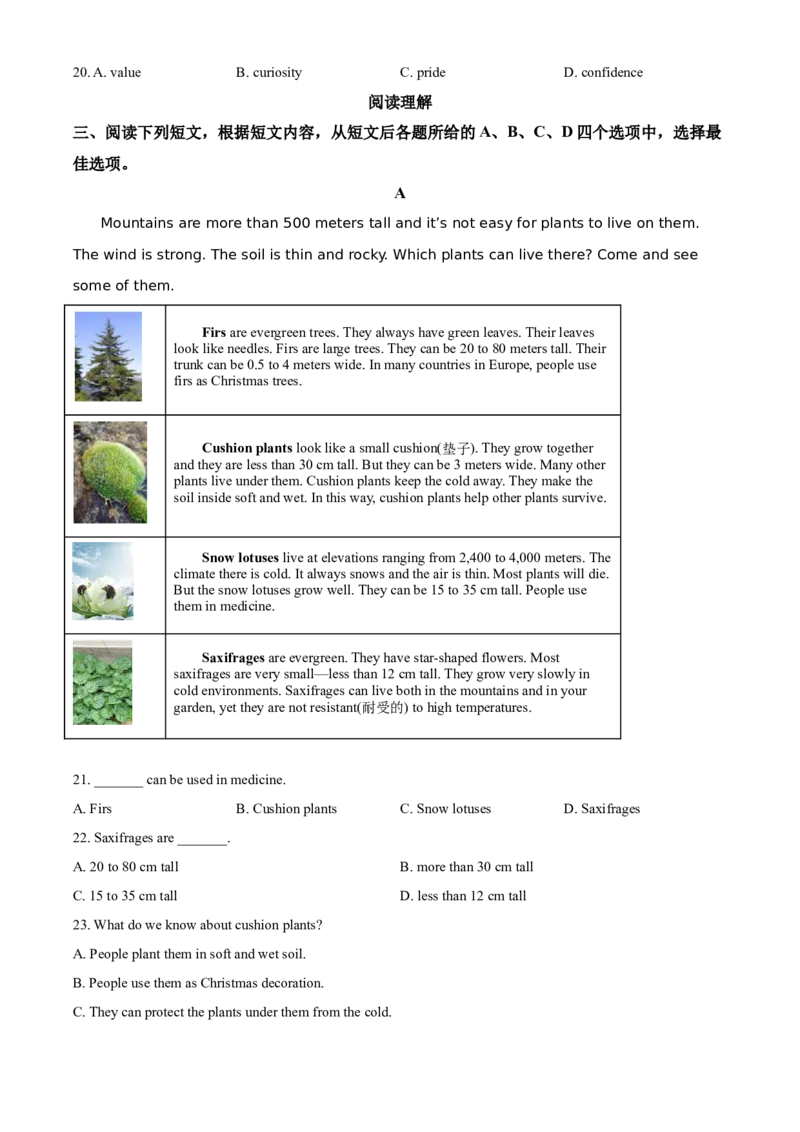
Firs are evergreen trees. They always have green leaves. Their leaves
look like needles. Firs are large trees. They can be 20 to 80 meters tall. Their
trunk can be 0.5 to 4 meters wide. In many countries in Europe, people use
firs as Christmas trees.
Cushion plants look like a small cushion(垫子). They grow together
and they are less than 30 cm tall. But they can be 3 meters wide. Many other
plants live under them. Cushion plants keep the cold away. They make the
soil inside soft and wet. In this way, cushion plants help other plants survive.
Snow lotuses live at elevations ranging from 2,400 to 4,000 meters. The
climate there is cold. It always snows and the air is thin. Most plants will die.
But the snow lotuses grow well. They can be 15 to 35 cm tall. People use
them in medicine.
Saxifrages are evergreen. They have star-shaped flowers. Most
saxifrages are very small—less than 12 cm tall. They grow very slowly in
cold environments. Saxifrages can live both in the mountains and in your
garden, yet they are not resistant(耐受的) to high temperatures.
21. _______ can be used in medicine.
A. Firs B. Cushion plants C. Snow lotuses D. Saxifrages
22. Saxifrages are _______.
A. 20 to 80 cm tall B. more than 30 cm tall
C. 15 to 35 cm tall D. less than 12 cm tall
23. What do we know about cushion plants?
A. People plant them in soft and wet soil.
B. People use them as Christmas decoration.
C. They can protect the plants under them from the cold.D. They can live both in the mountains and in your garden.
B
What can you do to help out?
One winter morning, Tapiwa Chiwewe was driving to work in Johannesburg, South Africa. He noticed a
haze(薄雾) hanging over the city and it didn’t take long for him to realize that it was an enormous cloud of air
pollution.
At that moment, Chiwewe wanted to do something about it, but didn’t know what. He was a computer
engineer and knew little about environmental science.
He first did research on air pollution and found that it is the world’s biggest environmental health risk. He
decided to work on it in a cooperative(合作的) way. He talked to scientists, officials, and engineers who helped
him develop a deeper understanding of the situation, as well as an idea to improve it.
Through years of work, Chiwewe and his coworkers from South Africa and China created an online air quality
decision support system. Based on historical and real-time data, the system can accurately predict air pollution and
air quality, which can help people make better decisions about their daily movements, as well as help officials
better manage their operations.
Chiwewe learned an important lesson—“a lesson we all need to take into heart if we are to work towards a
better future. Even if you’re not an expert in a particular field, your outside expertise may hold the key to solving
problems within that field,” he said.
What if Chiwewe hadn’t bothered to research the problem and do something about it? What if he had just
hoped that someone, somewhere, was taking care of the matter?
As Chiwewe said, “Why not just go ahead and deal with the problem as well as you can, in your own way?
You may be pleasantly surprised.”
24. What made Chiwewe want to take action?
A. He didn’t know what the cloud was.
B. He noticed air pollution over his city.
C. He didn’t want to be a computer engineer.
D. He was an expert in environmental science.
25. In which order did Chiwewe solve the problem?
a. He asked for expert’s suggestions.
b. He created a system that works online.
c. He did research on the problem.
d. He allowed others to use the system.A. cabd B. abcd C. cdab D. adbc
26. What is the point of the last two paragraphs?
A. We should always cooperate with others.
B. There is always something new to learn.
C. Experts need to do research when dealing with problems.
D. Taking action on your own is better than waiting for others.
C
Giving presentations is a challenging, but important part of education. A presentation is the key to making
your message clear, whether you are in an interview or giving a talk in front of the class. A well-prepared and
practiced presentation can improve your confidence dramatically. On presentation day, there are some ways you
can take to ensure that you perform well.
Practice the presentation. Before presentation, it can be helpful to practice on your own. While you are
practicing your presentation, do your best to work on memorizing what you want to say, and when you want to say
it. Your presentation will be a lot better if you aren’t constantly looking down at note cards or searching a piece of
paper to figure out what you want to say next.
Control your nerves. There are a few things you can do before the presentation to help calm your nerves —
many of which you can even do right at your desk. Try breathing deeply; silently repeating affirmations (such as “I
can do this. I’m going to do a great job”); or using positive visualization (imagine yourself giving your presentation
successfully and knocking it out of the park). These strategies can help you settle your nerves and go into your
presentation feeling calm and collected.
Speak slowly and enunciate clearly. If you have practiced enough, this shouldn’t be difficult; however, some
people talk too quickly and too quietly when they get nervous. Try to remind yourself to talk slowly and loudly
enough so everyone can hear you. If you’re using an electronic presentation, you can use each new slide as a
chance to stop for a few seconds and recognize whether you are speaking slowly and loudly enough for everyone to
hear.
Engage the audience. Whether you’ve got a one-on-one talk or a speech in front of 400 people, think “story
telling”. Sometimes all it takes is a few seconds to connect an audience member with a story, according to Eric
English, a communication teacher at the University of Pittsburgh in the US. Try to look around the room and make
eye contact with various listeners for a few seconds. If you are able to make eye contact for a few seconds with
several different people over the course of your presentation, you will be giving the impression that you are relaxed
and confident. Don’t forget to smile!27. If you want to get people’s attention, you should _______.
.
A prepare note cards while giving presentation
B. take a deep breath before your presentation
C. make eye contact with different listeners
D. consider speaking in front of a trusted friend
28. The expression “knocking it out of the park” probably means “_______”.
A. relaxing in the park
B. performing quite well
C. enjoying the presentation
D. knocking the rocks in the park
29. What would be the best title for the passage?
A. Presentation is important for education
B. Presentation is the key to success
C. How to give a better presentation
D. How to make the presentation clear
D
We often learn that many people, especially women, don’t like the sunshine. They are afraid of getting
sunburnt and making their skin deep-colored. But a growing body of scientific research suggests that completely
avoiding sunlight isn’t such a good idea. Researchers at Sweden’s Karolinska Institute say that avoiding the sun can
be as bad for you as smoking. Here is why you should soak up(吸收)some sunshine every day.
It promotes bone growth. “Vitamin D is a hormone(激素)that promotes calcium absorption and is necessary
for bone growth,” tells Dr. Roizen. Since sunlight is a primary source of Vitamin D, the hormone is also called as
“the sunshine vitamin”. “The Vitamin D found in our body needs activation. The sun helps to change inactive
Vitamin D levels to active,” explains Dr. Roizen. According to the World Health Organization (WHO), getting
anywhere from 5 to 15 minutes of sunlight on your arms, hands, and face twice or thrice a week is enough to get
the vitamin D.
It is good for your heart. People are more likely to die of heart disease in winter than in summer. According to
researchers from Copenhagen University Hospital, those with the lowest levels of vitamin D are 81% more likely to
die of heart disease compared with those with the highest levels of the vitamin. Sun exposure cut the risk of heart
attack and stroke by reducing blood pressure, according to the research.
It makes you feel happier. “We always feel better when the sun is shining, but is not on rainy or cloudy days.”
says Emma Derbyshire, public health nutritionist and spokeswoman for Health and Food Supplements InformationService. The sun works through a number of receptors in the brain to affect our mental status (精神状态).
Moderate sunlight exposure helps improve your mood and focus by boosting the serotonin (血清素) levels, which
known as the “happiness hormone”. “A test found that safe sun exposure can actually help treat depressive (抑郁
的) symptoms,” says Emma.
In addition, a 2017 study published in the Journal of Human Resources found that students who get more
sunlight every day perform better in tests. To soak up moderate sunlight every day is important for us. But if you’re
going to be outside for more than 15 minutes, it’s a good idea to protect your skin. You can do that by applying
sunscreen or wearing a protective hat and shirt can also help.
30. According to the text, women dislike the sunlight because _______.
A. they are afraid of being sunburnt
B. the sun is bad for eyes
C. it’s more likely to have skin cancer
D. they feel unhappy
31. According to the passage, Dr. Roizen probably agrees _______.
A. sunlight helps improve vitamin D levels in our bodies
B. sunlight helps lower your blood pressure levels
C. sunlight can produce happy hormone
D. sunlight can be bad for us as smoking
32. What can we learn from the passage?
A. The more we soak up the sunshine, the better.
B. Sunlight decreases the risk of depression.
C. People feel better in rainy or cloudy days.
D. Sunlight helps students get good grades in test.
33. What is the writer’s main purpose in writing this passage?
A. To discuss our problems of avoiding sunlight.
B. To introduce some ways of enjoying the sunlight.
C. To explain why sunlight is good for us.
D. To share researchers’ ideas on sunlight.
四、阅读短文,根据其内容回答问题。
Study a calendar. It looks simple and orderly. But a calendar is more of a mathematical puzzle than you might
guess. The calendar we use today has gone through centuries of changes.
For millennia, people watched the seasons, sun, moon, and stars to help them keep track of time passing.
Ancient people did not know that Earth orbits (沿轨道运行) the sun about every 365.25 days. They tried to trackthe year by counting the full moons. Each year had 12 full moons. Twelve moons, or months, made one lunar year.
Calendars in Babylon used a lunar year. Twelve months added up to only 354 days. That made the lunar year
11 days too short. As years went by, the months and the seasons no longer matched up.
People in ancient Egypt came up with a solar calendar of 365 days. They observed that Sirius, the Dog Star,
appeared near the rising sun every 365 days. Soon after that, the Nile River would rise. They looked forward to the
flooding of the Nile, because it brought good things. The rich soil left by floodwaters was good for planting.
The ancient Romans used a calendar of 10 months. Because a Roman year was only 304 days, it seemed to
always be out of step with the seasons. Holidays showed up at the wrong time of year.
A Roman ruler named Julius Caesar ordered a change. He created a calendar with 12 months, each 30 or 31
days long. He added an extra day every four years to keep things on track. This calendar was used for more than a
millennium. But by the end of the 16th century, it was ten days out of step.
Pope Gregory XIII created today’s calendar in 1582. He set new mathematical rules for keeping the calendar
in step with the seasons. Today, the Gregorian calendar is used almost everywhere in the world.
34. How long does the Earth orbit the sun?
___________________________________________________________
35. Why did people in ancient Egypt look forward to the flooding of the Nile?
___________________________________________________________
36. Who created a calendar with 12 months in ancient Romans?
___________________________________________________________
37. When was today’s calendar created?
___________________________________________________________
38. What is the passage mainly about?
___________________________________________________________
书面表达
五、文段表达
根据中文和英文提示,用英文写一封意思连贯、符合逻辑、不少于50词的文段。文中已给出
内容不计入总词数。所给提示词语仅供选用。请不要写出你的校名和姓名。
39. 世界在发展,文化在交融,英语已经成为人们沟通的桥梁。怎样学好英语是我们一直在探索的问
题。某英文报纸正在开展以“英语学习”为主题的征文活动。几年的学习经历你一定积累了许多成功的经验,
假如你是李华,请你用英语写一篇短文投稿,请从听、说、读、写四方面谈谈你在英语学习中是怎么做的,
以及你的感受。
提示词语: listen, speak, read, write, teacher, improve提示问题:● What do you do?
● How do you feel?
____________________________________________________________________________________________
____________________________________________________________________________________________
____________________________________________________________________________________________
____________________________________________________________________________________________
____________________________________________________________________________________________
____________________________________________________________________________________________
____________________________________________________________________________本试卷的题干、答案和解析均由组卷网(http://zujuan.xkw.com)专业教师团队编校出品。
登录组卷网可对本试卷进行单题组卷、细目表分析、布置作业、举一反三等操作。
试卷地址:在组卷网浏览本卷
组卷网是学科网旗下的在线题库平台,覆盖小初高全学段全学科、超过900万精品解析试题。
关注组卷网服务号,可使用移动教学助手功能(布置作业、线上考试、加入错题本、错题训练)。
学科网长期征集全国最新统考试卷、名校试卷、原创题,赢取丰厚稿酬,欢迎合作。
钱老师 QQ:537008204 曹老师 QQ:713000635