文档文本内容
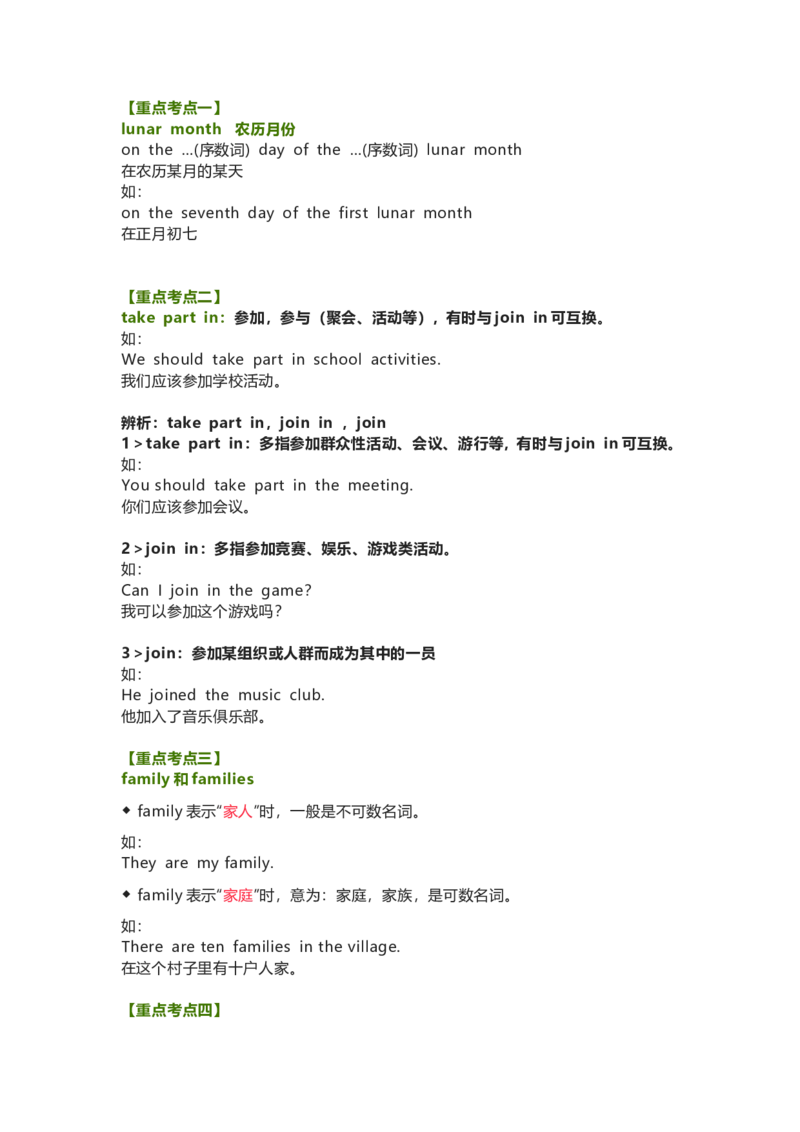
【重点考点一】
lunar month 农历月份
on the …(序数词) day of the …(序数词) lunar month
在农历某月的某天
如:
on the seventh day of the first lunar month
在正月初七
【重点考点二】
take part in:参加,参与(聚会、活动等), 有时与join in可互换。
如:
We should take part in school activities.
我们应该参加学校活动。
辨析:take part in,join in ,join
1>take part in:多指参加群众性活动、会议、游行等, 有时与join in可互换。
如:
You should take part in the meeting.
你们应该参加会议。
2>join in:多指参加竞赛、娱乐、游戏类活动。
如:
Can I join in the game?
我可以参加这个游戏吗?
3>join:参加某组织或人群而成为其中的一员
如:
He joined the music club.
他加入了音乐俱乐部。
【重点考点三】
family和families
◆ family表示“家人”时,一般是不可数名词。
如:
They are my family.
◆ family表示“家庭”时,意为:家庭,家族,是可数名词。
如:
There are ten families in the village.
在这个村子里有十户人家。
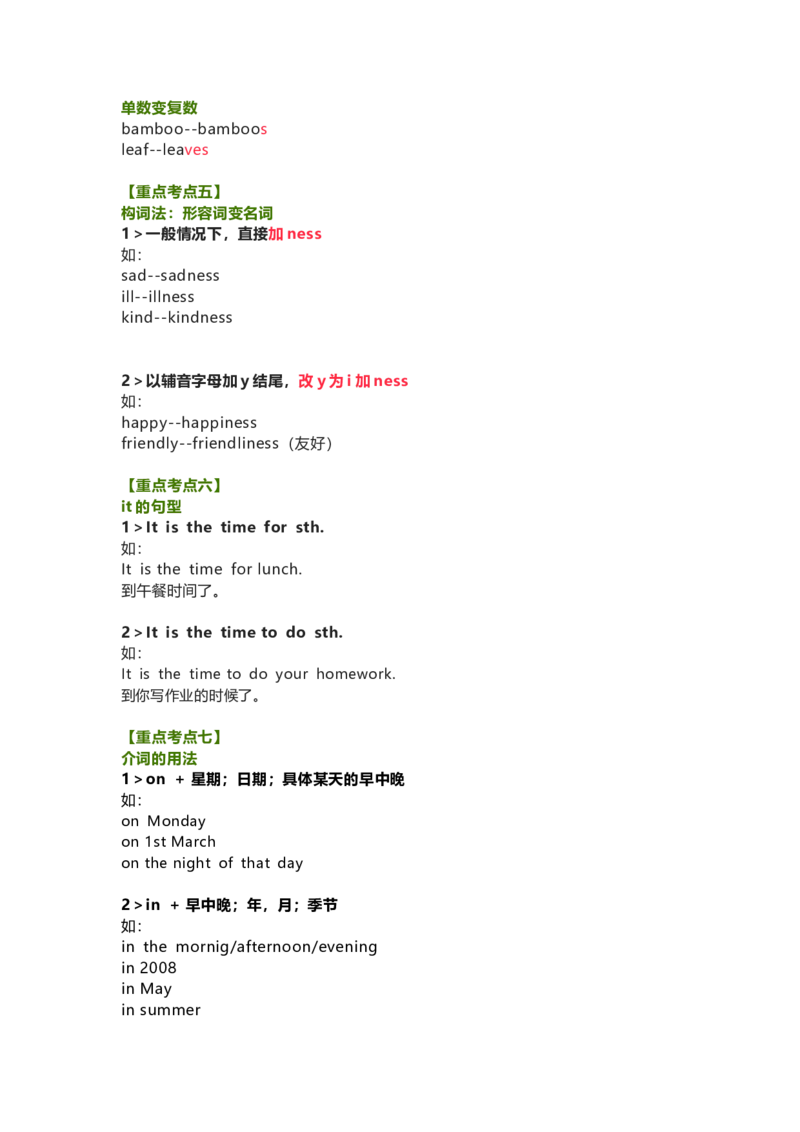
【重点考点四】单数变复数
bamboo--bamboos
leaf--leaves
【重点考点五】
构词法:形容词变名词
1>一般情况下,直接加ness
如:
sad--sadness
ill--illness
kind--kindness
2>以辅音字母加y结尾,改y为i加ness
如:
happy--happiness
friendly--friendliness(友好)
【重点考点六】
it的句型
1>It is the time for sth.
如:
It is the time for lunch.
到午餐时间了。
2>It is the time to do sth.
如:
It is the time to do your homework.
到你写作业的时候了。
【重点考点七】
介词的用法
1>on + 星期;日期;具体某天的早中晚
如:
on Monday
on 1st March
on the night of that day
2>in + 早中晚;年,月;季节
如:
in the mornig/afternoon/evening
in 2008
in May
in summer3>during + 名词,表示…期间
如:
during the holiday
【重点考点八】
kind of 表示“种类”
如:
a kind of 一种
different kinds of 不同种类的
all kinds of 各种各样的
【重点考点九】
special:形容词>特别的;特有的
如:
The cake is a special gift.
这个蛋糕是一个特别的礼物。
especially:副词>尤其;特别
如:
She loves all sports, especially swimming.
她喜爱各种运动,尤其是游泳。
I especially like sweet things.
我特别喜欢吃甜食。
【重点考点十】
put up:挂起,竖起
如:
put up red lanterns
挂红灯笼
put up the Christmas tree
竖起圣诞树
【重点考点十一】
not only…, but also…
不但…,而且…,表并列
1>并列主语
如:
Not only I but also my parents like watching TV.
2>并列谓语
如:
They can not only enjoy food but also play games.他们不仅可以享用美食而且可以玩游戏。
3>并列宾语
如:
He can speak not only Chinese but also English .
他会说汉语和英语。
【重点考点十二】
形容词最高级的用法
1>用法
用于三者或三者以上的人或事物的比较,表示“最……”,前面要加“the”
如:
He is the tallest boy in his class.
他是他班上最高的男生。
It is the fullest moom of the year.
这是一年之中最圆的月亮。
2>变化规则
◆ 一般情况下,在词尾加est
如:
small--smallest
short--shortest
She is the shortest student in her class.
她是她班上最矮的学生。
◆ 以不发音e结尾的单音节词,在词尾加st
如:
large--largest
nice--nicest
My brother is the nicest boy in the world.
我哥哥是世界上最好的男生。
◆ 在重读闭音节(即:辅音+元音+辅音)中,先双写末尾的辅音字母,再加est
如:
big--biggest
hot--hottest
fat--fattest
It is the hottest day in a year.这是一年中最热的一天。
◆ 以“辅音字母+y”结尾的双音节词, 改y为i,再加est;
如:
easy--easiest
busy--busiest
happy--happiest
My father is the busiest man in my family.
我爸爸是家里最忙的人。
◆ 其他双音节词和多音节词,在前面加most
如:
beautiful--most beautiful
different--most different
She is the most beautiful girl in my class.
她是我班里最漂亮的女生。
◆ 不规则变化
good--best
bad--worst
much--most
many--most
little--least