Unit 3 Could you please clean your room?
班级:________ 姓名:________ 得分:________
(测试时间:90分钟 总分:120分)
听力部分(共20分)
一、听句子或对话,根据所听内容选择最佳应答句。句子或对话念两遍。(共 5小题,每小题1分,
满分5分)
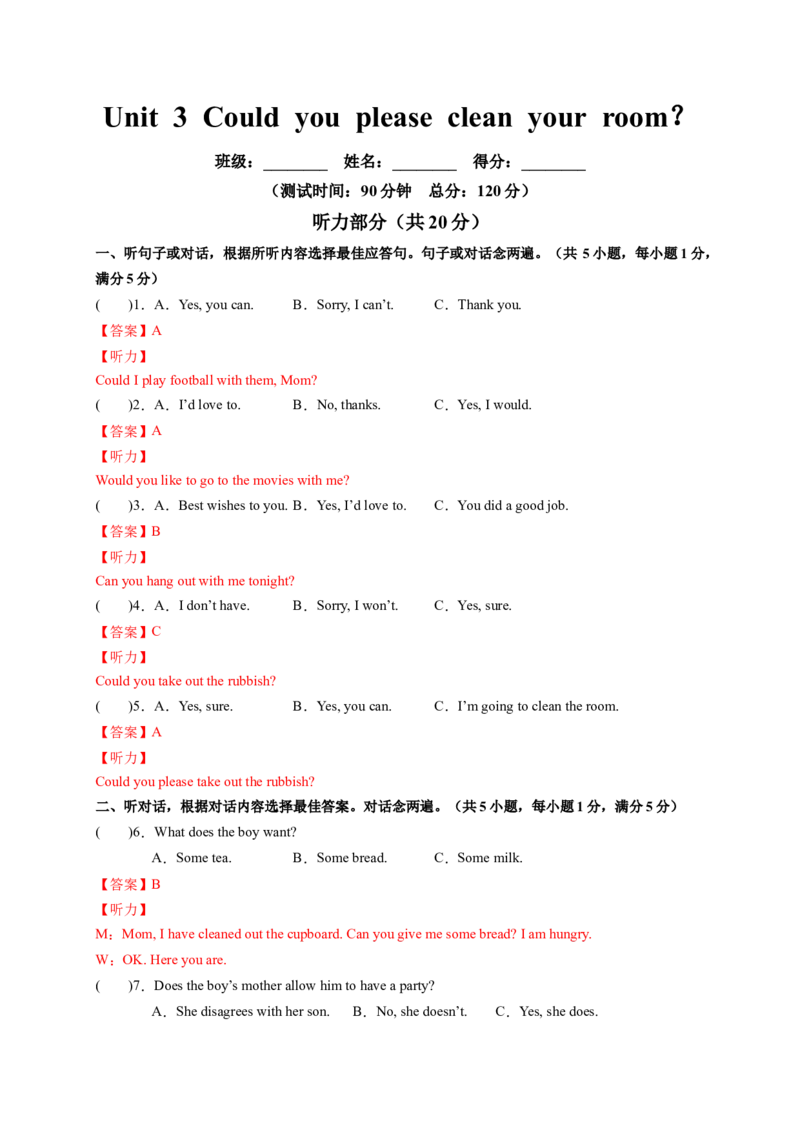
( )1.A.Yes, you can. B.Sorry, I can’t. C.Thank you.
【答案】A
【听力】
Could I play football with them, Mom?
( )2.A.I’d love to. B.No, thanks. C.Yes, I would.
【答案】A
【听力】
Would you like to go to the movies with me?
( )3.A.Best wishes to you. B.Yes, I’d love to. C.You did a good job.
【答案】B
【听力】
Can you hang out with me tonight?
( )4.A.I don’t have. B.Sorry, I won’t. C.Yes, sure.
【答案】C
【听力】
Could you take out the rubbish?
( )5.A.Yes, sure. B.Yes, you can. C.I’m going to clean the room.
【答案】A
【听力】
Could you please take out the rubbish?
二、听对话,根据对话内容选择最佳答案。对话念两遍。(共5小题,每小题1分,满分5分)
( )6.What does the boy want?
A.Some tea. B.Some bread. C.Some milk.
【答案】B
【听力】
M:Mom, I have cleaned out the cupboard. Can you give me some bread? I am hungry.
W:OK. Here you are.
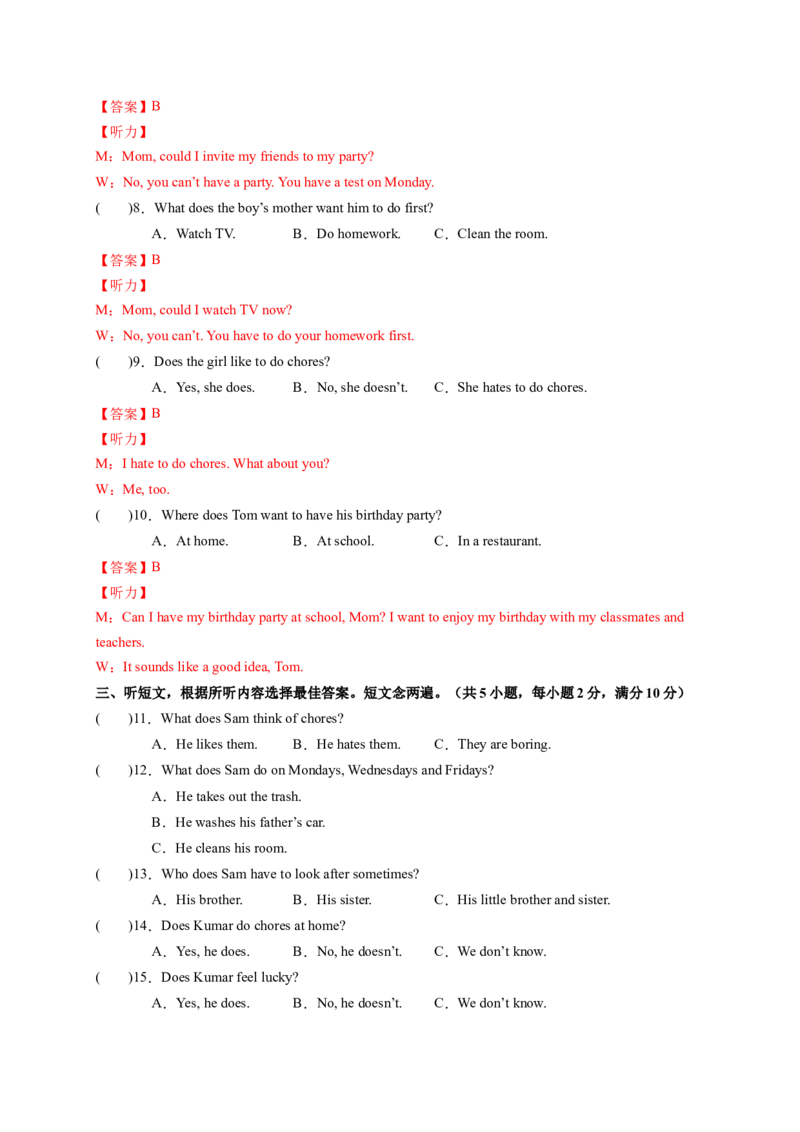
( )7.Does the boy’s mother allow him to have a party?
A.She disagrees with her son. B.No, she doesn’t. C.Yes, she does.【答案】B
【听力】
M:Mom, could I invite my friends to my party?
W:No, you can’t have a party. You have a test on Monday.
( )8.What does the boy’s mother want him to do first?
A.Watch TV. B.Do homework. C.Clean the room.
【答案】B
【听力】
M:Mom, could I watch TV now?
W:No, you can’t. You have to do your homework first.
( )9.Does the girl like to do chores?
A.Yes, she does. B.No, she doesn’t. C.She hates to do chores.
【答案】B
【听力】
M:I hate to do chores. What about you?
W:Me, too.
( )10.Where does Tom want to have his birthday party?
A.At home. B.At school. C.In a restaurant.
【答案】B
【听力】
M:Can I have my birthday party at school, Mom? I want to enjoy my birthday with my classmates and
teachers.
W:It sounds like a good idea, Tom.
三、听短文,根据所听内容选择最佳答案。短文念两遍。(共5小题,每小题2分,满分10分)
( )11.What does Sam think of chores?
A.He likes them. B.He hates them. C.They are boring.
( )12.What does Sam do on Mondays, Wednesdays and Fridays?
A.He takes out the trash.
B.He washes his father’s car.
C.He cleans his room.
( )13.Who does Sam have to look after sometimes?
A.His brother. B.His sister. C.His little brother and sister.
( )14.Does Kumar do chores at home?
A.Yes, he does. B.No, he doesn’t. C.We don’t know.
( )15.Does Kumar feel lucky?
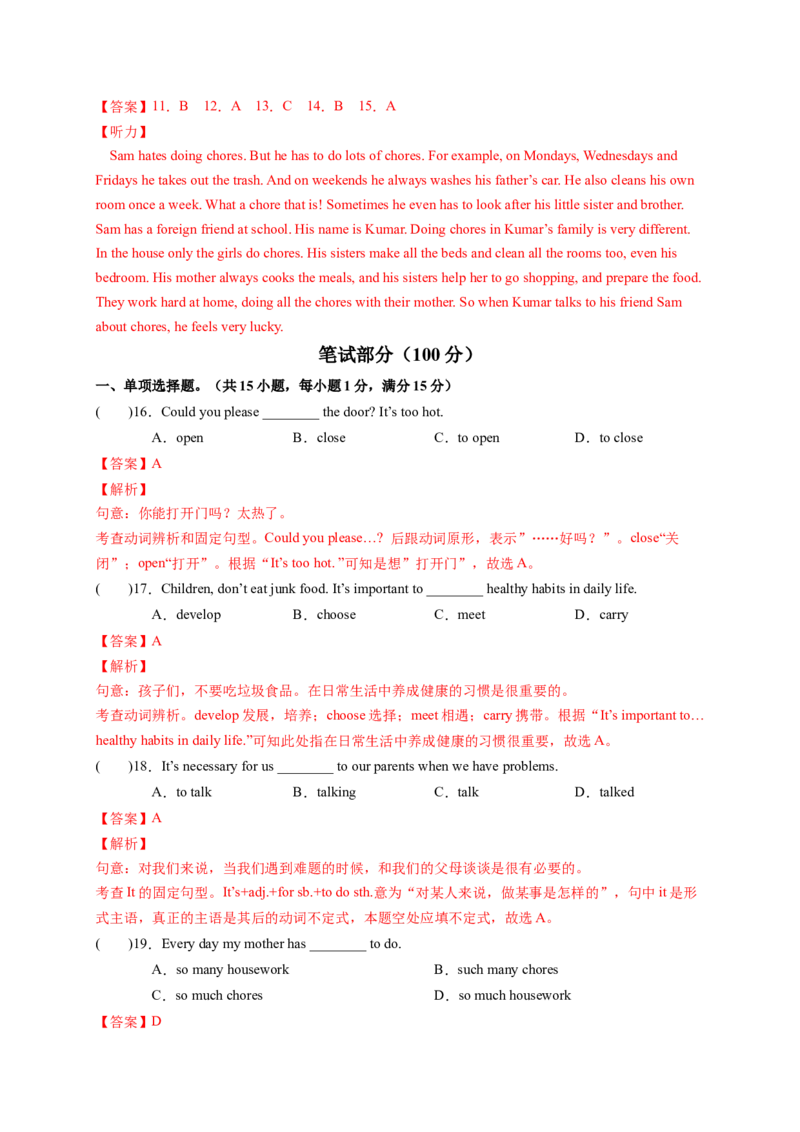
A.Yes, he does. B.No, he doesn’t. C.We don’t know.【答案】11.B 12.A 13.C 14.B 15.A
【听力】
Sam hates doing chores. But he has to do lots of chores. For example, on Mondays, Wednesdays and
Fridays he takes out the trash. And on weekends he always washes his father’s car. He also cleans his own
room once a week. What a chore that is! Sometimes he even has to look after his little sister and brother.
Sam has a foreign friend at school. His name is Kumar. Doing chores in Kumar’s family is very different.
In the house only the girls do chores. His sisters make all the beds and clean all the rooms too, even his
bedroom. His mother always cooks the meals, and his sisters help her to go shopping, and prepare the food.
They work hard at home, doing all the chores with their mother. So when Kumar talks to his friend Sam
about chores, he feels very lucky.
笔试部分(100分)
一、单项选择题。(共15小题,每小题1分,满分15分)
( )16.Could you please ________ the door? It’s too hot.
A.open B.close C.to open D.to close
【答案】A
【解析】
句意:你能打开门吗?太热了。
考查动词辨析和固定句型。Could you please…? 后跟动词原形,表示”……好吗?”。close“关
闭”;open“打开”。根据“It’s too hot. ”可知是想”打开门”,故选A。
( )17.Children, don’t eat junk food. It’s important to ________ healthy habits in daily life.
A.develop B.choose C.meet D.carry
【答案】A
【解析】
句意:孩子们,不要吃垃圾食品。在日常生活中养成健康的习惯是很重要的。
考查动词辨析。develop发展,培养;choose选择;meet相遇;carry携带。根据“It’s important to…
healthy habits in daily life.”可知此处指在日常生活中养成健康的习惯很重要,故选A。
( )18.It’s necessary for us ________ to our parents when we have problems.
A.to talk B.talking C.talk D.talked
【答案】A
【解析】
句意:对我们来说,当我们遇到难题的时候,和我们的父母谈谈是很有必要的。
考查It的固定句型。It’s+adj.+for sb.+to do sth.意为“对某人来说,做某事是怎样的”,句中it是形
式主语,真正的主语是其后的动词不定式,本题空处应填不定式,故选A。
( )19.Every day my mother has ________ to do.
A.so many housework B.such many chores
C.so much chores D.so much housework
【答案】D【解析】
句意:每天我的妈妈有如此多的家务活要做。
考查形容词和名词辨析。many,修饰可数名词;much,修饰不可数名词;housework,不可数名词;
chore,可数名词。应用much修饰不可数名词housework“家务活”,当名词前面有many/much/few/
little修饰时,用so而不用such,排除选项A;chores是复数名词,前面应该用so many修饰,排除
选项B和C。故选D。
( )20.Helen, the more careful you are during the exam, ________ mistakes you’ll make.
A.the more B.the fewer C.fewer D.more
【答案】B
【解析】
句意:Helen,你在考试中越细心,犯的错误就会越少。
考查比较级的用法。fewer较少的;more更多的。“the+比较级,the+比较级”表示”越……就
越……”,排除选项C和D;根据“the more careful…mistakes you’ll make”可知指的是越细心,犯
的错误就会越少,故选B。
( )21.Could I ________ your bike? Mine is broken.
A.borrow B.lend C.bring D.take
【答案】A
【解析】
句意:我可以借用你的自行车吗?我的(自行车)坏了。
考查动词辨析。borrow借入;lend借出;bring带来;take拿。根据“Could I…your bike?”可知是想
要”借入”,故用borrow。故选A。
( )22.Can you ________ me your eraser, please?
A.keep B.lend C.borrow D.take
【答案】B
【解析】
句意:你可以借给我你的橡皮吗?
考查动词辨析。keep保持;lend借出;borrow借入;take拿走。根据语境“Can you...me your
eraser, please?”可知,你能把你的橡皮借给我吗?相对主语“you”,是借出给我橡皮,故选B。
( )23.Linda, you can have the book now. I’ve just finished ________ it.
A.read B.reads C.reading D.to read
【答案】C
【解析】
句意:Linda,你现在可以拥有这本书。我刚刚读完了。
考查非谓语。finish doing sth.“完成做某事”。故选C。
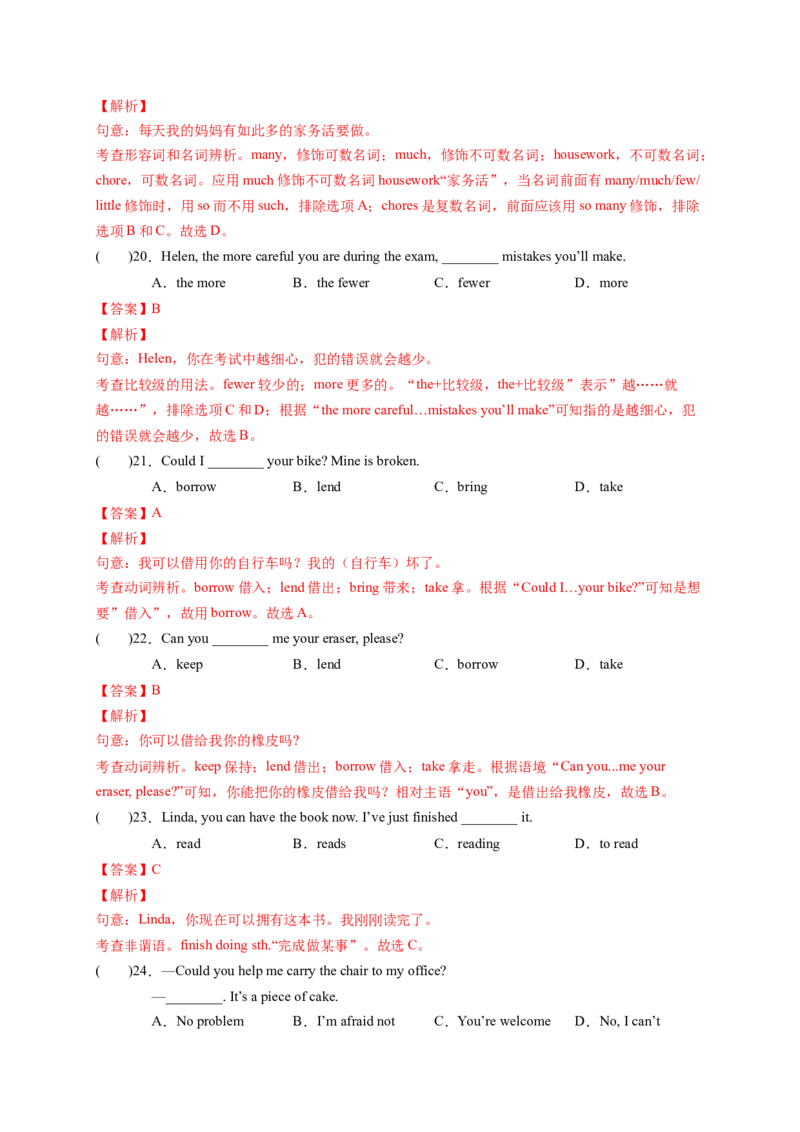
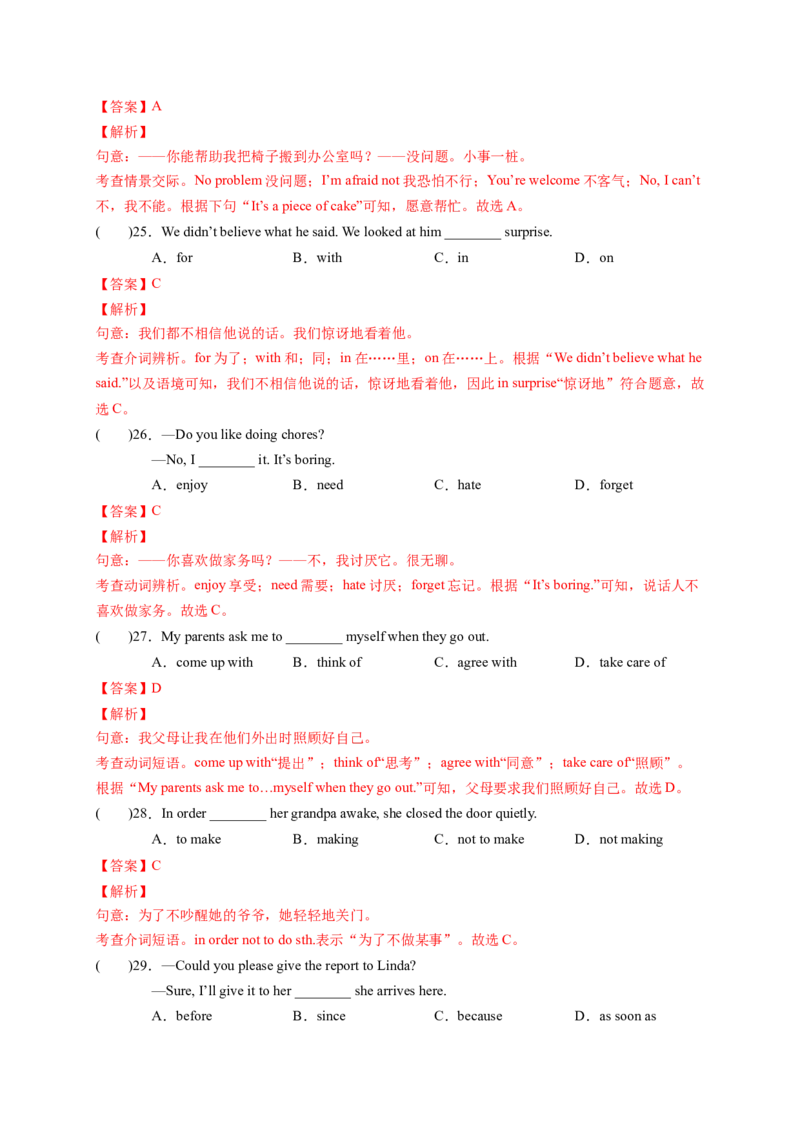
( )24.—Could you help me carry the chair to my office?
—________. It’s a piece of cake.
A.No problem B.I’m afraid not C.You’re welcome D.No, I can’t【答案】A
【解析】
句意:——你能帮助我把椅子搬到办公室吗?——没问题。小事一桩。
考查情景交际。No problem没问题;I’m afraid not我恐怕不行;You’re welcome不客气;No, I can’t
不,我不能。根据下句“It’s a piece of cake”可知,愿意帮忙。故选A。
( )25.We didn’t believe what he said. We looked at him ________ surprise.
A.for B.with C.in D.on
【答案】C
【解析】
句意:我们都不相信他说的话。我们惊讶地看着他。
考查介词辨析。for为了;with和;同;in在……里;on在……上。根据“We didn’t believe what he
said.”以及语境可知,我们不相信他说的话,惊讶地看着他,因此in surprise“惊讶地”符合题意,故
选C。
( )26.—Do you like doing chores?
—No, I ________ it. It’s boring.
A.enjoy B.need C.hate D.forget
【答案】C
【解析】
句意:——你喜欢做家务吗?——不,我讨厌它。很无聊。
考查动词辨析。enjoy享受;need需要;hate讨厌;forget忘记。根据“It’s boring.”可知,说话人不
喜欢做家务。故选C。
( )27.My parents ask me to ________ myself when they go out.
A.come up with B.think of C.agree with D.take care of
【答案】D
【解析】
句意:我父母让我在他们外出时照顾好自己。
考查动词短语。come up with“提出”;think of“思考”;agree with“同意”;take care of“照顾”。
根据“My parents ask me to…myself when they go out.”可知,父母要求我们照顾好自己。故选D。
( )28.In order ________ her grandpa awake, she closed the door quietly.
A.to make B.making C.not to make D.not making
【答案】C
【解析】
句意:为了不吵醒她的爷爷,她轻轻地关门。
考查介词短语。in order not to do sth.表示“为了不做某事”。故选C。
( )29.—Could you please give the report to Linda?
—Sure, I’ll give it to her ________ she arrives here.
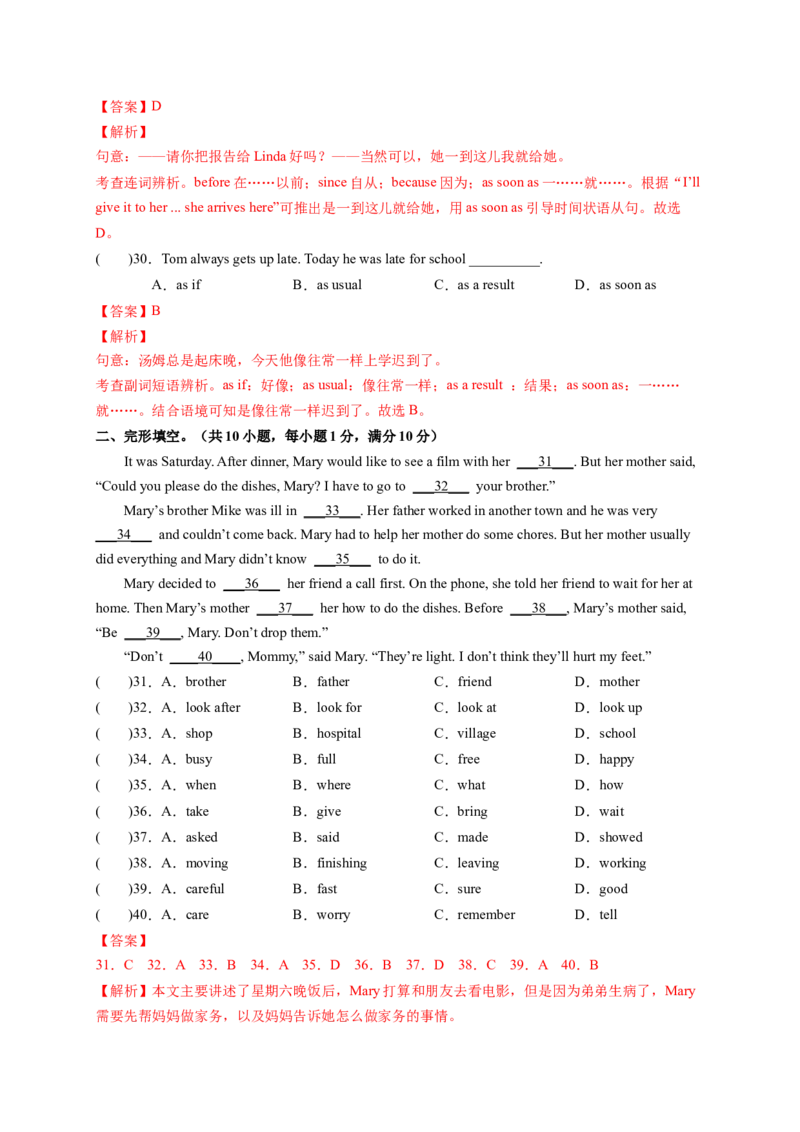
A.before B.since C.because D.as soon as【答案】D
【解析】
句意:——请你把报告给Linda好吗?——当然可以,她一到这儿我就给她。
考查连词辨析。before在……以前;since自从;because因为;as soon as一……就……。根据“I’ll
give it to her ... she arrives here”可推出是一到这儿就给她,用as soon as引导时间状语从句。故选
D。
( )30.Tom always gets up late. Today he was late for school __________.
A.as if B.as usual C.as a result D.as soon as
【答案】B
【解析】
句意:汤姆总是起床晚,今天他像往常一样上学迟到了。
考查副词短语辨析。as if:好像;as usual:像往常一样;as a result :结果;as soon as:一……
就……。结合语境可知是像往常一样迟到了。故选B。
二、完形填空。(共10小题,每小题1分,满分10分)
It was Saturday. After dinner, Mary would like to see a film with her ___31___. But her mother said,
“Could you please do the dishes, Mary? I have to go to ___32___ your brother.”
Mary’s brother Mike was ill in ___33___. Her father worked in another town and he was very
___34___ and couldn’t come back. Mary had to help her mother do some chores. But her mother usually
did everything and Mary didn’t know ___35___ to do it.
Mary decided to ___36___ her friend a call first. On the phone, she told her friend to wait for her at
home. Then Mary’s mother ___37___ her how to do the dishes. Before ___38___, Mary’s mother said,
“Be ___39___, Mary. Don’t drop them.”
“Don’t ____40____, Mommy,” said Mary. “They’re light. I don’t think they’ll hurt my feet.”
( )31.A.brother B.father C.friend D.mother
( )32.A.look after B.look for C.look at D.look up
( )33.A.shop B.hospital C.village D.school
( )34.A.busy B.full C.free D.happy
( )35.A.when B.where C.what D.how
( )36.A.take B.give C.bring D.wait
( )37.A.asked B.said C.made D.showed
( )38.A.moving B.finishing C.leaving D.working
( )39.A.careful B.fast C.sure D.good
( )40.A.care B.worry C.remember D.tell
【答案】
31.C 32.A 33.B 34.A 35.D 36.B 37.D 38.C 39.A 40.B
【解析】本文主要讲述了星期六晚饭后,Mary打算和朋友去看电影,但是因为弟弟生病了,Mary
需要先帮妈妈做家务,以及妈妈告诉她怎么做家务的事情。31.句意:晚饭后,Mary想和她的朋友去看电影。
brother兄弟;father父亲;friend朋友;mother母亲。根据后文“Mary decided to ... her friend a call
first.”可知,此处是指和她的朋友去看电影。故选C。
32.句意:我不得不照顾你的弟弟。
look after照顾;look for寻找;look at看;look up查阅。根据“Mary’s brother Mike was ill in...”可知,
弟弟生病了需要照顾。故选A。
33.句意:Mary的弟弟Mike生病住院了。
shop商店;hospital医院;village村庄;school学校。根据“Mary’s brother Mike was ill”可知,弟弟
生病住院了,in hospital“住院”。故选B。
34.句意:她的父亲在另一个镇上工作,他非常忙不能够回来。
busy忙碌的;full满的;free自由的,空闲的;happy高兴的。根据“Her father worked in another
town and he was very ... and couldn’t come back.”可知,父亲工作很忙不能回来。故选A。
35.句意:但是她的妈妈通常什么都做,Mary不知道怎么做。
when什么时候;where哪里;what什么;how怎么,如何。根据“her mother usually did everything”
可知,妈妈什么都做,因此Mary不知道怎么做家务。故选D。
36.句意:Mary决定首先给她的朋友打电话。
take带走;give给;bring带来;wait等。根据“On the phone”可知,此处是指打电话,give sb a
call“给某人打电话”。故选B。
37.句意:然后,Mary的母亲给她演示如何做家务。
asked问;said说;made制作;showed展示,演示。根据前文“Mary didn’t know... to do it.”可知,
此处是妈妈给她演示做家务。故选D。
38.句意:在离开之前,Mary的妈妈说,“小心一点,Mary。”
moving移动;finishing完成;leaving离开;working工作。根据前文Mary的弟弟生病住院需要妈
妈照顾,因此此处指妈妈离开之前。故选C。
39.句意:小心一点,Mary。
careful小心的;fast快的;sure确信的;good好的。根据“Don’t drop them.”可知,此处是指小心一
点,be careful“小心”。故选A。
40.句意:不要担心,妈妈。
care在乎;worry担心;remember记住;tell告诉。根据“They’re light. I don’t think they’ll hurt my
feet.”可知,此处是让妈妈不要担心,don’t worry“不要担心”。故选B。
三、阅读理解。(共15小题,每小题2分,满分30分)
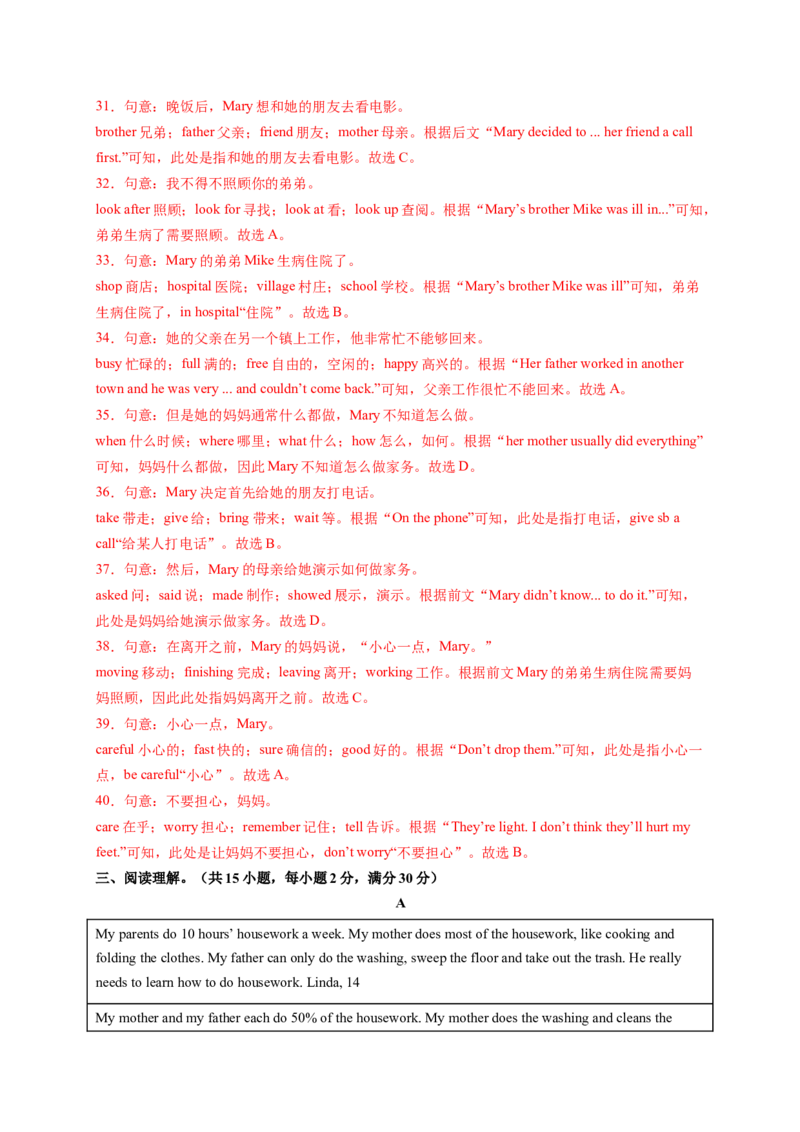
A
My parents do 10 hours’ housework a week. My mother does most of the housework, like cooking and
folding the clothes. My father can only do the washing, sweep the floor and take out the trash. He really
needs to learn how to do housework. Linda, 14
My mother and my father each do 50% of the housework. My mother does the washing and cleans theliving room. My father makes the bed and drives me to school. Celina, 13
My father doesn’t do a lot but he tries to help. He hangs up the clothes after my mother does the washing
and my mother is happy that he always gives her a hand. Paul, 16
My mother is a doctor. She is busy with her work every day, so she has little time to do housework. In fact
she isn’t good at doing housework. So my father has to do most of it. Sometimes my grandmother comes to
help. Bill, 15
( )41.Linda’s father doesn’t ________ at home.
A.do the washing B.take out the trash C.sweep the floor D.fold the clothes
( )42.How does Celina go to school?
A.By bike. B.By bus. C.By car. D.By subway.
( )43.The underlined phrase “hangs up” means ________ in Chinese.
A.闲逛 B.晾晒 C.熨烫 D.清洗
( )44.Whose father does most of the housework?
A.Linda’s. B.Celina’s. C.Paul’s. D.Bill’s.
( )45.Which of the following is TRUE according to the passage?
A.Linda is one year older than Celina but one year younger than Bill.
B.Celina’s father needs to learn how to do housework.
C.Paul’s mother is angry with his father because he never helps her with housework.
D.Bill’s grandmother helps Bill with his schoolwork.
【答案】41.D 42.C 43.B 44.D 45.A
【解析】本文主要讲了几个孩子谈论爸爸妈妈做家务的事情。
41.细节理解题。根据Linda的介绍中“My father can only do the washing, sweep the floor and take
out the trash.”可知,没有提到她的父亲叠衣服。故选D。
42.细节理解题。根据Celina的介绍中“My father makes the bed and drives me to school.”可知,
Celina乘坐父亲的车去上学。故选C。
43.词义猜测题。分析画线短语所在句的语境及“…after my mother does the washing”可知,当Paul
的母亲洗完衣服后,他的父亲总是晾衣服,hangs up意为“晾晒”。故选B。
44.细节理解题。根据Bill的介绍中“So my father has to do most of it.”可知,他的父亲做大部分家
务。故选D。
45.推理判断题。根据表格内容可知,Linda是14岁,而Celina是13岁,Bill是15岁,因此Linda
比Celina大一岁而比Bill小一岁,A选项表述正确。故选A。
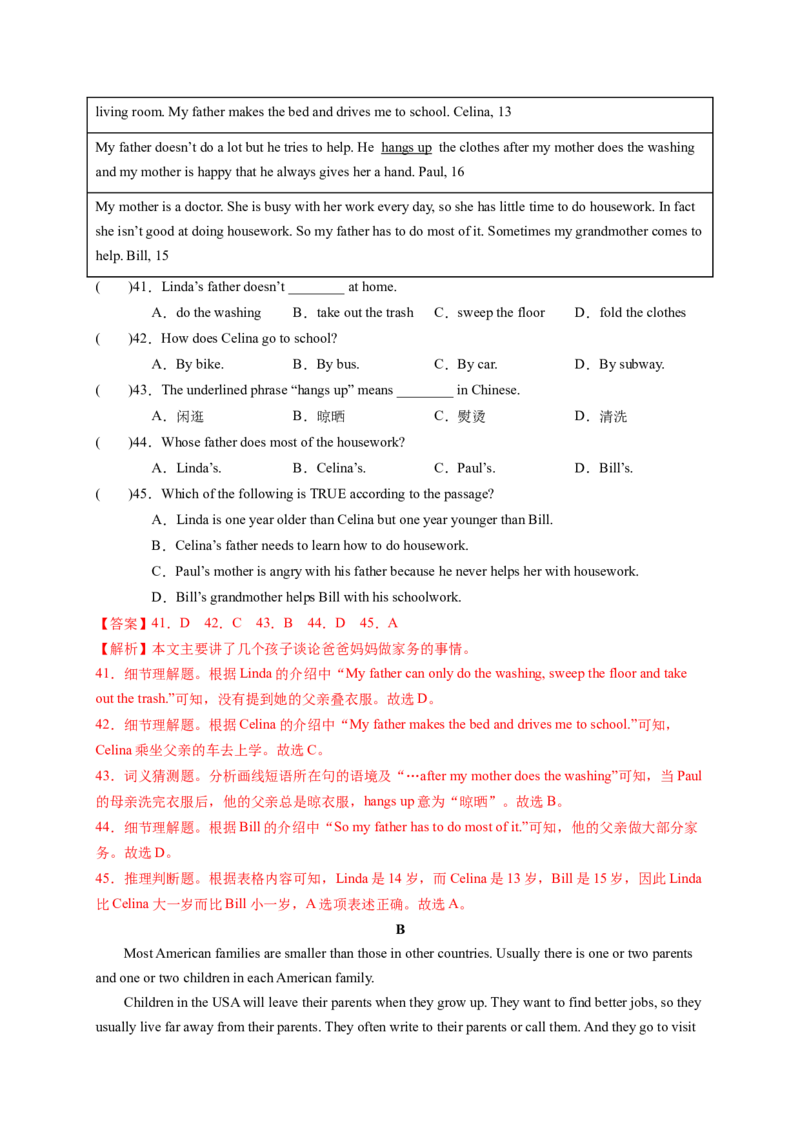
B
Most American families are smaller than those in other countries. Usually there is one or two parents
and one or two children in each American family.
Children in the USA will leave their parents when they grow up. They want to find better jobs, so they
usually live far away from their parents. They often write to their parents or call them. And they go to visittheir parents during their holidays.
Parents will ask their children to do some work around their house. In many families children will get
money for doing some housework so that they can learn to make money for their own. Parents usually let
their children choose their own jobs. Americans think that for young people it is important to decide on
their lives by themselves.
( )46.In most families in the USA there are usually ________.
A.no parents B.no children C.over 5 people D.less than 5 people
( )47.When they are old enough, American children will ________.
A.go to other countries B.decide on their lives by themselves
C.find jobs for their parents D.do better jobs around their house
( )48.Why do most American children live far away from their parents?
A.They are old enough to live all by themselves.
B.The parents are too busy to look after their children.
C.They want to have more chances to look for better jobs.
D.They can keep in touch (联系) with their parents by telephoning.
( )49.Parents will give their children some money if the children do some housework. What do the
American parents think of it?
A.Useful. B.Strange. C.Dangerous. D.Funny.
( )50.From the passage we can know that children in America ________.
A.leave their parents when they grow up B.often spend holidays at their parents’ house
C.sometimes look for jobs for their own parentsD.often call or write to their parents for
money
【答案】46.D 47.B 48.C 49.A 50.A
【解析】本文主要讲述了美国的家庭情况。
46.推理判断题。根据“Usually there is one or two parents and one or two children in each American
family.”可知,美国家庭通常有一个或两个父母,以及一个或两个孩子,由此可推,美国家庭通常
少于5人。故选D。
47.细节理解题。根据“Parents usually let their children choose their own jobs. Americans think that for
young people it is important to decide on their lives by themselves.”可知,美国父母通常会让孩子们选
择自己的职业,他们觉得对于年轻人来说,由年轻人自己来决定自己的生活是很重要的一件事,所
以美国孩子长大后,会由他们自己来决定他们的生活。故选B。
48.细节理解题。根据“They want to find better jobs, so they usually live far away from their parents.”
可知,美国孩子们住得离父母较远是为了能找到更好的工作。故选C。
49.推理判断题。根据“In many families children will get money for doing some housework so that
they can learn to make money for their own.”可知,在很多的美国家庭里,孩子们通过做家务是可以获
得钱的,这样孩子们就能学会自己赚钱,由此可推,美国父母们是觉得让孩子们通过做家务赚钱是
有用的一种举措。故选A。50.细节理解题。根据“Children in the USA will leave their parents when they grow up.”可知,美国
的孩子在长大后会离开父母。故选A。
C
In some Western countries, many children do chores to get pocket money. They usually start to do this
when they are ten years old.
School students have to do homework and study for tests. They don’t have much free time on
weekdays. They often do chores on weekends.
Young kids only do easy chores. So they don’t get much money. But that’s enough. Many of them only
want to buy candy. And candy is cheap! They often help do the dishes, sweep the floor, or feed the pet cat
or dog.
When they get older, they want to buy more and more things. They want things that are more
expensive than candy. So they have to work harder! They often help their parents wash the family car, cut
the grass, or cook meals.
Some jobs are a good way for kids to learn new things. For example, they can learn how to use a lawn
mower or how to cook. Of course, their parents help them at first.
( )51.How do many children get pocket money in some Western countries?
A.They study hard. B.They do chores.
C.They do part-time jobs. D.They go to school.
( )52.When do many children usually begin to do chores in some Western countries?
A.At the age of 10. B.At the age of 13. C.At the age of 15. D.At the age of 9.
( )53.Eric wants to get more pocket money to buy something expensive. He may ________.
A.do the dishes B.feed the pet cat C.cook meals D.sweep the floor
( )54.Which of the following is NOT true?
A.Young kids do easy chores because they can get much money from their parents.
B.School students often do chores on Saturdays and Sundays.
C.If kids get older and want something more expensive, they have to work harder.
D.Some jobs are a good way for kids to learn new things.
( )55.The passage mainly tells us how children in some Western countries ________.
A.find jobs B.get pocket money C.study at school D.do chores
【答案】51.B 52.A 53.C 54.A 55.B
【解析】本文主要讲述了在一些西方国家,许多的孩子通过做家务来赚取零花钱。
51.细节理解题。根据第一段“In some Western countries, many children do chores to get pocket
money.”可知,一些西方国家的孩子通过做家务得到零花钱。故选B。
52.细节理解题。根据第一段“They usually start to do this when they are ten years old.”可知,他们通
常在10岁开始做家务。故选A。
53.细节理解题。根据倒数第二段“They want things that are more expensive than ...They often help
their parents wash the family car, cut the grass, or cook meals.”可知,他可以做饭来得到更多的零花钱。故选C。
54.细节理解题。根据第三段“Young kids only do easy chores. So they don’t get much money.”可知,
年轻的孩子只能做简单的家务,因此不能够得到太多的零花钱,选项A说法错误。故选A。
55.主旨大意题。通读全文可知,本文主要讲述了一些西方国家的孩子通过做家务来得到零花钱。
故选B。
四、用所给单词的正确形式填空。(共5小题,每小题1分,满分5分)
56.Could you please do the ________ (dish) after dinner, Jenny?
【答案】dishes
【解析】
句意:珍妮,晚饭后你能洗碗吗?dish“碗”,do the dishes“洗碗”,故填dishes。
57.— Can you finish ________ (read) these books before 10 o’clock?
— Yes, I can.
【答案】reading
【解析】
句意:——你能在十点钟之前读完这些书吗?——是的,我可以。finish doing sth“完成做某事”,
是固定短语。故填reading。
58.He will leave for Shanghai as soon as he ________ (finish) his work.
【答案】finishes
【解析】
句意:他一完成工作就动身去上海。as soon as引导的时间状语从句遵循“主将从现”原则,主句
为一般将来时,从句要用一般现在时;从句主语是he,动词应用第三人称单数形式。故填
finishes。
59.Would you mind ________ (hang) out with me?
【答案】hanging
【解析】
句意:你介意和我一起出去玩吗?mind doing sth.“介意做某事”,此空应填动名词hanging作宾语。
故填hanging。
60.The kids saw the robot throw the ball into the box in ________ (surprised).
【答案】surprise
【解析】
句意:孩子们很惊奇地看着机器人把球投进盒子里。根据“The kids saw the robot throw the ball into
the box in...(surprised).”可知,此处表示孩子们惊奇地看着机器人把球投进盒子里,可用in
surprise“惊奇地”,所以此空应是填入名词surprise。故填surprise。
五、根据首字母、句意或中文提示填空。(共5小题,每小题1分,满分5分)
61.It’s boring to doing the same c________ for a long time.
【答案】(c)hores
【解析】句意:长时间做同样的家务很无聊。根据“It’s boring to doing the same…”及首字母提示,可知填
chore“家务”作宾语,此处表泛指,用其复数形式chores。故填(c)hores。
62.—Wow, the classroom is so clean.
—We s________ the floor just half an hour ago.
【答案】(s)wept
【解析】
句意:——哇,教室真干净。——我们半小时前刚扫过地。根据“the classroom is so clean”和“the
floor ”及首字母可知,应是扫过地,sweep“打扫”,由“just half an hour ago”可知,时态是一般过
去时,空处用动词的过去式,故填(s)wept。
63.The boy h________ eating rice day after day. He wants to eat something else.
【答案】(h)ates
【解析】
句意:那个男孩讨厌日复一日地吃米饭。他想要吃些别的东西。根据“ He wants to eat something
else.”和首字母可知,那个男孩想要吃点别的东西,所以此处“The boy h... eating rice day after day.”
应是在表示他讨厌日复一日地吃米饭,而该句的时态是一般现在时,主语为The boy,所以此空应
是动词三单形式hates“讨厌”,符合题意。故填(h)ates。
64.The r__________ goes bad. You should take it out.
【答案】(r)ubbish
【解析】
句意:垃圾变坏了。你应该把它拿出去。“垃圾”可用rubbish表示,不可数名词,在句中作主语。
故填(r)ubbish。
65.What a m________! You made your room so dirty. Please clean it up.
【答案】(m)ess
【解析】
句意:真是一团糟!你把房间弄得这么脏。请把它清理干净。不定冠词a后接单数名词。根据
“You made your room so dirty. Please clean it up.”可知房间很脏,要清理干净,因此此处应是感叹房
间一团糟,首字母为m,可用名词mess表示“脏乱”。故填(m)ess。
六、句型转换。(共5小题,每小题2分,满分10分)
66.Would you like to answer the question?(改为同义句)
________ ________ ________ answer the question?
【答案】Would you please
【解析】
句意:你想回答这个问题吗?本题要求改为同义句,原句的“Would like to do sth”意为“想要做某
事、愿意做某事”;“Would you please+动词原形”意为“你愿意做某事吗”,与“Would like to
do sth”同义,would是情态动词,后接动词原形,首字母大写。故填Would;you;please。
67.Could you please do the laundry(洗衣服)? (改为同义句)
Could you please ________ ________ ________ ?【答案】wash the clothes
【解析】
句意:你可以洗衣服吗?改为同义句,“do the laundry”可以用“wash the clothes”来替换。故填
wash;the; clothes。
68.You really have to take care of the pet when we are away. (同义句转换)
You really have to ________ ________ the pet when we are away.
【答案】look after
【解析】
句意:当我们离开时,你真的必须照顾好宠物。take care of=look after“照顾”,为固定短语。故填
look;after。
69.Could you please sweep the floor? (改为否定句)
________ you ________ ________ ________ the floor?
【答案】Could please not sweep
【解析】
句意:请你扫地好吗?could是情态动词,其否定形式在后面加not即可,后跟动词原形,也就是在
sweep前加not,其余不变,故填Could;please;not;sweep。
70.—Could you please clean your room? (作肯定回答)
—________, ________.
【答案】Yes sure
【解析】
句意:你可以打扫一下你的房间吗?答题空为2个,可以回答Yes, sure。故填Yes;sure。
七、情境交际。(共5小题,每小题2分,满分10分)
A.I cleaned it yesterday.
B.That sounds fun.
C.But I need to do my homework first.
D.Because I need to buy some snacks.
E.Could I borrow some money from you, Mom?
A:Could I invite my friends to my birthday party on Saturday, Mom?
B:Of course, dear. ___71___
A:___72___
B:Why do you need money?
A:___73___
B:Well, I'll go shopping tomorrow. I can buy them for you.
A:That's great. Thank you, Mom.
B:Could you please clean the living room?
A:___74___B:You need to clean it again for your party.
A:OK. ___75___
B:That's right. After you finish your homework, let's clean the room.
【答案】71.B 72.E 73.D 74.A 75.C
【解析】本文是一则妈妈和孩子的对话,围绕周六生日聚会展开。
71.由上句“Could I invite my friends to my birthday party onSaturday, Mom?”知,此句是要对孩子的
请求作出回应,B项“那听起来很有趣”符合语境,故选B。
72.由下句“Why do you need money”知,此句是说孩子向妈妈借钱了,E项“妈妈,我能向你借
点钱吗”符合语境,故选E。
73.由答语“I can buy them for you”知,此句是说孩子借钱是要买东西,D项“因为我需要买一些
零食”符合语境,故选D。
74.由下句“You need to clean it again for your party.”知,此句是说房子打扫过了,A项“我昨天打
扫过了”符合语境,故选A。
75.由答语“After you finish your homework, let's clean the room”知,此句是说先要完成作业,C项
“但我得先做作业”符合语境,故选C。
八、书面表达。(10分)
76.假如某报社正在以“We Should Do Chores at Home”为题进行征文比赛活动,请你根据表格中的
提示内容用英语写一篇短文参加比赛。
现存现象 你常做的家务 你的体会和看法
●整理床铺
许多学生不愿做家务,原因如下: ●浇花
1. 认为做家务是父母的工作; ●打扫房间 ……
2. 做家务占用学习的时间。 ●倒垃圾
……
要求:
(1)表达准确,语句通顺;
(2)短文须包括所有提示内容,可适当发挥;
(3)词数80左右。
We Should Do Chores at Home
______________________________________________________________________________________
______________________________________________________________________________________
______________________________________________________________________________________
____________________________________________________________________________________________________________________________________________________________________________
______________________________________________________________________________________
【答案】
We Should Do Chores at Home
Now many students don’t like doing chores at home. There are mainly two reasons. One is that they think
it’s their parents’ job to do chores at home. The other is that they think doing chores takes up their time for
study. But I think we should help to do chores at home because our parents are busy with their work and are
often tired after work. I often do chores at home, like making the bed, watering the flowers, cleaning the
rooms, taking out the rubbish and doing the dishes. I think doing chores makes us relaxing. I also feel great
to help my parents.