►专题 14 阅读理解微技能之事实细节题
讲
考点精
【思维导图】
【事实细节题微技能】
1.直接信息题——题干定位法
解答细节理解的直接信息题时,由于题目普遍较容易,不必通篇细读全文,一般是先通过题干信息来选择定位
关键词。关键词主要是题干中的名词、动词和数词,即问题的核心信息,再进行信息定位,运用略读及寻读的
技巧快速在文章中寻找与题干有关的关键词,找出相关的句子,得出正确答案。
题干定位法
【典例剖析】
Summer Employment Opportunities (机会)
Through the Summer Employment Opportunities program,students are hired each year in a variety of summer
positions across the Provincial Public Service, its related agencies and community groups.
Who is eligible:Students aged 15 or older.Some positions require students to be 15 to 24 or up to 29 for persons
with a disability.
23.Which program favors the disabled?
A.Jobs for Youth.
B.Summer Company.
C.Stewardship Youth Ranger Program.D.Summer Employment Opportunities.
2.间接信息题——断章取义法
考查间接信息题时,正确选项一般都会在原文基础上进行改造。常用方式是同义词替换或释义,即把文中语言
(词汇和结构)改头换面,来表达相同的意思。因此在做细节理解题时,要根据所找信息,分析选项,对比其中
所用词汇,避免误选答案。命题人主要从以下两个角度命制正确选项。
(1)同义替换
同义替换是指命题人利用同义词或近义词对原文的关键信息进行解释。解题时,同学们应该根据题意,快
速跳读全文,找到关键信息,然后在选项中寻找与原文信息最接近的同义词或近义词,这样就可确定正确答案。
(2)归纳信息
归纳信息是指命题人用精炼的语言来概括原文中比较分散或复杂的信息,这是命题人设计细节理解题时经
常使用的手段之一。同学们首先应抓住该题所涉及的重要信息去理解、提炼其中的关键信息,可尝试用自己的
语言去归纳文中的信息或事实,然后再看选项,挑选出和自己所归纳的信息最接近的选项作为正确答案。
断章取义法
【典例剖析】
Of the common berries,strawberries are highest in vitamin C,although,because of their seeds,raspberries
contain a little more protein (蛋白质),iron and zinc (not that fruits have much protein).Blueberries are particularly
high in antioxidants (抗氧化物质).The yellow and orange stone fruits such as peaches are high in the carotenoids we
turn into vitamin A and which are antioxidants.As for cherries (樱桃),they are so delicious who cares? However,
they are rich in vitamin C.
24.What does the author seem to like about cherries?
A.They contain protein.
B.They are high in vitamin A.
C.They have a pleasant taste.
D.They are rich in antioxidants.
3.排序题——首尾排除法
这种试题要求考生根据事情发生的先后顺序和句子之间的逻辑关系,找出事件的正确顺序。做此类试题时可采
用“首尾排除法”,即先找出第一件事情和最后一件事情,使用排除法迅速缩小范围,从而快速选出正确选项;
也可使用“代入淘汰法”按顺序逐一排除,得出正确选项。【典例剖析】
A schoolgirl saved her father’s life by kicking him in the chest after he suffered a serious allergic(过敏的) reaction
which stopped his heart.
Izzy,nine,restarted her father Colm’s heart by stamping(踩) on his chest after he fell down at home and stopped
breathing.
Izzy’s mother,Debbie,immediately called 999 but Izzy knew doctors would never arrive in time to save her
father,so decided to use CPR.
However,she quickly discovered her arms weren’t strong enough,so she stamped on her father’s chest instead.
Debbie then took over with some more conventional chest compressions(按压) until the ambulance arrived.
Izzy,who has been given a bravery award by her school,said:“I just kicked him really hard.My mum taught
me CPR but I knew I wasn’t strong enough to use hands.I was quite scared.The doctor said I might as well be a doctor
or a nurse.My mum said that Dad was going to hospital with a big footprint on his chest.”
40.What’s the right order of the events?
①Izzy kicked Colm.
②Debbie called 999.
③Izzy learned CPR.
④Colm’s heart stopped.
A.③①②④ B.④②③①
C.③④②① D.④③①②
4.数字计算题——查读分析法
此类试题在文章中直接表现出事实细节,但要经过具体的计算才能得出正确答案。具体可以是对年代、月份、
费用等计算。此类题目宜采用“查读分析法”,即先阅读题干,然后对文中相关的数字、时间、年代等作出标
记,按照一定的规律分门别类地列出相关数字,然后进行简单的计算。
【典例剖析】
Mothers have long known that their home workload was just as heavy as paid work.Now,the new study has
shown that if they were paid for their parental labours,they would earn as much as £172,000 a year.
The study looked at the range of jobs mothers do,as well as the hours they are working,to determine the
figure.This would make their yearly income £30,000 more than the Prime Minister earns.
38.How much would a mother earn a year if working as the Prime Minister?
A.£30,000. B.£142,000.
C.£172,000. D.£202,000.
_____
练
真题演2022年1月浙江卷
A
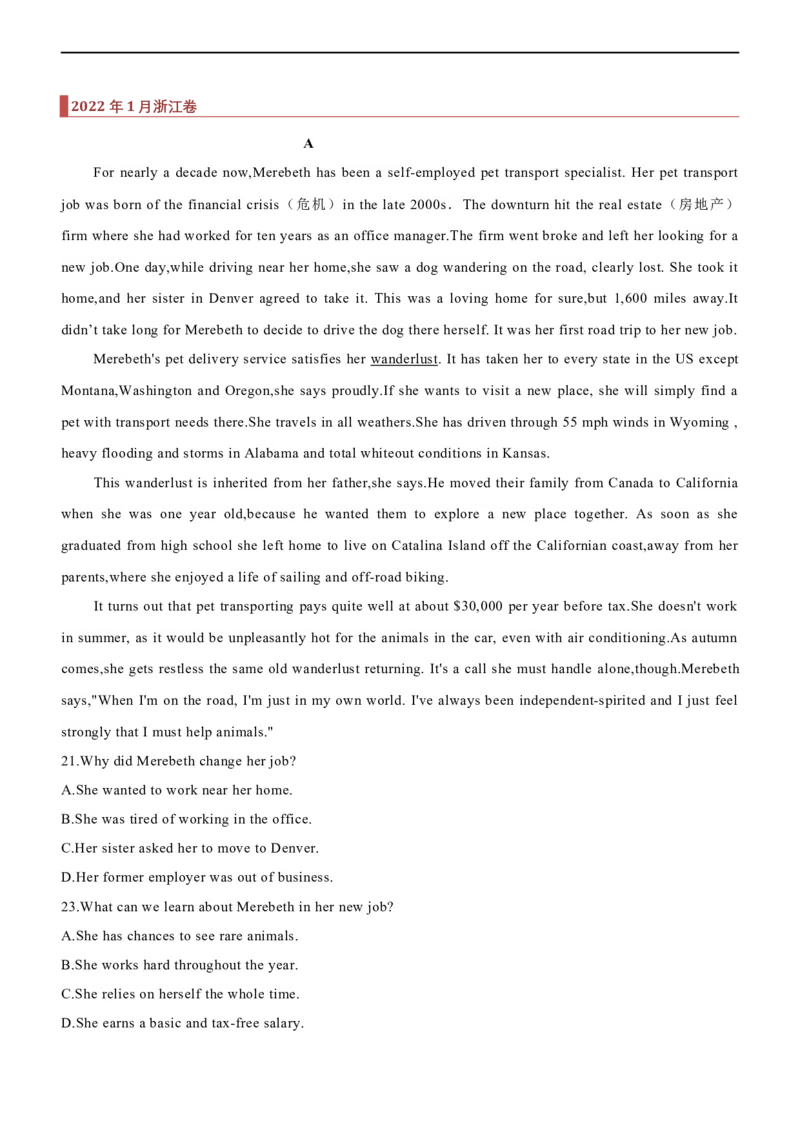
For nearly a decade now,Merebeth has been a self-employed pet transport specialist. Her pet transport
job was born of the financial crisis(危机)in the late 2000s.The downturn hit the real estate(房地产)
firm where she had worked for ten years as an office manager.The firm went broke and left her looking for a
new job.One day,while driving near her home,she saw a dog wandering on the road, clearly lost. She took it
home,and her sister in Denver agreed to take it. This was a loving home for sure,but 1,600 miles away.It
didn’t take long for Merebeth to decide to drive the dog there herself. It was her first road trip to her new job.
Merebeth's pet delivery service satisfies her wanderlust . It has taken her to every state in the US except
Montana,Washington and Oregon,she says proudly.If she wants to visit a new place, she will simply find a
pet with transport needs there.She travels in all weathers.She has driven through 55 mph winds in Wyoming ,
heavy flooding and storms in Alabama and total whiteout conditions in Kansas.
This wanderlust is inherited from her father,she says.He moved their family from Canada to California
when she was one year old,because he wanted them to explore a new place together. As soon as she
graduated from high school she left home to live on Catalina Island off the Californian coast,away from her
parents,where she enjoyed a life of sailing and off-road biking.
It turns out that pet transporting pays quite well at about $30,000 per year before tax.She doesn't work
in summer, as it would be unpleasantly hot for the animals in the car, even with air conditioning.As autumn
comes,she gets restless the same old wanderlust returning. It's a call she must handle alone,though.Merebeth
says,"When I'm on the road, I'm just in my own world. I've always been independent-spirited and I just feel
strongly that I must help animals."
21.Why did Merebeth change her job?
A.She wanted to work near her home.
B.She was tired of working in the office.
C.Her sister asked her to move to Denver.
D.Her former employer was out of business.
23.What can we learn about Merebeth in her new job?
A.She has chances to see rare animals.
B.She works hard throughout the year.
C.She relies on herself the whole time.
D.She earns a basic and tax-free salary.2021年6月北京卷
I remember the day during our first week of class when we were informed about our semester project of
volunteering at a non-profit organization. When the teacher introduced us to the different organizations that
needed our help, my last choice was Operation Iraqi Children (OIC). My first impression of the organization
was that it was not going to make enough of a difference with the plans I had in mind.
Then, an OIC representative gave us some details, which somewhat interested me. After doing some
research, I believed that we could really do something for those kids. When I went online to the OIC website, I
saw pictures of the Iraqi children. Their faces were so powerful in sending a message of their despair(绝望)
and need that I joined this project without hesitation. We decided to collect as many school supplies as possible,
and make them into kits—one kit, one child.
The most rewarding day for our group was project day, when all the efforts we put into collecting the
items finally came together. When I saw the various supplies we had collected, it hit me that every kit we were
to build that day would eventually be in the hands of an Iraqi child. Over the past four months, I had never
imagined how I would feel once our project was completed. While making the kits, I realized that I had lost
sight of the true meaning behind it. I had only focused on the fact that it was another school project and one I
wanted to get a good grade on. When the kits were completed, and ready to be sent overseas, the warm feeling I
had was one I would never forget.
In the beginning, I dared myself to make a difference in the life of another person. Now that our project is
over, I realize that I have affected not only one life, but ten. With our efforts, ten young boys and girls will now
be able to further their education.
1.How did the author feel about joining the OIC project in the beginning?
A.It would affect his/her initial plans.
B.It would involve traveling overseas.
C.It would not bring him/her a good grade.
D.It would not live up to his/her expectations.
2.What mainly helped the author change his/her attitude toward the project?
A.Images of Iraqi children.
B.Research by his/her classmates.C.A teacher's introduction.
D.A representative's comments.
3.The author's OIC project group would help ten Iraqi children to .
A.become OIC volunteers
B.further their education
C.study in foreign countries
D.influence other children
2021年6月新高考2卷B篇
I have worked as a keeper at the National Zoo, Paris for 11 years. Spot and Stripe are the first tiger cubs that have
ever been born here. Globally, a third of Sumatran cubs in zoos don't make it to adulthood, so I decided to give them
round-the-clock care at home.
I've got two children—the younger one, Kynan, was extremely happy about the tigers arriving - but all of us really
looked forward to being part of their lives and watching them grow. I wasn't worried about bringing them into my home
with my wife and kids. These were cubs. They weighed about 2.5 kg and were so small that there was absolutely no
risk.
As they grew more mobile, we let them move freely around the house during the day, but when we were asleep we
had to contain them in a large room, otherwise they'd get up to mischief. We'd come down in the morning to find
they'd turned the room upside down, and left it looking like a zoo.
Things quickly got very intense due to the huge amount of energy required to look after them. There were some
tough times and I just felt extremely tired. I was grateful that my family was there to help. We had to have a bit of a
production line going, making up “tiger milk”, washing baby bottles, and cleaning the floors.
When Spot and Stripe were four months old, they were learning how to open doors and jump fences, and we knew
it really was time for them to go. It was hard for us to finally part with them. For the first few days, Kynan was always
a bit disappointed that the cubs weren't there.
I'm not sad about it. I'm hands-on with them every day at the zoo, and I do look back very fondly on the time that
we had them.
4. Why did the author bring the tiger cubs home?
A. To ensure their survival. B. To observe their differences.
C. To teach them life skills. D. To let them play with his kids.
7. Why did the author decide to send Spot and Stripe back to the zoo?A. They frightened the children. B. They became difficult to contain.
C. They annoyed the neighbours. D. They started fighting each other.
2021年6月新高考2卷D篇
An Australian professor is developing a robot to monitor the health of grazing cattle, a development that could
bring big changes to a profession that's relied largely on a low-tech approach for decades but is facing a labor shortage.
Salah Sukkarieh, a professor at the University of Sydney, sees robots as necessary given how cattlemen are aging.
He is building a four-wheeled robot that will run on solar and electric power. It will use cameras and sensors to monitor
the animals. A computer system will analyze the video to determine whether a cow is sick. Radio tags (标签) on the
animals will measure temperature changes. The quality of grassland will be tracked by monitoring the shape, color and
texture (质地) of grass. That way, cattlemen will know whether they need to move their cattle to another field for
nutrition purposes.
Machines have largely taken over planting, watering and harvesting crops such as com and wheat, but the
monitoring of cattle has gone through fewer changes.
For Texas cattleman Pete Bonds, it's increasingly difficult to find workers interested in watching cattle. But Bonds
doesn't believe a robot is right for the job. Years of experience in the industry - and failed attempts to use technology -
have convinced him that the best way to check cattle is with a man on a horse. Bonds, who bought his first cattle almost
50 years ago, still has each of his cowboys inspect 300 or 400 cattle daily and look for signs that an animal is getting
sick.
Other cattlemen see more promise in robots. Michael Kelsey Paris, vice president of the Oklahoma Cattlemen's
Association, said a robot could be extremely useful given rising concerns about cattle theft. Cattle tend to be kept in
remote places and their value has risen, making them appealing targets.
12. What is a problem with the cattle-raising industry?
A. Soil pollution. B. Lack of workers.
C. Aging machines. D. Low profitability.
13. What will Sukkarieh's robot be able to do?
A. Monitor the quality of grass. B. Cure the diseased cattle.
C. Move cattle to another field. D. Predict weather changes.
14. Why does Pete Bonds still hire cowboys to watch cattle?
A. He wants to help them earn a living. B. He thinks men can do the job better.
C. He is inexperienced in using robots. D. He enjoys the traditional way of life.
15. How may robots help with cattle watching according to Michael Kelsey?A. Increase the value of cattle. B. Bring down the cost of labor.
C. Make the job more appealing. D. Keep cattle from being stolen.
2021年6月全国甲卷C篇
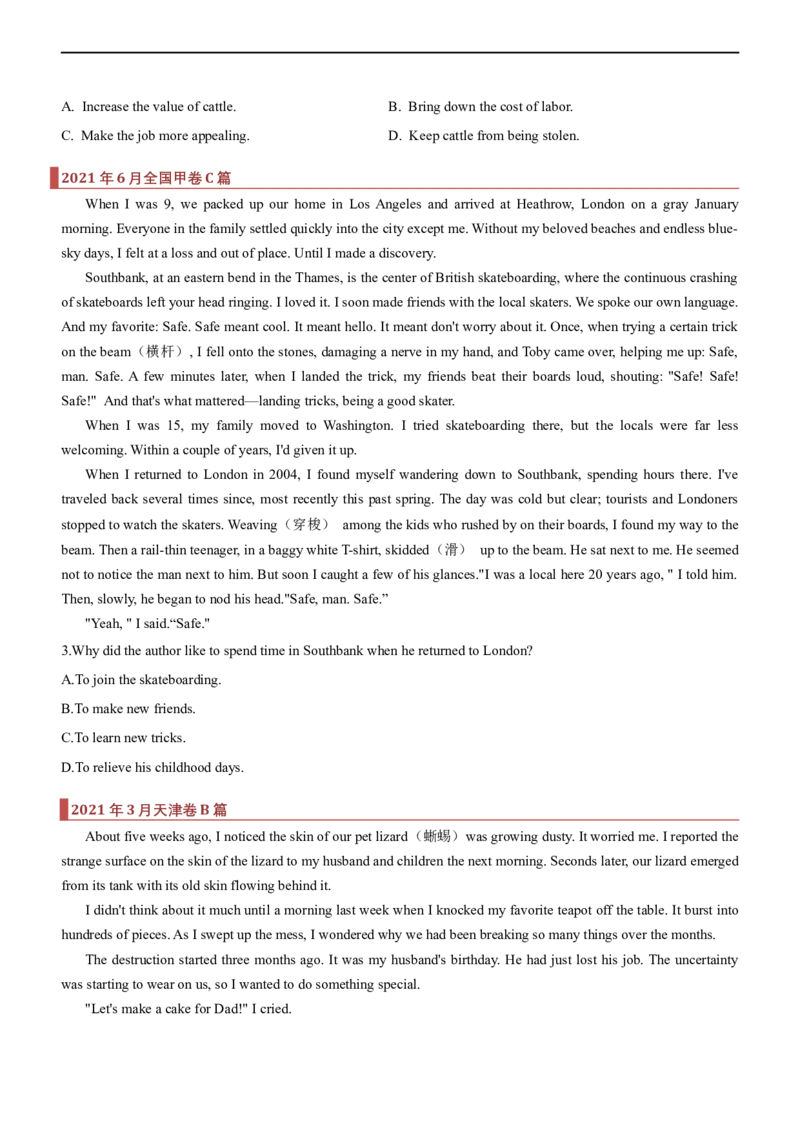
When I was 9, we packed up our home in Los Angeles and arrived at Heathrow, London on a gray January
morning. Everyone in the family settled quickly into the city except me. Without my beloved beaches and endless blue-
sky days, I felt at a loss and out of place. Until I made a discovery.
Southbank, at an eastern bend in the Thames, is the center of British skateboarding, where the continuous crashing
of skateboards left your head ringing. I loved it. I soon made friends with the local skaters. We spoke our own language.
And my favorite: Safe. Safe meant cool. It meant hello. It meant don't worry about it. Once, when trying a certain trick
on the beam(橫杆), I fell onto the stones, damaging a nerve in my hand, and Toby came over, helping me up: Safe,
man. Safe. A few minutes later, when I landed the trick, my friends beat their boards loud, shouting: "Safe! Safe!
Safe!" And that's what mattered—landing tricks, being a good skater.
When I was 15, my family moved to Washington. I tried skateboarding there, but the locals were far less
welcoming. Within a couple of years, I'd given it up.
When I returned to London in 2004, I found myself wandering down to Southbank, spending hours there. I've
traveled back several times since, most recently this past spring. The day was cold but clear; tourists and Londoners
stopped to watch the skaters. Weaving(穿梭) among the kids who rushed by on their boards, I found my way to the
beam. Then a rail-thin teenager, in a baggy white T-shirt, skidded(滑) up to the beam. He sat next to me. He seemed
not to notice the man next to him. But soon I caught a few of his glances."I was a local here 20 years ago, " I told him.
Then, slowly, he began to nod his head."Safe, man. Safe.”
"Yeah, " I said.“Safe."
3.Why did the author like to spend time in Southbank when he returned to London?
A.To join the skateboarding.
B.To make new friends.
C.To learn new tricks.
D.To relieve his childhood days.
2021年3月天津卷B篇
About five weeks ago, I noticed the skin of our pet lizard(蜥蜴)was growing dusty. It worried me. I reported the
strange surface on the skin of the lizard to my husband and children the next morning. Seconds later, our lizard emerged
from its tank with its old skin flowing behind it.
I didn't think about it much until a morning last week when I knocked my favorite teapot off the table. It burst into
hundreds of pieces. As I swept up the mess, I wondered why we had been breaking so many things over the months.
The destruction started three months ago. It was my husband's birthday. He had just lost his job. The uncertainty
was starting to wear on us, so I wanted to do something special.
"Let's make a cake for Dad!" I cried.My kids screamed with joy. We baked, iced and sprinkled for most of the day. Candles on the cake! Balloons on the
walls! Flowers on the table!
Two hours before my husband came back home from another job interview, my daughter climbed up to grab a glass
vase from a high shelf. It fell and crashed beside the cake. Tiny pieces of glass were everywhere. She sobbed loudly as I
threw the cake away. My husband had banana pudding for his birthday.
Three days ago, the light in our living room suddenly went out. After several frustrating hours of unsuccessful
attempts to fix it, my husband suggested watching the Michael Jordan documentary(纪录片)series The Last Dance.
The poignancy(酸楚)of Jordan retiring from his beloved basketball to play baseball and what had pushed him to
make such a tough decision took me by surprise. As I watched him take off his basketball uniform and replace it with a
baseball uniform, I saw him leaving behind the layer that no longer served him, just as our lizard had. Neither of them
chose the moment that had transformed them. But they had to live with who they were after everything was different.
Just like us. I realized that we have to learn to leave the past behind.
Humans do not shed skin(蜕皮)as easily as other animals. The beginning of change is upsetting. The process is
tiring. Damage changes us before we are ready. I see our lizard, raw and nearly new.
Jordan said that no matter how it ends, it starts with hope. With our tender, hopeful skin, that is where we begin.
1.What can we learn about the pet lizard from Paragraph 1?
A.Its tank grew dirty.
B.Its old skin came off.
C.It got a skin disease.
D.It went missing.
2.Why did the author's husband have banana pudding for his birthday?
A.The birthday cake was ruined.
B.The author made good puddings.
C.Pudding was his favorite dessert.
D.They couldn't afford a birthday cake.
3.Why does the author mention The Last Dance in the passage?
A.To prove a theory.
B.To define a concept.
C.To develop the theme.
D.To provide the background.
2021年3月天津卷D篇
There is something to be said for being a generalist, even if you are a specialist. Knowing a little about a lot ofthings that interest you can add to the richness of a whole, well-lived life.
Society pushes us to specialize, to become experts. This requires commitment to a particular occupation, branch of
study or research. The drawback to being specialists is we often come to know more and more about less and less.
There is a great deal of pressure to master one's field. You may pursue training, degrees, or increasing levels of
responsibility at work. Then you discover the pressure of having to keep up.
Some people seem willing to work around the clock in their narrow specialty. But such commitment can also
weaken a sense of freedom. These specialists could work at the office until ten each night, then look back and realize
they would have loved to have gone home and enjoyed the sweetness of their family and friends, or traveled to exciting
places, meeting interesting people. Mastering one thing to the exclusion (排除)of others can hold back your true
spirit.
Generalists, on the other hand, know a lot about a wide range of subjects and view the whole with all its
connections. They are people of ability, talent, and enthusiasm who can bring their broad perspective (视角)into
specific fields of expertise(专长). The doctor who is also a poet and philosopher is a superior doctor, one who can
give so much more to his patients than just good medical skills.
Things are connected. Let your expertise in one field fuel your passions in all related areas. Some of your interests
may not appear to be connected but, once you explore their depths, you discover that they are. My editor Toni, who is
also a writer, has edited several history books. She has decided to study Chinese history. Fascinated by the structural
beauty of the Forbidden City as a painter, she is equally interested to learn more about Chinese philosophy. "I don't
know where it will lead, but I'm excited I'm on this pursuit."
These expansions into new worlds help us by giving us new perspectives. We begin to see the interconnectedness
of one thing to another in all aspects of our life, of ourselves and the universe. Develop broad, general knowledge and
experience. The universe is all yours to explore and enjoy.
1.To become a specialist, one may have to .
A.narrow his range of knowledge
B.avoid responsibilities at work
C.know more about the society
D.broaden his perspective on life
2.The specialists mentioned in Paragraph 3 tend to .
A.treasure their freedom
B.travel around the world
C.spend most time working
D.enjoy meeting funny people
3.According to the author, a superior doctor is one who .A.is fully aware of his talent and ability
B.is a pure specialist in medicine
C.should love poetry and philosophy
D.brings knowledge of other fields to work
2021年1月浙江卷A篇
More than 25 years ago, Saroo Brierley lived in rural(农村)India. One day, he played with his brother
along the rail line and fell asleep. When he woke up and found himself alone, the 4-year-old decided his brother
might be on the train he saw in front of him—so he got on.
That train took him a thousand miles across the country to a totally strange city. He lived on the streets' and then in
an orphanage (孤儿院). There, he was adopted by an Australian family and flown to Tasmania.
As he writes in his new book, A Long Way Home, Brierley couldn't help but wonder about his hometown back in
India. He remembered landmarks, but since he didn't know his town's name, finding a small neighborhood in a vast
country proved to be impossible.
Then he found a digital mapping program. He spent years searching for his hometown in the program's satellite
pictures. In 2011, he came across something familiar. He studied it and realized he was looking at a town's central
business district from a bird's-eye view. He thought, "On the right-hand side you should see the three-platform train
station"—and there it was. "And on the left-hand side you should see a big fountain"—and there it was. Everything just
started to match.
When he stood in front of the house where he grew up as a child, he saw a lady standing in the entrance. "There's
something about me, " he thought—and it took him a few seconds but he finally remembered what she used to look
like.
In an interview Brierley says, "My mother looked so much shorter than I remembered. But she came forth and
walked forward, and I walked forward, and my feelings and tears and the chemical in my brain, you know, it was like a
nuclear fusion (核聚变). I just didn't know what to say, because I never thought seeing my mother would ever come
true. And here I am, standing in front of her."
1.Why was Brierley separated from his family about 25 years ago?
A.He got on a train by mistake.
B.He got lost while playing in the street.
C.He was taken away by a foreigner.
D.He was adopted by an Australian family.
2.How did Brierley find his hometown?
A.By analyzing old pictures.
B.By travelling all around India.
C.By studying digital maps.
D.By spreading his story via his book.3.What does Brierley mainly talk about in the interview?
A.His love for his mother.
B.His reunion with his mother.
C.His long way back home.
D.His memory of his hometown.
2021年1月浙江卷B篇
At the start of the 20th century, an American engineer named John Elfreth Watkins made predictions about life
today. His predictions about slowing population growth, mobile phones and increasing height were close to the mark.
But he was wrong in one prediction that everybody would walk 10 miles a day.
Today, in Australia, most children on average fall 2, 000 steps short of the physical activity they need to avoid
being overweight. In the early 1970s, 40 per cent of children walked to school, while in 2010, it was as low as 15 per
cent.
The decline is not because we have all become lazy, Families are pressed for time, many with both parents working
to pay for their house, often working hours not of their choosing, living in car-dependent neighborhoods with limited
public transport.
The other side of the coin is equally a deprivation: for health and well-being, as well as lost opportunities(机会)
for children to get to know their local surroundings. And for parents there are lost opportunities to walk and talk with
their young scholar about their day.
Most parents will have eagerly asked their child about their day, only to meet with a "good", quickly followed by
"I'm hungry". This is also my experience as a mother. But Somewhere over the daily walk more about my son's day
comes out. I hear him making sense of friendship and its limits. This is the unexpected and rare parental opportunity to
hear more.
Many primary schools support walking school-bus routes(路线)with days of regular, parent-accompanied
walks. Doing just one of these a few times a week is better than nothing. It can be tough to begin and takes a little
planning—running shoes by the front door, lunches made the night before, umbrellas on rainy days and hats on hot
ones—but it's certainly worth trying.
1.Why does the author mention Watkins' predictions in the first paragraph?
A.To make comparisons.
B.To introduce the topic.
C.To support her argument.
D.To provide examples.
2.What has caused the decrease in Australian children's physical activity?
A.Plain laziness. B.Health problems. C.Lack of time. D.Security concerns.
3.Why does the author find walking with her son worthwhile?
A.She can get relaxed after work.
B.She can keep physically fit.
C.She can help with her son's study.D.She can know her son better.
2021年6月新高考1卷B篇
By day, Robert Titterton is a lawyer. In his spare time though he goes on stage beside pianist Maria Raspopova—
not as a musician but as her page turner. "I'm not a trained musician, but I've learnt to read music so I can help Maria in
her performance."
Mr Titterton is chairman of the Omega Ensemble but has been the group's official page turner for the past four
years. His job is to sit beside the pianist and turn the pages of the score so the musician doesn't have to break the flow
of sound by doing it themselves. He said he became just as nervous as those playing instruments on stage.
"A lot of skills are needed for the job. You have to make sure you don't turn two pages at once and make sure you
find the repeats in the music when you have to go back to the right spot, " Mr Titterton explained.
Being a page turner requires plenty of practice. Some pieces of music can go for 40 minutes and require up to 50
page turns, including back turns for repeat passages. Silent onstage communication is key, and each pianist has their
own style of "nodding" to indicate a page turn which they need to practise with their page turner.
But like all performances, there are moments when things go wrong. "I was turning the page to get ready for the
next page, but the draft wind from the turn caused the spare pages to fall off the stand, " Mr Titterton said. "Luckily I
was able to catch them and put them back."
Most page turners are piano students or up-and-coming concert pianists, although Ms Raspopova has once asked
her husband to help her out on stage.
"My husband is the worst page turner, " she laughed. "He's interested in the music, feeling every note, and I have to
say: 'Turn, turn!'" "Robert is the best page turner I've had in my entire life."
1.What should Titterton be able to do to be a page turner?
A.Read music. B.Play the piano. C.Sing songs. D.Fix the instruments.
2Which of the following best describes Titterton's job on stage?
A.Boring. B.Well-paid. C.Demanding. D.Dangerous.
3What does Titterton need to practise?
A.Counting the pages.
B.Recognizing the "nodding".
C.Catching falling objects.
D.Performing in his own style.
4Why is Ms Raspopova's husband "the worst page turner" ?
A.He has very poor eyesight.
B.He ignores the audience.
C.He has no interest in music.
D.He forgets to do his job.2021年6月全国乙卷D篇
During an interview for one of my books, my interviewer said something I still think about often. Annoyed by the
level of distraction(干扰)in his open office, he said, "That's why I have a membership at the coworking space across
the street—so I can focus." His comment struck me as strange. After all, coworking spaces also typically use an open
office layout(布局). But I recently came across a study that shows why his approach works.
The researchers examined various levels of noise on participants as they completed tests of creative thinking. They
were randomly divided into four groups and exposed to various noise levels in the background, from total silence to 50
decibels(分贝), 70 decibels, and 85 decibels. The differences between most of the groups were statistically
insignificant; however, the participants in the 70 decibels group—those exposed to a level of noise similar to
background chatter in a coffee shop—significantly outperformed the other groups. Since the effects were small, this
may suggest that our creative thinking does not differ that much in response to total silence and 85 decibels of
background noise.
But since the results at 70 decibels were significant, the study also suggests that the right level of background noise
—not too loud and not total silence—may actually improve one's creative thinking ability. The right level of
background noise may interrupt our normal patterns of thinking just enough to allow our imaginations to wander,
without making it impossible to focus. This kind of "distracted focus" appears to be the best state for working on
creative tasks.
So why do so many of us hate our open offices? The problem may be that, in our offices, we can't stop ourselves
from getting drawn into others' conversations while we're trying to focus. Indeed, the researchers found that face-to-
face interactions and conversations affect the creative process, and yet a coworking space or a coffee shop provides a
certain level of noise while also providing freedom from interruptions.
1.Why does the interviewer prefer a coworking space?
A.It helps him concentrate.
B.It blocks out background noise.
C.It has a pleasant atmosphere.
D.It encourages face-to-face interactions.
2.Which level of background noise may promote creative thinking ability?
A.Total silence. B.50 decibels.
C.70 decibels. D.85 decibels.
_____
测
好题必
1.【Z20名校联盟(浙江省名校新高考研宄联盟)2022-2023学年髙三第一次联考】
ABefore you worry about bacon and how much it may cost when new animal welfare laws go into effect next year,
let’s talk about the pigs that gave their lives for it.
California has been on the forefront of protecting animals who live short lives on factory farms either to produce
food for us or to be slaughtered and sold as food. The latest advance came in November 2018, when 62.7% of the
state’s voters supported Proposition 12, the Prevention of Cruelty to Farm Animals Act. The law began going into effect
last year, requiring hens and veal calves to be given more space to live in. Starting on Jan. 1st, the law will require that
all eggs sold in California come from cage-free hens and that pork sold in the state come from breeding pigs that are not
held in cages. These are humane steps designed to lift these animals out of structures that barely allow them to move.
Pork producers have had the longest time to comply (遵守). Some big companies like Hormel Foods have
pledged to do so fully, but others have spent the last few years fighting the law rather than figuring out how to put it
into practice. They say that the law will significantly raise the price of pork and that it violates the Commerce Clause of
the Constitution, which gives Congress sole power over interstate business activity. So far, that fight has been a waste
of time that pork producers could have better spent figuring out how to retrofit (翻新)their farms.
They also complain that the regulations on the law are not set. But the California Department of Food and
Agriculture, which has yet to finalize the regulations, says that the delay should not have prevented producers from
retrofitting their housing for breeding pigs. The agency has publicly posted draft regulations, which mostly concern
record-keeping, certification and definitions of terms.
For fans of bacon and other pork, any rise in cost is the price of not having a pig suffer before it’s killed for food.
It’s a price the animals shouldn’t have to pay.
28. What do we know about Proposition 12?
A. The law will come into force next year.
B. More space is required for raising hens and pigs.
C. Raising hens and pigs in limited space is humane.
D. Half of the state’s voters subscribed to Proposition 12.
29. What does the underlined word “pledged” in paragraph 3 mean?
A. Suspect. B. Refuse. C. Promise. D. Hesitate.
30. Which of the following is TRUE according to paragraph 3?
A. Some pork producers have raised the price of pork.
B. All the pork producers don’t comply with the law.
C. Pork producers have wasted a lot of time retrofitting their farms.
D. Pork producers resist the Commerce Clause of the Constitution.31. Which word can best describe the author's attitude to the new animal welfare laws?
A. Skeptical. B. Conservative C. Tolerant. D. Favorable.
B
Tina Brigham, a 50-year-old store owner from a suburb of Washington, DC, wrestled with the puzzles while
waiting for customers. “If it’s a 30-minute puzzle, I try to figure it out in 12,” she said. After several years, she found
she could easily put together employee work schedules in her head. A lot of stores use an electronic scheduling tool, but
I have all the data in my mind,” she said. “I think my brain seems sharper and more focused because of the game.”
The games do seem to work. In one 2020 study, Gary Small, chair of psychiatry at Hackensack University Medical
Center, found that 1,091 women and men who frequently played cards, bingo, or did crossword puzzles had sharper
thinking and memory skills — equivalent to an IQ up to 5.6 points higher — than those who rarely did. The study
doesn’t prove that the puzzles directly led to the higher IQs, but it does show that even people who increased their
game-playing in their 70s seemed to get brain benefits within a few years.
Exactly how games sharpen memory and cognitive function is still something of a mystery. But advances in
neuroimaging (神经影像学) allow researchers to study how the brain reacts to all sorts of outside stimulation. Small
later included 60 women and men completing Latin squares. As the puzzles grew more difficult with fewer clues,
players slowed down and made more mistakes. That’s when he discovered something surprising: More regions of the
brain got involved, especially in the prefrontal cortex (前额叶皮质区),an area involved with problem-solving,
judgment, and memory.
Small suggests that if you find yourself debating whether to spend the next 20 minutes taking a walk or playing a
brain game, you should choose the walk. Physical activity can help deliver oxygen and fuel to your brain cells. “If you
do one thing to help your brain, I’d say it’s exercise.” he says. “Getting good sleep and keep a balanced diet are also
important. Brain games work best as part of a whole package of brain-healthy strategies. And remember: A little fun
never hurts.
32. How does the author introduce the topic in paragraph 1?
A. By sharing a story. B. By comparing facts.
C. By report findings. D. By presenting figures.
33. What can we know from Gary Small's study?
A. Puzzles directly leads to higher IQs.
B. People in their 70s benefit more from brain games.
C. How games sharpen minds has not been clearly understood.
D. Physical activities play an equally important role ais brain games.34. Why does the author mention good sleep and a healthy diet in the last paragraph?
A. To advocate good sleep and a balanced diet.
B. To advise what we should do to keep healthy.
C. To stress the importance of good sleep and a healthy diet.
D. To explain that brain games function best as part of brain-healthy strategies.
35. What is the main idea of the text?
A. Puzzles make brains sharp and focused.
B. Physical activities play an important role in sharp thinking.
C. Brain games are beneficial to memory skills and cognitive function.
D. Sharp memory and cognitive function depend largely on brain games.
3.【2023届山东省齐鲁名校高三第一次学业质量联合检测】
C
Researchers have developed a new method for training people to be creative, one that shows promise of
succeeding far better than current ways of inspiring creativity.
This new method, based on narrative (叙述的) theory, helps people be creative in the way children and artists are
by making up stories that imagine alternative worlds, change perspective and generate unexpected actions.
“The narrative method works by recognizing that we’re all creative,” said Angus Fletcher, who developed the
method and is a professor of English and a member of the Ohio State University’s Project Narrative. “We as a society
completely undervalue the creativity of kids and many others because we are addicted to the idea that some people are
more creative than others.”
The narrative method of training for creativity uses many of the techniques that writers use to create stories. One is
to develop new worlds in your mind. For example, employees at a company might be asked to imagine a world in
which all their customers are like that. Another technique is perspective-changing. An employer might be asked to
answer a problem by thinking like another member of their team.
“Creativity isn’t about guessing the future correctly. It’s about making yourself open to imagining completely
different possibilities,” Fletcher said. “When you do that, you can respond more quickly and flexibly to the changes that
do occur.”
Fletcher and his team are also continuing to work with new organizations, such as the Worthington Local School
District in Ohio.
“It’s better to hire a diverse group of people and then train them to be creative. That creates a culture which
recognizes that there are already creative people in your organization you aren’t taking advantage of,” he said. “Thisnew method of training creativity could only have come from Ohio State University’s Project Narrative, which is itself
proof of the power of creativity.”
8. What may make the narrative method workable according to Fletcher?
A. Creating alternative stories. B. Changing new perspective.
C. Generating unexpected tasks. D. Being aware of our creativity.
9. How does the author develop paragraph 4?
A. By using examples. B. By making comparison.
C. By answering questions. D. By quoting techniques.
10. What result is expected of training creativity?
A. To develop a culture gradually. B. To react to changes quickly.
C. To create possibilities freely. D. To predict the future correctly.
11. What is the most suitable title for the text?
A. Ways Can Be Adopted to Inspire Creativity
B. The Power of Creativity Has Been Found
C. Anyone Can Be Trained to Be Creative
D. A Way Is Found to Recognize Creative People
D
Migratory (迁徙的) birds are declining globally because of the way that humans have changed the landscape over
recent decades — according to new research from the University of East Anglia (UEA).
A new study published today reveals that population declines have been greatest among species that migrate to
areas with more human infrastructure — roads, buildings, power lines, wind turbines (涡轮机) — as well as more
population and hunting levels.
Dr. James Gilroy, from UEA’s School of Environmental Sciences, said, “We know that migratory birds are in
greater decline than non-migratory species, but it’s not clear why. We want to find out where in their life cycles these
migratory species are most exposed to human impacts.”
The research team identified 16 human-induced threats to migratory birds, including infrastructure associated with
bird disturbance and impacts, transformation of land from natural habitat to human land use, and climate change.
Advances in satellite imagery allowed the team to map each of the 16 threats across Europe, Africa and Western Asia.
The team also created the first ever large-scale map of hunting pressure across the region. A total of 103 species of
migrating birds were studied, including many rapidly declining species like the turtle dove and the common cuckoo,
using large-scale datasets. The team calculated threat scores for factors such as habitat loss and climate change, acrossbreeding locations, as well as non-breeding ranges. They then explored the relationships between these threat scores
and bird population trends calculated from 1985 to 2018 by the Pan-European Common Bird Monitoring Scheme
(PECBMS).
Dr. Aldina Franco, also from UEA’s School of Environmental Sciences, said, “Our findings are important because
we need to understand where declining species are being most impacted by humans across their seasonal migrations.
Locating where birds are most exposed to these threats could help us target conservation actions.”
12. What causes migratory birds to decrease?
A. A longer migratory route. B. Serious industrial pollution.
C. Illegal hunting from humans. D. The changing of landscape.
13. What does the underlined word “infrastructure” in paragraph 2 refer to?
A. Basic systems and services. B. Local transportation.
C. Internet facilities. D. Power supplies.
14. What does paragraph 4 talk about?
A. The results of the study. B. The promise of the study.
C. The process of the study. D. The database of the study.
15. What is the purpose of studying migratory birds according to Dr. Aldina Franco?
A. To raise people’s awareness of protecting birds.
B. To offer advice to do conservation work precisely.
C. To stress the necessity of increasing bird population.
D. To state the importance of living in harmony with nature.
_____