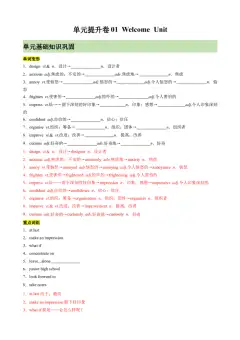
单元提升卷 06 Unit 5 Languages Around the World
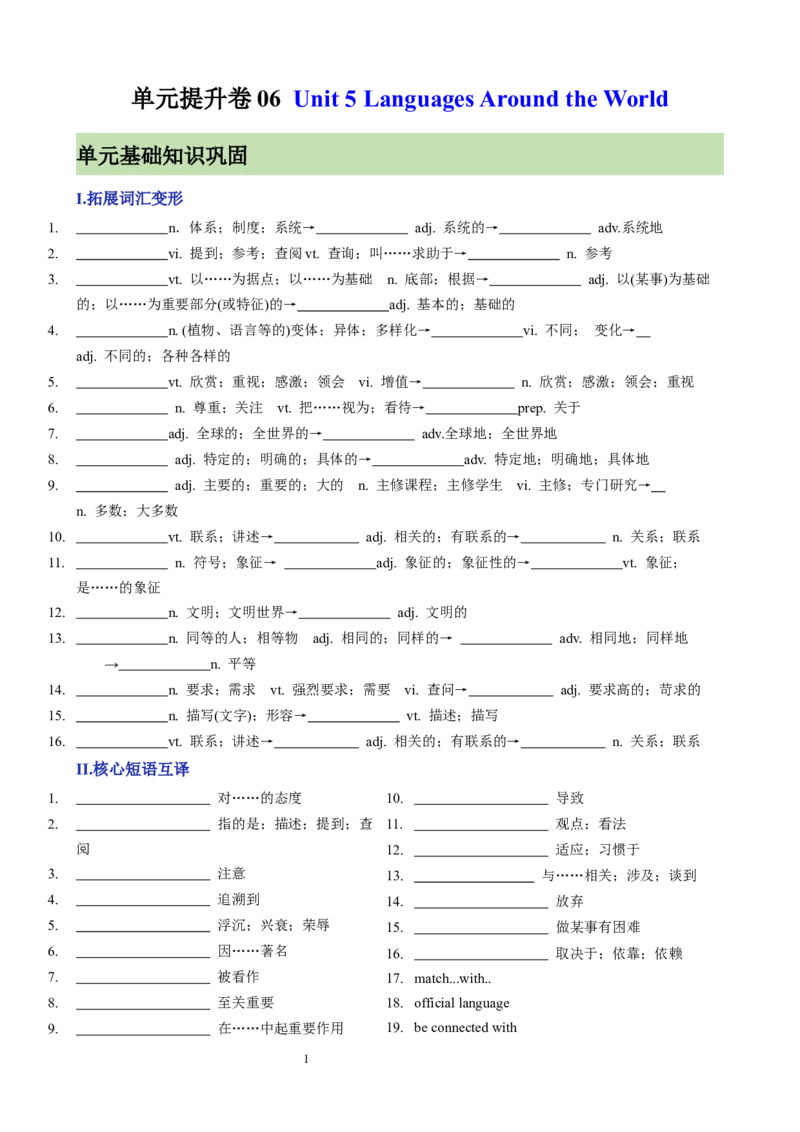
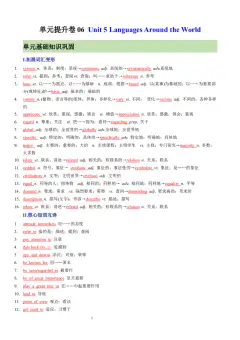
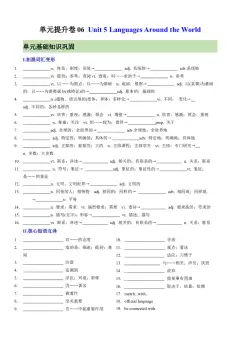
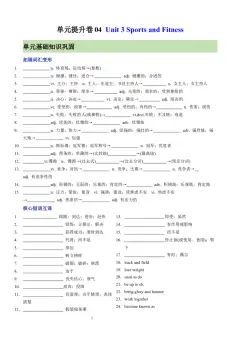
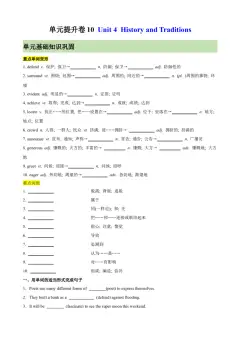
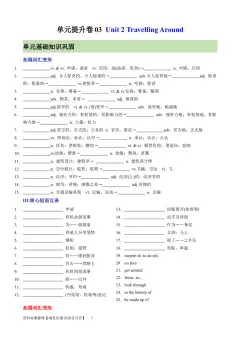
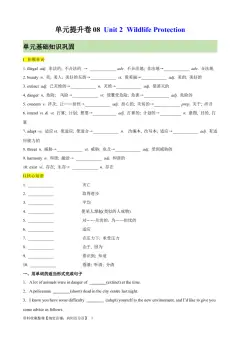
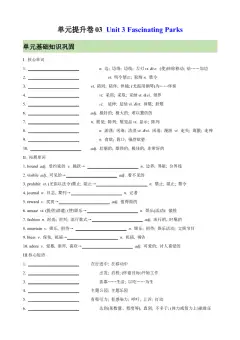
单元基础知识巩固
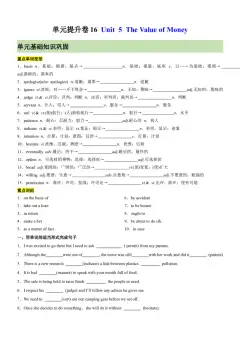
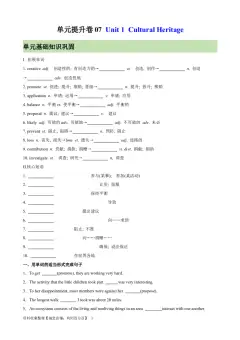
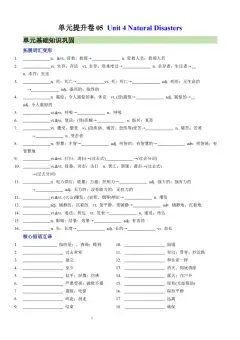
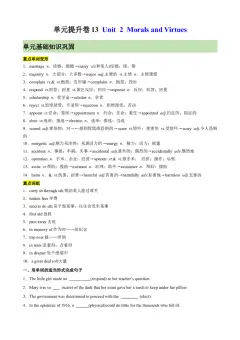
I.拓展词汇变形
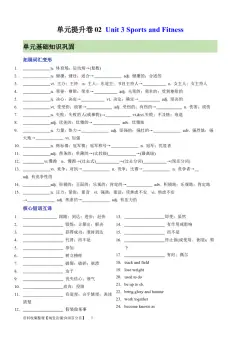
1. n.体系;制度;系统→ adj. 系统的→ adv.系统地
2. vi. 提到;参考;查阅vt. 查询;叫……求助于→ n. 参考
3. vt. 以……为据点;以……为基础 n. 底部;根据→ adj. 以(某事)为基础
的;以……为重要部分(或特征)的→ adj. 基本的;基础的
4. n. (植物、语言等的)变体;异体;多样化→ vi. 不同; 变化→
adj. 不同的;各种各样的
5. vt. 欣赏;重视;感激;领会 vi. 增值→ n. 欣赏;感激;领会;重视
6. n. 尊重;关注 vt. 把……视为;看待→ prep. 关于
7. adj. 全球的;全世界的→ adv.全球地;全世界地
8. adj. 特定的;明确的;具体的→ adv. 特定地;明确地;具体地
9. adj. 主要的;重要的;大的 n. 主修课程;主修学生 vi. 主修;专门研究→
n. 多数;大多数
10. vt. 联系;讲述→ adj. 相关的;有联系的→ n. 关系;联系
11. n. 符号;象征→ adj. 象征的;象征性的→ vt. 象征;
是……的象征
12. n. 文明;文明世界→ adj. 文明的
13. n. 同等的人;相等物 adj. 相同的;同样的→ adv. 相同地;同样地
→ n. 平等
14. n. 要求;需求 vt. 强烈要求;需要 vi. 查问→ adj. 要求高的;苛求的
15. n. 描写(文字);形容→ vt. 描述;描写
16. vt. 联系;讲述→ adj. 相关的;有联系的→ n. 关系;联系
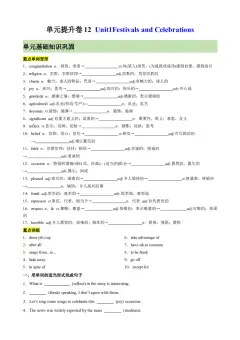
II.核心短语互译
1. 对……的态度 10. 导致
2. 指的是;描述;提到;查 11. 观点;看法
阅 12. 适应;习惯于
3. 注意 13. 与……相关;涉及;谈到
4. 追溯到 14. 放弃
5. 浮沉;兴衰;荣辱 15. 做某事有困难
6. 因……著名 16. 取决于;依靠;依赖
7. 被看作 17. match...with..
8. 至关重要 18. official language
9. 在……中起重要作用 19. be connected with
120. at the beginning 23. no matter where, who, what, etc.
21. develop into 24. be considered to be
22. global affairs 25. be related to
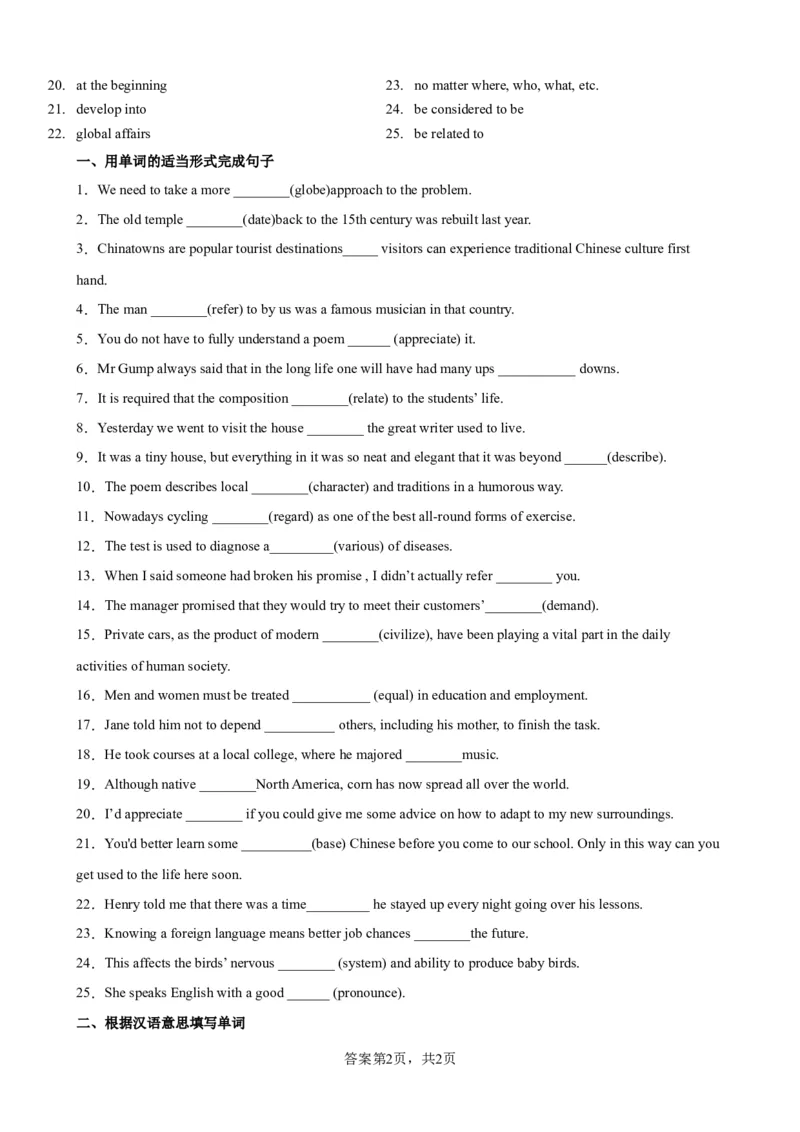
一、用单词的适当形式完成句子
1.We need to take a more ________(globe)approach to the problem.
2.The old temple ________(date)back to the 15th century was rebuilt last year.
3.Chinatowns are popular tourist destinations_____ visitors can experience traditional Chinese culture first
hand.
4.The man ________(refer) to by us was a famous musician in that country.
5.You do not have to fully understand a poem ______ (appreciate) it.
6.Mr Gump always said that in the long life one will have had many ups ___________ downs.
7.It is required that the composition ________(relate) to the students’ life.
8.Yesterday we went to visit the house ________ the great writer used to live.
9.It was a tiny house, but everything in it was so neat and elegant that it was beyond ______(describe).
10.The poem describes local ________(character) and traditions in a humorous way.
11.Nowadays cycling ________(regard) as one of the best all-round forms of exercise.
12.The test is used to diagnose a_________(various) of diseases.
13.When I said someone had broken his promise , I didn’t actually refer ________ you.
14.The manager promised that they would try to meet their customers’________(demand).
15.Private cars, as the product of modern ________(civilize), have been playing a vital part in the daily
activities of human society.
16.Men and women must be treated ___________ (equal) in education and employment.
17.Jane told him not to depend __________ others, including his mother, to finish the task.
18.He took courses at a local college, where he majored ________music.
19.Although native ________North America, corn has now spread all over the world.
20.I’d appreciate ________ if you could give me some advice on how to adapt to my new surroundings.
21.You'd better learn some __________(base) Chinese before you come to our school. Only in this way can you
get used to the life here soon.
22.Henry told me that there was a time_________ he stayed up every night going over his lessons.
23.Knowing a foreign language means better job chances ________the future.
24.This affects the birds’ nervous ________ (system) and ability to produce baby birds.
25.She speaks English with a good ______ (pronounce).
二、根据汉语意思填写单词
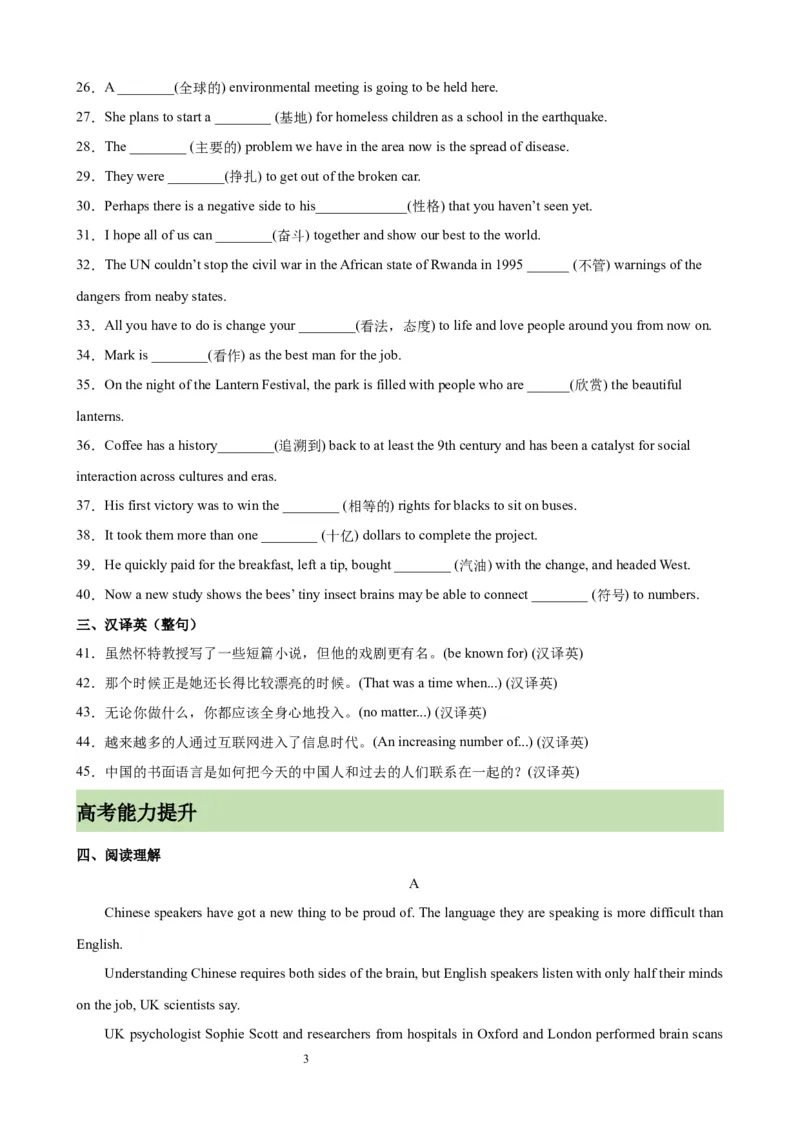
答案第2页,共2页26.A ________(全球的) environmental meeting is going to be held here.
27.She plans to start a ________ (基地) for homeless children as a school in the earthquake.
28.The ________ (主要的) problem we have in the area now is the spread of disease.
29.They were ________(挣扎) to get out of the broken car.
30.Perhaps there is a negative side to his_____________(性格) that you haven’t seen yet.
31.I hope all of us can ________(奋斗) together and show our best to the world.
32.The UN couldn’t stop the civil war in the African state of Rwanda in 1995 ______ (不管) warnings of the
dangers from neaby states.
33.All you have to do is change your ________(看法,态度) to life and love people around you from now on.
34.Mark is ________(看作) as the best man for the job.
35.On the night of the Lantern Festival, the park is filled with people who are ______(欣赏) the beautiful
lanterns.
36.Coffee has a history________(追溯到) back to at least the 9th century and has been a catalyst for social
interaction across cultures and eras.
37.His first victory was to win the ________ (相等的) rights for blacks to sit on buses.
38.It took them more than one ________ (十亿) dollars to complete the project.
39.He quickly paid for the breakfast, left a tip, bought ________ (汽油) with the change, and headed West.
40.Now a new study shows the bees’ tiny insect brains may be able to connect ________ (符号) to numbers.
三、汉译英(整句)
41.虽然怀特教授写了一些短篇小说,但他的戏剧更有名。(be known for) (汉译英)
42.那个时候正是她还长得比较漂亮的时候。(That was a time when...) (汉译英)
43.无论你做什么,你都应该全身心地投入。(no matter...) (汉译英)
44.越来越多的人通过互联网进入了信息时代。(An increasing number of...) (汉译英)
45.中国的书面语言是如何把今天的中国人和过去的人们联系在一起的?(汉译英)
高考能力提升
四、阅读理解
A
Chinese speakers have got a new thing to be proud of. The language they are speaking is more difficult than
English.
Understanding Chinese requires both sides of the brain, but English speakers listen with only half their minds
on the job, UK scientists say.
UK psychologist Sophie Scott and researchers from hospitals in Oxford and London performed brain scans
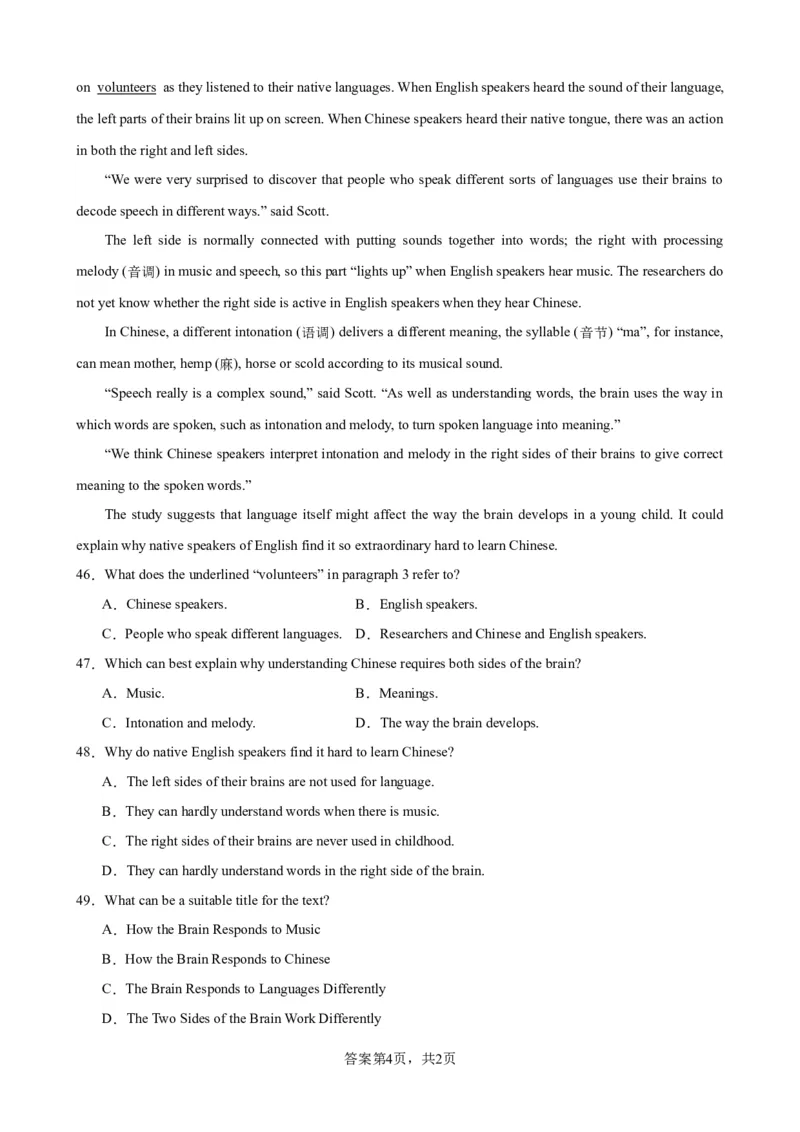
3on volunteers as they listened to their native languages. When English speakers heard the sound of their language,
the left parts of their brains lit up on screen. When Chinese speakers heard their native tongue, there was an action
in both the right and left sides.
“We were very surprised to discover that people who speak different sorts of languages use their brains to
decode speech in different ways.” said Scott.
The left side is normally connected with putting sounds together into words; the right with processing
melody (音调) in music and speech, so this part “lights up” when English speakers hear music. The researchers do
not yet know whether the right side is active in English speakers when they hear Chinese.
In Chinese, a different intonation (语调) delivers a different meaning, the syllable (音节) “ma”, for instance,
can mean mother, hemp (麻), horse or scold according to its musical sound.
“Speech really is a complex sound,” said Scott. “As well as understanding words, the brain uses the way in
which words are spoken, such as intonation and melody, to turn spoken language into meaning.”
“We think Chinese speakers interpret intonation and melody in the right sides of their brains to give correct
meaning to the spoken words.”
The study suggests that language itself might affect the way the brain develops in a young child. It could
explain why native speakers of English find it so extraordinary hard to learn Chinese.
46.What does the underlined “volunteers” in paragraph 3 refer to?
A.Chinese speakers. B.English speakers.
C.People who speak different languages. D.Researchers and Chinese and English speakers.
47.Which can best explain why understanding Chinese requires both sides of the brain?
A.Music. B.Meanings.
C.Intonation and melody. D.The way the brain develops.
48.Why do native English speakers find it hard to learn Chinese?
A.The left sides of their brains are not used for language.
B.They can hardly understand words when there is music.
C.The right sides of their brains are never used in childhood.
D.They can hardly understand words in the right side of the brain.
49.What can be a suitable title for the text?
A.How the Brain Responds to Music
B.How the Brain Responds to Chinese
C.The Brain Responds to Languages Differently
D.The Two Sides of the Brain Work Differently
答案第4页,共2页B
The older you get, the more difficult it is to learn to speak French like a Parisian. But what is the exact cutoff
point—at what age it becomes harder?
To analyse this problem, a research team collected data on a person’s current age, language capability and
time studying English. The investigators thought they needed more than half a million people to figure out when
the “critical period” for achieving the highest levels of grammatical fluency ends. So they turned to the world’s
greatest experimental subject pool: the internet.
They created a short online grammar quiz. From the responses, an algorithm predicted the tester’s native
language and which dialect of English they spoke. Meanwhile, the researchers developed models that predicted
how long it takes to become fluent in a language and the best age to start learning. They concluded that the ability
to learn a new language, at least grammatically, is strongest until the age of 18, after which there is a sharp
decline. To become completely fluent, however, learning should start before the age of 10.
There are three main ideas as to why language-learning ability declines at 18: social changes, interference
from one’s primary language and continuing brain development. At 18, kids typically graduate high school and go
on to start college or enter the work force full-time. Once they do, they may no longer have the time, opportunity
or learning environment to study a second language like they did when they were younger.
However, Elissa Newport, a professor at Georgetown University who specializes in language learning,
remains a skeptic, saying “Testing 600,000 people doesn’t give you a dependable, reliable outcome if you’re not
asking the right questions. Besides, even among native speakers it takes 30 years to fully master a language and
there are numerous examples of people who pick up a language later in life, and our ability to learn new
vocabulary appears to remain constant.”
50.Why did the researchers turn to the Internet to collect data?
A.They are good at computer operation
B.They want to get an exact conclusion.
C.The Internet can lower the cost of the research.
D.Internet Data Centers provide reliable resources
51.Which can replace the underlined word “decline” in paragraph 3?
A.Drop. B.Increase. C.Turn. D.Push.
52.What’s the author’s attitude towards the result of the research?
A.Negative. B.Supportive. C.Objective. D.Doubtful.
53.What can be the best title?
A.It’s never too old to learn
5B.Age affects language learning
C.Online quiz predicts native language
D.Grammar counts in language learning
五、用单词的适当形式完成短文
阅读下面短文,在空白处填入1个适当的单词或括号内单词的正确形式。
Mary-Jo Saunders goes to kindergarten every morning, just like many other five-year-olds in New York.
Today, she is learning 54 poem. What is special is that it is a Chinese poem and 55 she is
able to recite it 56 an accent. Soon she is going to learn Chinese handwriting too. “ 57 (learn)
the world’s most spoken language might give Mary-Jo a head start in her future career,” says her mother Alison.“I
think it’s good for her to stretch 58 (her) by listening to and pronouncing new sounds, as well as
learning to read and 59 (write) Chinese characters.”
More and more 60 (ambition) parents in the world are signing their children up for Chinese
classes. Keen for their sons and daughters 61 (succeed) in life,they see being fluent in a second or third
language as an advantage. Learning Chinese is becoming so popular that so far the language 62 in the
educational systems of more than 75 countries. Over 4,000 overseas universities offer Chinese language courses
and now about 25 million people 63 (study) Chinese outside China.
六、建议信
64.假设你是李华,你的美国朋友Peter正在学习汉语但遇到了一些困难,他写信向你求助,现在请你写
封回信,内容包括:
1. 写信目的;2. 提出建议;3. 表达祝愿。
注意:1. 词数80左右;
2. 可以适当增加细节,以使行文连贯。
___________________________________________________________________________________________
___________________________________________________________________________________________
___________________________________________________________________________________________
___________________________________________________________________________________________
__________________________________________________________________________________________
七、读后续写
65.阅读下面材料,根据其内容和所给段落开头语续写两段,使之构成一篇完整的短文。
Eleven-year-old Kristina shouted on the phone. Vera, her mother, packing lunches for her two children, heard
the shouting and dashed to Kristina. Kristina gave her the phone. Kristina was talking to her father at his doctor’s
office in Moscow, Russia.
答案第6页,共2页“Vlad, why is Kristina shouting?” began Vera in Russian.
“Vera, this afternoon I must attend a conference at her school. But I cannot be there. I have an important
meeting. Why don’t you attend it?” Vlad replied.
"How can I go?”
“You are not going to a forest. You’ll be fine!”
“I know, but I can’t speak English properly. It’s a rule at her school.”
“You can manage. GO!”
Vera turned to Kristina, “Kristina, your father is busy. I will come instead of him.”
Kristina shouted, “Mother, you can’t speak English. How can you come to the conference? NO!” She plowed
through her mother and ran sobbing. But Vera convinced Kristina. As there was no option, she agreed and left for
school.
Vera was depressed. She felt that if only she knew English, she could avoid such situations. But “how is it
possible for me to learn English while balancing so many tasks?” Suddenly, she realized that Andrei was getting
late, so she got him ready and walked him to school.
In the afternoon, Vera attended the conference at the school. All the teachers and staff gave a warm welcome
to Vera. Kristina kept quieting her mother. All she said were phrases like, “You are embarrassing!” “Stop talking!”
and “You do not know English!” Ignoring her daughter’s comments, Vera managed to keep her cool and finished
the meeting.
After delivering a cake to a customer, Vera went home to start dinner. At home, she asked her mother-in-law
where Kristina was. She said that Kristina had gone to study with her friends. While they were talking, Kristina
walked in.
Vera asked, “Why did you go out? You can study at home, you know!”
“I have doubts about English Literature. Can YOU clarify them?” Kristina said in an arrogant (傲慢的) tone.
注意:1. 续写词数应为150左右;
2. 请按如下格式在答题卡的相应位置作答。
At dinner, Vera complained about Kristina’s behavior to Vlad.
___________________________________________________________________________________________
___________________________________________________________________________________________
___________________________________________________________________________________________
___________________________________________________________________________________________
___________________________________________________________________________________________
____________________
7The next day, she saw an advertisement from LCC, The London Language Center, on the TV.
___________________________________________________________________________________________
___________________________________________________________________________________________
___________________________________________________________________________________________
___________________________________________________________________________________________
___________________________________________________________________________________________
____________________
答案第8页,共2页